INTRODUCTION
Agriculture is the predominant land use across the globe and is expected to increase in area and intensity as the size of the human population increases (Tilman et al. Reference Tilman, Fargione, Wolff, D’Antonio, Dobson, Howarth, Schindler, Schlesinger, Simberloff and Swackhamer2001; Ellis et al. Reference Ellis, Goldewijk, Siebert, Lightman and Ramankutty2010). Effective management of natural resources must thus include humans as a component of the system (Folke et al. Reference Folke, Carpenter, Walker, Scheffer, Chapin and Rockstrom2010). Land use and appropriation of natural resources for human use are among the primary drivers of biodiversity loss and environmental degradation (Foley et al. Reference Foley, DeFries, Asner, Barford, Bonan, Carpenter, Chapin, Coe, Daily, Gibbs, Helkowski, Holloway, Howard, Kucharik, Monfreda, Patz, Prentice, Ramankutty and Snyder2005). The need to feed a growing human population is expected to simplify the landscape as natural spaces are removed in the process of agricultural intensification (Tilman et al. Reference Tilman, Fargione, Wolff, D’Antonio, Dobson, Howarth, Schindler, Schlesinger, Simberloff and Swackhamer2001). Agricultural landscapes are expected to face added pressure with increased demand for bioenergy feedstocks and wind-energy generation resulting in loss of grasslands and other habitat (Lu et al. Reference Lu, McElroy and Kiviluoma2009; Dale et al. Reference Dale, Kline, Wright, Perlack, Downing and Graham2011; Wright & Wimberly Reference Wright and Wimberly2013).
Protected-area networks are the primary tool used to stem biodiversity loss caused by human-induced changes. Protected areas cover >12% of the Earth's land surface (Hansen & DeFries Reference Hansen and DeFries2007), however they are affected by their surroundings through ecological flows, and land use surrounding them constrains their effectiveness (Hansen & DeFries Reference Hansen and DeFries2007; Franklin & Lindenmayer Reference Franklin and Lindenmayer2009). Unfortunately, many protected areas are surrounded by intensive or intensifying land use, diminishing their conservation value (Radeloff et al. Reference Radeloff, Stewart, Hawbaker, Gimmi, Pidgeon, Flather, Hammer and Helmers2010).
A major concern threatening future functioning of protected-area networks is climate change because of its potential impact on ecological systems and species (Griffith et al. Reference Griffith, Scott, Adamcik, Ashe, Czech, Fischman, Gonzalez, Lawler, McGuire and Pidgorna2009; Heller & Zavaleta Reference Heller and Zavaleta2009). Climate change causes the extirpation of range-restricted species, changes demographic rates, facilitates the occurrence and spread of disease and invasive species, and fosters habitat loss (Mawdsley et al. Reference Mawdsley, O’Malley and Ojima2009). These impacts are similar to those of land-use change (Lepczyk et al. Reference Lepczyk, Flather, Radeloff, Pidgeon, Hammer and Liu2008), and the synergistic effects of land use and climate change may pose a severe threat to biodiversity conservation in general and protected areas specifically.
The question is: how to reduce anticipated adverse impacts from changing land use and climate (Griffith et al. Reference Griffith, Scott, Adamcik, Ashe, Czech, Fischman, Gonzalez, Lawler, McGuire and Pidgorna2009; Sohl et al. Reference Sohl, Loveland, Sleeter, Sayler and Barnes2010)? Adaptation can include modifying practices and activities to reduce the vulnerability of ecological systems (Smith et al. Reference Smith, Burton, Klein and Wang2000). Many of the management tools necessary for adaptation are already in use (Mawdsley et al. Reference Mawdsley, O’Malley and Ojima2009). These tools include increasing the connectivity among protected areas, mitigating threats such as pollution and invasive species, interagency coordination, and the promotion of conservation biology concepts, such as increasing reserve size or improving representation in protected area networks (Heller & Zavaleta Reference Heller and Zavaleta2009). The ultimate goal of these activities is to reduce the vulnerability of native species to threats from changing land use and climate (Crossman et al. Reference Crossman, Bryan and Summers2012).
A critical component of any adaptation strategy is the comprehensive assessment of conservation threats (Merenlender et al. Reference Merenlender, Newburn, Reed and Rissman2009). Assessing the likelihood of future changes and the effectiveness of different policies for mitigating negative effects of those changes has been identified as one of the most pressing concerns facing land managers (Fleishman et al. Reference Fleishman, Blockstein, Hall, Mascia, Rudd, Scott, Sutherland, Bartuska, Brown, Christen, Clement, DellaSala, Duke, Eaton, Fiske, Gosnell, Haney, Hutchins, Klein and Marqusee2011). The USA's Fish and Wildlife Service (FWS) identified the need for rigorous projections of possible future conditions for improving their management of the National Wildlife Refuge System (NWRS; Griffith et al. Reference Griffith, Scott, Adamcik, Ashe, Czech, Fischman, Gonzalez, Lawler, McGuire and Pidgorna2009). Adaptation requires examining changes in surrounding lands to improve future management decisions (Lindenmayer et al. Reference Lindenmayer, Hobbs, Montague-Drake, Alexandra, Bennett, Burgman, Cale, Calhoun, Cramer, Cullen, Driscoll, Fahrig, Fischer, Franklin, Haila, Hunter, Gibbons, Lake, Luck and MacGregor2008), and considering alternative futures. The use of scenarios, namely, plausible alternative futures based on a stated set of assumptions, can be an effective tool for evaluating likely changes (Coreau et al. Reference Coreau, Pinay, Thompson, Cheptou and Mermet2009). Projections of future land use in the USA indicate that land use will change substantially, with the greatest amount of change in the eastern half of the country (Martinuzzi et al. Reference Martinuzzi, Radeloff, Higgins, Helmers and Plantinga2013). For the NWRS, conservation-focused scenarios led to increased urban and range lands, and decreased crop and pasture lands by mid-century (Hamilton et al. Reference Hamilton, Martinuzzi, Plantinga, Radeloff, Lewis, Thogmartin, Heglund and Pidgeon2013). However, those studies did not explore the effects of economic conditions leading to widespread increases in agricultural land use. Increased agricultural land use is a realistic scenario given projected increases resulting from, for example, increased food supply or bioenergy demands (Dale et al. Reference Dale, Kline, Wright, Perlack, Downing and Graham2011; Tilman et al. Reference Tilman, Balzer, Hill and Befort2011).
The NWRS is one of two systems of USA federally-managed lands whose primary focus is the conservation of fish and wildlife resources (the National Park Service is the other). Our goal was to evaluate changes in land use surrounding refuges throughout the conterminous USA between 2001 and 2051 under two economic scenarios. We evaluated current and future land-use scenarios within 25 km of all refuges in the conterminous USA to answer four questions:
-
(1) What is the current distribution of land uses around the National Wildlife Refuges?
-
(2) What is likely change in land use by 2051 under a ‘pro-agriculture’ scenario?
-
(3) How does that change compare with a ‘business-as-usual’ scenario?
-
(4) How does land-use change vary across the USA?
METHODS
Study area
We analysed land-use change within 25 km of 461 National Wildlife Refuges (hereafter ‘refuges’) of the conterminous USA. We excluded NWRS lands not directly managed by the FWS (namely, cooperatively managed lands) or not specifically designated as refuges in the FWS Cadastral database (http://www.fws.gov/GIS/data/cadastralDB/index.htm). Some areas fell within analysed distances for more than one refuge; these areas were counted more than once when calculating values for individual refuges, but were counted only once when calculating values for the refuge system as a whole. The 25-km distance was selected because it is a pertinent scale for extending management to the lands surrounding many of the refuges (Hamilton et al. Reference Hamilton, Martinuzzi, Plantinga, Radeloff, Lewis, Thogmartin, Heglund and Pidgeon2013).
Analyses
We quantified future land-use change around the refuges using predictions of the econometric land-use model of Radeloff et al. (Reference Radeloff, Nelson, Plantinga, Lewis, Helmers, Lawler, Withey, Beaudry, Martinuzzi, Butsic, Lonsdorf, White and Polasky2012). An advantage of this econometric model was that it permitted evaluating effects of different economic and policy scenarios on land-use change. For instance, an afforestation subsidy will alter the net return for forest land use and result in a change in land use transition probabilities among the different land uses because land owners may decide to convert their land to a use that is more profitable. This model accounted for costs associated with making changes in land use, soil capabilities, county-level net economic returns for particular land uses, and the USA's National Land Cover Dataset (NLCD; http://www.epa.gov/mrlc/nlcd-2001.html). With these variables, transition probabilities for urban, forest, range, agriculture, and pasture land uses were calculated between 2001 and 2051 as a multinomial logit model with pijk = F(βjkXi ), where pijk is the probability of parcel i changing from use j to use k between 1992 and 1997, βjk is a vector of parameters associated with the j-k transition, Xi is a matrix of independent variables for parcel i (current land use, soil capability, county-level net profit for a land use). The variables within Xi can be adjusted to simulate effects of economic changes or implementation of a policy on land-use transition probabilities (Lubowski et al. Reference Lubowski, Plantinga and Stavins2006). The results from the economic estimation postulate probabilistic land-use transition matrices for each county and each land capability class, with each matrix providing transition probabilities for a 5-year time step. We derived 50-year transition probabilities by applying matrix multiplication and combined the inputs in ArcGIS (ESRI 2011) to produce maps of land-use change. The output of the model is at 100-m resolution and gives the probability of a 100-m pixel transitioning from one use to another by 2051.
We considered two different scenarios of future land-use change in this analysis, a ‘business-as-usual’ scenario, reflecting observed transition probabilities from 1992 to 1997, and a ‘pro-agriculture’ scenario, providing for a 10% increase in agricultural returns every five years. We chose the pro-agriculture scenario at the request of land managers and regional policy developers, because they considered current economic conditions to be similar to that policy scenario. This subsidy is equivalent to a mean annual increase of +2% per year over background rates of increasing return (+4.4% per year over 1990–2008; Nickerson et al. Reference Nickerson, Morehart, Kuethe, Beckman, Ifft and Williams2012) and is thus likely an upper limit of what may occur. In addition, the scenario included an assumption that no land entered or left enrolment in the Conservation Reserve Program (CRP). The CRP is the largest conservation programme in the USA, with rental payments paid to landowners to re-establish land cover to improve habitat for wildlife, reduce soil erosion, and improve water quality (http://www.fsa.usda.gov/FSA/webapp?area=home&subject=copr&topic=crp). While CRP functions differently from crop land, it is classified as crop in the USA's Department of Agriculture (USDA) National Resources Inventory (NRI, http://www.nrcs.usda.gov/wps/portal/nrcs/main/national/technical/nra/nri/) and, therefore, is inseparable within our analyses. We used data from the 1990s NRI because this is the last decade for which the data provided plot-level estimates of land-use change. We assumed no transition from urban landscape since there were no observed occurrences of this type of transition in the observed data (Nusser & Goebel Reference Nusser and Goebel1997). In addition, we did not include a transition into or from wetland, as wetland areas are regulated by state and federal agencies. Finally, only private lands were deemed subject to change.
We calculated the number of refuges with > 20% of natural land use (such as forest and/or range) under the different scenarios. We chose this 20% threshold under the premise that corridors between reserves have to be sufficiently large so that the corridors can be found and successfully negotiated by dispersing organisms (Stauffer Reference Stauffer1985; Boswell et al. Reference Boswell, Britton and Franks1998); this 20% threshold is likely a minimum amount of habitat needed for most species of concern to the NWRS (With & Crist Reference With and Crist1995).
We identified changes in five land-use classes: forest and range (encompassing natural habitat), crop and pasture (denoting intensively used lands), and urban. Finally, we analysed land-use scenarios for the refuge system as a whole, as well as for each of seven FWS administrative regions. Since resource issues can vary regionally, we examined differences among administrative regions. We reported change as the absolute change in area of particular land uses, absolute change in the percentage of particular land uses, and rate of change in extent, relative to the 2001 extent of land use. We based our simulations on the 2001 NLCD data since these data capture land use at the end of the 1990s, namely the decade for which we had land-use transition data from the USDA NRI.
RESULTS
Use in 2001
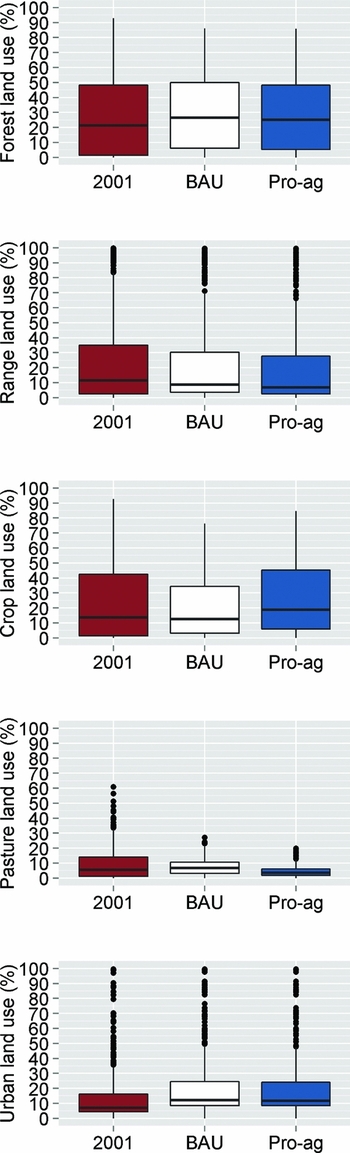
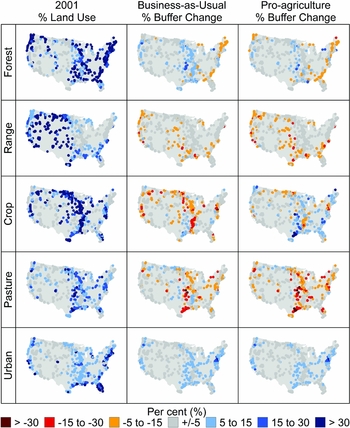
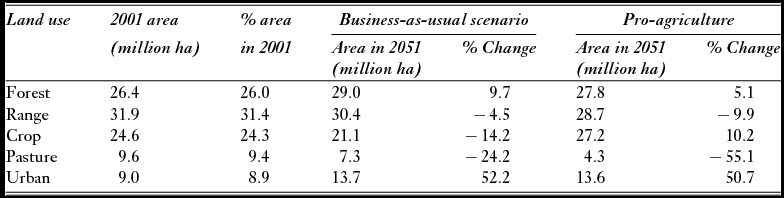
Range was the most prevalent land use surrounding refuges in 2001 (31.9 million ha, 31.4% of the area within 25 km of refuges), followed by forest (26.4 million ha, or 26.0% of the area), crops (including CRP; 24.3 million ha, 24.3%), pasture (9.6 million ha, 9.4%) and urban (9 million ha, 8.9%). The prevalent land use varied widely among refuges and exhibited clear regional patterns (Figs 1 and 2). For example, range was most common near refuges in the Great Plains, while croplands were common near refuges in the Upper Midwest and the Lower Mississippi River.
Box plots showing the variability in each land use for starting conditions and under each scenario (BAU = business-as-usual, Pro-ag = pro-agricultural production).

Initial per cent land use (2001) within 25 km of USA Fish and Wildlife Service National Wildlife Refuges and per cent of buffer area changing by 2051 under each scenario.

Projected landscape changes to the land surrounding NWRS by 2051
Forest and urban land use increased around refuges, while range and pasture decreased in both future scenarios, but the rates of change for all but urban land use differed considerably by scenario (Table 1). The only land use surrounding refuges to change between scenarios was cropland, decreasing under the business-as-usual scenario and increasing, as expected, under the pro-agriculture scenario (Table 1, Fig. 1). In addition, the pro-agriculture scenario resulted in a nearly 50% smaller forest increase and a doubling of the rate of range and pasture loss. Urban land-use change rates on lands around refuges slightly decreased under the pro-agriculture scenario (Table 1, Figs 1 and 2). Nearly half of the crop area gained under the pro-agriculture scenario came at the expense of pasture (Table 1, Fig. 1).
Area (million ha), percentage area, and percentage change under two scenarios within 25 km of the National Wildlife Refuges between 2001 and 2051.

The number of refuges with >20% natural land use (such as forest and/or range) in the surrounding land was stable for the pro-agriculture scenario (increasing from 299 in 2001 to 300 refuges in 2051), but increased under the business-as-usual scenario (from 299 to 319 refuges). The pro-agriculture net change was the result of nearly equal numbers of refuges increasing (12) and decreasing (11) across the 20% threshold of surrounding range and forest land, whereas the increase under the business-as-usual scenario was primarily the result of an increase (21 increases; 1 decrease) (Table 2).
Number of refuges among the total 461 refuges with >20% cover of forest and/or range (natural) land use in 2001, number of refuges that transition above and below the 20% threshold over 50 years, and the total number of refuges above the threshold in 2051.

Regional change patterns
High proportions of a specific land use surrounding refuges tended to be clustered regionally, with forest concentrated in the north-western USA and along the Atlantic coast from Georgia to Maine, range in the Great Plains and Rocky Mountains, crops and pasture along the Mississippi River and in the northern Great Plains, and urban along the coasts, with clusters of highest use in the mid-Atlantic region, Florida, the Gulf Coast, and scattered along the west coast of the USA (Fig. 2). Forest land-use change tended to be concentrated regionally, with gains along the Mississippi River and losses in the north-eastern and south-eastern regions. Forest gains tended to align with areas where crops decreased (namely along the Mississippi River) and forest losses where crops increased (in north-eastern and south-eastern USA) (Fig. 2). Pasture exhibited primarily losses, especially along the Mississippi River and in the mid-Atlantic region (Table 1, Fig. 2). Urban use increased east of the Mississippi River and near the west coast, with particularly sharp increases in the mid-Atlantic region. The pro-agriculture scenario resulted in fewer refuges in the upper midwestern USA, with an increase in urban land use within 25 km distance from the refuge (Fig. 2).
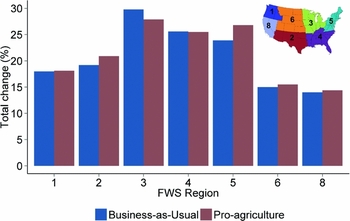
The percentage of the total area changing land use ranged from 12–30% in the different regions, with the highest rates of change occurring in the eastern USA (Fig. 3). The midwestern USA (Region 3) was the most dynamic region under both scenarios, with the pro-agriculture scenario resulting in less change. The North-east (Region 5) exhibited the largest difference between scenarios with pro-agriculture resulting in more land-use change. The total area of land in forest, range and urban use showed little change regardless of scenario. However, crop increases and pasture decreases were substantial and consistent under the pro-agriculture scenario (Appendix 1, Fig. S1, see supplementary material at Journals.cambridge.org/ENC).
Regional predictions for the percentage of the area surrounding refuges that will change use under the different scenarios. The USA's Fish and Wildlife Service (FWS) administrative regions (inset) are: (1) Pacific, (2) South-west, (3) Midwest, (4) South-east, (5) North-east, (6) Mountain-prairie, and (8) Pacific-Southwest. Alaska (FWS region 7) was not considered part of the conterminous USA study area.

The rate of increase of any land use was by far the highest for urban, which grew at a rate of 40–80% in both scenarios (Table 1; Appendix 1, Fig. S1, see supplementary material at Journals.cambridge.org/ENC). Rate of change for the other land uses was more variable. Changes in forest between scenarios were only notable in the (1) Pacific, (2) South-west, (3) Midwest, and (4) South-east FWS regions, with a lower rate of increase under the pro-agriculture scenario. Even then, growth rates remained positive for regions 1, 2, and 3. The Midwest and North-east regions exhibited increases in range under the business-as-usual scenario, while the other regions experienced losses. Under the pro-agriculture scenario, however, range losses occurred in all regions and the rate of loss was higher. Crop losses occurred in all but the South-west under the business-as-usual scenario but changed to gains in all regions under the pro-agriculture scenario, with the highest rates of increase occurring in the Midwest and North-east regions. Pasture use increased slightly in the Pacific and the Mountain-prairie regions, but decreased dramatically in all other regions under the business-as-usual scenario. Under the pro-agriculture scenario, however, all regions experienced 25–70% decreases in pasture land-use (Appendix 1, Fig. S1, see supplementary material at Journals.cambridge.org/ENC).
DISCUSSION
Our analyses predicted substantial land-use change by 2051 in areas surrounding National Wildlife Refuges, particularly for refuges in the eastern USA. Forest and urban use are expected to increase. Regardless of scenario, the largest total area and highest rates of change are projected to be in urban land use, which agrees with previous studies (Pijanowski & Robinson Reference Pijanowski and Robinson2011; Radeloff et al. Reference Radeloff, Nelson, Plantinga, Lewis, Helmers, Lawler, Withey, Beaudry, Martinuzzi, Butsic, Lonsdorf, White and Polasky2012). Forest increases are expected to occur at the expense of pasture. The pro-agriculture scenario suggests substantial changes in land-use trajectories from the business-as-usual scenario. In fact, cropland use changed from a likely net decrease to a net increase under the pro-agriculture scenario, range and pasture decreases doubled, and forest increases were only half as large. Interestingly, the number of refuges with >20% natural habitat in the surrounding landscape stayed relatively stable in the pro-agriculture scenario, whereas numbers increased under the business-as-usual scenario.
The high rate of urbanization varied minimally between scenarios. Economic returns from urban uses tend to be much larger than from other uses, explaining why increasing crop prices under the pro-agriculture scenario produced little change in the rate of urbanization. While they did not differ between scenarios, urbanization rates ranged widely among regions, similar to other forecasts of future urbanization (Wear Reference Wear2011; Radeloff et al. Reference Radeloff, Nelson, Plantinga, Lewis, Helmers, Lawler, Withey, Beaudry, Martinuzzi, Butsic, Lonsdorf, White and Polasky2012). The high rate of urban growth around the National Wildlife Refuges agrees with other studies reporting high rates of housing growth around protected areas (Radeloff et al. Reference Radeloff, Stewart, Hawbaker, Gimmi, Pidgeon, Flather, Hammer and Helmers2010; Wade & Theobald, Reference Wade and Theobald2010). This is troublesome, because once land is converted to urban use, it is unlikely to revert to other uses. Tax- or subsidy-based policies are unlikely to change land-use trajectories for urban use, but strong urban containment policies can, however, significantly reduce urban growth (Woo & Guldmann Reference Woo and Guldmann2011; Hamilton et al. Reference Hamilton, Martinuzzi, Plantinga, Radeloff, Lewis, Thogmartin, Heglund and Pidgeon2013).
Refuges, as with other protected areas, are threatened by encroachment of intensive land uses (Griffith et al. Reference Griffith, Scott, Adamcik, Ashe, Czech, Fischman, Gonzalez, Lawler, McGuire and Pidgorna2009). Much of the land currently surrounding the National Wildlife Refuges remains in forest and range, and therefore is potential habitat for wildlife. This is important because the amount of suitable habitat in the matrix surrounding refuges influences population persistence. As the amount of habitat in the vicinity of refuges declines below c. 30% of the landscape, fragmentation results in additional threats to population persistence (Fahrig Reference Fahrig2001). Thus, even small changes to other land uses may negatively impact the quality of habitat (Gagne & Fahrig Reference Gagne and Fahrig2010a , Reference Gagne and Fahrig b ; Kuhman et al. Reference Kuhman, Pearson and Turner2010), but we note that there may be also cases where land use change benefits refuges. Regardless, areas of relatively natural habitat outside protected areas are critical for maintenance of biodiversity (Franklin & Lindenmayer Reference Franklin and Lindenmayer2009).
Increases in crop under the pro-agriculture scenario were much greater than we had anticipated given that many studies project future decreases in crop area (Pijanowski & Robinson Reference Pijanowski and Robinson2011; Wear Reference Wear2011). It is reasonable to expect intensification of agriculture as the human population continues to grow over the next four decades (Foley et al. Reference Foley, Ramankutty, Brauman, Cassidy, Gerber, Johnston, Mueller, O’Connell, Ray, West, Balzer, Bennett, Carpenter, Hill, Monfreda, Polasky, Rockstrom, Sheehan, Siebert and Tilman2011), and, as agricultural lands are increasingly used as sites for wind power and biofuels in addition to food (Dale et al. Reference Dale, Kline, Wright, Perlack, Downing and Graham2011), it is likely more land will be needed for agricultural production. In fact, other studies have shown increases in agricultural land use for the Upper Midwest and Great Plains regions (Sohl et al. Reference Sohl, Sleeter, Sayler, Bouchard, Reker, Bennett, Sleeter, Kanengieter and Zhu2012).
CONCLUSIONS
Profitability of agricultural land use could drive substantial changes in land-use patterns near wildlife refuges, with negative impacts on the capacity of the NWRS to maintain wildlife populations. The majority of the increase in crop would likely come at the expense of pasture, but also from forest and range losses. The loss of forest, range and pasture around refuges, which in a semi-natural state provide habitat value and corridors for wildlife, could reduce resilience of the NWRS and complicate climate change adaptation. Habitat loss and fragmentation from increasing crop cover could be exacerbated by continuing growth in urban land use, ultimately resulting in a much more fragmented and complex landscape.
The relative stability of forest and range land area around many refuges may provide opportunities for improving connectivity among protected areas. Given the shifts in suitable climate space that many species are facing, land-use change which reduces landscape connectivity compounds the threat to biodiversity from climate change (Griffith et al. Reference Griffith, Scott, Adamcik, Ashe, Czech, Fischman, Gonzalez, Lawler, McGuire and Pidgorna2009; Heller & Zavaleta Reference Heller and Zavaleta2009). Recognizing this compounded threat, one of the tools that the FWS and other land management agencies promote as an adaptive measure to climate change is the establishment of habitat corridors connecting protected areas, removing barriers to dispersal (Griffith et al. Reference Griffith, Scott, Adamcik, Ashe, Czech, Fischman, Gonzalez, Lawler, McGuire and Pidgorna2009). Our models may be useful for identifying regions with higher threat of land-use change and, consequently, guide the implementation of conservation actions that promote increased connectivity for the NWRS, thereby increasing the resilience of the protected area system to climate change. While our data are presented at the national level, we have provided the output for all 461 refuges to FWS managers in spreadsheet form for consideration in their conservation planning efforts. This is a far more relevant scale for taking specific management actions.
Our results indicated regional approaches to policy development and implementation may be at least as important as scenario conditions. Land-use change occurs in a regional context; flexible policy and budgets would allow a network of lands as large as the National Wildlife Refuge System to accommodate regional differences in threat and opportunity. Given that change in the lands surrounding refuges may impact the viability of these refuges, a focus on private land conservation programmes may be useful because these programmes can work proactively with local stakeholders often needing technical assistance in areas such as habitat restoration and conservation planning. Given the regional nature of land-use change, it also may be useful to focus conservation efforts in areas where land-use changes are most threatening to the integrity of the NWRS. Finally, we wish to emphasize that our ‘what if’ scenario, focusing on increasing agricultural land use surrounding wildlife refuges is plausible given recent changes in land use and projections from other research and therefore provides useful information for managers considering adaptation to climate and land use change.
Supplementary material
To view supplementary material for this article, please visit Journals.cambridge.org/ENC