Introduction
The loss of biodiversity is one of the most pressing environmental problems and is increasingly being implicated as a major driver of the Anthropocene (Millennium Ecosystem Assessment 2005, Hooper et al. Reference Hooper, Adair, Cardinale, Byrnes, Hungate, Matulich, Gonzalez, Duffy, Gamfeldt and O’Connor2012, Diaz et al. Reference Díaz, Pacual, Stenseke, Martín López, Watson, Molnár and Shirayama2018). The world is currently facing the cardinal challenge of reducing the accelerated rate of biodiversity loss (Wake & Vredenburg Reference Wake and Vredenburg2008, Cardinale et al. Reference Cardinale, Duffy, Gonzalez, Hooper, Perrings, Venail, Narwani, Mace, Tilman, Wardle, Kinzig, Daily, Loreau, Grace, Larigauderie, Srivastava and Naeem2012). Conservationists have increasingly called attention towards the prioritization of conservation efforts (Parr et al. Reference Parr, Bennun, Boucher, Brooks, Chutas, Dinerstein, Drummond, Eken, Fenwick, Foster, Martínez-Gómez, Mittermeier and Molur2009, Wilson et al. Reference Wilson, Joseph, Moore and Possingham2011) because the number of species threatened with extinction far exceeds the resources required for their conservation (Gauthier et al. Reference Gauthier, Debussche and Thompson2010, Pimm et al. Reference Pimm, Jenkins, Abell, Brooks, Gittleman, Joppa, Raven, Roberts and Sexton2014). Effective conservation primarily requires priority setting and operates through the implementation of targeted conservation action with limited resources (Balmford et al. Reference Balmford, Bennun, Brink, Cooper, Cote and Crane2005, Gauthier et al. Reference Gauthier, Debussche and Thompson2010, Minin et al. Reference Minin, Soutullo, Bartesaghi, Rios, Szephegyi and Miolanen2017).
Of the various components of biodiversity that contribute significantly to the provision of ecosystem goods and services, the conservation and sustainable use of medicinal plants is receiving increased attention due to these plants’ crucial roles in global healthcare, particularly in the developing world (Shahidullah & Haque Reference Shahidullah and Haque2015, Chen et al. Reference Chen, Yu, Luo, Wu, Li and Steinmetz2016). Of the total number of medicinal plant species used globally, 21% fall under the Endangered category of the International Union for Conservation of Nature (IUCN; Schippmann et al. Reference Schippmann, Leaman and Cunningham2006, Chen et al. Reference Chen, Yu, Luo, Wu, Li and Steinmetz2016). A higher number of medicinal plant species are currently listed under all threat categories, and in the near future, several species might warrant designation of a threatened status once sufficient scientific data are available (Brehm et al. Reference Brehm, Maxted, Martins-Loucao and Ford-Lloyd2010). Therefore, the main challenge in the conservation of medicinal plants is to empirically prioritize the species that need urgent conservation action (Sapir et al. Reference Sapir, Shmida and Fragman2003).
Priority setting for biodiversity conservation can be undertaken at different levels (e.g., at species, ecosystem or landscape level). Prioritization at the species level is relatively simple, catches public attention and is relevant for socioeconomically important medicinal plants (Brehm et al. Reference Brehm, Maxted, Martins-Loucao and Ford-Lloyd2010). Although the benefits of ecosystem-based conservation are well recognized (Grumbine Reference Grumbine1994, Noss Reference Noss1996, Slocombe Reference Slocombe1998, Rodríguez et al. Reference Rodríguez, Rodríguez-Clark, Baillie, Ash, Benson, Boucher, Brown, Burgess, Collen, Jennings, Keith, Nicholson, Revenga, Reyers, Rouget, Smith, Spalding, Taber, Walpole, Zager and Zamin2011), it is species that are commonly considered for conservation recovery plans (Che-Castaldo & Neel Reference Che-Castaldo and Neel2012). Besides providing knowledge about the taxa that should be primarily targeted for conservation, prioritization at the species level also identifies those taxa that do not need immediate conservation action or for which sufficient scientific information is lacking in order to set conservation priority (Brehm et al. Reference Brehm, Maxted, Martins-Loucao and Ford-Lloyd2010). Conservation of individual species acts as a coarse filter for the management of ecosystems and other facets of biodiversity such as vegetation types, natural communities and geophysical features (Jenkins Reference Jenkins1985, Noss Reference Noss1987, Hunter et al. Reference Hunter, Jacobson and Webb1988).
Priority setting at the species level involves many ecological criteria, including the socioeconomic drivers of threat to the species (Mace & Lande Reference Mace and Lande1991). Globally, there is no single approach with universal applicability for the development of effective conservation prioritization. The priority-setting schemes vary and are largely dependent upon the available information, local perceptions and development objectives (UNEP 1995). A major challenge in the identification of prioritized species is the selection of the methodology and criteria to be used, and these depend largely on the available information and the target of conservation strategy (Brehm et al. Reference Brehm, Maxted, Martins-Loucao and Ford-Lloyd2010). One of the earliest methods developed was based on the range, habitat specificity and local abundance of the species in order to evaluate different ‘types of rarity’ (Rabinowitz Reference Rabinowitz1981, Rabinowitz et al. Reference Rabinowitz, Cairns and Dillon1986). Other prioritization methods developed later include rule-, ranking- and score-based approaches. The rule-based method developed by the International Union for Conservation of Nature and Natural Resources relies on a series of rules against which the species has to be evaluated and, upon agreement with certain criteria, each species is assigned a certain category (IUCN 2001). Amongst the ranking-based methods, the most widely employed is the one jointly developed by the Natural Heritage Network and The Nature Conservancy (Master Reference Master1991, Morse Reference Morse1993, Stein Reference Stein1993). The score-based method uses a multiple-scoring system, wherein different scores are assigned to a wide range of parameters and the total scores for each of the species are determined by the summation of the individual scores (Given & Norton Reference Given and Norton1993); the process results in a prioritized list of species as per the total scores. Such priority approaches have been applied to a wide range of taxa all over the world (e.g., Perring & Farrell Reference Perring and Farrell1983, Briggs & Leigh Reference Briggs and Leigh1988, Millsap et al. Reference Millsap, Gore, Runde and Cerulean1990, Carter & Barker Reference Carter and Barker1993, Hunter et al. Reference Hunter, Carter, Pashley and Barker1993, CALM 1994, Lunney et al. Reference Lunney, Curtin, Ayers, Cogger and Dickman1996, Carter et al. Reference Carter, Hunter, Pashley and Rosenberg2000, Dhar et al. Reference Dhar, Rawal and Upreti2000, Sapir et al. Reference Sapir, Shmida and Fragman2003, Kala et al. Reference Kala, Farooquee and Dhar2004, Ray et al. Reference Ray, Hunter and Zigouris2005, Rosenberg & Wells Reference Rosenberg and Wells2005). Methods based on the risk of extinction at population, taxon and ecological community levels, genetic structure and population ecology have also been used (Coates & Atkins Reference Coates and Atkins2001, van Andel et al. Reference van Andel, Croft, van Loon, Quiroz, Towns and Raes2015, Posthouwer et al. Reference Posthouwer, Verheijden and van Andel2016).
The Indian Himalayan state of J&K (located at the north-western boundary of the Himalayan biodiversity hotspot) has high biodiversity, including prized medicinal plants (Dar et al. Reference Dar, Khuroo and Aman2008, Zachos & Habel Reference Zachos and Habel2011, Dar & Khuroo Reference Dar and Khuroo2013). These medicinal plants are subject to a multitude of threats (Tali et al. Reference Tali, Ganie, Nawchoo, Wani and Reshi2014). The various human-driven threats operative in this Himalayan region include drastic decline in total forest area, habitat fragmentation, over-harvesting and illicit trade of these medicinal herbs (Dar & Naqshi Reference Dar and Naqshi2001, Khuroo et al. Reference Khuroo, Dar, Khan and Malik2007, Ganie & Tali Reference Ganie and Tali2013, Rashid et al. Reference Rashid, Romshoo, Chaturvedi, Rabindranath, Sukumar and Jayaraman2015). The present study used a scoring-based method to empirically assess the conservation status of the medicinal flora of J&K in order to identify the species that merit urgent conservation priority.
Materials and Methods
Study Area
The Indian Himalayan Region (IHR), lying between 21°57″–37°50″N and 72°40″–97°25″E, covers about 16.2% of India’s total geographical area (Nandy & Rao Reference Nandy and Rao2001). Out of the 12 states that fall under the IHR, J&K state is situated on the north-western boundary of India. J&K state is mostly mountainous, has an area of 222 236 km2 and is located between 32°11″70′N–36°15″80′N latitude and 73°12″60′E–80°13″00′E longitude (Singh Reference Singh1995, FSI 2011). Biogeographically, the state comprises three distinct regions, namely Jammu, Kashmir and Ladakh. The state possesses a wide altitudinal gradient, land with diverse geological formations and different climatic zones including subtropical, temperate, alpine and cold-arid, resulting in the rich diversity of its flora (Dar & Khuroo Reference Dar and Khuroo2013, Gairola et al. Reference Gairola, Sharma and Bedi2014, Malik et al. Reference Malik, Rashid, Ganie, Khuroo and Dar2015).
Source of Medicinal Plant Database
The comprehensive database on medicinal plants of J&K used here was developed by the authors on the basis of the authors’ field records over the last 20 years supplemented with a systematic review of 96 previous studies on ethno-medicinal plants conducted over the last 35 years (1980–2015) in the study area (Supplementary Table S1, available online). The database has been arranged based on the Angiosperm Phylogeny Group-III (APG-III) classification (Haston et al. Reference Haston, Richardson, Stevens, Chase and Harris2009).
An Integrated Ecological and Socioeconomic Priority Framework
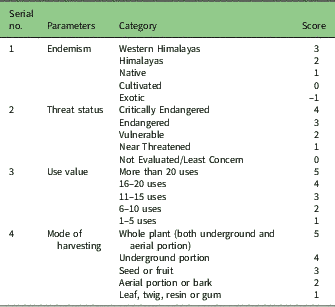
To develop a list of prioritized medicinal plant species for the J&K state, an empirical framework based on globally standardized criteria was adopted. These include the ecological criteria of endemism and threat status and the socioeconomic criteria of use value and mode of harvesting (i.e., part(s) used). Each of these criteria was assigned an appropriate numerical score (Kala et al. Reference Kala, Farooquee and Dhar2004, Pandey et al. Reference Pandey, Sekar, Joshi and Rawal2018). The prioritized species were based on the summation of the scores assigned to each of these criteria (Table 1), as explained in Box 1.
Different parameters, categories and assigned scores (see Box 1 for a detailed explanation)

Criteria used and their detailed explanation

Results
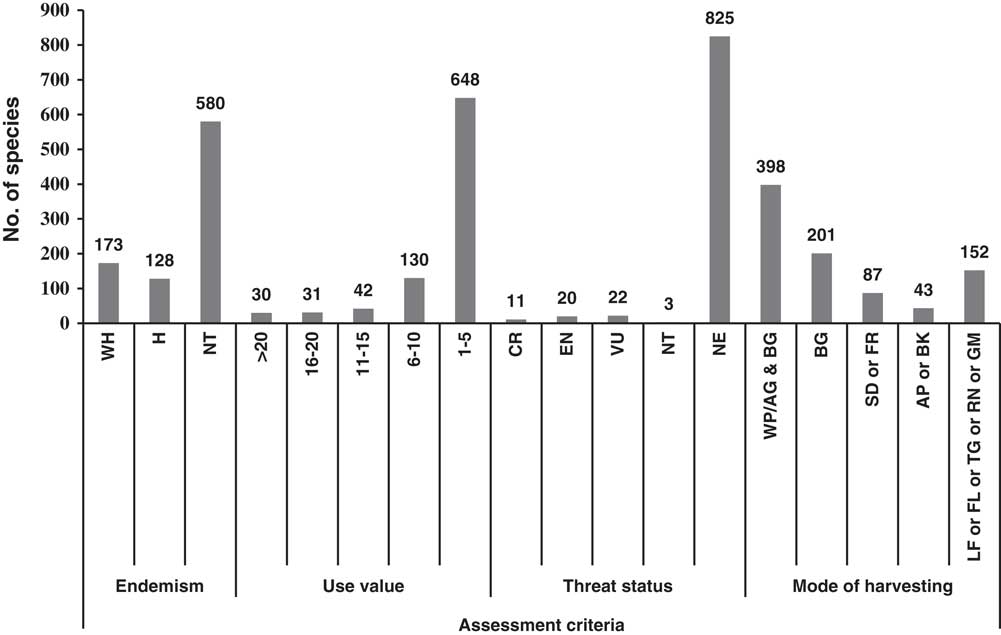
Of the 1123 plant species used for medicinal purposes (Supplementary Table S1) in J&K state, 881 (78.45%) are native, 153 (13.62%) are exotic, 69 (6.14%) are currently under cultivation and 20 (1.78%) are of unknown origin. For prioritization analysis, only the 881 native species were further evaluated (Supplementary Table S1), and of these, 173 species have narrow distribution ranges (i.e., are Western Himalaya endemics) and 128 have relatively broader ranges (i.e., endemic to the entire Himalayas), while 580 species extend their distribution ranges beyond the Himalayas (Fig. 1).
Number of species according to their assessment criteria. WH=Western Himalayas; H=Himalayas; NT=native; >20=used to cure more than 20 types of diseases; 16–20=used to cure 16–20 types of diseases; 11–15=used to cure 11–15 types of diseases; 6–10=used to cure 6–10 types of diseases; 1–5=used to cure 1–5 types of diseases; CR=Critically Endangered; EN=Endangered; VU=Vulnerable; NT=Near Threatened; NE=Not Evaluated; WP=whole plant; AG=aboveground; BG=belowground; SD=seed; FR=fruit; AP=aerial portion; BK=bark; LF=leaf; FL=flower; TG=twig; RN=resin; GM=gum.

The maximum aggregate score for any species was 17 for Aconitum heterophyllum and the lowest score (1) was for Lantana camara. Based on the aggregate scores of all 881 native species, the first 100 medicinal plant species with scores ≥9 (i.e., based on 50% threshold value) were selected for the identification of the final priority species list (Supplementary Table S1). Among these selected species, 39 are narrow Western Himalaya endemics, 20 are broad Himalaya endemics and 41 have ranges extending beyond the Himalayas. Half of the 100 selected species fall under various threat categories (Vulnerable, Endangered and Critically Endangered), 49 species belong to the Not Evaluated category and a single species is categorized as Near Threatened. The herbaceous habit was dominant (89 species), followed by trees and shrubs with six and five species, respectively. Sixty-five species are harvested either as whole herbs or as both belowground and aboveground parts. Of these species, 72% are used to alleviate more than ten different types of disease (Supplementary Table S1).
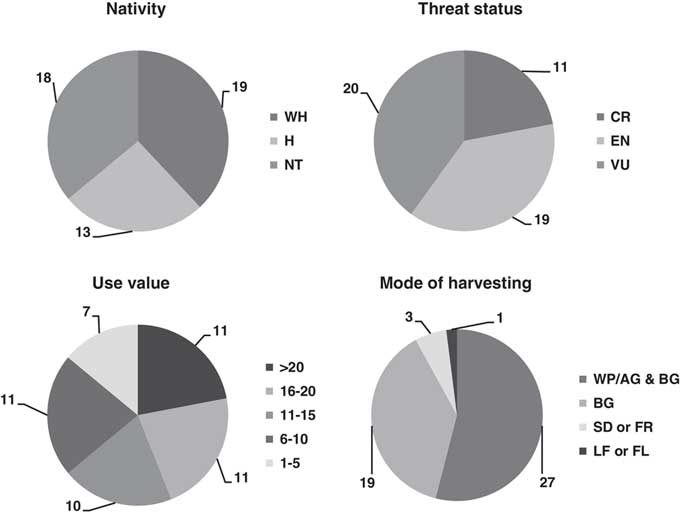
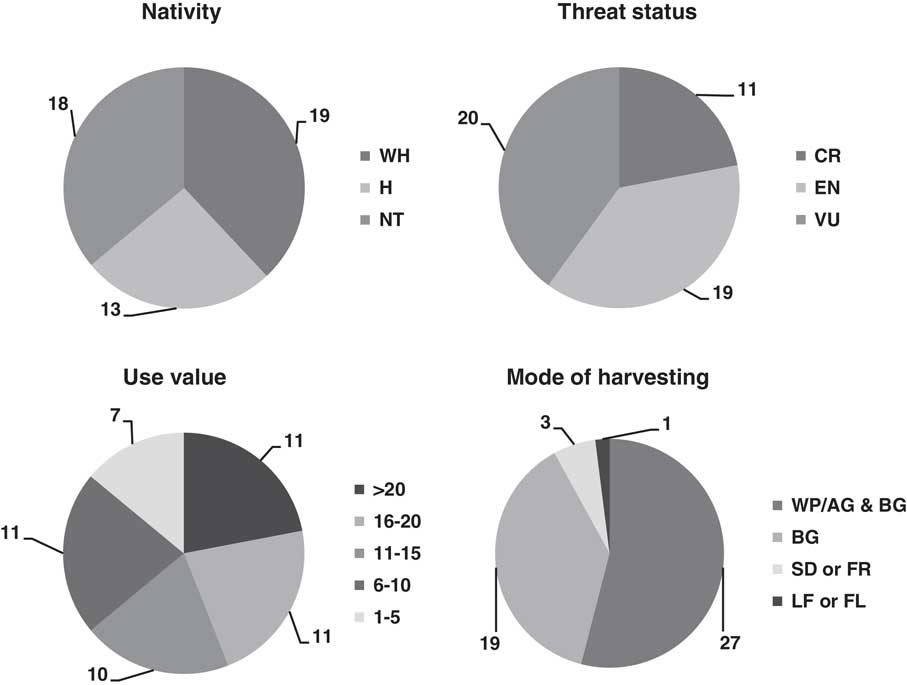
From the 100 selected species, 50 species were selected as conservation priorities on the basis of IUCN threat category in the region. The prioritized species belong to 42 genera in 30 families. The most speciose genera are Aconitum and Rheum, with three species each. At the family level, the family Asteraceae leads the prioritized group, with five species. The dominant growth form of these prioritized species is herbs (43 species), followed by trees and shrubs with four and three species, respectively. Within these prioritized species, 19 species are narrow endemics, 13 are broad endemics and 18 are native. All of the prioritized species fall under the threat categories of Critically Endangered (11 species), Endangered (19 species) or Vulnerable (20 species). Moreover, these plant species are medicinally important and are used to cure various diseases: of the 50 prioritized species, 33 are used to treat more than 10 types of disease in this region. Most of these species are under severe pressure of overharvesting, and of the 50 prioritized species, 27 are unscientifically harvested as whole herbs from their natural habitats, in addition to their other parts being used in traditional healthcare (Fig. 2).
Status of 50 prioritized species with reference to the four criteria used in the present study. For list of abbreviations, see Fig. 1.
Of the 19 narrow endemic species, 8 are Critically Endangered, 11 are harvested as whole herbs, 12 are used against diseases and 18 have herbaceous growth forms. Based on the native range and extent of endemism, the prioritized species were divided into the following groups: narrow endemic, broad endemic and native. The assessment scores pertaining to these three groups are depicted in Supplementary Figs S1, S2 and S3, respectively.
Discussion
The present study for the first time empirically evaluated 881 medicinal plant species for priority conservation in this biodiversity-rich Himalayan state. Fifty medicinal plant species are prioritized for conservation action in this global biodiversity hotspot. Ten of these species (Aconitum heterophyllum, Arnebia benthamii, Angelica glauca, Dactylorhiza hatagirea, Fritillaria roylei, Meconopsis aculeata, Picrorhiza kurroa, Podophyllum hexandrum, Saussurea costus and Thymus linearis) have been previously prioritized for conservation in the neighbouring Indian Himalayan state of Uttarakhand (Negi et al. Reference Negi, Pushpa, Ravi, Deepika, Indra, Ranbeer, Sundriyal and Shyamal2018, Pandey et al. Reference Pandey, Sekar, Joshi and Rawal2018). Some of these prioritized species (e.g., Aconitum violaceum, Angelica glauca and Gentiana kurroo) also figure in the recent IUCN Red List (IUCN 2017). Pandey et al. (Reference Pandey, Sekar, Joshi and Rawal2018) prioritized 20 species in Johar valley (Uttarakhand, Western Himalayas) for conservation, and nine of these species also figure in the present prioritized list. These prioritized species need immediate conservation attention in this Himalayan state as well.
Approximately 64% of the total prioritized species are endemic to the Himalayas, of which c. 38% are narrowly restricted in their distribution (i.e., endemic to the Western Himalayas). Due to their irreplaceability and distinctive features, the endemic species assume conservation priority because they are restricted to a particular region, and hence conservation biologists have called for their scientific documentation, assessment, monitoring and conservation (Khan et al. Reference Khan, Page, Ahmad and Harper2013). To maximize the benefits of conservation action at a regional scale, it is important to prioritize the species for which the region constitutes the main centre of distribution (Burgman Reference Burgman2002, Keller & Bollmann Reference Keller and Bollmann2004, Schmeller et al. Reference Schmeller, Gruber, Budrys, Framstead, Lengyel and Henle2008). Furthermore, the conservation of endemic species can be instrumental in the conservation of biodiversity-rich natural landscapes (Myers et al. Reference Myers, Mittermeier, Mittermeier, da Fonseca and Kent2000). This is in line with the global goal of protecting 50% of significant regions for plant diversity and conservation based on species endemism, richness and ecosystem endangerment (Ma et al. Reference Ma, Moseley, Chen and Zhou2007).
In the Himalayas, biodiversity in general and medicinal flora in particular are under severe anthropogenic pressures, including overgrazing, landslides/soil erosion, constructional activities/unplanned development, overexploitation/overharvesting, mining/stone quarrying, conversion of forests and grasslands for agricultural purposes and alien species invasion (Khuroo et al. Reference Khuroo, Dar, Khan and Malik2007, Ganie & Tali Reference Ganie and Tali2013, Barik et al. Reference Barik, Rao, Haridasan, Adhikari, Singh and Tiwary2018, Haridasan et al. Reference Haridasan, Mao, Janarthanam, Pandey, Barik, Srivastava, Panda, Suresh, Borthakur, Datta and Rao2018, Mehraj et al. Reference Mehraj, Khuroo, Qureshi, Muzafar, Friedman and Rashid2018). Recent climate change is also making these species more susceptible to extinction (Rashid et al. Reference Rashid, Romshoo, Chaturvedi, Rabindranath, Sukumar and Jayaraman2015, Agnihotri et al. Reference Agnihotri, Husain, Shirke, Sidhu, Singh, Dixit, Khuroo, Amla and Nautiyal2017). Thus, the results of the present study could guide local government and stakeholders in deciding which species to target for conservation. Nearly two-thirds of the present prioritized species have not been evaluated as per IUCN guidelines in this part of the world, and hence deserve immediate conservation assessment (Tali et al. Reference Tali, Ganie, Nawchoo, Wani and Reshi2014). In fact, the assessment of threatened status is considered to be one of the most important steps in biodiversity conservation (Cheng & Zang Reference Cheng and Zang2004, Barik et al. Reference Barik, Rao, Haridasan, Adhikari, Singh and Tiwary2018). The identification of taxa at risk of extinction has proven to be helpful by drawing public focus to these taxa, as well as their declining habitats (Ferrar Reference Ferrar1991, Possingham et al. Reference Possingham, Andelman, Burgman, Medellin, Master and Keith2002). Threatened species lists have also been utilized in order to set priorities for the allocation of limited conservation resources (Maes & Van Swaay Reference Maes and van Swaay1997, Bennum et al. Reference Bennum, Njoroge and Pomeroy2000, Possingham et al. Reference Possingham, Andelman, Burgman, Medellin, Master and Keith2002, Rodríguez et al. Reference Rodríguez, Rojas-Suárez and Sharpe2004, Miller et al. Reference Miller, Rodríguez, Aniskowicz-Fowler, Bambaradeniya, Boles, Eaton, Gärdenfors, Keller, Molur, Walker and Pollock2006). Generally, the species that are most threatened are considered ecologically as having high priority for conservation, although some species that experience relatively low levels of threat may also assume priority because of their socioeconomic values (Given & Norton Reference Given and Norton1993).
The prioritized species are of great value to the people of this Himalayan region. They are widely used for curing various human diseases. Most of the species (66%) are used to treat more than ten types of human disease. The potential ethno-medicinal use of some of these plants of the high Himalayan alpine areas identified in folklore and documented in ancient Sanskrit literature (e.g., Rigveda, Ayurveda) dates back to 3000–1000 BCE and was in all probability the only means of curing and/or protecting the human population from various diseases in the Kashmir Himalayas (Malik et al. Reference Malik, Khuroo, Dar and Khan2011, Gairola et al. Reference Gairola, Sharma and Bedi2014). These plants have historically proven their value as sources of molecules with therapeutic potential; most of them possess bioactive principles with anti-cancer and anti-ageing (anti-oxidant) properties apart from antipyretic, asthmatic, diuretic and other effects, and they still represent an important pool for the identification of novel drug leads (Kaul Reference Kaul1997, Atanasov et al. Reference Atanasov, Waltenberger, Pferschy-Wenzig, Linder, Wawrosch and Uhrin2015). The plants are harvested unscientifically (i.e., usually extracted as whole plants or the underground portions are extracted) from their natural habitats for their use in the herbal industry (Bisht et al. Reference Bisht, Negi and Bhandari2016, Pandey et al. Reference Pandey, Sekar, Joshi and Rawal2018). For instance, 27 of the prioritized species are harvested as whole plants, and in 19 species the belowground parts are used.
The Himalayas have been a source of important medicinal plants for local herbalists and plant explorers for a very long time (Samant et al. Reference Samant, Dhar and Palni1998, Badola et al. Reference Badola and Aitken2003), but during the past two decades, human activities have led to the disappearance of a number of medicinal plants from the wild. The increasing demand for raw plant material from the pharmaceutical industry for domestic needs as well as for export has resulted in further overharvesting of wild medicinal plant species (Kala et al. Reference Kala, Rawat and Uniyal1998, Dhar et al. Reference Dhar, Rawal and Upreti2000). In India, approximately 80% of medicinal plant species are being harvested from the wild, leading to a drastic decline in their natural regeneration (FRLHT 1999, Nishteswar Reference Nishteswar2014). With overharvesting and habitat loss, 21% of global medicinal plant species are now endangered (Schippmann et al. Reference Schippmann, Leaman and Cunningham2006, Chen et al. Reference Chen, Yu, Luo, Wu, Li and Steinmetz2016). The ever-declining population of threatened medicinal plants due to illegal trade and overexploitation has become a pressing conservation concern (Dhar et al. Reference Dhar, Rawal and Upreti2000, Semwal et al. Reference Semwal, Saradhi, Nautiyal and Bhatt2007). The degree of disturbance to species populations and their vulnerability to overexploitation depend on supply and demand dynamics (Robbins Reference Robbins2000), the plant part used and the lifeform of the plant concerned (Cunningham Reference Cunningham1991). Medicinal plant resources are being harvested in increasing volumes, mostly from wild populations, to meet the demands of local, regional and international markets (Ahmad et al. Reference Ahmad, Tripathi and Parray2016). Generally, medicinal plant collectors are unaware of the proper collection and storage practices (Maikhuri et al. Reference Maikhuri, Nautiyal, Rao and Saxena1998, Nautiyal et al. Reference Nautiyal, Prakash, Chauhan, Purohit and Nautiyal2001), which results in destructive harvesting and finally leads to the species’ poor natural regeneration capacity (Rao et al. Reference Rao, Nautiyal, Maikhuri and Saxena2000). Furthermore, the removal of the entire plant before seed maturation reduces the possibility of seed development for future regeneration (Sheldon et al. Reference Sheldon, Balick and Laird1998). Harvesting of underground parts and whole plants is more destructive to medicinal plants (e.g., herbs, shrubs and trees) than the collection of leaves and flowers or buds. For the drugs obtained from whole plants, using their leaves as a remedy may be a benign alternative (Chen et al. Reference Chen, Yu, Luo, Wu, Li and Steinmetz2016).
Conclusion
Based on an integrated ecological and socioeconomic approach, 50 Himalayan medicinal plant species that need immediate conservation action for their sustainable utilization are identified for the first time. The results have implications for conservation policy and practice in other regions of the Himalayan biodiversity hotspot and more widely.
Supplementary Material
For supplementary material accompanying this paper, visit multimediafluids.uam.elogim.com/core/journals/environmental-conservation.
Acknowledgements
We are thankful to the Head, Department of Botany, University of Kashmir, Srinagar, for providing necessary facilities. We are thankful to the reviewers and Nicholas Polunin for their insightful comments, which have helped to improve the quality of earlier versions of this manuscript.
Financial support
This work received financial support from UGC-New Delhi (India) under the SAP Programme, sanctioned to the Department of Botany, University of Kashmir, and DST-New Delhi (India) under the NMSHE-TKS Scheme (vide grant number:PAC-SES-DST-12141219-863), sanctioned to Irshad A Nawchoo and Anzar A Khuroo.
Conflict of Interest
None.
Ethical Standards
None.