INTRODUCTION
We designed a research program in order to gain a better understanding of sedation at the end of life as practiced in Quebec palliative care circles. The first step defined the sedation practices of doctors according to two variables—prognosis (short or long) and type of suffering (physical or emotional) (Blondeau et al., Reference Blondeau, Roy and Dumont2005).Footnote * For the second part of this study, we decided to use a sampling of doctors practicing palliative care in Quebec in order to identify the main aspects of their practices regarding sedation of patients nearing the end of life. Specifically, we had the following objectives:
1. To examine sedation practices from a clinical point of view to identify similarities and differences.
2. To identify standard practices regarding clinical indications within the health care community.
3. To ascertain the ethical issues related to sedation.
METHODS
Conceptual Framework
This study rests on a qualitative method based on a constructivist approach using English sociologist Anthony Giddens's Theory of Structuration (Giddens, 1987). This conceptual framework allows us to take into account the cultural, structural, and organizational aspects of end-of-life sedation. Using this structurational approach, we can examine the practice from the dual perspectives of the health care providers themselves and the structural organization and the sociocultural environment in which their actions take place. Gidden's Theory of Structuration makes it possible to identify the structural elements of a practice like sedation as it is observed in a given sociocultural and organizational environment because it allows us to draw conceptual, methodological, and empirical links. The value of this theory has been demonstrated in numerous studies (Calender, Reference Calender2000; Phillips & Smith, Reference Phillips and Smith2000; New, Reference New1994; Purkis, Reference Purkis1994). It has also been used in the study of complex issues within the Quebec health care network in a number of areas: the continuity of medical care in oncology (Turgeon et al., in press), deinstitutionalization in mental health care (Carrière, Reference Carrière1998), the regulation of emergency room overcrowding (Demers, Reference Demers1996), the creation of a mother–child center in the Quebec City region (Saint-Pierre, Reference Saint-Pierre2000), and an analysis of the role of alliances in the work done by the Rochon CommissionFootnote † (Bergeron, Reference Bergeron1992).
In addition to Giddens's theoretical framework, a complementary conceptual framework was used in order to identify the ethical issues raised by sedation. It has been developed and validated over the last few years through a number of studies of behavior related to health with ethical implications (Blondeau et al. 1998; Blondeau et al., Reference Blondeau, Lavoie and Valois2000, Reference Blondeau, Godin and Gagné2004). The ethical dimensions explored in this theoretical framework were beneficence, respect for autonomy, and justice.
These two theoretical frameworks served as a basis for creating the study's analytical framework, developing the interview guide, and analyzing the results.
Target Population and Sampling
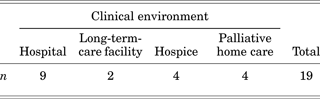
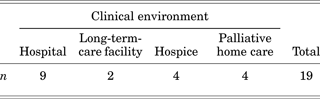
This study of sedation in Quebec's palliative care centers deals with practices as they are described by doctors, bearing in mind the variety of environments in which they are practiced. For the first part of the study, we recruited 100 doctors from 37 clinical environments (hospitals, hospices, home care). These doctors were all invited to participate in the second phase of the study. We also sent invitations to 32 clinical environments. In total, 20 doctors accepted our invitation and signed a consent form to participate in the second part of the study. One subject was discontinued from the study due to the poor quality of the recording of his interview (Table 1).
Origin of respondents
Collecting Data
Data were collected through semistructured interviews. The interview guide was based on theoretical frameworks by Giddens (Reference Giddens and Audet1987) and by Blondeau et al. (Reference Blondeau, Valois and Keyserlingk1998). The first part of the research interview was geared toward gathering the subjects' experience with end-of-life sedation. It addressed various aspects such as indications and contraindications, medications used, objectives pursued, and ethical issues. The second part dealt with descriptions (from the doctors' points of view) of cultural, organizational, and structural environments related to the practice of sedation. A variety of open questions addressed such things as an institution's position regarding sedation, colleagues' practices, and the clinical environment's attitude toward the practice.
Analyzing the Data
The contents of all 19 interviews were transcribed verbatim. Qualitative analysis was carried out using N-Vivo software. Codification and analysis were carried out by a specialist in content analysis according to procedures recommended by Deslauriers (Reference Deslauriers1991) and Poupart et al. (Reference Poupart, Deslauriers and Groulx1997). The elements of meaning identified were analyzed by one of the researchers and then submitted to all researchers (n = 3).
RESULTS
The respondents' answers revealed a number of recurring themes illustrative of views on end-of-life sedation and of similarities and differences in sedation practices. In respect to the analytic framework, content analysis revealed standards of behavior with regard to this practice in various palliative care settings, where such environments are defined as structural organization built in a specific sociocultural environment. In all, four main dimensions were identified: relational, clinical, environmental, and ethical.
Relational Dimension
Regarding sedation at the end of life, respondents placed considerable emphasis on the relationships between those involved. The respondents—doctors, in this case—described or perceived their relationships in different ways depending on whether they interacted with patients, their families, or other members of the health care team. The doctor–patient relationship appears central, and commitment and loyalty to the patient were major elements of convergence. Here is what one respondent had to say:
In order to really understand why a patient is making the request [for sedation] and to find out what the patient really wants, you have to establish a dialogue. You have to really listen to the patient. Really listen, without trying to convince the patient one way or another. (Respondent 6)
This relational commitment to the patient has no true parallel with families or even with other team members, with whom relations tended to be more variable in geometry, changing according to circumstances. Though many respondents did indeed recognize the important role of the family, they constantly reasserted their loyalty to the patient, who remained the top priority. As a result, doctors' attitudes toward families are tinged with both empathy and caution: “The family is also important to me, but my decision will be made with … the patient” (Respondent 10). The doctor–family relationship can even be an occasional source of tension when the patient's will differs from that of the family.
However, once sedation has begun, doctors interact more closely with the family, which presents an opportunity to reconcile and to redefine their relationship. Here is how one respondent put it:
Once we have begun sedation, the patient is basically asleep. So that relationship of explanations, reassurances, and questions will continue through the family. (Respondent 5)
Relationships with members of the multidisciplinary team are also geometrically variable. Many respondents see the team as a sort of coach because it encourages doctors to have a more global view of patients. Respondent 10 summed up the idea: “I think that what the [multidisciplinary] team provides as a group is a more global view of the patient.” However, relationships with the health care team can also be a major source of tension if doctors and nurses do not reach the same conclusions about indications for sedation regarding relief of the patient's symptoms.
Although respondents stressed the importance of consensus and the multidisciplinary team's agreement with decisions regarding sedation, the diversity of opinion in this respect was surprising. Some doctors said they saw the decision-making process as an opportunity for members to share openly and wanted the team to come to a consensus whereas others were more interested in convincing the team of the merits of a predetermined therapeutic focus. One respondent had this to say:
It's a team decision, but the doctor has the most influence. We know how to convince. Personally, I think I have a lot of influence with my team, but that influence isn't just based on my ability to convince them. It's based on the fact that my team knows how I work. … So, I think you gain a certain amount of credibility and then your team follows you. (Respondent 11)
In other cases, respondents said that they simply informed the team of their decision. “I inform the team, and everyone agrees. If I see the slightest hesitation, I deal with whatever the issue is” (Respondent 1). Although it remains debatable whether the latter example can even be called a consensus, our analysis revealed three different types of consensus: shared, reached, and imposed.
The relationships between doctors and all those but the patients seem to be influenced by the care environment. For example, there are fewer interactions with the patient's family in an institutional setting than in a home care setting, which requires a real partnership with the family. In the home settings, the family plays a key role. The safe, appropriate, and legal use of controlled substances (e.g., opioids) depends greatly on the level of trust established with the main natural caregiver. So the care setting affects the nature of the doctor–family relationship in many ways. The clinical environment also affects the doctor–healthcare team relationship. Smaller groups, for example, tend to encourage familiarity and cooperation among members.
A close, ongoing working relationship between doctors and a palliative care team seems to favor the emergence of implicit norms regarding sedation, which then become part of their unique caregiving culture.
Clinical Dimension
Distinctions appear when the clinical dimension is analyzed: when to proceed with sedation, the type of sedation to use, and how often to use it.
According to our doctor respondents, the strict therapeutic aim of sedation at the end of life is to ease the suffering of patients, but at the expense of awareness. Indeed there are patients whose self-determined solution to their suffering is the elimination of awareness without the intent to hasten death. Indirectly, palliative sedation can also have a calming effect on loved ones who are troubled by the sight of a patient's suffering. Our respondents all agreed that refractory symptoms were the clinical indication for sedation. In cases of refractory physical symptoms or uncontrollable physical pain, there was a strong consensus to proceed with sedation. Many doctors (n = 13) also saw emotional or existential suffering as a possible reason for proceeding with sedation. However, other respondents (n = 7) expressed discomfort at treating that type of pain with sedation:
What I am the least comfortable with when it comes to sedation are problems that are more existential or psychological in nature. I don't see them as official contraindications, but they're … I'm more cautious, I consult more before … when the patient asks for … It isn't really something that I'll suggest to the patient. (Respondent 21)
Other respondents clearly stated that existential suffering was not an indication to proceed with sedation. There is thus a lack of consensus on indications for proceeding with sedation when dealing with existential or emotional symptoms.
In addition, with regard to the type of sedation, we note a certain inconsistency in sought-after duration and degree. Our respondents did, however, show a preference for intermittent rather than continuous sedation. They stated they had less difficulty with continuous sedation in cases of short prognosis than in cases of long prognosis. The choice of medication also varied, but there was a notable preference for methotrimeprazine, midazolam, and lorazepam.
Regarding sedation frequency, some doctors speculated that sedation was less and less used due to new and increasingly efficient ways of treating pain. Others claimed that patient requests for sedation were on the rise. Further study would be needed to see whether there really has been a change.
Environmental Dimension
No explicit standards have yet been set out to guide sedation practice in Quebec. To date, the Collège des médecins du Québec (CMQ) has not taken an official stand on the subject, and our respondents indicated that no institutional standards regarding sedation currently exist in their respective workplaces. Only one reported having developed an “in-house protocol” to guide sedation within his establishment. Sedation practices and the decision-making process vary depending on culture of care in the clinical setting. Respondents were divided on the issue of creating uniform standards for the practice of sedation. Some were open to an official position by the CMQ on the matter whereas others were strongly opposed, saying that a normative framework would most likely be out of touch with the reality in the field and that it was impossible to take an official stance because sedation was a “case-by-case” issue.
A look at what respondents had to say suggests there is an implicit normative framework, demonstrated in adherence to the principles of palliative care. Respect for the patient's autonomy, for example, and sensitivity to the needs expressed by the family are major reference points.
Finally, our respondents felt that experience and acquired expertise in palliative care eased the decision-making process in many ways. They expressed concern regarding inexperienced professionals practicing sedation on palliative patients:
A doctor who doesn't have a lot of experience in palliative care will lack certain skills… . That doctor, I think, has a certain obligation to consult an expert before . . . practicing sedation. (Respondent 18)
This concern is greater in the absence of a multidisciplinary palliative care team.
Ethical Dimension
Analysis of the research interviews reveals the existence of an implicit ethical frame of reference. It is understood that the patient's approval is necessary before sedation, as it is before any treatment: “I think the patients are the ones to tell you what they want and how they see their situations and whether they find them bearable or not” (Respondent 21). If the patient is incapacitated, the consent of the family is required. Respondents reported using the principles of beneficence and double effect to help guide their sedation practices. According to the principle of beneficence, sedation can be used to procure a benefit like relieving pain even at the expense of consciousness. In this case, the benefit is considered to outweigh the harm, such as the inability to communicate with loved ones. The principle of double effect stipulates that a sought-after beneficent action like pain relief may be accompanied by a predictable but undesirable consequence like the inability to communicate. Our respondents seemed to view these principles as a safety net.
Respondents felt that sedation at end of life and euthanasia were two distinct practices with two distinct goals, the former being intended to relieve pain and the latter being intended to cause death. Some doctors also explained that sedation was sometimes used as an alternative when euthanasia was requested. Lastly, some respondents pointed to the risk of sedation becoming a slippery slope to euthanasia, or at least a slippery slope toward too liberal a use of sedation.
DISCUSSION
We discuss below three points of particular interest from our analysis of the results. The first is the nature of existential suffering and its relation to the body, as there is no consensus on existential suffering as an indication for palliative sedation in the literature and in the study group. The second is the role of patient autonomy in the choice of end-of-life treatment. The third concerns shifts in decision-making roles.
Existential Suffering: Its Nature and Effects
As previously mentioned, the use of palliative sedation to relieve refractory physical suffering remains a controversial practice—especially from an ethical point of view—because it is often conflated with euthanasia (Billings & Block, Reference Billings and Block1996; Orentlicher, Reference Orentlicher1997; Quill et al., Reference Quill, Dresser and Brock1997; Quill & Byock, Reference Quill and Byock2000). The literature on palliative sedation in case of existential suffering is somewhat sparse and relatively recent, dating back only to around 2000. The material is essentially speculative because very little scientific research or even research using a theoretical framework has been carried out. To date, the justification for palliative sedation in this population is “self-determination” (autonomy) in patients who have capacity and voluntarily elect this intervention, cognizant of consequences and alternatives. Nonetheless, the use of sedation as a way of relieving existential suffering remains the subject of much controversy.
To begin with, there is no clear definition of the concept of existential suffering, or, as Strang et al. (Reference Strang, Strang and Hultborn2004) put it: “Clearly, there is no standard definition of existential pain (p. 247).” However, a number of definitions have been suggested. Strang et al. (Reference Strang, Strang and Hultborn2004), for example, attempted to explain the concept to doctors and pastoral workers. They cited four sources of existential questioning that could lead to existential suffering: (1) choices made earlier in life that lead to existential regret at the end of life, (2) meaning or lack of meaning, (3) existential isolation that creates a sense of aloneness for the patient in facing certain matters, and (4) death as a source of anxiety. According to Rousseau, the term existential suffering “encompasses many domains, commonly the spiritual and psychological realms of being and especially the meaning of life (Rousseau, Reference Rousseau2002, p. 222).” Morita (Reference Morita2004) offers the following summary, but uses the expression “psycho-existential suffering,” which he describes as “loss of autonomy, dependency, feelings of meaninglessness, and burden on others (p. 446).” Last, several authors use the term existential suffering without ever defining it. In essence, even though definitions of existential suffering exist, they are blurred and not universally accepted, so it is safe to say that the nature of existential suffering has yet to be defined.
Thus, psycho-existential suffering remains undefined. And it must be defined before we can discuss whether it is appropriate to prescribe sedation as a treatment for this type of suffering. Once a consensus is reached, based on an accepted definition of the nature of existential suffering, it will no doubt be easier to set up guidelines for the practice. However, such an initiative is a real challenge because psycho-existential suffering is not well conceptually defined as a construct, evidence in this matter has serious flaws, and the concept carries a cultural bias.
In a previous study, we showed that doctors in Quebec did not consider emotional suffering—whether the prognosis was short or long term—to be an indication for recommending sedation (Blondeau et al., Reference Blondeau, Roy and Dumont2005). According to most respondents, physical suffering—though in some cases difficult to define—was fundamentally different from emotional or existential suffering. In Quebec's current cultural environment of care, emotional suffering was not seen as affecting the body but rather the spirit or the “psyche” in the immaterial sense of the word. Doctors are therefore faced with either “physical” suffering (which refers to symptoms felt within the physical body and whose origins are physiological) or “emotional” suffering (whose symptoms and origins are something other than physical). We are dealing here with a representation of the phenomenon of suffering that is a cultural construct generally shared within the social environment that produced the Quebec doctors taking part in this study. It is part of the mind–body or spirit–body duality that still defines medical practice despite the recent influence of more holistic approaches.
In conclusion, it would be beneficial to have a clear definition of the concept of “existential suffering,” and further reflection on the ethical aspects of the propriety of using sedation to treat existential suffering could provide helpful guidance. However, such an initiative is really challenging; psycho-existential suffering is not well conceptually defined as a construct, evidence in this matter has serious flaws, and the concept itself carries a cultural bias.
Respecting Autonomy: A Huge Challenge
Respondents who took part in our study recognized the importance of respecting the will of the patient. As previously mentioned, commitment and loyalty to the patient were major themes common to all our respondents. The limits of autonomy require thoughtful consideration. For instance, from a respect-for-autonomy standpoint, what is the distinction between physical and emotional suffering? Are requests for assistance in dying (hastened death) similar to or different from elimination of awareness (palliative sedation)?
The specialty of palliative care has placed great emphasis on patient self-determination: “Patient autonomy has been the cornerstone of our approach to decisions near the end of life” (Murray & Jennings, Reference Murray and Jennings2005, S53). Our research supports this premise, insofar as physician interviews revealed that doctors place great importance on patient autonomy, which results, among other things, in their seeking patients' consent for care and treatment. But although informed consent is a core value, various factors may confound clinicians' abilities to determine patient capacity, such as the extremely weakened state of dying patients, lapses of consciousness, or ambivalence when faced with choices concerning one's own death.
Notwithstanding the preeminence of autonomy as an ethical principle, there are legal bounds that constrain it within the context of end-of-life care. In stating that “the autonomy framework in the context of end-of-life decision-making simply doesn't fit the facts,” Burt (Reference Burt2005, p. S9) points out that a disconnect exists between promotion of the principle of autonomy and its full application in our society. This is best exemplified by the injunction against voluntary euthanasia throughout North America and prohibitions against physician-assisted suicide except in Oregon. Reluctance to proceed with palliative sedation in patients who have decision-making capacity is simply a more subtle example of this disconnect.
In summary, although doctors are concerned about respect for patient autonomy at the end of life, there are several obstacles to its practice, and the overabundance of demands in its name serves only to undermine its very meaning.
Changes to the Decision-Making Process
This study allowed us to observe that what could be described as decision-making authority in matters of sedation is, in fact, shared in varying degrees between doctors and their teams. How this decision-making authority is shared rests in part on individual practice and the characteristics of team members and the institutional culture, but it is also determined by the patient's capacity to take part in the process. How decision-making authority is shared differs according to context—a hospital environment (where a palliative care specialist generally acts as a consultant), a long-term-care facility, or a home care environment. Nevertheless, this phenomenon of shared decision-making authority between doctors, patients, family, and the health care team, which changes according to context, deserves special attention.
On the one hand, there is an obvious shift in how decisions are made in a terminal sedation context. Though attending physicians are responsible for prescribing medication, they are increasingly likely to share their authority in complicated situations and to do so in a way that respects the values and principles increasingly shared by those who work in palliative care. On the other hand, because terminal sedation raises ethical issues relating to respect for life and respect for the patient's will and dignity, it is a contemporary social phenomenon over and above its clinical reality. It is likely that the shift in decision-making authority observed in cases of terminal sedation will continue to bring into play crucial ethical considerations such as self-determination and respect for life. This will most likely be a source of discomfort for palliative care providers and make it even more difficult to discuss sedation at end of life without raising the issues of euthanasia and assisted suicide.
CONCLUSION
There are still very few guidelines regarding end-of-life sedation in Quebec, and its normative framework is more implicit than explicit. Its practice raises issues of respect for life and individual self-determination, which in turn raise fundamental ethical questions regarding the limits of autonomy. It should be noted, incidentally, that although most of the respondents to this study regarded sedation and euthanasia as two distinct practices, some regarded sedation as a potential alternative when a request for euthanasia was received. This seems to contradict the assertion that they are, from the respondents' point of view, two different practices. Furthermore, the vague definition of existential suffering warrants further exploration in order to help guide decisions regarding sedation in such cases and to provide an ethical reflection on the subject.
ACKNOWLEDGMENT
Thanks to Anglocom for translation.