Introduction
Worldwide, more than 771 million adults are illiterate, being unable to read nor write (UNESCO, 2005). In Korea, the illiteracy rate reaches about 20% of the population over the age of 70 years. Several researchers (Ardila et al., Reference Ardila, Rosselli and Rosas1989; Castro-Caldas et al., Reference Castro-Caldas, Petersson, Reis, Stone-Elander and Ingvar1998; Ostrosky-Solis et al., Reference Ostrosky-Solis, Ardila, Rosselli, Lopez-Arango and Uriel-Mendoza1998; Manly et al., Reference Manly1999) have reported that literacy ability impacts cognitive performance in a number of domains. Specifically, illiterate adults have been shown to perform more poorly on naming and verbal fluency tests when compared to literate adults (da Silva et al., Reference da Silva, Petersson, Faisca, Ingvar and Reis2004; Reis et al., Reference Reis, Faisca, Ingvar and Petersson2006). In addition, elders who are illiterate have also been shown to perform more poorly on tests of memory (Reis et al., Reference Reis, Guerreiro and Petersson2003) and visual construction tasks (Ardila et al., Reference Ardila, Rosselli and Rosas1989; Reis et al., Reference Reis, Petersson, Castro-Caldas and Ingvar2001) relative to literate peers. Despite these findings, however, the degree to which illiterate elders differ from dementia patients has not been explored.
Given that the rates of Alzheimer's disease (AD) are higher among elders who are illiterate than literate elders (Lee et al., Reference Lee2008), determining the impact of illiteracy on neuropsychological performance is particularly important. Potential mechanisms for the increased AD rate in elders who are illiterate include the impact that early acquisition of reading and writing abilities have on brain development (Castro-Caldas et al., Reference Castro-Caldas, Petersson, Reis, Stone-Elander and Ingvar1998; Ardila et al., Reference Ardila, Ostrosky-Solis, Rosselli and Gomez2000; Petersson et al., Reference Petersson, Silva, Castro-Caldas, Ingvar and Reis2007; Carreiras et al., Reference Carreiras2009) and how subsequent reading and writing, over the course of a lifetime, acts as a factor in the development of a “cognitive reserve” in the aging process (Snowdon et al., Reference Snowdon, Greiner and Markesbery2000). In addition, dementia may be diagnosed more commonly in elders who are illiterate than in literate elders due to poorer performance on cognitive tests which were largely developed for individuals who can read and write.
Therefore, given both etiological and methodological considerations regarding the impact of illiteracy on dementia, in countries where the illiteracy rate is high, evaluating the impact of literacy on measures of cognitive functioning is particularly salient. Despite this need, difficulties in interpreting neuropsychological test results for elders who are illiterate are commonplace (Scazufca et al., Reference Scazufca, Almeida, Vallada, Tasse and Menezes2009), and they are particularly challenging with respect to diagnosing dementia. Furthermore, most studies that have evaluated the impact of illiteracy on cognitive testing have not considered performance decrements associated with dementia (Reis et al., Reference Reis, Guerreiro and Petersson2003), and to our knowledge there have been no studies that compare cognitive performance of elders who are illiterate to that of dementia patients. As a result, very little is known about the utility of neuropsychological tests for detecting AD in elders who are illiterate. In addition, in many countries, age-, sex-, and education-adjusted normative data are available for commonly utilized neuropsychological measures (Prince et al., Reference Prince, Acosta, Chiu, Scazufca and Varghese2003) but whether using age-, sex-, and/or education-adjusted norms can solve these difficulties is still uncertain.
This study was conducted to evaluate the effectiveness of commonly-utilized neuropsychological assessments in differentiating illiterate healthy elders from AD patients. We hypothesized that (1) normal participants who were illiterate would have lower scores on formal neuropsychological tests than normal participants who were literate would, and (2) formal neuropsychological tests would not differentiate normal participants who were illiterate from dementia patients without consideration of literacy level.
Methods
Participants
The sample consisted of 100 women aged 65 to 80 years. We included only women in this study because most illiterate elders in Korea are women due to cultural differences in women's access to education in the early 1900s. Participants in this study comprised four groups: 25 healthy participants who were literate (literate NC), 25 healthy participants who were illiterate (illiterate NC), 25 literate AD patients (literate AD), and 25 illiterate AD patients (illiterate AD). NC were recruited from the local community near the hospital and mild AD participants were enrolled from the Seoul National University Boramae Hospital.
Participants were excluded from participation if they had history of alcohol or substance abuse; head trauma with loss of consciousness; severe medical illness; neurologic or psychiatric disorders other than dementia, such as mental retardation, stroke, or Parkinson's disease; severe motor or hearing difficulties; and current medications likely to affect cognitive function.
Each AD diagnosis was based on the Diagnostic and Statistical Manual of Mental Disorders (DSM- IV; American Psychiatric Association, 1994). DSM-IV criteria for AD consist of three areas: cognitive impairment, functional impairment, and no other CNS/systemic conditions that cause dementia. We evaluated cognitive impairment by means of a clinical interview using CDR interview (Morris, Reference Morris1993). One study undertaken among elders with low education reported that sensitivity and specificity of CDR for detecting dementia were 86% and 100% respectively (Chaves et al., Reference Chaves2007). We did not use formal neuropsychological tests because they could have some limitations to diagnose dementia in illiterate elders. These interviews were conducted by one psychiatrist to all participants. We only included mild AD patients (CDR = 1) and excluded very mild AD cases (CDR = 0.5) to ensure we had clear separation between AD patients and normal healthy participants.
We evaluated functional impairment according to the Barthel activities of daily living (ADL) index (Collin et al., Reference Collin, Wade, Davies and Horne1988) for all participants. If normal healthy subjects had any impairment in Barthel ADL (cut-off <20), we excluded these subjects.
Central nervous system abnormalities were evaluated by a brain MRI in all participants who were illiterate and AD patients. Subjects were excluded if the MRI showed evidence of cortical infarction, hemorrhage, brain tumor, encephalitis, or severe white matter lesions (WML). Severe WML were evaluated according to the modified Fajekas's and Sheltens's criteria (Scheltens et al., Reference Scheltens1993; Pantoni et al., Reference Pantoni2005). If the longest diameter of white matter changes around the lateral ventricle (capping or banding on the periventricular areas) or the maximum diameter in deep white matter changes were longer than 10 mm, we excluded those patients. We evaluated systemic condition by complete medical history, physical examinations, neurologic examinations, serum chemistry, blood count, vitamin B12, syphilis serology, and thyroid function tests.
We included only those illiterate elders who lacked education due to social causes. Illiteracy was evaluated using the Moon and Chey literacy questionnaire (Moon and Chey, Reference Moon and Chey2004) (see Appendix). This comprises 11 explorative questions such as, “To find your way, could you use street signs?”, “Could you read the tag of an item in a market?”, and “Can you note the name of the caller?” The literacy questionnaire is a semi-structured interview. One psychologist interviewed the participants to establish their reading and writing abilities in daily activities based on the literacy questionnaire and classified literacy status into pure illiteracy (cannot read and write at all); functional illiteracy (cannot read and write enough to accomplish everyday tasks); semi-literacy (cannot read or write enough to accomplish everyday tasks); and literacy (can read and write fluently). We defined pure or functional illiteracy as illiteracy. Among normal participants who were illiterate, nine were purely illiterate and sixteen were functionally illiterate. Among illiterate AD patients, seven were purely illiterate and eighteen were functionally illiterate. There was no difference in illiteracy types between the two illiterate groups (χ2 = 0.45, p = 0.76).
This research was approved by the institutional review board of the Seoul National University Boramae Hospital. All the participants gave informed consent to participate in the study.
Instruments
One clinical psychologist, blinded to the participants’ diagnoses, administered all tests to all study participants. The neuropsychological assessments were those of the Consortium to Establish a Registry for Alzheimer's Disease (CERAD) assessment package, which is a widely used neuropsychological evaluation method for elders (Welsh et al., Reference Welsh1994). Recent studies have demonstrated its high sensitivity (93.7%) and high specificity (92.6%) for detecting AD (Welsh et al., Reference Welsh1994), and reported ability to assess the stage of the disease's progression (Chandler et al., Reference Chandler2005). The CERAD has been translated into Korean (CERAD-K) and administered to 618 healthy literate Korean volunteers, aged 60 to 90 years. Based on the results, the CERAD-K was standardized to four age groups (60 to 74, 65 to 79, 70 to 84, and 75 to 90 years) by three educational strata (0–3 years, 4–6 years, and ≥7 years), for both genders, in literate healthy elders (Lee et al., Reference Lee2004). This assessment includes the Mini-Mental State Examination (MMSE) and tests of semantic verbal fluency, naming, visuo-spatial construction, and verbal learning, as described below.
Mini-Mental State Examination (MMSE). This scale is a popular measure to screen for mental impairment, particularly in the elderly (Folstein et al., Reference Folstein, Folstein and McHugh1975). MMSE items were designed to assess orientation, attention and calculation, memory, and language ability. The score is the total number of correct answers and the maximum score is 30. It has high test-retest reliability and is very sensitive to the presence of dementia. For the Korean version of the MMSE (Lee, D. Y. et al., Reference Lee2002), two writing ability questions were changed to two judgment questions: “Why do you wash your clothes?” and “How can you return someone else's ID card?”
Verbal Fluency Test (VFT). This test evaluates the spontaneous production of words under specific conditions (Gladsjo et al., Reference Gladsjo, Schuman, Evans, Peavy, Miller and Heaton1999). It evaluates semantic and executive abilities. Participants are asked to produce as many animal names as possible in one minute. The score is the total correct number of all admissible words for animal category. It has high test-retest reliability and is useful for the early detection of AD.
Short-form of the Boston Naming Test (BNT). The purpose of this test is to assess visual naming ability (Mack et al., Reference Mack, Freed, Williams and Henderson1992). This version includes 15 drawings of common objects. The score is the total number of correct responses and the maximum score is 15. It has high test-retest reliability and patients with AD show more impairment on this test than patients with vascular dementia (Lukatela et al., Reference Lukatela, Malloy, Jenkins and Cohen1998).
Rosen Drawing Test (RDT). The RDT is a measure of visuo-constructive ability, using four geometric figures (circle, rhombus, cross, cube) (Rosen, Reference Rosen1981). The score is the total number of correct responses and ranges from 0 to 11. It is sensitive to brain damage.
Verbal Learning Test (VLT). The VLT is a measure of verbal learning and memory, consisting of a 10-item word list (Welsh et al., Reference Welsh1994; Lee, J. H. et al., Reference Lee2002). The examiner reads the word list three times and asks the participants to repeat the list of words in any order. The interstimulus interval is 2 seconds. After 5 to 10 minutes delay, retention is tested by free recall and recognition. In the recognition task, 10 unrelated distracting words are intermixed with the target 10 words. The total scores are the total numbers of correct responses for each three trials of immediate free recall (0–30), delayed free recall (0~10), and word recognition (0~10). It has high test-retest reliability and is sensitive for AD.
Statistical analysis
We first compared illiterate NC to literate NC to test for the illiteracy effect on the cognitive scores of formal neuropsychological tests in healthy elders. Second, we compared illiterate NC to literate AD patients to examine the diagnostic utility of the formal neuropsychological tests for discriminating between illiteracy and dementia when we disregarded literacy level. Third, we compared illiterate NC to illiterate AD to examine the formal neuropsychological tests’ diagnostic utility for discriminating dementia when we considered literacy level. Finally, we used age-, sex-, and education-matched cut-off scores when administering formal neuropsychological tests to our sample, to analyze the effectiveness of this cut-off system for dementia evaluation in illiterate elders. Group differences in all groups were compared via Kruskal-Wallis tests and χ2 tests. To compare demographic data and neuropsychological test scores between the illiterate NC and other groups, we used Mann-Whitney U tests, and we conducted Holm-Bonferroni adjustments to correct for multiple comparisons in the Kruskal-Wallis tests and Mann-Whitney U tests. Next, we used receiver operating characteristic (ROC) curves to demonstrate the discriminative ability of the neuropsychological tests for distinguishing normal participants from AD patients. The area under the ROC curves indicated the tests’ discriminative abilities. An area of 1 represented a perfectly discriminative test, and an area of 0.5 indicated a discriminant ability no greater than chance. Discriminative ability is regarded as highly accurate if the area under the ROC exceeds 0.9 and moderately accurate if the area exceeds 0.7 (Swets, Reference Swets1988). When using age-, sex-, and education-matched cut-off scores, the false positive rates and specificities between illiterate and literate groups were compared via χ2 tests. We used cut-off scores at -2SD from CERAD standardization data (Lee et al., Reference Lee2004). For all statistical tests, we utilized an α coefficient of 0.05, in two-tailed analyses. The data were analyzed with SPSS, version 11.0 (SPSS, Chicago, IL).
Results
All participants were women. The mean age was 73.2 years (SD = 6.0) in the illiterate NC, 71.3 (SD = 3.6) in the literate NC, 76.3 (SD = 5.0) in the illiterate AD, and 74.5 (SD = 4.3) in the literate AD. There were no significant differences in age between illiterate NC and all other groups (p = 0.32 (vs. literate NC), p = 0.06 (vs. illiterate AD), and p = 0.33 (vs. literate AD)). All participants who were illiterate had received no formal education. The mean education level, in years, was 8.0 (SD = 2.3) for the literate NC and 7.5 (SD = 2.5) for the literate AD. There was no significant difference in mean education years between these two groups.
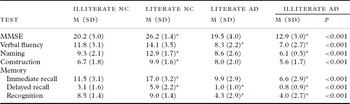
Table 1 shows the cognitive characteristics of the four study groups. All neuropsychological test scores showed between-group differences (all p < 0.01). When we compared illiterate NC to literate NC, the illiterate NC had lower scores than the literate NC on all neuropsychological tests (all p < 0.01), except for the VFT (p = 0.12) and verbal recognition memory (p = 0.16) in the VLT.
Cognitive characteristics of illiterate normal controls (NC), literate NC, illiterate patients with Alzheimer's disease (AD), and literate AD

* Holm-Bonferroni corrected p value < 0.05 on the Mann-Whitney U tests per group, when compared to illiterate normal controls.
MMSE = Mini-Mental State Examination.
When we compared the illiterate NC to literate AD, illiterate NC performed better than literate AD in scores on the VFT (p < 0.01), delayed recall (p < 0.01) and recognition (p < 0.01) in the VLT. However, the MMSE (p = 0.68), BNT (p = 0.81), RDT (p = 0.07), and immediate recall in the VLT (p = 0.16) did not differentiate the illiterate NC and literate AD groups. All illiterate elders failed to copy the cube in the RDT.
When we compared the illiterate NC with the illiterate AD group, we found the scores on all tests (all p < 0.01) were lower in the illiterate AD than in the illiterate NC group, except for construction ability (RDT, p = 0.14).
Figure 1 shows the areas under the ROC curves for all the tests when we compared the illiterate NC to the literate AD, and illiterate AD groups. The ROC curves were consistent with the results from nonparametric between-group analyses.
Areas under the receiver operating characteristic (ROC) curve of neuropsychological tests for differentiating between illiterate normal controls (illiterate NC) and literate patients with Alzheimer's disease (literate AD), and between illiterate NC and illiterate AD, showing that the MMSE, verbal fluency, naming ability, construction ability, and immediate recall ability did not discriminate illiterate NC from literate AD. MMSE = Mini-Mental State Examination. *p < 0.05.

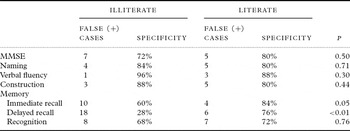
When we used age-, sex-, and education-matched cut-off scores in both literate and illiterate groups, the specificities of the MMSE (72%, χ2 = 0.4, p = 0.50), VFT (84%, χ2 = 0.1, p = 0.71), BNT (96%, χ2 = 1.1, p = 0.30), RCT (88%, χ2 = 0.6, p = 0.44), and recognition (68%, χ2 = 0.1, p = 0.76) for cognitive impairment in the participants who were illiterate were comparable to the specificities in the participants who were literate, but the specificities of immediate recall (60%, χ2 = 3.6, p = 0.05) and delayed recall (28%, χ2 = 11.5, p < 0.01) were lower in the participants who were illiterate than in the participants who were literate (Table 2). The sensitivities did not differ between the two groups. When we analyzed the MMSE's sensitivity and specificity in this sample using a cut-off score of 24/25, the test's sensitivity and specificity were 100% and 4% in participants who were illiterate and 96% and 92% in participants who were literate. The higher false positive rate (49%) in illiterate elders than in literate elders indicated that the screening cut-off score (24/25) was too high for the participants who were illiterate.
False positive cases and specificities in illiterate (n = 50) and literate (n = 50) elders according to age-, sex-, and education-standardized cut-off scores

* p value by χ2 between illiterate and literate elders.
Discussion
Determining the utility of neuropsychological measures for identifying cognitive impairment in older, illiterate adults is of critical importance for the early diagnosis and treatment of neurodegenerative disorders. This is the first study to evaluate the discriminatory ability of formal neuropsychological tests with regard to dementia evaluations of illiterate elders. Our study produced four primary results: (1) the cognitive performance of NC participants who were illiterate was poorer than that of NC participants who were literate in all neuropsychological areas except verbal fluency and recognition memory; (2) the cognitive performance of NC participants who were illiterate was not better than that of AD participants who were literate on the MMSE, naming, construction, and immediate recall areas; (3) the cognitive performance of NC participants who were illiterate was better than that of AD participants who were illiterate in all neuropsychological areas except construction; and (4) the specificities of all tests administered to illiterate participants, except the immediate and delayed recalls, were good when we used age-, sex-, and education-matched cut-off scores. We will discuss each of these findings below.
Our finding that the cognitive performance of NC illiterate participants was poorer than that of literate NC participants in the memory, construction, and naming was expected and is consistent with previous studies on participants who were illiterate (Reis et al., Reference Reis, Guerreiro and Petersson2003). These results suggest that literacy level significantly affects scores on formal neuropsychological tests in this population. We observed poor performances on the naming test in healthy illiterate participants. The small vocabularies of illiterate NC may explain this poor performance. We also noticed a short-term memory decrease in the illiterate NC group, but recognition memory scores showed no difference between the two NC groups. Previous studies of illiterate participants have found similar results (Ardila et al., Reference Ardila, Rosselli and Rosas1989). Petersson et al. (Reference Petersson, Reis, Askelof, Castro-Caldas and Ingvar2000) indicate that the phonological loop system in working memory is impaired in participants who are illiterate and this impairment can influence verbal short-term memory (da Silva et al., Reference da Silva, Petersson, Faisca, Ingvar and Reis2004). In the RDT, all illiterate elders failed to copy the cube. This may be related to their lack of experience in writing with a pencil. Adrian and colleagues report a similar result (Adrian et al., Reference Adrian, Alegria, Morais and 1995). However, Baiyewu and colleagues (Reference Baiyewu2005) report that literacy level does not affect visuospatial ability when participants use sticks instead of paper and pencil. The semantic fluency scores show no difference between our two NC groups. Previous studies report that, while literacy level affects phonological verbal fluency (Ostrosky-Solis et al., Reference Ostrosky-Solis, Ardila, Rosselli, Lopez-Arango and Uriel-Mendoza1998), it does not affect semantic verbal fluency (Manly et al., Reference Manly1999; Reis et al., Reference Reis, Guerreiro and Petersson2003). These indicate that fluency strategy when using a semantic cue can be preserved in adults who are illiterate.
Second, we found that the cognitive performance of healthy illiterate participants was not better than that of literate AD patients in the MMSE, naming, construction, and immediate recall areas. These results indicate that, in countries where the illiteracy rate is high among the elderly, clinicians should consider the patient's literacy level when administering and interpreting neuropsychological tests at dementia clinics and place more emphasis on the scores of verbal fluency and recognition memory which are not affected by literacy level and showed same specificities in illiterate elders as in literate elders.
Third, the cognitive performance of healthy participants who were illiterate was better than that of the illiterate AD patients, except for performance on a construction area. This finding implies that formal neuropsychological tests could be used to discriminate AD in illiterate elders when the literacy level is considered. RDT score shows poor discriminant ability for detecting AD in illiterate people because all illiterate elders failed to copy the cube (the three-dimensional object on the RDT). Reportedly, three-dimensional constructional apraxia is more frequent in adults who are illiterate than in adults who are literate, and this poor ability may indicate that the acquisition of reading and writing skills affects the left temporoparietal areas, which are associated with three-dimensional construction abilities (Castro-Caldas et al., Reference Castro-Caldas, Petersson, Reis, Stone-Elander and Ingvar1998).
Fourth, the MMSE, naming, verbal fluency, construction, and recognition showed comparable specificities in participants who were illiterate to those in participants who were literate, except for the immediate and delayed recalls, when we used age-, sex-, and education-matched cut-off scores. Considering that the MMSE score showed a higher false positive rate in literate adults when we used the 24/25 cut-off value, such use of age-, sex-, and education-matched cut-off scores for elders with very little education (0–3 years) will be useful in screening for cognitive impairment in illiterate elders. However, clinicians should avoid screening for cognitive impairment by means of the MMSE in countries where the illiteracy rate is high and age-, sex-, and education-matched cut-off scores are not made. Moreover, age-, sex-, and education-matched cut-off scores for immediate and delayed recalls still give high false positive rates in illiterate elders. Therefore, it will be more helpful to consider the illiteracy level, in addition to age, sex, and education, when standardizing neuropsychological batteries in countries where the illiteracy rate is high among the elderly.
Our study has several strengths. First, we measured the illiteracy level. Previous studies counted “having no formal education” as illiteracy (Xu et al., Reference Xu, Meyer, Huang, Du, Chowdhury and Quach2003), but this definition cannot differentiate the illiteracy effect from the low education effect, because many elders without formal education can be literate. Second, we evaluated the discriminant ability of formal neuropsychological tests for four groups by several methods: nonparametric group comparison, ROC curve, and age-, sex-, and education-matched cut-off score analyses.
However, despite these strengths, several limitations should be noted when interpreting our results. First, by design we included only women in this study. Therefore, further studies are needed to determine if gender is a significant contributor in low scores in cognitive tests. Second, small numbers of this study can introduce selection or other biases. A third limitation is that we used only the verbal fluency task to measure executive functioning. Because most executive tests require the ability to read and write or are not standardized among elders, it is difficult to administer these tests to people who are illiterate. In a forthcoming study, we plan to utilize new executive tasks, suited to participants who are illiterate, which will use numbers or pictures (Choi et al., 2010). Fourth, we evaluated normal participants who were illiterate by means of clinical interviews, the activities of daily living scale, and MRI images. We were unable to use formal neuropsychological tests, because no suitable neuropsychological batteries for participants who are illiterate exist.
In conclusion, the current study reports that illiterate, healthy people show poor cognitive performance on the formal neuropsychological tests and that, for optimal clinical practice when carrying out dementia evaluations, consideration of the effect of illiteracy is necessary.
Conflict of interest
None.
Description of authors’ roles
J.H. Youn collected and analyzed the data, and wrote the paper. J.Y. Lee designed the study and revised the paper. M. Siksou and R.S. Mackin revised the paper. J.S. Choi participated in supervising data collection. J. Chey participated in statistical analysis.
Acknowledgments
This study was supported by a grant from the Korea Health 21 R & D Project, Ministry of Health and Welfare, Republic of Korea (A050079), and by a grant from the SNUH research fund (04-2006-0290).
Appendix: Translated version of the Literacy Questionnaire and Literacy Evaluation Form (Moon and Chey, Reference Moon and Chey2004)
Literacy Questionnaire
1. At what age did you learn to read and write?
2. Do you have difficulty in reading or writing? If so, please explain.
3. To find your way, could you use street signs? If not, please explain.
4. When using public transport, could you read a route map? If not, please explain.
5. Could you read the tag of an item in a market? If not, please explain.
6. If you follow a religion, do you read the scriptures yourself? If not, please explain.
7. How often do you read a newspaper? If you don't read a newspaper, please explain.
8. Can you make a list of things to buy before going to the supermarket? If not, please explain.
9. Can you note the name of someone who calls on the phone? If not, please explain.
10. Can you write important events on your calendar? If not, please explain.
11. How often do you write in your diary or write a letter? If you don't do either of these, please explain.
Literacy Evaluation Form
1. Reading ability (based on 3rd–7th questions)
1) Cannot read at all
2) Cannot read enough to accomplish everyday tasks
3) Can read fluently
2. Writing ability (based on 8th–11th questions)
1) Cannot write at all
2) Cannot write enough to accomplish everyday tasks
3) Can write fluently
3. Literacy evaluation
1) Cannot read and write at all (pure illiteracy)
2) Cannot read and write enough to accomplish everyday tasks (functional illiteracy)
3) Cannot read or write enough to accomplish everyday tasks (semi-literacy)
4) Can read and write fluently (literacy)