Does how we access the Internet moderate its impact on our political participation? There is great hope that technology will give people the tools to become better citizens, but more research needs to examine exactly how people access the Internet and how these differing usages may have differing impacts. We have known since Downs (Reference Downs1957) that information costs limit political participation. The ease of information gathering that the Internet provides has the potential to ameliorate these costs, and thus increase participation (Tolbert and McNeal, Reference Tolbert and McNeal2003; Mossberger et al., Reference Mossberger, Tolbert and McNeal2007; Xenos and Moy, Reference Xenos and Moy2007). But as technological sophistication increases, it is possible that the Internet has more and less advantageous platforms for increasing political participation, and this has gone unexamined in the enthusiasm for the Internet's potential. In this study, we seek to provide a baseline for this comparison by researching the differential impact of using PCs or mobile phones to access the Internet on political participation in an ideal test country, Japan. Japan features a large population of both PC and mobile phone Internet users. As the proportion of the population that uses mobile phones only to browse the Internet is growing in the United States and elsewhere, this research can help us understand how technological development patterns will generally impact political behavior.
Recent research shows that PC Internet usage promotes political participation (e.g., Bennett, Reference Bennett and Bennett2008; Boulianne, Reference Boulianne2009; Kenski and Stroud, Reference Kenski and Stroud2006). Internet usage is proposed to be beneficial because it increases activity in diverse politicized social networks (Davis, Reference Davis2005; Stromer-Galley, Reference Stromer-Galley2003) and provides greater access to information (see Cantijoch et al., Reference Cantijoch, Jorba and Martin2008). Even though Internet usage may begin as a non-political activity, political participation may be sparked later through encounters with new information. This interaction provides opportunities to encounter different views, discuss options, and make open negotiations, all of which are seeds to ferment participation. Research shows that these processes are not unique to the United States, but also work in Japan (see Ikeda and Richey, Reference Ikeda and Richey2005). The Internet's ability to easily multiply and amplify our information gathering abilities and its interactive nature make it a promising tool for overcoming the time-costs associated with political participation. This positive impact, however, is likely to be diminished by some modes of Internet browsing including mobile phones, which are more difficult to use for full-scale Internet browsing (Ishii, Reference Ishii2004). Very little is known, however, on how alternative platforms of Internet access may impact the mobilizing influence of the Internet.
In addition, studies have shown that mobile phone usage correlates with greater political participation (Campbell and Kwak, Reference Campbell and Kwak2010). The theorized mechanism revolves around ease of access to information (Ling and Campbell, Reference Ling and Campbell2011). Mobile phones allow users to access information when they need it, and the lower information costs should lead to greater participation. However, mobile phone Internet use is facilitated by specific applications designed to help users avoid cumbersome mobile phone browsing. Instead of browsing for information, mobile phone users often minimize their browsing and limit their Internet usage to only those websites for which they have applications (Ballagas et al., Reference Ballagas, Borchers, Rohs and Sheridan2006). In fact, mobile phone usage overall is trending toward ‘smart’ technologies, which are meant to minimize and potentially eliminate the need for browsing (Raento et al., Reference Raento, Oulasvirta, Petit and Toivonen2005).
Ikeda (Reference Ikeda, Yoshiaki and Hyug-Gaeg2006) finds that this trend towards more targeted interfaces serves to reduce the types of online activities that promote political participation, such as posting and replying to comments on blogs. The mobile Internet may promote existing interpersonal relationships, but, due to opportunity costs of time, they will thereby delimit other types of news exposure such as would be typical of PC browsing. Furthermore, because these closed networks found amongst texting and other mobile users are often homogeneous, they would promote an insular ‘bonding social capital’, which would correlate with less usage. Based on these ideas, we posit that users accessing the Internet primarily through their mobile phone are directed toward one-to-one communication with individuals already in their social network, whereas, PC Internet users are better able to engage in the types of activities that facilitate bridging social capital such as full-scale browsing, contributing to chat-room discussions, and posting on blogs. Thus, it remains an open empirical question as to whether mobile usage increases participation due to lower costs of obtaining it, or decreases participation due to more closed social networks and homogenized browsing activities.
To test the impact Internet platforms have on participation, we use nationally representative survey data from Japan, a country which has more pronounced usage of mobile phone browsing than almost any other nation. Using a Seemingly Unrelated Regression model, we also show that the youth and less educated use mobile phones more than PCs as their primary access to the Internet. We also show that PC-based Internet usage correlates with more political participation, but mobile phone Internet usage does not. This mobile divide has the potential to widen the participation gap for these groups, given the limitations of mobile phone browsing discussed earlier. As alternative platforms of Internet usage become more popular worldwide, it is important to understand the impact they have on the Internet's potential for stimulating political participation.
Participation and the Internet
In the study of the Internet, there have been two typical opposing discussions regarding the consequences of Internet use on political participation (see Polat, Reference Polat2005). First, some claim that the Internet ‘cyber-balkanizes’ people by allowing users to micro-target their exposure to information and only increases their exposure to like-minded individuals. Furthermore, as technology increasingly limits where users visit, similar people may naturally visit the same cyber-spaces over and over again, promoting network and information homogeneity. Some research indicates that this selection process may isolate groups and create mutual antagonism that promotes ‘flaming’ interactions that end in aggression. Schneider (Reference Schneider1996) did a pioneering study of a chat-room on abortion politics, and found that while discussion flourished online, it was dominated by a few members who added most of the content. Besides this homogenizing critique, others suggest that the Internet may be keeping people at home by giving them tools for virtual communication, which may reduce the voluntary experiences that are valued by social capital theorists.
Opposing research has shown that by promoting virtual communication, the Internet can actually increase participation in voluntary organizations and politics (Wellman et al., Reference Wellman, Haase, White and Hampton2001). This line of research also suggests that Internet browsing eases the information costs that work as a barrier to participation (Chadwick, Reference Chadwick2006; Shah et al., Reference Shah, Cho, Nah, Gotlieb, Hwang, Lee, Scholl and McLeod2006). These arguments suggest that the Internet actually facilitates positive social functions such as creating diverse ties among citizens by enabling previously unknown others to easily share information (Davis, Reference Davis2005; Hardy and Scheufele, Reference Hardy and Scheufele2005; Price and Cappella, Reference Price and Cappella2002; Stromer-Galley, Reference Stromer-Galley2003; Wojcieszak and Mutz, Reference Wojcieszak and Mutz2009). In this view, the Internet builds a diverse, free-spoken cyber community.
The literature to date has not sufficiently examined the differential impact of Internet platforms on participation, but by scrutinizing the Internet platform, we are able to test the impact of the micro-targeted Internet usage that is common among mobile phone Internet users in contrast to the more broad utilization that is common among PC users. We expect to find that different Internet platforms have differential impacts on participation.
Internet usage in Japan
We need to discuss the peculiarities of Japanese computer use that make it an excellent test case for studying the effects of mobile phone Internet browsing. Far more people use the Internet from mobile phones than desktop or laptop computers in Japan (see Ito et al., Reference Ito, Daisuke and Misa2005, for more on this topic). Research shows that from 2003 to 2005, mobile phone access had a large increase, whereas PC access use stagnated.Footnote 1 International comparisons show that this is unique to Japan. This big change in mobile phone Internet use is facilitated by its quick diffusion to younger people. A national sample survey from the Ministry of General Affairs conducted in early 2007 showed that more than 85% of 20 year-olds text message at least once a day, almost half text more than five times a day, and 10% more than 20 times per day.Footnote 2 But the preference for mobile Internet over PC Internet is not only for younger generations. Other data from the same Ministry survey on time use and leisure activities show that this preference for mobile phone Internet use holds over all age groups, which is much different than in other countries. For example, by the end of 2004, the rate of mobile phone devices with Internet access was 94% in Japan, whereas in the United States it was 34%, and other countries were much less. Some say this mobile phone dominance originated from a Japanese cultural inclination to prefer close social networks, as texting is most common among close relationships (as shown in Ikeda and Kobayashi, Reference Ikeda, Kobayashi, Hsung, Lin and Breiger2005), but the proliferation of ‘smart-phones’ in the United States and other developed nations indicates this phenomenon is not specific to Japan.
Although the Japanese are unique in their early adoption of mobile phone Internet, our survey shows that the Japanese still obtain daily political news very traditionally: 90% via TV, 61% from newspapers, 11% from PC websites, and only 1% through their mobile phone. Therefore, the Japan case offers a sample that is more mobile connected than any other country, but whose political information gathering habits mirror countries such as the United States. One explanation for this is that Japanese regulations on Internet use in political campaigns are severely stricter than any other developed country. Candidates and political parties can only distribute their campaign materials in a very limited way, especially during the formal election campaign period.
The mobile divide
Ikeda (Reference Ikeda, Yoshiaki and Hyug-Gaeg2006) discovered a ‘mobile phone divide’ in a local random-sampled survey in 2002. Whereas PC-based Internet browsing facilitates social networking and political participation, mobile phone Internet usage did not have a similar positive effect. Both styles of Internet usage promote ‘bonding’ social networks, but only PC Internet use stimulates bridging diverse virtual social networks. They find that this ‘mobile divide’ occurs because browsing the full Internet from a mobile phone is more cumbersome, and mobile phone users tend to focus on one-to-one communication, such as texting or e-mail. Thus, mobile phone users have more difficulty taking full advantage of the Internet, and the bridging effect of Internet usage is less potent on this type of user. While PC Internet users often access search engines, chat-rooms, and blogs, the constraints and conventions of mobile phone Internet use make these activities nearly impossible for users accessing the Internet through their mobile phones. Therefore, mobile phone Internet users minimize the possibility of being exposed to heterogeneous others, which are a source of political information (Huckfeldt et al., Reference Huckfeldt, Johnson and Sprague2004). The more expansive use of the Internet by PC users exposes them to a wider diversity of viewpoints as compared to mobile phone Internet users. Compounding this divide is that younger and less educated people more often rely exclusively on their mobile phone for Internet access. Therefore, it is possible that the mobile divide may widen the participation gap for these groups. In sum, mobile phone users are browsing alone in comparison to PC users.
Theory and hypotheses
As using the Internet as a tool for searches and communication enhancement help users overcome the information costs which limit participation, we expect the device with which users access the Internet is likely to significantly impact these activities, and therefore participation. Specifically, the platform restrictions of mobile devices make it more difficult to participation in online communities and engage in browsing. We suspect that for the Internet to promote participation it must come from full-blown Internet searches. Given that ‘apps’ are the primary access point to the Internet on mobile phones, full-blown Internet searches are likely to be less common among those who access the Internet from mobile phones. With companies like Apple offering nearly 200,000 apps,Footnote 3 mobile phone Internet users are being socialized to think, ‘There's an app for that’; while PC-based Internet users still ‘Google it’ regardless of where they live. This point deserves more scholarly attention, and we approach it by examining the differential impact of PC and mobile phone Internet use.
Our theory then is based in part on prior research that shows that the Internet increases participation. But we add a second component, whereby the cumbersome mobile phone browser delimits information searches and promotes close-tie networking and also takes time away from other internet activity because users do not have access to full-scale browsing. Based on these past findings, we focus on two themes: demographic bias of accessing the Internet through different platforms and the effect of these differential Internet platforms. We have two hypotheses. The first hypothesis is based on the idea that exposure to greater information and more diverse networks via PC Internet usage will promote political participation even if we control for relevant variables. Another expectation is that personal use of Internet by mobile phone will not promote participation, because this type of use leads to less robust Internet searches, forms a more closed network, and lacks diverse social interaction which is essential for democracy. Thus, Hypothesis 1 is that PC Internet usage increases political participation and mobile phone Internet usage decreases it.
For the second hypothesis, we investigate whether there are differential usage patterns by different demographic groups. We suspect that those who heavily use mobile phones to access the Internet are less exposed to diverse information and networks that would sponsor political participation. If this usage gap exists, political participation could be indirectly affected by social groupings that use different Internet platforms. Thus, even if Internet usage rates are high in a society, mobile phone Internet users may not exhibit the same gain from the Internet as PC users do, and a gap will develop that may restrict certain groups in the public sphere more than others. This would be problematic if it is focused on groups who have differing policy preferences from PC users. In order to examine this possibility, we see which groups use each mode of browsing more often, by regressing usage for both types on independent variables for gender, age, education, years of residence, size of the city one is living in, and living within 50 miles of Tokyo. Hypothesis 2 is that socially less-powerful groups will use mobile phones to access the Internet more than socially powerful groups.
Data
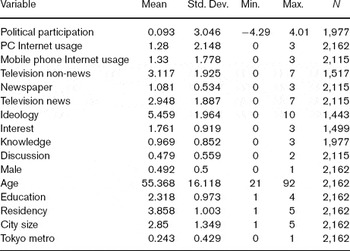
The data are from a nationally representative sample survey; the Japan Election Study 3 (JES3).Footnote 4 The JES3 is the Japanese equivalent to the American National Election Study, and is regularly used in social science research on Japan (e.g., Ikeda, Reference Ikeda2007). The response rate was 61% (N = 2,162 out of total 3,573). The questions used in this research are listed in the Appendix. Table 1 lists the summary statistics.
Summary statistics

Dependent variable
We sum respondent involvement in five measures of political participation. These categories are chosen because they represent a wide range of political activities, and are often used in studies of participation (e.g. Verba et al., Reference Verba, Schlozman and Brady1995). The data show that the most frequently experienced participatory behavior is, of course, voting (71%). The other categories are: Wrote or phoned a politician/official, Signed a petition, Made donation or participated in fund-raising, Voiced (an) opinion(s) by writing/calling/appearing in the mass media (Cronbach's α = 0.83). A principle component analysis shows that this is a uni-dimensional construct as there is only one factor (Eignevalue 1.36). This loads about equally on each of these five forms of participation (0.28, 0.58, 0.46, 0.53, and 0.12). Thus, this is an accurate scale of political participation measured with these data.
Independent variables
We create two Internet use variables: PC Internet usage and mobile phone Internet usage. We created PC Internet usage from a question that asked about frequency of ‘checking web pages on a computer’, while mobile phone usage was measured with a question regarding frequency of ‘checking web pages on a cellular phone’. Respondents could rate the level of usage for each of these as: 3 frequently, 2 sometimes, 1 seldom, and 0 never. This is a somewhat thin measure of usage, but it is the only one available in these data. Both questions have wide variance, with many respondents stating they are either frequent users or non-users.
We will also control for variables in the regression models for political participation, because the socially less-powerful groups that rely on mobile phones for Internet access, may also participate less. The control variables that we include are gender, age, education, years of residence, city size, and living in the Tokyo metropolitan area. These variables are linked to political participation, and according to the Ministry of General Affairs, predict increased reliance on mobile phones for the Internet. Also, we include measures of political knowledge and ideology, all of which have been shown to influence political participation in Japan (Ikeda and Richey, Reference Ikeda and Richey2005). To control for the informational level of the respondents, we include variables for interest in politics, amount of political discussion, mass media exposure from TV, and newspaper usage. Interest in politics is coded 3 if very interested, 2 if somewhat interested, 1 if a little interested, and 0 if not interested. Political knowledge also promotes participation. The political knowledge questions were derived from Delli Carpini and Keeter (Reference Delli, Michael and Keeter1995), and involve five open-ended questions about five Japanese politicians. Ideology has been found to motivate political participation, and here it is measured on a ten-point scale, with conservatives coded higher. Exposure to news may simplify the political process, and stimulate participation. We control for reading a Newspaper coded dichotomously, and Television news by counting the number of television news shows watched during the week, and hours per day spent watching Television non-news. We also control for being a LDP supporter, as different parties have different mobilization rates of their members. We control for socioeconomic demographic variables including Male (male as 1, female as 0), Age (in years), length of Residency (from 1 for less than three years to 5 for since birth), Education (years of schooling), City size, and living in the Tokyo metropolitan area. Due to data limitations, we are not able to include income. This may not be a problem, as education, age, and gender are all highly correlated with income and are included in the model. Further, in Japan income inequalities are less pronounced than in many other countries. Due to these factors, we believe that our results are relevant, but do acknowledge this limitation.
Methods
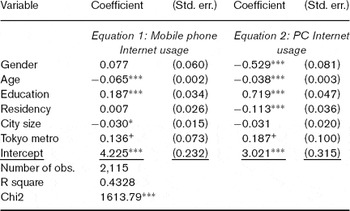
To test Hypothesis 1, we use an ordinary least squares regression model. This is because the principal component analysis of political participation produced a continuous component, with a mean about 0 and is normally distributed. To test hypothesis 2, we want to estimate the effects of demographic variables on usage of each type, but around 53% of the variation in mobile phone Internet usage is correlated with PC Internet usage. This is such a large correlation, that they could be measuring the same underlying construct, Internet usage regardless of technological platform. If so, it would be best to untangle this relationship, to allow insight into the impact of demographics on each type, separate from their joint influence. A Seemingly Unrelated Regression Model (SURM) (Greene, Reference Greene2003: 710) allows us to include two dependent variables into the same model but with correlated disturbances. This will measure the effect of demographics on both mobile phone and PC Internet usage simultaneously. To decide whether a SURM is needed, we can test for the presence of correlation in the two equations. Specifically, a Lagrange likelihood ratio test determines the usefulness of this model, which has a null hypothesis that ρ equals 0. If ρ approximates 0, then the sum of the log likelihoods from two separate univariate models will equal the log likelihood from the bivariate model. For both the equations in Table 2, we obtain a p-value of 0.0000 for the test of ρ, and this leads us to reject the null hypothesis. Therefore, it is advantageous to use a SURM as opposed to the two separate regression models. This shows that there is some overlap in the causes of mobile phone and PC Internet usage.
Determinants of mobile phone and PC Internet usage

+p < .10 *p < .05 **p < .01 ***p < .001.
Note: Cells represent unstandardized coefficients and standard errors for a seemingly unrelated regression model of the likelihood of Internet use.
Results
Internet usage
Table 2 shows the effect of demographic factors on PC Internet usage and mobile phone Internet usage. The results clearly reveal a consistent pattern. For PC Internet usage, the effect of gender is small but significant; males use PC-based Internet more than females. In contrast, the effects of age and education are conspicuous. Elderly respondents use PCs to access the Internet less, and the educated use of PC Internet more. These effects are large. Results from the mobile phone Internet usage equation show that there was less effect from gender, which we find to be barely significant. We observe both of the effects of age and education, but the effect of education was less than for PC Internet use, while age was larger. Thus, the platform usage is determined by the demographic variables of age, education, and somewhat by gender.
Impact on participation
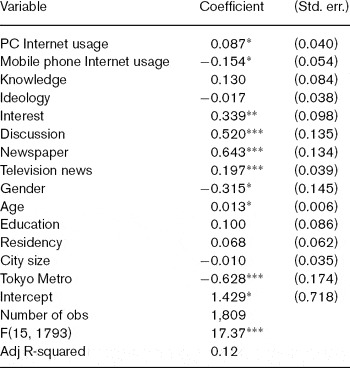
The results for Hypothesis 1 are shown in Table 3. PC Internet usage has a positive effect on political participation, while mobile phone Internet use has a negative effect. To interpret these coefficients, we see that the difference in participation between those who report the least PC Internet usage and those who report the most (from 0 to 3) is an increase in political participation of around one fourth of a standard deviation. The negative effect of mobile phone Internet usage was also large, at around one half of a standard deviation. These impacts are what we expected. Thus, the results confirm Hypothesis 1 and show that the type of browsing platform does have differential impacts on participation. This shows that different platforms have a different impact on behavior.
Effects of Internet use on political participation

+p < 0.10 *p < 0.05 **p < 0.01 ***p < 0.001.
Note: Cells represent unstandardized coefficients and standard errors for an ordinary least squares regression model of the likelihood of participating in political activities.
Additionally, the control variables match expectations that there is a positive effect for political interest, political discussion, newspaper, and television exposure on participation, while living in the Tokyo metropolitan area decreases participation.Footnote 5 These effects are also consistent with other studies. It is important to restate that these results are robust to the inclusion of demographic variables which we find below predict differential usage. Thus, we have found that even after you control for the influence of belonging to these different groups on participation, the type of platforms used to access the Internet has additional explanatory power.
Conclusion
We find that the ‘mobile divide’ does exist. After controlling for relevant variables, we observe that PC Internet usage correlates with increased political participation and mobile phone Internet usage correlates with less political participation. Thus, a possible consequence of mobile phone Internet use is less political participation, which is probably due to its inability to promote network heterogeneity. On the other hand, PC Internet use correlates with greater political participation, which confirms past findings. We also find that the strongest determinants of the PC or mobile phone Internet use are age and education. The implication of these findings reveals an important substantial gap in the beneficial effects of PC Internet usage; younger, as well as less educated people use mobile phone platforms for Internet access. If so, then the ‘mobile divide’ could be serious because less powerful groups may not gain the same benefits from the Internet that encourage participation as more educated people, which may widen an already present participation gap.
For scholars of the influence of technology on political behavior, our analysis shows that different platforms correlate differentially with political participation. We know from a massive literature on representation that more participation leads to better democracies (e.g., Isham et al., Reference Isham, Narayan and Pritchett1995). So, if we want to make democracy work, we need to study the exact nature of how people engage in Internet social interaction, because it may sponsor participation, which in the end pressures government to act better. With richer models, we can better analyze the sources of problems, such as mobile phone Internet usage which may limit searching and online social interaction, and thereby political participation. Conversely, this evidence suggests that increasing PC-based online usage and promoting online interaction through better educational programs could be beneficial. It also highlights the need for mobile phone Internet providers and developers to address the negative consequences of limiting mobile phone browsing; including decreased participation.
About the authors
Dr Ken'ichi Ikeda is a Professor in the Department of Media Studies at Doshisha University in Kyoto from April 2013, and has long taught at the University of Tokyo. He is interested in social/political participation and the mediated effects of social network on political behavior. He represents Japan in three international comparative projects, i.e. Asian Barometer Study (ABS), World Values Survey (WVS), and Comparative Study of Electoral Systems (CSES).
Dr Sean Richey is an Associate Professor in the Department of Political Science at Georgia State University. He teaches and researches political communication and political behavior, with a specialization in voting behavior, political discussion networks, social capital, and political participation. In 2013–14, he will be a Fulbright Scholar in Japan in residence at the University of Tokyo.
Dr Holly Teresi is the former Research Director of the New Organizing Institute. She recently completed a Ph.D. in Political Science at Georgia State University, where she pioneered the adaptation of randomized field experiments to social media. She has extensive experience organizing young voters for electoral campaigns, served as the National Communications Director of Youth Vote Coalition, and worked as a researcher for Harris Interactive and Penn, Schoen, and Berland Associates.
Appendix
Below is a translation of the survey questions used in this research. Note that the City size and Tokyo metro variables are constructed from information known from the sample procedures, and, thus, are not listed specifically below.
Political participation: Please mark all items you have experienced in the past 5 years in the list below: voted in an election, participated in a self-governing body or neighborhood association, contacted a local influential person, contacted a politician/official out of necessity, went to an assembly or public office to petition or lobby, participated in assemblies pertaining to an election or politics, signed a petition, made donation or participated in fund-raising, participated in a demonstration, spoke out about politics on the Internet, and voiced (an) opinion(s) by writing/calling/appearing in the mass media.
Knowledge: How much do you know about this candidate? 1. Know a lot 2. Know a little 3. Know only the candidate's name 4. Do not know this candidate.
Internet usage: Choose one answer for each item and circle the number. Check webpages on a cellular phone, Check webpages on a computer 3. Frequently 2. Sometimes 1. Seldom 0. Never.
Interest: During the recent House of Representatives election, how much interest did you have in the campaigns the different parties and candidates conducted? Did you have a great deal of interest, some interest, hardly any interest, or no interest at all?
Newspaper news: From which sources do you usually obtain political information? First, how about the newspaper? (M. A.) 1. Yomiuri Newspaper 2. Asahi Newspaper 3. Mainichi Newspaper 4. Sankei Newspaper 5. Nihon Keizai Newspaper 6. Tokyo Newspaper 7. Hokkaido Newspaper 8. Kahoku Newspaper 9. Chunichi Newspaper 10. Kobe Newspaper 11. Chugoku Newspaper 12. Nishi Nihon Newspaper 13. Some other newspaper () 14. None 15. DK 16. NA
News exposure: Which kinds of TV programs did you watch often during this election campaign? Are there any not listed below? 1. NHK news programs 2. Izumi Oguri's ‘Today's Events’ (NTV) 3. Masako Fuefuki Hiroaki Konno's ‘News Plus 1’ (NTV) 4. Tetsuya Chikushi Mitsuyo Kusano's ‘News 23’ (TBS) 5. Takae MikumoEHiroyuki Ikeda ‘Evening 5’ (TBS) 6. MasayaMatsumoto Christel Takigawa's ‘News Japan’ (FTV) 7. Taro Kimura Yuko Ando's ‘FNN Super News’ (FTV) 8. Ichiro Furudate@’Houdou (Broadcast) Station’ (ATV) 9. Etsuko Komiya's ‘Super J Channel’ (ATV) 10. Maoko Kotani's ‘World Business Satellite’ (TTV) 11.Jiro Shinbo's ‘Wake Up! PLUS’ (NTV) 12. Kazuo Tokumitsu's ‘The Sunday’ (NTV) 13. Hiroshi Sekiguchi's ‘Sunday Morning’ (TBS) 14. Misuzu Tamaru's ‘News Special’ (TBS) 15. Yuji Kuroiwa's ‘News 2001’ (FTV) 16. Souichiro Tahara's ‘Sunday Project’ (ATV) 17. Isao Fukutome Junko Kubo's ‘Broadcaster’ (TBS) 18. Morning and evening variety shows 19. Other television program(s) () 20. Radio program(s) () 21. Weekly magazine(s) 22. DK 23. NA
Ideology: Are you conservative, or are you liberal? Where do you think is the place your political position on a scale of 1 to 10? (1 stands for a liberal position, and 10 for a conservative position.)
Education: What is your highest level of education? 1. Primary or lower-secondary school (junior high school) 2. High school 3. Junior college and trade school 4. University and graduate school 5. NA
1. Primary or lower-secondary school (junior high school)
2. High school
3. Junior college and or trade school
4. University and Four-year college or graduate school
Gender: 1. Male 2. Female
Age: How old are you?
Residency: How long have you lived in your present location, or within 30 minutes by foot from your present location? 1. 3 years or less 2. 4 to 9 years 3. 10 to 14 years 4. 15 years or more (If respondent lived in their present location their entire life, circle the next answer.) 5. All my life 6. NA. 1