

Introduction
The 2006 Institute of Medicine report on hospital-based emergency care stated, “An average of once every minute, an ambulance carrying a patient is diverted from an emergency department that is full and sent to one that is farther away. Nearly half of all hospitals—and close to 70 percent of urban hospitals—diverted patients at some point during 2004.” The report further argues “Each diversion adds precious minutes to the time before a patient can be wheeled into an emergency department and be seen by a doctor, and these delays in fact may mean the difference between life and death for some patients.”1
In Massachusetts, ambulance diversion could be requested by individual hospitals when emergency department capacity reached saturation or during physical disasters.2 When an emergency department officially is placed on diversion, additional patients no longer will be accepted (except for major trauma, ST-elevation myocardial infarction, etc.). In the City of Boston, annual ambulance diversion hours increased more than six-fold from 448 in 1997 to 2,855 in 2006.3
To reduce the number of ambulance diversion hours, the Department of Public Health issued a “Best Practices Guideline” in 1999, followed by additional recommendations the following year.Reference Koh4,Reference Koh5 It was evident that hospitals diverted ambulances largely because of hospital overcrowding and a lack of inpatient beds, rather than high volumes or rates of patient arrivals in emergency departments.Reference Friedman6,Reference Rathlev, Chessare and Olshaker7 Although the automatic period of diversion was reduced from four to two hours, the number of diversion hours continued to mount; while some individual hospitals spent very little or no time on diversion, others frequently recorded >100 hours/month.3 In response, emergency department directors from hospitals in six contiguous towns in southeastern Massachusetts conducted a successful six-month “no diversion” trial in 2005.8 During the trial, diversion occurred rarely, decreasing by >90% from the baseline.
The Conference of Boston Teaching Hospitals (COBTH) consists of 10 member institutions including four Level-1 Trauma Centers. Representatives from member emergency departments and Boston Emergency Medical Services (EMS) form the COBTH EMS Committee, which reviews all EMS activity including the number of diversion hours in the city on a monthly basis. Boston EMS is the primary provider of prehospital care in the City of Boston, responding to 97% of the emergency 9-1-1 calls within the city.Reference Dyer9 Investigators of this study performed extensive Medline and PubMed searches and failed to uncover any literature demonstrating beneficial effects of ambulance diversion on EMS or emergency department operations, emergency department length of stay, or crowding measures. Therefore, the COBTH EMS committee members unanimously approved a two-week moratorium on ambulance diversion by all of the hospitals with an acute care emergency department with the purpose of measuring the effects on standard daily measures of hospital and EMS efficiency.
Methods
The study was a retrospective analysis of data elements collected during a two-week trial period (study period: 02 October 2006 through 15 October 2006) compared with the two weeks immediately prior (control period: 18 September 2006 to 01 October 2006). The study setting was the COBTH consortium of teaching hospitals plus the municipal EMS service in Boston, Massachusetts. The COBTH EMS committee instituted a voluntary, two-week moratorium on citywide diversion of ambulances responding to 9-1-1 calls in the cities of Boston and Cambridge during the two-week study period. During the trial, conference calls were held on a daily basis to update participants. All 10 COBTH hospitals participated in the “no diversion” trial. Two hospitals in Cambridge, the largest municipality immediately to the north of Boston, also participated in the voluntary “no diversion” period. Boston EMS also participated and contributed data to the analysis.
The hypothesis was that no significant difference would be found between mean daily measures of hospital and EMS operations between the study period and the two weeks immediately prior to the moratorium. The hospital measures were: (1) emergency department volume; (2) emergency department length of stay (LOS) for admitted, discharged, and all patients; (3) the number of patients admitted from the emergency department; and (4) the number of patients eloping from the emergency departments prior to being seen (elopements). The LOS was defined as the time from when a patient arrived in the emergency department until he or she left after admission, discharge, or transfer. The EMS field data originated from the Boston EMS Medical Information System (MIS) derived from its Computer-Aided Dispatch System. The Dispatch System electronically time stamps activities entered via mobile workstations in the ambulances. The following mean standard measures of field operations were collected for basic life support (BLS) and advanced life support (ALS) units for all destinations: (1) transport to hospital time; (2) at hospital time; and (3) number of responses with transport initiated/day. The mean interval between incident call entry to the Dispatch System to arrival of the first EMS unit at the hospital was collected for BLS and ALS units together. The purpose of measuring the interval between incident call entry to hospital arrival of the first EMS unit is to assess unit availability. In addition, Boston EMS at-hospital time and the percentage of total Boston EMS transports to individual hospitals also were collected by destination. The percent of total transports to individual hospitals was included in order to determine whether the “no diversion” policy resulted in significant shifts in EMS destination hospitals.
Each participating hospital submitted retrospective data after the completion of the trial. The data submitted included mean values of the above measures for the study and control periods. The difference between the mean values for the study and control periods was calculated for each hospital and EMS destination-specific measure (Boston EMS at-hospital time and the percent of total Boston EMS transports to individual hospitals). The median difference (MD) was calculated as the median of the difference between the means of those values from the study and control periods for all participating institutions. Typical parametric statistical analyses were not appropriate due to the aggregation of the data and the inability to accurately measure the standard error. Therefore, basic statistics were calculated to summarize the data for the control and study periods. Additionally, performed non-parametric, paired, Wilcoxon tests were performed on the MDs for each variable to determine if statistically significant changes occurred between the control and study periods for hospital data. The EMS data categorized according to ALS and BLS transport only can be summarized, but statistical testing were not appropriate, since there are only two replicates (ALS and BLS). Unlike the hospital-based data and EMS data collected by destination hospital, there is no replication across hospitals that would allow for statistical analysis. A statistician/epidemiologist from the consortium hospitals analyzed all of the data.
At the conclusion of the study period, Boston EMS offered an online survey to field personnel. The open-ended question was: “Do you have any comments or suggestions about this moratorium experiment, or hospital diversion issues in general?” The Superintendent-in-Chief of Boston EMS tabulated the responses to this survey. Expedited review was obtained from the Institutional Review Board of each participating institution. This permitted the collection and reporting of aggregate data without requiring consent from individual patients. Data were processed using STATA/SE 8.2 for Windows (Stata Corp., College Station, TX).
Results
Boston EMS and a total of nine institutions—seven in Boston and two in Cambridge—reported data. These included all four adult Level-1 Trauma Centers, two of which also were Pediatric Trauma Centers in the City of Boston. The city's largest pediatric hospital and trauma center did not utilize ambulance diversion prior to the trial, and therefore, did not participate in the data collection. In addition, two other COBTH member community hospitals were unable to provide data, although the two-week moratorium on diversion was universal throughout the city.
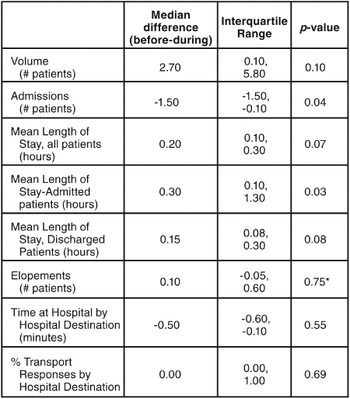
The results are listed in Table 1. Paired Wilcoxon tests indicated that the LOS for admitted patients (MD = 0.30 hours; IQR 0.10, 1.30; p = 0.03) and the number of admissions per day (MD = −1.50 patients; IQR 1.50, 0.10; p = 0.04) were different statistically. Consequently, the LOS for admitted patients decreased by 18 minutes and the number of daily admissions increased by 1.5 patients during the “no diversion” period. Marginal significance was observed, indicating that both the mean LOS for all patients (MD = 0.20 hours; p = 0.07) and for discharged patients (MD = 0.15 hours; p = 0.08) decreased, and that the emergency department volume increased (MD = 2.70 patients; p = 0.10). The EMS time at the hospital by destination (MD = −0.50 minutes; p = 0.55) and the percent of all Boston EMS transports to each hospital revealed no significant difference (MD = 0.0; p = 0.69). The number of elopements was submitted by only three hospitals and no statistically significant difference was found between periods (MD = 0.10; p = 0.75).

(* based on three observations only)
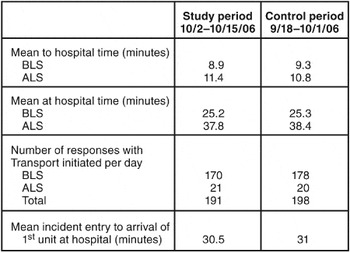
Results submitted by Boston EMS for the study period of 02–15 October, 2006 and for the previous two weeks prior are in Table 2. During the study period, the mean value for to-hospital-time was 8.9 minutes for BLS units and 11.4 minutes for ALS units, the mean value for at-hospital-time was 25.2 minutes BLS units and 37.8 minutes for ALS units, and the mean value for incident-entry-to-hospital-arrival was 30.5 minutes for all units. The maximum difference between the study and control periods for any of these time intervals was 0.6 minutes or 36 seconds. The number of responses with transport initiated per day decreased by 4% (7/198) during the study period.

The data originate from the Boston EMS medical information system (MIS) derived from its Computer Aided Dispatch System that electronically time stamps activities entered via mobile workstations in the ambulances
A total of 77 (33%) Boston EMS field personnel responded to the optional, open-ended survey that was administered at the end of the study period. The vast majority of respondents believed that the “no diversion” policy should be made routine practice. Many believed that the greatest benefit was that EMS personnel did not have to explain diversion to any patient or family member during the study period.
Discussion
Demand for emergency services across the United States has grown in all population groups at the same time that the number of EDs and hospitals has been decreasing. Thus, ambulance diversion, often considered to be an indicator of hospital and emergency department crowding, has been an ongoing and increasing problem for more than a decade.1,10,Reference Olshaker and Rathlev11 One report noted that 11% of US emergency departments were on ambulance diversion simultaneously.Reference Schneider, Gallery and Schafermeyer12 The 2006 Institute of Medicine report indicated that one-half of emergency departments had utilized ambulance diversion during the previous year, and about 500,000 diversion hours were reported.Reference Burt, McCaig and Valverde13 While investigators suggest that diversion merely creates the illusion of a solution to emergency department crowding, patients experience higher trauma mortality and delays in care for patients presenting with high-acuity cardiac conditions.Reference Sun, Mohanty and Weiss14–Reference Schull, Morrison and Vermeulen16 Moreover, the literature is inconclusive regarding the effect of ambulance diversion on hospital revenue.Reference Falvo, Grove and Stachura17–Reference McConnell, Richards and Dava19 In considering these factors, the 2006 Institute of Medicine report recommended that the practices of emergency department boarding and ambulance diversion be eliminated in all but in the most extreme circumstances, such as during a mass-casualty incident. Ideally, instances in which crowded hospitals essentially close their doors to new ambulance patients would never occur, except in the most extreme situations.1
Overall, few trends were identified in the present study. As hypothesized, the results did not demonstrate any adverse effects of “no diversion” on standard measures of EMS, hospital, and emergency department efficiency. If anything, the results indicate a beneficial association between “no diversion” and the time that admitted patients spent in the emergency department from initial presentation to departure for the floor or intensive care unit. A decrease of 18 minutes in total LOS for admissions may benefit patient flow in the emergency department, as a whole, particularly in institutions in which the emergency department admission rate is high; however, the association does not necessarily imply direct cause and effect. Rather, eliminating ambulance diversion may have forced hospital administrators and inpatient services to collaborate to find solutions to the problem of extensive “boarding” of admitted patients in the emergency department. Unfortunately, this theory could not be substantiated, since participating institutions were not able to measure the time interval from admission decision to departure for in-patient units consistently.
The positive association between “no diversion” and an increase in the number of admissions across institutions is not explained easily. It will be viewed as a positive outcome that contributes to the hospital's bottom line; however, the result should be viewed with a jaundiced eye. A possible explanation may be that during the control period, some patients were taken to neighboring institutions (that did not participate in the two-week study) by EMS because of diversion at the destination hospital. Conversely, these same patients may have been brought to participating destination institutions during the trial period.
Comparison of mean to-hospital time, at-hospital time, and incident-entry-to-arrival of the first Boston EMS unit at the hospital suggests no significant adverse impact upon field operations. The time intervals are comparable between comparison periods and the maximum difference in any of these parameters is unlikely to substantively affect patient outcomes. As shown in Table 2, volume, as reflected by the number of transport responses (both overall and by unit type), was relatively constant across time intervals. Patients are likely to be frustrated with being denied transport to their preferred destination where their doctors and medical records are located.Reference Pham, Patel and Millin20,Reference Asplin21 Likewise, EMS crews are placed in the unenviable position of traveling further to transport their patients and responding to the protests from patients after informing them that they cannot go to their hospital of choice. The results of the on-line survey administered to EMS personnel support these theories, and suggest positive field unit support for the “no diversion” concept.
Limitations
This study has several limitations. The two-week trial period in October was chosen arbitrarily and may not accurately represent the volume, acuity, and other conditions seen over the course of an entire year. October precedes the busiest time of year in the emergency department coincident with the influenza season; however, different choices of months and two-week periods would not have altered the results of the study. The original study design called for two control periods: two weeks period to no diversion and the same two-week period one year prior. Unfortunately, several participating institutions were unable to generate data from the previous year. The main interest was to determine the impact—or lack thereof—across a system of hospitals. Therefore, it was decided to include as many institutions in the system as possible, while limiting the number and types of data points that could be collected.
The trial was planned carefully by each Boston hospital, and preparations for the potential increase volume and acuity were planned weeks and months ahead of time. Thus, during the two-week trial period, hospitals may have reallocated resources to support emergency department volume, and prioritized throughput. Informally, most institutions reported that they did not change policies or add staff in preparation for no diversion, but formal data collection was not performed to confirm these reports. At minimum, the study supports the concept that hospitals can—with proper preparation—take steps to mitigate the impact of “no diversion”.
It may be difficult to extrapolate the results to other municipalities or regions. The study involved a single city, small in geographic size, moderate in population density, with a disproportionate number of hospitals, many of which provide tertiary care and are designated trauma centers. Perhaps the results would be different in an area with fewer trauma centers and greater dispersion among hospitals (most of which are community rather than teaching hospitals).
Participating hospitals reported aggregate data for summary measures of hospital efficiency. Daily measures with standard deviations would have allowed for more accurate comparisons. The statistical process used has limitations because the median difference of the means from individual hospitals was analyzed. The analysis should be interpreted with caution, since the aggregation of data might compromise the interpretability of the data. Finally, the number of variables tested was limited to measures of efficiency; unfortunately, measures of quality, such as the time-to-first-caregiver, time-to-first-antibiotics for patients with community-acquired pneumonia, or door-to-needle time for patients with ST-elevation myocardial injury, could not be recorded.
Conclusions
It appears that ambulance diversion is not a solution to the problem of emergency department crowding; the trial demonstrates that diversion can be eliminated temporarily without negative consequences to the efficiency of EMS transports and emergency department care. A reduction in the length of emergency department stay for patients being admitted to the hospital and a small increase in the number of patients being admitted at each hospital during the trial were found. Both of these results should be considered positive outcomes in terms of emergency department and hospital operations and financial health. The results of this limited pilot study also suggest that Boston EMS operations were not adversely affected by the intervention and that field personnel were supportive of “no diversion.” Moreover, the distribution of transports by hospital destination during the pilot period appears to be comparable to that of the various comparison periods. Due to the success of this trial, as well as the experience of other communities in the Commonwealth, Massachusetts eliminated the practice of ambulance diversion entirely on 01 January 2009.
Abbreviations:
ALS = advanced life support
BLS = basic life support
COBTH = Conference of Boston Teaching Hospitals
EMS = emergency medical services
LOS = length of stay