Owing to the fact that mortality and morbidity in patients with congenital heart disease have improved significantly over the past decades, increasing attention is now being paid to long-term behavioural and emotional outcomes and quality of life of patients.Reference Latal, Helfricht and Fischer 1 – Reference Landolt, ValsangiacomoBuechel and Latal 3 Children with significant congenital heart disease show problems with behavioural adjustment and cognitive functioning.Reference Bellinger and Newburger 4 Problems with anxiety, depression, attention, social cognition, and relationships have been noted,Reference Bellinger, Newburger and Wypij 5 – Reference Shillingford, Glanzman and Ittenbach 8 with some suggestion that difficulties increase with ageReference Karsdorp, Everaerd, Kindt and Mulder 9 and remain in young adulthood.Reference Van Rijen, Utens and Roos-Hesselink 10 However, most of these studies have focused on children with complex congenital heart diseases.
Here, we focused on the social and behavioural problems of children with simple ventricular septal defects, especially those who underwent surgery or transcatheter closure. We retrospectively followed up a consecutive sample of school-aged children who underwent surgery or transcatheter closure to repair ventricular septal defect at the Provincial Hospital affiliated with Shandong University – Jinan, Shandong province – their parents, and their best friends as a control group. We used P300-evoked potentials to objectively assess cognitive function; the outcomes were previously reported.Reference Guan, Jin, Zheng, Liu and Wang 11 We report on behavioural and psychosocial functioning outcomes in children, as well as risk factors for developing such behavioural problems.
Methods
Subjects and procedures
Using the postal method, we recruited patients who had undergone surgery or transcatheter closure to repair ventricular septal defect at the Provincial Hospital affiliated to Shandong University between January, 1999 and December, 2005. Eligibility criteria included birth between January, 1995 and December, 2002 (the age range was set to 6–13 years to correspond with the school age) muscular or perimembranous ventricular septal defect position within the septum, and no associated anomalies. Subjects were excluded if they had congestive heart failure or pulmonary hypertension before surgery. Parents, including 79 mothers and 41 fathers, of 64 patients and their 56 “best-friend” control subjects completed the Child Behavior Checklist and the General Health Questionnaire. All of the patients and parents had been assessed before the test by a psychiatrist, and none of them had any psychological or psychiatric disorders.
This study was approved by the Shandong Provincial Hospital Committee on Clinical Investigation and was conducted in accordance with institutional guidelines. Informed consent was obtained from all parents, and consent was obtained from all subjects older than 10 years.
Patient characteristics
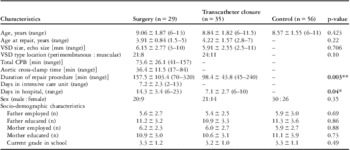
Children undergoing surgery or transcatheter repair and healthy controls did not differ in demographic characteristics (Table 1). The two treatment groups did not differ in ventricular septal defect size or location or median age at intervention. The duration of repair and hospitalisation were significantly greater for surgical than transcatheter patients. Ventricular septal defect patients and their best friends had a similar level of intelligence. Mean full-scale intelligence quotient and verbal and performance intelligence quotient did not differ among groups (Table 2).
Demographic and clinical characteristics of patients with ventricular septal defect undergoing surgery or transcatheter closure and controls.

CPB = cardiopulmonary bypass; VSD = ventricular septal defect; surgery vs transcatheter closure *p < 0.05; **p < 0.01
Score on the Hollingshead Four Factor Index of Social Class, higher score indicating higher social class. Data are mean ± standard deviation unless indicated
Intelligence quotient score.

Data are mean ± standard deviation
Outcome measures
Parents of patients and controls were asked to complete the Child Behavior Checklist and the 28-item version of the General Health Questionnaire. The Child Behavior Checklist was previously used to obtain standardised parents’ scores for behavioural and emotional problems in children 7–17 years of age.Reference Achenbach 12 Parents rated their child's behaviour during the preceding 6 months on a 3-point scale (0, not true; 1, somewhat or sometimes true; 2, very true or often true) for 120 items. Good validity and reliability have been established for this checklistReference Achenbach 12 , Reference Achenbach and Rescorla 13 and were confirmed for the Dutch version.Reference Verhulst, Van der Ende and Koot 14 The Child Behavior Checklist consists of eight scales for specific syndromes and two for broadband syndromes designated “internalising” and “externalising”. A total score is obtained by summing the scores for all individual items. A higher score indicates more problems.
The 28-item version of the General Health Questionnaire, a reliable and valid standardised self-report, was used to assess the level of psychological distress of parents. ChenReference Chen, Zhang, Jiang, Li and Lu 15 validated the General Health Questionnaire-28 as a screening tool to assess mental health in Chinese people. The General Health Questionnaire contains four scales concerned with somatic symptoms, anxiety and sleeplessness, social dysfunction, and serious depression. The total scale score is calculated by summing the four scale scores. The Cronbach's α for the total score is 0.94.Reference Koeter and Ormel 16 We used the scales for anxiety and sleeplessness and the total score – assessing psychological distress.
Characteristics of patients, ventricular septal defect, and treatment
We obtained information from medical records on the height and weight of patients, the type and size of the ventricular septal defect as determined by pre-operative echocardiography, duration of repair and anesthesia during closure, time on mechanical ventilation, and days of hospitalisation after the procedure. For patients undergoing surgery, we obtained information on the period of cardiopulmonary bypass from perfusion records.
Intelligence quotient test
Only patients with family residence within 100 km of the hospital returned to take the intelligence quotient test. In all, 16 surgical patients and 18 transcatheter closure patients and their best friends completed the Wechsler Scale for Children–Second Edition. The scales for each test include individual subtests on verbal and performance skills. The verbal subtests measure skills involving the use of language and language-related abilities, and the performance subtests involve primarily non-verbal reasoning skills.
Related variables
We examined a wide range of factors, representing before, during, and after treatment, as possibly related to developing any of behavioural or emotional problems. These included (1) age at repair; (2) sex – male or female; (3) ventricular septal defect size – echo size; (4) ventricular septal defect type location – perimembranous or muscular; (5) deep hypothermic cardiopulmonary bypass (minutes); (6) aortic cross-clamp time (minutes); (7) duration of repair procedure (minutes); (8) days in intensive care unit after first surgery; (9) days hospitalised; (10) type of treatment – open-heart surgery or transcatheter closure; (11) post-operative atrioventricular block (no or yes); (12) low cardiac output after surgery (no or yes); (13) major tachyarrhythmias such as supraventricular tachycardia or ventricular tachycardia after surgery (no or yes); (14) neurological events after surgery (no or yes); (15) post-operative skin scar (0 = no or tiny, 1 = small and well healed, 2 = moderately or poorly healed); (16) intelligence quotient score; and (17) parental General Health Questionnaire score.
Statistical analysis
Data are expressed as mean ± standard deviation. Data of the two groups were compared by Student's t test for continuous variables after testing for normality of distribution and by χ2 test for categorical variables. Data of the three groups were compared by multivariate ANOVA, after testing of homogeneity of variance, followed by Tukey's student size range (honestly significant difference) post-hoc analysis to investigate possible intergroup differences. We used Pearson correlation to analyse the correlation between factors and behavioural and emotional outcomes. Multiple logistic regression was used to determine risk factors. Statistical analysis involved the use of SPSS for Windows v13.0 (SPSS Inc., Chicago, Illinois, United States of America). Significance was set at p < 0.05 (two-tailed) and modified according to Bonferroni correction for multiple comparisons.
Results
All surgical patients underwent similar extracorporeal circulation procedures with full-flow cardiopulmonary bypass (2.4–3.0 L/min/m2 body surface area) and moderate hypothermia (28–30°C). Circulatory arrest was not used. All patients were haemodynamically stable and in good health at the time of testing.
Child behaviour checklist and General Health Questionnaire outcomes
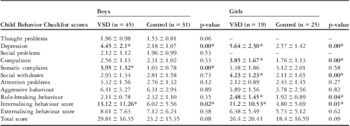
In all, 120 parents of 72 boys and 48 girls, including both patients and controls, completed the Child Behavior Checklist and General Health Questionnaire. Patients with ventricular septal defect and controls did not differ in total Child Behavior Checklist score and externalising behaviour problem scores (Table 3). For patients, behavioural problems were more commonly internalising problems, such as depression and somatic complaints, particularly in boys, with other internalising problems, such as depression, compulsion, and social withdrawal, being common in girls. Internalising behaviour scores were higher for patients than controls.
Comparison of patients with ventricular septal defect undergoing surgery or transcatheter treatment and controls using Child Behavior Checklist score.

Data are mean ± standard deviation
*p < 0.05 compared with controls
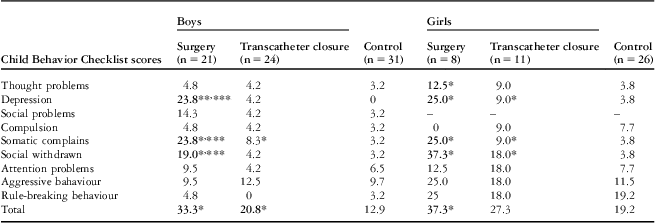
For boys undergoing surgery, the proportion with behavioural problems was higher than in the control group (33.3% versus 12.9%, p < 0.05) and was higher but not significantly than in the transcatheter group (33.3% versus 20.8%, p > 0.05) (Table 4). The proportion with behavioural problems was higher for those undergoing transcatheter closure than controls (20.8% versus 12.9%, p < 0.05). For girls undergoing surgery, the proportion with behavioural problems was higher than in the control group (37.3% versus 19.2%, p < 0.05) and higher but not significantly than in the transcatheter group (37.3% versus 27.3%, p > 0.05) (Table 4).
Percentage of patients with behavioural problems (%).

Data are mean ± standard deviation
*p < 0.05 compared with control
**p < 0.01 compared with control
***p < 0.05 compared with transcatheter closure
Depression, somatic complaints, and social withdrawal symptoms were higher for boys who underwent surgery and transcather closure than controls, and depression and somatic complaints were higher for boys undergoing surgery than transcatheter closure (Table 4). Thought problems, depression, somatic complaints, and social withdrawal symptoms were higher for girls who underwent surgery than controls, and were higher for girls undergoing transcatheter closure than controls. Behavioural problems did not differ by treatment group for girls (Table 4).
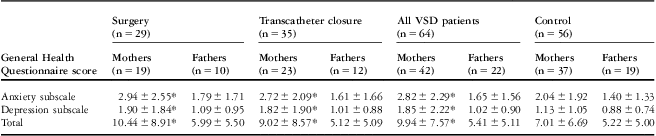
Anxiety and total scores were higher for mothers of ventricular septal defect patients than control mothers (Table 5). Scores did not differ between fathers of ventricular septal defect patients and control fathers. Scores for parents did not differ by treatment type.
General Health Questionnaire score for parents.

VSD = ventricular septal defect
Data are mean ± standard deviation
*p < 0.05 compared with the control parent
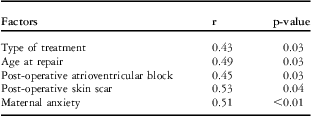
Factors correlated with abnormal behavioural problems included type of treatment, age at defect repair, skin scar, post-operative atrioventricular block, and maternal anxiety (Table 6). The risk factors shown by multiple regression analysis were age at defect repair, skin scar, post-operative atrioventricular block, and maternal anxiety (Table 7).
Pearson correlation of factors associated with abnormal behavioural problems in children with ventricular septal defect.

Risk factors of abnormal behavioural problems in children with ventricular septal defect.

Discussion
Previous studies reported that children with chronic illnesses are likely to have internalising behavioural problems.Reference Fredriksen, Mengshoel, Frydenlund, Sørbye and Thaulow 17 – Reference Gupta, Mitchell, Giuffre and Crawford 20 Hövels-Gürich et alReference Hövels-Gürich, Konrad and Skorzenski 21 used the Child Behavior Checklist to evaluate behavioural problems after corrective cardiac surgery in infants with tetralogy of Fallot or ventricular septal defect: internalising and externalising problems were greater for all patients than healthy children, and externalising problems were greater for patients with tetralogy of Fallot than those with ventricular septal defect. We also found that children aged 6–13 years who underwent surgery or transcatheter closure for ventricular septal defect showed internalising behaviour problems as compared with their best-friend controls according to the Child Behavior Checklist completed by their parents. Hövels-Gürich et alReference Hövels-Gürich, Konrad and Skorzenski 21 found that anxiety and depression were the main internalising problems and aggression was the main externalising problem for patients with tetralogy of Fallot or ventricular septal defect. However, in our study, we found differences between boys and girls in behavioural problems. Behavioural problems such as depression and somatic complaints were greater for boys than controls, and depression, compulsion, social withdrawal, and prohibition were more prevalent for girls than controls. Externalising behavioural problems did not differ between patients and controls.
However, in a prediction study involving adults, Van Rijen et alReference Van Rijen, Utens and Roos-Hesselink 22 found that patients undergoing surgery for ventricular defect showed increased risk of developing externalising problems. One meta-analysis showed that only older children and adolescents with congenital heart disease showed increased risk of developing internalising problems.Reference Karsdorp, Everaerd, Kindt and Mulder 23 The different findings may be due to the age of subjects studied.
For both boys and girls in our study, as compared with controls, surgery and transcatheter groups showed increased occurrence of internalising problems such as depression, somatic complaints, and social withdrawal. A previous study showed that patients who had undergone surgery reported poorer quality of life than those who did not have surgery.Reference Teixeira, Coelho and Proença 24 Surgery commonly results in restrictions in daily life and limitations in physical activity. Patients who undergo surgery may experience pain and discomfort and see themselves as more fragile. Consequently, especially children may feel excluded from social activities and develop some behavioural problems. The subjects enrolled in our study were school-aged children. Although they were still very young when undergoing surgery or transcatheter treatment, the painful experience may still negatively affect their behaviour, especially with increasing age at repair and for those with post-operative atrioventricular conductive block.
We found that biological risk factors of behavioural problems included age at repair, a scar, and post-operative atrioventricular block. Although there was a significant difference for duration of repair procedure and hospitalisation between transcatheter and surgical patients (Table 1), they were not proved to be risk factors. The increase in repair age could contribute to improved treatment results, with less physical complications. However, it may lead to worse psychological outcomes. Post-operative atrioventricular conductive block is the most severe complication with ventricular septal defect treatment. Most patients need to have a pacemaker and more hospitalisation days. All of these will increase the economic and psychological burden on families and have psychological effects.
Post-operative scarring as a result of open-heart surgery is another important risk factor of behavioural problems. One study also showed that the scar judged by the physician as moderately or poorly healed was significantly associated with a higher internalising behaviour score in children and adolescents with congenital heart disease.Reference van Rijen, Utens and Roos-Hesselink 25 Having a scar in itself might be a burden for such patients. Its inevitable presence may be of greater importance than aesthetic considerations. Furthermore, these factors may explain why we found a low occurrence of abnormal behavioural problems in patients undergoing transcatheter closure than surgery. However, considering the high standard deviation (0.71) for this risk factor (post-operative scarring; Table 7), the factor may be conditioned and influenced by other factors.
Similarly, biological risk factors could be modified by environmental factors. Mothers of children with chronic illness show increased risk of psychological distress, particularly anxiety and depression, which could have negative effects on children. In our study, the most significant risk factor for behavioural problems was maternal anxiety (p < 0.01; odds ratio = 4.5; Table 7). In addition, mother's anxiety was greater for ventricular septal defect patients than controls and the most important environmental risk factor related to children's behavioural problems. Stephen et alReference Lawoko and Soares 26 found that 18% of a relatively large number of parents of children with congenital heart disease reported abnormal levels of anxiety. The authors examined differences in distress and hopelessness among parents of children with congenital heart disease, parents of children with other diseases, and parents of healthy children. They also found mothers of all parent groups had higher levels of distress and hopelessness than did fathers, with the highest levels among mothers of children with congenital heart disease. Data on parents who care for chronically ill children, including those with congenital heart disease, indicate that mothers are highly involved in caretaking tasks and that such involvement may lead to emotional strain,Reference Gudermuth 27 – Reference Svavarsdottir and McCubbin 36 and thus mothers would have higher levels of distress and anxiety. Thus, mothers with maladaptive anxiety might be somewhat overly protective of their children, which could hamper the development of children and be responsible for the internalising behaviour problems.Reference Gilliom and Shaw 37 Furthermore, we found that mothers of surgery patients had higher levels of anxiety than did mothers of transcatheter-closure patients, which may explain the increased number of children with abnormal behavioural problems. Interestingly, mothers of our control group showed a higher degree of anxiety than did fathers. We guess this observation may represent a cultural factor because mothers have lower education than fathers in China. All of these data indicate that mothers of children with ventricular septal defect should be educated more in nurturing and discipline of their children, especially in developing countries.
Limitations
The enrolment period was from January, 1999 to December, 2005, and thus our findings are specific to the surgical protocols used at our hospital during this time. Nevertheless, most aspects of these protocols are widely used at many paediatric heart surgery and transcatheter intervention centres. The patients included in this investigation did not differ significantly from other eligible patients who did not participate in terms of anatomic diagnosis, surgical procedures, or age at repair. This study was retrospective, and detailed pre-operative neurological assessment was not available or not easily assessed before surgery. This limitation is common in this type of investigation. Pre-existing differences between surgical and transcatheter closure groups rather than differences in medical management of ventricular septal defect may be responsible for the differences in developmental outcome. Even though treatment type groups were closely matched in socio-demographic characteristics, we cannot exclude that group differences in outcome may reflect unmeasured characteristics that distinguish families who chose device closure over surgery. Ventricular septal defect itself may affect the patients’ behaviour but remains to be proven.
Conclusions
In general, we found that school-aged patients with ventricular septal defect are at risk of internalising behavioural problems, whether undergoing surgery or transcatheter closure for the condition. The risk factors for developing behavioural problems were age at repair, scarring, post-operative atrioventricular block, and maternal anxiety. In particular, maternal anxiety is the most important risk factor.
Acknowledgements
This study was supported by the department of cardiac surgery affiliated to Shandong Provincial Hospital.
Financial Support
This project was supported by a grant from the Health Ministry of Shandong province, People's Republic of China.
Conflicts of Interest
None.