





Anxiety disorders are the most prevalent psychiatric disorders among children (Sacco et al., Reference Sacco, Camilleri, Eberhardt, Umla-Runge and Newbury-Birch2024). Several meta-analyses consistently demonstrated the efficacy of cognitive behavior therapy (CBT); approximately 60% of children recover from their primary anxiety disorder after CBT treatment (e.g., Warwick et al., Reference Warwick, Reardon, Cooper, Murayama, Reynolds, Wilson and Creswell2017) Nevertheless, a sizeable proportion of children do not recover from their anxiety disorder, underlining the need to elucidate why some children fail to recover while others improve.
Child anxiety is closely linked to observed emotions and behavior during parent–child interactions (Van der Giessen & Van Steensel, Reference Van der Giessen, Van Steensel, Martin, Patel and Preedy2023), which is why parents are often included in CBT for child anxiety. The added value of parental involvement in CBT remains unclear, partly due to the heterogeneity in the way and extent to which parents are involved, and because most research has focused on children’s anxiety outcomes rather than potential benefits for parent–child interactions (Byrne et al., Reference Byrne, Cobham, Richardson and Imuta2023; Carnes et al., Reference Carnes, Matthewson and Boer2019; Kreuze et al., Reference Kreuze, Pijnenborg, de Jonge and Nauta2018). Observing changes in parent–child interactions may clarify how CBT exerts its effects (Byrne et al., Reference Byrne, Cobham, Richardson and Imuta2023; Peris et al., Reference Peris, Thamrin and Rozenman2021; Van der Giessen & Van Steensel, Reference Van der Giessen, Van Steensel, Martin, Patel and Preedy2023). Existing studies showing the benefits of CBT on parent–child interactions have primarily relied on parental questionnaires (e.g., Jongerden & Bögels, Reference Jongerden and Bögels2015; Peris et al., Reference Peris, Thamrin and Rozenman2021; Settipani et al., Reference Settipani, O’neil, Podell, Beidas and Kendall2013), with only a handful of observational studies examining actual changes in parent–child interaction patterns after CBT (for an overview see Van der Giessen & Van Steensel, Reference Van der Giessen, Van Steensel, Martin, Patel and Preedy2023). It is therefore still unclear whether and how parent–child interactions change following (successful) CBT for child anxiety. This observational study addressed this gap by examining whether changes in emotional flexibility and expressivity of parent–child dyads during interactions were associated with treatment success, and whether these associations varied by CBT modality (child versus family) and parents’ gender.
Emotion communication during parent–child interactions with anxious children
Emotion communication is a broad concept referring to how parents and children express, encourage, regulate, shift, socialize, and discuss emotions (Morris et al., Reference Morris, Silk, Steinberg, Myers and Robinson2007). Through parent–child interactions, children learn to appropriately recognize, understand, express, and manage emotions, which may lower their risk for anxiety (Brumariu & Kerns, Reference Brumariu and Kerns2015; Suveg et al., Reference Suveg, Morelen, Brewer and Thomassin2010). When parents socialize maladaptive emotion regulation during interactions, for instance, discouraging negative emotions, suppressing positive emotions, or promoting avoidance, children might not learn to adequately deal with emotions during interactions, which may increase or intensify their anxiety (Suveg et al., Reference Suveg, Morelen, Brewer and Thomassin2010; Van der Giessen & Van Steensel, Reference Van der Giessen, Van Steensel, Martin, Patel and Preedy2023). In turn, anxious children also contribute to the interaction, as they evoke, reinforce, and shape parental emotion socialization practices, resulting in anxiogenic interaction cycles between parents and children (Brumariu & Kerns, Reference Brumariu and Kerns2015; Emerson et al., Reference Emerson, Ogielda and Rowse2019). Considering these temporal and dynamic linkages between the emotions of parents and anxious children, CBT success for child anxiety might be related to accompanying changes in how parents and children emotionally respond to one another over time during these interactions (Peris et al., Reference Peris, Thamrin and Rozenman2021; Silverman et al., Reference Silverman, Marin, Rey, Jaccard and Pettit2021; Van der Giessen & Van Steensel, Reference Van der Giessen, Van Steensel, Martin, Patel and Preedy2023).
Observational studies demonstrate that parent–child dyads with anxious children show difficulties in expressing positive and negative emotions, and parents struggle to support emotions during interactions compared to dyads without child anxiety (e.g., Brumariu & Kerns, Reference Brumariu and Kerns2015; Hurrell et al., Reference Hurrell, Houwing and Hudson2017; Russell et al., Reference Russell, Bird and Herbert2024; Suveg et al., Reference Suveg, Sood, Barmish, Tiwari, Hudson and Kendall2008). Treatment studies using observational data have reported post-CBT changes in parental emotion communication, including increases in maternal encouragement of bravery (Silk et al., Reference Silk, Sheeber, Tan, Ladouceur, Forbes, McMakin, Dahl, Siegle, Kendall, Mannarino and Ryan2013), decreases in parental rejection (Van der Giessen et al., Reference Van der Giessen, Colonnesi and Bögels2019), and both increases (Hiller et al., Reference Hiller, Apetroaia, Clarke, Hughes, Orchard, Parkinson and Creswell2016) as well as decreases (Wood et al., Reference Wood, McLeod, Piacentini and Sigman2009) in parental intrusiveness, as well as decreases in emotional overinvolvement (Gar & Hudson, Reference Gar and Hudson2009). However, these changes were inconsistently related to child anxiety improvement, and the degree of parental involvement in CBT varied across these studies. Importantly, all of these studies focused exclusively on how parents express emotions and behave during interactions, leaving parent–child dyadic changes in emotion communication largely unexplored. Since parent–child emotion communication during interactions is a dyadic and dynamic process (Butler, Reference Butler2015; Ferrar et al., Reference Ferrar, Stack, Dickson and Serbin2020; Sokolovic et al., Reference Sokolovic, Plamondon, Rodrigues, Borairi, Perlman and Jenkins2021), capturing the temporal dynamics of dyadic emotional exchanges during parent–child interactions is crucial for understanding post-CBT changes in parent–child dyads with anxious children.
Emotional flexibility in parent–child interactions with anxious children
An approach that emphasizes time-based dyadic emotional exchanges that emerge and fade over the course of an interaction is the dynamic systems (DS) approach to emotions (Butler, Reference Butler2015; Granic, Reference Granic2005; Lunkenheimer et al., Reference Lunkenheimer, Hamby, Lobo, Cole and Olson2020). According to this framework, emotional flexibility, also known as socio-affective or dyadic affective flexibility, is crucial for healthy emotional functioning. Emotional flexibility refers to the ability of parent–child dyads to shift in and out of a wide range of dyadic emotions from moment to moment during interactions according to situational demands (Grumi et al., Reference Grumi, Pettenati, Manfredini and Provenzi2022; Hollenstein et al., Reference Hollenstein, Lichtwarck-Aschoff and Potworowski2013; McKone & Silk, Reference McKone and Silk2022). All emotional states, including negative emotions, are adaptive in at least some contexts, and are therefore important for dyad members to (learn to) flexibly express and regulate (Hollenstein et al., Reference Hollenstein, Lichtwarck-Aschoff and Potworowski2013; Lougheed & Hollenstein, Reference Lougheed and Hollenstein2016).
Dyads with high emotional flexibility are thought to be able to adjust their emotional responses to the demands of the interaction (Grumi et al., Reference Grumi, Pettenati, Manfredini and Provenzi2022; Hollenstein et al., Reference Hollenstein, Lichtwarck-Aschoff and Potworowski2013; McKone & Silk, Reference McKone and Silk2022). For instance, expressing anger during a conflict may be necessary to communicate your point of view and frustration, but resolving the conflict requires switching to positive emotions, thereby managing emotions effectively. In contrast, dyads who continuously make jokes during conflicts, who do not at all express how they feel, or who cannot let go of their anger, seem unable to adapt their emotional responses to the demands of conflict interactions. These parent–child dyads with low emotional flexibility become trapped in rigid and highly absorbing patterns, struggle to flexibly express and recover from emotions, and show poor emotional control. As such, research suggests that the ability of dyads to flexibly express, transition between, and recover from emotions (i.e., emotional flexibility) is more important for well-being than the sheer amount of positive or negative emotions (i.e., emotional expressivity) (Granic, Reference Granic2005; Lougheed & Hollenstein, Reference Lougheed and Hollenstein2016; McKone & Silk, Reference McKone and Silk2022). Parent–child dyads with clinically anxious children likely display low emotional flexibility, as these dyads often experience intense negative emotions, have a limited and stereotyped emotional repertoire, and engage in less emotional exploration (Brumariu & Kerns, Reference Brumariu and Kerns2015; Russell et al., Reference Russell, Bird and Herbert2024).
Lower emotional flexibility of parent–child dyads has been associated with more emotional problems in children, particularly with clinical anxiety (e.g., Grumi et al., Reference Grumi, Pettenati, Manfredini and Provenzi2022; McKone & Silk, Reference McKone and Silk2022). In a community sample, less emotional flexibility of mother–child dyads during conflict interactions in early adolescence predicted more anxiety symptoms in adolescents five years later, controlling for initial symptom levels (Van der Giessen et al., Reference Van der Giessen, Hollenstein, Hale, Koot, Meeus and Branje2015). More emotional rigidity of parent–child dyads has also been concurrently, not longitudinally, related to more internalizing problems in high-risk children in kindergarten (Hollenstein et al., Reference Hollenstein, Granic, Stoolmiller and Snyder2004). Also, parent–child dyads with clinically anxious children showed less emotional flexibility by displaying a narrower emotional repertoire, fewer switches between emotions, and emotional states for longer periods compared to dyads with non-anxious children (Van der Giessen & Bögels, Reference Van der Giessen and Bögels2018). However, in an adolescent community sample, higher levels of internalizing symptoms were associated with greater dyadic emotional flexibility both concurrently and six months later, which may be due to subclinical and moderate levels of internalizing problems (Mancini & Luebbe, Reference Mancini and Luebbe2021). In most studies (Hollenstein et al., Reference Hollenstein, Granic, Stoolmiller and Snyder2004; Van der Giessen et al., Reference Van der Giessen, Hollenstein, Hale, Koot, Meeus and Branje2015; Van der Giessen & Bögels, Reference Van der Giessen and Bögels2018), emotional flexibility, rather than overall emotional expressivity, appears strongly related to children’s anxiety, highlighting the value of fine-grained, dynamic, and time-sensitive measures of parent–child interactions in understanding and treating child anxiety.
Changes in emotional flexibility of parent–child dyads following CBT
Although evidence on changes in dyadic emotional flexibility (and even emotional expressivity) following treatment for children’s anxiety is limited, studies on CBT for children’s externalizing problems show that treatment success is linked to dyadic emotional flexibility. Specifically, decreases in emotional flexibility of parent–child dyads following PMT/CBT treatment were associated with less improvement in children’s aggressive behavior (Granic et al., Reference Granic, O’Hara, Pepler and Lewis2007), while more fluctuating, recurring patterns of dyadic emotions were associated with greater reductions in children’s aggressive behavior (Lichtwarck-Aschoff et al., Reference Lichtwarck-Aschoff, Hasselman, Cox and Pepler2012). These studies showed that mean levels of dyadic positive or negative affect (emotional expressivity) were not related to changes in children’s externalizing behavior after treatment. Perhaps dyads that benefit from treatment may still engage in negative emotional expressions during interactions. Yet, the ability of dyads to shift in and out of these emotions (emotional flexibility) during parent–child interactions might be more strongly associated with successful treatment than the amount of emotional expressivity.
Applied to child anxiety interventions, successful treatment may particularly improve dyads’ ability to shift out of and repair problematic emotional states. Anxious children often struggle with handling positive and negative emotions, while parents, perceiving them as highly vulnerable, tend to discourage, avoid, or inadequately support effective emotion expression and regulation (Brumariu & Kerns, Reference Brumariu and Kerns2015; Russell et al., Reference Russell, Bird and Herbert2024). Consequently, these parent–child dyads often express a small and highly stable repertoire of emotions extending beyond anxiety-provoking situations (Van der Giessen & Bögels, Reference Van der Giessen and Bögels2018). After successful CBT, both children and parents likely learned to express and regulate a broader range of positive and negative emotions in more adaptive ways, even if emotion regulation is not directly targeted in treatment (Helland et al., Reference Helland, Baardstu, Kjøbli, Aalberg and Neumer2023; Peris et al., Reference Peris, Thamrin and Rozenman2021), resulting in greater dyadic emotional flexibility (e.g., Granic et al., Reference Granic, O’Hara, Pepler and Lewis2007; Van der Giessen & Bögels, Reference Van der Giessen and Bögels2018). This study, therefore, examined changes in emotional flexibility, as well as emotional expressivity, of parent–child dyads during interactions after CBT for child anxiety, and their relation to treatment success.
Child versus family CBT
There is ongoing debate and empirical inconsistency about whether and how the inclusion of family members in CBT (family CBT) enhances its effectiveness in reducing child anxiety compared to child CBT (Byrne et al., Reference Byrne, Cobham, Richardson and Imuta2023). Although some studies suggest that child-focused CBT may be more effective (James et al., Reference James, Reardon, Soler, James and Creswell2020), the majority of meta-analyses and reviews showed no differences between family CBT and child CBT (Byrne et al., Reference Byrne, Cobham, Richardson and Imuta2023; Carnes et al., Reference Carnes, Matthewson and Boer2019; In-Albon & Schneider, Reference In-Albon and Schneider2006; Thulin et al., Reference Thulin, Svirsky, Serlachius, Andersson and Öst2014), and overall, there is no clear evidence that involving parents improves treatment outcomes for child anxiety disorders. However, most studies comparing these treatment modalities have focused on changes in child anxiety and parental behavior after treatment (Peris et al., Reference Peris, Thamrin and Rozenman2021; Van der Giessen & Van Steensel, Reference Van der Giessen, Van Steensel, Martin, Patel and Preedy2023), rather than on whether improvements in parent–child emotional flexibility and expressivity depend on family involvement. Since family CBT targets dysfunctional and rigid communication patterns of families that maintain child anxiety, successful family CBT might lead to greater improvements in the emotional flexibility and expressivity of parent–child dyads during real-life interactions than child CBT (Van der Giessen & Bögels, Reference Van der Giessen and Bögels2018). This study, therefore, investigated whether changes in emotional flexibility and expressivity of parent–child dyads during interactions differed between child and family CBT, and how these changes related to treatment success.
Father–child versus mother–child dyads
Women generally tend to be more emotionally expressive than men during interactions (Aznar & Tenenbaum, Reference Aznar and Tenenbaum2020; Fivush et al., Reference Fivush, Marin, McWilliams and Bohanek2009), and fathers interacting with anxious children show more verbal and physical activating behaviors than mothers (e.g., Möller et al., Reference Möller, Nikolić, Majdandžić and Bögels2016). Only a few observational studies compared emotional flexibility and expressivity between mother–child and father–child dyads, yielding inconsistent results. Regarding expressivity, father–child dyads generally display less positive and negative affect during interactions than mother–child dyads (Lunkenheimer et al., Reference Lunkenheimer, Olson, Hollenstein, Sameroff and Winter2011; Van der Giessen & Bögels, Reference Van der Giessen and Bögels2018). Regarding flexibility, while one study found greater flexibility in father–infant dyads during playful interactions than mother-infant dyads (Cerezo et al., Reference Cerezo, Sierra-García, Pons-Salvador and Trenado2017), another study observed during conflicts that both father–child and mother–child dyads (8-18 years) displayed reduced emotional flexibility in the presence of child AD, with further reductions observed only in mother–child dyads when mothers also had an AD (Van der Giessen & Bögels, Reference Van der Giessen and Bögels2018). Adding to the complexity, during a challenging task, emotional flexibility in mother–child dyads at age 3 predicted poorer child externalizing outcomes, whereas flexibility in father–child dyads at age 3 predicted better child outcomes at age 5. However, the combination of greater dyadic flexibility and more positive affect was over time associated with less child externalizing behavior for both father–child and mother–child dyads (Lunkenheimer et al., Reference Lunkenheimer, Olson, Hollenstein, Sameroff and Winter2011).
Overall, results across observational studies with varying age ranges and tasks are inconsistent regarding parental gender effects on emotional flexibility and expressivity. There is also a lack of understanding about parental gender differences in dyadic flexibility and expressivity following CBT for child anxiety. Mother–child dyads may generally show higher but increasing levels of emotional flexibility and expressivity, whereas father–child dyads might display more pronounced post-treatment gains due to potentially having more room for improvement. Alternatively, both father–child and mother–child dyads might show improvements in emotional flexibility as children recover, since more emotional flexibility is considered a hallmark of well-being and signifies evolving interaction patterns. The current study explored whether changes in emotional flexibility and expressivity following CBT treatment for child anxiety differed between father–child and mother–child dyads, and whether this was related to treatment success.
The current study
This observational study examined whether (1) changes in emotional flexibility and expressivity of parent–child dyads were associated with children’s treatment success, and (2) whether treatment modality (child versus family CBT) and parent gender (mother–child versus father–child dyads) affected changes in emotional flexibility and expressivity after CBT. Regarding our first aim, we expected that parent–child dyads with children who recovered from their anxiety disorders after CBT would demonstrate improvements in emotional flexibility compared to parent–child dyads with children who did not recover from their anxiety disorders after CBT (Granic et al., Reference Granic, O’Hara, Pepler and Lewis2007; Grumi et al., Reference Grumi, Pettenati, Manfredini and Provenzi2022; Van der Giessen & Bögels, Reference Van der Giessen and Bögels2018). We also hypothesized that changes in parent–child emotional expressivity would be present following CBT, yet less pronounced and less strongly associated with children’s anxiety recovery (Granic et al., Reference Granic, O’Hara, Pepler and Lewis2007; Grumi et al., Reference Grumi, Pettenati, Manfredini and Provenzi2022; Van der Giessen et al., Reference Van der Giessen, Colonnesi and Bögels2019). Regarding our second aim, we hypothesized that compared to child CBT, family CBT would be associated with greater gains in emotional flexibility, rather than expressivity, within parent–child dyads of children who recovered from treatment, compared to those who did not (Van der Giessen & Van Steensel, Reference Van der Giessen, Van Steensel, Martin, Patel and Preedy2023). Given the scarcity of research on parental gender differences, we explored whether changes in emotional flexibility and emotional expressivity differed between mother–child and father–child dyads, and whether this was related to treatment success.
Method
Participants and procedure
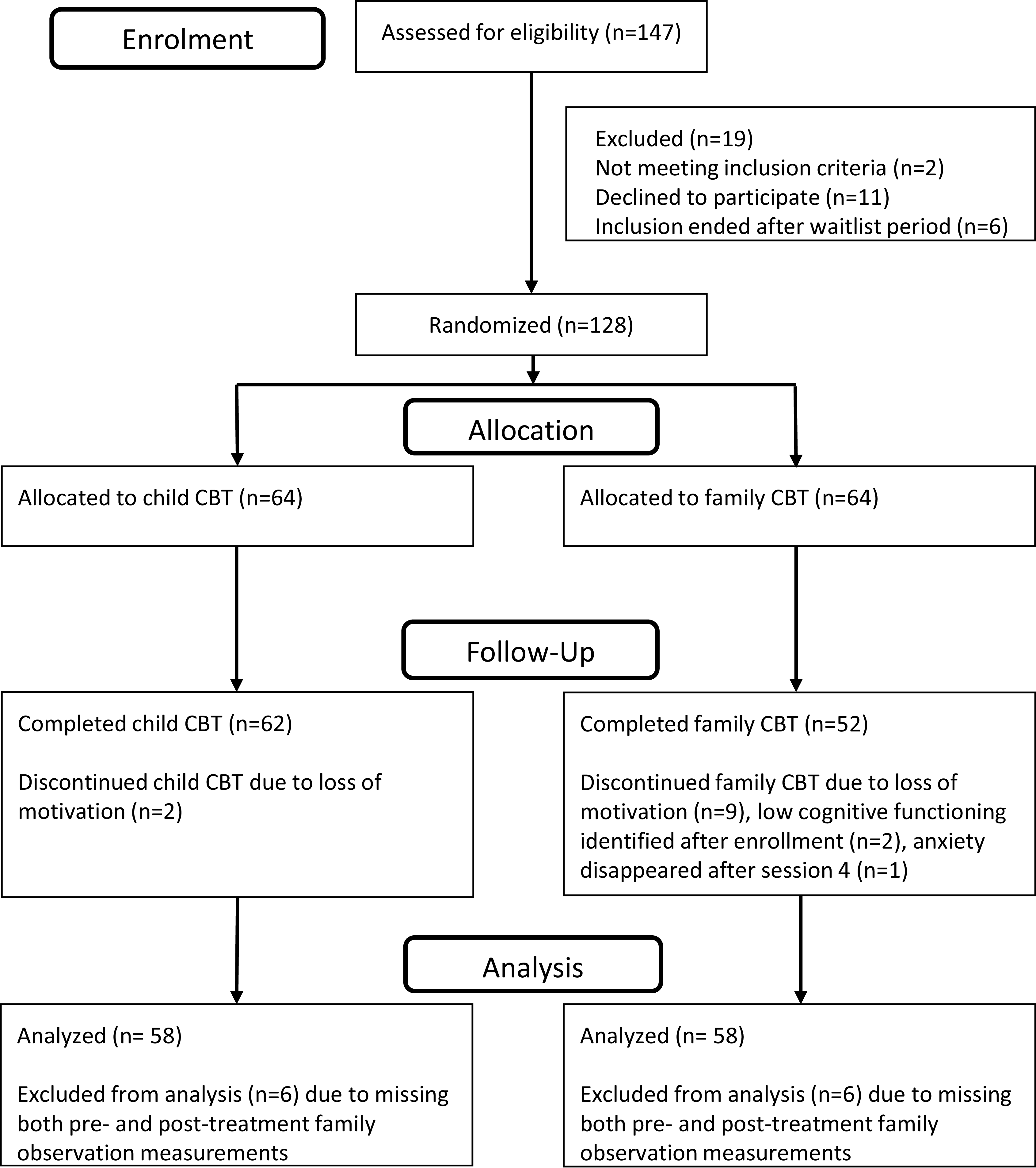
Children (n = 128) and their families participated in a randomized controlled trial (RCT) in which the (cost-)efficacy of child CBT (n = 64) versus family CBT (n = 64) was studied (Bodden, Bögels, Nauta, et al., Reference Bodden, Bögels, Nauta, De Haan, Ringrose, Appelboom, Brinkman and Appelboom-Geerts2008; Bodden, Dirksen, Bögels, et al., Reference Bodden, Dirksen and Bögels2008). The current study is a secondary analysis of an existing dataset and involved the recoding and reanalyzing of observational data of children and parents from a published effectiveness trial (Bodden, Bögels, Nauta, et al., Reference Bodden, Bögels, Nauta, De Haan, Ringrose, Appelboom, Brinkman and Appelboom-Geerts2008). Every effort was made to have both mother and father participate in the observations with their child. Observational data were available for 116 families (90.6%). There were 102 (87.9%) families in which both father and mother participated in the interaction tasks with their child, 12 (10.3%) families in which only the mother participated, and two (1.7%) families in which only the father participated. See the supplementary materials for the characteristics of children and parents of the 116 families at pre-treatment. No differences were found at pre-treatment between children and their families who were randomized to child CBT (n = 58) versus family CBT (n = 58) for children’s age, gender, and school level, and for parental age, marital status, educational level, and ethnic background, indicating that randomization succeeded. Figure 1 presents a CONSORT diagram of participant flow through the study.
CONSORT 2025 flow diagram of randomization and dropout rates.

The Medical Ethical Committee of Maastricht University approved this study. Inclusion criteria were: children (a) were between the ages of 8 to 18, (b) were diagnosed with a primary anxiety disorder (excluding obsessive–compulsive disorder or post-traumatic stress disorder, conform DSM-5), (c) demonstrated adequate cognitive functioning, as estimated by clinicians based on school performance, and (d) had at least one biological or step-parent who was willing to participate. Children were excluded when they (a) suffered from substance abuse, (b) attempted suicide recently, (c) had an untreated attention deficit hyperactivity disorder, pervasive developmental disorders, or psychosis, (d) used anxiety-reducing medication, unless they kept a constant dosage during treatment (n = 3) or ended the medication use before the start of treatment. At intake, all parents and adolescents signed informed consent. Research assistants who were blind to the treatment condition collected all the data for the study. Parent–child observations were conducted at pre-treatment and post-treatment. Questionnaires and diagnostic interviews were administered at pre-treatment, post-treatment, three-month follow-up, and one-year follow-up. For a detailed description of the randomization procedure, training of the research assistants and therapists, assessment, treatment integrity, and overall effects of the two treatment conditions, see (Bodden, Bögels, Nauta, et al., Reference Bodden, Bögels, Nauta, De Haan, Ringrose, Appelboom, Brinkman and Appelboom-Geerts2008).
Treatment: CBT
Child CBT and family CBT both consisted of 13 sessions (60–90 min), which were highly structured and manual-based, focusing on traditional CBT components such as psychoeducation, cognitive restructuring, exposure, and relapse prevention (Bodden, Bögels, Nauta, et al., Reference Bodden, Bögels, Nauta, De Haan, Ringrose, Appelboom, Brinkman and Appelboom-Geerts2008; Bögels & Siqueland, Reference Bögels and Siqueland2006). The child-focused CBT component was identical across both conditions: children received the same workbook and an equivalent number of sessions (13 sessions). In child CBT, the therapist guided the child through all treatment components, while parents were involved as little as possible (max 2.5 hours). Parents only received information about the treatment rationale (start therapy); they were involved in designing a fear hierarchy and reward system (session 4), and they were involved when discussing the results of treatment (last session). In family CBT, parents or the whole family were included in the sessions, with therapist time distributed across the child, parents, and siblings (children 13.5 hours, parents 18 hours, and siblings 4.5 hours). Family CBT was delivered in three phases. First, children and parents were taught CBT skills to reduce their anxiety. Second, dysfunctional parental beliefs about parenting and the child were targeted. Third, problematic family interactions were addressed by encouraging communication and problem-solving. Throughout family CBT, parents had an active role in guiding the child through treatment by engaging in contingency management and transfer of control (e.g., helping with exposures, through courageous modeling, and giving rewards), and fostering the child’s autonomy
Measures
Treatment non-response
Pre- and post-treatment, children’s anxiety disorders were assessed with the child and parent Dutch version of the Anxiety Disorders Interview Schedule for Children (ADIS-C/P, Brown et al., Reference Brown, Di Nardo, Lehman and Campbell2001; Siebelink & Treffers, Reference Siebelink and Treffers2001). Children and parents were interviewed separately and were asked to rate each diagnosis on a severity scale ranging from zero to eight (≥ four warrants a diagnosis). Interrater agreements on primary and comorbid anxiety diagnosis were high (Bodden, Bögels, Nauta, et al., Reference Bodden, Bögels, Nauta, De Haan, Ringrose, Appelboom, Brinkman and Appelboom-Geerts2008). According to ADIS instructions, child and parent reports were combined to determine diagnosis.
The use of diagnostic recovery as an index of treatment success and non-response is common in childhood anxiety intervention research and aligns with established guidelines and standard practice in RCTs (Creswell et al., Reference Creswell, Nauta, Hudson, March, Reardon, Arendt, Bodden, Cobham, Donovan, Halldorsson, In-Albon, Ishikawa, Johnsen, Jolstedt, de Jong, Kreuze, Mobach, Rapee, Spence and Kendall2021; Warwick et al., Reference Warwick, Reardon, Cooper, Murayama, Reynolds, Wilson and Creswell2017). Successful treatment outcome for children was defined as no longer meeting criteria for any anxiety disorder (primary and comorbid) post-treatment (n childCBT = 33, 56.9%; n familyCBT = 16, 27.6%). These children are further referred to as “treatment responders.” Children who still met criteria for one or more anxiety disorders at post-treatment are referred to as “treatment non-responders.” For children’s primary anxiety disorder specifically, recovery was 61% for family-CBT and 73% for child-CBT (Bodden, Bögels, Nauta, et al., Reference Bodden, Bögels, Nauta, De Haan, Ringrose, Appelboom, Brinkman and Appelboom-Geerts2008). The results of the analyses, when the presence or absence of the primary anxiety disorder was used as a measure of treatment non-response (TNR), and the percentage of primary and comorbid anxiety disorders, are provided in the supplementary materials.
Parent–child interaction task
For reporting, we used the Systematic Coding of Observed human Behaviour guidelines (SCOBe, Hillen et al., Reference Hillen, Hoeben, Kok, McHale, Sexton, van der Asdonk, van de Bongardt, Bowman, Brown, Branje, Chorney, Donker, Ejbye-Ernst, Geeraerts, Van der Giessen, Humphris, Larsen, Philpot, Portell and Yuan2025). Pre- and post-treatment, all children participated in two 5-minute conflict interactions (M = 5.85 minutes, SD = 1.65), separately and in random order with their father and mother. Interaction duration varied due to practical factors such as unfinished conversations, experimenter time management, or families finishing early. No differences were found in average conflict duration between mother–child and father–child dyads, nor between treatment conditions. The conflict topic was determined with The Issue Checklist (Robin & Weiss, Reference Robin and Weiss1980), which assessed how often 44 issues, such as cleaning up, were discussed during the last two weeks, and how calm or angry the discussion was. Issues with the highest frequency and intensity ratings (average of dyad members’ ratings) were selected.
Father–child and mother–child interactions were coded by different coders using the Simple Affect Coding system (SACS, Connell et al., Reference Connell, McKillop, Patton, Klostermann and Hughes-Scalise2015; Jabson et al., Reference Jabson, Venkatraman and Dishion2003). The SACS identifies the emotions expressed during interactions through a combination of voice tone, facial expression, and physical cues. Five mutually exclusive affect codes were used: positive affect, validation, anger/disgust, distress, and neutral. These codes were recorded continuously in real-time for each dyad member (i.e., parent and child) independently using The Observer XT 14 (Noldus). Coders were trained intensively over three months to achieve a minimum inter-observer criterion of 75% agreement and 0.65 kappa. At each measurement, 20% of videotapes were double-coded independently; coders were blind to treatment conditions and interrater assessments. Using an event-unit-based comparison with a 3s tolerance window (Bakeman et al., Reference Bakeman, Quera and Gnisci2009), the average inter-observer agreement was (1) for father–child interactions, 81.71% (0.76 kappa) before treatment and 74.29% (0.68 kappa) after treatment, and (2) for mother–child interactions, 80.13 % (0.75 kappa) before treatment and 75.38% (0.71 kappa) after treatment.
Emotional flexibility
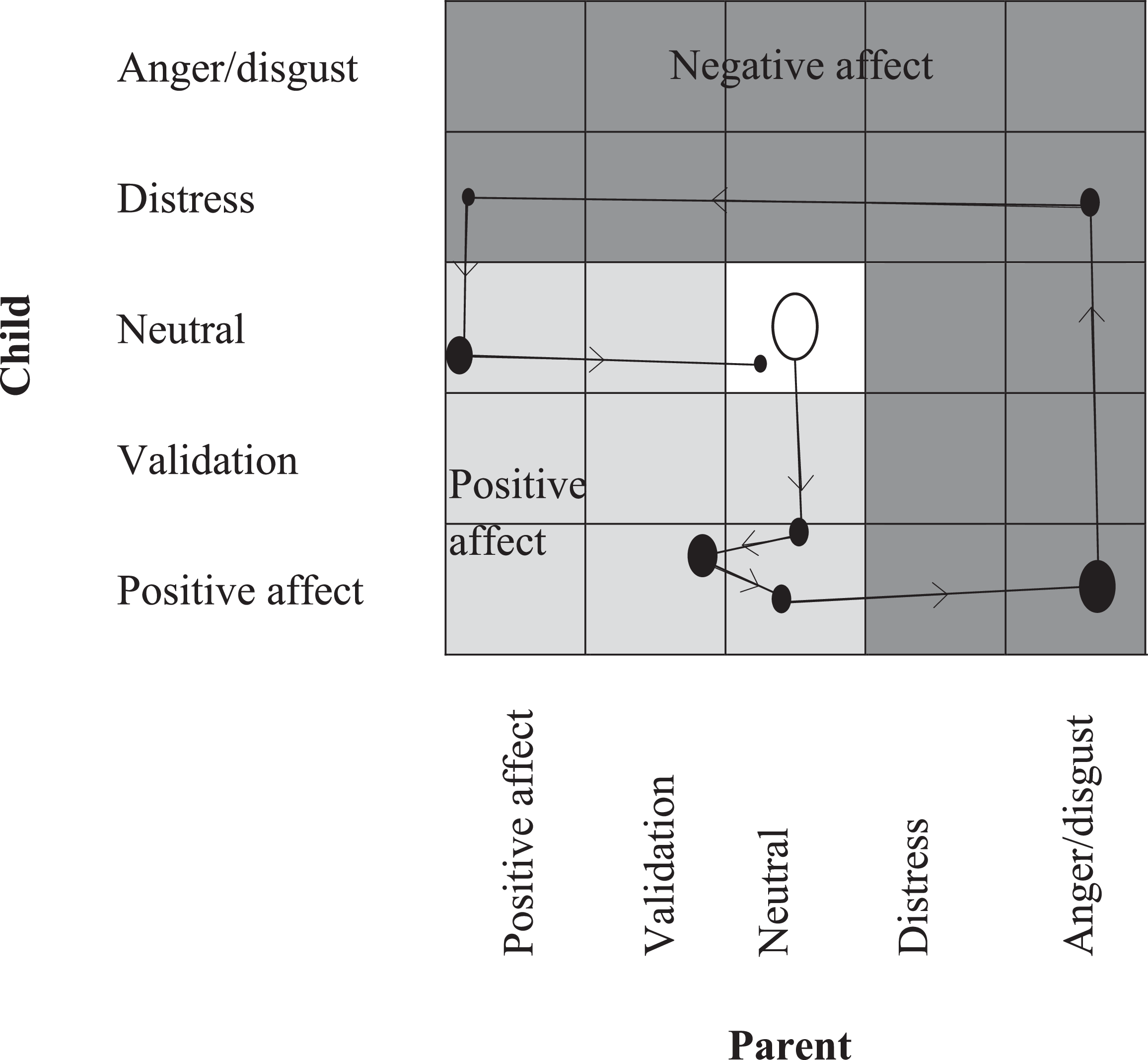
To capture dyadic emotional flexibility, the SACS affect codes were plotted on state space grids (SSGs) in GridWare 1.1 (Lamey et al., Reference Lamey, Hollenstein, Lewis and Granic2004), separately for father–child dyads and mother–child dyads at pre- and post-treatment (Figure 2). A grid represents all possible emotional combinations of a dyad, and each cell on the grid represents a potential emotional state of the dyad. Parents’ coded emotions were plotted on the x-axis, and children’s emotions were plotted on the y-axis. When an emotion changed (of either parent, child, or both), a new point was plotted on the grid and a line was drawn connecting it to the previous point. A trajectory was plotted through the successive points on the grid in the same order as the emotions proceeded in real-time. A grid represents a sequence of dyadic emotions.
An example of a state space grid depicting a sequence of emotions of a parent-child dyad. The size of the circles is proportional to the duration of time each emotion is expressed, and the arrows reflect the changes between emotions. The light gray area on the grid is the positive affect region, the dark gray area on the grid is the negative affect region. The white area on the grid is the mutual neutral region. Separate grids were created for mother-child and father-child dyads.

Three distinct, widely used, theory-driven indices of dyadic emotional flexibility, which have been shown to exhibit good reliability as well as predictive and discriminant validity (Grumi et al., Reference Grumi, Pettenati, Manfredini and Provenzi2022; Mancini & Luebbe, Reference Mancini and Luebbe2021) were derived from GridWare 1.1. First, transitions (emotional switching) assessed the number of dyadic changes per minute between cells on the state space grid, and were corrected for differences in total interaction duration. Higher transition values indicated more frequent changes between dyadic emotional states. Second, dispersion (emotional repertoire) assessed the spread of dyadic emotional states. Dispersion ranges from one to zero, with values close to one indicating that behavior was equally distributed across cells and values of zero indicating that behavior was only in one cell. Higher dispersion values indicated a broader dyadic emotional repertoire. Third, average duration (emotional rigidity) assessed the mean duration of each dyadic emotion that was expressed. Higher average duration values indicated more emotional rigidity of dyads as they tended to remain in dyadic emotions for longer periods. Importantly, higher values of transitions and dispersion indicate more dyadic emotional flexibility, while higher values of average duration indicate less dyadic emotional flexibility. Correlations between the three flexibility measures were significant, in the expected direction, and of moderate to high strength (supplementary materials).
Emotional expressivity
Two commonly employed observational measures (Grumi et al., Reference Grumi, Pettenati, Manfredini and Provenzi2022) of dyadic emotional expressivity (duration of positive and negative affect) were also derived from GridWare 1.1 (Lamey et al., Reference Lamey, Hollenstein, Lewis and Granic2004) for each father–child and mother–child dyad at pre-treatment and post-treatment. Grids were divided into two distinct regions (see Figure 2); positive affect included the SACS codes positive affect and validation of at least one dyad member, and negative affect included the SACS codes distress and anger/disgust of at least one dyad member. Regions were not limited to mutual emotions since parents and children rarely express the same emotions at the same moment in time. Expressivity measures were adjusted for total interaction duration to ensure comparability across flexibility and expressivity measures, consistent with previous research (Van der Giessen et al., Reference Van der Giessen, Hollenstein, Hale, Koot, Meeus and Branje2015). To correct for these duration differences, the two measures of dyadic expressivity represented, respectively, the percentage of dyadic positive affect and negative affect as a function of the total duration of the interaction. Higher scores indicated that dyads showed more positive or negative affect, thus more dyadic positive or negative emotional expressivity, during interactions.
Data preparation and analyses
All measures were checked for extreme univariate outliers (z > |3.29|), which were truncated to the nearest non-outlying value (Tabachnick & Fidell, Reference Tabachnick and Fidell2019). Residuals of all measures showed adequate normality (skewness & kurtosis <|2|). Of the 116 families, 12 (10.3%) dropped out of treatment, all from the family CBT condition. Chi-square and t-test analyses revealed no pre-treatment sociodemographic differences between completers and dropouts, except that mothers in dropout families were more often unemployed (χ2(1) = 4.93, p = .026), and parents were more often separated (χ2(1) = 5.46, p = .020) than in completer families. Analyses with and without dropouts yielded similar results; therefore, data were analyzed according to an intent-to-treat principle using full information maximum likelihood.
Observational data were partially missing for 45 families due to recording errors (e.g., recordings not being made or saved correctly, technical issues, or equipment not being turned on) or nonparticipation in an assessment (e.g., family members unable to attend the scheduled videotaping session). Little’s MCAR test indicated that the observational data can be considered missing completely at random (χ2(143) = 146.66, p = .400). In addition, chi-square analyses showed that missingness did not differ between mother–child and father–child interactions, treatment conditions, or pretest and posttest for mother–child interactions. However, for father–child interactions, missingness was significantly higher at posttest than at pretest, χ2(1) = 12.34, p < .001. The multilevel modeling approach allowed inclusion of all available data, even when pre-treatment or post-treatment observational data of father–child or mother–child dyads were missing.
Multi-level regression analyses in SPSS 24 examined whether changes in emotional flexibility and expressivity differed between treatment responders and non-responders. A three-level structure was used, with assessments (pre- and post-treatment) nested within respondents (child-mother and child-father dyads), and respondents nested within families. A figure illustrating the multilevel model structure and the SPSS syntax for the multilevel regression analyses is provided in the supplementary materials.
To examine (1) whether changes in emotional flexibility and expressivity over time differed between treatment responders and treatment non-responders, we used emotional flexibility (i.e., dispersion, transitions, and average duration) and emotional expressivity (i.e., positive affect and negative affect) as the dependent variables, and entered measurement occasion (0 = pre-treatment and 1 = post-treatment) and TNR (i.e., 0 = not meeting criteria for anxiety disorders, i.e., treatment responder; 1 = still meeting criteria for at least one anxiety disorder, i.e., treatment non-responder) as predictors, and interaction effects between predictors. Models were run separately for each measure of emotional flexibility and expressivity. To examine (2) whether treatment modality (i.e., child versus family CBT) affected changes in emotional flexibility and expressivity, we added treatment modality (0 = child CBT; 1 = family CBT), and its interactions to the same models (of the first aim). To examine whether parental gender (father–child versus mother–child dyads) affected changes in emotional flexibility and expressivity we added parent’s gender (0 = mother–child; 1 = father–child) and its interactions to the models (of the first aim). All significant two-way and three-way interactions identified in the multilevel models were examined using post hoc analyses to clarify the direction and nature of the effects. To facilitate interpretation, figures were generated for significant interactions. Post-hoc power analyses in Gpower 3.1.9.7 indicated that the study was sufficiently powered to detect medium to large effects in two- and three-way interactions (f = 0.25–0.40), but had limited power to detect small effects (f = 0.10). All variables were standardized, allowing parameter estimates (β) to be interpreted as effect sizes (Nieminen et al., Reference Nieminen, Lehtiniemi, Vähäkangas, Huusko and Rautio2013); for dichotomous predictors, β corresponds to Cohen’s d (.3 = small, .5 = medium, .8 = large (Cohen, Reference Cohen1992).
Results
Main analyses
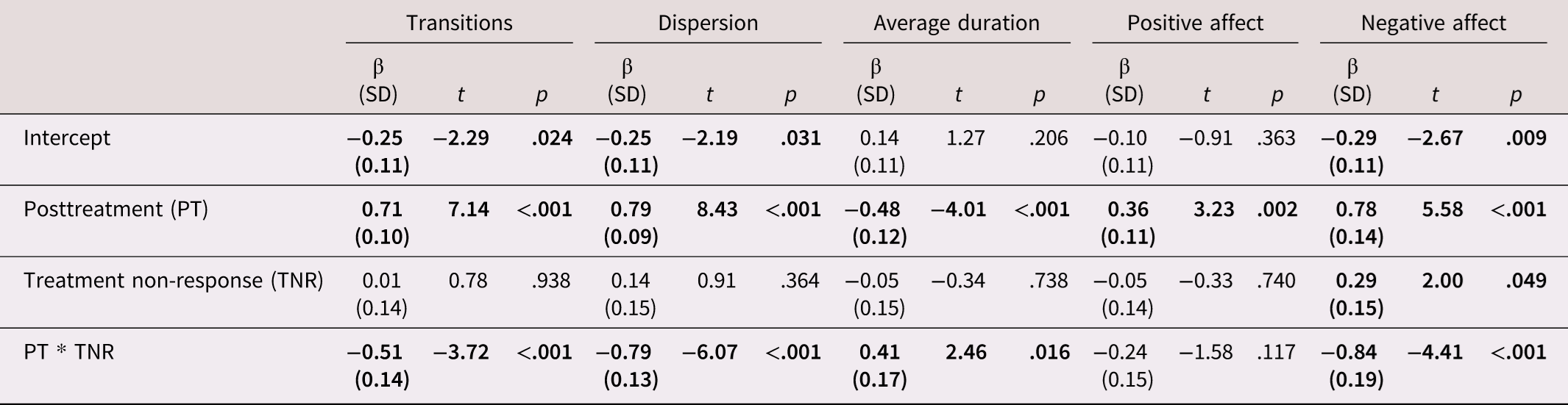
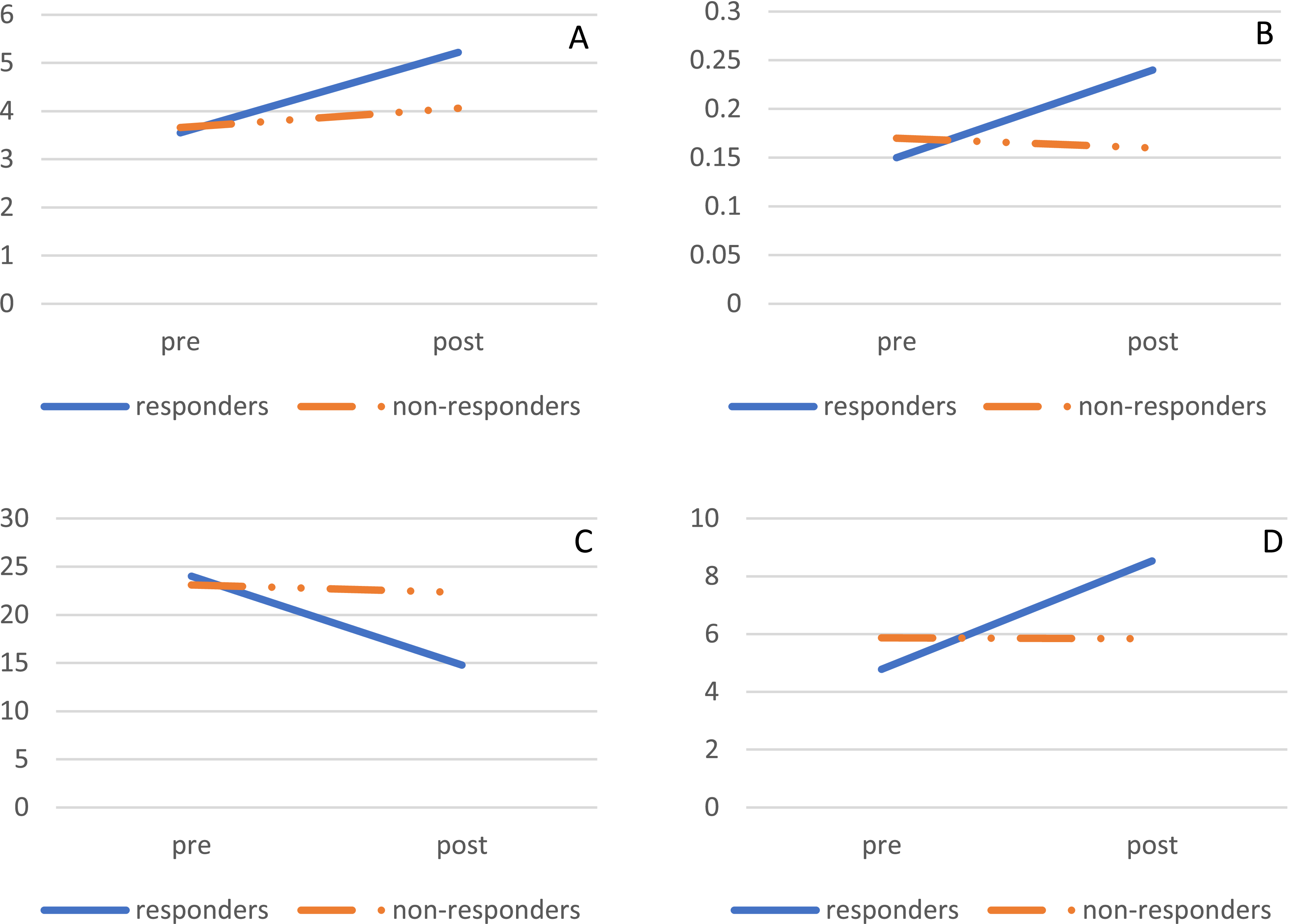
Table 1 shows means and standard deviations. Table 2 presents multilevel regression results. Significant main effects of measurement occasion were found for all three dyadic measures of emotional flexibility (i.e., transitions, dispersion, and average duration), and significant two-way interactions between measurement occasion and treatment non-response were also found. To interpret the two-way interactions (Figure 3), we conducted post hoc analyses separately for the responders and non-responders (emotional flexibility measures were the dependent variables, and measurement occasion was the predictor). Results revealed that after CBT, treatment responders showed significant increases in transitions (β = 0.71, p < .001) and dispersion (β = 0.80, p < .001), and significant decreases in average duration (β = −0.49, p < .001), while no significant changes were observed for non-responders (p = .064, .800 and .430 respectively). This indicates that all three indices of dyadic emotional flexibility only changed for parent–child dyads in which children no longer met criteria for any anxiety disorder after CBT.
Means and standard deviations of dyadic emotional flexibility and emotional expressivity

Table 1. Long description
Among responders, both mother-child and father-child dyads showed increased transitions, dispersion, negative affect, and postive affect, and decreased average duration after treatment. Patterns were generally observed in both CCBT and FCBT, whereas non-responders showed fewer changes.
Note. CCBT = child cognitive behavioral therapy; FCBT = family cognitive behavioral therapy; PA = positive affect; NA = negative affect; Transitions = transitions per minute; AD = average duration.
The effects of measurement occasion and treatment non-response on emotional flexibility and emotional expressivity of parent-child dyads
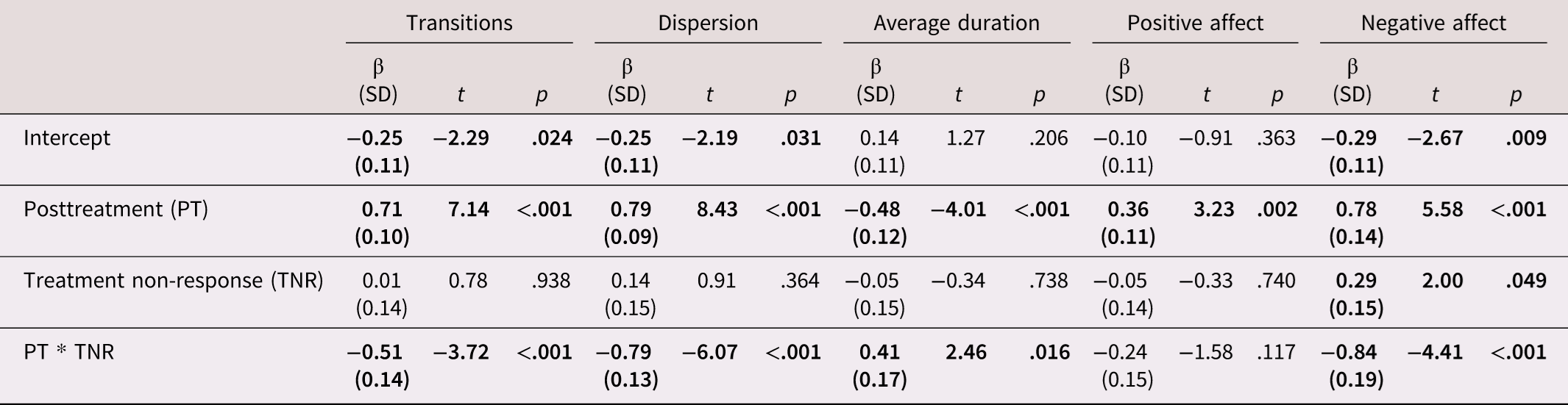
Table 2. Long description
Significant measurement occasion × treatment non-response interactions were found for transitions, dispersion, average duration, and negative affect. For positive affect, only a main effect of measurement occasion was found.
Note. PT: 0 = pre-treatment, 1 = post-treatment; TNR: 0 = treatment responder, 1 = treatment non-responder. Significant effects are shown in bold.
Changes in transitions (a), dispersion (b), average duration (c), and negative affect (d) for treatment responders and treatment non-responders.

Figure 3. Long description
Line graphs comparing pre- and post-treatment changes in transitions, dispersion, average duration, and negative affect. Among treatment responders, Figure A shows increases in transitions, Figure B shows increases in dispersion, Figure C shows decreased average duration, and Figure D shows increased negative affect. Non-responders showed no changes across these measures.
For positive affect, a significant main effect of measurement occasion was found, but no interaction effects. The result indicated an increase in positive affect (expressivity) of parent–child dyads after CBT for both treatment responders and non-responders (i.e., all children). For negative affect, results revealed significant main effects for measurement occasion and TNR as well as a significant two-way interaction between measurement occasion and treatment non-response. Post hoc analyses in which we examined these changes in dyadic negative affect for responders and non-responders separately (negative affect was the dependent variable and measurement occasion was the predictor), revealed significant increases in dyadic negative affect after CBT for responders (β = 0.80, p < .001), but no significant changes in dyadic negative affect for non-responders (p = .362). This indicates that parent–child dyads showed increases in dyadic negative affect (expressivity) when children no longer had any anxiety diagnosis (treatment responders) after CBT.
Child versus family CBT
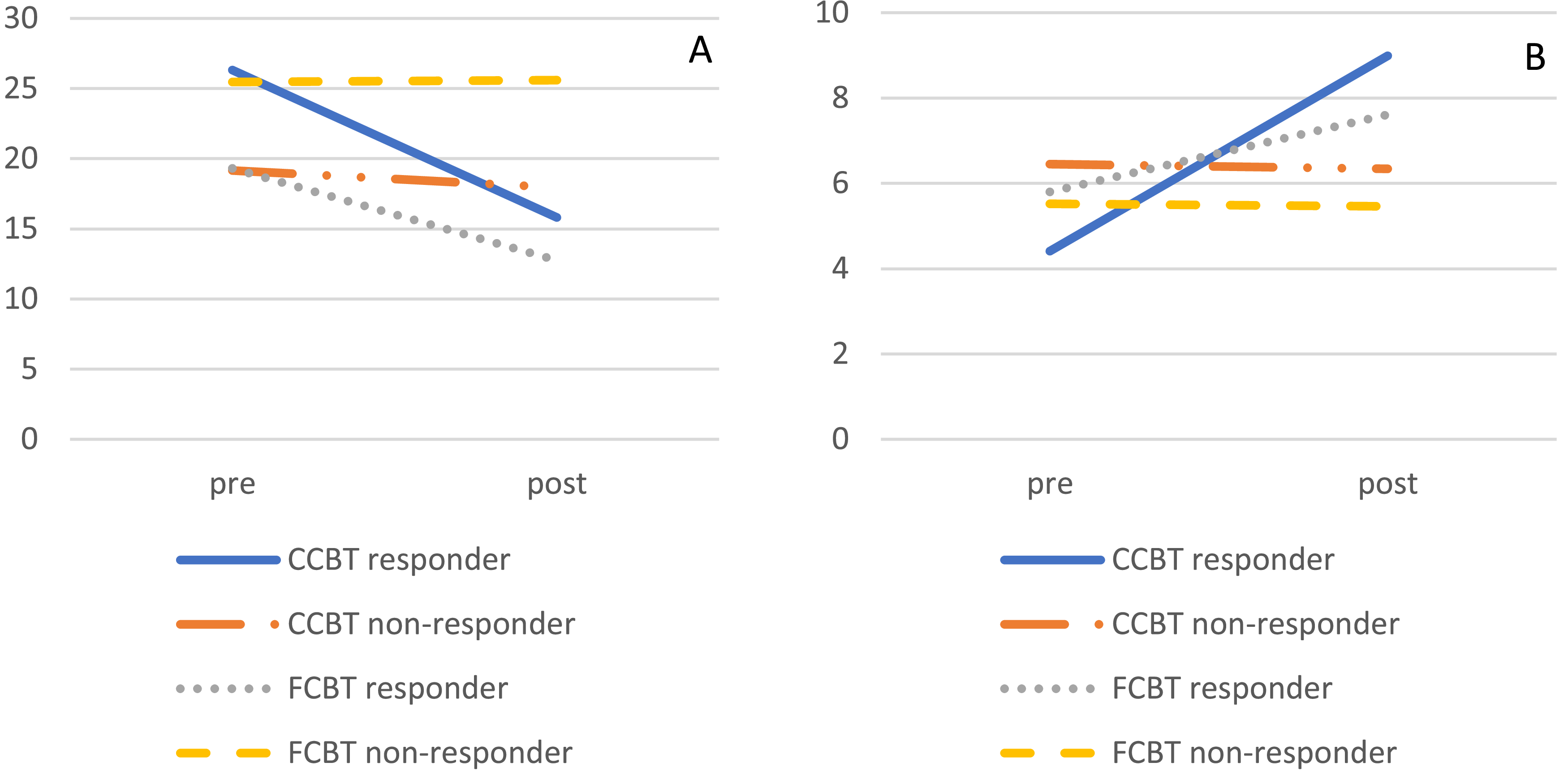
For all measures of emotional flexibility and expressivity, no significant main effects were found for treatment modality, and no significant three-way interactions of treatment modality with TNR and measurement occasion were found (Table 3). Significant main effects of measurement occasion were found (same as main analyses), and two significant two-way interactions were found (Figure 4), namely between treatment non-response and treatment modality for average duration (flexibility) and between measurement occasion and treatment modality for negative affect (expressivity). Next, post hoc analyses were used to interpret these significant two-way interactions.
The effects of measurement occasion, treatment non-response, and treatment modality on emotional flexibility and emotional expressivity of parent–child dyads
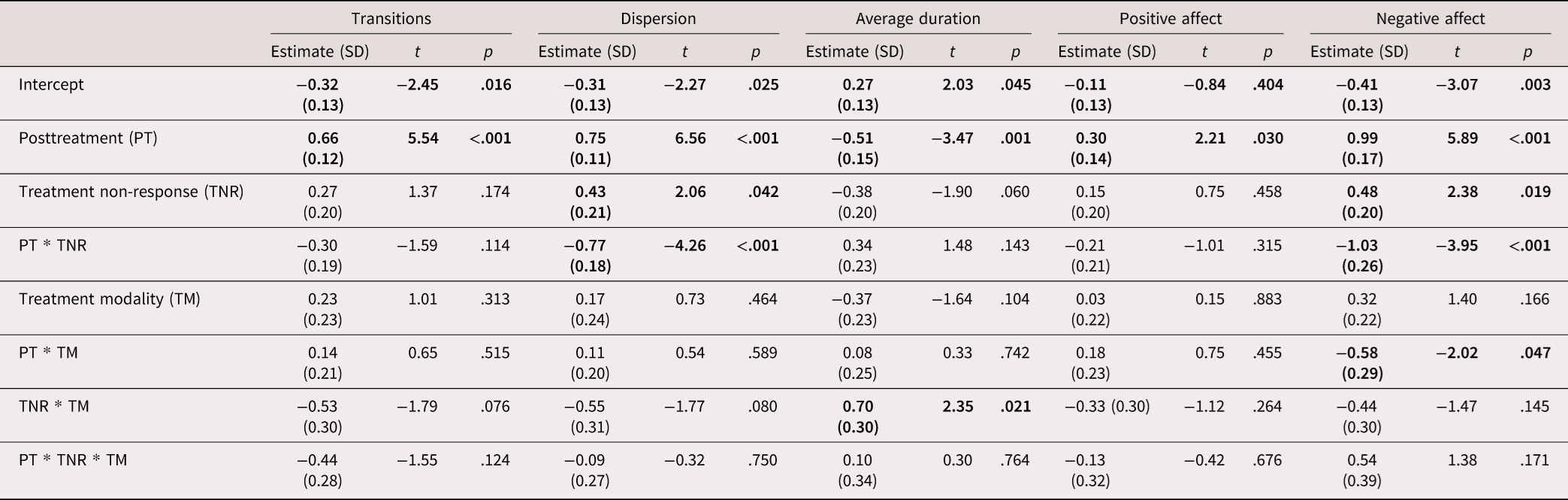
Table 3. Long description
Significant intercept and measurement occasion main effects were found for all measures of emotional flexibility and expressivity. A significant main effect of treatment non-response was found for dispersion and negative affect. A significant measurement occasion × treatment non-response interaction was also found for dispersion and negative affect. No significant main effects of treatment modality or three-way interactions were found for any outcome. Significant two-way interactions were found between treatment non-response and treatment modality for average duration, and between measurement occasion and treatment modality for negative affect.
Note. PT: 0 = pre-treatment, 1 = post-treatment; TNR: 0 = treatment responder, 1 = treatment non-responder; TM: 0 = childCBT, 1 = familyCBT. Significant effects are shown in bold.
Changes in average duration (a), and negative affect (b) for CCBT responders, CCBT non-responders, FCBT responders and FCBT non-responders. Two significant two-way interactions for dispersion and negative affect replicated (see Figure 3(b) and (d)).

Figure 4. Long description
Line graphs comparing pre- to post-treatment changes in average duration and negative affect across CCBT and FCBT responders and non-responders. Figure A shows decreased average duration for both CCBT and FCBT responders, with no changes for non-responders. Figure B shows increased negative affect for CCBT responders, with no changes for FCBT responders or non-responders.
First, to examine the significant two-way interaction between treatment modality and TNR for average duration (flexibility), we conducted separate analyses for responders and non-responders (average duration was the dependent variable, and measurement occasion and treatment modality, including their interaction, were predictors). Results demonstrated: (1) non-significant interactions between treatment modality and measurement occasion for both responders (p = .801) and non-responders (p = .548), (2) non-significant main effects for treatment modality (FCBT versus CCBT) for both responders (p = .828) as well as non-responders (p = .071), and (3) a significant main effect of measurement occasion (post-treatment), for responders (p < .001) but not for non-responders (p = .362). These results indicate that there is a decrease in dyadic average duration (flexibility) after CBT for responders but not for non-responders (same as in main analysis), and that the significant two-way interaction between treatment modality and treatment non-response seems to be driven by a borderline main effect of treatment modality for non-responders (those in FCBT having higher scores than those in CCBT).
Second, to examine the significant two-way interaction between treatment modality and measurement occasion for negative affect (expressivity), we run separate models for CCBT and FCBT (negative affect was the dependent variable, and measurement occasion and TNR, including their interaction, were predictors). Results demonstrated: (1) a significant interaction between measurement occasion and treatment non-response (p < .001), as well as significant main effects for measurement occasion (p < .001) and TNR (p = .007) for children in CCBT and (2) non-significant (interaction and main) effects for children in FCBT (p’s > .093). Thus, for children in FCBT no significant changes were found in dyadic negative affect (expressivity) after CBT, but for children in CCBT significant increases in dyadic negative affect (expressivity) were found only for treatment responders.
Father–child versus mother–child dyads
Regarding the emotional flexibility measures, significant main effects for measurement occasion were found (same as main analyses), as well as several significant interactions with parent gender for dispersion and transitions (Table 4). Regarding emotional expressivity, no significant main effects were found, and only significant interactions with parent gender were found for negative affect, but not for positive affect. The significant interactions for dispersion, transitions, and negative affect were examined next with post hoc analyses (Figure 5).
The effects of measurement occasion, treatment non-response, and parent gender on emotional flexibility and emotional expressivity of parent–child dyads
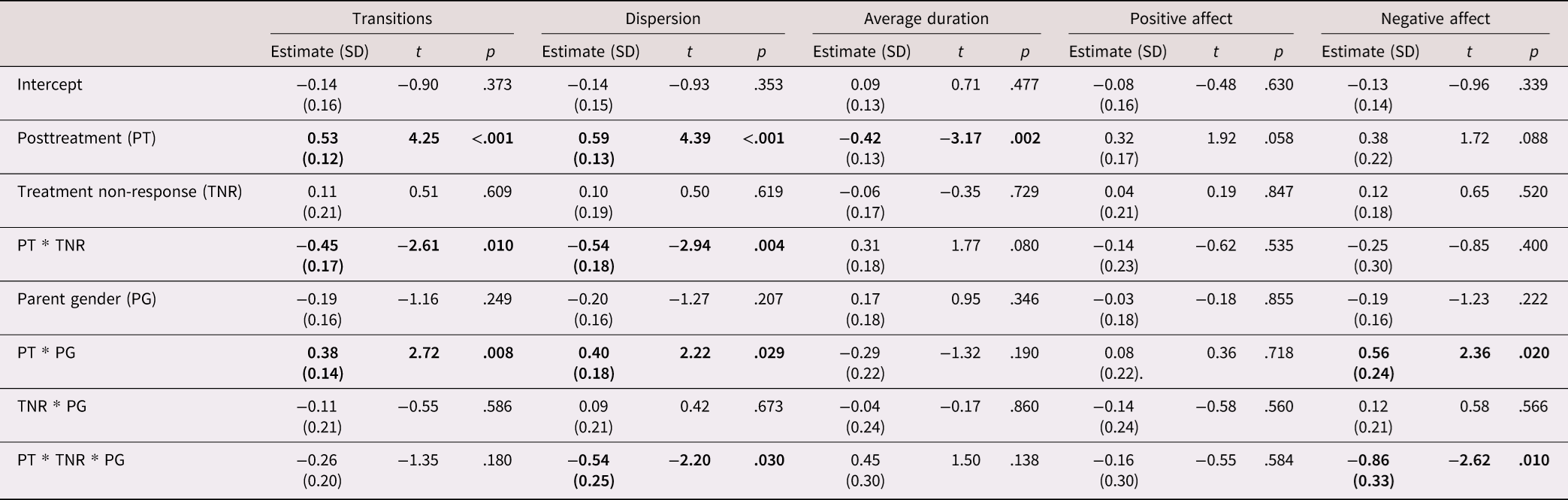
Table 4. Long description
Significant main effects of measurement occasion were found for transitions, dispersion, and average duration. Significant measurement occasion × treatment non-response interactions were found for transitions and dispersion. Significant measurement occasion × parent gender interactions were found for transitions, dispersion, and negative affect. A significant three-way interaction between measurement occasion, treatment non-response, and parent gender was found for dispersion and negative affect.
Note. PT: 0 = pre-treatment, 1 = post-treatment; TNR: 0 = treatment responder, 1 = treatment non-responder; PG: 0 = mother, 1 = father. Significant effects are shown in bold.
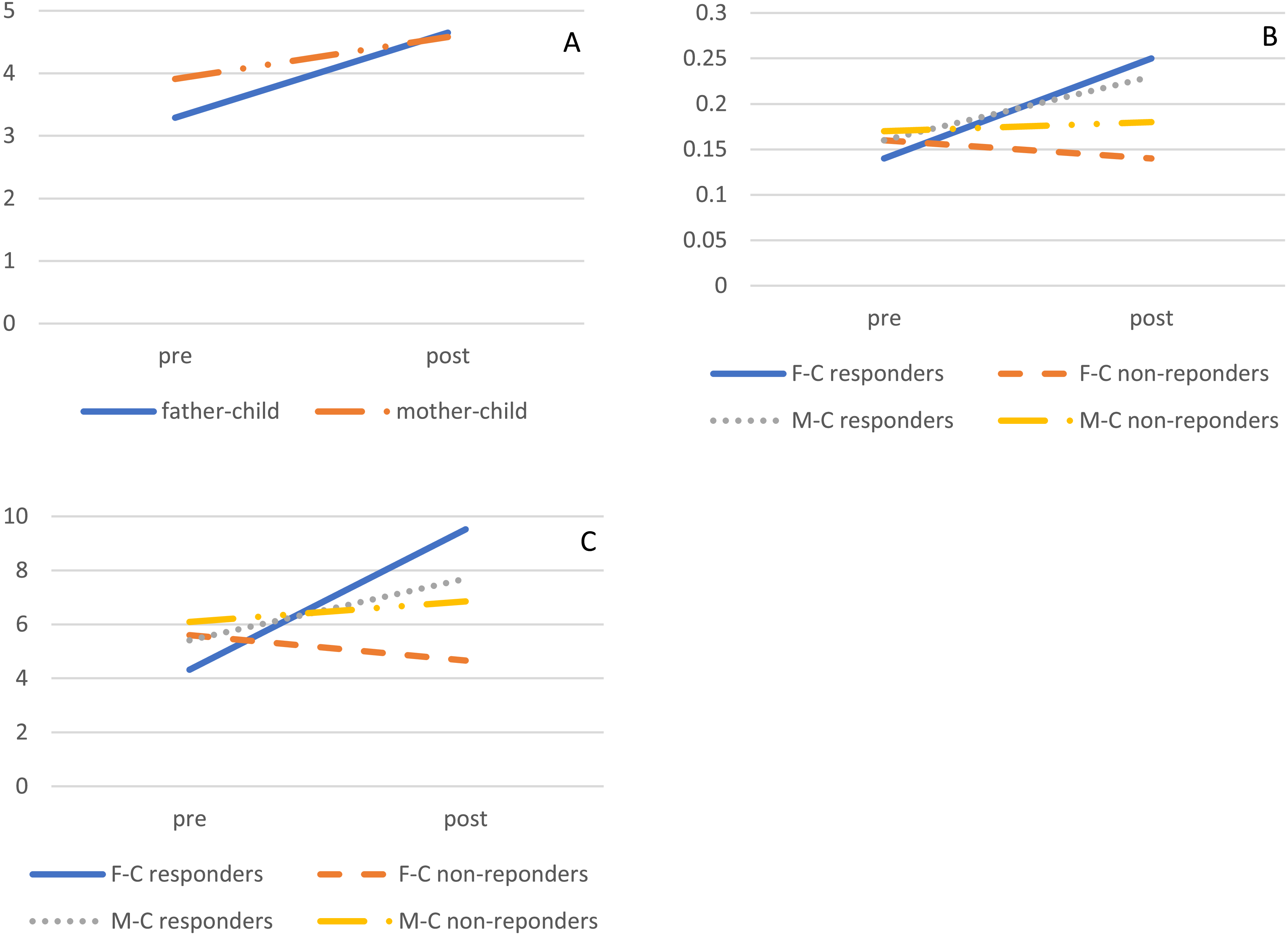
Changes in transitions for the father-child and mother-child dyads (a), in dispersion (b), and negative affect (c) for father-child dyad responders, father-child dyad non-responders, mother-child dyad responders, and mother-child dyad non-responders. Two significant two-way interactions for dispersion and negative affect replicated (see Figure 3(b) and (d)). When both two- and three-way interactions involved the same variables, only the three-way interaction was visualized.

Figure 5. Long description
Line graphs showing pre- to post-treatment changes in transitions, dispersion, and negative affect for father-child and mother-child responders and non-responders. Figure A shows somewhat larger increases in transitions for father-child dyads compared with mother-child dyads. Figures B and C show larger increases in dispersion and negative affect for father-child responders than mother-child responders.
For dispersion (flexibility), a significant two-way interaction (parents’ gender* measurement occasion), and a significant three-way interaction (measurement occasion* parents’ gender*treatment non-response) were found. Post hoc analyses were run for responders and non-responders separately (dispersion was the dependent variable, and measurement occasion and parent gender, including their interaction, were predictors). The analyses for responders demonstrated (consistent with the main analyses) a significant increase in dispersion (β = 0.59, p < .001) after CBT, and this increase seemed larger for the father–child dyads compared to the mother–child dyads, but the difference did not reach significance (β = 0.38; p = .060). In contrast, for treatment non-responders, no evidence was found for changes in dispersion after CBT, nor in differences in these changes between father–child and mother–child dyads (p’s > .297).
Regarding transitions (flexibility), a significant two-way interaction between parents’ gender and measurement occasion was found. Post hoc analyses for mother–child dyads and father–child dyads separately were conducted (transitions was the dependent variable, and measurement occasion and TNR, including their interaction, were predictors). Considering the size of the effect, results demonstrated a slightly larger increase after CBT in the number of transitions for the father–child dyads (β = 0.59; p < .001) than the mother–child dyads (β = 0.29; p = .001).
Finally, for negative affect (expressivity), a significant two-way interaction (between parents’ gender and measurement occasion), and a significant three-way interaction were found (between measurement occasion and parents’ gender, and treatment non-response. Post hoc analyses exploring the interaction effects (separate models for mother–child dyads and father–child dyads with negative affect as the dependent variable, and measurement occasion and TNR as predictors) revealed no significant main- or interaction effects for mother–child dyads, while a significant main effect of measurement occasion (β = 0.95; p < .001) and a significant interaction effect between measurement occasion and treatment non-response (β = 1.08; p < .001) was found for father–child dyads. Further analyses (including only the father–child dyads, separate models were run for treatment responders and non-responders with duration of negative affect as the dependent variable and measurement occasion as predictor) indicated that for father–child dyads, the duration of negative affect of father–child dyads increased after CBT for treatment responders (β = 0.96; p < .001), but no changes in negative affect of father–child dyads were observed for treatment non-responders (β = −0.13; p = .330).
Discussion
This observational study fills a crucial gap by examining whether changes in parent–child dyadic emotional flexibility and expressivity during interactions were associated with successful CBT treatment for children’s anxiety disorders. We also investigated whether treatment modality (TM) (child versus family CBT) and parent gender (mother–child versus father–child dyads) affected these changes. First, dyadic emotional flexibility increased only in children who achieved diagnostic recovery from all anxiety disorders after CBT (treatment responders), and not in children who did not recover (non-responders). These observed changes did not depend on TM or parents’ gender. Second, dyadic positive affect increased after CBT for all children, regardless of TNR, treatment modality, or parent gender. Third, dyadic negative affect changed only for treatment responders, not for non-responders, and varied by TM and parent gender. Specifically, among treatment responders, increases in dyadic negative affect were observed only in father–child dyads, not mother–child dyads, and only following child CBT, not family CBT. Together, these findings highlight the impact of CBT for child anxiety on dyadic emotional flexibility and expressivity in parent–child interactions.
Changes in dyadic emotional flexibility after CBT
As hypothesized, treatment responders, but not non-responders, showed changes in all three indices of dyadic emotional flexibility. When children achieved diagnostic recovery from their anxiety disorders after CBT, parent–child dyads switched between emotions more frequently, used a broader emotional repertoire, and maintained emotions for shorter periods during conflict discussions. These findings align with a DS approach (Butler, Reference Butler2015; Granic, Reference Granic2005; Grumi et al., Reference Grumi, Pettenati, Manfredini and Provenzi2022; McKone & Silk, Reference McKone and Silk2022), emphasizing the value of observing real-time dyadic emotional flexibility for understanding child well-being and treatment efficacy. Response to CBT in children with anxiety is reflected not only in individual symptom reduction but also in enhanced parent–child emotion dynamics. Notably, these improvements occurred even though flexibility was not directly targeted, suggesting that successful CBT for child anxiety can simultaneously foster changes in dyadic emotional flexibility during interactions.
Although our findings indicate co-occurring improvements in anxiety and emotional flexibility after successful CBT, the direction of these changes remains unclear (Settipani et al., Reference Settipani, O’neil, Podell, Beidas and Kendall2013; Silverman et al., Reference Silverman, Marin, Rey, Jaccard and Pettit2021; Van der Giessen & Van Steensel, Reference Van der Giessen, Van Steensel, Martin, Patel and Preedy2023). Successful CBT might enhance dyadic emotional flexibility, as recovered children reduce avoidance of emotionally evocative situations, potentially fostering new ways to express and regulate emotions and a healthier dyadic emotional climate in parent–child conflict discussions (Granic et al., Reference Granic, O’Hara, Pepler and Lewis2007; Van der Giessen & Bögels, Reference Van der Giessen and Bögels2018). Alternatively, CBT may directly improve children’s ability to express and regulate their emotions, enhancing healthier parent–child emotional communication, contributing to reduced anxiety (Asnaani et al., Reference Asnaani, Tyler, McCann, Brown and Zang2020; Helland et al., Reference Helland, Baardstu, Kjøbli, Aalberg and Neumer2023). Mid-treatment, real-time observational assessments of dyadic emotion dynamics could clarify temporal patterns, informing how to adapt maladaptive parent–child emotion communication in CBT and guiding future experimental studies on causal mechanisms (Settipani et al., Reference Settipani, O’neil, Podell, Beidas and Kendall2013; Silverman et al., Reference Silverman, Marin, Rey, Jaccard and Pettit2021; Suveg et al., Reference Suveg, Jones, Davis, Jacob, Morelen, Thomassin and Whitehead2018; Van der Giessen & Van Steensel, Reference Van der Giessen, Van Steensel, Martin, Patel and Preedy2023).
The lack of an effect of CBT modality on dyadic emotional flexibility was unexpected but aligns with previous research showing no consistent differences between child and family CBT in reducing child anxiety (Byrne et al., Reference Byrne, Cobham, Richardson and Imuta2023) and parenting-related outcomes (Peris et al., Reference Peris, Thamrin and Rozenman2021; Van der Giessen et al., Reference Van der Giessen, Colonnesi and Bögels2019). Although the family CBT condition targeted anxiety-related, dysfunctional, and rigid family communication, it provided no additional benefits for enhancing dyadic flexibility beyond child CBT, suggesting that improvements in child anxiety may precede changes in dyadic emotion patterns. However, the exact sequence of change may be less critical than triggering change in the anxiogenic cycle (Van der Giessen & Van Steensel, Reference Van der Giessen, Van Steensel, Martin, Patel and Preedy2023). Further research should examine variations in family involvement and explicitly target dyadic emotional flexibility through psychoeducation, emotion skill building, and in vivo practice. Randomized micro-trials (Leijten et al., Reference Leijten, Raaijmakers, Orobio De Castro and Matthys2015) could isolate the effects of specific treatment components on parent–child interactions and child anxiety, informing how dyadic emotion-focused elements in CBT for child anxiety can be refined and personalized to each family’s emotion communication needs, and when and how family CBT relates to changes in dyadic emotion dynamics and (larger) improvements in child anxiety.
Successful treatment of children’s anxiety disorders was associated with increased emotional flexibility in both father–child and mother–child dyads, highlighting its importance for well-being and treatment success, regardless of parental gender (Grumi et al., Reference Grumi, Pettenati, Manfredini and Provenzi2022; McKone & Silk, Reference McKone and Silk2022). While some interaction effects with parental gender were significant, upon closer examination, only subtle, yet non-significant gender differences were observed. They suggested that father–child dyads with treatment responders may have greater potential for post-treatment improvement in emotional repertoire (dispersion) among treatment responders and emotional switching (transitions) compared to mother–child dyads with both responders and non-responders. These results might suggest that while mothers may initially engage in somewhat more flexible emotional exchanges with their anxious children than fathers (Russell et al., Reference Russell, Bird and Herbert2024; Van der Giessen & Bögels, Reference Van der Giessen and Bögels2018), father–child dyads with responders might have a greater need and potential for improvement in emotional flexibility post-treatment than mother–child dyads. Future studies with larger samples should examine these preliminary findings and their potential implications for gender-tailored dyadic emotion components in CBT (Ravindran et al., Reference Ravindran, Hu, McElwain and Telzer2020; Zuzama Pons et al., Reference Zuzama Pons, Roman-Juan, Fiol-Veny, Caimari-Ferragut and Balle2021).
Changes in dyadic emotional expressivity after CBT
Partly in line with our hypothesis and earlier studies (De Rubeis & Granic, Reference De Rubeis and Granic2012; Granic et al., Reference Granic, O’Hara, Pepler and Lewis2007; Van der Giessen et al., Reference Van der Giessen, Colonnesi and Bögels2019; Wood et al., Reference Wood, McLeod, Piacentini and Sigman2009), increases in dyadic positive affect were observed post-CBT, regardless of treatment non-response, modality, or parents’ gender. This general improvement in dyadic positive affect likely reflects improvements in children’s emotion regulation skills (Sloan et al., Reference Sloan, Hall, Moulding, Bryce, Mildred and Staiger2017; Suveg et al., Reference Suveg, Sood, Comer and Kendall2009), fostering more positive emotions during parent–child interactions. This suggests that increases in dyadic positive affect may reflect general benefits of CBT, rather than a specific marker of treatment success (Granic et al., Reference Granic, O’Hara, Pepler and Lewis2007; Lougheed & Hollenstein, Reference Lougheed and Hollenstein2016).
Overall, results revealed increased dyadic negative affect in treatment responders, but not in non-responders. While seemingly counterintuitive, this aligns with current perspectives (Ferrar et al., Reference Ferrar, Stack, Dickson and Serbin2020; Granic et al., Reference Granic, O’Hara, Pepler and Lewis2007; Van der Giessen & Bögels, Reference Van der Giessen and Bögels2018) suggesting that negative emotions can be constructive when managed adaptively, and that healthy parent–child interactions involve both dyadic negative emotions and greater dyadic emotional flexibility. Modality-specific patterns emerged: in child CBT, increased dyadic negative affect was observed only in responders, whereas in family CBT, although a similar trend was observed, no significant post-treatment changes in dyadic negative affect occurred. This may reflect differences in treatment focus: successful child CBT might encourage greater emotional awareness and reduce (emotional) avoidance, leading to more engagement with challenging emotions (Helland et al., Reference Helland, Baardstu, Kjøbli, Aalberg and Neumer2023), and more emotionally engaged, diverse, and negative parent–child conflict interactions post-treatment. These dyads may become, after CBT, more willing to experience and express negative emotions rather than avoiding emotionally evocative situations. In family CBT, where dysfunctional communication patterns were explicitly targeted, conflicts may be more effectively and flexibly resolved, possibly resulting in smaller increases in negative affect and overall lower levels of dyadic negative affect post-treatment compared to child CBT. Importantly, responders in both treatment modalities showed increases in dyadic emotional flexibility, suggesting that parent–child dyads with children free from anxiety diagnoses became better able to navigate emotional exchanges flexibly, regardless of changes in the amount of negative affect (Granic et al., Reference Granic, O’Hara, Pepler and Lewis2007). Future studies should examine how different CBT modalities affect changes in dyadic negative affect, and under which conditions such changes reflect constructive emotional engagement.
Parental gender also affected post-treatment changes in dyadic negative affect. Among father–child dyads only, the duration of negative affect increased after CBT for treatment responders, but not for non-responders. A similar, yet non-significant pattern appeared among mother–child dyads. This pattern may reflect that fathers and children are typically less elaborative and expressive about emotions (Fivush et al., Reference Fivush, Marin, McWilliams and Bohanek2009; Suveg et al., Reference Suveg, Sood, Comer and Kendall2009; Zuzama Pons et al., Reference Zuzama Pons, Roman-Juan, Fiol-Veny, Caimari-Ferragut and Balle2021), and generally show lower levels of negative affect during interactions than mother–child dyads (Lunkenheimer et al., Reference Lunkenheimer, Olson, Hollenstein, Sameroff and Winter2011; Van der Giessen & Bögels, Reference Van der Giessen and Bögels2018). Thus, particularly father–child dyads with clinically anxious children may need to learn not only to navigate emotions flexibly but also to express more negative emotions together. As children recover from anxiety and show less avoidance and better emotion regulation skills after CBT, both fathers and children might be more comfortable expressing disagreements and tolerating negative emotions (Suveg et al., Reference Suveg, Sood, Comer and Kendall2009) resulting in greater dyadic negative affect during interactions. In contrast, mother–child dyads may primarily need to focus on flexible emotion navigation rather than on increasing the expression of negative affect. Future research should examine whether these gender-specific patterns of emotional expression across mother- and father–child dyads following CBT can be replicated.
Strengths and limitations
This observational treatment study is the first to examine real-time changes in dyadic emotion communication of parent–child dyads following CBT for child anxiety, and it has several strengths. By including father–child dyads, often overlooked in clinical and observational research, we provided evidence that dyadic emotions in father–child interactions are as meaningful as, and potentially more distinctive than, those in mother–child interactions for understanding treatment outcomes (Carnes et al., Reference Carnes, Matthewson and Boer2019; Van der Giessen & Bögels, Reference Van der Giessen and Bögels2018). Furthermore, adopting a dyadic perspective on real-time interactions using state SSGs extends prior work by moving beyond individual contributions to interactions and emphasizing the importance of a dyadic approach to emotion dynamics in parent–child interactions, particularly for clinically anxious children (Grumi et al., Reference Grumi, Pettenati, Manfredini and Provenzi2022; McKone & Silk, Reference McKone and Silk2022; Perlman et al., Reference Perlman, Lunkenheimer, Panlilio and Pérez-Edgar2022).
Despite its strengths, several limitations should be noted. First, the sample lacked cultural and ethnic diversity, which limited its generalizability (Peris et al., Reference Peris, Thamrin and Rozenman2021). In addition, generalizability and representativeness may have been affected by missing data, with post-treatment father–child observations more often missing, and higher treatment dropout in the family CBT condition. Treatment dropout was associated with parental unemployment and separation, which may complicate engagement and potentially represent contraindications for FCBT. While such challenges are not uncommon in family-based treatments for youth anxiety, most studies generally show no consistent differences in treatment effects between family- and child-focused CBT (Byrne et al., Reference Byrne, Cobham, Richardson and Imuta2023), although effects in family-CBT may take longer to emerge as parents gradually acquire skills to manage their child’s anxiety and broader family challenges (Bodden, Bögels, Nauta, et al., Reference Bodden, Bögels, Nauta, De Haan, Ringrose, Appelboom, Brinkman and Appelboom-Geerts2008). Second, the absence of a control group of typically developing children without anxiety disorders makes it difficult to attribute observed changes solely to CBT. However, pre-treatment data from this sample (Van der Giessen & Bögels, Reference Van der Giessen and Bögels2018) provided insight that parent–child dyads with clinically anxious children were less emotionally flexible than healthy parent–child dyads. Consistent with this, previous studies (Hiller et al., Reference Hiller, Apetroaia, Clarke, Hughes, Orchard, Parkinson and Creswell2016; Van der Giessen et al., Reference Van der Giessen, Colonnesi and Bögels2019; Wood et al., Reference Wood, McLeod, Piacentini and Sigman2009) have also demonstrated that CBT for child anxiety alters parent–child interactions. Third, TNR was operationalized as diagnostic recovery based on categorical interview-based outcomes. Although common in childhood anxiety trials and clinically meaningful (Creswell et al., Reference Creswell, Nauta, Hudson, March, Reardon, Arendt, Bodden, Cobham, Donovan, Halldorsson, In-Albon, Ishikawa, Johnsen, Jolstedt, de Jong, Kreuze, Mobach, Rapee, Spence and Kendall2021; Warwick et al., Reference Warwick, Reardon, Cooper, Murayama, Reynolds, Wilson and Creswell2017), it may not capture more subtle improvements in symptoms or functioning. Fourth, although parent–child conflict discussions reliably elicit a range of emotions and are frequently studied (Lougheed et al., Reference Lougheed, Main and Helm2020; Main et al., Reference Main, Paxton and Dale2016), optimal levels of emotional flexibility (and expressivity) are thought to depend on the specific goals and demands of the context (Lougheed & Hollenstein, Reference Lougheed and Hollenstein2016; McKone & Silk, Reference McKone and Silk2022). Future studies should include diverse emotion-eliciting contexts, such as disappointment, problem-solving scenarios, or reminiscing about past emotional experiences, to provide a broader understanding of how emotion dynamics relate to anxiety outcomes after CBT beyond conflict interactions. Fifth, although the study was adequately powered to detect medium-to-large interaction effects, power to detect small interaction effects was more limited; therefore, findings involving higher-order interactions should be interpreted cautiously. Finally, father–child and mother–child dyads were observed separately, even though anxiety disorders likely affect emotion communication at the family-system level (Perlman et al., Reference Perlman, Lunkenheimer, Panlilio and Pérez-Edgar2022). Future research should examine triadic or broader family interactions (e.g., with siblings or other caregivers) to capture these systemic processes more fully. Addressing these limitations will advance our understanding of how dyadic parent–child emotion communication evolves in real-time during anxiety treatment.
Clinical implications and conclusion
This observational study bridges the gap between dynamic systems (DS) research and clinical practice (Grumi et al., Reference Grumi, Pettenati, Manfredini and Provenzi2022; Van der Giessen & Bögels, Reference Van der Giessen and Bögels2018) by demonstrating that changes in dyadic emotional flexibility were consistently linked to succesful CBT treatment for child anxiety. Even when not explicitly targeted in CBT, successful individual and family treatment enabled parent–child dyads to shift more fluidly between emotional states during conflict discussions. Observing dyadic flexibility might provide a more sensitive indicator of treatment-related changes than expressivity alone, particularly in the context of CBT.
Clinicians (and researchers) should consider the benefits of a dyadic-based emotional mindset in parents and children to foster more adaptive interactive emotional exchanges within dyadic interactions. Rather than emphasizing the increase of positive and reduction of negative affect, clinicians could highlight the importance of jointly navigating a range of emotions, including negative or divergent ones, effectively. The persistence or even increase of both negative and positive emotions, as well as fluid transitions between them after successful CBT, likely reflects healthy parent–child interaction patterns. Such increases in dyadic negative affect might be most pronounced in father–child dyads and parent–child dyads after CCBT. Encouraging this broader emotional view may help parents of anxious children develop a more realistic understanding of healthy parent–child interactions.
To advance the field, future research should incorporate assessments of parent–child emotion dynamics when evaluating the effects of CBT on child anxiety. Learning if, when, and how to tailor CBT for child anxiety to meet specific dyadic emotional communication needs of each parent–child dyad could enhance overall treatment outcomes for children’s anxiety disorders (Creswell et al., Reference Creswell, Waite and Hudson2020; Van der Giessen & Van Steensel, Reference Van der Giessen, Van Steensel, Martin, Patel and Preedy2023).
Supplementary material
The supplementary material for this article can be found at https://doi.org/10.1017/S0954579426101825.
Data availability statement
Examples of SPSS syntax for the multilevel regression analyses can be found in the supplementary materials. The materials and code necessary to replicate findings will be provided upon reasonable request.
Funding statement
This study was financially supported by a grant from ZonMw, the Netherlands Organisation for Health Research and Development, grant number 945-02-052.
Competing interests
The authors have no conflict of interest to report.
Pre-registration statement
This study is a secondary analysis of an existing dataset and was not preregistered, as data collection and initial analyses, including educational analyses conducted by master’s students, had already been completed.





 Open access

