Minor physical anomalies (MPAs) are defined as “slight dysmorphic features representing subtle alterations in the development of various bodily structures” and are most common in the hands, face, ears, and feet (Ismail, Cantor-Graae, & McNeil, Reference Ismail, Cantor-Graae and McNeil1998). These anomalies have no cosmetic or functional significance, but they appear to reflect disruptions in fetal development that may have more serious consequences elsewhere. In their review article, Tarrant and Jones (Reference Tarrant and Jones1999) note that all minor and/or major congenital anomalies can be timed to specific stages of fetal development. For example, MPAs of the feet reflect disruption during Gestation Weeks 1–8, whereas abnormalities in the fingerprints may reflect disruption during Gestation Weeks 14–22 (van Valen, Reference van Valen1962). Fingerprint anomalies are of little interest in and of themselves. However, because fingerprint development occurs during the second trimester of gestation when critical brain structures (such as the hippocampus) are also developing, because fingerprints and brain develop out of the same fetal ectodermal tissue, and because fingerprints remain unchanged throughout life, these dermatoglyphic abnormalities may have important implications for developmental psychopathology.
The neurodevelopmental hypothesis of schizophrenia suggests that some genetic or prenatal event disrupts fetal brain development at a critical period and increases risk for later onset of the disorder (Weinberger, Reference Weinberger, Hirsch and Weinberger1995). Research on dermatoglyphic abnormalities in schizophrenia patients supports the neurodevelopmental model. Schizophrenia patients have more MPAs than normal controls, including greater differences in right- and left-hand finger ridge counts, referred to as “fluctuating dermatoglyphic asymmetries” (Davis Weinstein, Diforio, Shiffman, Walker, & Bonsall, Reference Davis Weinstein, Diforio, Shiffman, Walker and Bonsall1999; Markow & Wandler, Reference Markow and Wandler1986; Mellor, Reference Mellor1992; Reilly et al., Reference Reilly, Murphy, Byren, Larkin, Gill and O'Callaghan2001; van Oel et al., Reference van Oel, Baare, Hulshoff Pol, Haag, Balazs and Dingemans2001).
The precise origins of dermatoglyphic abnormalities are unknown; however, there is indirect research evidence supporting both genetic (Holt, Reference Holt1968; Markow & Wandler, Reference Markow and Wandler1986; Murthy & Wig, Reference Murthy and Wig1977) and prenatal environmental factors (Babler, Reference Babler1978; Green, Bracha, Satz, & Christenson, Reference Green, Bracha, Satz and Christenson1994; Kelly et al., Reference Kelly, Kotter, Denihan, Larkin, Murphy and Kinsella2004). Although twin and sibling studies support genetic origins, there are no data linking specific adverse environmental events at specific times during pregnancy to dermatoglyphic anomalies in humans. Results from one study of the macaque did, however, find that daily mild stressors predict greater dermatoglyphic asymmetry in the offspring (Newell-Morris, Fahrenbruch, & Sackett, Reference Newell-Morris, Fahrenbruch and Sackett1989).
Prenatal maternal stress (PNMS) is one possible environmental cause of both schizophrenia in humans (Huttenen & Niskanen, Reference Huttenen and Niskanen1978; Van Os & Selten, Reference Van Os and Selten1998) and dermatoglyphic asymmetries in nonhuman primates (Newell-Morris et al., Reference Newell-Morris, Fahrenbruch and Sackett1989). The mechanism by which prenatal stress influences fetal development may involve maternal glucocorticoids: traumatic experiences are known to alter cortisol levels in exposed individuals (Yehuda, Reference Yehuda2002). Lowered integrated cortisol levels are frequently (Anisman, Griffiths, Matheson, Ravindran, & Merali, Reference Anisman, Griffiths, Matheson, Ravindran and Merali2001; Braehler et al., Reference Braehler, Holowka, Brunet, Beaulieu, Baptista and Debruille2005; Yehuda, Resnick, Schmeidler, Yang, & Pitman, Reference Yehuda, Resnick, Schmeidler, Yang and Pitman1998), but not always (Pitman & Orr, Reference Pitman and Orr1990), observed in individuals who have experienced traumatic life events. Altered maternal cortisol levels resulting from stressful life events may influence fetal brain development and long-term fetal programming (Matthews, Reference Matthews2002; Seckl, Reference Seckl2001; Trautman, Meyer-Bahlburg, Postelnek, & New, Reference Trautman, Meyer-Bahlburg, Postelnek and New1995; Uno, Tarara, Else, Sulemen, & Sapolsky, Reference Uno, Tarara, Else, Sulemen and Sapolsky1989).
Thus, although both PNMS and dermatoglyphic asymmetries are associated with schizophrenia, and prenatal stress has been shown in animals to produce these fingerprint abnormalities, there are no data in humans showing that a well-timed stressor will produce dermatoglyphic asymmetry. In addition, although maternal cortisol during pregnancy is thought to mediate the effect of PNMS on dermatoglyphic asymmetry, there are also no human data demonstrating a role of maternal cortisol in the association between prenatal stress and fingerprint development.
The goal of the present study was to determine the extent to which a sudden-onset natural disaster, timed during Pregnancy Weeks 14–22, which corresponds to the timing of fingertip development in the fetus, predicts greater fingerprint ridge count asymmetry in children. In January 1998, a series of freezing rain storms struck southern Quebec in Canada, knocking out electrical power to more than 3 million people for as long as 40 days. The crisis was judged by the Insurance Bureau of Canada to be the most severe natural disaster in Canadian history, resulting in $2.7 billion CND in economic losses (www.ibc.ca), and resulted in at least 24 deaths. Power outages of varying lengths were randomly distributed and unrelated to demographic indicators. Studying the effects of a natural disaster allows us to tease apart the respective roles of timing, the pregnant woman's degree of objective exposure to the event, her subjective response to it, and her cortisol levels.
It was anticipated that greater finger ridge count asymmetry would be observed in children exposed during the critical target period of finger development (Weeks 14–22) compared to children exposed during other periods of pregnancy. Moreover, we predicted that greater objective and subjective stress, and either higher or lower integrated maternal cortisol levels, would be associated with increases in finger ridge count asymmetry in children exposed during Weeks 14–22 of pregnancy.
Materials and Methods
Participants
The research protocol for this study was approved by the Douglas Hospital Research Ethics Board. Mothers provided written, informed consent for all assessments, and for the fingerprinting of their children. All data were stored in a password-protected computer separate from identifying information. The raters of the children's fingerprints were blind to all information about the families. Fingerprints were labeled only with the families' identification numbers.
The participants (n = 97) were a subsample of participants from Project Ice Storm, an ongoing longitudinal study of the effects of PNMS on pregnancy, labor/delivery, and infant outcomes (King, Laplante, & Joober, Reference King, Laplante and Joober2005). To contact women who were pregnant during the ice storm, we sought the assistance of 20 obstetricians who were associated with the four major hospitals in the Montérégie, a region southeast of Montreal that endured the longest electrical power losses from the ice storm. These obstetricians agreed to identify patients who met the inclusion criteria for our study: being pregnant during the ice storm or conceiving within 3 months of the ice storm, White, French Canadian, and 18 years of age or older. The first questionnaire, “Reactions to the storm,” was mailed on June 1, 1998, to 1,440 women who met the inclusion criteria. A total of 224 women responded to this first questionnaire. Of these women, 178 gave consent to be contacted for further follow-up. The second questionnaire, “Outcomes of the pregnancy,” was mailed to these 178 women 6 months after the due date of their pregnancy. Of these women, 177 returned the second questionnaire. In addition to other follow-up contacts, families were contacted when the children were 5.5 years of age for a comprehensive in-home assessment. At that time we were able to contact 140 families from our original sample, of which 116 families (82.9%) agreed to the assessment. One hundred one families allowed us to take their children's fingerprints, either during a medical visit for their inoculations at 4 or 5 years of age, or during a home assessment of their development at 5.5 years of age. Fingerprints from four children were of poor quality, which did not permit assessment of finger ridges on at least three homologous finger pairs, leaving a final sample of 97 children for the analyses.
Comparisons were made between the families who participated in the present study and those who (a) failed to provide us with contact information (Questionnaire 1) and (b) provided contact information but did not take part in the present study. No differences were observed for family variables (parental education, parental income, and parental socioeconomic status), maternal variables (objective PNMS, subjective PNMS, state anxiety, life events, obstetric complications), or child variables (gestational age, birth weight, birth length, head circumference).
The timing of the children's in utero exposure to the ice storm was determined using the difference in days between the mothers' anticipated due date and January 9, 1998, the date corresponding to the peak of the ice storm. Using these dates, we were able to identify children in the sample who were exposed in utero to the ice storm between Weeks 14 and 22 of their mothers' pregnancies. Of the 97 children in the sample, 20 were in the target-exposed group (exposed during Weeks 14–22) and the remaining 77 children composed the nontarget-exposed group (exposed prior to conception, or during Weeks 1–13 or during Weeks 22–40).
Measures
Dermatoglyphic asymmetry was assessed for homologous fingers of the right and left hands of the children by the third author (A.M.-M.) and by a research assistant (A.M.) who were blind to all information about the child and family. Fingerprints were obtained from the children at age 4 or 5 years using an inkless pad and photosensitive paper. Digital scans were taken of all fingerprints so that the prints of each finger could be enlarged. Using the popular procedure described by Holt (Reference Holt1968) and used previously by our group (Weinstein, Diforio, Schiffman, Walker, & Bonsall, Reference Weinstein, Diforio, Schiffman, Walker and Bonsall1999), the number of ridges crossing a line drawn between the center of the pattern and the triradius of each fingerprint was counted for all fingers on both hands. The number of ridges on each finger of the left hand was subtracted from the number of ridges on the homologous finger of the right. The total ridge count asymmetry score was calculated by summing the absolute values of the differences observed for each homologous finger. Because the number of usable prints (i.e., prints for which the center of the pattern and the triradius were clearly visible) varied between the children, the average ridge count asymmetry (ARCA) between homologous fingers was calculated by dividing the total difference in the number of ridges for each homologous finger by the number of valid homologous fingerprints for each child. Five usable pairs of homologous fingerprints were available for 74 children, 4 homologous fingerprints for 14 children, and 3 homologous fingerprints for 9 children. The distribution of valid homologous fingerprints was similar for target (15.0%, 15.0%, and 70.0%, for 3, 4, and 5 valid homologous fingerprints) and nontarget (7.8%, 14.3%, and 77.9%, for 3, 4, and 5 valid homologous fingerprints) children, χ2 (2) = 1.03, p = .59. Of the four children excluded for poor fingerprint quality, one child was excluded because only two pair of homologous fingerprints were available, one child had only 1 pair of homologous fingerprints available, and two children were excluded because no usable homologous fingerprints were obtainable. Twelve pairs of randomly selected sets of fingerprints (110 fingerprints in all) were recoded by the last author (D.P.L.). The recoded total ridge count asymmetry scores matched for all but 6 fingerprints, for a 95% accuracy score.
Severity of maternal objective stress was estimated using the mothers' responses to the first questionnaire mailed to them on June 1, 1998. We included questions about their ice storm experience that were from categories of exposure used in other disaster studies: threat, loss, scope, and change (Bromet & Dew, Reference Bromet and Dew1995). Because each natural disaster presents unique experiences to the exposed population, questions pertaining to each of the four categories must be tailored made; the complete list of items can be found in another recent publication (Laplante, Zelazo, Brunet, & King, Reference Laplante, Zelazo, Brunet and King2007). Each dimension was scored on a scale of 0–8, ranging from no exposure to high exposure. A total objective stress score, referred to as STORM32, was calculated by summing scores from all four dimensions using McFarlane's (1988) approach: because there was no theoretical or empirical basis to believe that any one of the four dimensions of exposure has a greater impact than the other dimensions, and based on McFarlane's study of Australian firefighters (McFarlane, Reference McFarlane1988), each dimension was weighted equally to obtain the total score of our scale. In the present study, the low and high objective stress groups were composed of children whose mothers scored below and above the median of STORM32, respectively.
A subset of mothers (n = 59) completed the same questionnaire 6 years after the ice storm to gauge the reliability of their initial responses to the objective hardships they experienced during the disaster. Strong correlations were obtained for three of the four categories (scope: r = .80; change: r = .83; and loss: r = .69). Recall for the last category, threat, was less strong (r = .43). Overall, the relationship between initial STORM32 scores and scores obtained 6 years later was good (r = .78), suggesting that our initial questionnaire has acceptable test–retest reliability.
Subjective PNMS was assessed using the Impact of Event Scale—Revised (IES-R; Weiss & Marmar, Reference Weiss and Marmar1997), which was included in the June 1998 postal questionnaire. The 22-item scale describes symptoms from three categories relevant to posttraumatic stress disorder (PTSD): intrusive thoughts, hyperarousal, and avoidance. A French version of the scale was developed and validated (Brunet, St-Hilaire, Jehel, & King, Reference Brunet, St-Hilaire, Jehel and King2003) to reflect the mothers' symptoms relative to the ice storm crisis. Participants respond on a 5-point Likert scale, from not at all to extremely, the extent to which the behavior describes how they felt over the preceding 7 days. In the present study, the low and high subjective stress groups were formed using children whose mothers scored below and above the median of the IES-R. Pearson correlations between the subscales and the total score were high and significant at the .01 level. Moreover, Cronbach coefficients for the subscales (intrusion = .86; avoidance = .86; hyperarousal = .81) and for the total score (.93) were also high, suggesting that the French version of the IES-R had good internal consistency.
Maternal integrated cortisol was assessed in June 1998. The first postal questionnaire included a saliva sampling kit consisting of numbered strips of filter paper, instructions, and a stamped return envelope. Women were requested to take six samples of salivary cortisol between waking and bedtime on the first day and then a seventh upon waking on the second day. Sampling times corresponded to waking, 30 min after waking, 1 hr after waking, before lunch, midafternoon, evening, and waking on the second day. The women indicated the exact time each sample was taken. After the samples were collected, they were analyzed using a competitive binding radioimmunoassay. Calculations of the area under the curve using the trapezoidal rule, and average hourly rates of salivary cortisol (integrated cortisol: ng/ml/hr) were used in analyses. Maternal cortisol samples were available from 89 mothers (target = 17, nontarget = 72). Of the mothers who provided cortisol samples, 56 were pregnant (target = 9, nontarget = 47) and 33 had already given birth (target = 8, nontarget = 25) at the time of the sampling. Correlations were conducted among cortisol values taken at all possible pairs of sampling times to estimate the reliability of the assays. Using the total sample, correlations ranged from a low of .39 to a high of .88, with an average correlation of .68. When grouped by trimester of exposure, average correlations ranged from a low of .51 (second trimester) to .75 (preconception group). These correlations suggest that the assays had adequate reliability. By computing the integrated cortisol value, we are basing the estimate of each participant's cortisol level on multiple samples, rather than a single measure. As a result, the reliability of the estimate will be significantly enhanced beyond the mean test–retest reliability of .68 obtained from any pair of samples.
Data analyses
Pearson product–moment correlations were conducted between the children's ARCA and the mothers' levels of objective and subjective stress (one-tailed tests given the directional hypotheses), and maternal integrated cortisol levels (two-tailed given the nondirectional hypothesis), for both the total sample and individually for the target and nontarget groups. Because the average levels of cortisol are generally higher in pregnant than in nonpregnant women, we further divided the target and nontarget groups into sub-groups according to whether the mothers were pregnant or not at the time of the cortisol sampling, and reran the correlations.
The effects of the timing of the ice storm between Weeks 14 and 22, and maternal objective and subjective stress, were tested using a 2 (Exposure: Target, Nontarget) × 2 (Objective Stress: Low, High) × 2 (Subjective Stress: Low, High) analysis of variance.
Results
Women in the sample were without electricity in their homes as a result of the ice storm for an average of 15.2 days (SD = 7.9 days). The STORM32 scores, reflecting all four aspects of objective stress, were similar in the target group (M = 13.0, SD = 4.6) and the nontarget group (M = 11.2, SD = 4.0), t (95) = 1.540, ns. Using IES-R total scores to reflect the degree of subjective distress related to the ice storm, no differences were found between the target group (M = 9.9, SD = 11.4) and the nontarget group (M = 9.9, SD = 12.0), t (95) = .009, ns.
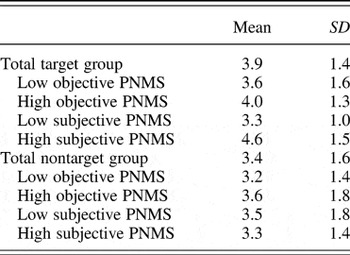
Table 1 presents the means and standard deviations for the children's ARCA by sample: total sample, low and high objective PNMS, and low and high subjective PNMS samples. Although the ARCA is slightly higher in the target than nontarget-exposed group, the difference was not great enough to be considered significant, t (95) = 1.275, p = .2053.
Means and standard deviations for the children's average ridge count asymmetry as a function of exposure group

Note: PNMS, prenatal maternal stress.
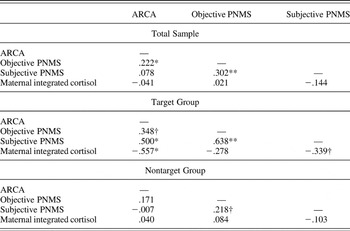
Correlations between the children's ARCA and the mothers' levels of objective and subjective stress
As indicated in Table 2, when the full sample was analyzed, maternal objective stress was significantly correlated to the children's ARCA: higher levels of maternal objective stress were mildly related to greater ARCA in the children. Neither maternal subjective stress nor maternal integrated cortisol was significantly related to the children's ARCA in the total sample.
Correlations between the independent variables (maternal objective PNMS, maternal subjective PNMS, maternal integrated cortisol) and the dependent variable (children's ARCA)

Note: PNMS, prenatal maternal stress; ARCA, average ridge count asymmetry. Full sample: n = 97 for ARCA, objective and subjective PNMS; n = 89 for maternal integrated cortisol; target group: n = 20 for ARCA, objective and subjective PNMS; n = 17 for maternal integrated cortisol; nontarget group: n = 77 for ARCA, objective and subjective PNMS; n = 72 for maternal integrated cortisol.
One- or two-tailed significance levels: †p < .10. *p < .05. **p < .001.
The sample was then divided into target and nontarget groups. For the nontarget group, neither objective nor subjective stress correlated significantly with ARCA. For the target group, however, maternal subjective stress was significantly and moderately correlated with the children's ARCA: higher levels of maternal subjective stress were related to greater ARCA in the children. The correlation between objective stress and ARCA also neared significance (p = .066). In the target group, but not in the nontarget group, there was also a strong and significant positive correlation between objective stress and subjective stress, suggesting the possibility that subjective stress mediates the indirect effects of objective stress during vulnerable periods of pregnancy. Consistent with Baron and Kenny's (Reference Baron and Kenny1986) approach to testing mediating effects, this hypothesis was supported by the finding that the standardized regression coefficient for objective stress on ARCA in the target group (B = .348, p = .133) falls to a much smaller value (B = .049, p = .859) after the entry of subjective stress into the equation.
Exposure group differences in ARCA
The results of the analysis of variance (ANOVA) revealed a significant exposure Group × Subjective Stress interaction. Follow-up analyses indicate that children in the target group whose mothers reported high levels of subjective stress had significantly greater ARCA (M = 4.6, SD = 1.5) compared to other children in the target group whose mothers reported experiencing low levels of subjective stress (M = 3.3, SD = 1.0), F (1, 19) = 5.95, p = .025, with an effect size of 1.1. No significant differences in ARCA were observed for children in the nontarget group whose mothers reported experiencing low or high levels of subjective stress.
Correlations between maternal integrated cortisol levels and the children's ARCA
As presented in Table 2, a significant negative correlation was obtained between the mothers' integrated cortisol levels and the ARCA for children in the target group (r = −.557, p < .05): lower maternal integrated cortisol levels were associated with greater average ridge count asymmetries in the children. The correlation between maternal integrated cortisol levels and ARCA for children in the nontarget group was near zero.
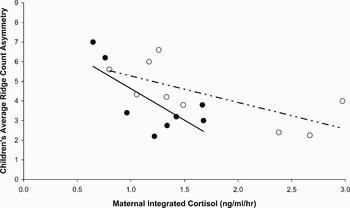
As illustrated in Figure 1, when the target group was divided according to the pregnancy status of the mother at the time of the salivary cortisol sampling, significant negative correlations were obtained between maternal integrated cortisol levels and the children's ARCA for women who were still pregnant at the time of sampling (n = 9; r = −.704, p < .05) and for those who had already given birth (n = 8; r = −.731, p < .05). In both instances, lower maternal integrated cortisol levels were related to greater ARCA in the children. For the nontarget group, no significant correlations were observed between maternal cortisol levels and the children's ARCA for the women who were either still pregnant (n = 47; r = .112, p = .45) or for those who had already given birth (n = 25; r = −.106, p = .62) at the time of sampling.
The association between maternal integrated cortisol levels and the children's average ridge count asymmetry for the group exposed to the ice storm between Weeks 14 and 22 shown separately for women who were still pregnant at the time of sampling (n = 9; open circles, dot–dash line) or who had already given birth at the time of sampling (n = 8; solid circles and line).

Discussion
Research has shown that dermatoglyphic asymmetries are associated with psychological disturbances such as schizophrenia (Weinstein et al., Reference Weinstein, Diforio, Schiffman, Walker and Bonsall1999). It is believed that environmental insult during prenatal development, including that stemming from PNMS, plays a role in the development of these dermatoglyphic asymmetries. However, evidence for this is based solely on nonhuman primate research because researchers cannot randomly assign pregnant women to stress or no-stress groups. Moreover, because the research in this area has been limited to nonhuman primates, it remains unknown whether it is the objective stress exposure per se, or the pregnant females' psychological or hormonal reaction to the stress, that is the active ingredient behind the association between PNMS and increases in dermatoglyphic asymmetries.
The 1998 Quebec ice storm provided a unique opportunity to determine whether PNMS is related to dermatoglyphic asymmetries in a human population for several reasons. First, the objective hardship experienced by large numbers of pregnant women exposed to the ice storm was randomly distributed within the population: women in the affected region were deprived of electricity during the coldest month of the year for anywhere from several hours to several weeks without regard to education or occupational status. Second, the nature of the ice storm permitted us to separate three aspects of PNMS: what was experienced by the pregnant women (objective stress exposure), their subjective reaction to their experience (subjective stress), and their hormonal response (cortisol secretion). Third, we were able to determine the timing of the stressor during pregnancy for each woman with great accuracy, which cannot be done in retrospective studies of other forms of PNMS (e.g., Lou et al., Reference Lou, Nordentoft, Jensen, Pryds, Nim and Hemmingsen1992). Thus, the 1998 Quebec ice storm provided a unique opportunity to assess the effects of randomly distributed PNMS on the developing human fetus.
The importance of parsing the stress exposure and response into objective, subjective, and hormonal is supported by the differential associations among these three aspects, and between each one and outcomes. These associations may differ according to the timing in pregnancy of the stress exposure, as some studies have found women to become less responsive to stress as the pregnancy progresses (Glynn, Wadhwa, Dunkel Schetter, Chicz-Demet, & Sandman, Reference Glynn, Wadhwa, Dunkel Schetter, Chicz-Demet and Sandman2001).
Our results suggest that the Quebec ice storm was of sufficient magnitude to influence the physical development of unborn children. In the well-controlled macaque study, the females in the stress group were captured daily throughout most of the pregnancy, resulting in an effect size of 0.72 for fingerprint asymmetry (Newell-Morris et al., Reference Newell-Morris, Fahrenbruch and Sackett1989), whereas the degree of hardship experienced by pregnant women as a result of the ice storm resulted in an even larger effect size of 1.1 for those exposed during the critical weeks. If there is a tendency for greater objective hardship to produce greater distress, larger scale events of a more lethal nature, such as the terrorist attacks of 9/11 or recent natural disasters such as the Asian tsunami, hurricane Katrina, and the Pakistani earthquake, would be likely to produce disruptions in prenatal physical development of even greater magnitude than those observed as a result of the ice storm.
Our results also provide preliminary answers to questions about the underlying process. Although the objective severity of the stress exposure was moderately correlated with finger ridge count asymmetry when the full sample was analyzed, the women's degree of subjective distress emerged as a much stronger predictor of dermatoglyphic asymmetry for the subsample of children exposed during critical Gestation Weeks 14–22. The moderating effects of the timing during pregnancy is supported by both the statistically significant interaction in the ANOVA when the IES-R was split at the median, and by the significant correlation between the continuous IES-R and ARCA for the target group only. The significant interaction found indicates that the greatest ARCA was observed in children exposed in utero to the ice storm between Weeks 14 and 22 of gestation and whose mothers experienced high levels of subjective stress.
Before concluding that objective hardship is unimportant in the process, however, it is important to consider that objective and subjective stress are highly correlated within the target group (r = .638); the correlation of .218 obtained for the nontarget group may echo results of studies showing that women become progressively less responsive to stress as the pregnancy progresses beyond the second trimester (Glynn et al., Reference Glynn, Wadhwa, Dunkel Schetter, Chicz-Demet and Sandman2001). Thus, given a vulnerable time point in gestation, the more severe the objective hardship, the greater the woman's subjective distress, which then triggers a cascade of physiological events leading to disrupted development whose clues are left behind in the children's fingerprints. Objective stress exposure, therefore, appears to have a positive indirect effect on fingerprint asymmetry.
Our results regarding maternal cortisol must be interpreted with caution given the small numbers of subjects for whom these data were available. Our results suggest the possibility, however, that the mother's diurnal cortisol secretion may play a role, albeit paradoxical, in this process, and that evidence of this may be seen even when assessing cortisol several months after the resolution of the traumatic event. Degrees of objective and subjective stress were only mildly, and negatively, correlated with maternal cortisol, which was found to have the strongest correlation with the children's dermatoglyphic asymmetry. This suggests that the effects of subjective stress and of cortisol may be relatively independent and additive. Of interest, for the target exposure group, maternal integrated cortisol levels were negatively related to the children's average ridge count differences: our findings suggest that lower, rather than higher, maternal integrated cortisol levels obtained following a natural disaster may play a disruptive role in finger ridge count formation. If these results, from an admittedly small sample of 17 mother–child pairs, are replicated, they may contribute to a larger debate in the literature on whether lower cortisol levels in patients with PTSD are the result of powerful negative feedback loops within the hypothalamic–pituitary–adrenal (HPA) axis that dampen acute bursts of stress hormones at the time of the stressor, or whether lower cortisol levels are a relatively stable trait that preexist the trauma but represent a physiological vulnerability to developing PTSD symptoms in the face of a traumatic event (Young & Breslau, Reference Young and Breslau2004). The PTSD-like symptoms assessed by the IES-R could be associated with increased central and peripheral catecholamines and vasoconstriction of the placental artery, which would limit blood flow to the fetus. Unfortunately, although our data may contribute to this debate, they are incapable of resolving it.
Similarly, although fingerprints develop at about the same time as the hippocampus, our findings provide only indirect support for the idea that the prenatal stress from the ice storm resulted in potential alterations in brain development. In previous analyses with the current sample, we showed significant differences in the level of intellectual and linguistic development as a function of the severity of the mothers' objective exposure to the ice storm (Laplante et al., Reference Laplante, Barr, Brunet, Galbaud du Fort, Meaney and Saucier2004): toddlers whose mothers were exposed to high levels of objective PNMS because of the ice storm had lower Bayley Mental Developmental Index scores, and understood and spoke fewer words compared to toddlers whose mothers were exposed to low levels of objective ice storm stress. Based upon the animal literature (Weinstock, Reference Weinstock2001), we suspect that PNMS influences postnatal cognitive development through its impact on the fetal HPA axis. Animal research indicates that elevated levels of PNMS alter the functioning of the fetal HPA axis resulting in permanent changes to brain structures (Weinstock, Reference Weinstock2001), in particular, the hippocampus (Takahashi, Reference Takahashi1998; Uno et al., Reference Uno, Eisle, Sakai, Shelton, Baker and DeJesus1994), thereby resulting in poorer cognitive functioning (Schneider, Reference Schneider1992). Other relevant data show that MPAs are associated with altered cerebral morphology (DeMyer et al., Reference DeMyer, Gilmor, Hendrie, DeMyer, Augustyn and Jackson1988; Rubin et al., Reference Rubin, Vorstrup, Hemmingsen, Andersen, Bendsen and Stromso1994; Weinberger & Wyatt, Reference Weinberger, Wyatt and Usdin1982). Taken collectively, then, these data and the current results suggest that finger ridge count asymmetry may be a potential marker for alterations in limbic structures in children exposed in utero to high levels of maternal stress. This conclusion is speculative, however, and requires imaging of the children's hippocampal formations to provide more direct evidence of such an effect.
Based upon our results from this study of human children exposed to varying levels and types of PNMS from the ice storm, we conclude that, although all three indices of PNMS (objective exposure, subjective stress response, and maternal cortisol) are associated with dermatoglyphic asymmetry, it is the subjective and hormonal indices that have the greater effects in the vulnerable subjects exposed during the target weeks of pregnancy. Objective severity of exposure to the ice storm, however, retains its importance in Project Ice Storm by having a weak but significant correlation with dermatoglyphic asymmetry in the total sample and by having a strong effect on intellectual and language functioning at age 2 years (Laplante et al., Reference Laplante, Barr, Brunet, Galbaud du Fort, Meaney and Saucier2004). Thus, the results emerging from Project Ice Storm point toward an intricate interplay among these three components of the stress experience, in interaction with timing during pregnancy, in explaining variance in a variety of physical and cognitive outcomes.
The relevance of dermatoglyphic indices as markers of altered brain development, with subsequent direct effects on other aspects of child development, remains to be shown. In contrast, our exploratory correlations with the present data set suggest that greater ARCA is significantly, but weakly (r < .30), associated with poorer performance at 5.5 years on measures of general IQ, motor balance, and autistic-like behaviors. We hope to present further results of these associations, and associations with brain imaging data, at a later date.
This is the first study to investigate the impact of the exact timing of an independent stressor during pregnancy on finger ridge count formation in humans. We conclude that pregnant women's exposure to a moderately stressful event during the period of fingerprint development results in greater dermatoglyphic asymmetry in their children, particularly when combined with higher levels of maternal subjective distress and, possibly, with lower cortisol levels. Our results highlight the sensitivity of the developing fetus to the environmental conditions, and emotional status, of the mother. These findings have implications not only for public health and safety personnel managing natural and man-made disasters, but also for those who work to protect pregnant women from situations of domestic violence and other forms of stress. Although fingerprint abnormalities are permanent, continued follow-up of our Project Ice Storm cohort will eventually reveal the longevity of the effects of prenatal stress on children's cognitive development, and provide information about potential protective factors contributing to children's resiliency in the face of a difficult prenatal experience.
It must be noted, however, that our results are based on a relatively small group of children. We were able to obtain ARCA scores for only 20 children exposed to the effects of the ice storm during the critical period of finger development. Further replication with a larger sample size is required. Regardless, the present results strongly suggest that stress resulting from an independent stressor may be sufficient enough to alter the development of fingerprints.