Loneliness is defined as an unpleasant experience or feeling associated with a lack of close relationships (de Jong Gierveld, Reference de Jong Gierveld1998). It has two dimensions: social and emotional. According to Weiss (Reference Weiss1973), social loneliness refers to a deficit in a person’s social relations, social network, and social support; and emotional loneliness is a lack of closeness or intimacy with the other. Although loneliness can happen at any age, older people as a population exhibit extra factors that make them more susceptible to it. Retirement, the death of loved ones, their children leaving home, and perceived hostility from the environment can be important risk factors for loneliness to appear in this stage of life (Abellán et al., Reference Abellán, Fernández-Mayoralas, Rojo, Sancho, Pérez, Puga and Castejón2007).
Some studies have reported a prevalence of loneliness in older adults over 45% (Cohen-Mansfield, Hazan, Lerman, & Shalom, Reference Cohen-Mansfield, Hazan, Lerman and Shalom2016; Savikko, Routasalo, Tilvis, Strandberg, & Pitkälä, 2015; Velarde-Mayol, Fragua-Gil, & García-de-Cecilia, Reference Velarde-Mayol, Fragua-Gil and García-de-Cecilia2016; Victor & Bowling, Reference Victor and Bowling2012). Loneliness is a known risk factor for morbidity as well as mortality (Cacioppo et al., Reference Cacioppo, Hawkley, Crawford, Ernst, Burleson, Kowalewski and Berntson2002). It is an important public health matter that predicts low quality of life in older adults (Chalise, Kai, & Saito, Reference Chalise, Kai and Saito2010).
Cohen-Mansfield et al.’s (2016) review of loneliness predictors in the elderly analyzed 38 international studies, positing as sociodemographic predictors being a woman, unmarried, older, lower-income, and having a lower level of education. Living alone, living in a rural area, and having low-quality social relations are other social aspects with noteworthy links to loneliness in older people. Other variables related to feelings of loneliness include poor health and low level of functioning, because they can make it hard for a person to leave the house and attend social engagements. Cohen-Mansfield et al.’s (2016) review highlights some psychological features associated with loneliness in older people, such as depression, low self-efficacy beliefs, negative life events, and cognitive deficit. It is hard to discern whether loneliness is the cause or consequence of these psychological characteristics since hardly any longitudinal research has explored that question. Losada et al. (Reference Losada, Márquez-González, García-Ortiz, Gómez-Marcos, Fernández-Fernández and Rodríguez-Sánchez2012, Reference Losada, Márquez-González, Pachana, Wetherell, Fernández-Fernández, Nogales-González and Ruiz-Díaz2015) as well as Cohen-Mansfield & Parpura-Gill (2007) reported that loneliness and mental health are connected.
Previous studies have sometimes used just one item to evaluate loneliness, and most have only addressed the depression variable when analyzing the association between loneliness and mental health. Also, mental disorders have not been discerned through structured diagnostic interview. Moreover, past studies of older people more advanced in age (over 75) are under-represented in the literature. The present study examines sociodemographic, psychosocial, and mental health variables related to loneliness in older people. It attempts to overcome the above limitations; to do so it employed a standardized instrument to evaluate loneliness, structured diagnostic interview to assess the main diagnostic categories, and a sample of older persons in which people over 75 are amply represented.
Methods
Sample and procedure
The sample was obtained from a longitudinal study – the MentDis_ICF65+ (health and well-being of people between 65 and 84 years old in Europe) (Andreas et al., Reference Andreas, Härter, Volkert, Hausberg, Sehner, Wegscheider and Schulz2013, Reference Andreas, Schulz, Volkert, Dehoust, Sehner, Suling and Härter2016) – and was collected in the Community of Madrid in urban as well as rural areas. The sample was randomly selected from a population over 65 years old and less than 84 years old. It was stratified by age (65–74 and 75–84) and sex in order to balance the groups in terms of those variables.
The sample was facilitated by the Instituto de Estadística de la Comunidad de Madrid and by a statistical research company.
The criteria for inclusion in the sample were the following: a) residing in the Community of Madrid; b) being 65 to 84 years old; c) able to provide informed consent to participate in the study. The criteria for exclusion from the sample were the following: a) exhibiting severe cognitive deficit; b) unable to communicate adequately through language to be interviewed.
We contacted older people via a written letter of invitation and a phone call. The interviews were conducted at the older participants’ homes and lasted 95 minutes on average.
The Ethics Committee at Madrid Complutense University approved the procedure for gathering a sample and furnishing participants’ informed consent to participate in the study.
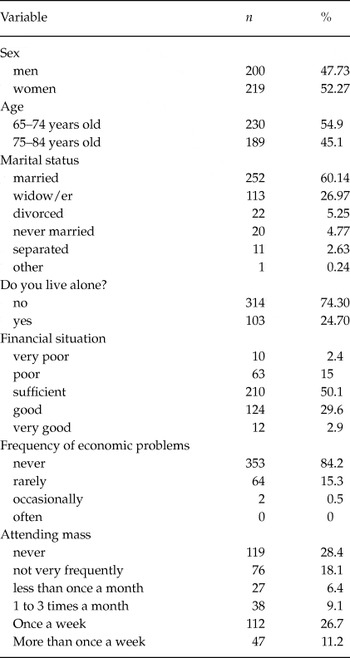
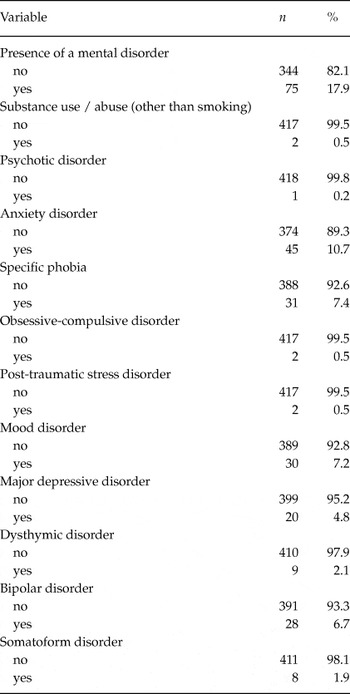
The sample was comprised of 419 people with a mean age of 74.85 years. Its characteristics appear in Tables 1 and 2. Participants had 2.45 children on average. Their mean years of schooling was 9.19 years. 17.9% of the sample had a mental disorder in the past year.
Sociodemographic Characteristics of the Sample (N = 419)

The Sample’s (N = 419) Mental Health Diagnoses in the Past Year (DSM-IV)

Instruments
Sociodemographic variables were evaluated using a brief questionnaire designed for that purpose.
Perceived loneliness was gauged by the UCLA Loneliness Scale (Russell, Reference Russell1996; Spanish version by Prieto, Ricchetti, Hernández-Jorge, & Rodríguez-Naveiras, Reference Prieto, Ricchetti, Hernández-Jorge and Rodríguez-Naveiras2008), a 20-item self-report measure. All items were scored from one to four, one being never, two rarely, three sometimes, and four always.
Mental health variables were ascertained by the Composite International Diagnostic Interview for people over 65 years old (CIDI65+) (Wittchen et al., Reference Wittchen, Strehle, Gerschler, Volkert, Dehoust, Sehner and Andreas2014), which determines if mental disorder diagnoses are present. The CIDI65+ was adapted to older people’s abilities and needs in terms of social, cognitive, and psychological aspects, and produces diagnoses according to the criteria of the Diagnostic and statistical manual of mental disorders DSM-IV-TR classification system American Psychiatric Association (2000).
Quality of life variables were assessed by the short-form version of the World Health Organization Quality of Life Assessment (WHOQoL-BREF) (WHOQoL Group, 1998; Spanish-language version by Espinoza, Osorio, Torrejón, Lucas-Carrasco, & Bunout, Reference Espinoza, Osorio, Torrejón, Lucas-Carrasco and Bunout2011). Each question is answered on a scale of 1 to 5, with higher scores indicating higher quality of life.
Last, a questionnaire was created to evaluate aspects relating to: financial problems; being burdened with the care of another person; and religious practices.
Statistical analysis
All analyses in this study were carried out using the psych package (Revelle, Reference Revelle2015) of R statistics software (R Core Team, 2014). To describe and separately compare each sociodemographic, clinical, and psychosocial variable, contrasts for independent samples were carried out along with Pearson correlations. Our dependent variable (loneliness) deviated slightly from normal distribution (skew = 1.11; Kurtosis = 1.29), which is often the case for this type of variable. We chose to present parametric contrasts (Student’s t test, Analysis of Variance) in the results given their demonstrated robustness when there are slight deviations from normal distribution in large samples, and because their non-parametric counterparts produced identical results.
To examine the influence of this study’s variables on loneliness, a linear regression model was created manually. It was estimated using the method of least squares and a criterion for variable selection based on statistically significant change in R 2 . Automatic stepwise-type procedures based on R 2 and AIC were utilized to test the result’s stability. The assumption of homoscedasticity was tested by visual inspection of the standard residuals. Absence of collinearity was ensured by a procedure including variables in the model in which the factor of variance inflation was taken into account.
Results
Relationship between loneliness and sociodemographic, psychosocial, and mental health variables
Table 3 presents means comparisons for the sociodemographic, quality of life, and mental health variables of interest, and correlations with relevant psychosocial variables. The results in Table 3 clearly indicate significant differences for the variables Living Alone; Marital Status such that married people scored lower (1.46); Frequency of Economic Problems such that people without such problems were less lonely on average (1.50); Quality of Life such that people with very good quality of life have lower mean scores (1.32); Life Satisfaction, such that people who are satisfied with their lives have a lower mean (1.45); Satisfaction with Social Relations, for those very satisfied with their relationships (1.35); Presence of a Mental Disorder, with an average of 1.66 for participants with a diagnosis versus 1.49 for those without; and Anxiety Disorder such that people with an anxiety diagnosis had higher loneliness levels (1.67) than those without (1.51). Meanwhile no significant differences were found for these variables: Sex, Financial Situation, Attending Mass, Mood Disorder, Major Depressive Disorder, Dysthymic Disorder, Bipolar Disorder, Somatoform Disorder, and Substance Use/Abuse Disorder.
Means Comparison of Sociodemographic, Quality of Life, and Mental Health Variables of Interest, and Correlations with Pertinent Psychosocial Variables

Descriptive data and contrasts: Each box holds the mean and standard deviation (in parentheses). The last row reports results for each contrast (Student’s t or F, depending on which is applicable). Those under 0.05 are in bold. Correlations: Those that were significant appear in bold. *p < .05 **p < .01; *** p <.001.
The bottom of Table 3 presents Pearson correlations between loneliness and the variables age, number of children, how many people they live with, years of schooling, number of psychiatric diagnoses in the past year and past month, and level of functioning. Three of the correlations were found to be statistically significant (how many people they live with – which correlated negatively – and number of psychiatric diagnoses in the past year and past month).
Regression Analysis
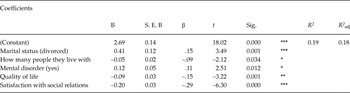
Table 4 presents direct and standardized coefficients from the resulting equation, the selected variables being: marital status, how many people they live with, presence of a mental disorder, quality of life, and satisfaction with social relations. Those variables explained 19% of variance in loneliness in this elderly sample (R 2 = .19 and R 2 adjusted = .18).
Direct and Standardized Coefficients of the Regression Line that Best Explains Loneliness Scores, Comprised of the Variables: Marital Status (Divorced), How Many People they Live With, Presence of a Mental Disorder, Quality of Life, and Satisfaction with Social Relations

B = Unstandardized coefficient.
S.E.B = Standard error of estimation in B.
β = Standardized coefficient.
t = Contrast statistic.
Sig.= *p < .05 **p < .01; *** p < .001.
R 2 = Coefficient of determination.
R 2 adj = adjusted coefficient of determination.
Discussion
Perceived loneliness in older people and the variables associated with it have been widely studied, as Cohen-Mansfield et al. (Reference Cohen-Mansfield, Hazan, Lerman and Shalom2016) note in their review. However, previous studies under-represented the older people most advanced in age, often employed just one item to evaluate loneliness, and most used the depression variable alone to analyze the association between loneliness and mental health (and did not evaluate it through structured diagnostic interview). The present study examined sociodemographic, psychosocial, and mental health variables related to loneliness in older people while attempting to overcome those limitations.
Below we discuss results pertaining to the relationship between loneliness and the sociodemographic variables: living alone, age, sex, marital status, financial problems, attending mass, and level of education.
Regarding the relationship between loneliness and sociodemographic variables, like every study, we found that people who live alone experience more feelings of loneliness. In contrast, this study did not find a relation between age and loneliness, surely because the sample was stratified by age and sex and had a similar proportion of men and women. Conversely, past studies (Cohen-Mansfield et al., Reference Cohen-Mansfield, Hazan, Lerman and Shalom2016) included more women since their life expectancy is longer and they therefore tend to more often endure loss, of loved ones and of broader social networks. We must add that it is easier for women than men to admit and express feelings of loneliness.
With respect to Marital Status, separated individuals reported feeling the highest loneliness levels, followed by divorced participants, widows and widowers, people who never married, and married people. Of the 38 studies Cohen-Mansfield et al. (Reference Cohen-Mansfield, Hazan, Lerman and Shalom2016) analyzed, 18 obtained similar results as the present study in this regard. It could be that single and widowed individuals lack, or lose, the support of a partner who could serve as a confidant with whom to share thoughts and feelings (Paul & Ribeiro, Reference Paul and Ribeiro2009). Similarly, single people are less likely to have children, who could provide social support.
As for the age variable, 11 of the studies Cohen-Mansfield et al. (Reference Cohen-Mansfield, Hazan, Lerman and Shalom2016) analyzed indicate this is a risk factor for loneliness, but 5 actually found an inverse relation between age and loneliness. Those results were from studies with samples around age 50 that underrepresented people over 75 years old. When, conversely, studies have gathered samples of people over 75, the direct relation between age and loneliness is clear. That is consistent with the present study’s findings, probably because our sample had a similar proportion of participants in both strata (65–74 years and 75–84 years). The age-loneliness relationship could be mediated by the increased physical limitations that occur with age and can diminish a person’s chances of maintaining social relationships. Other possible mediating variables include the ones noted in widows, such as the loss of loved ones.
The variable Frequency of Economic Problems revealed that the more financial problems a person has, the greater their sense of loneliness. That finding is consistent with 25 of the 38 studies Cohen-Mansfield et al. (Reference Cohen-Mansfield, Hazan, Lerman and Shalom2016) analyzed. Having a low income limits one’s ability to attend certain social events. Likewise, low income can affect self-esteem and self-efficacy and as a result reduce social contacts and increase feelings of loneliness (Fry & Debats, Reference Fry and Debats2002). No relation was observed nonetheless between loneliness and Financial Situation. Perhaps people are affected more by having financial problems than by low income itself.
Attending Mass showed no relationship to feelings of loneliness. Contrary to expectations, no connection was found between Number of Children and loneliness either (5 of the studies Cohen-Mansfield et al. analyzed (2016) reported a children-loneliness relationship).
Another variable we examined was level of education, which can affect income as well as access to resources. The present study found no relation between Years of Schooling and loneliness.
In addition to examining the relationship between loneliness and certain sociodemographic variables, we sought to analyze the relation between loneliness and variables pertaining to quality of life and level of functioning. As for the relation between loneliness and Quality of Life, we should point out that older people who reported a higher proportion of feelings of loneliness reported lower quality of life. Meanwhile, Satisfaction with Life and Satisfaction with Social Relations were directly related to feelings of loneliness. This study’s results supported the aforementioned findings.
However, no relation was found between Level of Functioning and loneliness. That result contradicts previous studies which observed that poor levels of functioning predicted loneliness in older people (Cohen-Mansfield et al., Reference Cohen-Mansfield, Hazan, Lerman and Shalom2016). Perhaps that is because the present study assessed level of functioning by means of a single self-report item.
The relationship between loneliness and having a mental disorder was examined in 12 of the 38 studies reviewed in Cohen-Mansfield et al. (Reference Cohen-Mansfield, Hazan, Lerman and Shalom2016), but they limited themselves to analyzing loneliness in relation to depressive disorder only (or a tendency toward depression, since they did not use structured diagnostic interview). The present study wished to expand the number of psychiatric disorders analyzed in relation to loneliness, and it evaluated them through structured diagnostic interview adapted for people over 65 years (CIDI65+, Wittchen et al., Reference Wittchen, Strehle, Gerschler, Volkert, Dehoust, Sehner and Andreas2014). We also used a more inclusive variable, called Presence of a Mental Disorder, to encompass all remaining psychiatric diagnoses (mood disorders, anxiety disorders, substance use/abuse-related disorders, psychotic disorders, and somatoform disorder). We found that this variable was tied to a higher proportion of feelings of loneliness. In analyzing psychiatric disorders separately, we found that the only diagnostic category related to loneliness to a statistically significant extent was Anxiety Disorder.
Statistically significant differences were not observed for the variables Mood Disorder, Major Depressive Disorder, Dysthymic Disorder, Bipolar Disorder, or Somatoform Disorder, nor for Substance Use/Abuse Disorder.
Looking at Pearson correlations between loneliness and the variables age, number of children, how many people they live with, years of schooling, number of psychiatric diagnoses in the past year and past month, and level of functioning, three turned out to be statistically significant (number of psychiatric diagnoses in the past year and past month, and how many people they live, which correlated negatively).
Of all the variables found to have a relationship to feelings of loneliness, multiple regression analyses ultimately led us to confirm that marital status, how many people they live with, presence of a mental disorder, quality of life, and satisfaction with social relations explained 19% of total variance in loneliness.
The results presented in this study highlight some predictors of loneliness in older adults, the goal being to intervene with people before feelings of loneliness set in. This study furthermore attempted to rectify the limitations of similar past studies.
One limitation of this study was its exclusion of older people with cognitive deficit (because they could not complete a structured psychiatric diagnostic interview). Future research should address this population with deficit, elucidate their feelings of loneliness and barriers to access to a social network, and seek out strategies to mitigate their loneliness.