

1. IntroductionFootnote 1
Gender assignment in languages with formal assignment systems has been a topic of much discussion in recent years, not least in the Scandinavian languages, which show interesting patterns of variation in gender assignment. While most mainland Scandinavian languages have developed a two-gender system (merging the Proto-Germanic masculine and feminine genders into a single ‘uter’ or ‘common’ gender), a few, including many rural dialects, have maintained a three-gender system. These varieties often show marked differences from gender assignment in the standard languages (for instance in Norwegian; see Enger Reference Enger and Siemund2011, Kvinlaug Reference Kvinlaug2011, Enger & Corbett Reference Enger and Greville G.2012; and in Finland-Swedish; see Rabb Reference Rabb2007, Sandström Reference Sandström2010).
In this study, we attempt to uncover some of the strongest tendencies for gender assignment in the Jamtlandic variety of Scandinavian. We then look at how these principles overlap and interact in order to draw conclusions about their relative strength and whether or not certain generalizations take precedence over others. We also perform a multinomial logistic regression analysis in order to test the validity of some of the predictors.
We begin by giving a brief background on existing work on gender assignment and an introduction to Jamtlandic (Sections 2–3). We describe our methodology in Section 4. In Sections 5–7 we present our gender assignment tendencies for Jamtlandic. In Section 8, we discuss the relative strengths of the assignment principles,Footnote 2 based on how reliably they apply. We also discuss how assignment principles interact in situations of conflict, and how certain tendencies can reinforce each other. We further discuss the results of our statistical analysis and the implications it has for gender assignment. In Section 9 we discuss gender assignment in modern loanwords, in Section 10 we discuss relative strength of assignment tendencies and default gender, and in Section 11 we provide a brief conclusion.
2. Gender: Background and previous research
Grammatical gender can be defined as ‘classes of nouns reflected in the behavior of associated words’ (Hockett Reference Hockett1958:231, from Corbett Reference Corbett1991:1). That is, gender is shown through agreement of various elements (targets) with their head nouns (controllers). Gendered languages have varying ranges of values (the number of genders present). In addition, they vary with respect to assignment, or how individual lexical items receive a gender (Audring Reference Audring, Paciaroni, Loporcaro and Anna2014:7). Gender assignment is the main focus of our study. Furthermore, in this study we are interested in the gender a noun possesses in a general sense, rather than in a specific context. Thus, (following Dahl Reference Dahl, Unterbeck, Rissanen, Nevalainen and Saari2000) we look at lexical rather than referential gender; also referred to as syntactic rather than semantic gender (Corbett Reference Corbett1991:225).
Some languages assign gender solely on the basis of semantic principles; these languages are said to have semantic assignment systems. Semantic systems usually assign gender according to cognitively salient categories. Other languages have formal assignment systems: they assign gender on the basis of both semantic and formal criteria.Footnote 3 Formal assignment can in turn be divided into morphological assignment and phonological assignment. Languages with phonological gender assignment allocate gender primarily on the basis of the phonological form of nouns. In languages with predominantly morphological gender assignment, inflectional classes can be used to predict gender. Another type of morphological gender assignment relies on derivational suffixes indicating a particular gender for the words in which they appear (as in German; see Corbett Reference Corbett1991:49–50); this is also the case in Scandinavian languages (Källström Reference Källström1996:159; Trosterud Reference Trosterud2001:43–44, Reference Trosterud, Enger, Nesset and Rice2006:1451–1460).
Corbett (Reference Corbett1991:86) states that for gendered languages which have been studied in depth, the gender of at least 85% of the nouns can be predicted from information required independently in the lexicon. Although it might not be possible to completely map out gender assignment in a language with formal assignment, this does not mean that we cannot discover worthwhile generalizations. As Mel’čuk (Reference Mel’čuk and Rozencvejg1974:33) puts it, rules can be valuable even if there are exceptions, and a rule that assigns the correct gender to a large proportion of the nouns in a language is still of theoretical interest. Likewise, it is unreasonable to assume that gender assignment must be completely arbitrary simply because it is not fully predictable (Enger Reference Enger2001:166–169).
There has been much debate over which kinds of rules take precedence in gender assignment. Corbett (Reference Corbett1991) and Corbett & Fraser (Reference Corbett, Fraser and Senft2000) give priority to semantic criteria, asserting that major semantic rules take precedence over formal rules. In other approaches, rules are seen as unranked, and are simply tallied to determine which gender is assigned. In the case of a tie, the default gender is assigned. This basic approach is taken by Steinmetz (Reference Steinmetz and Faarlund1985, Reference Steinmetz1986, Reference Steinmetz2006) and Rice (Reference Rice2006).
Others have proposed amendments to Corbett’s ‘semantics first’ stance: Nesset (Reference Nesset, Enger, Nesset and Rice2006) asserts that only the semantic core (based on biological sex) takes precedence over formal rules. Thornton (Reference Thornton2009) sides with Corbett in that semantic rules always win, confronting the issue of counterexamples by severely constraining the types of semantic assignment rules that are acceptable.Footnote 4 In contrast, Enger (Reference Enger2009) argues for the existence of ‘crazy’ rules (non-core semantic rules that cover smaller semantic domains), but argues that these too should be constrained (see Section 5.3).
A persistent question in the literature on gender assignment is how we determine what constitutes a valid assignment rule (see for instance Enger Reference Enger2009). Nevertheless, there seems to be a reluctance to draw boundaries based on the numbers of nouns that rules cover and the number of exceptions. This appears to be justified, as it would be questionable to draw an arbitrary line somewhere separating ‘rules’ from other possible tendencies which are judged to have too many exceptions or cover too few nouns. However, it is equally questionable to refer to something as a ‘rule’ if it only correctly predicts gender, say, 55% of the time. For this reason, we present our assignment principles as ‘tendencies’ rather than ‘rules’. In Section 8, we explore the interaction between these tendencies, including how evidence from our data contributes to the ‘semantics first’ debate. While we do not attempt to assemble an exhaustive list of gender assignment principles for Jamtlandic, we aim to establish some clear tendencies for gender assignment, in enough detail to be able to draw comparisons to related Scandinavian languages (in a forthcoming paper).
3. The Jamtlandic variety of Scandinavian
Jamtlandic is spoken mainly by older speakers, born around 1970 or earlier, in the region of Jämtland, located in northwestern Sweden at the Norwegian border.Footnote 5 Jamtlandic is distinguished from Swedish by several features, including differences in nominal morphology (a three-gender system, the maintenance of the dative case, and different plural forms), differences in verbal inflection, and maintenance of diphthongs inherited from Old Norse (see Oscarsson & Nygren Reference Oscarsson, Nygren and Ohlson1973).
There has historically been some speculation as to the genealogical affiliation of Jamtlandic. Jamtlandic shares many features of both Norwegian and Northern Swedish dialects, and has a varied socio-political history, as it was a part of Norway from around 1100 to 1645 (although it still belonged to the archbishopric in Uppsala) (Kardell Reference Kardell, Ahlenius and Sjögren1924, Bromé Reference Bromé1945, Ahnlund Reference Ahnlund1948). While some sources (e.g. Wessén Reference Wessén1945:39; Pamp Reference Pamp1978:127) list Jamtlandic as a dialect of Swedish, others (Noreen Reference Noreen1903:112; Österberg Reference Österberg1914:5; Haugen Reference Haugen1982:9) count it as a West Scandinavian variety, descended directly from Old Norse and more closely related to Norwegian than to Swedish. Support for this view includes some of Jamtlandic’s phonological characteristics, such as /u/ instead of /o/ in words such as bu ‘nest’ (compare Swedish bo) and ku ‘cow’ (compare Swedish ko), and the maintenance of the Old Norse diphthongs (as in bein ‘leg’ and höy ‘hay’) (see Noreen Reference Noreen1903:112–113). As of now, there is insufficient research on the topic of Jamtlandic’s genealogical position within the Scandinavian language family. Its position is made still more obscure by the long history of contact with both Swedish and Norwegian dialects. Further research is necessary to determine Jamtlandic’s genealogical relationship with more certainty.
Jamtlandic makes an interesting object for a study on gender assignment because it maintains the three gender system from Old Norse and Proto-Germanic (masculine, feminine, and neuter), while contemporary Standard Swedish now has a two-gender system (the masculine and feminine distinction has collapsed into a single ‘uter’ or ‘common’ gender; see Haugen Reference Haugen1982:105). Examples (1)–(3) show Jamtlandic nouns with the indefinite marker (masculine, feminine, and neuter):
(1)


(2)

(3)

Examples (4)–(6) show anaphoric pronouns in Jamtlandic (masculine, feminine, and neuter).Footnote 6, Footnote 7
(4)

(5)

(6)

While the three-gender system is still robust in Jamtlandic, it has been influenced to some degree by the gender system of Standard Swedish (Van Epps & Carling Reference Van Epps and Carling2017). This complicates the study of gender assignment in the dialect. We expect to find some irregularity in gender assignment tendencies due to the changing gender system.
4. Method
In this study, we investigate how gender assignment can be predicted by semantic, morphological, and phonological factors. We begin by looking at some well-established tendencies for gender assignment in Scandinavian languages, including core semantic tendencies, derivational suffixes, and plural inflection. We also include the results of an in-depth phonological analysis, as well as some additional semantic generalizations that we find to hold true for our data. We then discuss some interactions and conflicts between the assignment tendencies, drawing conclusions as to what these interactions can tell us about gender assignment. In addition, we perform a statistical analysis in order to determine whether or not the weaker predictors have a significant effect on the gender of a noun. This is not intended to be a complete list of rules for Jamtlandic, as it is our view that it is not possible to develop rigid ‘rules’; it is merely an observation of the most salient patterns.
4.1 Data collection
The data for our study consists of a list of 1029 Jamtlandic nouns and their gender. The main inspiration for the list comes from Haspelmath & Tadmor’s (Reference Haspelmath and Tadmor2009) World Loanword Database (WOLD). This is an extensive and varied list of word meanings organized by semantic fields. We chose to use this as a base in order to obtain a wide range of concepts denoted by the nouns we would investigate. We removed some concepts that we judged would be unknown or irrelevant to Jamtlandic speakers (such as ‘cassava’, ‘tapir’, ‘manioc bread’, and ‘banyan tree’). Likewise, we added concepts with certain suffixes (-eri, -ion, -els, -heit, -dom, and -skap) because derivational suffixes have been shown to influence gender assignment in the Scandinavian languages (Källström Reference Källström1996:159; Trosterud 2001:44, Reference Trosterud, Enger, Nesset and Rice2006:1451).
We also added a few modern concepts that were not on the WOLD list in order to investigate how new words are assigned gender. (See Appendix N for the full word list.) We define ‘modern loans’ as words that entered Jamtlandic from the mid-19th century onward. We chose this cutoff point because it can be considered to represent a significant cultural shift in Jämtland. This period was characterized by an accelerating growth rate and a substantial increase in industrialization in Sweden (Magnusson Reference Magnusson2002:106). The rise of new technology during this period led to the introduction of many new words, the majority coming through Swedish. Consequently, the words that were borrowed after this period are influenced by Standard Swedish to a greater degree than those that existed in Jamtlandic prior to this period. The list of words we classified as ‘modern loans’ can be found in Appendix M.
4.2 Elicitation and coding
The fieldwork took the form of seven elicitation sessions, each lasting 40–80 minutes. Participants worked in groups of 6–8. There were 21 participants in total, all born between 1935 and 1966. We chose to focus on older speakers in order to obtain traditional dialect forms; younger people generally do not speak traditional Jamtlandic and are so different from the older speakers that they can be considered a different population (Van Epps & Carling Reference Van Epps and Carling2017). During the elicitation sessions, speakers were given a Swedish word and were asked to provide the Jamtlandic translation along with the indefinite article (definite articles and anaphoric pronouns often came up in the discussions as well). This showed us which gender speakers assigned to each noun. In general, speakers agreed on the gender for the words on the list. There were a few disagreements, most notably for words denoting animals. In these cases, we allowed the speakers to discuss the matter among themselves and kept the gender that speakers agreed on. We kept a record of the gender assigned, and each session was recorded so that we could refer back as needed.
We chose to work with groups of participants, rather than with individuals, in hopes of eliciting discussion about the lexical items. In addition, we wanted to receive input from many speakers instead of just a few. Although it could have been desirable to elicit lexical items using pictures or other stimuli, this was unfortunately not possible for a project of this scope. We are aware that using Standard Swedish to elicit the Jamtlandic lexical items runs the risk of priming speakers to use forms that could be similar to the standard language (Majid Reference Majid and Thieberger2012:56). In an attempt to counteract this, we made it clear that we were interested in obtaining dialect forms. In addition, conducting the elicitation sessions in groups helped to mitigate this – participants were able to speak Jamtlandic with each other as they discussed the lexical items, and they sometimes ‘corrected’ each other when Standard Swedish forms came up.
After the elicitation sessions, we reviewed the recordings and entered each Jamtlandic lexical item into a spreadsheet along with its gender. We also included the plural forms of each noun.Footnote 8 For each noun, we coded for the semantic properties count/mass, human/nonhuman, and male/female. We also coded for semantic field, which we mainly obtained from the original Haspelmath & Tadmor (Reference Haspelmath and Tadmor2009) list.
A final methodological note concerns our decision to leave compound words in the material. In many studies compounds are removed, because it is well-established that a compound word will receive the same gender as the simplex word that is its head (Haspelmath & Sims Reference Haspelmath and Sims2010), and this is certainly true for Scandinavian languages (see for instance Källström Reference Källström1996:154). We decided to include the compound words that were elicited during the field sessions, so that we would not alter and lose data unnecessarily. In addition, we believe that compounds can contribute to generalizations in the minds of speakers, even if the gender of the compound is mainly based on the gender of its head.
4.3 Principles to investigate
Some work on gender assignment in Scandinavian languages uses default genders and a large number of rules, attempting to provide an exhaustive account of gender assignment. Trosterud takes this approach for Norwegian (2001) and Old Norse (2006), using a method influenced by Steinmetz’ (Reference Steinmetz and Faarlund1985, Reference Steinmetz1986) analyses of Icelandic and German. Källström (Reference Källström1996) takes a different approach for Swedish, starting with a discussion of assignment rules taken from Swedish grammars, and then testing the ability of plural forms to predict gender using a test corpus. Though we avoid proposing strict ‘rules’ for gender assignment, the works above provide useful generalizations from which we can begin our analysis. In addition, we draw from Enger’s work on Scandinavian gender assignment (Enger Reference Enger2001, Reference Enger2002, Reference Enger2004a, b, Reference Enger2007, Reference Enger2009, Reference Enger, Dammel, Kürschner and Nübling2010, Reference Enger and Siemund2011, Reference Enger2014; Enger & Corbett Reference Enger and Greville G.2012).
For this investigation, we start from the generalizations that we predict will be the most reliable indicators of gender based on evidence from related languages. We then add a few generalizations that become apparent on further examination of the data. Table 1 shows the areas we chose to investigate.
Gender assignment principles investigated
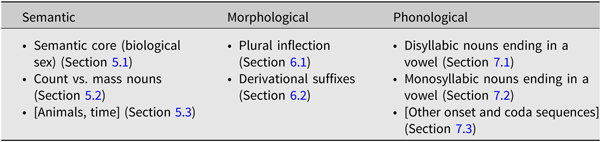
Most of the above principles (aside from those in brackets) are those which have been shown to reliably predict gender assignment in other Scandinavian languages. The brackets in Table 1 indicate areas that are less well-established but that we wished to investigate further to see if any reliable tendencies exist for Jamtlandic.
To determine whether or not these principles are applicable to the Jamtlandic data, we first selected the words in our data set that fell into the relevant categories (see Appendices A–G, K and M). From these lists, we determined the percentage of words that fell into each gender (see Appendix H). This gave us an idea of how useful the various generalizations are for predicting the gender of a noun. For the phonological analysis, we made a list of possible onset and coda sequences, recorded the number of nouns of each gender that fit into each sequence, and grouped the sequences in various ways to see if any patterns became apparent (see Appendices I–J).
An assignment principle can be seen as stronger or weaker – in our study, we base this on the percentage of nouns for which the tendency correctly applies, how it fares against competing assignment tendencies, and whether or not the tendency is statistically significant as determined by a multinomial logistic regression analysis. We present figures indicating the percentage of nouns in a given category for which an assignment tendency holds true. For those principles which we tested statistically, we also include the results of this test. However, it is not necessary to draw strict boundaries as to what constitutes a valid assignment tendency – the existence of a tendency simply increases the likelihood that the nouns that fall within its domain will be assigned a particular gender.
4.4 Overall gender distribution in the material
Our final list contains 1029 words with the following gender distribution: 473 masculine, 278 feminine, and 278 neuter.Footnote 9 Thus the overall distribution is about 46% masculine, 27% feminine, and 27% neuter. This can be compared to the gender distribution of a similar word list for Old Norse with 725 lexemes, in which the distribution is 42.6% masculine, 26.9% feminine, and 30.8% neuter (Van Epps, Carling & Sapir Reference Van Epps, Carling and Sapir2019). According to this data, the percentage of masculine nouns has increased slightly from Old Norse, and the percentage of neuter nouns has decreased. However, this difference is not quite as great as in Norwegian, in which masculine gender has also increased at the expense of neuter gender. In a similar word list for Norwegian Nynorsk (with 1026 lexemes), the distribution is 47.2% masculine, 28.1% feminine, and 24.6% neuter (Van Epps et al. Reference Van Epps, Carling and Sapir2019).
5. Semantic factors
Below we discuss the semantic tendencies that apply to our material, both inside and outside of the semantic core.
5.1 Semantic core and words denoting humans
For the Scandinavian languages, the semantic core is based on biological sex (Källström Reference Källström1996:153; Trosterud Reference Trosterud2001:35, Reference Trosterud, Enger, Nesset and Rice2006:1444); that is, words referring to human males receive masculine gender, and words referring to human females receive feminine gender. This is a strong predictor of gender, with a few exceptions (see Källström Reference Källström1996:153; Enger Reference Enger2009:1288; Enger & Corbett Reference Enger and Greville G.2012). We have eight words in our list for human or animal referents with a specific biological sex (see Appendix A), all of which align with the expected gender (e.g. trollkering ‘witch’ is feminine, kong ‘king’ is masculine, drottning ‘queen’ is feminine).
Related to the semantic core is the tendency for words referring to people without a specified sex to be masculine (Trosterud 2001:35, Reference Trosterud, Enger, Nesset and Rice2006:1445). This tendency found support in our data. Out of 57 words referring to people without a specified sex, 46 (80.7%) received masculine gender (e.g. shlav ‘slave’, sme ‘smith’), eight (14.0%) received neuter gender (e.g. vittne ‘witness’, syschen ‘sibling’), and three (5.3%) received feminine gender (e.g. menisch ‘person’, sjukskötersk ‘nurse’). The statistical analysis shows that these words are significantly more likely to be masculine (p = .046 for masculine, and p = .017 for feminine, with neuter as the reference level). (See Appendix B for a complete list of words in this category.)
5.2 Mass nouns
Another generalization that is outside of the semantic core, but is on some level related to it (because it lies on the animacy hierarchy; see Enger Reference Enger2009:1292) is the tendency for words for materials and masses to be neuter. This tendency is present in several Germanic languages. Some varieties have even rearranged their gender systems around these lines, as in the Danish of West Jutland; see Braunmüller (Reference Braunmüller, Unterbeck, Rissanen, Nevalainen and Saari2000:28–29) and Josefsson (Reference Josefsson2013:73–94, Reference Josefsson2014:71–74); this also occurs in Dutch (see Audring Reference Audring2006:93–95). However, there is some disagreement in the literature regarding gender assignment for mass nouns in Norwegian. While Trosterud (Reference Trosterud2001:40) says that words for mass nouns are neuter, Enger & Conzett (Reference Enger and Conzett2016:226) assert that while mass nouns were neuter in Old Norwegian, in Modern Norwegian the masculine gender is taking over nouns in this category.
We have 112 mass nouns in our data set, of which 37 (33.0%) are masculine (e.g. snö ‘snow’, dagg ‘dew’), 15 (13.4%) are feminine (e.g. ånge ‘steam’, olja ‘oil’), and 60 (53.6%) are neuter (e.g. jarn ‘iron’, gres ‘grass’). (See Appendix C for a complete list of the words we included in this category.)
While the neuter nouns form a majority of the words for materials and masses, there are a number of exceptions. We included this predictor in the multinomial regression analysis in order to get a better idea of how well this tendency predicts neuter gender. According to the statistical analysis, mass nouns are significantly more likely to be neuter than masculine or feminine (p < .001 for both masculine and feminine, with neuter as the reference level). This indicates that ‘mass nouns are neuter’ is a significant predictor of neuter gender in Jamtlandic, similarly to Norwegian (Trosterud Reference Trosterud2001:40).
5.3 Other semantic tendencies
Below we outline some additional tendencies for nouns outside of the semantic core. These are a couple of semantic fields that seem to tend towards a particular gender, meriting a closer look. To avoid proposing semantic rules in an unprincipled manner, we attempted to constrain our proposed tendencies to those which meet the minimum criteria for ‘non-core’ semantic rules set forth in Enger (Reference Enger2009).Footnote 10
5.3.1 Animals
We find that words denoting animals are predominantly masculine. Out of the 76 words in our data set that denote animals, 46 (59.0%) are masculine (e.g. möur ‘ant’, bjenn ‘bear’), 27 (34.6%) are feminine (e.g. lus ‘louse’, ödle ‘lizard’), and 5 (6.4%) are neuter (e.g. bi ‘bee’, lamm ‘lamb’). (See Appendix D for the list of words in this category.)Footnote 11 Of the feminine words, 19 are disyllabic and end in -e, a phonological property which generally indicates feminine gender (e.g. räke ‘shrimp’, råtte ‘rat’; see Section 7.1).
This semantic tendency fits the criteria put forth by Enger (Reference Enger2009) because it is a well-established cultural category, it is diachronically productive (newer words for non-native animals such as krokodil ‘crocodile’ and skorpion ‘scorpion’ are masculine), and it covers a reasonable share of candidate nouns. It also has parallels in other languages – in Norwegian, nouns denoting animals are masculine according to Faarlund, Lie & Vannebo (Reference Faarlund, Lie and Vannebo1997:155), and animals form a gender category in other languages (such as in Zande; see Corbett Reference Corbett1991:14).
The fact that masculine is the largest gender in Jamtlandic must be taken into consideration when looking at this assignment tendency (see Section 10 for further discussion). The multiple regression analysis controls for the effect of the dominant gender in the material and can help us determine how strong this assignment principle actually is. The statistical analysis shows that words for animals are significantly more likely to be masculine (p = .006), and that the difference between feminine and neuter is not significant (p = .203). Therefore, the tendency for animals to be masculine is significant. This forms a parallel with the previously stated tendency for nouns denoting humans not specified for sex to be masculine (see Section 5.1). It also points to the role of animacy in Jamtlandic gender assignment: since female humans and animals receive feminine gender, and male humans and animals receive masculine gender, it is natural that animals as living beings would be assigned to one of these genders. The fact that they are usually masculine is an indication of the status of masculine gender as the default for Jamtlandic (see Section 10). Combining the three tendencies that are related to the semantic core and animacy, we can make a broader generalization that nouns denoting animate beings are masculine, unless they specifically denote females, in which case they are feminine.
5.3.2 Time
In Jamtlandic, words denoting time concepts tend to be masculine. Of the 34 words for time concepts in our material, 23 (67.6%) are masculine (e.g. etmeda ‘afternoon’, höst ‘autumn’), eight (23.5%) are feminine (e.g. natt ‘night’, våkku ‘week’), and three (8.8%) are neuter (e.g. dygn ‘24-hour period’, åur ‘year’). (See Appendix E for a list of the words we included.) This semantic tendency covers a reasonable share of nouns and is culturally significant. In addition, there are parallels in other languages – in Old Norse, for example, time concepts form a category for which masculine is the default gender, according to Trosterud (Reference Trosterud, Enger, Nesset and Rice2006:1446). However, the fact that masculine gender is assigned to the largest proportion of nouns in Jamtlandic means that we must be careful proposing this as a tendency. It should also be noted that this group of nouns includes a fairly large proportion of compound nouns, as it includes the seven days of the week, all of which end in dag ‘day (m)’ in Jamtlandic. For these compound words, the gender of their head is undoubtedly the main contributing factor to their masculine gender. The results from our statistical analysis show that this tendency is in fact not significant (p = .951 for feminine, p = .079 for masculine, with neuter as the reference level). The reason for the lack of significance is most likely the high proportion of masculine nouns in the overall material, and the relatively low count of nouns in our material that fit into this semantic category.
5.4 Summary of semantic factors
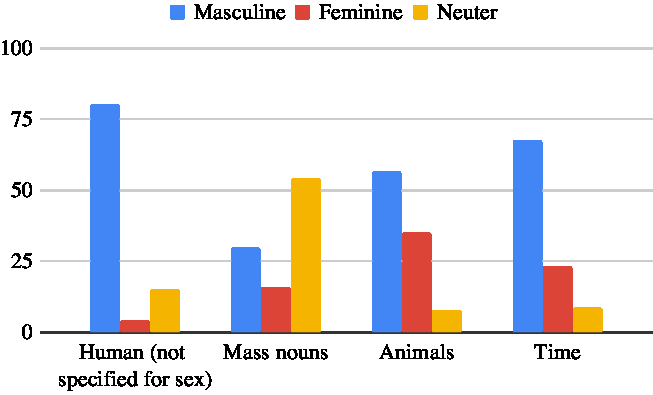
Figure 1 shows the percentage distribution for each of the non-core semantic factors. The figure reflects the overall dominance of masculine gender in the material, with masculine as the predominant gender for three out of the four semantic tendencies. As can be seen in Figure 1, none of the tendencies is exceptionless in the material. We discuss the relative strength of the tendencies in detail in Section 8 below.
Gender distribution (percentage) for semantic factors.
6. Morphological factors
The morphological factors we have included (plural inflection and derivational suffixes) have been shown to be reliable predictors of gender in the Scandinavian languages. Enger (Reference Enger and Siemund2011:190) discusses how plural inflection in various Norwegian dialects has become more closely aligned with gender and can thus be used to predict gender. Källström (Reference Källström1996) concludes that plural forms are remarkably accurate at predicting gender for monosyllabic nouns in Swedish, correctly assigning gender for more than 83% of his test corpus (Källström Reference Källström1996:160). However, plural forms do not always reliably predict gender in Scandinavian languages, as Enger (Reference Enger and Siemund2011:189–190) shows for Old Norse. Likewise, derivational suffixes have also been shown to indicate gender in Scandinavian languages (Källström Reference Källström1996:159; Trosterud 2001:43–44, Reference Trosterud, Enger, Nesset and Rice2006:1451–1460), and gender assignment for suffixes tends to be relatively stable across time and language varieties.
6.1 Plural inflection
Gender and declension tend to be closely intertwined, and this is certainly the case for Germanic languages. There is some debate as to whether declension predicts gender or gender predicts declension. Arguments exist for both directions. Many researchers, including Corbett (Reference Corbett1991), Källström (Reference Källström1996) and Spencer (Reference Spencer1999) argue that because there are fewer genders than declensions, it is more suitable to say that declension predicts gender. On the other side, Enger (2004a, Reference Enger and Siemund2011) argues that the opposite direction is more plausible for Scandinavian (gender predicts plural inflection), primarily because of diachronic evidence – it is much more common for a plural form of a noun to change because its gender has changed than for the opposite to occur. He also asserts that both directions can have validity in a single language. For some nouns, gender may predict declension, and for other nouns, the opposite may be true, depending on token frequency (Enger Reference Enger2004a:52–55). Rather than saying that plural inflection predicts gender, it is perhaps more accurate to say that gender and plural inflection are correlated, with each influencing the other. It would be equally plausible to say that the gender of any given noun is assigned by other principles, and then the noun is mapped onto a particular plural paradigm based on the gender. Nevertheless, the fact remains that knowing the plural inflection of a noun can help to predict which gender the noun will have.
From plural inflection we can posit five generalizations for plural patterns, which are based on the indefinite plural and definite plural forms of the nouns in our list. They are presented and discussed here in turn.
1. Nouns with indefinite plural -a and definite plural -an are non-neuter. However, when we divide this further, the pattern becomes clearer:
a. Disyllabic nouns ending in -e in the indefinite singular with the a–an plural pattern are feminine.
b. All other nouns with the a–an plural pattern are masculine.
We have 131 words in our material that have -e in the indefinite singular along with the a–an plural pattern. Of these, 103 (78.6%) are feminine (e.g. fikke–fikka–fikkan ‘pocket–pockets–the pockets’), 27 (19.8%) are masculine (e.g. lime–lima–liman ‘broom–brooms–the brooms’), and one (0.8%) is neuter (örhänge–örhänga–örhängan ‘earring–earrings–the earrings’). Of the words which have -a in the indefinite singular, 10 (27.8%) are feminine (e.g. kvisshla–kvisshla–kvisshlan ‘pitchfork–pitchforks–the pitchforks’), 26 (72.2%) are masculine (e.g. spela–spela–spelan ‘tail–tails–the tails’), and none are neuter. For all other words with this plural pattern (those ending in consonants or in other vowels, or monosyllabic words), we have 83 (20.75%), with feminine gender (e.g. råu–råua–råuan ‘corner–corners–the corners’), 311 (77.75%) with masculine gender (e.g. krok–kroka–krokan ‘hook–hooks–the hooks’), and six (1.5%) with neuter gender (e.g. tåur–tåura–tåuran ‘tear–tears–the tears’).
2. Nouns with indefinite plural -r and definite plural -ran are non-neuter (including nouns with umlaut).
Twenty-two masculine nouns (e.g. venn–venner–vennran ‘friend–friends–the friends’), 26 feminine nouns (e.g. jeit–jetter–jettran ‘goat–goats–the goats’), and only one neuter noun (e.g. lann–länner–lännran ‘land/country–lands/countries–the lands/countries’) have this pattern. The r-ran pattern includes nouns with umlaut (e.g. bok–bökker–bökkran ‘book–books–the books’, f). For nouns with umlaut, there is an additional tendency towards feminine gender – 11 of these are feminine, four are masculine, and one is neuter.Footnote 12 Additionally, it should be noted that seven out of eight nouns with disyllabic -u have plural pattern 2, and all of these are feminine (see Section 7.1).
3. Nouns with null indefinite plural and definite plural -a are neuter.
This is the most common plural pattern for neuter nouns, covering 152 neuter nouns (e.g. bein–bein–beina ‘bone–bones–the bones’); 80.5% of all neuter nouns in the material. Only three feminine nouns (my–my–mya ‘sandfly–sandflies–the sandflies’, lus–lus–lusa ‘louse–lice–the lice’, and va–va–vaa ‘calf (of leg)–calves–the calves’) have this pattern, and one masculine noun has this pattern (tjel–tjel–tjela ‘kettle–kettles–the kettles’). Since this pattern covers so many neuter nouns and picks out a single gender, it is the strongest predictor of gender with respect to plural pattern.
4. Nouns with indefinite and definite plural -a are neuter.
This pattern also indicates neuter gender and reliably picks out most of those neuter nouns that do not have plural pattern 3. Most disyllabic neuter nouns, as well as neuter nouns that end in the suffix -eri, have this pattern. 29 neuter nouns (e.g. styre–styra–styra ‘rudder–rudders–the rudders’, batteri–batteria–batteria ‘battery–batteries–the batteries’, er–era–era ‘scar–scars–the scars’), five feminine nouns (e.g. släkt–släkta–släkta ‘relative–relatives–the relatives’, lever–levra–levra ‘liver–livers–the livers’), and two masculine nouns (slätt–slätta–slätta ‘plain–plains–the plains, kant–kanta–kanta ‘edge–edges–the edge’) take this pattern. The plural pattern a–a still indicates neuter gender fairly reliably, though it does not cover as many nouns as the null–a pattern.
5. Nouns with null indefinite plural and definite plural -an are masculine.
Only four nouns in our data set have this plural pattern: three masculine nouns (bune–bune–bunen ‘tool–tools–the tools’, kłänning–kłänning–kłänningan ‘dress–dresses–the dresses’, bånt–bånt–båntan ‘bunch–bunches–the bunches’) and one feminine noun (kongro–kongro–kongroan ‘spider–spiders–the spiders’). Because of the lack of data for this plural pattern, we cannot draw any conclusions from this and we exclude it from our analysis.
Figure 2 shows the gender distribution for all of the above plural patterns (excluding pattern 5).
Gender distribution (percentage) for plural patterns.
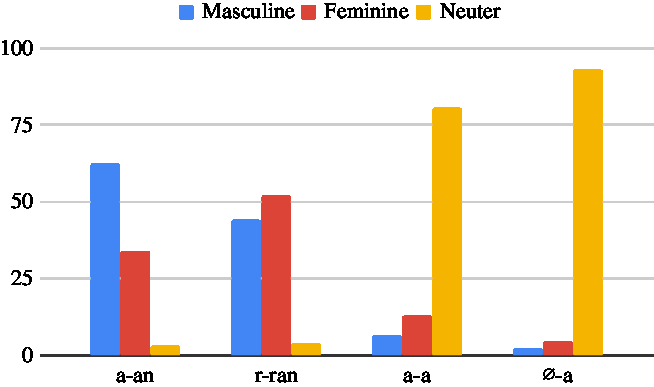
The assignment tendencies based on plural declensions are relatively robust, as they can predict the gender of 65.1% of the neuter nouns in our data. Although plural patterns may be reliable predictors for neuter gender, plural declension does not usually pick out a single gender for masculine and feminine nouns.
6.2 Derivational suffixes
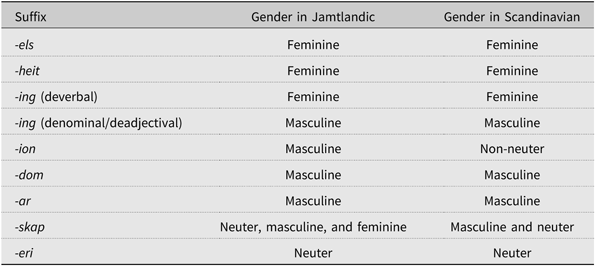
Based on studies of other Scandinavian languages (Källström Reference Källström1996; Trosterud Reference Trosterud2001, Reference Trosterud, Enger, Nesset and Rice2006), we selected certain suffixes to include in our study which we thought would be of relevance to gender assignment in Jamtlandic. Table 2 gives an overview of our results for the derivational suffixes, and we discuss each result below in detail. See Appendix F for a complete list of the words with derivational suffixes in our material.
Gender indicated by derivational suffixes in Jamtlandic and Scandinavian
6.2.1 Suffixes that indicate feminine gender
The suffix -heit is feminine in Norwegian (Trosterud Reference Trosterud2001:44); -het and -else are non-neuter in Swedish (Källström Reference Källström1996:159). These correspond to -heit and -els in Jamtlandic. In our material, we have 12 words with -heit, and 10 words with -els. All of the words with -heit are feminine (e.g. einsamheit ‘loneliness’), and all of the words with -els are feminine (e.g. opplævels ‘experience’) with the exception of fengels ‘prison’, which is masculine.Footnote 13 This indicates that both of these suffixes are reliable predictors of gender in Jamtlandic.
6.2.2 Suffixes that indicate masculine gender
The suffixes -dómr and -ari are masculine in Old Norse (Trosterud Reference Trosterud, Enger, Nesset and Rice2006:1451); -dom and -ar are masculine in Norwegian (Trosterud Reference Trosterud2001:44). These correspond to -dom and -ar in Jamtlandic. Our list contained 5 words with -dom and 20 with -ar. Words with the suffix -dom behave exactly as expected – all of the words in our material are masculine (e.g. barndom ‘childhood’, visdom ‘wisdom’).
All of the Jamtlandic words that contain -ar as an agentive suffix are masculine (e.g. meborjar ‘citizen’, lerar ‘teacher’, vasskokar ‘kettle’). In addition, out of nine words in our list that have /ar/ as a phonological ending, seven are also masculine (begar ‘cup’, hammar ‘hammer’, koppar ‘copper’, mästar ‘master’, pełar ‘post, pole’, peppar ‘pepper’, and sommar ‘summer’ are masculine; alhtar ‘altar’ and ankar ‘anchor’ are neuter).Footnote 14 This indicates that the masculine gender of the agentive suffix may have been generalized to the word-final phonological sequence /ar/. However, the masculine gender of some of these words could also be accounted for by other factors. For instance, begar, hammar, pelar, mästar and sommar have plural pattern 1, which indicates masculine gender for words ending in a consonant. Additionally, mästar denotes a human not specified for sex, which also indicates masculine gender. If we accept the possibility that multiple assignment tendencies that point to the same gender can overlap to contribute to gender assignment, this simply makes it more likely that these words will have masculine gender (see Section 8.2.1).
The suffix -ion is common gender in Swedish (Källström Reference Källström1996:159). Our list contains 10 words with -ion, all of which are masculine (e.g. station ‘station’). Thus we can confidently say that in Jamtlandic the suffix -ion predicts masculine gender.
6.2.3 Suffixes that indicate neuter gender
The suffix -eri is neuter in Swedish (Källström Reference Källström1996:159) and Norwegian (Trosterud Reference Trosterud2001:44). We have seven words with -eri in our material, and all of them are neuter (e.g. mejeri ‘dairy’). We also have one word in our material which contained /eri/ as a phonological sequence (selleri ‘celery’); this word is feminine.Footnote 15 Based on this limited data, it appears that while words with the derivational suffix -eri are reliably neuter, the gender of this derivational suffix has not been generalized to any word ending in /eri/, as was the case with the agentive suffix.
6.2.4 Suffixes that indicate multiple genders
Deverbal nouns with -ing are feminine in Norwegian, and denominal and deadjectival nouns with -ing are masculine (Trosterud Reference Trosterud2001:44). Our list contains 18 denominal/deadjectival nouns and 13 deverbal nouns with -ing. All of the denominal and deadjectival nouns are masculine (e.g. tining ‘newspaper’) except for two nouns that specifically denote women and are feminine (trollkering ‘witch’ and drottning ‘queen’). All deverbal nouns with -ing are feminine (e.g. regering ‘government), except for veling ‘gruel’ and meining ‘intention’, which are masculine. Thus it seems that this suffix behaves as expected: denominal/deadjectival nouns with -ing are masculine, and deverbal nouns with -ing are feminine, with a few exceptions.
We investigated the suffix -skap because of its interesting history and distribution across the Scandinavian languages. This suffix comes from Old Norse -skapr, which is masculine by virtue of its -r ending (the usual nominative ending for strong masculine nouns in Old Norse). When the -r ending disappeared from the language, -skap lost its morphological gender assignment and gradually became subject to semantic gender assignment: nouns with -skap that had an abstract meaning tended to be assigned masculine gender, and those with a concrete or collective meaning tended to be assigned neuter gender (Conzett Reference Conzett2004:184). The situation for -skap in our material is complicated – four words (kunskap ‘knowledge’, lannskap ‘landscape, scenery’, ledarskap ‘leadership’, and sällskap ‘company’) are neuter, one is masculine (veitskap ‘science’), and one is feminine (ovänskap ‘unfriendliness’). From this (admittedly limited) data, it seems that -skap no longer strongly indicates masculine gender, as it does in Old Norse. It does not follow the pattern described by Conzett either, as some of the neuter nouns are abstract. This is similar to the situation in Swedish, where according to Holmes & Hinchcliffe (Reference Holmes and Hinchliffe1993:4ff.), the suffix -skap indicates either neuter or non-neuter gender.Footnote 16 We can say that -skap weakly indicates neuter gender, but more research is necessary to better understand the patterns of this suffix in Jamtlandic.
7. Phonological tendencies
Some phonological sequences can also be indicative of a particular gender. The patterns for disyllabic nouns ending in a vowel, for instance, are of particular interest across Scandinavian languages (Trosterud 2001:35, Reference Trosterud, Enger, Nesset and Rice2006:1448; Enger & Conzett Reference Enger and Conzett2016:226–227). Trosterud has found gender assignment tendencies for monosyllabic nouns ending in a vowel in Norwegian (Trosterud Reference Trosterud2001:47) and Old Norse (Trosterud Reference Trosterud, Enger, Nesset and Rice2006:1457). We investigated these phonological patterns in detail. We also performed a thorough analysis of onset and coda sequences in Jamtlandic, since some studies have suggested that gender assignment can be predicted from other phonological sequences (Köpcke Reference Köpcke1982 for German, Trosterud Reference Trosterud2001 for Norwegian, and Trosterud Reference Trosterud, Enger, Nesset and Rice2006 for Old Norse).
7.1 Disyllabic nouns ending in a vowel
Here we present a brief history of weak masculine and feminine nouns in Scandinavian. We go on to look at how the phonological endings from historically weak nouns can indicate gender in Jamtlandic.
In Old Norse, weak masculine nouns took -i in the nominative form, and -a in the accusative. In contrast, weak feminine nouns took -a in the nominative and -u in the accusative (Haugen Reference Haugen2015:71–72). According to Wessén (Reference Wessén1955[1969]:138), in most Swedish dialects the distinction between nominative and accusative was erased by the medieval period, leaving -e as the ending for weak masculines and -a as the ending for weak feminines. However, in the dialects of Norrland, endings of weak masculine nouns are divided according to animacy: -e (from the Old Norse nominative -i) occurs with animate nouns, and -a (from the Old Norse accusative -a) with inanimates. This is because animates are more likely to occur in subject position, taking the nominative; while inanimates were more likely to occur in object position, taking the accusative. For weak feminine nouns, -a is the usual ending, though occasionally -å or -u can be used (from the old accusative form).
In Norwegian, the final vowels in weak nouns developed differently in different dialects. In some dialects, -i and -a merged to -e after the Old Norwegian period, so the distinction between weak masculine and weak feminine nouns was lost. However, in Østlandet and Trøndelag, jamvektsord (words with equal stress on both syllables; see Kristoffersen & Torp Reference Kristoffersen and Torp2016:174–188) behave differently: the vowel is not reduced, and instead the oblique form of the noun is taken (-a for weak masculine nouns, and -u for feminine nouns, with some dialectal variation; see Enger & Conzett Reference Enger and Conzett2016:236–237). Nevertheless, in modern Norwegian, -e is most strongly connected with feminine gender. Evidence for this can be seen in the fact that many loanwords ending in -e are assigned feminine gender, and some formerly masculine nouns ending in -e are now feminine (Enger & Conzett Reference Enger and Conzett2016:227). Since Jamtlandic shares some features with both Norwegian and Norrland dialects, we could expect it to display characteristics of either Norwegian or Norrland Swedish in this respect. For this reason, we consider disyllabic words ending in -e, -u, and -a in our data (see Appendix G).
In our material there are 8 disyllabic words ending in -u (the old oblique form for weak feminines; see Wessén Reference Wessén1955[1969]:139); all of these are feminine (e.g. bråsu ‘fire’, håku ‘chin’). Based on this data, we can make the generalization that disyllabic nouns ending in -u are feminine in Jamtlandic. This is what we would expect from Jamtlandic as a Norrland Swedish variety.
Next, we look at the 38 disyllabic nouns that end in -a. Of these, 22 (57.9%) are masculine (e.g. hæga ‘pasture’, nåsa ‘nose’), 16 (42.1%) are feminine (e.g. knæpa ‘lock’, sjæga ‘ladder’), and none are neuter. Though it is slightly more likely for these nouns to be masculine, there does not seem to be much motivation to posit a rule that assigns masculine gender to these nouns. To confirm this, we included this measure in the statistical analysis, and found that this measure is in fact not significant (p = .323). However, it is noteworthy that none of these nouns are neuter. The gender distribution for disyllabic nouns ending in -a is shown in Figure 3.
Distribution of disyllabic nouns ending in -a and -e.
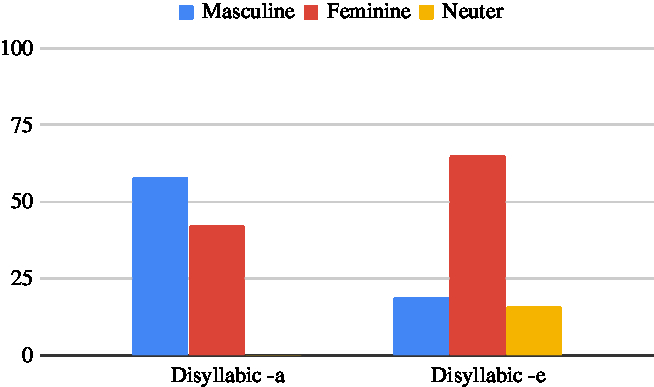
We might expect nouns with -a to take masculine gender in Jamtlandic, since this is the expected pattern for dialects of Norrland. The relatively even distribution between masculine and feminine in this category might reflect influence from Standard Swedish, in which disyllabic nouns with -a formerly were feminine, and some of these nouns still have a feminine flavor (as in klocka ‘clock’, which is frequently pronominalized with hon ‘she’ in Standard Swedish). However, a closer look reveals that there is a pattern that explains the distribution we see for word-final vowels in weak masculine nouns in Jamtlandic: weak masculine nouns with a short stem vowel end in -e, and weak masculine nouns with a long stem vowel can end in either -e or -a. In our material, 10 weak masculine nouns with a long stem end in -e, and 18 weak masculine nouns with a long stem end in -a.
Of the 169 disyllabic nouns ending in -e, 110 (65.1%) are feminine (e.g. tonge ‘tongue’, uggle ‘owl’), 32 (18.9%) are masculine (e.g. vinge ‘wing’, åshle ‘carcass’), and 27 (16.0%) are neuter (e.g. veite ‘wheat’, styre ‘rudder’). Figure 3 shows the gender distribution among disyllabic nouns ending in -e, compared to disyllabic nouns ending in –a.
The statistical analysis confirms the significance of this assignment tendency (p < .001 for feminine gender, with neuter as the reference level). We include ‘disyllabic nouns with -e are feminine’ as a generalization for Jamtlandic.
7.2 Monosyllabic nouns ending in a vowel
According to Trosterud (Reference Trosterud2001:47), monosyllabic nouns ending in a vowel are feminine in Norwegian; in addition, monosyllabic nouns ending in a back vowel are feminine in Old Norse (Trosterud Reference Trosterud, Enger, Nesset and Rice2006:1457). Our list contains 40 monosyllabic nouns that end in a vowel. Of these, 11 (27.5%) are masculine (e.g. söu ‘sheep’), 16 (40%) are feminine (e.g. ske ‘spoon’), and 13 (32.5%) are neuter (e.g. huu ‘head’). Thus, there does not seem to be a clear tendency for monosyllabic nouns ending in a vowel. However, when we separate out the back vowels from the front vowels, we find that monosyllabic nouns ending in a back vowel tend to be feminine. Of the 18 monosyllabic words that end in a back vowel, 11 (61.1%) are feminine (e.g. tåu ‘toe’, bu ‘shop, store’), five (27.8%) are masculine (e.g. tråu ‘thread’), and two (11.1%) are neuter (e.g. bła ‘leaf’), as shown in Figure 4. See Appendix K for a full list of words in this category.
Gender distribution for monosyllabic nouns ending in a back vowel.
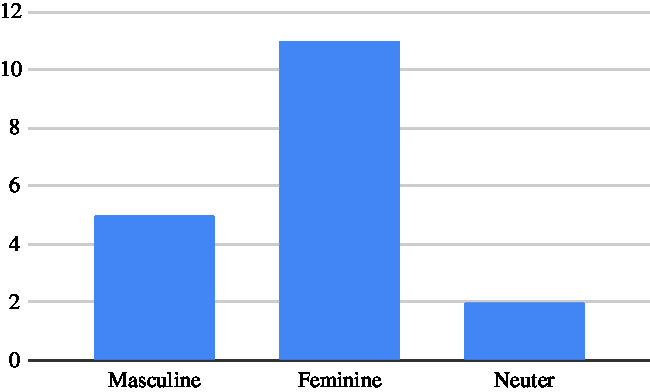
Based on this data, there is a slight tendency for monosyllabic words ending in a back vowel to be feminine in Jamtlandic. To test whether or not this is significant, we included this measure in our statistical analysis. The results show that the tendency towards feminine gender for monosyllabic words ending in a back vowel is not significant (p = .215 for feminine gender, with neuter as the reference level).
7.3 Onset and coda sequences
We performed a thorough analysis of onset and coda sequences in Jamtlandic in order to find any gender assignment patterns that might exist (see Appendices I–J). Besides the pattern for monosyllabic back vowels discussed in Section 7.2 above, we did not find any patterns based on onsets and codas that seemed to be of much significance for gender assignment. While some studies have made claims about onset and coda sequences and gender assignment in German (e.g. Köpcke Reference Köpcke1982, Köpcke & Zubin Reference Köpcke and Zubin1983), Norwegian (Trosterud Reference Trosterud2001:47–50), and Old Norse (Trosterud Reference Trosterud, Enger, Nesset and Rice2006:1453–1456), these generalizations tend to have many exceptions.
The absence of strong tendencies for onset and coda sequences in our material does not necessarily mean that phonological assignment tendencies do not exist in Jamtlandic, however. Because some phonological sequences are relatively rare, it is difficult to detect tendencies with only a limited subset of nouns. It is possible that an analysis of onsets and codas in all Jamtlandic nouns would yield different results. In addition, there could be some patterns based on phonological structure, which we did not investigate due to our limited data. Some tendencies for phonological structure have been found in Standard Swedish (Noreen Reference Noreen1923, Liljegren Reference Liljegren1995) and German (Köpcke Reference Köpcke1982, Köpcke & Zubin Reference Köpcke and Zubin1983).
8. Discussion of assignment principles and conflicts
In the following section, we discuss the assignment principles presented above with regards to how reliably they apply and how they fare when occurring in conflict with other assignment tendencies. In addition, we discuss the statistical analysis we performed with some of the assignment principles as predictors of gender. From this, we comment on the relative strength of the assignment tendencies.
8.1 Final list of assignment principles
One way of measuring the efficacy of assignment tendencies is by looking at the percentage of words for which a tendency correctly predicts gender (for those words in which it is expected to apply). Below we list all the semantic, morphological and phonological gender assignment tendencies discussed above and provide the percentages of words for which the tendency holds true. We put the tendencies that can assign either masculine or feminine gender in parentheses, in order to point out that they are different from the other tendencies, which assign only one gender.
Semantic tendencies
Words referring to males receive masculine gender, and words referring to females receive feminine gender: five feminine, three masculine, 100%
Words for people not specified for sex are masculine: 46/57, 80.7%
Words for time concepts are masculine: 23/34, 67.6%
Words for animals are masculine: 46/78, 59.0%
Mass nouns are neuter: 60/112, 53.6%
Morphological tendencies
Pluralization
○ Nouns with indefinite plural -a and definite plural -an are non-neuter (as per below):
▪ Disyllabic nouns with singular -e, indefinite plural -a, and definite plural -an are feminine: 103/131, 78.6%
▪ Other nouns with indefinite plural -a and definite plural -an are masculine: 337/436, 77.3%
○ (Nouns with indefinite plural -r and definite plural -ran are non-neuter: 48/49, 98%)
○ Nouns with null indefinite plural and definite plural -a are neuter: 152/156, 97.4%
○ Nouns with indefinite and definite plural -a are neuter: 29/36, 80.6%
○ Nouns with umlaut in the plural are feminine: 11/16, 68.8%
Derivational suffixes
○ Words with -heit are feminine: 12/12, 100%
○ Words with -ion are masculine: 10/10, 100%
○ Words with -dom are masculine: 5/5, 100%
○ Words with the agentive suffix -ar are masculine: 16/16, 100%
○ Words with the derivational suffix -eri are neuter: 6/6, 100%
○ Words with -els are feminine: 9/10, 90%
○ Denominal and deadjectival nouns with -ing are masculine: 14/16, 87.5%
○ Deverbal nouns with -ing are feminine: 11/13, 84.6%
○ Words with -skap are neuter: 4/6, 66.7%
Phonological tendencies
Disyllabic words ending in -u are feminine: 8/8, 100%
(Disyllabic words ending in -a are non-neuter: 38/38, 100%)
Disyllabic words ending in -e are feminine: 110/169, 65.1%
Monosyllabic words ending in a back vowel are feminine: 11/18, 61.1%
Onset and Coda: no clear tendencies
Figure 5 shows the above percentages visually, ordered from most to least reliable and color-coded by category (semantic, plural, phonological, and derivational suffix).
Percentage of correct predictions for each assignment tendency, by category.
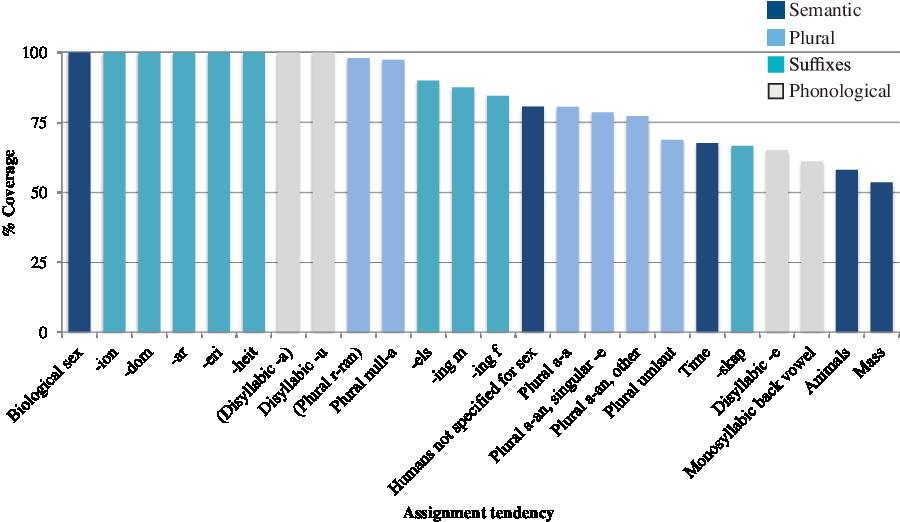
From Figure 5, we can see that the strongest assignment tendencies span a wide range of categories. We have again put the plural r-ran tendency and the disyllabic -a tendency in parentheses here, because they indicate two genders and thus have an ‘unfair advantage’. Biological sex stands out as the only semantic tendency that reaches or approaches 100%, and while disyllabic -a and -u have 100% accuracy, the other phonological tendencies fall on the less-accurate side. Derivational suffixes tend to be very reliable, with 5 of the suffixes at 100%. The remaining suffixes fall around the middle of the chart, while -skap is less effective as a predictor and falls towards the end. None of the plural suffixes reach 100%, but three of them are at 97.4% or above. From percentage coverage, then, it is not really possible to determine which categories of assignment principles are the strongest – besides the non-core semantic tendencies, which seem to be weaker than other types of assignment tendencies.
Figure 6 shows the percentage coverage of each of the tendencies, color-coded by gender. From this, we can see which genders have the most reliable assignment tendencies.
Percentage of correct predictions for each assignment tendency, by gender.
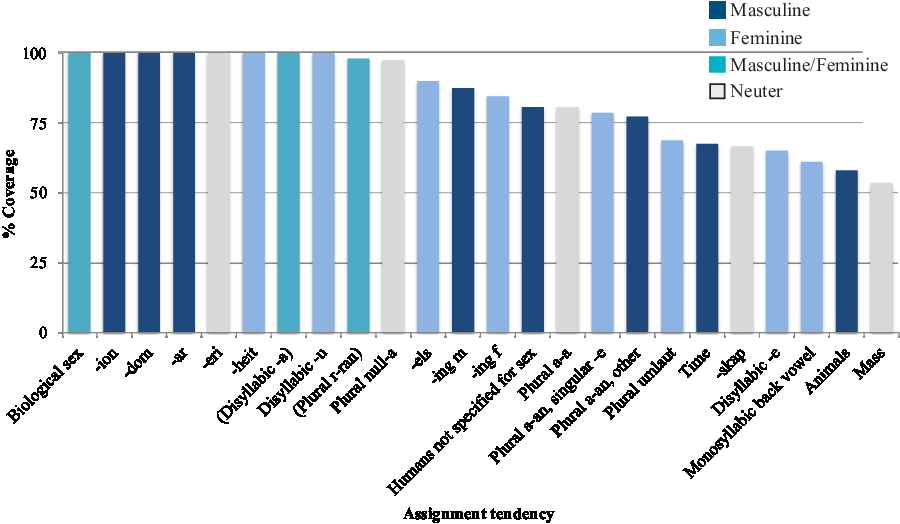
According to Figure 6, the most reliable tendencies are those that predict the non-neuter genders (shown here in shades of blue). Only two tendencies that predict neuter (the derivational suffix -eri and the plural pattern null-a) have a very high percentage (tendencies for neuter gender are shown in light gray). The tendencies that can predict either masculine or feminine gender are both very reliable, but this is undoubtedly because these can indicate two different genders instead of just one. While the percentage coverage is certainly not the only thing worth considering in gender assignment, it can give us a general sense of which tendencies are the most reliable for Jamtlandic gender assignment.
8.2 Conflicts and interactions
Assignment principles overlap and interact, competing with and reinforcing each other to assign gender. Another way of measuring the strength of assignment tendencies is by looking at these interactions and conflicts. Here we provide some examples of interaction in our material, drawing some conclusions as to what this tells us about gender assignment.
8.2.1 Reinforcement
In our view, new assignment tendencies can be created when speakers make new generalizations about groups of nouns. This situation will lead to two assignment principles that often overlap, with the new assignment principle now able to assign gender to other nouns that are outside the domain of the original assignment tendency. For example, since the agentive -ar suffix tends to occur in words for humans, and words for humans tend to be masculine, speakers might begin to view the -ar suffix as indicating masculine gender (even if the masculine gender originally came from the semantic rule). Once the connection between -ar and masculine gender has been established, speakers will generalize masculine gender to inanimate nouns with the -ar suffix (such as vasskokar ‘kettle’), and possibly even to words with /ar/ as a phonological sequence (such as koppar ‘copper’, peppar ‘pepper’). This mechanism has also been shown to create new rules for inflectional class assignment (for further discussion; see Enger Reference Enger2009:1296). In these and other instances of assignment principles interacting, the tendencies reinforce each other, making it less likely that the words will change gender. It is not a requirement that only one tendency assign gender to a noun; rather, the existence of multiple tendencies pointing to a single gender for a given noun simply makes it more likely that a noun will have that gender. In our material, words that have two assignment principles that point to the same gender will always be assigned that gender.
8.2.2 Conflicts
We created a list of the words in our material in which two or more assignment principles compete to assign gender to a noun (Appendix L). In the material there are 69 words for which two or more conflicting assignment principles applied. From this list, we looked at which types of tendencies won and lost over other types of tendencies. The results of this are summarized in Table 3.
Summary of assignment tendency conflicts in the material
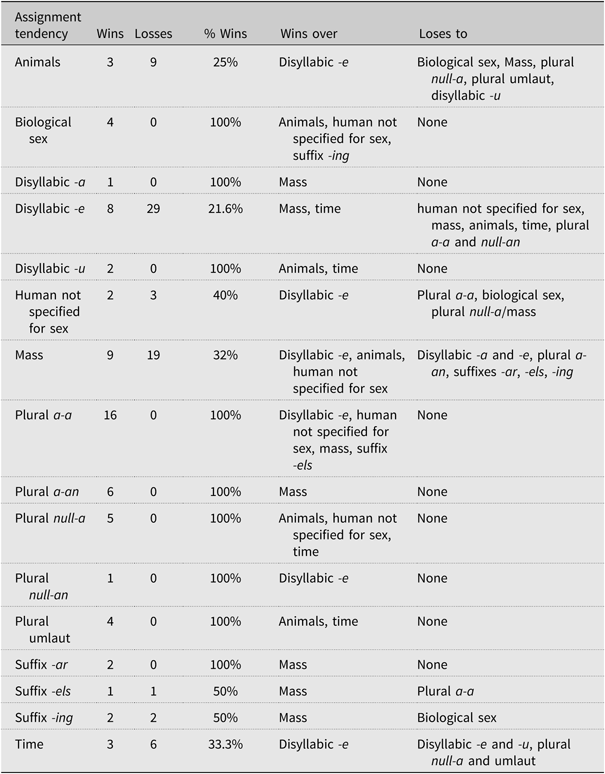
Table 3 reveals some of the relative strengths and weaknesses of the different assignment tendencies. According to Table 3 the strongest tendencies are biological sex, disyllabic -a, disyllabic -u, plural inflection, and the suffix -ar. However, all of these categories apart from the plural inflection have four or fewer instances of conflict, so we should be careful about placing too much weight on this. The weakest seems to be disyllabic -e, with only eight wins and 29 losses. This too should be taken with a grain of salt, given the complex status of words with disyllabic -e in Jamtlandic (see Section 7.1). Notably, the tendencies for disyllabic -e and mass nouns seem to be evenly balanced, with each winning and losing against the other.
We have represented the percentages of ‘wins’ from Table 3 in a hierarchy (Figure 7).
Hierarchy of precedence of different assignment tendencies, based on Table 3.
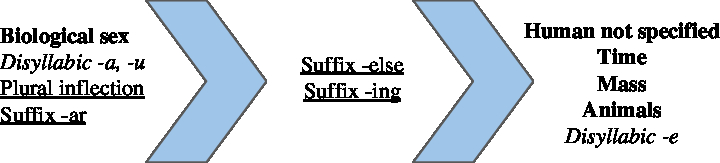
In Figure 7, the semantic tendencies are in bold, the phonological tendencies are in italics, and the morphological tendencies are underlined. The tendencies on the leftmost level of the hierarchy are the strongest. For any given level, a tendency will win over the tendencies that appear on levels to the right. Tendencies may either win or lose to tendencies within the same level. One problem with this is that some of the tendencies (monosyllabic back vowels, and the suffixes -heit, -ing, -dom, -ion, -skap, and -eri) did not conflict in our material, so they are not present in the hierarchy. In addition, we can only establish three levels for the hierarchy without making inaccurate predictions, so our hierarchy clarifies the situation only to a limited degree. Notably, Figure 7 does not show a clear dominance of semantic assignment tendencies over formal tendencies. Biological sex comes out as the strongest predictor, but other tendencies that are related to the semantic core (words for humans not specified for sex, mass nouns, and animals) are less reliable. This contradicts both Corbett’s (Reference Corbett1991) assertion that semantic rules take precedence over formal rules, and the opposite approach (Steinmetz Reference Steinmetz and Faarlund1985, Reference Steinmetz1986, Reference Steinmetz2006; Rice Reference Rice2006) in which rules are unranked. It lends support to Nesset’s (Reference Nesset, Enger, Nesset and Rice2006) Core Semantic Override Principle (see Section 2), which holds that the semantic core outranks formal rules, but other semantic rules do not. Notably, the tendencies based on plural forms always take precedence over other tendencies. Disyllabic -a and -u also win out 100% of the time, while disyllabic -e has far more losses. The suffixes are mixed, with the agentive suffix always winning (possibly because of its ties to the semantic core; see Section 8.2.1 above), and the -ing and -els suffixes in the middle of the hierarchy, split equally between wins and losses.
When we compare percentage coverage and the conflicts table, we notice that some assignment tendencies have 100% in both measures. These are biological sex, disyllabic -a and -u, and the suffix -ar. Next come the generalizations based on plural forms and the other suffixes, all of which have 100% for some measures, but less in others. The non-core semantic tendencies and the tendency for disyllabic -e rank low on both measures and can thus be seen as the weakest tendencies in the material.
8.3 Statistical analysis
Another way to test the strength of the various predictors is by fitting them to a statistical model. In order to test the significance of some of the predictors, we conducted a statistical analysis using multinomial logistic regression. We focused on the non-core semantic tendencies and the phonological tendencies for this analysis. We included the following predictors: nouns referring to humans not specified for sex, mass/count, animals, time, disyllabic -a and -e, and monosyllabic back vowels. In this section we summarize the results of the statistical analysis and compare the results to our measures of percentage coverage and the conflicts hierarchy.
The statistical analysis can help us determine which of the non-core semantic predictors are valid. The analysis shows that words referring to humans (not specified for sex) are significantly more likely to be masculine (p < .001 for feminine and masculine, with neuter as the reference level). We also find that words for animals are significantly more likely to be masculine (p = .006). In addition, mass nouns are significantly more likely to be neuter: with neuter as the reference level, p < .001 for both masculine and feminine. This shows that even though these tendencies are low on the conflicts hierarchy, they are valid assignment principles. However, time concepts do not come out as significant, with p = .079 for masculine. This result, combined with the relatively low status of this predictor in the percentage coverage and the conflicts hierarchy, means that this tendency may not be valid for Jamtlandic.
The statistical analysis also clarifies the situation for those phonological predictors whose status was uncertain. The tendency for disyllabic words ending in -e to be feminine is significant (p = .001), and there is not a significant difference between masculine and neuter (p = .067). This means that even though this tendency is low in the conflicts hierarchy, it is valid for gender assignment. In contrast, disyllabic -a was not a significant predictor of masculine gender (p = .323). We did not expect masculine and feminine gender to be significantly different from each other for this measure, so this confirms our intuition and supports our decision to leave this as a tendency for non-neuter (assigning either masculine or feminine gender), rather than for masculine gender (see Section 7.1). In addition, monosyllabic words ending in a back vowel was not a significant predictor of feminine gender (p = .215). Table 4 summarizes the statistical results, with the significant results highlighted.
P-values from multinomial logistic regression analysis (with significant results highlighted)
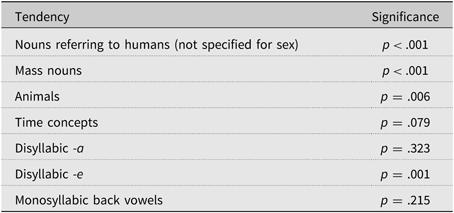
The statistical analysis helps clarify the status of many of the assignment principles. From Table 4, it appears that the tendency for time concepts to be masculine and the tendency for monosyllabic words ending in back vowels to be feminine should be discarded. Interestingly, all of the semantic predictors that come out as significant are connected in some way to the semantic core and animacy (or individuation, in the case of mass nouns). The only tendency that has no connection to this (time concepts) is not significant.
Because of the large number of predictors in our study, we were unable to include all of the assignment tendencies in the statistical analysis. We did not look at those which have 100% or nearly 100% support in the material, but have smaller numbers of nouns (biological sex, disyllabic -u, and derivational suffixes). Because these are well-supported tendencies in other Scandinavian languages, it is likely that they could be shown to be statistically valid in a larger material. Further research is necessary to confirm this.
9. Gender assignment in modern loanwords
We wished to look briefly at the gender assignment of modern loanwords in order to determine whether or not gender assignment is different for these words than for the rest of the material. Research has shown that looking at gender assignment in loanwords can allow us to see how assignment rules operate in a language (Corbett Reference Corbett1991:70). We define ‘modern loans’ as those words which have entered Jamtlandic from the Industrial Revolution onwards (for a more detailed explanation of our criteria; see Section 4.1 above).
Our data shows that the gender distribution of these modern words is different from that of inherited words. If we look at the distribution for modern loans versus our word list as a whole, we can see that the feminine gender is greatly reduced, while neuter gender is reduced slightly and masculine gender increases. In our material there are 44 modern loanwords altogether; of these only four (9.1%) are feminine; while 29 (59.1%) are masculine, and 11 (25%) are neuter. Recall that the overall gender distribution in our material is 46% masculine, 27% feminine, and 27% neuter. Figure 8 shows the gender distribution for modern loans as compared to the overall gender distribution in the material.
Gender distribution for modern loans and gender distribution for material as a whole.
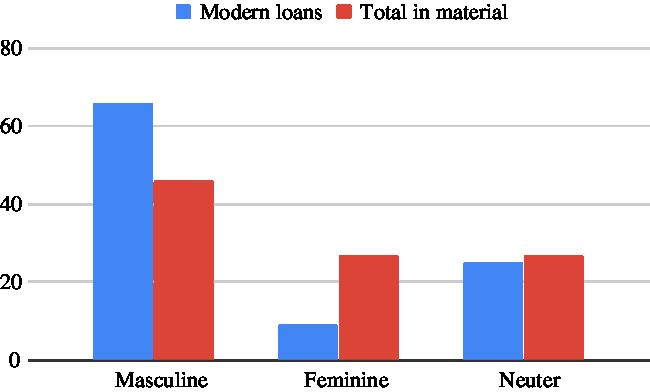
This therefore constitutes a significant departure from the gender distribution of the rest of our data. It may be an indication that the masculine gender is overtaking the feminine gender, moving Jamtlandic in the same direction in Standard Swedish, even though this trend is not as apparent when looking at the Jamtlandic gender system as a whole (see Van Epps & Carling Reference Van Epps and Carling2017).
Most of the words that are assigned feminine or neuter gender among the modern loans in our material have clear reasons to be assigned a non-masculine gender. Three of the feminine nouns (webbsie ‘web page’, surfplatte ‘tablet computer’, skördetröske ‘combine harvester’) are compounds whose heads are disyllabic nouns ending in -e and are feminine (and already existed in Jamtlandic prior to our ‘modern period’). Some of the neuter nouns are compounds as well (frimarse ‘stamp’, fłygplan ‘airplane’, körkort ‘driver’s license’, personbevis ‘birth certificate’, vykort ‘postcard’), with heads that are pre-existing neuter nouns. One (batteri ‘battery’ contains the ending -eri, which reliably indicates neuter gender (see Section 6.2). Internet is neuter by analogy with nät ‘net’, and tåg ‘train’ comes from an older word tåg ‘procession, marching’. Dass ‘toilet’ comes from the German neuter definite article das (Svenska akademien 1997). The only two neuter words that are not readily explainable as compounds or by relation to older words are sms ‘text message’ and mejl ‘email’. We would argue that these are neuter by analogy with words such as meddelande ‘message’, kort ‘card’, and brev ‘letter’, which are neuter.Footnote 17 That is, words for written messages in Jamtlandic tend to be assigned neuter gender.
Thus it seems reasonable to assume that modern loanwords are by default assigned masculine gender in Jamtlandic, unless there is a clear reason for them to be feminine or neuter. The fact that new words are being assigned masculine gender at the expense of feminine gender hints at a changing gender system. It also partially explains the increase in masculine gender that we see in Jamtlandic. However, we still see nouns being assigned to the feminine and neuter genders when we expect an assignment principle to apply, so asserting that these genders are about to disappear would probably be going too far. Further research is necessary to better understand the processes at work for gender assignment of modern loanwords in Jamtlandic.
10. Validity of assignment principles and default gender
Some of the assignment tendencies we have outlined appear to be relatively strong in comparison to other tendencies. In particular, gender assignment for the semantic core (biological sex), disyllabic -a and -u, and the agentive -ar suffix are exceptionless in the material, and win out over any other assignment principles that may be in conflict (see Section 8.2.2 above). However, those assignment tendencies which are exceptionless cover only a small number of nouns in our material. It would be necessary to gather more data in these categories in order to say definitively that they are highly reliable assignment principles. In contrast, we can more confidently assert that the tendencies which have a few exceptions but cover a large number of nouns (such as the tendencies for a–an and null–a plural patterns; see Section 6.1) are reliable assignment principles for Jamtlandic. In addition, the assignment tendencies that are significant predictors in our statistical analysis (nouns denoting animals are masculine, nouns denoting humans not specified for sex are masculine, mass nouns are neuter, and disyllabic nouns ending in -e are feminine) can be said to be valid assignment tendencies, but fall low on the conflicts hierarchy.
Nevertheless, it can be difficult to know which are ‘real’ assignment tendencies, as discussed in Section 4.3. A possible method of distinguishing between which assignment tendencies are ‘real’ and which are not is by devising experiments in which speakers assign gender to pseudowords. This method has been used for various languages (including Scandinavian languages) to test the validity of assignment principles (see e.g. Köpcke & Zubin Reference Köpcke and Zubin1983; Corbett Reference Corbett1991:89–92; Källström Reference Källström1992; Liljegren Reference Liljegren1995). It seems reasonable to argue that an assignment tendency is only valid if speakers use it productively to assign gender.Footnote 18 Testing our assignment principles in an experimental setting is a possible avenue for future research on this topic. This could provide evidence for accepting or discarding some of the assignment tendencies (such as non-core semantic tendencies and disyllabic -e) that do not fare so well on the measures of percentage coverage and ‘wins and losses’ against other assignment tendencies.
Some approaches to gender assignment (e.g. Steinmetz Reference Steinmetz and Faarlund1985, Reference Steinmetz2006; Trosterud Reference Trosterud2001, Reference Trosterud, Enger, Nesset and Rice2006; Rice Reference Rice2006) use the notion of ‘default gender’ in order to explain gender assignment (see Section 2). The high proportion of masculine nouns in our overall material and among modern loans makes it clear that masculine is the dominant gender in Jamtlandic and can be considered to be the ‘default’. In our view, it is important not to rely too heavily on a default to explain gender assignment. When a ‘default gender’ is used as a fallback to explain a large proportion of gender assignment, important generalizations can easily be missed. Additionally, if a default exists, it is unlikely that speakers would not also form generalizations for this gender as well. And since default gender can change over time, it seems unlikely that no assignment principles would exist for the default gender (see Enger Reference Enger2009:1285ff.). For this reason, we think it is important to posit assignment tendencies for masculine gender. Nevertheless, as the default gender, it is necessary to view the tendencies that assign masculine gender differently from the tendencies that assign feminine and neuter gender. For example, since feminine nouns only constitute about 27% of the nouns in the material, it is notable that 65.1% of disyllabic nouns ending in -e are feminine. The evidence for this should perhaps be seen as stronger than, for instance, the fact that 67.6% of words for time concepts are masculine. This intuition is borne out by the statistical analysis, which shows that the tendency for disyllabic words ending in -e to be feminine is significant, while the tendency for nouns denoting time concepts to be masculine is not.
Lastly, the tendency for modern loans to take masculine gender at the expense of feminine gender is indicative of the ongoing development of the Jamtlandic gender system. The proportion of feminine nouns has gone down in modern loanwords (27% in the overall material, as compared to 9.1% in modern loans), while the proportion of masculine has increased (from 46% to 59.1%) and neuter has remained more or less the same (from 27% to 25%). The only modern words that are feminine are compounds whose heads have a recognizable phonological shape (disyllabic nouns ending in -e), which speakers can easily identify as feminine. Nouns ending in a consonant are not assigned feminine gender, despite the existence of such nouns in the overall material. The fact that speakers are choosing masculine gender for most new words entering the language indicates an increased reliance on and similarity to Standard Swedish. While speakers have not lost their sense of which gender an inherited noun should have, the reduced domain of feminine gender in modern loanwords may point towards the gradual loss of the three-gender system in Jamtlandic.
11. Conclusion
In this paper, we discussed several of the most salient gender assignment principles in the Jamtlandic variety of Scandinavian. We discussed how well they apply to the lexical items in our data, and how each assignment tendency fares when it comes into conflict with other assignment principles. In addition, we conducted a statistical analysis to check the validity of some of the assignment tendencies that did not fare as well by percentage coverage and the conflicts hierarchy. We then discussed what this means in terms of the relative strength and weakness of the assignment tendencies. Lastly, we looked at modern loanwords and drew conclusions about what this says about gender assignment in Jamtlandic. We follow Mel’čuk (Reference Mel’čuk and Rozencvejg1974) and Enger (Reference Enger2001) in the assertion that any generalizations we have found are worthwhile, even though they do not explain every aspect of gender assignment in Jamtlandic (see Section 2).
Our results indicate that the strongest assignment tendencies can be semantic, morphological, or phonological. We looked at three ways of measuring the relative strength of the assignment tendencies: percentage coverage, percentage of ‘wins’ against other assignment tendencies, and multinomial logistic regression. Many of these tendencies fare better by some measures and worse by others. The semantic core fares well by the measures of percentage coverage and conflicts with other assignment tendencies, as do the phonological rules for disyllabic -a and -u. However, the same cannot be said for the non-core semantic tendencies. The hierarchy in Figure 7 shows that semantic assignment rules do not always take precedence over formal rules. This is in contradiction to Corbett’s (Reference Corbett1991) view. Nevertheless, it does support the idea that the semantic core takes precedence over other assignment rules, while other types of semantic rules do not (as in Nesset Reference Nesset, Enger, Nesset and Rice2006; see Section 2).
Predicting gender on the basis of plural declension can be problematic because of the difficulty in establishing the direction of implicature (see Section 6.1). In any case, plural inflection and gender are closely interrelated in the Scandinavian languages. Plural paradigms, when used to predict gender, tend to have a high level of accuracy. Tendencies based on derivational suffixes also fare well in the measures of percentage coverage and conflicts with other tendencies. However, a more thorough study of derivational suffixes in Jamtlandic would be necessary to show statistical significance for these tendencies.
The gender distribution of modern loanwords shows that the dominance of masculine gender is increasing – the proportion of nouns with masculine gender in this subset of our data is considerably higher than that of the general data set. This changing gender distribution also indicates that the feminine gender may be losing ground in Jamtlandic.
The results from this study give us some assignment principles with which we can perform a comparative study on gender assignment in several varieties of Scandinavian (Van Epps et al. Reference Van Epps, Carling and Sapir2019). Further research on gender in Jamtlandic could give us a clearer picture of how assignment tendencies operate. In particular, a more thorough look at the gender assignment of loanwords could reveal some additional assignment principles. The assignment principles we have discussed should be tested against a more complete list of Jamtlandic nouns. In addition, potential gender assignment principles could be tested under experimental conditions with pseudowords.
Acknowledgements
The authors wish to thank Joost van de Weijer and Johan Frid for help with the statistical analysis, and Staffan Hellkvist for assistance in creating Figures 5 and 6. In addition, we wish to thank three anonymous referees for insightful comments on the manuscript. Fieldwork for the present study was supported by grants from Stiftelsen Fil dr Uno Otterstedts fond för främjande av vetenskaplig forskning och undervisning. This paper is included as Study II in Van Epps (2019).
Supplementary material
For supplementary material/s referred to in this article, please visit https://doi.org/10.1017/S0332586519000209.


 Open access

