Introduction
In sub-Saharan Africa (SSA), maize (Zea mays L.) contributes over 55% of the daily calorie intake, with an average consumption of 85–140 kg/year/person (Bhatnagar et al., Reference Bhatnagar, Betran and Transue2003). Despite this high consumption, protein energy deficiency has remained high, resulting in retarded growth and productivity as well as high infant mortality rates among pregnant and lactating women, and children below the age of five (De Groote et al., Reference De Groote, Chege, Tomlins and Gunaratna2014). The maize varieties grown by farmers have an endosperm that is deficient in the two essential amino acids called lysine and tryptophan (Krivanek et al., Reference Krivanek, De Groote, Gunaratna and Friesen2007; Machida et al., Reference Machida, Derera, Tongoona, Langyintuo and Macrobert2014). However, quality protein maize (QPM) was developed through conventional breeding from a mutant maize with an opaque-2 gene which elevates the levels of lysine and tryptophan (Vasal, Reference Vasal2000). These two essential amino acids allow the body to synthesize proteins that reduce the incidence of pellagra through its conversion to niacin in the body. Therefore, QPM varieties are considered to have a superior nutritive value compared to non-QPM varieties, both as food for humans and feed for monogastric livestock (Vivek et al., Reference Vivek, Krivanek, Palacios-Rojas, Twumasi-Afriyie and Diallo2008; Mpofu et al., Reference Mpofu, Sibanda, Shonihwa and Pixley2012).
Adoption of QPM varieties in SSA varies from country to country (De Groote et al., Reference De Groote, Gunaratna, Ergano and Friesen2010). This suggests that despite the importance and availability of QPM varieties, most farmers are not aware of QPM products and their benefits (Machida et al., Reference Machida, Derera, Tongoona, Langyintuo and Macrobert2014). Understanding the factors that influence farmers' choice of varieties to grow is a key factor that guides the development, promotion and adoption of varieties that are widely grown in southern Africa region. Several studies have shown that farmers mainly select varieties based on high grain yield and other visible and desirable plant morphological traits (Bello et al., Reference Bello, Olawuyi, Ige, Mahamood, Afolabi, Azeez and Abdulmaliq2014; Machida et al., Reference Machida, Derera, Tongoona, Langyintuo and Macrobert2014) and some of these choices become traditional (Prasanna et al., Reference Prasanna, Vasal, Kassahun and Singh2001). However, in order to determine yield and agronomic performance of new varieties, they have to be evaluated under a multi-location model, by assessing genotype main effects (G) plus genotype by environment (GE) interaction (Yan et al., Reference Yan, Hunt, Sheng and Szlavnics2000, Reference Yan, Kang, Ma, Woods and Cornelius2007). Multi-location trials assist in determining the yield performance and stability of individual varieties through biplot comparisons (G + GE biplot analyses) as described by Yan and Kang (Reference Yan and Kang2002). A high-yielding and stable variety is identifiable if it has a high average yield coupled with a low degree of changeability in yielding ability when grown in varied environments (Arshad et al., Reference Arshad, Bakhsh, Haqqani and Bashir2003). Identification of stable and high-yielding varieties is vital since it determines successful adoption of such particular new varieties in different environments (Mebratu et al., Reference Mebratu, Wegary, Mohammed, Teklewold and Tarekegne2019). A similar research involving new experimental QPM varieties was conducted by Mebratu et al. (Reference Mebratu, Wegary, Mohammed, Teklewold and Tarekegne2019) and assisted in the identification of potentially high-yielding and stable QPM varieties in southern Africa.
According to Dugje et al. (Reference Dugje, Odo, Teli, Kamara and Asiedu2014), farmers' participatory data collection helps researchers to select and recommend new varieties based on farmers' preference. Using this approach, QPM hybrids with relatively high-yielding advantage to non-QPM varieties have been developed by CIMMYT (Secretariat, 2001). Farmers' participatory variety selection (PVS) is an efficient way of effecting rapid awareness and adoption of newly improved varieties by farmers (Etwire et al., Reference Etwire, Abdoulaye, Obeng-Antwi, Samuel, Buah, Kanton, Asumadu, Abdulai, Haruna and Etwire2013). This is achieved through farmers' variety preference and acceptability assessed using variety ear characteristics and sensory evaluations (De Groote et al., Reference De Groote, Gunaratna, Ergano and Friesen2010). In the past, more attention has been paid to the agronomic performance of new varieties, while palatability attributes of consumers have been ignored (Kiria et al., Reference Kiria, Vermeulen and De Groote2010). Anecdotal evidence suggests that the palatability of maize is greatly influenced by its oil and amino acid composition among other factors, hence the need to ascertain farmers' perceptions regarding QPM palatability as well as the yield and agronomic performance of new varieties (De Groote et al., Reference De Groote, Gunaratna, Ergano and Friesen2010; Ouma et al., Reference Ouma, De Groote and Gunaratna2012) for them to adopt it based on their own preferences.
Moreover, with marginal rainfall which has been received of late, farmers are employing conservation agriculture (CA) as a mitigatory strategy against drought. CA is a resource-saving technology aimed at conserving soil and soil moisture through the use of three main principles of minimum soil disturbance, permanent ground cover and diverse crop rotations (Derpsch et al., Reference Derpsch, Friedrich, Kassam and Li2010). Thierfelder and Wall (Reference Thierfelder and Wall2010) and Masvaya et al. (Reference Masvaya, Nyamangara, Descheemaeker and Giller2017) reported CA as a promising climate change adaptation relative to conventional tillage as it is less sensitive to the effects of drought. Unlike conventional tillage, CA has higher infiltration rates hence high effective rainfall (Derpsch et al., Reference Derpsch, Friedrich, Kassam and Li2010). In contrast to conventional tillage, CA has the advantages of reversing organic matter loss, improving soil–microbial interactions as well as maintaining soil porosity and prolong plant-available water, hence resultant high grain yield (Twomlow et al., Reference Twomlow, Urolov, Jenrich and Oldrieve2008; Derpsch et al., Reference Derpsch, Friedrich, Kassam and Li2010). According to Rockström et al. (Reference Rockström, Kaumbutho, Mwalley, Nzabi, Temesgen, Mawenya, Barron, Mutua and Damgaard-Larsen2009) and Ngoma et al. (Reference Ngoma, Mason and Sitko2015), yield increases ranging from 20 to 120% have been recorded on CA over conventional tillage systems around the world. The objective of this study was to compare multi-location agronomic performance of new generation of QPM with non-QPM varieties under the basin planting method of CA and to ascertain farmers' perceptions of QPM palatability.
Materials and methods
Study site and germplasm
The experiment was carried out on-farm in Gokwe South District, Midlands province in agro-ecological region III of Zimbabwe during the 2014/15 and 2015/16 summer growing seasons. The description of the trial sites is presented in Table 1. Twelve locally procured maize varieties were used for this study (Table 2).
Description of trial sites used in the evaluation of the maize varieties

pH, concentration of hydrogen ions; %N, percentage nitrogen; P, phosphorus; K+, potassium ion; Na+, sodium ion; Ca2+, calcium ion; Mg2+, magnesium ion; %OC, percentage organic carbon.
Maize varieties used in the study

QPM, quality protein maize.
Agronomic evaluation
Experimental design and crop management
Twelve maize varieties were planted under dry-land conditions at five different sites (Table 1) in Gokwe South District of Zimbabwe for two cropping seasons (2014/15 and 2015/16). Planting basins (dug holes in which crops are planted) of 15 cm length × 15 cm width × 15 cm depth were established at each site (Twomlow et al., Reference Twomlow, Urolov, Jenrich and Oldrieve2008). The 12 maize varieties were planted in a 4 × 3 α-lattice design with four incomplete blocks and three varieties per incomplete block replicated three times across the five sites for the two seasons. A spacing of 90 cm inter-row and 60 cm in-row was used, as recommended for CA in farming region III where the study sites were located (Twomlow et al., Reference Twomlow, Urolov, Jenrich and Oldrieve2008; Harford et al., Reference Harford, Le Breton and Oldreive2009). Three maize seeds were planted at each planting station using the triangle planting pattern recommended for CA (Harford et al., Reference Harford, Le Breton and Oldreive2009) and later thinned to two plants per station 2 weeks after crop emergence (WACE). Compound D (7% N, 14% P2O5, 7% K2O) basal fertilizer was applied at the rate of 11.2 kg N/ha, 9.8 kg P/ha and 9.3 kg K/ha, followed by split application of ammonium nitrate (34.5% N) at the rate of 27.6 kg N/ha at four and six WACE to mimic farmer practice (Harford et al., Reference Harford, Le Breton and Oldreive2009; Chitagu et al., Reference Chitagu, Rugare and Mabasa2014). Weeds were controlled using glyphosate (N-(phosphonomethyl) glycine); atrazine (6-chloro-N-ethyl-N9-(1-methylethyl)-1,3,5-triazine-2,4-diamine); stella® star (3,6-Dichloro-2-methoxybenzoic acid + [3-(4,5-Dihydro-3-isoxazolyl)-2-methyl-4-(methylsulfonyl)phenyl] (5-hydroxy-1-methyl-1H-pyrazol-4-yl) methanone); and alachlor (2-chloro-N-(2,6-diethylphenyl)-N-(methoxymethyl)acetamide). The glyphosate, atrazine and alachlor were tank mixed and sprayed before emergence of the maize, while the stellar star was applied post emergence mainly to control Cynodon dactylon. Harvesting was done manually on a plot of 15.12 m2 net size at all sites. The trial at Nemangwe 5 failed in the 2015/16 farming season due to the effects of the El Nino-induced drought. This site was not included in the single site analysis for the 2015/16 farming season and was excluded from the combined analysis across sites and years.
Data collection
Rainfall data were recorded at all the sites (Table 1). Observations on the agronomic traits were recorded based on the descriptions by Magorokosho et al. (Reference Magorokosho, Vivek and MacRobert2009). Grain weight per plot was adjusted to 12.5% moisture content and used to calculate grain yield per hectare.
Data analyses
The quantitative data collected were analysed using the unbalanced analyses of variance (ANOVA) option of GenStat statistical package version 14 (GenStat, 2011). For across years the model was;

where Yijklm is the response of the lth genotype evaluated in the ith incomplete block nested within the jth replication also nested within the kth site by the mth year, μ is the grand mean, bijkm is the effect of the ith incomplete block nested within the jth replication also nested within the kth site by the mth year, rjkm is the effect of the jth replication nested within the kth site by the mth year, gl is the effect of the lth genotype, sk is the effect of the kth site, ym is the effect of the mth year, (gs)lk is the interaction effect between the lth genotype by the kth site, (gy)lm is the interaction effect of the lth genotype by the mth year, (sy)km is the interaction effect of the kth site by the mth year, (gsy)klm is the interaction effect of the lth genotype by kth site by the mth year, and eijklm is the pooled error term, and i = 1, 2, 3…12, j = 1, 2, 3, 4 and 5, k = l = 1, 2 and 3, and m = 1 and 2. Means were generated using the restricted maximum likelihood estimation option of GenStat version 14. The genotype plus genotype × environment interaction (GGE) analysis was done on the adjusted means from the across site × variety analysis of variance using GenStat version 14 software (GenStat, 2011). The GGE biplot model was described by Yan et al. (Reference Yan, Hunt, Sheng and Szlavnics2000) and Yan and Kang (Reference Yan and Kang2002) as:

where Yij is the mean yield of the ith genotype in the jth environment; μ is the grand mean; βj is the main effect of the environment j; λl is the singular value of the lth principal component and k = 2 in this case; ξil is the eigenvector of the genotype i for PC l; ηjl is the eigenvector of environment j for PC l; and ɛij is the residual associated with genotype i in the environment j. Based on this model the biplot is environment-centred using GenStat software version 14 (GenStat, 2011). Visualization of the mean yield and stability of genotypes using a genotype comparison biplot was achieved by representing an average environment by an arrow. A line that passed through the biplot origin to the average environment was drawn followed by a perpendicular line that passed through the biplot origin.
Farmer participatory variety selection
Experimental design and procedure
In addition to the data on agronomic traits, variety preference by farmers was assessed at harvesting. The total numbers of farmers for 2014/2015 cropping season were: 141, 54, 27, 30 and 45 at Chisina 2, Njelele 2, Nemangwe 3, Nemangwe 5 and Ngomeni respectively. However, for 2015/2016 cropping season, the total numbers of farmers were as follows: 39, 18, 21 and 30 at Chisina 2, Njelele 2, Nemangwe 3 and Ngomeni, respectively, were provided with scoring sheets, which they used for scoring overall variety ear characteristics (such as number of kernel rows per ear, number of kernels per row and cob and kernel size) based on a 1–5 hedonic scale where 1 = liked very much, and 5 = disliked very much. Ear texture score was recorded using a scale of 1–5 where 1 = flint and 5 = dent.
After the harvesting of 12 maize varieties during the 2014/15 cropping season, the varieties were separately ground into maize flour. Sensory evaluations, specifically organoleptic tests, were done to assess the taste of sadza (thick porridge), a common local maize product made from maize flour in Zimbabwe. A panel of 30, 41, 37, 28 and 36 farmers at Chisina 2, Njelele 2, Nemangwe 3, Nemangwe 5 and Ngomeni respectively was selected as judges to perform the tests on the samples. The central location test (CLT) method was used as the suitable method for the palatability evaluations. The CLT involves a gathering of potential consumers of a product in one central point, at a central homestead of a village in this study (Kiria et al., Reference Kiria, Vermeulen and De Groote2010). The samples were evaluated using a 1–5 hedonic scale similar to the one described by Ahenkora et al. (Reference Ahenkora, Twumasi-Afriyie, Sallah and Obeng-Antwi1999) where 1 = delicious and 5 = distasteful.
Triangulation tests were also carried out using the top two selected varieties (one QPM and one non-QPM) and MQ623 variety which is currently the major QPM variety on the market (Kiria et al., Reference Kiria, Vermeulen and De Groote2010). A panel of ten farmers was randomly selected and each given a plate with three portions of sadza labelled with codes (two portions of sadza from the same mealie-meal and one made from the other variety); they were asked to perform sensory evaluations in which they were tasked to identify the odd one out. The process was repeated three times with a panel of ten farmers each time.
Data analyses
Ordinal data from farmers' ear rankings were analysed using the non-parametric, Friedman's test using GenStat statistical package version 14 (GenStat, 2011). The lower the mean rankings, the best that variety was ranked by farmers.
Sensory scores were analysed using non-parametric Friedman's test using GenStat statistical package version 14 (GenStat, 2011). For triangulation tests, the number of people who were able to distinguish between the two varieties was recorded, and the data subjected to χ 2 test of independence using GenStat software version 14 (GenStat, 2011).
Results
Agronomic performance
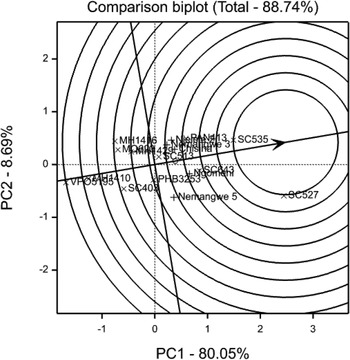
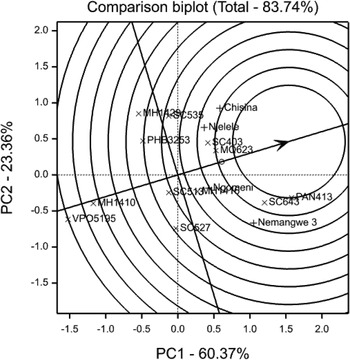
Highly significant differences (P < 0.001) in terms of grain yield and other traits were recorded among the 12 varieties across all the five sites over the 2014/15 and 2015/16 cropping seasons (Tables 3 and 4) as well as across the two cropping seasons (Table 5). The QPM varieties SC527, SC535 and SC643 were the top three yielding varieties during the first season (Table 6). The QPM variety SC527 recorded the highest grain yield across all the sites with a mean yield of 4.2 t/ha (Table 6). This variety yielded a ton more than the highest yielding local non-QPM variety, PAN413, which recorded 3.2 t/ha even though it recorded more days to 50% anthesis than SC527 (Table 6). In general, all non-QPM varieties had moderate yield (3.0–3.2 t/ha), but comparable to that of the widely-grown QPM variety, MQ623 (Table 6). Three of the QPM varieties (SC527, SC535 and SC643) were high-yielding and stable across the five sites relative to non-QPM local checks (Fig. 1). One non-QPM local check (PAN413) and one QPM variety (SC643), which were in the same maturity category with regard to days to 50% anthesis, recorded the highest yield at 2.8 t/ha (Table 7). However, in all cases, the open pollinated variety (OPV5195) had the lowest yield compared to the hybrids described in Tables 6–8. The GGE biplot revealed some QPM hybrids (SC643 and MQ623) which were comparable in stability to widely grown non-QPM hybrids such as SC403 and PAN413 (Fig. 2). Similarly, across seasons, analysis revealed that the non-QPM variety PAN413 was the highest yielder, but comparable to QPM varieties such as SC643, SC527 and SC535 which recorded relatively earlier days to 50% anthesis in comparison to PAN413 (Table 8). The non-QPM variety PHB3253 recorded significantly (P < 0.001) less yield than the QPM varieties (SC535 and MQ623) in the same maturity category (Tables 5 and 8). Across seasons, GGE biplot showed that QPM hybrids (SC643 and SC535) and non-QPM (PAN413) were more stable than the rest of the varieties (Fig. 3).
The comparison biplot showing the best yielding and stable maize varieties evaluated across five sites during the 2014/2015 cropping season in Zimbabwe. The biplot was produced based on genotype SVP, no transformation, no scaling and the data were environment centred.

The comparison biplot showing the best yielding and stable maize varieties evaluated across four sites during the 2015/2016 cropping season in Zimbabwe. The biplot was produced based on genotype SVP, no transformation, no scaling and the data were environment centred.

The comparison biplot showing the best yielding and stable maize varieties evaluated across 2014/15 and 2015/2016 cropping seasons in Zimbabwe. The biplot was produced based on genotype SVP, no transformation, no scaling and the data were environment centred.

ANOVA table showing error mean squares recorded during the 2014/2015 cropping season for maize yield and agronomic traits in Zimbabwe

DF, degrees of freedom; GY, grain yield; 100 KW, hundred kernel weight; PH, plant height; EH, ear height; DTA, days to 50% anthesis; DTS, days to 50% silking; DPM, days to physiological maturity; NKRE, number of kernel rows per ear; NKR, number of kernels per row; ET, ear texture; PV, plant vigour.
aTrait recorded in two of the four sites.
*, ** and ***Significant at the 5, 1 and 0.1% probability levels, respectively; ns, non-significant.
ANOVA table showing error mean squares recorded during the 2015/2016 cropping season for maize yield and agronomic traits in Zimbabwe

DF, degrees of freedom; GY, grain yield; 100 KW, hundred kernel weight; PH, plant height; EH, ear height; DTA, days to 50% anthesis; DTS, days to 50% silking; DPM, days to physiological maturity; NKRE, number of kernel rows per ear; NKR, number of kernels per row; ET, ear texture; PV, plant vigour.
a Trait recorded in two of the four sites.
b Degrees of freedom for residual for plant vigour, plant height, days to 50% tasselling and 50% silking were 52 while it was 26 for ear height.
*, ** and *** significant at the 5, 1 and 0.1% probability levels, respectively; ns, non-significant.
ANOVA table showing error mean squares recorded across 2014/2015 and 2015/2016 cropping seasons for maize yield and agronomic traits in Zimbabwe

DF, degrees of freedom; GY, grain yield; 100 KW, hundred kernel weight; PH, plant height; EH, ear height; DTA, days to 50% anthesis; DTS, days to 50% silking; DPM, days to physiological maturity; NKRE, number of kernel rows per ear; NKR, number of kernels per row; ET, ear texture; PV, plant vigour.
a Degrees of freedom of residual for DTA, DTS, PH and PV were 104 while degrees of freedom for EH were 10, 45 and 65 for replications, blocks and residual respectively.
b EH was recorded in two out of four sites during 2015/2016 cropping season.
*, ** and *** significant at the 5, 1 and 0.1% probability levels, respectively; ns, non-significant.
Means of grain yield and secondary traits of QPM and non-QPM varieties across five sites arranged according to grain yield evaluated in 2014/2015 summer cropping season in Zimbabwe

GY, grain yield; 100 KW, hundred kernel weight; PH, plant height; EH, ear height; DTA, days to 50% anthesis; DTS, days to 50% silking; DPM, days to physiological maturity; NKRE, number of kernel rows per ear; NKR, number of kernels per row; ET, ear texture; PV, plant vigour.
Means of grain yield and secondary traits of QPM and non-QPM varieties across four sites arranged according to grain yield evaluated in 2015/2016 summer cropping season in Zimbabwe

GY, grain yield; 100 KW, hundred kernel weight; PH, plant height; EH, ear height; DTA, days to 50% anthesis; DTS, days to 50% silking; DPM, days to physiological maturity; NKRE, number of kernel rows per ear; NKR, number of kernels per row; ET, ear texture; PV, plant vigour.
a EH was recorded in two out of the four sites.
Means of grain yield and secondary traits of QPM and non-QPM varieties across four sites arranged according to grain yield evaluated across 2014/2015 and 2015/2016 summer cropping seasons in Zimbabwe

GY, grain yield; 100 KW, hundred kernel weight; PH, plant height; EH, ear height; DTA, days to 50% anthesis; DTS, days to 50% silking; DPM, days to physiological maturity; NKRE, number of kernel rows per ear; NKR, number of kernels per row; ET, ear texture; PV, plant vigour.
There were also significant variations (P < 0.001) among the 12 varieties in terms of ear texture in both seasons. Interestingly, in terms of ear texture some QPM hybrids (MQ623, SC527, SC553 and SC643) and some non-QPM local checks (PAN413, PHB3253 and SC513) were recorded to be dent. However, there were also some QPM hybrids that were flint as well as one non-QPM local check, SC403 (Tables 6 and 7). QPM varieties SC527 and SC643 recorded significantly (P < 0.05) greater hundred kernel weights, which were comparable to that of the non-QPM variety (SC403) during the first farming season. During the second season, one non-QPM variety, PHB3253, had the greatest kernel weight, which was comparable to that of SC527, a QPM variety (Table 7). Overall, the QPM varieties SC527 and SC643 recorded the greatest hundred kernel weights across the two cropping seasons (Table 8).
Combined ANOVA also revealed significant variations (P < 0.001) in terms of ear placement (ear height) during the 2014/15 farming season. QPM varieties such as MQ623 and SC535 had similar ear heights as the non-QPM local checks including SC403 (Table 6). Similar results were recorded for both seasons in terms of number of kernel rows per ear. The QPM varieties SC535 in the first season and SC535 and SC643 in the second season recorded the highest number of kernels rows per ear relative to all non-QPM local checks. The high-yielding QPM varieties also had moderate kernel numbers per row, which were similar to those recorded for some non-QPM local checks such as PHB3253 (Tables 6–8).
During the 2014/15 farming season, an independent two-sample t test revealed that there were no significant differences (P > 0.05) between QPM and non-QPM varieties for grain yield and all the secondary traits (Table 9). However, results for the 2015/16 farming season indicated significant differences (P < 0.05) between QPM and non-QPM varieties only in terms of number of kernel rows per ear, ear height and hundred kernel weight (Table 10).
Independent two-sample t test for QPM and non-QPM varieties secondary traits during the 2014/2015 cropping season in Zimbabwe

GY, grain yield; 100 KW, hundred kernel weight; PH, plant height; EH, ear height; DTA, days to 50% anthesis; DTS, days to 50% silking; DPM, days to physiological maturity; NKRE, number of kernel rows per ear; NKR, number of kernels per row; ET, ear texture; PV, plant vigour; ns, non-significant.
Independent two-sample t test for QPM and non-QPM varieties secondary traits during the 2015/2016 cropping season in Zimbabwe

GY, grain yield; 100 KW, hundred kernel weight; PH, plant height; EH, ear height; DTA, days to 50% anthesis; DTS, days to 50% silking; DPM, days to physiological maturity; NKRE, number of kernel rows per ear; NKR, number of kernels per row; ET, ear texture; PV, plant vigour.
aTrait recorded in two of the four sites.
*, ** and *** significant at the 5, 1 and 0.1% probability levels, respectively; ns, non-significant.
Yield was observed to be positively correlated with hundred kernel weight (P < 0.05; r = 0.67), ear texture (P < 0.001; r = 0.71) and plant vigour (P < 0.05; r = 0.66). Correlations for the 2015/16 farming season revealed that days to physiological maturity were positively correlated to days to 50% silking (P < 0.05; r = 0.68).
Farmer participatory variety selection
Famers' overall variety ear characteristics ranking
The non-parametric Friedman's test showed that there were significant differences (P < 0.001) among the famers' overall variety ear characteristics mean rankings across all the five sites for the 2014/15 cropping season (Table 11). For the 2015/16 cropping season, Friedman's test revealed significant differences (P < 0.05) among the varieties in terms of overall variety ear characteristic rating across all the five sites as well (Table 12).
Mean ranks for maize varieties ear characteristics performance across five sites during 2014/2015 cropping season

Mean ranks for maize varieties ear characteristics performance across four sites during 2015/2016 cropping season

Palatability tests (sensory evaluation)
There were significant differences (P < 0.001) in terms of palatability mean ranks between QPM and non-QPM varieties across the sites (Table 13) but post hoc analysis showed that there were no differences among varieties. The χ 2 contingency table for triangulation results revealed that there were no significant differences (P > 0.05) among the varieties in terms of taste at Chisina 2 (χ 2 = 4.8), Njelele 2 (χ 2 = 0), Nemangwe 3 (χ 2 = 3.7) and Nemangwe 5 (χ 2 = 1.9) (Table 14).
Mean ranks for maize varieties palatability evaluation by farmers at five sites

Chi-square contingency table for QPM and non-QPM palatability triangulation tests

Discussion
Significant differences observed among the 12 varieties during both 2014/15 and 2015/16 as well as across the two cropping seasons highlight the genetic variations for the different traits of the varieties (Akande and Lamidi, Reference Akande and Lamidi2006). Moreover, across sites, variations might be due to different soil properties (Table 1). Sandy-loam soils are normally acidic and characterized by low organic matter content, hence the need for CA to improve percentage carbon of such soils (Haynes and Mokolobate, Reference Haynes and Mokolobate2001). Sandy soils are mainly deficient in nitrogen (N), phosphorus (P) and potassium (K) due to heavy leaching and are also associated with higher salt concentrations and little exchangeable calcium (Zingore et al., Reference Zingore, Delve, Nyamangara and Giller2008). Under acidic conditions phosphorus is immobile and coupled with low P concentrations as well (Table 1). Thus low yield obtained in some sites such as Ngomeni can be explained by low N and P (Table 1 and Fig. 3). Hence the stability of some of these varieties is due to tolerance to acidic conditions coupled with high nutrient use efficiency particularly for NPK. However, in general higher yields were obtained across sites than expected, probably due to CA which was used as the farming method, which is in line with 20–120% yield difference of CA against conventional tillage as reported by Rockström et al. (Reference Rockström, Kaumbutho, Mwalley, Nzabi, Temesgen, Mawenya, Barron, Mutua and Damgaard-Larsen2009) and Ngoma et al. (Reference Ngoma, Mason and Sitko2015). In CA, residual moisture and fertility as well as organic nutrients released from other decomposing crop residues all contribute to a nourished crop stand leading to an increased final yield (Hobbs et al., Reference Hobbs, Sayre and Gupta2008; Derpsch et al., Reference Derpsch, Friedrich, Kassam and Li2010). Moreover, CA can also increase yield through suppression of weeds, diseases, pests and may favour beneficial soil-microorganisms' activity (Derpsch et al., Reference Derpsch, Friedrich, Kassam and Li2010). Despite the generally high yield obtained, variations existed among the varieties in terms of yield under CA. These significant differences in traits offer an opportunity to select varieties with desirable traits. The three QPM varieties SC527, SC535 and SC643 performed very well in terms of final grain yield as they out-yielded all the local non-QPM checks. The same trend was also observed across seasons with the only exception that PAN413 (non-QPM) recorded the highest yield which was comparable to the top three yielding QPM varieties, although these QPM varieties recorded earlier days to 50% anthesis than PAN413. Practically, days to 50% anthesis are positively correlated to days to physiological maturity (Trachsel et al., Reference Trachsel, Burgueno, Suarez, San Vicente, Rodriguez and Dhliwayo2017). Most importantly, late maturity varieties normally have higher grain yield than early maturity varieties, but it was not the case with QPM varieties as alluded earlier (Gasura et al., Reference Gasura, Setimela, Edema, Gibson, Okori and Tarekegne2013). Yield was related with hundred kernel weight, ear texture and plant vigour. This is mainly because greater individual kernel weight directly increases final yield (Milošević et al., Reference Milošević, Vujaković and Karagić2010; Gasura et al., Reference Gasura, Setimela, Edema, Gibson, Okori and Tarekegne2013). Flint varieties have kernels that are denser than dent kernels (since starch in the endosperm is closely packed), resulting in greater kernel weight in flint varieties which are commonly found among the QPM varieties (Prasanna et al., Reference Prasanna, Vasal, Kassahun and Singh2001; Olakojo et al., Reference Olakojo, Omueti, Ajomale and Ogunbodede2007). Moreover, ear texture is an important quality trait in maize; it is important in that it determines the processing properties, flour-cooking properties and susceptibility to insect pests (Abadassi, Reference Abadassi2015). Hence in relation to this information, some QPM and non-QPM varieties were observed to be flint (Tables 6–8). These results are consistent with those reported by Bello et al. (Reference Bello, Olawuyi, Ige, Mahamood, Afolabi, Azeez and Abdulmaliq2014) in that quality similarities existed between QPM and non-QPM varieties. Hence farmers who consider ear texture when choosing maize varieties can have QPM with a range of ear textures to choose from.
The non-QPM varieties PAN413 and SC403 and the QPM variety SC527 had the best plant vigour. Good vigour gives the plant a competitive advantage over weeds in terms of growth performance, and the vigourous canopy cover also deprives weeds of much-needed sunlight (Milošević et al., Reference Milošević, Vujaković and Karagić2010). According to Milošević et al. (Reference Milošević, Vujaković and Karagić2010), good plant vigour indicates that the plant tolerates different stresses, including adverse environmental factors. As a preference trait, some QPM and non-QPM local checks exhibited good plant vigour across sites, thereby confirming their wide environmental adaptation. Consequently, QPM varieties have the same chances as non-QPM varieties of being selected for planting by farmers as they possess similar plant vigour.
Although QPM varieties had similar trait performance as non-QPM varieties, they also differed in traits such as ear height, number of kernels per row and hundred kernel weight (Tables 6–8). Significantly high values recorded by non-QPM varieties for number of kernels per row and hundred kernel weight may be attributed to individual varieties such as PAN413 and PHB3253 respectively, which were specifically bred for those traits. Ear placement is another agronomic trait of critical importance for lodging (Shah and Ali, Reference Shah and Ali2015). Interestingly, both QPM and non-QPM varieties had moderate ear height though differences existed. According to Dugje et al. (Reference Dugje, Odo, Teli, Kamara and Asiedu2014) plant and ear heights as growth parameters offer distinctiveness to a particular variety in terms of uniformity and stability.
Convincingly, QPM varieties had some similar agronomic traits to those of non-QPM varieties. These traits included grain yield, plant vigour, plant height, days to 50% anthesis and silking, days to physiological maturity and number of kernel rows per ear. In terms of days to physiological maturity, QPM and non-QPM varieties were in the range of early to medium maturity, which is good for escaping drought and for an early supply of food. Across seasons, yield attained ranged from 1.8 to 3.2 t/ha and days to 50% anthesis was in the range of 60–66 days (Table 8). Number of days to flowering is essential as it indicates the days to physiological maturity of a variety. Although some QPM varieties such as OPV5195 (an open pollinated variety) had low yield, some better QPM hybrids were identified. This is understandable because hybrids normally perform better than OPVs as they exhibit heterosis (Malik et al., Reference Malik, Ara, Naeem, Hussain, Hanif and Yousaf2010). In general, both QPM and non-QPM varieties have other good traits such as grain yield, plant height, days to flowering and physiological maturity, ear texture and plant vigour.
In terms of adaptation, Bhatnagar et al. (Reference Bhatnagar, Betran and Transue2003) and Bello et al. (Reference Bello, Olawuyi, Ige, Mahamood, Afolabi, Azeez and Abdulmaliq2014) echoed the same sentiments, namely that QPM varieties with wide environmental adaptation and competitive yield in the tropics and sub-tropics have been developed. In this regard, notably the QPM varieties SC535, SC527, SC643 and MQ623 (Figs 1–3) clearly demonstrated that QPM varieties can perform at par or much better than non-QPM varieties in terms of grain yield across different environments, thereby indicating their wider environmental adaptation. With regard to agronomic performance, QPM varieties performed similarly to non-QPM local checks as they were similar in terms of good height, days to 50% anthesis, silking and physiological maturity. This clearly suggests that the QPM varieties evaluated in this study, especially the varieties SC535, SC527, SC643 and MQ623, could be adopted by farmers as they outperformed popular local non-QPM varieties in terms of yield and agronomic performance (Tables 6–8). Furthermore, results obtained in this study indicated that QPM varieties SC643 and MQ623 were equally good, as they exhibited good agronomic performance in that they were able to tolerate the El Nino-induced drought during the 2015/16 cropping season (Table 7). These findings support the main objective of this study, as farmers are much more interested in the yield and agronomic performance of a variety than in its nutritional composition which they cannot measure. From farmers' overall variety ear characteristics scoring it is clear that farmers like varieties that are high yielding and stable. It can be deduced from the results that the QPM and non-QPM varieties SC527, SC643 and SC535 received the best overall ear characteristic mean ranks from the farmers. This is most probably because these varieties had perfect perceived farmer agronomic traits in terms of ear texture, and ear and kernel size that translate to yield.
The good agronomic and yield performance exhibited by the QPM varieties SC527, SC535, SC643 and MQ623 will directly benefit farmers by enhancing maize production as well as in providing them with the direct benefits of balanced protein nutrition from QPM varieties. It is also clearly evident that breeders have been working hard to produce QPM varieties with favourable agronomic traits. This is mainly because the opaque-2 gene in QPM had unfavourable pleiotropic effects, such as low yield and soft endosperm associated with it, rendering it highly susceptible to pests and disease (Vasal, Reference Vasal2000; Sofi et al., Reference Sofi, Wani, Rather and Wani2009). In accordance with the findings of Upadhyay et al. (Reference Upadhyay, Gurung, Paudel, Koirala, Sah, Prasad, Pokhrel and Dhakal2009), QPM genotypes recorded significantly higher grain yield than most of farmers' favourite non-QPM local checks. With such findings, seed companies can easily determine that the top three genotypes, SC527, SC535 and SC643, are good alternatives for the currently grown non-QPM varieties, as these will provide bumper harvests as well as quality protein nutrition for food and feed. The QPM varieties MQ623 and SC643 can also be singled out as drought-tolerant QPM varieties as they performed relatively well in terms of grain yield during the 2016/15 cropping season which was characterized by the El Nino-induced drought.
Moreover, QPM is important as a cheap alternative source of quality protein, as maize is the commonest of the food sources which constitute the greater portion of the daily diets of communities in SSA and other maize-dependent developing countries. Furthermore, QPM is better in this respect than most commonly-grown legume grains such as common beans (Phaseolus vulgaris L.), groundnuts (Aranchis Hypogea L.), and cowpeas (Vigna unguiculata L.), which have good quality protein but contain a lot of anti-nutritional factors (ANF) such as trypsin inhibitors, lectins and tannins which inhibit protein digestibility and utilization (López-Barrios et al., Reference López-Barrios, Gutiérrez-Uribe and Serna-Saldívar2014).
Although farmers ranked varieties differently during sensory evaluation tests, they failed to distinguish between the varieties which they had ranked among the top three in taste scores. With these findings it can be argued that these QPM varieties suit the local diet well, as the triangulation results indicated that QPM and non-QPM varieties cannot be separated in terms of taste. This is in line with Ahenkora et al. (Reference Ahenkora, Twumasi-Afriyie, Sallah and Obeng-Antwi1999), who found that overall acceptability and palatability of QPM and non-QPM varieties were not significantly different, indicating that all these varieties had an acceptable taste. Hence as a preference factor, taste should not hinder the adoption of QPM by farmers. Therefore, QPM varieties may be considered to be as equally acceptable to consumers as non-QPM local varieties. Ultimately QPM is the way to go in order to improve food security and the protein nutrition of maize-dependent communities, especially resource-poor rural communities, since some QPM genotypes were at par in performance with the best non-QPM varieties and in some instances were much better than the local checks.
Conclusions
QPM varieties SC527, SC535, SC643 and MQ623 were comparable to non-QPM and local checks in terms of yield, stability and agronomic performance. These QPM varieties received good overall ear characteristics mean rankings from farmers through PVS. Moreover, farmers failed to distinguish between QPM and non-QPM varieties in terms of taste. Farmers consider yield when selecting varieties, and the high-yielding QPM varieties (SC527, SC535, SC643 and MQ623) are likely to be adopted by farmers in southern Africa.
Data
Data available on request.
Acknowledgements
We thank the International Maize and Wheat Improvement Centre (CIMMYT), Seed Co Pvt Ltd and Mukushi Seeds Pvt Ltd for providing us with the QPM germplasm used in this research.
Author contributions
E. G. and J. T. R. conceived and designed the study, C. S. N., E. G. and J. T. R. collected the data, C. S. N., S. M. and E. G. performed data analysis. C. S. N., E. G., J. T. R. and P. S. S. wrote the paper while C. S. N., E. G., S. M. and P. S. edited the paper.
Financial support
This research was partially supported through a grant from the European Union through the WeltHungerHilfe organization and partial scholarship from the Germany Academic Exchange Service (DAAD) to the first author.
Conflict of interest
None.