





Impact statement
Perinatal mental health issues have well-established impacts on maternal well-being, infant development and family functioning. In high-income countries, women from ethnic minorities experience a disproportionate burden of perinatal mental health problems and are much less likely to access timely, culturally appropriate care. This inequality results from a complex interaction of language barriers, migration-related stress, racial discrimination, socioeconomic hardship and the lack of culturally sensitive services within mainstream perinatal care, factors that systematically hinder support during one of the most psychologically vulnerable times in a woman’s life. Although there is increasing awareness of these disparities, the evidence to address them remains scattered. No previous review has assessed and compared the effectiveness, facilitators and implementation hurdles of peer support interventions delivered digitally versus non-digitally for this group. This gap restricts clinicians, service planners and policymakers from identifying the most effective delivery models, suitable populations and optimal conditions. This systematic review fills existing gaps by analysing data from 19 studies in 7 high-income countries. It reveals a key equity paradox: digital interventions meant to increase access might unintentionally exclude the most marginalised women. The review also points out a lack of sufficient cultural adaptation in both intervention types. These findings help guide the creation of equitable, culturally appropriate perinatal mental health services, inform decisions about peer support implementation and focus on the experiences of a population whose needs have often been overlooked in research and practice.
Introduction
Perinatal mental health has become a pressing global health concern, with growing recognition of its impact on maternal, child and family well-being (Howard and Khalifeh, Reference Howard and Khalifeh2020). Within high-income countries (HICs), women from ethnic minority backgrounds are disproportionately affected, in terms of both prevalence and their access to timely and appropriate support (Onozawa et al., Reference Onozawa, Kumar, Adams, Doré and Glover2003; Prady et al., Reference Prady, Pickett, Petherick, Gilbody, Croudace, Mason, Sheldon and Wright2016). Evidence consistently demonstrates that ethnic minority women are less likely than their majority counterparts to receive adequate treatment during periods of perinatal mental health distress (Jankovic et al., Reference Jankovic, Parsons, Jovanović, Berrisford, Copello, Fazil and Priebe2020; Prady et al., Reference Prady, Endacott, Dickerson, Bywater and Blower2021). These disparities persist despite the availability of well-established perinatal mental health services, suggesting that conventional service delivery models may be inadequately responsive to the cultural, linguistic and social needs of diverse populations and cannot be explained solely by service availability; rather, they arise from a complex interplay of structural, cultural and systemic barriers, including language discordance between patients and providers, cultural stigma surrounding mental illness, institutional mistrust rooted in experiences of racial discrimination, socioeconomic precarity and the design of services around majority-population norms that render them structurally inaccessible to women from diverse ethnic backgrounds (Prady et al., Reference Prady, Pickett, Petherick, Gilbody, Croudace, Mason, Sheldon and Wright2016; Watson et al., Reference Watson, Harrop, Walton, Young and Soltani2019; Jankovic et al., Reference Jankovic, Parsons, Jovanović, Berrisford, Copello, Fazil and Priebe2020).
Peer support has increasingly been recognised as a vital component of mental health services across various mental health conditions (Shalaby and Agyapong, Reference Shalaby and Agyapong2020). It is commonly described as providing and accepting help based on the key rule of mutual respect, agreement and shared responsibility of support (Mirbahaeddin and Chreim, Reference Mirbahaeddin and Chreim2022).
Due to a shortage of specialists, a gap often exists in the delivery of healthcare services. To bridge this gap, non-specialist peer support has proven instrumental in providing effective recovery and has significantly contributed to patient engagement, patient activation and positive medical outcomes, leading to the establishment of self-management techniques (Chinman et al., Reference Chinman, McInnes, Eisen, Ellison, Farkas, Armstrong and Resnick2017; Joo et al., Reference Joo, Bone, Forte, Kirley, Lynch and Aboumatar2022).
For the purposes of this review, key terms are defined as follows. Digital peer support refers to both live and automated peer support services provided via technological platforms, including peer-to-peer networks on social media, interventions supported by smartphone apps, text messaging, social media, telephone-based telemedicine and internet-based programmes (Fortuna et al., Reference Fortuna, Venegas, Umucu, Mois, Walker and Brooks2019). Non-digitally delivered peer support interventions refer to face-to-face, community-based or in-person peer support models, including one-to-one peer mentoring, peer support groups, home visiting programmes and community outreach. Non-specialist peer supporters are individuals without formal clinical training who provide emotional, informational and practical support based on shared lived experience of perinatal mental health difficulties. They are distinct from lay counsellors, who are trained community members delivering structured mental health interventions without necessarily sharing lived experience of the condition; this review focuses specifically on peer support grounded in shared lived experience. Ethnic minority women, in the context of this review, refer to women from racialised and minoritised communities living in HICs, including first- and second-generation immigrants, refugees and long-established minority communities who experience structural disadvantage relative to the majority population (Bhopal, Reference Bhopal2004).
Peer support interventions in mental health are crucial for several reasons. A systematic review and meta-analysis by Singla et al. (Reference Singla, Lawson, Kohrt, Jung, Meng, Ratjen, Zahedi, Dennis and Patel2021) examining non-specialist-delivered interventions for perinatal mental health across HICs stated that such interventions were associated with significant reductions in depressive and anxiety symptoms for both preventive and treatment purposes. Another review by Cooper et al. (Reference Cooper, Saunders, Greenburgh, Shah, Appleton, Machin, Jeynes, Barnett, Allan, Griffiths, Stuart, Mitchell, Chipp, Jeffreys, Lloyd-Evans, Simpson and Johnson2024), drawing on evidence predominantly from HIC populations, found that peer support can help in mental health recovery and depression and enhance self-efficacy, defined as individuals’ confidence in their own capacity to manage their mental health. These findings stated that peer support is mutually beneficial for both peer support workers and service users. Well-being is achieved mutually by both individuals who are delivering and receiving peer support.
Peer support has been implemented across both low- and middle-income countries (LMICs) and HICs, though in different contexts. In LMICs, it is typically integrated into community health worker and task-sharing models addressing mental health alongside social adversity (Singla et al., Reference Singla, Lawson, Kohrt, Jung, Meng, Ratjen, Zahedi, Dennis and Patel2021). In HICs, it has been delivered through statutory services, third-sector organisations and digital platforms (Cooper et al., Reference Cooper, Saunders, Greenburgh, Shah, Appleton, Machin, Jeynes, Barnett, Allan, Griffiths, Stuart, Mitchell, Chipp, Jeffreys, Lloyd-Evans, Simpson and Johnson2024). Ethnic minority women in HICs occupy a distinct position facing barriers comparable to those in under-resourced settings despite nominal access to well-resourced healthcare systems.
The landscape of peer support delivery has evolved significantly with technological advances, creating modalities such as digitally assisted and non-digitally assisted intervention models (Fortuna et al., Reference Fortuna, Venegas, Umucu, Mois, Walker and Brooks2019). With the advancement of digital platforms, potential solutions to accessibility barriers faced by ethnic minority women, including geographical constraints and childcare responsibilities, have emerged. However, these technological innovations have also introduced new considerations around digital literacy, cultural appropriateness and privacy concerns that may be particularly salient for minority communities.
Despite increasing interest in peer support interventions, the evidence specific to ethnic minority perinatal populations remains fragmented and limited. Existing research often includes ethnic minority women as subgroups within larger studies rather than designing interventions specifically tailored to their needs and contexts (Watson et al., Reference Watson, Harrop, Walton, Young and Soltani2019). This gap is particularly problematic, given that cultural factors significantly influence help-seeking behaviours, symptom expression and the acceptability of interventions across different ethnic communities (Watson et al., Reference Watson, Harrop, Walton, Young and Soltani2019; Jankovic et al., Reference Jankovic, Parsons, Jovanović, Berrisford, Copello, Fazil and Priebe2020; Joo and Liu, Reference Joo and Liu2021). Key critical gaps that must be addressed to advance perinatal peer support for ethnic minority women in high-income settings include (Akhavan and Lundgren, Reference Akhavan and Lundgren2012) underrepresentation of diverse cultural groups in trials (Alsan and Wanamaker, Reference Alsan and Wanamaker2018; Cooper et al., Reference Cooper, Saunders, Greenburgh, Shah, Appleton, Machin, Jeynes, Barnett, Allan, Griffiths, Stuart, Mitchell, Chipp, Jeffreys, Lloyd-Evans, Simpson and Johnson2024; Jovanović et al., Reference Jovanović, Conneely, Bicknell and Janković2025; Pardhan et al., Reference Pardhan, Sehmbi, Wijewickrama, Onumajuru and Piyasena2025), limited empirical guidance on cultural adaptation (Joo and Liu, Reference Joo and Liu2021; Gardner et al., Reference Gardner, Oduola and Teague2024; Jovanović et al., Reference Jovanović, Conneely, Bicknell and Janković2025; Baker-Ericzén et al., Reference Baker-Ericzén, Connelly, Hazen, Dueñas, Landsverk and Horwitz2012), limited evaluation of digital peer support models among minority populations (Barrera et al., Reference Barrera, Wickham and Muñoz2015; Borges do et al., Reference Borges do, Abdulazeem, Vasanthan, Martinez, Zucoloto, Østengaard, Azzopardi-Muscat, Zapata and Novillo-Ortiz2023), lack of implementation studies examining real-world scale-up (Bhopal, Reference Bhopal2004; Mirbahaeddin and Chreim, Reference Mirbahaeddin and Chreim2022) and the absence of a mixed-methods approach linking outcomes with implementation challenges and facilitators.
While individual studies have examined aspects of peer support for perinatal mental health, none have comprehensively synthesised the facilitators and implementation challenges of both delivery modalities among ethnic minority women in high-income healthcare settings. Understanding not only whether interventions work but also how, for whom and in what contexts is essential for developing evidence-based, culturally responsive peer support that can be implemented and sustained at scale. A preliminary search of PROSPERO and the Cochrane Database confirmed that no existing review specifically addresses this evidence for ethnic minority perinatal women in high-income settings.
This systematic review addresses these critical gaps by synthesising global evidence on peer support interventions for ethnic minority women’s perinatal mental health. It evaluates both digitally delivered and non-digitally delivered approaches, providing a comprehensive assessment of intervention effectiveness, facilitators and implementation challenges across delivery modalities.
Method
Study design
This mixed-methods systematic review synthesised quantitative and qualitative evidence following the PRISMA 2020 guidelines (Page et al., Reference Page, McKenzie, Bossuyt, Boutron, Hoffmann, Mulrow, Shamseer, Tetzlaff, Akl, Brennan, Chou, Glanville, Grimshaw, Hróbjartsson, Lalu, Li, Loder, Mayo-Wilson, McDonald, McGuinness, Stewart, Thomas, Tricco, Welch, Whiting and Moher2021) and was registered with PROSPERO (CRD42025644255). A mixed-methods approach was employed to comprehensively evaluate the effectiveness of the interventions and implementation challenges and facilitators, thereby integrating and cross-validating quantitative and qualitative findings.
Search strategy
Six electronic databases were searched: MEDLINE (via Ovid), PubMed, Embase, Web of Science, CINAHL and Scopus. The search was conducted from July 2025 to August 2025, covering publications from 2000 onwards. The year 2000 was selected to include contemporary peer support models while ensuring sufficient literature following increased recognition of perinatal mental health disparities in ethnic minority populations. Grey literature was searched using Open Grey, ProQuest Dissertations and Theses, and the websites of relevant public health organisations and non-governmental organisations. A customised Google Scholar search was also conducted using focused search terms. Search terms centred on six areas (Akhavan and Lundgren, Reference Akhavan and Lundgren2012): population (pregnant, perinatal, postpartum women) (Alsan and Wanamaker, Reference Alsan and Wanamaker2018), ethnic minority and migrant women (Baker-Ericzén et al., Reference Baker-Ericzén, Connelly, Hazen, Dueñas, Landsverk and Horwitz2012), perinatal mental health conditions (anxiety, depression) (Barrera et al., Reference Barrera, Wickham and Muñoz2015), peer support interventions (digital and face-to-face) (Bhopal, Reference Bhopal2004), effectiveness of these interventions and implementation challenges (Borges do et al., Reference Borges do, Abdulazeem, Vasanthan, Martinez, Zucoloto, Østengaard, Azzopardi-Muscat, Zapata and Novillo-Ortiz2023). The search strategy used MeSH terms such as “Ethnic Groups,” “Minority Groups,” “Immigrant Women” and “Vulnerable Populations” to identify ethnic minority groups in various countries. It is important to recognise that terminology differs between HICs; examples include “BIPOC” in the USA, “BME” in the UK and “racialized” in Canada, and some studies using only non-MeSH terms might have been overlooked. This variation is acknowledged as a limitation of this review.
Eligibility criteria
Studies were eligible if (Akhavan and Lundgren, Reference Akhavan and Lundgren2012) they were available in English (Alsan and Wanamaker, Reference Alsan and Wanamaker2018) with any study design, including randomised controlled trials (RCTs), quasi-experimental studies, mixed-methods and qualitative studies (Baker-Ericzén et al., Reference Baker-Ericzén, Connelly, Hazen, Dueñas, Landsverk and Horwitz2012), and if the population studied was ethnic minority women in HICs experiencing or having experienced perinatal mental health distress (Barrera et al., Reference Barrera, Wickham and Muñoz2015). Interventions studied were peer support interventions, either digitally assisted or non-digitally assisted or individually (Barrera et al., Reference Barrera, Wickham and Muñoz2015). Outcomes measured in the studies evaluated the effectiveness and implementation challenges of one type of peer support intervention (digitally assisted or non-digitally assisted), even without direct comparison. Systematic reviews were excluded; however, where relevant, the studies were incorporated into the introduction and discussion.
Studies were excluded if they (Akhavan and Lundgren, Reference Akhavan and Lundgren2012) focused exclusively on general perinatal populations without specific inclusion of ethnic minority women (Alsan and Wanamaker, Reference Alsan and Wanamaker2018); they were conducted in LMICs (Baker-Ericzén et al., Reference Baker-Ericzén, Connelly, Hazen, Dueñas, Landsverk and Horwitz2012); they did not evaluate peer support interventions or examined professional-led interventions without a peer component (Barrera et al., Reference Barrera, Wickham and Muñoz2015); they reported only physical health outcomes without mental health assessment (Bhopal, Reference Bhopal2004); they were systematic reviews, meta-analyses, protocols, conference abstracts without full data, editorials or commentaries (Borges do et al., Reference Borges do, Abdulazeem, Vasanthan, Martinez, Zucoloto, Østengaard, Azzopardi-Muscat, Zapata and Novillo-Ortiz2023); they were published in languages other than English (Chan et al., Reference Chan, Reid, Skeffington and Marriott2021); or they were published before 2000. Detailed inclusion and exclusion criteria are reported in Supplementary Table 1.
Data extraction
Two independent reviewers first manually screened the studies at the title and abstract stage, using the inclusion and exclusion criteria. Eligible studies were further screened in full text by both reviewers. All studies identified through database searches were imported into Rayyan for screening; duplicates were first identified and removed automatically and then manually. Full-text articles were independently evaluated for data extraction. Any disagreements concerning data extraction were discussed and resolved by the reviewers. The search strategy and Population, Intervention, Comparison, and Outcome (PICO) criteria are reported in Supplementary Tables 2 and 3.
Quality assessment
Study quality was assessed independently by two reviewers using tools appropriate to each study design. Seven RCTs used the Cochrane Risk of Bias tool to evaluate risk of bias across five domains: Nine qualitative studies used the Critical Appraisal Skills Programme (CASP) checklist to assess methodological rigour, credibility, reflexivity and transferability. Three non-randomised quantitative and mixed-methods studies used the Mixed Methods Appraisal Tool (MMAT) to evaluate methodological quality across study components. Quality assessment results informed data interpretation but were not used as exclusion criteria. Disagreements were resolved through discussion. Quality assessment was conducted independently by two reviewers: Dr. E.S. and Dr. S.M., co-author. Disagreements were resolved through discussion until consensus was reached.
Among the seven RCTs, two demonstrated low risk of bias (Howell et al., Reference Howell, Balbierz, Wang, Parides, Zlotnick and Leventhal2012; Lutenbacher et al., Reference Lutenbacher, Elkins, Dietrich and Riggs2018), three raised some concerns in specific domains (Segre et al., Reference Segre, Brock and O’Hara2015; Shorey et al., Reference Shorey, Chee, Ng, Lau, Dennis and Chan2019; Collado et al., Reference Collado, Hicks, Hubley, Levy, McKimmy, Genovez, Gallop, Bauer, Aranda and Dimidjian2025) and two were rated high risk of bias (Barrera et al., Reference Barrera, Wickham and Muñoz2015; Baker-Ericzén et al., Reference Baker-Ericzén, Connelly, Hazen, Dueñas, Landsverk and Horwitz2012). Of the nine qualitative studies assessed using the CASP checklist, five met all criteria and were rated high quality, three showed minor limitations and one demonstrated more notable limitations (Perrenoud et al., Reference Perrenoud, Chautems and Kaech2022). All three non-RCT and mixed-methods studies achieved high MMAT ratings (5/5). Overall, the evidence was deemed suitable for synthesis, with quality assessment informing interpretation rather than serving as an exclusion criterion.
Data synthesis
Quantitative data synthesis
The review used a convergent integrated approach to synthesise quantitative and qualitative findings. The approach involved three stages: first, thematic synthesis was conducted following Thomas and Harden (Reference Thomas and Harden2008). Two reviewers independently coded qualitative findings from the included studies line by line, developing descriptive themes.
Second, a narrative synthesis of quantitative data was conducted following Popay et al. (Reference Popay, Roberts, Sowden, Petticrew, Arai, Rodgers, Britten and Duffy2006). Meta-analysis was not feasible due to substantial heterogeneity in study designs, intervention formats, populations, outcome measures and assessment timing. Studies were grouped by intervention type and by digitally assisted and non-digitally assisted outcome domains.
Following independent synthesis of each data type, findings were compared and integrated to identify areas of convergence and divergence. Integrated synthesis informed conclusions about what types of peer support work, for whom, in what contexts and why, addressing all review objectives regarding effectiveness, facilitators and implementation challenges.
Results
Study characteristics
Nineteen studies meeting the inclusion criteria were included in this systematic review (Table 1). The studies were conducted across seven HICs: the USA (10 studies), Sweden (Baker-Ericzén et al., Reference Baker-Ericzén, Connelly, Hazen, Dueñas, Landsverk and Horwitz2012), Singapore (Alsan and Wanamaker, Reference Alsan and Wanamaker2018), the UK (Akhavan and Lundgren, Reference Akhavan and Lundgren2012), Switzerland (Akhavan and Lundgren, Reference Akhavan and Lundgren2012), Denmark (Akhavan and Lundgren, Reference Akhavan and Lundgren2012) and Turkey (Akhavan and Lundgren, Reference Akhavan and Lundgren2012). Study designs included seven RCTs, nine qualitative studies, two non-RCT quantitative studies and one mixed-methods study. Two studies involved a single participant cohort with separate quantitative and qualitative components (Shorey et al., Reference Shorey, Chee, Ng, Lau, Dennis and Chan2019, Parts 1 and 2). Participant sample sizes ranged from 10 to 540 women. The age of participating women varied from 16 to 45 years. All studies assessed mental health distress (perinatal depression, perinatal anxiety, perinatal stress). Nine studies evaluated digitally delivered interventions, eight explored non-digitally delivered interventions and two examined hybrid models combining both formats. Detailed study characteristics are shown in Table 1. Outcomes are detailed in Supplementary Tables 7–11.
Characteristics of all included studies

Table 1. Long description
The table consists of nine columns: Study Number, Study I D, Study design, Setting, Delivery mode, Participants, Interventions, Comparison, and Outcomes measured.
* Row 1: Baker-Ericzén et al. 2012, R C T, USA. Digitally delivered peer support for 79 Latina women using mobile-based telemedicine. Measured effectiveness via E P D S scale.
* Row 2: Perrenoud et al. 2022, Qualitative study, Switzerland. WhatsApp messaging for 30 peer workers and 20 immigrant women. Focused on communication patterns.
* Row 3: Shorey and Ng 2019, R C T, Singapore. WhatsApp, phone calls, and mobile app for 138 mothers. Measured E P D S, P H Q, S T A I, and U L S.
* Row 4: Shorey et al. 2019, Qualitative study, Singapore. WhatsApp and phone calls for 20 mothers and 19 peer workers.
* Row 5: Meyer et al. 2022, Qualitative study, Turkey. M-health for 14 Syrian women.
* Row 6: Li et al. 2021, Qualitative study, USA. WeChat and text messaging for 13 Chinese women.
* Row 7: Söderström et al. 2022, Qualitative study, Sweden. M-health and telemedicine for 14 immigrant women using the Healthy moms app.
* Row 8: Johnsen et al. 2021, Mixed-method, Denmark. M A M A minus A C T app for 21 non-Western immigrant women.
* Row 9: Barrera et al. 2015, R C T, USA. Internet-based support for 111 Spanish and Hispanic women. Measured via E P D S and C E S minus D.
* Row 10: Segre L et al., R C T, USA. Non-digital home visits for 60 depressed ethnic minority women. Measured via H R S D minus 17 and E P D S.
* Row 11: Howell et al. 2012, R C T, USA. Face-to-face support for 540 Black and Latina mothers. Measured via E P D S and P H Q minus 9.
* Row 12: Käks et al. 2024, Mixed method, Sweden. Community face-to-face support for 1,294 mothers.
* Row 13: Robidoux et al. 2023, Quantitative, USA. Community-based support for 234 Latinx immigrant mothers.
* Row 14: McLeish and Redshaw 2017, Qualitative, U K. Face-to-face support for 47 ethnic minority women.
* Row 15: Akhavan and Lundgren 2012, Qualitative, Sweden. Face-to-face support for 10 Asian and African women.
* Row 16: Lutenbacher et al. 2018, R C T, USA. M I H O W community support for 178 Hispanic mothers.
* Row 17: McKimmy et al. 2023, Mixed method, USA. Face-to-face support for 507 first-time client mothers.
* Row 18: Rokicki et al. 2024, Quantitative, USA. 33 community-based groups for Black, Hispanic, and Asian women.
* Row 19: Collado et al. 2025, R C T, USA. Peer-led behavioral activation via face-to-face and video conferencing for 126 Latina or Hispanic women with P H Q minus 9 scores greater than or equal to 5.
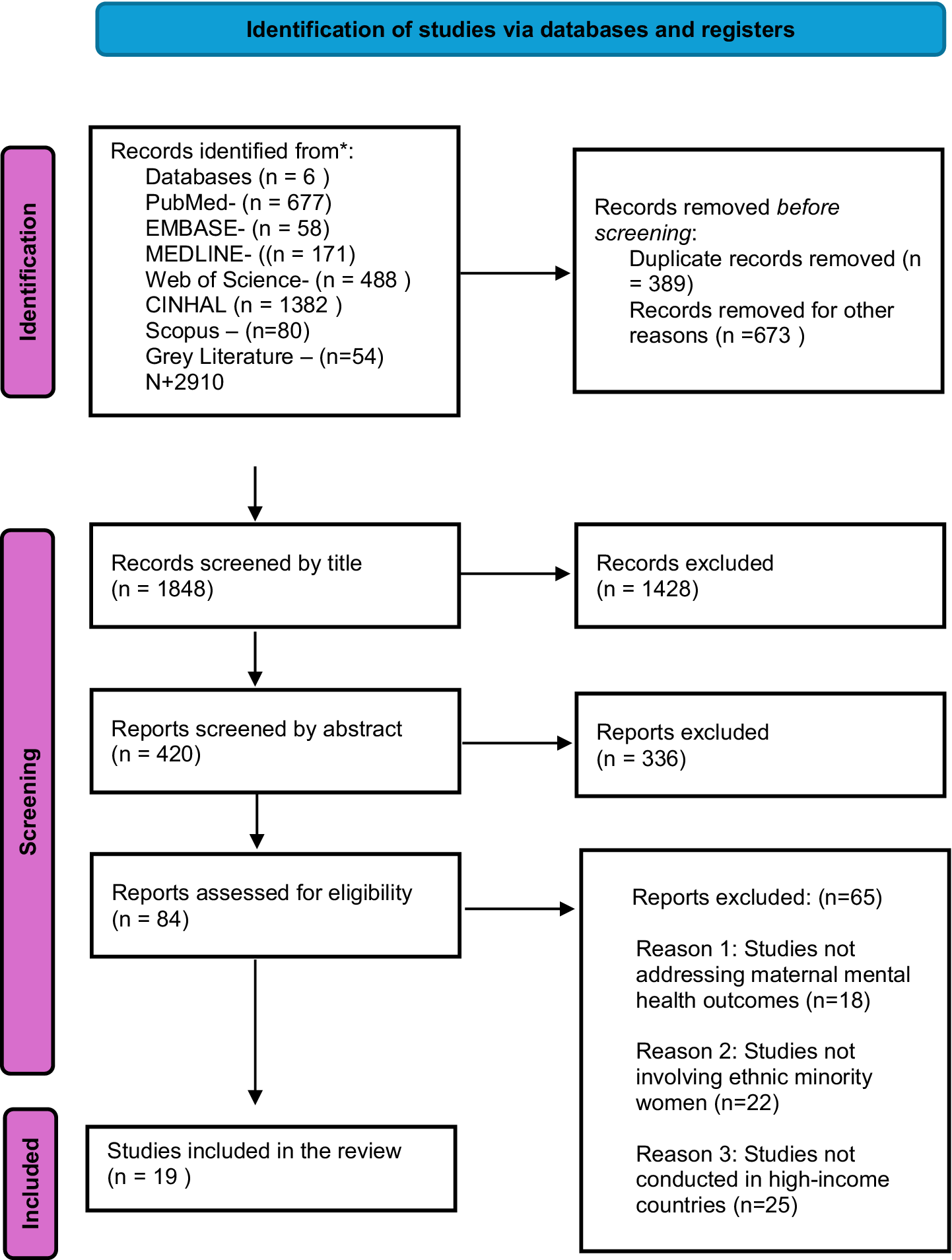
The included studies showed significant ethnic and national diversity. Among the ten US-based studies, participants included Hispanic and Latina women from both established communities and recent immigrant backgrounds (Baker-Ericzén et al., Reference Baker-Ericzén, Connelly, Hazen, Dueñas, Landsverk and Horwitz2012; Barrera et al., Reference Barrera, Wickham and Muñoz2015; Lutenbacher et al., Reference Lutenbacher, Elkins, Dietrich and Riggs2018; McKimmy et al., Reference McKimmy, Levy, Collado, Pinela and Dimidjian2023; Robidoux et al., Reference Robidoux, Williams, Cormack and Johnson2023; Collado et al., Reference Collado, Hicks, Hubley, Levy, McKimmy, Genovez, Gallop, Bauer, Aranda and Dimidjian2025); self-identified Black and Latina mothers (Howell et al., Reference Howell, Balbierz, Wang, Parides, Zlotnick and Leventhal2012); Black, Hispanic and Asian women (Rokicki et al., Reference Rokicki, Patel, Suplee and D’Oria2024); immigrant Chinese women (Li et al., Reference Li, Xue, Gong, Quan, Li, Xiao, Xu, Caine and Poleshuck2021); and mixed low-income ethnic minority groups (Segre et al., Reference Segre, Brock and O’Hara2015). Swedish studies included immigrant mothers from Asian and African backgrounds, such as Arabic- and Somali-speaking women (Akhavan and Lundgren, Reference Akhavan and Lundgren2012; Söderström et al., Reference Söderström, Müssener, Löfgren, Sandell, Thomas and Löf2022; Kåks et al., Reference Kåks, Stansert Katzen, Målqvist, Bergström and Herzig van Wees2024). Studies from Singapore involved Chinese, Malay and Indian mothers (Shorey et al., Reference Shorey, Chee, Ng, Lau, Dennis and Chan2019). Other research involved Syrian refugee women in Turkey (Meyer et al., Reference Meyer, Surmeli, Hoeflin Hana and Narla2022), non-Western immigrant women in Denmark (Johnsen et al., Reference Johnsen, Christensen, Juhl and Villadsen2021), immigrant women in Switzerland (Perrenoud et al., Reference Perrenoud, Chautems and Kaech2022) and ethnic minority women in the UK (McLeish and Redshaw, Reference McLeish and Redshaw2017). This diverse representation affects how the findings are contextualised and their transferability. The study selection process is summarised in the PRISMA flow diagram (Figure 1).
PRISMA flow diagram (Page et al., Reference Page, McKenzie, Bossuyt, Boutron, Hoffmann, Mulrow, Shamseer, Tetzlaff, Akl, Brennan, Chou, Glanville, Grimshaw, Hróbjartsson, Lalu, Li, Loder, Mayo-Wilson, McDonald, McGuinness, Stewart, Thomas, Tricco, Welch, Whiting and Moher2021).

Figure 1. Long description
The flowchart is organized into three vertical phases labeled on the left: Identification, Screening, and Included.
1. Identification Phase:
* Top box: Identification of studies via databases and registers.
* Main box: Records identified from Databases n equals 6, PubMed n equals 677, E M B A S E n equals 58, M E D L I N E n equals 171, Web of Science n equals 488, C I N H A L n equals 1382, Scopus n equals 80, Grey Literature n equals 54. Total N plus 2910.
* Right box: Records removed before screening: Duplicate records removed n equals 389, Records removed for other reasons n equals 673.
2. Screening Phase:
* First central box: Records screened by title n equals 1848. Arrow points right to Records excluded n equals 1428.
* Second central box: Reports screened by abstract n equals 420. Arrow points right to Reports excluded n equals 336.
* Third central box: Reports assessed for eligibility n equals 84. Arrow points right to Reports excluded n equals 65. Reasons for exclusion: Reason 1: Studies not addressing maternal mental health outcomes n equals 18. Reason 2: Studies not involving ethnic minority women n equals 22. Reason 3: Studies not conducted in high-income countries n equals 25.
3. Included Phase:
* Final box: Studies included in the review n equals 19.
Quality appraisal
Seven RCTs were assessed using the Cochrane RoB tool. Overall, four RCTs (Shorey et al., Howell et al., Lautenbacher et al., Segre et al.) showed a low risk of bias across multiple domains. Three RCTs (Barrera et al., Baker et al., Collado et al.) exhibited some concerns or a high risk in specific domains. Nine qualitative studies were evaluated using the CASP checklist. Eight studies demonstrated methodological rigour across credibility, reflexivity and transferability criteria. One study (Perrenoud et al., Reference Perrenoud, Chautems and Kaech2022) displayed limited methodological rigour. Two non-RCT quantitative studies and one mixed-methods study were appraised using the MMAT, all of which showed high methodological quality. Overall, the evidence was deemed suitable for synthesis despite variability in methodological rigour. Detailed quality assessment results are provided in Supplementary Tables 4–6, and the overall quality assessment of this review is presented in Supplementary Table 12.
Narrative synthesis of quantitative findings
Effectiveness of digitally delivered peer support interventions
Effectiveness on mental health symptoms. The effectiveness of digitally delivered peer support in reducing perinatal distress was examined in three included RCTs. The multimodal, digitally delivered intervention by Shorey et al. (Reference Shorey, Chee, Ng, Lau, Dennis and Chan2019), using the Edinburgh Postnatal Depression Scale (EPDS), measured depressive symptoms, anxiety, loneliness and perceived social support. Depressive symptoms showed no significant difference at one month postpartum, but after three months, there was improvement (d = −2.11; 95% CI −4.0 to −0.3; p = .03). At one and three months postpartum, the intervention group’s general psychological distress, as measured by the PHQ (Patient Health Questionnaire), was found to be considerably lower (p = .02 and p = .04, respectively). These findings suggest that the intervention is effective when used for a longer duration, with positive trends in anxiety, loneliness and perceived social support.
The electronic-based mindfulness peer support intervention by Barrera et al. (Reference Barrera, Wickham and Muñoz2015) showed a significant subgroup effect for women with elevated prenatal depressive symptoms but failed to achieve statistical significance for preventing postpartum depression at the predefined alpha level (b = −0.514, χ2 = 3.43, p = .061). Compared with women with lower baseline scores, those with Centre for Epidemiological Depression Scale (CES-D) scores ≥24 had substantially larger protective effects (b = −0.605, χ2 = 5.20, p = .023; hazard ratio 0.546, 95% CI 0.324–0.936), indicating a 45.4% lower chance of negative mental health outcomes, suggesting it is effective in higher depressive scores. An intervention using mobile-based telemedicine by Baker-Ericzén et al. (Reference Baker-Ericzén, Connelly, Hazen, Dueñas, Landsverk and Horwitz2012) showed improved depression symptom trajectories and increased engagement in identifying and addressing depression during pregnancy and the postpartum period. EPDS scores improved among consistent users.
Effectiveness of non-digitally delivered peer support interventions
Effectiveness on mental health symptoms. Three RCTs evaluated the effectiveness of non-digitally delivered peer support. Segre et al. (Reference Segre, Brock and O’Hara2015) evaluated the peer-delivered listening visits. Depression was measured using three validated instruments (Hamilton Rating Scale for Depression-17-item [HRSD-17], EPDS, and Inventory of Depression and Anxiety Symptoms-General Depression subscale [IDAS-GD]). At 8-week follow-up, 36% of women receiving listening visits experienced clinically significant improvement in depressive symptoms compared to 14% in the control group.
Howell et al. (Reference Howell, Balbierz, Wang, Parides, Zlotnick and Leventhal2012) evaluated a behavioural education-based peer support intervention and found that postpartum depression screening rates consistently favoured the intervention group across three timepoints: week 3 (7.1% intervention vs. 14.4% control, p = .01), month 3 (6.3% vs. 11.4%, p = .058) and month 6 (7.5% vs. 13.1%, p = .068). The study stated that mothers with behavioural education-based peer support were less likely to screen positive for depression (odds ratio 0.67, 95% CI 0.47–0.97). Treatment analysis 16 (95% CI 9–112) stated that with every 16 women receiving the behavioural education peer support intervention, one case of postpartum depression will be prevented.
Lutenbacher et al. (Reference Lutenbacher, Elkins, Dietrich and Riggs2018) evaluated the Maternal Infant Health Outreach Worker (MIHOW) programme. The study stated that the depressive symptom scores measured using the EPDS were consistently lower in the MIHOW group than in the comparison group across all assessment points.
Lutenbacher et al. (Reference Lutenbacher, Elkins, Dietrich and Riggs2018) also measured secondary outcomes, including lower parenting stress (d = 0.57, p < .001) and higher levels of emotional and social support (d = 0.39 and 0.43, respectively; p < .001). These findings indicated that peer support benefits extend beyond mood symptoms and include broader maternal well-being and psychosocial functioning.
Robidoux et al. (Reference Robidoux, Williams, Cormack and Johnson2023) reported improved rates of postpartum depression detection and treatment initiation. Rokicki et al. (Reference Rokicki, Patel, Suplee and D’Oria2024) evaluated a community-based peer support programme that was predominantly digitally delivered (82%), with some face-to-face components, improving postpartum depression detection and treatment.
Effectiveness in hybrid models
Collado et al. (Reference Collado, Hicks, Hubley, Levy, McKimmy, Genovez, Gallop, Bauer, Aranda and Dimidjian2025) evaluated a hybrid peer-led behavioural activation programme combining face-to-face and video-conferencing components among 126 Latina and Hispanic women with perinatal depression (PHQ-9 score ≥ 5). The intervention produced significant improvements across multiple outcomes: depression (earlier phase: t = −7.80, p < .0001, d = 0.71; later phase: t = 5.06, p < .0001, d = 0.46), anxiety (t = −8.74, p < .0001, d = 0.78), perceived stress (t = −7.70, p < .0001, d = 0.68) and activity level (t = 10.13, p < .0001, d = 0.90). High satisfaction was reported (M = 28.83, SD = 2.63; 95% CI 28.3–29.4), but attrition was notable (40% dropout rate), primarily among women using non-digitally delivered components.
Qualitative findings
A thematic synthesis of nine qualitative and mixed-methods studies identified facilitators and implementation challenges across both digitally delivered and non-digitally delivered peer support interventions (Figure 2). Findings are organised by intervention modality and domain.
A thematic map demonstrating the facilitators and implementation challenges of digital-based and non-digital-based peer support interventions for ethnic minority women living in high-income countries.
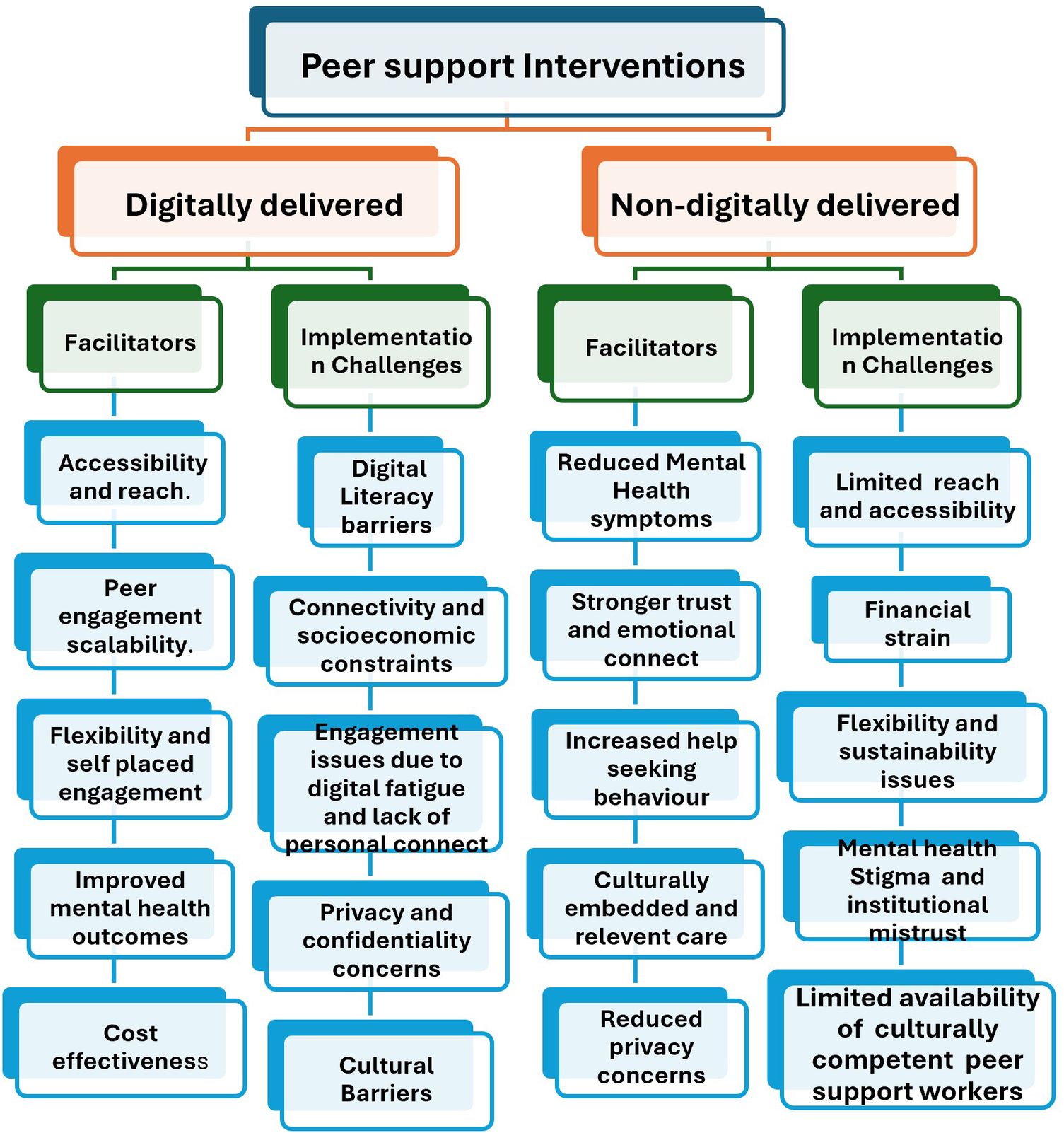
Figure 2. Long description
The flowchart begins at the top with a central node titled Peer support Interventions. This node branches into two main categories.
1. Digitally delivered interventions (left branch):
- Facilitators: Accessibility and reach, Peer engagement scalability, Flexibility and self placed engagement, Improved mental health outcomes, and Cost effectiveness.
- Implementation Challenges: Digital Literacy barriers, Connectivity and socioeconomic constraints, Engagement issues due to digital fatigue and lack of personal connect, Privacy and confidentiality concerns, and Cultural Barriers.
2. Non-digitally delivered interventions (right branch):
- Facilitators: Reduced Mental Health symptoms, Stronger trust and emotional connect, Increased help seeking behaviour, Culturally embedded and relevent care, and Reduced privacy concerns.
- Implementation Challenges: Limited reach and accessibility, Financial strain, Flexibility and sustainability issues, Mental health Stigma and institutional mistrust, and Limited availability of culturally competent peer support workers.
Facilitators of digitally delivered interventions
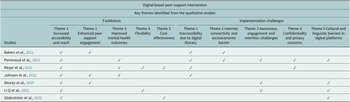
Across the included studies, digitally delivered peer support consistently facilitated access and sustained engagement among ethnic minority perinatal women, in ways that traditional in-person services could not (Table 2). Accessibility and flexible engagement emerged as the most prominent facilitators. Asynchronous messaging platforms such as WhatsApp, text messaging and app-based peer support accommodated women’s constraints, including transportation, childcare responsibilities and inflexible clinic hours (Baker-Ericzén et al., Reference Baker-Ericzén, Connelly, Hazen, Dueñas, Landsverk and Horwitz2012; Shorey et al., Reference Shorey, Chee, Ng, Lau, Dennis and Chan2019; Johnsen et al., Reference Johnsen, Christensen, Juhl and Villadsen2021; Li et al., Reference Li, Xue, Gong, Quan, Li, Xiao, Xu, Caine and Poleshuck2021; Meyer et al., Reference Meyer, Surmeli, Hoeflin Hana and Narla2022; Perrenoud et al., Reference Perrenoud, Chautems and Kaech2022; Söderström et al., Reference Söderström, Müssener, Löfgren, Sandell, Thomas and Löf2022). The ability to engage with content in preferred languages, at convenient times and with optional anonymity proved particularly valuable for women with diverse literacy levels and competing demands (Li et al., Reference Li, Xue, Gong, Quan, Li, Xiao, Xu, Caine and Poleshuck2021; Meyer et al., Reference Meyer, Surmeli, Hoeflin Hana and Narla2022), enabling women to tailor support to their individual contexts and driving sustained engagement.
A thematic analysis of digital-based peer support interventions for ethnic minority women living in high-income countries
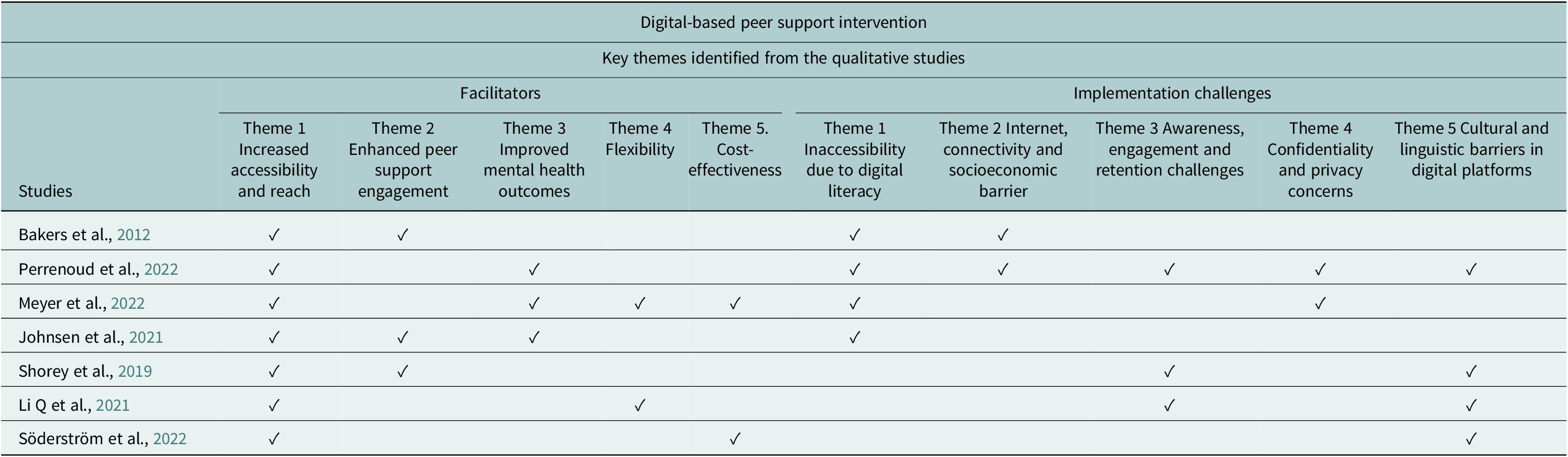
Table 2. Long description
The table is structured with 11 columns. The first column lists the studies, followed by five columns under the heading Facilitators and five columns under Implementation challenges.
Facilitator Themes:
* Theme 1: Increased accessibility and reach.
* Theme 2: Enhanced peer support engagement.
* Theme 3: Improved mental health outcomes.
* Theme 4: Flexibility.
* Theme 5: Cost-effectiveness.
Implementation Challenge Themes:
* Theme 1: Inaccessibility due to digital literacy.
* Theme 2: Internet, connectivity and socioeconomic barrier.
* Theme 3: Awareness, engagement and retention challenges.
* Theme 4: Confidentiality and privacy concerns.
* Theme 5: Cultural and linguistic barriers in digital platforms.
Data by Study:
* Bakers et al: Facilitators 1 and 2; Challenges 1 and 2.
* Perrenoud et al: Facilitators 1 and 3; Challenges 1, 2, 3, 4, and 5.
* Mayer et al: Facilitators 1, 3, 4, and 5; Challenges 1 and 4.
* Johnsen et al: Facilitators 1, 2, and 3; Challenge 1.
* Shorey et al: Facilitators 1 and 2; Challenges 3 and 5.
* Li Q et al: Facilitators 1 and 4; Challenges 3 and 5.
* Soderstrom et al: Facilitators 1 and 5; Challenge 5.
Closely related to accessibility was the role of continuous peer engagement in mental health outcomes. Regular digital contact with culturally matched peers fostered an ongoing sense of connection, with women reporting feeling seen, supported and less isolated through text- or call-based check-ins (Baker-Ericzén et al., Reference Baker-Ericzén, Connelly, Hazen, Dueñas, Landsverk and Horwitz2012; Shorey et al., Reference Shorey, Chee, Ng, Lau, Dennis and Chan2019; Johnsen et al., Reference Johnsen, Christensen, Juhl and Villadsen2021). This steady contact translated into tangible improvements in well-being: prompt digital responses and personalised support were associated with reduced anxiety, lower depression scores and healthier postpartum behaviours (Shorey et al., Reference Shorey, Chee, Ng, Lau, Dennis and Chan2019; Johnsen et al., Reference Johnsen, Christensen, Juhl and Villadsen2021; Perrenoud et al., Reference Perrenoud, Chautems and Kaech2022). Digital nudges and automated reminders further reinforced self-efficacy and coping strategies, acting as preventive prompts during critical moments of distress.
Further facilitators were cost-effectiveness and scalability. Digital delivery models reduced clinician time by handling low-acuity queries through automated features and group forums, while eliminating transportation and venue costs (Meyer et al., Reference Meyer, Surmeli, Hoeflin Hana and Narla2022; Söderström et al., Reference Söderström, Müssener, Löfgren, Sandell, Thomas and Löf2022). This enhanced the potential for scale-up without a proportional increase in resource expenditure, while maintaining meaningful human connection.
Implementation challenges of digitally delivered interventions
Despite their accessibility advantages, digitally delivered interventions faced significant and interrelated implementation challenges. The most pervasive of these concerned digital access and equity. Many ethnic minority women, particularly those with limited formal education or limited familiarity with digital tools, found it difficult to navigate apps and digital platforms (Baker-Ericzén et al., Reference Baker-Ericzén, Connelly, Hazen, Dueñas, Landsverk and Horwitz2012; Johnsen et al., Reference Johnsen, Christensen, Juhl and Villadsen2021; Meyer et al., Reference Meyer, Surmeli, Hoeflin Hana and Narla2022; Perrenoud et al., Reference Perrenoud, Chautems and Kaech2022). These digital literacy barriers were compounded by socioeconomic constraints: intermittent internet access and data-cost concerns disrupted continuity of care, particularly in rural or low-income households (Baker-Ericzén et al., Reference Baker-Ericzén, Connelly, Hazen, Dueñas, Landsverk and Horwitz2012; Perrenoud et al., Reference Perrenoud, Chautems and Kaech2022). Together, these barriers risk widening rather than narrowing existing health inequities, representing a critical equity paradox at the heart of digitally delivered peer support.
Engagement, retention and privacy concerns formed a further cluster of interrelated challenges. The absence of face-to-face rapport could render digital support impersonal, undermining motivation to sustain engagement over time (Shorey et al., Reference Shorey, Chee, Ng, Lau, Dennis and Chan2019; Li et al., Reference Li, Xue, Gong, Quan, Li, Xiao, Xu, Caine and Poleshuck2021; Perrenoud et al., Reference Perrenoud, Chautems and Kaech2022). Concerns about data security and mental health stigma led some women to withhold sensitive disclosures, limiting the therapeutic depth of interactions (Meyer et al., Reference Meyer, Surmeli, Hoeflin Hana and Narla2022; Perrenoud et al., Reference Perrenoud, Chautems and Kaech2022). Studies consistently found that sustained engagement required deliberate rapport-building strategies, including scheduled video calls, periodic in-person contact and robust privacy safeguards such as end-to-end encryption and transparent data policies, to maintain trust and reduce attrition.
Underpinning many of these challenges was a broader issue of cultural and linguistic adaptation. Platforms with inadequate language options or culturally relevant content experienced lower uptake and higher dropout rates (Shorey et al., Reference Shorey, Chee, Ng, Lau, Dennis and Chan2019; Li et al., Reference Li, Xue, Gong, Quan, Li, Xiao, Xu, Caine and Poleshuck2021; Perrenoud et al., Reference Perrenoud, Chautems and Kaech2022; Söderström et al., Reference Söderström, Müssener, Löfgren, Sandell, Thomas and Löf2022). Adaptations were predominantly surface level, typically limited to language translation, without addressing deeper cultural values, help-seeking norms or community-specific beliefs. Community co-creation of digital content was identified across multiple studies as essential to ensuring cultural resonance and reducing attrition.
Facilitators of non-digitally delivered interventions
Non-digitally delivered peer support interventions were consistently valued for the quality of human connection they fostered (Table 3). The most prominent facilitator was the strength of the emotional connection, trust and cultural grounding established through face-to-face interaction. Women described peer supporters as creating culturally resonant spaces and building relationships grounded in mutual understanding and shared lived experience (Akhavan and Lundgren, Reference Akhavan and Lundgren2012; McKimmy et al., Reference McKimmy, Levy, Collado, Pinela and Dimidjian2023; Rokicki et al., Reference Rokicki, Patel, Suplee and D’Oria2024; Collado et al., Reference Collado, Hicks, Hubley, Levy, McKimmy, Genovez, Gallop, Bauer, Aranda and Dimidjian2025). This emotional safety encouraged disclosure and sustained participation and reduced the perinatal isolation frequently reported by ethnic minority women. Crucially, one-to-one in-person contact enabled peer supporters to respond flexibly and responsively to individual community needs, offering culturally sensitive care that participants perceived as meaningfully different from institutional services (Akhavan and Lundgren, Reference Akhavan and Lundgren2012; McKimmy et al., Reference McKimmy, Levy, Collado, Pinela and Dimidjian2023; Kåks et al., Reference Kåks, Stansert Katzen, Målqvist, Bergström and Herzig van Wees2024). Face-to-face interactions also substantially reduced privacy concerns, with women reporting a stronger sense of being heard and understood than with digital modalities (Akhavan and Lundgren, Reference Akhavan and Lundgren2012; McLeish and Redshaw, Reference McLeish and Redshaw2017; McKimmy et al., Reference McKimmy, Levy, Collado, Pinela and Dimidjian2023).
A thematic analysis of non-digital-based peer support interventions for ethnic minority women living in high-income countries
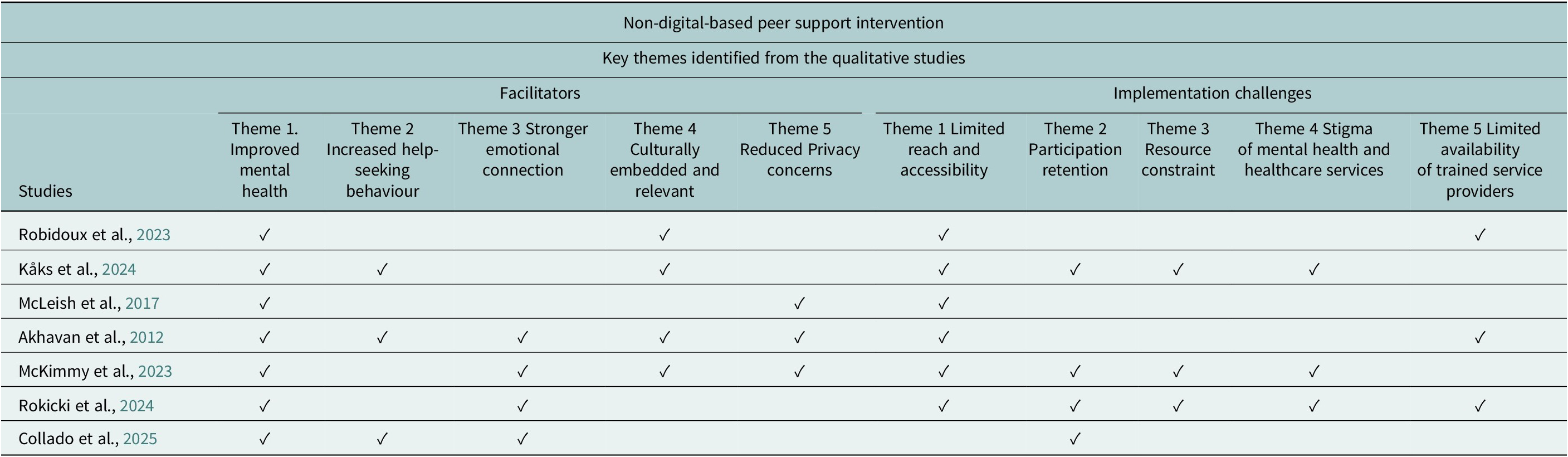
Table 3. Long description
A table titled Non-digital-based peer support intervention. The columns are divided into two main categories: Facilitators and Implementation challenges.
Facilitator themes include:
* Theme 1: Improved mental health.
* Theme 2: Increased help-seeking behaviour.
* Theme 3: Stronger emotional connection.
* Theme 4: Culturally embedded and relevant.
* Theme 5: Reduced Privacy concerns.
Implementation challenge themes include:
* Theme 1: Limited reach and accessibility.
* Theme 2: Participation retention.
* Theme 3: Resource constraint.
* Theme 4: Stigma of mental health and healthcare services.
* Theme 5: Limited availability of trained service providers.
Data mapping by study:
* Robidoux et al: Facilitators 1 and 4; Challenges 1 and 5.
* Kaks et al: Facilitators 1, 2, and 4; Challenges 1, 2, 3, and 4.
* McLeish et al: Facilitators 1 and 5; Challenge 1.
* Akhavan et al: Facilitators 1, 2, 3, 4, and 5; Challenges 1 and 5.
* McKimmy et al: Facilitators 1, 3, 4, and 5; Challenges 1, 2, 3, and 4.
* Rokicki et al: Facilitator 1 and 3; Challenges 1, 2, 3, 4, and 5.
* Collado et al: Facilitators 1, 2, and 3; Challenge 2.
These relational qualities had direct effects on mental health outcomes and help-seeking behaviour. Participants across qualitative and mixed-methods studies reported meaningful reductions in depressive symptoms, anxiety and perceived stress, reflecting therapeutic mechanisms such as shared understanding, normalisation of experience and validation (Akhavan and Lundgren, Reference Akhavan and Lundgren2012; McLeish and Redshaw, Reference McLeish and Redshaw2017; McKimmy et al., Reference McKimmy, Levy, Collado, Pinela and Dimidjian2023; Robidoux et al., Reference Robidoux, Williams, Cormack and Johnson2023; Kåks et al., Reference Kåks, Stansert Katzen, Målqvist, Bergström and Herzig van Wees2024; Rokicki et al., Reference Rokicki, Patel, Suplee and D’Oria2024; Collado et al., Reference Collado, Hicks, Hubley, Levy, McKimmy, Genovez, Gallop, Bauer, Aranda and Dimidjian2025). Beyond symptom reduction, peer groups and one-to-one support promoted social capital, increased confidence and empowered women to seek professional help, demonstrating how peer relationships led to proactive engagement with mental health services (Akhavan and Lundgren, Reference Akhavan and Lundgren2012; McLeish and Redshaw, Reference McLeish and Redshaw2017; Kåks et al., Reference Kåks, Stansert Katzen, Målqvist, Bergström and Herzig van Wees2024).
Implementation challenges of non-digitally delivered interventions
Non-digitally delivered interventions faced a distinct yet equally significant set of implementation challenges, mainly related to reach, accessibility and systemic barriers to engagement. Language barriers, limited programme awareness and deeply rooted distrust of institutional healthcare services restricted initial uptake across multiple studies (Akhavan and Lundgren, Reference Akhavan and Lundgren2012; McLeish and Redshaw, Reference McLeish and Redshaw2017; McKimmy et al., Reference McKimmy, Levy, Collado, Pinela and Dimidjian2023; Robidoux et al., Reference Robidoux, Williams, Cormack and Johnson2023; Kåks et al., Reference Kåks, Stansert Katzen, Målqvist, Bergström and Herzig van Wees2024; Rokicki et al., Reference Rokicki, Patel, Suplee and D’Oria2024). Cultural stigma surrounding mental health further discouraged participation, requiring deliberate community engagement strategies and culturally sensitive programme framing to overcome these barriers.
Retention, logistics and workforce capacity formed a further cluster of interrelated challenges. Rigid scheduling and requirement for regular in-person attendance posed significant difficulties for mothers managing childcare, employment and transportation, contributing to high attrition rates, particularly among women with the greatest competing demands (McKimmy et al., Reference McKimmy, Levy, Collado, Pinela and Dimidjian2023; Kåks et al., Reference Kåks, Stansert Katzen, Målqvist, Bergström and Herzig van Wees2024; Rokicki et al., Reference Rokicki, Patel, Suplee and D’Oria2024; Collado et al., Reference Collado, Hicks, Hubley, Levy, McKimmy, Genovez, Gallop, Bauer, Aranda and Dimidjian2025). These logistical constraints were exacerbated by resource limitations: inconsistent funding, reliance on trained personnel and dependence on physical meeting spaces, which restricted scalability and confined the reach to women in geographical proximity to services (McKimmy et al., Reference McKimmy, Levy, Collado, Pinela and Dimidjian2023; Robidoux et al., Reference Robidoux, Williams, Cormack and Johnson2023; Kåks et al., Reference Kåks, Stansert Katzen, Målqvist, Bergström and Herzig van Wees2024). Compounding these pressures was a shortage of culturally competent, well-trained peer supporters, which led to uneven service quality and underutilisation in some programmes (Akhavan and Lundgren, Reference Akhavan and Lundgren2012; Robidoux et al., Reference Robidoux, Williams, Cormack and Johnson2023; Rokicki et al., Reference Rokicki, Patel, Suplee and D’Oria2024). This workforce capacity gap highlighted the need for standardised training frameworks and accreditation pathways to ensure consistent and equitable service delivery.
Mixed-methods synthesis analysis
This mixed-methods data analysis showed that both intervention types are effective, but in different ways and through distinct pathways. Digitally delivered interventions helped women with higher initial depression severity (Barrera et al., Reference Barrera, Wickham and Muñoz2015) and had effects that developed over time (Shorey et al., Reference Shorey, Chee, Ng, Lau, Dennis and Chan2019). Non-digitally delivered interventions showed steady, statistically significant reductions in depression across multiple timepoints, with larger effect sizes in some studies (Howell et al., Reference Howell, Balbierz, Wang, Parides, Zlotnick and Leventhal2012; Segre et al., Reference Segre, Brock and O’Hara2015; Lutenbacher et al., Reference Lutenbacher, Elkins, Dietrich and Riggs2018). The hybrid model (Collado et al., Reference Collado, Hicks, Hubley, Levy, McKimmy, Genovez, Gallop, Bauer, Aranda and Dimidjian2025) achieved greater improvements across depression, anxiety and stress, although higher dropout rates were also noted.
Digitally delivered interventions were highly accessible, with 24/7 availability, broad geographical reach, flexibility, user-paced options, multiple language options and cost-effectiveness (reducing additional logistical costs). Limitations included digital literacy requirements, privacy concerns, dependence on connectivity and reduced in-person communication for rapport-building. Non-digitally delivered interventions excelled in emotional connection, cultural congruence, reduced privacy concerns and personalised relationship-building. Limitations included geographical and scheduling constraints, higher per-user costs, limited scalability and gaps in workforce capacity. Hybrid models potentially leveraged the reach and flexibility of digital platforms while maintaining periodic face-to-face or video contact to sustain emotional connection and cultural adaptation. The Collado et al. (Reference Collado, Hicks, Hubley, Levy, McKimmy, Genovez, Gallop, Bauer, Aranda and Dimidjian2025) hybrid study showed strong effectiveness but highlighted the need to address retention challenges in non-digitally delivered components.
Discussion
This systematic review synthesised evidence from 19 studies, understanding the effectiveness, facilitators and implementation challenges of digitally delivered and non-digitally delivered peer support interventions for ethnic minority women experiencing perinatal mental health distress living in HICs. To our knowledge, this is the first systematic review to comprehensively analyse both delivery modalities for the perinatal ethnic minority population. While previous reviews have evaluated peer support broadly or analysed single modalities, none have systematically addressed the unique implementation barriers and effectiveness patterns across both intervention types simultaneously for ethnic minority women experiencing perinatal mental health difficulties and living in HICs.
This review revealed that the intervention modalities have significantly influenced the clinical outcomes, feasibility and implementation challenges. Non-digitally delivered interventions showed a consistent and statistically significant pattern of effectiveness across multiple studies. Digitally delivered interventions were shown to be particularly effective for high-risk subgroups, like women experiencing high severity of perinatal depression. The cultural responsiveness associated with non-digital approaches does not reflect an inherent property of the delivery modality itself, but rather the greater opportunity for relational, flexible and culturally adaptive care that face-to-face contact affords, including the ability of peer supporters to respond to individual cultural needs, communicate in preferred languages and build trust through sustained personal contact (Akhavan et al., Reference Akhavan and Lundgren2012). Singla et al. (Reference Singla, Lawson, Kohrt, Jung, Meng, Ratjen, Zahedi, Dennis and Patel2021) found notable symptom reductions in both digital and non-digital formats, indicating that cultural adaptation, not delivery mode, influences effectiveness. This is further supported by the SUMMIT trial (Singla et al., Reference Singla, Silver, Vigod, Schoueri-Mychasiw, Kim, La Porte, Ravitz, Schiller, Lawson, Kiss, Hollon, Dennis, Berenbaum, Krohn, Gibori, Charlebois, Clark, Dalfen, Davis, Gaynes, Leszcz, Katz, Naslund, Reyes-Rodríguez, Stuebe, Zlobin, Mulsant, Patel and Meltzer-Brody2025), a pragmatic multisite non-inferiority randomised trial across the USA and Canada, showing that telemedicine psychotherapy is not less effective than in-person treatment for perinatal depression and anxiety. The critical analysis revealed that the digitally delivered intervention offered superior scalability, accessibility, engagement and cost-effectiveness, but might unintentionally exacerbate disparities through digital omissions related to connectivity, privacy and digital literacy. Conversely, non-digitally delivered approaches provide culturally meaningful and emotionally supportive care but face sustainability challenges related to resource limitations, stigma, limited reach, accessibility and retention. These workforce sustainability challenges parallel those documented for lay counsellor models in the global mental health literature, and future research comparing the sustainability of peer support and lay counsellor approaches would be valuable. Cultural adaptation emerged as a critical yet underdeveloped area across both modalities, with most interventions implementing only surface-level changes, such as language translation and ethnic matching of peer workers, rather than deeper adaptations that address cultural values, beliefs and help-seeking norms.
The key issue highlighted is the digital equity paradox: interventions delivered digitally to boost access and reduce healthcare disparities often unintentionally exclude the very populations they aim to help. While these methods have greater reach and scalability, they tend to overlook women with limited digital literacy, poor internet access, privacy worries or distrust in digital health data. This exclusion more heavily impacts ethnic minority women, who already face multiple layers of healthcare marginalisation. The literature documents concerns about digital privacy and data misuse among these populations. Campos-Castillo and Anthony (Reference Campos-Castillo and Anthony2015) showed that racialised minorities in the USA express higher worries about electronic health record privacy, linked to historical discrimination. Similarly, Alsan and Wanamaker (Reference Alsan and Wanamaker2018) highlighted that institutional mistrust from past medical harm influences health behaviours and data sharing in minority groups. Specifically, for digital mental health, Naslund et al. (Reference Naslund, Aschbrenner, Araya, Marsch, Unützer, Patel and Bartels2017) observed that stigma and privacy fears create a double barrier for ethnic minority women. These insights underscore the need for digital health platforms to incorporate transparent, culturally sensitive data privacy measures before engaging ethnic minority perinatal women.
The assumption that younger populations are “digital natives” who automatically benefit from digitally delivered health care was not supported by qualitative evidence. Digital literacy for social communication does not automatically translate into comfort with health-focused digital platforms, particularly when discussing sensitive mental health topics. Moreover, documented concerns about privacy and data security reflect legitimate fears rooted in experiences of institutional discrimination and systematic mistrust among ethnic minority communities.
A critical limitation across both intervention types was the superficiality of cultural adaptation. Most studies made surface-level adaptations limited to language translation and to the ethnic matching of peer workers, without addressing deeper cultural structures that shape help-seeking behaviours, symptom expression and intervention acceptability (Johnsen et al., Reference Johnsen, Christensen, Juhl and Villadsen2021; Li et al., Reference Li, Xue, Gong, Quan, Li, Xiao, Xu, Caine and Poleshuck2021; Meyer et al., Reference Meyer, Surmeli, Hoeflin Hana and Narla2022; Söderström et al., Reference Söderström, Müssener, Löfgren, Sandell, Thomas and Löf2022). Surface-level adaptations address visible elements (language, peer background), whereas deep structural adaptations address cultural values, family hierarchies, parenting and child-rearing practices, beliefs about the causation of illness, and social norms governing emotional expression and help-seeking. The absence of deep structural cultural adaptation across both intervention modalities represents a critical gap in the current evidence base, with direct implications for intervention acceptability, engagement and long-term effectiveness among ethnic minority perinatal populations. While both measures have demonstrated reasonable cross-cultural validity in some settings, their cultural equivalence has been questioned across multiple ethnic minority populations. Specifically, the EPDS has been found to have limited cultural relevance for Indigenous mothers worldwide (Chan et al., Reference Chan, Reid, Skeffington and Marriott2021). Additionally, both measures face limitations in South Asian groups, where the expression of somatic symptoms and culturally specific idioms of distress can influence scoring sensitivity (Husain et al., Reference Husain, Cruickshank, Husain, Khan, Tomenson and Rahman2012). Furthermore, concerns about cultural and reporting biases have been noted among East Asian perinatal populations, where cultural stigmas linked to mental illness and different symptom expression patterns may impact the accuracy of scoring (Guan et al., Reference Guan, Sun, Yang and Zhang2025).
Unlike women in LMICs, where peer support often fills gaps left by absent mental health services, ethnic minority women in HICs live in countries with established perinatal mental health care. However, they face similar barriers such as language difficulties, poverty, stigma and mistrust of services, which make available care inaccessible. In HICs, peer support plays a different but equally important role: it does not replace missing services but helps women access the care that already exists (Singla et al., Reference Singla, Lawson, Kohrt, Jung, Meng, Ratjen, Zahedi, Dennis and Patel2021).
Implication of practice
This synthesis highlighted three key practice implications. First, healthcare providers should avoid assuming that digital solutions are always better or more accessible. Instead, they should base the intervention choice on a detailed assessment of individual factors such as age, education, cultural background and digital literacy, as well as risks and contextual elements like access to the internet, privacy statement and community trust, rather than just on digital preferences and assumptions. Second, the success of digitally delivered interventions for high-risk women indicated that risk-based approaches are effective. Women at moderate to high risk may benefit from intensive digital support combined with regular human contact, whereas lower-risk women can be effectively served by asynchronous digital platforms. This personalised approach can optimise resources and increase cultural relevance. Third, hybrid models combining digital and in-person interactions show promise but require careful planning (Collado et al., Reference Collado, Hicks, Hubley, Levy, McKimmy, Genovez, Gallop, Bauer, Aranda and Dimidjian2025). Effective strategies should incorporate digital tools for initial engagement, ongoing access and support, as well as periodic face-to-face or video sessions for crisis management, relationship-building and cultural adaptation. However, hybrid models are not automatically superior; they demand thoughtful integration. Clinical practice should incorporate standardised cultural sensitivity training and utilise bicultural or multilingual health workers and peer support workers. Services should be available in all formats, in-person, digital and hybrid, to let women choose the option that best fits their preferences, circumstances and cultural comfort. Policymakers should understand that achieving digital health equity requires proactive measures beyond simply providing access to technology. Comprehensive policies should ensure access to devices, internet connectivity, digital literacy training, privacy and safeguards tailored to healthcare needs. The assumption that younger populations are “digital natives” and will naturally benefit from digital health care without targeted support can be misleading.
Strengths and limitations
This review presented the first comparative analysis of digitally and non-digitally delivered peer support for ethnic minority perinatal women living in HICs. Multiple databases were used in this review, along with a mixed-methods approach and rigorous quality assessment using validated tools, thereby enhancing robustness. Addressing effectiveness, facilitators and implementation challenges together provided a complete picture of what works, what does not and why. The systematic separation of two intervention modalities revealed the patterns that might have been masked in a combined analysis, hence contributing methodological value.
The wide variation in intervention design, outcomes and follow-up periods prevented conducting a meta-analysis. The predominance of US-based studies (10 out of 19) could limit their applicability to other HICs with different healthcare systems and ethnic compositions. Several studies, especially non-RCT quantitative ones, had limited statistical power and generalisability. Methodological issues related to randomisation and outcome measurement in some studies may have impacted the reliability of their findings, although these studies still provided valuable insights into implementation and were included. Although the search strategy was thorough, it may have overlooked non-English studies specialised in the ethnic community database, and MeSH terminology might not have captured all relevant studies using alternative national terminology such as Black, Indigenous, and People of Colour (BIPOC), racialised, Black and Minority Ethnic (BME) or culturally and linguistically diverse. Future reviews should incorporate these terms explicitly to maximise search sensitivity. The focus on HICs might have excluded different approaches from various contexts.
Future research
The findings of this review emphasised on the importance of future research on (Akhavan and Lundgren, Reference Akhavan and Lundgren2012) evaluating the effectiveness, cost-effectiveness, user preference and long-term sustainability of both digital- and non-digital-based peer support interventions. Such studies would eliminate confounding factors that limit cross-study comparisons and provide clearer guidance on intervention selection (Alsan and Wanamaker, Reference Alsan and Wanamaker2018). The hybrid model intervention should be evaluated for effectiveness, acceptability and adaptability across different settings and populations (Baker-Ericzén et al., Reference Baker-Ericzén, Connelly, Hazen, Dueñas, Landsverk and Horwitz2012). Future research should assess the long-term impact and sustainability of digital, non-digital and hybrid model interventions. 4) Future research should evaluate the culturally appropriate adaptation of digitally delivered interventions, specifically evaluating linguistic appropriateness, cultural congruence with values, help-seeking norms and implementation feasibility within specific community contexts.
Conclusion
This systematic review examined the effectiveness, facilitators and challenges of implementations in both digitally assisted and non-digitally assisted peer support interventions for the perinatal mental health care of ethnic minority women living in HICs. The findings indicated that both types of peer support interventions provided significant benefits, including improved mental health outcomes, support for recovery and a sense of connection among perinatal ethnic minority women. Digitally assisted interventions have advantages such as greater accessibility, scalability, flexibility and cost-effectiveness, while non-digitally assisted models offer greater interpersonal engagement and cultural relevance, such as increased help-seeking behaviour. However, both intervention types faced notable implementation challenges. Digitally based models encountered issues related to digital literacy, privacy and user disengagement caused by digital fatigue and lack of personal connection, whereas non-digitally based models faced problems with culturally competent support staff, logistical constraints, scalability limitations due to inflexibility, sustainability concerns and funding pressures. Overall, this review highlighted the need to develop peer support interventions that address key factors such as accessibility, acceptability, flexibility, cost-effectiveness, data privacy, digital literacy, technological connectivity, emotional connection, engagement, sustainability and cultural sensitivity of the target population.
Further research is required, including a comparative analysis of long-term sustainability, effectiveness and user preferences; the development of culturally adapted, technologically oriented hybrid models; and an examination of digital inequality and real-world implementation strategies. A meaningful integration of both intervention models is required to ensure sustainable, equitable and user-centred mental health care.
Open peer review
To view the open peer review materials for this article, please visit http://doi.org/10.1017/gmh.2026.10310.
Supplementary material
The supplementary material for this article can be found at http://doi.org/10.1017/gmh.2026.10310.
Acknowledgements
We acknowledge institutional support from The University of Liverpool. We are grateful to all researchers and practitioners whose work contributed to this systematic review.
AI statement
The author used Grammarly’s AI-generated language improvement and paraphrasing tool to improve spelling, grammar, clarity and readability during manuscript preparation. After using the tool, the author carefully reviewed and edited the text and takes full responsibility for the final content.
Author contributions
Conceptualisation: E.S., S.S.; Data extraction: E.S.; Data extraction verification: S.M.; Data synthesis: E.S.; Full-text review: E.S.; Literature search: E.S., S.M.; Title and abstract screening: E.S.; Quality assessment: E.S.; Quality assessment review: S.M.; Supervision: R.O., A.R., S.S.; Writing – original draft preparation: E.S.; Writing – review and editing: E.S., S.M., A.W., R.O., A.R., S.S.
Competing interests
The authors declare that they have no competing interests.
Data availability statement
All data used in this systematic review are from published studies listed in the references. The complete search strategies, inclusion/exclusion criteria, quality assessment tools and list of excluded studies with reasons are available in the Supplementary Materials.
Ethics and approvals
This systematic review did not involve human subjects research and did not require ethics approval. All included studies were published research with their own ethics approvals.
Funding statement
This work was conducted as part of a doctoral (MD) study and received no specific funding or financial support from external sources.
Inclusivity statement
This systematic review prioritises centring the voices and experiences of ethnic minority women in perinatal mental health research. We acknowledge that research on ethnic minority populations has historically been extractive and marginalised. We committed to equitable representation by (Akhavan and Lundgren, Reference Akhavan and Lundgren2012) systematically examining barriers and facilitators specific to ethnic minority populations (Alsan and Wanamaker, Reference Alsan and Wanamaker2018), critically appraising how cultural factors were considered in intervention design and implementation and (Baker-Ericzén et al., Reference Baker-Ericzén, Connelly, Hazen, Dueñas, Landsverk and Horwitz2012) highlighting the need for community-based participatory research and deep cultural adaptation in future work.




 Open access

