INTRODUCTION
Sugar beet (Beta vulgaris L.) is grown worldwide as a sugar crop because of its high sugar content (140–200 g/kg fresh weight), high yield over a wide range of environments and high adaptability. Sugar beet is grown mainly in temperate climates and especially in Europe and North America. Moreover, sugar beet is grown mainly for sugar production and seed yield is considered to be of secondary importance. However, the seed yield is quite variable ranging from 1·8 to 3·0 t/ha (Kockelmann & Meyer Reference Kockelmann, Meyer and Draycott2006). The main objective of sugar beet seed production is to produce high quality seeds with excellent field emergence, as well as fast and uniform germination under all conditions (Bornscheuer et al. Reference Bornscheuer, Meyerholz, Wunderlich, Cooke and Scott1993).
Seed yield is a complex trait as it is the product of a number of individual yield components (such as seed bearing plants/ha, seeds/plant and mean weight/seed). There are many factors that can affect seed yield and seed quality, such as genotype, agronomic techniques and the environment (Bornscheuer et al. Reference Bornscheuer, Meyerholz, Wunderlich, Cooke and Scott1993; Apostolides & Goulas Reference Apostolides and Goulas1998). Seed quality is reflected in seedling density, seedling vigour and the competitiveness and uniformity of crop growth (Apostolides & Goulas Reference Apostolides and Goulas1998; Pospisil et al. Reference Pospisil, Pospisil and Rastija2000).
Although sugar beet (B. vulgaris) is well adapted to a wide range of growing conditions and soils, nutritional disorders caused by boron (B) deficiency are quite common (Gupta Reference Gupta1979; Bell Reference Bell1997; Shorrocks Reference Shorrocks1997; Draycott & Christenson Reference Draycott and Christenson2003). Boron deficiency in sugar beet causes death of the growing point and the development of a black heart rot. Before the deficiency has reached this stage, the leaves may have cracked petioles; they will have become progressively smaller and somewhat misshapen. After the death of the growing point, small bunches of leaves develop in the older leaf axils. The internodes of the top growth become progressively shorter and the short branches help to give the plant a rosette appearance. Additionally, at this stage flowering is reduced and the flowers fall before setting seed (Stoker & Tolman Reference Stoker and Tolman1941; Shorrocks Reference Shorrocks1997).
Most of the existing leaf boron standard values for sugar beet are compilations and it is reported that under 35 mg/kg is considered deficient while 35–300 mg/kg dry weight (DW) is considered sufficient (Vlamis & Ulrich Reference Vlamis and Ulrich1971; Gupta Reference Gupta1979; Bell Reference Bell1997). Between these two categories plant performance is not clearly defined. These critical values were determined on visual symptoms and not on yield response, especially in crops grown for seed production. Symptoms of B deficiency, however, often become clearly visible only after a deficiency is acute and growth and yield are already severely depressed (Marschner Reference Marschner1995; Draycott & Christenson Reference Draycott and Christenson2003). There are several reports in a number of crops which demonstrated that B can be deficient and have a significant impact on yield, even when there are no vegetative signs of deficiency and even when B concentration is in the adequate range (Nyomora et al. Reference Nyomora, Brown and Krueger1999; Perica et al. Reference Perica, Brown, Connell, Nyomora, Dordas, Hu and Stangoulis2001; Asad et al. Reference Asad, Blamey and Edwards2003; Dordas Reference Dordas2006a, Reference Dordasb). Moreover, a number of previous studies have increased the significance of the role of foliar B application in the productivity of crop plants (Schon & Blevins Reference Schon and Blevins1990; Nyomora et al. Reference Nyomora, Brown and Freeman1997; Perica et al. Reference Perica, Brown, Connell, Nyomora, Dordas, Hu and Stangoulis2001; Dordas Reference Dordas2006a, Reference Dordasb).
It is commonly accepted that floral and fruiting organs are especially sensitive to boron deficiency (Gupta Reference Gupta1979; Dell & Huang Reference Dell and Huang1997; Brown et al. Reference Brown, Bellaloui, Wimmer, Bassil, Ruiz, Hu, Pfeffer, Dannel and Romheld2002; Dell et al. Reference Dell, Huang, Bell, Goldbach, Rerkasem, Wimmer, Brown, Thellier and Bell2002). In many crops, there is a much higher demand for B during flowering and seed set, even in crops where B levels in leaves are in the adequate range. Moreover, it was reported that there was an increase in fruit, seed set and yield with B foliar applications (Johnson & Wear Reference Johnson and Wear1966; Nyomora et al. Reference Nyomora, Brown and Krueger1999; Perica et al. Reference Perica, Brown, Connell, Nyomora, Dordas, Hu and Stangoulis2001; Dordas Reference Dordas2006a, Reference Dordasb).
Sugar beet has a high requirement for B and it is often applied as soil or foliar applications (Stoker & Tolman Reference Stoker and Tolman1941; Oertli & Roth Reference Oertli and Roth1969; Vlamis & Ulrich Reference Vlamis and Ulrich1971). This application is used mainly to correct or control B deficiency in the vegetative parts. However, there is very little information regarding the reproductive requirements of sugar beet for B and also the effect of B application on flowering, seed set, seed development and seed quality. The objectives of the present study were to determine the effect of foliar and soil B application on seed yield and on seed quality of sugar beet.
MATERIALS AND METHODS
Experimental set-up
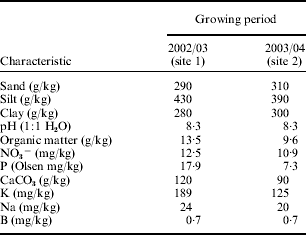
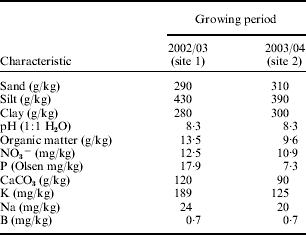
The experiments were carried out at a farm located in Aridaia county in Northern Greece (Latitude 40·973, Longitude 22·056) during the 2002/03 (2003) and 2003/04 (2004) growing seasons. The soil type was a calcareous clay loam (Table 1). The soil characteristics were determined according to Sparks et al. (Reference Sparks, Page, Helmke, Loeppert, Soltanpour, Tabatabai, Johnson and Sumner1996). The crop preceding sugar beet was durum wheat (Triticum turgidum sp. durum). The seed crop consisted of the diploid maternal and paternal lines of the cultivar Ariete. The ratio of female to male lines was 6:2. The experimental plots were 4·6×5 m and contained two pollinator rows and six male sterile maternal rows. The maternal and paternal rows were sown at the end of August at inter-row spacings of 0·53 m (maternal) and 0·80 m (paternal) and an intra-row spacing of 0·10 m. The final stand population was around 100 000 plants/ha. The fertilizer application was 110 kg N/ha, 150 kg P2O5/ha and 150 kg K/ha; 100 kg/ha of N was applied in the spring at the beginning of stem elongation. The experimental design was a completely randomized block with six treatments (foliar applications of 0, 245, 490 and 735 mg/l B and two soil application of 1·5 and 3 kg/ha) and five replications. B was applied during flowering as foliar applications and for the soil applications B was applied at the beginning at the elongation of the main stem (27 March 2003). During 2004, only the foliar applications were made (4 April 2004) as it was more effective in increasing leaf B concentration. B was applied in the form of Solubor, containing 20% of B (Na2B8O13 4H2O; US Borax, Boron, CA, USA). The foliar applications were made with an AZO portable field plot sprayer at 250 kPa pressure and applying 1000 litres of water/ha on 8 May 2003 and on 12 May 2004.
Soil characteristics to a depth of 0·30 m of the farms where the experiments were conducted during the 2002/03 and 2003/04 growing periods
The following parameters were determined: concentration of B in leaf and inflorescences, seed yield, yield components (seed number/plant, seed weight/plant, number of seeds/inflorescence, seed weight/inflorescence), mean seed weight, distribution of seeds to different sizes, seed germination and seed vigour.
Determination of B content of plant tissue
Leaves and inflorescences were sampled 2 weeks after the foliar application. Plant tissues were washed for 1 min in deionized water, dried at 60°C in a forced air oven for 3 days and ground to pass through a 30-mesh screen. One gram of tissue was placed in a porcelain crucible for ashing at 500°C overnight. The ashed samples were then extracted with 20 ml of 2 M HCl and after filtration the samples were transferred to plastic vials. Two ml of the solution was added to the 4 ml of buffer solution (containing 250 g/kg ammonium acetate, 15 g/kg EDTA and 125 g/kg acetic acid) and 4 ml of azomethine-H solution containing 4·5 g/kg azomethine-H and 10 g/kg of ascorbic acid prepared right before the analysis (John et al. Reference John, Chuah and Neufeld1975). The colour was left to develop for at least 45 min and the amount of B was determined using a spectrophotometer at 420 nm (Perkin Elmer, San Jose, CA, USA).
Seed yield and yield components
For the determination of the total yield the whole plot was cut on 7 July 2003 and on 10 July 2004 and the stems were left to dry. Subsequently, seeds were collected using a harvesting machine on 17 July 2003 and on 20 July 2004. After harvest, the seeds were cleaned and polished and the seed yield was determined. In addition, the yield components were determined by harvesting ten plants from each plot and determining the total seed weight and the mean seed weight and using these quantities to estimate the number of seeds produced.
The distribution of seeds in different size classes was determined by passing 1000 g of seeds from each plot through sieves of different sizes and weighing the seeds that were obtained from each sieve.
Effect of B on seed quality
Seed quality was evaluated by germination, the presence of abnormal and ungerminated seeds and seed vigour test at the 7th and 14th days (ISTA 2003). Germination tests were performed according to ISTA rules (ISTA 2003). Vigour assay was done using the compact sand cold test. Four replicates of 50 seeds from each plot were used.
Statistical analysis
The experiments were performed during the growing period in two consecutive years (2003 and 2004), with five replications in each treatment. Statistical significance was determined with Analysis of Variance (ANOVA). Analyses were performed using the SPSS™ (SPSS Inc., Chicago, IL, USA; SPSS 2005). Differences were considered significant when P<0·05.
RESULTS
Effect of B application on tissue B concentration
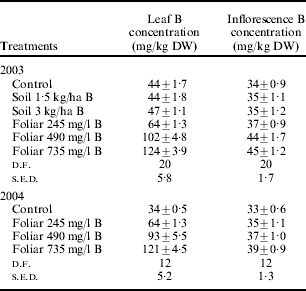
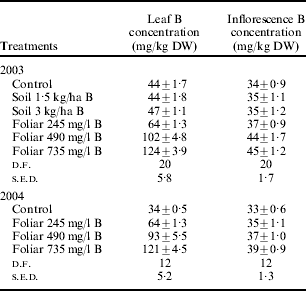
Without application of B, the leaf B concentration was slightly above the level considered as adequate (35 mg/kg) in 2003. Leaf B content was increased more by foliar application than by soil application (Table 2). Soil application of B did not increase leaf B concentration at 1·5 kg B/ha but it was increased slightly at 3 kg B/ha. Foliar B application increased leaf B concentration by 45, 131 and 181% at 245, 490 and 735 mg/l B, respectively, compared with the control treatment. The concentration of B in inflorescence tissue was also increased with foliar B application by 29% at 735 mg B/l compared with the control treatment (Table 2). Soil application did not increase B concentration in inflorescences as much as the foliar application. During the second year, without B application, leaf B concentration was 34·4 mg/kg, and it was increased by 85, 171 and 252% at 245, 490 and 735 mg of foliar-applied B/litre, respectively. Similarly, B concentration in the inflorescence stage was increased by 7, 12 and 17% at 245, 490 and 735 mg B/l, respectively, compared with the control treatment.
Effect of B application on leaf and inflorescence B concentration during the 2003 and 2004 growing seasons of sugar beet (Beta vulgaris) (values are given as mean±standard error)
Effect of B application on seed yield, yield components, and mean seed weight
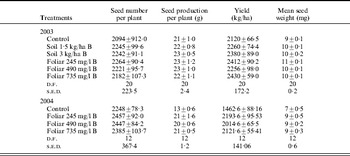
The seed yield was affected by B application. There were small increases of 12, 14, 11 and 14% at 1·5 kg of soil-applied B/ha and at 245, 490 and 735 mg of folia-applied B/litre, respectively, compared with the control. The mean seed weight was increased only at the higher soil B application (3 kg of B/ha) compared with the control treatment. With foliar B applications the mean seed weight was increased by 15% compared with the control treatment (Table 3). Yield components, such as the number of seeds/plant and the seed weight/plant, were also affected by both the soil B application and the foliar application. The highest increase was found at 245 mg B/l, where the seed weight/plant increased by 10% compared with the control treatment.
Effect of B application on seed number per plant, seed production per plant, seed yield and on mean seed weight on sugar beet (Beta vulgaris) during the 2003 and 2004 growing seasons (values are given as mean±standard error)

During the second year (2003/04), seed yield was significantly increased by 49, 38 and 45% at the 245, 490 and 735 mg B/l, respectively, compared with the control treatment (Table 3). However, among the different rates of B there was no difference. Also the mean seed weight was affected by the B application as it was increased by 21, 22 and 24% at 245, 490 and 735 mg B/l, respectively, compared with the control. The number of seeds/plant also increased by 15 and 8% at 245 and 490 mg B/l, respectively, compared with the control. The seed weight/plant was increased by an average of 54% with B foliar applications compared with the control treatment.
Effect of B application on the distribution of seeds to different sizes
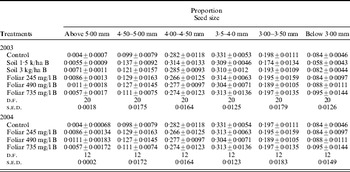
Seed size is an important quality characteristic, because larger seeds have superior field performance. During 2003, B application increased the proportion of seeds above 5 mm by 77, 115 and 171% at 3 kg/ha of soil-applied B, 245, and 490 mg of foliar-applied B/litre, respectively, compared with the control. Also, in seeds of 4·5–5·0 mm there was an increase by 38, 22, 31, 28 and 12% at 1·5, 3 kg of soil-applied B/ha and 245, 490, 735 mg of foliar-applied B/litre, respectively, compared with the control treatment. In addition, the other four categories with a seed size of 4·00–4·50, 3·50–4·00, 3·00–3·50 and below 3·00 mm were affected by B application. A similar trend was observed during the second year (2004; Table 4). The proportion of seeds with a diameter above 5 mm increased with B application. Additionally, seeds with a diameter between 4·50 and 5·00 mm showed an increase of 78, 97 and 78% at 245, 490 and 735 mg B/l, respectively, compared with the control treatment. There were no differences between the different B treatments among the seeds with a diameter of 4·00–4·50 mm. Seeds with a diameter of 3·50–4·00 mm decreased by 15, 18 and 14% at 245, 490 and 735 mg B/l, respectively, compared with the control treatment (Table 4). Overall, seed B application increased the proportion of seeds above 3·5 mm compared with the control, which is significant as it is important to produce larger seeds as they have better field performance.
Effect of B application on the proportion of seeds in different size classes of sugar beet (Beta vulgaris) during the 2003 and 2004 growing seasons (values are given as mean±standard error)

Effect of B application on seed germination, seed vigour and seed quality
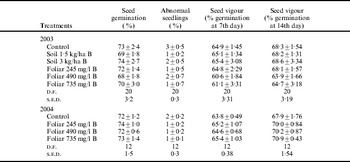
Boron application did not affect seed germination (Table 5). The proportion of abnormal seedlings is a characteristics affected by the environment and by genotype. The proportion of abnormal seedlings was decreased by B application compared with the control treatment. Seed vigour is an important characteristic of seed quality as it affects seedling establishment under field conditions. There was no change in interim seed germination on the 7th day. However, at the 14th day there was a decrease in seed vigour from the 490 mg B/l treatment compared with the control (Table 5).
Effect of B application on final and interim seed germination, the proportion of abnormal seedlings of sugar beet (Beta vulgaris) during the 2003 and 2004 growing seasons (values are given as mean±standard error)

During the second year (2004), seed germination was not affected by foliar B applications (Table 5). Moreover, the proportion of abnormal seedlings decreased by 44, 42 and 37% at 245, 490 and 735 mg B/l, respectively, compared with the control. Seed vigour at the 7th day and at the 14th day was not affected by B application.
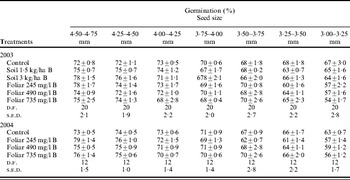
Seed germination in relation to seed size was also affected by B treatment (Table 6). There was an increase of the germination of seeds with larger sizes, e.g. 4·25–4·50 and 4·50–4·75 mm, with B application. Additionally, seed germination increased in the case of seeds with a diameter of 4·50–4·75 mm and it was increased by 8% compared with the control at 3 kg B/ha of soil-applied B and at 245 mg of foliar-applied B/litre during 2003. Also during the 2004 there was an increase by 8% at 245 mg/l compared with the control. However, the seeds with a smaller diameter of 3·00–3·25 mm were affected by B application, as the germination decreased during the first year and the second year with B application. Seeds with a diameter of 3·50–3·75, 3·75–4·00 and 4·00–4·25 mm did not show any significant change on germination during the second year of the study (Table 6).
Effect of B application on seed germination of seeds belonging to different sizes of sugar beet (Beta vulgaris) during the 2003 and 2004 growing seasons (values are given as mean±standard error)

DISCUSSION
Seed yield of sugar beet is generally recognized as being of secondary importance to sugar yield. However, high seed yield provides a competitive price for an effective distribution to farmers and seed yield determines the economic viability of seed producers. Seed yield is affected by environmental conditions, genotype and agronomic techniques (Bornscheuer et al. Reference Bornscheuer, Meyerholz, Wunderlich, Cooke and Scott1993; Draycott & Christenson Reference Draycott and Christenson2003). Nutrient fertilization is one of the factors that can have a direct impact on seed yield and also on seed quality. Boron is one of the essential nutrients for higher plants and has a direct influence on flower development, pollen germination, fertilization and seed development (Marschner Reference Marschner1995; Dell et al. Reference Dell, Huang, Bell, Goldbach, Rerkasem, Wimmer, Brown, Thellier and Bell2002). Despite the fact that sugar beet has high requirements for B, the effect of B application on seed production was not determined (Shorrocks Reference Shorrocks1997; Dell & Huang Reference Dell and Huang1997; Draycott & Christenson Reference Draycott and Christenson2003). To the best of our knowledge, this is the first report that shows that B can affect seed yield and seed quality on sugar beet. In the present study, the effect of B application on seed yield and seed quality of sugar beet in two consecutive years was determined.
The soils contained 0·7 mg B/kg, which seldom produces plants with classic B deficiency symptoms (Draycott & Christenson Reference Draycott and Christenson2003). Additionally, the average leaf B concentration in control plants was above the current recognized adequate concentration of 35 mg/kg. Despite this, there was a significant effect on seed yield, yield components and seed quality when B was applied. These findings suggest that the critical concentration of B for sugar beet is lower when sugar beet is used for sugar production compared with that used for seed production. The fact that B had a beneficial effect on seed production was found also in other crops such as white clover, soybean, canola, sunflower, alfalfa and cotton (Johnson & Wear Reference Johnson and Wear1966; Schon & Blevins Reference Schon and Blevins1990; Asad et al. Reference Asad, Blamey and Edwards2002; Asad et al. Reference Asad, Blamey and Edwards2003; Dordas Reference Dordas2006a, Reference Dordasb). For most parameters studied there was no further response above the 245 mg B/l, indicating that the B requirement was supplied by this amount and there was a negative effect at the higher B rates, which can be interpreted as B toxicity (Brown et al. Reference Brown, Bellaloui, Wimmer, Bassil, Ruiz, Hu, Pfeffer, Dannel and Romheld2002).
The significant effect that B had on seed yield and seed quality indicates that B plays an important role in seed formation and seed yield of sugar beet. It is also possible that the current B critical value for sugar beet (35 mg/kg) is not applicable when sugar beet is grown for seed production. Moreover, since B in sugar beet is immobile, it will require B uptake from the roots during flowering and seed development (Brown & Shelp Reference Brown and Shelp1997). A major constraint of B movement taken up from the roots and other immobile elements is that the xylem connection between seed and mother tissue is not well developed (Dell et al. Reference Dell, Huang, Bell, Goldbach, Rerkasem, Wimmer, Brown, Thellier and Bell2002) and also that flowers and seeds transpire less than leaves. This is one of the possible reasons why in many studies there has been a significant effect of foliar B application on seed and fruit yield (Schon & Blevins Reference Schon and Blevins1990; Asad et al. Reference Asad, Blamey and Edwards2003; Dordas Reference Dordas2006a, Reference Dordasb). There are still many unanswered questions about how B acts in increasing seed yield and its components and also how B moves into the flowers and into the developing fruits and seeds (Dell et al. Reference Dell, Huang, Bell, Goldbach, Rerkasem, Wimmer, Brown, Thellier and Bell2002).
Boron application influenced the mean seed weight. The mean seed weight is a measure of how well the seed is developed (Bornscheuer et al. Reference Bornscheuer, Meyerholz, Wunderlich, Cooke and Scott1993). The results of the present study, suggest that nutrients such as B can play a significant role in seed development. Application of B during anthesis in sugar beet significantly increased the number of larger seeds. In other species it was reported that B has a direct effect on seed size and development (Dell & Huang Reference Dell and Huang1997 and references therein).
Seed germination was not affected by B application. However, the germination of seeds of different sizes was affected by B as seeds with a larger diameter showed an increase in the germination when B was applied. In a number of species (black gram, pea, wheat and alfalfa), it was reported that B can affect seed germination (Dell & Huang Reference Dell and Huang1997; Dordas Reference Dordas2006a, Reference Dordasb). This is because B affects the development of the seed but also the metabolic processes associated with the seed germination and establishment.
With foliar applications, 245 mg B/l gave the highest increase in seed yield and seed quality. This indicates that reproductive tissues have a higher demand for B than vegetative tissues and also that the existing critical values for sugar beet are different when the crop is grown for sugar production compared with the sugar beets grown for seed production.
In conclusion, B application affected seed yield, yield components and seed quality of sugar beet in both years. The effect of B on yield can be attributed to increasing the mean seed weight, the number of seeds/plant and seed yield/plant. Moreover, B influenced the distribution of seeds to different sizes and there was an increase in the proportion of large seeds with B application and the proportion of abnormal seedlings was decreased. In contrast, seed vigour was not affected by B applications. The results provide some clear guidelines for developing more productive sugar beet seed production and with better quality. However, the mode of action of B application on seed yield of sugar beet is poorly understood.