Introduction
Childhood maltreatment refers to physical, sexual, or emotional abuse or neglect occurring in a relationship of responsibility, trust, or power that can harm children’s health, survival, development, or dignity (World Health Organization, 2024). It is a major public health concern that has significant implications for various domains of functioning, including a person’s parenting in adulthood (Nivison et al., Reference Nivison, Labella, Raby, Doom, Martin, Johnson, Zamir, Englund, Simpson, Carlson and Roisman2024). In the current prospective longitudinal investigation, we examined whether the link between early childhood maltreatment and negative parental orientations and behaviors in adulthood is mediated by lower socioemotional competence in middle childhood and adolescence and whether this process is buffered by having a larger social network in adulthood.
Early maltreatment and the socioemotional competence of parents
A large body of evidence links childhood maltreatment with parenting difficulties in adulthood (Dilillo & Damashek, Reference Dilillo and Damashek2003; Greene et al., Reference Greene, Haisley, Wallace and Ford2020; Macintosh & Ménard, Reference Macintosh and Ménard2021). Parents who were maltreated as children are more likely to be ineffective, unavailable, harsh, and/or abusive when parenting their own children (Liu et al., Reference Liu, Dong and Wang2021; Pears & Capaldi, Reference Pears and Capaldi2001). A recent meta-analysis on the intergenerational transmission of childhood maltreatment found moderate associations between childhood exposure and adult perpetration of physical, sexual, and emotional abuse, with a smaller association found for parental neglect (Madigan et al., Reference Madigan, Cyr, Eirich, Fearon, Ly, Rash, Poole and Alink2019). A different meta-analysis found a small association between mothers’ exposure to childhood maltreatment and their observed and self-reported negative parental behaviors (Savage et al., Reference Savage, Tarabulsy, Pearson, Collin-Vézina and Gagné2019).
The effects of childhood maltreatment on parenting have been explained through various theoretical perspectives (Alink et al., Reference Alink, Cyr and Madigan2019). While social learning models (Bandura, Reference Bandura1973) focus on the intergenerational transmission of abusive parenting through learned parenting behaviors and practices (e.g., Pears & Capaldi, Reference Pears and Capaldi2001), other theories focus on the cognitive and emotional consequences of early maltreatment, which are carried forward to adulthood. According to attachment theory (Bowlby, Reference Bowlby1969), maltreatment experienced early in life undermines the formation of a secure attachment bond between the child and the caregiver (Cyr et al., Reference Cyr, Euser, Bakermans-Kranenburg and Van Ijzendoorn2010), which predicts social and emotional difficulties throughout life (Thompson, Reference Thompson, Cassidy and Shaver2008), as well as parenting difficulties (Jones et al., Reference Jones, Cassidy and Shaver2015; Van Ijzendoorn, Reference Van Ijzendoorn1995). According to social information processing theory (Dodge et al., Reference Dodge, Bates and Pettit1990; Milner, Reference Milner1993), abused children acquire maladaptive patterns of processing social information, which later in life manifests in cognitive, attentional, and attributional deficits in the processing of their children’s behavior, resulting in parental maltreatment (Camilo et al., Reference Camilo, Garrido and Calheiros2020). Both theories, therefore, delineate how childhood maltreatment undermines the development of social or emotional competencies that are important for positive parenting.
The social and emotional competencies of maltreated parents may also be undermined at the neurobiological level. Neurobiological models emphasize the effects of early maltreatment on brain development and stress responsivity (Gunnar & Quevedo, Reference Gunnar and Quevedo2007; Teicher & Samson, Reference Teicher and Samson2016). Childhood maltreatment often involves a combination of threat and deprivation (Sheridan & McLaughlin, Reference Sheridan and McLaughlin2014). Constant threat and deprivation expose children to chronic stress that provokes neurobiological responses, cascading to affect brain development in structure and function. Experiences of abuse pose a threat to the physical safety of a child, resulting in changes to neural circuits that underlie emotional learning and threat detection, including the hippocampus, amygdala, and ventromedial prefrontal cortex (Teicher & Samson, Reference Teicher and Samson2016). Experiences of neglect deprive a child of expected cognitive and social inputs, resulting in reductions in the thickness and volume of cortical areas associated with the processing of complex social and cognitive information, including the prefrontal cortex, superior and inferior parietal cortex, and superior temporal cortex (McLaughlin et al., Reference McLaughlin, Sheridan and Lambert2014). Together, these neurocognitive changes typically forecast reduced social and emotional competence later in development (McLaughlin et al., Reference McLaughlin, Weissman and Bitrán2019; Tottenham, Reference Tottenham2012).
Consistent with these models, studies have shown that early maltreatment predicts social and emotional difficulties (Manly et al., Reference Manly, Cicchetti and Barnett1994; Pfaltz et al., Reference Pfaltz, Halligan, Haim-Nachum, Sopp, Åhs, Bachem, Bartoli, Belete, Belete, Berzengi, Dukes, Essadek, Iqbal, Jobson, Langevin, Levy-Gigi, Lüönd, Martin-Soelch, Michael and Seedat2022). Maltreated children typically have poorer social skills and experience greater social isolation and rejection by their peers (Darwish et al., Reference Darwish, Esquivel, Houtz and Alfonso2001; Kim & Cicchetti, Reference Kim and Cicchetti2010). These difficulties are mediated by neurocognitive changes that can persist into adulthood (McCrory et al., Reference McCrory, Foulkes and Viding2022). Maltreated children also display a range of emotional and behavioral problems, including emotion dysregulation, heightened emotional reactivity, negatively biased emotional processing, and hypervigilance to threat (Kim et al., Reference Kim, Weissman, Sheridan and McLaughlin2021; Warmingham et al., Reference Warmingham, Duprey, Handley, Rogosch and Cicchetti2023), as well as externalizing and internalizing problems (Baldwin et al., Reference Baldwin, Wang, Karwatowska, Schoeler, Tsaligopoulou, Munafò and Pingault2023; Heleniak et al., Reference Heleniak, Jenness, Vander Stoep, McCauley and McLaughlin2016).
Social and emotional difficulties experienced by maltreated children negatively affect their future functioning as parents (Belsky & Jaffee, Reference Belsky, Jaffee, Cicchetti and Cohen2006). Effective parental emotion regulation, for example, is critical in facilitating positive parenting behaviors (Hajal & McNeil, Reference Hajal, McNeil, Roskam, Gross and Mikolajczak2024). Moreover, parents’ lack of emotional awareness and recognition predicts using less adaptive emotion regulation strategies during interactions with their children (Shai et al., Reference Shai, Szepsenwol and Lassri2023). Similarly, emotional instability in parents is associated with more aversive reactions to their children’s problematic behavior (de Haan et al., Reference de Haan, Deković and Prinzie2012). Social competence, as well, has been shown to mediate intergenerational effects on parenting quality (Shaffer et al., Reference Shaffer, Burt, Obradović, Herbers and Masten2009). More generally, social competence is one of a few important developmental markers toward the end of adolescence that forecast greater competence in multiple adult domains (Roisman et al., Reference Roisman, Masten, Coatsworth and Tellegen2004).
The neurobiological and psychological effects of maltreatment are more pronounced when occurring during periods of rapid brain development and plasticity (Teicher et al., Reference Teicher, Samson, Anderson and Ohashi2016). Adverse experiences in early childhood are considered the most influential (Bick & Nelson, Reference Bick and Nelson2016). Changes during these critical early periods establish fundamental, lifelong cognitive abilities and behaviors (Gilmore et al., Reference Gilmore, Knickmeyer and Gao2018). For example, the effects of sexual abuse on hippocampal volume are strongest between ages 3 and 5 (Andersen et al., Reference Andersen, Tomada, Vincow, Valente, Polcari and Teicher2008). Similarly, caregiving experiences in the first 3 years of life have enduring effects on adolescent social competence (Fraley et al., Reference Fraley, Roisman and Haltigan2013). Studies have also shown that the caregiving environment in the first years of life is biologically embedded in profiles of DNA methylation across development (Lussier et al., Reference Lussier, Zhu, Smith, Cerutti, Fisher, Melton, Wood, Cohen-Woods, Huang, Mitchell, Schneper, Notterman, Simpkin, Smith, Suderman, Walton, Relton, Ressler and Dunn2023; Merrill et al., Reference Merrill, Gladish, Fu, Moore, Konwar, Giesbrecht, MacIssac, Kobor and Letourneau2023). Early exposure to maltreatment, therefore, may have long-lasting effects on socioemotional competence and, in turn, parental functioning.
The moderating role of social network size
Social ties with friends and relatives are an important resource for parents, promoting mental health and well-being (Belsky, Reference Belsky1984). Social ties include connections and relationships with primary and secondary groups. Primary groups, such as family and close friends, are small, intimate, and emotionally close, offering enduring personal bonds. Secondary groups, like work teams or voluntary and religious institutions, are often larger and vary in duration, offering more formal and less personal connections (Thoits, Reference Thoits2011). Individuals differ in the overall size of their social network and the strength and emotional intensity of their relationships with network members (Marsden, Reference Marsden1990).
The size and makeup of the social network influence the provision and receipt of social support. Social support refers to psychological and material resources provided by a social network to promote the capacity of individuals to cope with stress (Cohen, Reference Cohen2004). Social support is the primary mechanism through which social ties benefit individuals, particularly by helping them navigate stress and distress (Uchino, Reference Uchino2009). Close friends and relatives (primary group) often provide emotional support, symbolically conveying care for and value of the supported person and scaffolding a sense of mattering, self-worth, and belonging. They can also offer instrumental assistance and advice, which helps to reduce feelings of threat. The availability of social support from one’s close relationships is particularly important, as these individuals are more familiar with the person’s needs and are generally expected to help (Marsden, Reference Marsden1990). Distant friends and acquaintances (secondary groups) can also offer information, advice, appraisal, and encouragement, promoting physical and psychological well-being while fostering a sense of control (Thoits, Reference Thoits2011). Therefore, a larger social network may offer greater social support, especially one that includes more close friends and relatives (i.e., primary group members).
Social support may have a key role in promoting physical and mental well-being in adults with a history of childhood maltreatment or other adverse childhood experiences. A recent systematic review (Buchanan et al., Reference Buchanan, Walker, Boden, Mansoor and Newton-Howes2023) found that social support mitigates internalizing symptoms associated with childhood maltreatment, such as reducing depressive symptoms. These findings align with neuropsychological research, which demonstrates that social support moderates the impact of stress on the brain (Davidson & McEwen, Reference Davidson and McEwen2012). Another large-scale prospective cohort study, which included repeated measures of social support across different ages, found that support from a network of friends and family offers individuals with a history of childhood adversity protection against depression and anxiety symptoms (Buchanan et al., Reference Buchanan, Newton-Howes, Cunningham, McLeod and Boden2024).
Accordingly, the effects of early maltreatment on parenting may be attenuated in parents who have a larger network of friends and relatives capable of providing practical and emotional support (Cohen & Wills, Reference Cohen and Wills1985; McLaughlin et al., Reference McLaughlin, Colich, Rodman and Weissman2020). Indeed, studies show that the parenting of individuals who were maltreated as children can benefit from greater social support (Schury et al., Reference Schury, Zimmermann, Umlauft, Hulbert, Guendel, Ziegenhain and Kolassa2017; St-Laurent et al., Reference St-Laurent, Dubois-Comtois, Milot and Cantinotti2019). Smaller social networks, on the other hand, may produce feelings of social isolation that are detrimental to the mental health of parents (Leigh-Hunt et al., Reference Leigh-Hunt, Bagguley, Bash, Turner, Turnbull, Valtorta and Caan2017) and the quality of their parenting (Lee et al., Reference Lee, Ward, Lee and Rodriguez2022). Despite these associations, no research to date has examined whether having a larger social network buffers the process through which early maltreatment is associated with parental functioning in adulthood and the importance of different groups within one’s social network.
The current study
The current study leveraged data from the Minnesota Longitudinal Study of Risk and Adaptation (MLSRA), which has prospectively followed individuals from before birth into middle adulthood (Sroufe et al., Reference Sroufe, Egeland, Carlson and Collins2005). The study participants were born to first-time mothers living below the poverty line who were recruited at free public health clinics in Minneapolis, Minnesota, between 1975 and 1977. The participants were exposed to a variety of stressors during their early years and a significant number of them experienced at least some form of maltreatment, which was assessed and coded prospectively (Nivison et al., Reference Nivison, Facompré, Raby, Simpson, Roisman and Waters2021). The social and emotional competence of the participants was also assessed throughout their childhood. For participants who later became parents, parental functioning was also assessed using both coded interviews and behavioral observations, as was the size of their adult social networks.
The current research builds on prior research on the connection between early adversity and parental outcomes in the MLSRA. In one study (Szepsenwol et al., Reference Szepsenwol, Simpson, Griskevicius and Raby2015), greater unpredictability in early childhood (ages 0–4) forecasted fathers’ lower parental supportive presence in behavioral observations with their firstborn child when they were 24 and 42 months old, as well as less positive parental orientations expressed in interviews at age 32. A less positive parental orientation involves greater hostility, lower involvement, and reduced emotional connection with one’s child. These associations were mediated by attachment insecurity in adolescence and early adulthood. In another study (Labella et al., Reference Labella, Raby, Martin and Roisman2019), maltreatment between ages 0–17.5 predicted lower parental support and greater Child Protective Services involvement. These associations were partially mediated by lower competence in romantic relationships and greater relational violence in adulthood, respectively.
The current study adds to this prior research by: (a) focusing on early childhood maltreatment (ages 0–5), a phase of development that is more likely to produce changes in structure and connectivity in brain areas associated with social and emotional functioning (McLaughlin et al., Reference McLaughlin, Sheridan and Lambert2014; Teicher et al., Reference Teicher, Samson, Anderson and Ohashi2016; Tottenham, Reference Tottenham2012), (b) examining the mediating role of socioemotional competence in middle childhood and adolescence (rather than romantic relationship competence in adulthood), and (c) examining a possible protective factor: social network size in adulthood.
The variables used in this research and the general modeling approach were preregistered with the MLSRA projectFootnote 1 . We hypothesized that (H1) greater maltreatment in infancy and early childhood (ages 0N5) will predict lower socioemotional competence in middle childhood and adolescence (ages 5–16), which, in turn, will predict lower parental supportive presence in behavioral observations and less positive parental orientations at age 32. We also hypothesized that (H2) having a larger social network in adulthood (i.e., having more important people in one’s life) will moderate the association between socioemotional competence at ages 5–16 and positive parental orientation at age 32, such that the indirect negative effect of early maltreatment on parenting through socioemotional competence will be smaller in parents who have a larger social network, reflecting a buffering effect.
Method
Participants
The sample consisted of all MLSRA participants who were coded for maltreatment at ages 0–5 and whose socioemotional competence was rated by their teachers at ages 5–16 (N = 173; 53.8% male). Of this sample, 85 were parents observed with their 24 and 42-month-old toddlers at various ages, 106 were parents who completed a parenting interview at age 32, and 147 completed a social network measure at age 32. Of the participants who completed the age 32 assessment, 6.8% had not graduated from high school, 12.2% had a GED, 16.2% had a high school diploma, 48.6% had some post-high school education, 10.1% had a 4-year college degree, and 6.1% had a post-baccalaureate degree. Most were White (65.3%), 11.6% were Black, 2.3% were other races, 16.8% were mixed race, and 4.0% reported an unknown race.
Monte Carlo simulations indicated the study was sufficiently powered to detect medium mediation and moderation effects. Considering the missing data in each variable, the simulations indicated that the sample affords 85.6% power to detect a standardized indirect effect of 0.09 on positive parental orientation and 88.8% power to detect a standardized indirect effect of 0.105 on parental supportive presence. The analyses also indicated that the sample affords 92.2% power to detect a medium interaction effect on positive parental orientation (β = .30).
Procedure
The data were collected and coded prospectively as part of the MLSRA project.
Measures
Early maltreatment (ages 0–5)
The MLSRA codes for abuse and neglect were used to compute a measure of early maltreatment (see Nivison et al., Reference Nivison, Facompré, Raby, Simpson, Roisman and Waters2021). Information about MLSRA participants’ exposure to physical abuse, sexual abuse, and neglect was collected prospectively from birth to age 17.5. These data were later re-coded based on definitions developed by the Centers for Disease Control and Prevention supplemented by more specific coding guidelines (see Supplemental materials).
The re-coding process involved reviewing all available data from birth to 17.5 years on MLSRA participants who had been previously flagged as potentially abused or neglected. Information regarding caregiving quality, physical discipline, supervision, home environment, physical and sexual assault, child protective service involvement, and foster care history was obtained from parent-child observations, caregiver interviews, reviews of available child protection and medical records, adolescent reports, and teacher interviews. Two coders rated each case for the presence or absence of physical abuse, sexual abuse, and/or neglect (dichotomous coding) in four developmental periods: infancy, early childhood, middle childhood, and adolescence (Kappas were between 80 and .84 for each type of maltreatment within each development period). All discrepancies were resolved by consensus.
In the current investigation, we used only the codes for infancy (0–2 years) and early childhood (2–5 years). Consistent with Nivison et al. (Reference Nivison, Facompré, Raby, Simpson, Roisman and Waters2021), we created an early maltreatment score by summing the number of types of abuse (physical abuse, sexual abuse, neglect) during infancy and early childhood. The possible range was 0 (no physical abuse, sexual abuse, or neglect) to 6 (physical abuse, sexual abuse, and neglect in both infancy and early childhood). In the current sample, the range was 0–4, with 37.6% of participants having been exposed to at least one type of maltreatment during at least one developmental period. Of the participants who experienced abuse, 54.1% also experienced neglect, and of the participants who experienced neglect, 41.7% also experienced abuse. Of the participants who experienced maltreatment at ages 0–5, 67.7% also experienced maltreatment at ages 6–12 (middle childhood), and 20% also experienced maltreatment at ages 13–17.5 (adolescence).
Early SES (ages 42–54 months)
There were two assessments of SES between 0–5 years: (1) a 42-month assessment based on the educational attainment of each participant’s mother along with the revised Duncan Socioeconomic Index (SEI; Stevens & Featherman, Reference Stevens and Featherman1981), and (2) a 54-month assessment based on mothers’ SEI alone. A composite early-SES measure was created for each assessment by computing SES-based z scores. These values were then transformed into t scores (M = 50, SD = 10). Similar to prior MLSRA studies (e.g., Szepsenwol et al., Reference Szepsenwol, Simpson, Griskevicius and Raby2015), we used the mean of the two measures to assess early SES (r = .41, p = .001).
Socioemotional competence (ages 5-16)
In kindergarten, 1st, 2nd, 3rd, and 6th grades, and at age 16, participants were ranked by their classroom teachers for their emotional health/self-esteem and social competence. The teachers were given descriptions of an emotionally healthy child with high self-esteem and a child with high social competence (see Supplemental materials). Each teacher then rank-ordered all the children in their class on each characteristic, with the child highest in each characteristic receiving a rank of 1. The teacher ratings were converted to percentiles and averaged separately for each characteristic (α = .80 and .78 for emotional health and social competence, respectively). We then standardized the two mean scores and averaged them to create a measure of socioemotional competence at ages 5–16 (r = .86, p < .001).
Parental supportive presence (various ages)
We used the same observational measure of parental supportive presence used by Szepsenwol et al. (Reference Szepsenwol, Simpson, Griskevicius and Raby2015). These observations occurred at various parental ages. When their firstborn child was 24 and 42 months old, each participant and their child came to the lab and were observed while the child completed problem-solving and teaching tasks. The tasks gradually increased in complexity, eventually becoming too difficult for the child to solve on their own. The parents were instructed to first allow their child to attempt the task independently and then step in and provide help if/when they thought it was appropriate. The videotaped sessions were rated by trained coders for parental supportive presence on a 7-point scale (ICCs = .79 and .86 for the 24- and 42-month assessments, respectively). High scores were given to parents who showed interest and were attentive to the needs of their child, who responded contingently to their child’s emotional signals, and who reinforced their child’s success. Low scores were given to parents who were distant, hostile, and/or unsupportive. The mean of the two assessments was our measure of parental supportive presence (r = .56, p < .001).
Positive parental orientation (age 32)
We used the same positive parental orientation measure used by Szepsenwol et al. (Reference Szepsenwol, Simpson, Griskevicius and Raby2015). This measure is based on a semi-structured, hour-long parenting interview administered to participants who were parents at the age-32 assessment. These audio-recorded interviews were rated by trained coders on several parenting dimensions using 7-point rating scales (see Raby et al., Reference Raby, Lawler, Shlafer, Hesemeyer, Collins and Sroufe2015). The parental orientation measure was designed to assess each parent’s general positive versus negative orientation toward parenting based on three coded scales: positive emotional connectedness (reflecting the amount of warmth expressed toward children and the pleasure of being a parent), parental investment/involvement (reflecting the amount of importance placed on being a parent and being committed to parenting), and hostile parenting (reflecting the amount of derogation or rejection of children, which was reverse-keyed). Interrater reliabilities were good for all three scales (ICCs > .80). A composite measure of positive parental orientation was computed as the mean of the three scales (α = .74).
Social network size (age 32)
At age 32, participants were shown a “social support circle,” which included three concentric circles around a smaller colored circle representing the participant. They were asked to write the names of all the people in their lives who belong in one of these circles. They were told that these should be people they know well, not just people they have contact with. The inner circle should include people to whom they feel so close that it is hard to imagine life without them. The middle circle should include people to whom they might not feel quite so close, but who are still important to them. The outer circle should include people whom they have not mentioned, but who are important enough that they should be included. The participants also indicated what their relationship was with each person (e.g., relative, friend, romantic partner). The total social network size was the overall number of people listed by the participants. The numbers of friends and relatives in each circle were also logged.
Data analysis strategy
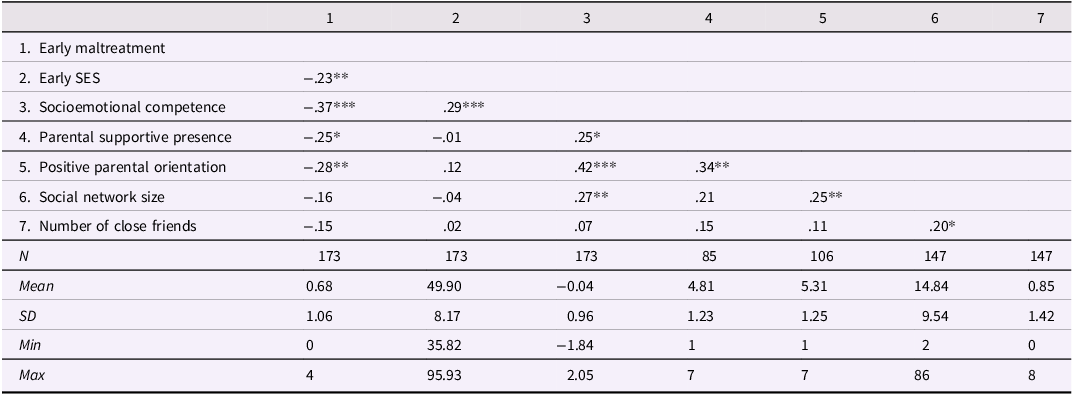
Preliminary analyses were conducted using IBM SPSS 28. The mediation and moderated mediation analyses were conducted using path analysis via Mplus version 8.3 (Muthén & Muthén, Reference Muthén and Muthén1998-2019) using Full Information Maximum Likelihood (FIML) estimation. FIML uses all available data and produces unbiased estimates when data are missing at random. Thus, we were able to estimate each path in the model with all available data points. We did not impute data for non-parents. Therefore, although the sample size for the mediation analysis was 173 (the Ns for early maltreatment, early SES, and socio-emotional competence, Table 1), the paths leading to positive parental orientation and parental supportive presence were estimated based on fewer data points. Similarly, although the sample size for the moderated mediation analysis was 147 (the N for social network size), the paths leading to positive parental orientation were estimated based on fewer data points. Indirect and conditional indirect effects were estimated using 95% bias-corrected bootstrap confidence intervals. The analysis scripts are publicly available through the following link: https://osf.io/5fnv9/?view_only=352fd18e47d246c4947ca0f14b4e98d6
Descriptive statistics and zero-order correlations between the main study variables

Note. *p < .05** p < .01 ***p < .001.
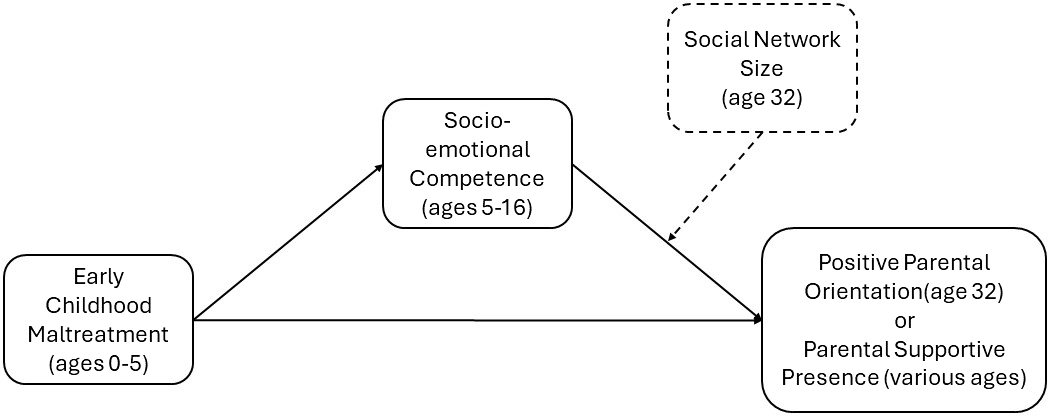
Figure 1 describes the conceptual mediation and moderated mediation models. Separate mediation models were estimated with parental supportive presence or positive parental orientation as the dependent variable. In each of these models, early maltreatment was specified as the independent variable, and socioemotional competence was specified as the mediator. A direct effect of early maltreatment on parenting was also specified. Unlike the mediation model, the moderated mediation model was estimated only for positive parental orientation because parental supportive presence was observed at various ages and no age-corresponding measures of social network size existed. In the moderated mediation model, social network size was specified to moderate the path between socioemotional competence and positive parental orientation. This was done by adding social network size and the social network size × socioemotional competence interaction to the equation predicting positive parental orientation. These variables were mean-centered before the creation of the interaction term. Consistent with prior MLSRA studies (e.g., Nivison et al., Reference Nivison, Facompré, Raby, Simpson, Roisman and Waters2021), we controlled for early SES, race (White vs. non-White), and biological sex in all models.
Conceptual mediation and moderated mediation models. Moderated mediation (dashed lines) was examined only for positive parental orientation. Covariates are not depicted. They included early SES, race, and gender.

Results
Preliminary analysis
Descriptive statistics and zero-order correlations are provided in Table 1. Early maltreatment at ages 0 – was associated with worse teacher-reported socioemotional competence at ages 5 – 16, lower parental supportive presence in behavioral observations, and a less positive parental orientation at age 32. In addition, socioemotional competence was positively correlated with both parental supportive presence and positive parental orientation, which were moderately correlated. Early SES was negatively associated with early maltreatment and positively associated with socioemotional competence, supporting our decision to control for this variable. Finally, social network size was correlated with better socioemotional competence, a more positive parental orientation, and having more inner circle (close) friends.
Mediation analysis
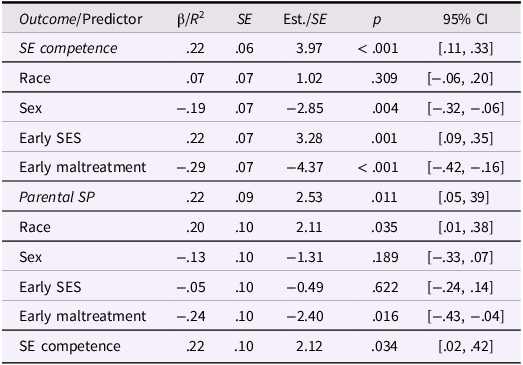
The results of the mediation analysis predicting parental supportive presence are presented in Table 2. Consistent with H1, exposure to early maltreatment at ages 0 – 5 predicted lower socioemotional competence at ages 5 – 16, which in turn forecasted lower parental supportive presence of the participants with their 24- and 42-month-old children. The indirect effect of early maltreatment on parental supportive presence through socioemotional competence was significant (β = −.06, CI [−.16, −.001]), supporting the mediation hypothesis. A significant negative direct effect of early maltreatment on parental supportive presence also emerged, suggesting that the negative effect of early maltreatment on parental supportive presence is only partly mediated by lower socioemotional competence in middle childhood and adolescence. Additionally, early SES predicted better socioemotional competence, which resulted in a significant positive indirect effect of early SES on parental supportive presence through socioemotional competence (β = .05, CI [.00, .13]). The only other significant effects in the model were a sex effect on socioemotional competence, with girls rated as more competent than boys, and a race effect on parental supportive presence, with White participants coded as more supportive than participants of color.
Standardized maximum likelihood estimates for mediation model predicting parental supportive presence

Note. SE = socio-emotional, SP = supportive presence, Race: 1 = White, 0 = Non-White; Sex: −1 = Female, 1 = Male.
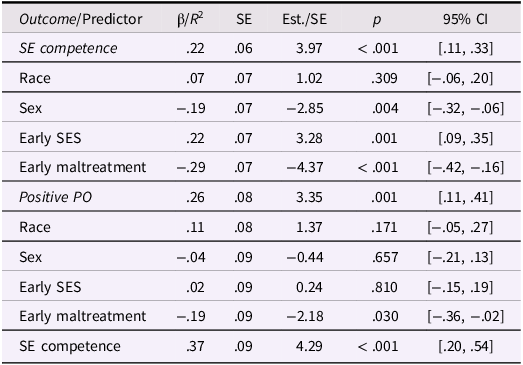
Similar results were obtained in the mediation model predicting positive parental orientation (see Table 3). Socioemotional competence at ages 5 – 16 forecasted a more positive parental orientation at age 32, which, along with the negative effect of early maltreatment on socioemotional competence, resulted in a significant negative indirect effect of early maltreatment on positive parental orientation through socioemotional competence (β = −.11, CI [−.19, −.05]). Moreover, a significant negative direct effect of early maltreatment on positive parental orientation emerged, indicating that socioemotional competence in middle childhood and adolescence partly mediates the negative effect of early maltreatment on positive parental orientation at age 32. Finally, a positive indirect effect of early SES on positive parental orientation through socioemotional competence emerged (β = .08, CI [.03, .16]).
Standardized maximum likelihood estimates for mediation model predicting positive parental orientation

Note. SE = socio-emotional, PO = parental orientation, Race: 1 = White, 0 = Non-White; Sex: −1 = Female, 1 = Male.
Because of the overlap between maltreatment at ages 0 – 5 and maltreatment at later ages in the MLSRA data, we repeated these analyses while controlling for maltreatment at ages 6 – 17.5. The results remained significant, including the indirect effects. The only exception was the direct effect of early maltreatment on positive parental orientation, which became nonsignificant (β = −.17, SE = .12, t = −1.47, p = .142). Maltreatment at ages 6 – 17.5 was not directly associated with parental supportive presence (β = .12, SE = .13, t = 0.91, p = .362) or positive parental orientation (β = −.04., SE = .11, t = −0.38, p = .702) but was correlated with socioemotional competence at ages 5 – 16 (β = −.25., SE = .07, t = −3.53, p < .001).
Moderated mediation analysis
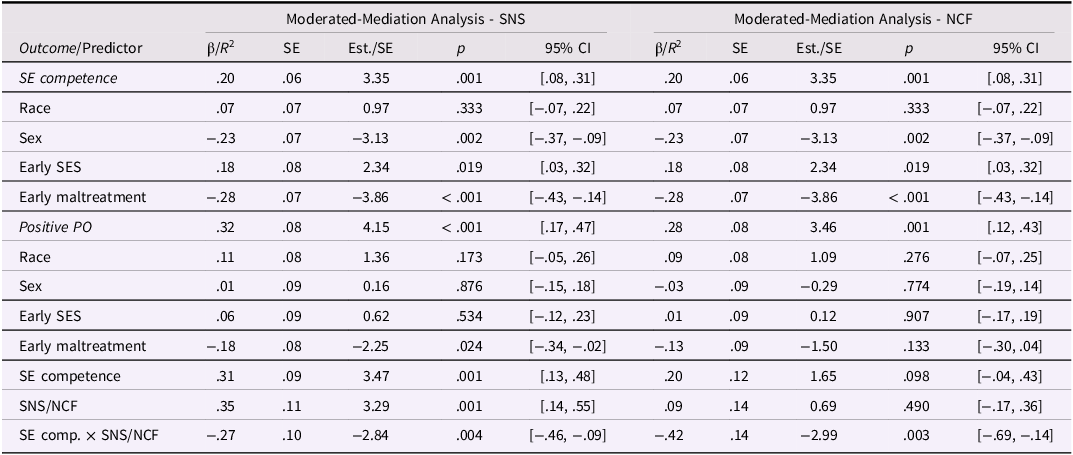
To examine whether the overall size of MLSRA parents’ social network at age 32 moderated the association between their socioemotional competence at ages 5 – 16 and their positive parental orientation at age 32 (and, as a result, the indirect effect of early maltreatment on positive parental orientation through socioemotional competence), we conducted a moderated mediation analysis. In this analysis, the size of the social network and the interaction between the size of the social network and socioemotional competence were added as predictors of positive parental orientation. The results are shown in Table 4.
Standardized maximum likelihood estimates for moderated-mediation models predicting positive parental orientation with social network size (SNS) and the number of close friends (NCF) as moderators

Note. SE = socioemotional, PO = parental orientation, SNS = social network size; NCF = number of close friends; Race: 1 = White, 0 = Non-White; Sex: −1 = Female, 1 = Male.
Consistent with H2, the social network size × socioemotional competence interaction was significant, supporting moderation. To probe this interaction, we inspected the simple slopes of socioemotional competence predicting positive parental orientation for small (−1 SD = 5.30), medium (Mean = 14.84), and large (+1 SD = 24.38) social network sizes. Whereas the simple slope was significant for small (β = .56, SE = .14, t = 4.10, p < .001) and medium (β = .31, SE = .09, t = 3.55, p < .001) social network sizes, it was not significant for large ones (β = .06, SE = .16, t = 0.36, p = .717). We then inspected the conditional indirect effects of early maltreatment on positive parental orientation through socioemotional competence for small, medium, and large social networks. These indirect effects were significant for small (β = −.16, CI [−.30, −.06]) and medium (β = −.09, CI [−.18, −.03]) social network sizes, but nonsignificant for large ones (β = −.02, CI [−.12, .07]). Thus, having a large social network size buffers the indirect negative effect of early maltreatment on positive parental orientation through socioemotional competence.
In addition to this buffering effect, the size of the social network also had a direct association with positive parental orientation, with parents who had a larger social network at age 32 having a more positive parental orientation at this age. The two other significant associations in the model were the associations of early SES and sex with socioemotional competence, which were similar to those reported in the mediation model.
To explore which aspect of MLSRA parents’ social networks was driving the moderation effect, we conducted a series of moderated-mediation analyses replacing the overall number of people in each parent’s social network with the number of relatives or friends within each of the social support circles. The number of inner circle (close) friends emerged as the only significant moderator as indicated by its interaction with socioemotional competence (see Table 4). The mean number of close friends was 0.85, so we next inspected the simple slopes of socioemotional competence predicting positive parental orientation for 0, 1, and 2 close friends (88.4% of the sample fell within this range). The simple slope was significant for 0 close friends (β = .51, SE = .10, t = 4.93, p < .001), but nonsignificant for 1 (β = .14, SE = .15, t = 0.95, p = .034) and 2 (β = −.23, SE = .28, t = −0.82, p = .411) close friends. This result was also reflected in the conditional indirect effect of early maltreatment on positive parental orientation through socioemotional competence, which was significant for 0 close friends (β = −.15, CI [−.27, −.05]), but nonsignificant for 1 (β = −.04, CI [−.13, .05]) and 2 (β = .07, CI [−.08, .28]) close friends.
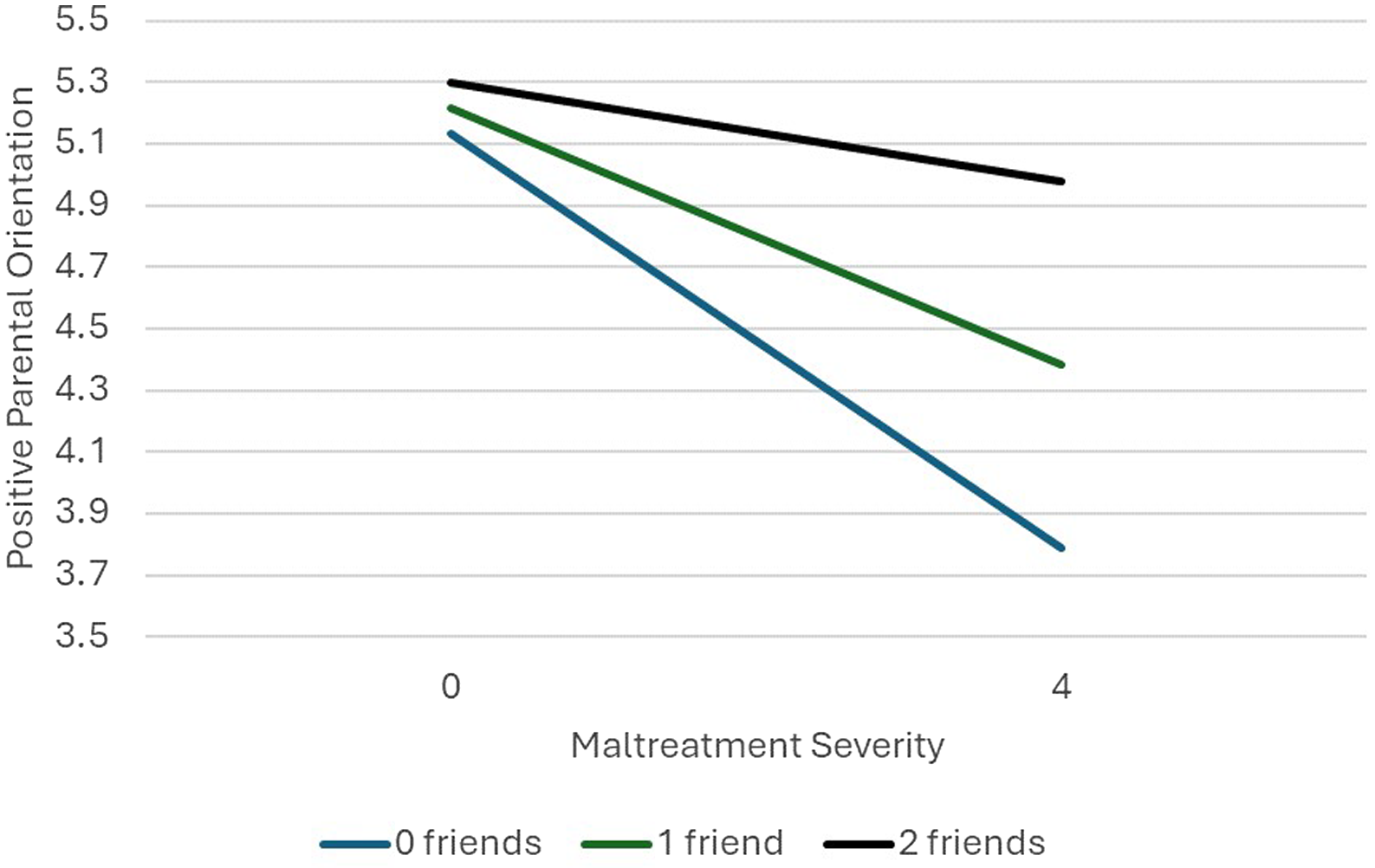
In the moderated mediation model with close friends, the direct effect of early maltreatment on positive parental orientation was nonsignificant. Hence, the buffering of the indirect effect significantly influenced the conditional total effect (direct + indirect) of early maltreatment on positive parental orientation. The total early maltreatment effect was significant for 0 close friends (β = −.28, CI [−.48, −.09]), but nonsignificant for 1 (β = −.17, CI [−.44, .04]) and 2 (β = −.07, CI [−.31, .24]) close friends (see Figure 2). Thus, having even one or two close friends in adulthood buffers the negative effect of early maltreatment on positive parental orientation. Importantly, these results held even when the number of close friends was recoded to remove the influence of positive outliers (e.g., by collapsing all individuals who reported 2 or more close friends).
Conditional total effects of early maltreatment on positive parental orientation for 0, 1, and 2 inner circle (close) friends.

Alternative model
In our main analysis, we examined the size of each parent’s social network as a moderator of the cascading effects of early maltreatment on parental orientation in adulthood. Social network size, however, may also be impacted by earlier experiences of maltreatment (Buchanan et al., Reference Buchanan, Walker, Boden, Mansoor and Newton-Howes2023; Reinhard et al., Reference Reinhard, Rek, Nenov-Matt, Barton, Dewald-Kaufmann, Merz, Musil, Jobst, Brakemeier, Bertsch and Padberg2022). To examine this possibility, we fitted an alternative serial mediation model in which social network size was specified as a mediator of the path from socioemotional competence to parental orientation, rather than as a moderator. In this model, early maltreatment predicted lower socioemotional competence (β = −.29, SE = .07, t = −4.37, p < .001), which in turn predicted a smaller social network size (β = .19, SE = .08, t = 2.29, p = .022). The path from social network size to positive parental orientation, however, did not reach significance (β = .15, SE = .08, t = 1.81, p = .071). Bootstrapped CIs indicated that the total indirect effect of early maltreatment on positive parental orientation was significant (β = −.12, CI [−.20, −.06]). About 80.6% of this total indirect effect, however, represented a significant specific indirect effect of early maltreatment on positive parental orientation through socioemotional competence alone, namely, not through social network size (β = −.10, CI [−.17, −.04]). The specific indirect effect of early maltreatment on positive parental orientation through social network size alone was not significant (β = −.01, CI [−.06, .002]). The specific serial indirect effect of early maltreatment on positive parental orientation through socioemotional competence and social network size was significant (β = −.01, CI [−.02, −.001]), but accounted for only about 7.3% of the total indirect effect of early maltreatment on positive parental orientation, and about 2.1% of the total effect. These results suggest that social network size does not play a substantial mediating role in the process leading from early maltreatment, through socioemotional difficulties, to less positive parental orientations.
Discussion
Research has demonstrated the detrimental effects of childhood maltreatment on parenting quality (e.g., Greene et al., Reference Greene, Haisley, Wallace and Ford2020; Macintosh & Ménard, Reference Macintosh and Ménard2021; Madigan et al., Reference Madigan, Cyr, Eirich, Fearon, Ly, Rash, Poole and Alink2019). The current study employed prospective, multi-sourced data to identify a mechanism by which early experiences of maltreatment lead to poorer socioemotional competence in middle childhood and adolescence, which forecasts later parenting difficulties. The current research also points to a possible protective factor—having a larger social network in adulthood. Additionally, post hoc analysis highlighted the protective effect of having close friends in one’s social network.
Socioemotional mediation of childhood maltreatment effects on parenting
Our findings regarding the link between early maltreatment and impaired socio-emotional functioning are consistent with the growing literature on how threat and deprivation impact neurocircuitry associated with social and emotional functioning (Feeney et al., Reference Feeney, Pintos Lobo, Hare, Morris, Laird and Musser2024). Threat exposure is primarily associated with changes in brain structures and neurocircuitry mediating greater threat reactivity and reduced emotion regulation (e.g., amygdala, mPFC; e.g., McLaughlin et al., Reference McLaughlin, Peverill, Gold, Alves and Sheridan2015), whereas deprivation is mainly associated with changes in frontoparietal brain structures mediating cognitive control and higher cognitive functions (McLaughlin et al., Reference McLaughlin, Weissman and Bitrán2019; Teicher & Samson, Reference Teicher and Samson2016). Maltreatment often involves both threat (parental abuse) and deprivation (parental neglect), which is true of our sample. Accordingly, most children exposed to early maltreatment experience a range of emotional, social, and cognitive effects (Manly et al., Reference Manly, Cicchetti and Barnett1994; Pfaltz et al., Reference Pfaltz, Halligan, Haim-Nachum, Sopp, Åhs, Bachem, Bartoli, Belete, Belete, Berzengi, Dukes, Essadek, Iqbal, Jobson, Langevin, Levy-Gigi, Lüönd, Martin-Soelch, Michael and Seedat2022), which can extend into adulthood (Warmingham et al., Reference Warmingham, Duprey, Handley, Rogosch and Cicchetti2023).
The cascading developmental effects of early maltreatment may be underpinned by additional biological embedding mechanisms by which early adversity “gets under the skin” (Hertzman & Boyce, Reference Hertzman and Boyce2010; van der Kolk, Reference Van der Kolk2014), such as epigenetic modifications (e.g., Lussier et al., Reference Lussier, Zhu, Smith, Cerutti, Fisher, Melton, Wood, Cohen-Woods, Huang, Mitchell, Schneper, Notterman, Simpkin, Smith, Suderman, Walton, Relton, Ressler and Dunn2023; Merrill et al., Reference Merrill, Gladish, Fu, Moore, Konwar, Giesbrecht, MacIssac, Kobor and Letourneau2023), HPA axis programing (e.g., Juruena et al., Reference Juruena, Eror, Cleare, Young and Kim2020; Schär et al., Reference Schär, Mürner-Lavanchy, Schmidt, Koenig and Kaess2022), and changes to sensory systems (e.g., Teicher et al., Reference Teicher, Samson, Anderson and Ohashi2016; Tomoda et al., 2024). These biological mechanisms may underlie psychological changes in how individuals process and respond to social information. Accordingly, various psychological processes may play a role in the association between early maltreatment and low socioemotional competence. Early maltreatment by a caregiver can lead to insecure or disorganized attachment styles (Baer & Martinez, Reference Baer and Martinez2006; Cyr et al., Reference Cyr, Euser, Bakermans-Kranenburg and Van Ijzendoorn2010), which may predict enduring social and emotional difficulties (Fraley et al., Reference Fraley, Roisman and Haltigan2013; Thompson, Reference Thompson, Cassidy and Shaver2008). Maltreated children also interpret social information differently, performing more encoding errors and hostile attributions, which may result in aggressive responses and social maladjustment (Dodge et al., Reference Dodge, Pettit, Bates and Valente1995). Moreover, maltreated children are at an elevated risk for psychopathology (Cicchetti & Toth, Reference Cicchetti and Toth2005; Jaffee, Reference Jaffee2017; Teicher & Samson, Reference Teicher and Samson2013).
The enduring social and emotional consequences of early maltreatment can explain the documented link between childhood maltreatment and poor parental functioning. Socioemotional difficulties typically hinder the ability of childhood maltreatment survivors to navigate developmental milestones like effective parenting. Parental emotional instability and dysregulation tend to impede parent-child interactions and socialization processes (Hajal & Paley, Reference Hajal and Paley2020), whereas lower competence in emotional intelligence, empathy, and conflict management predicts more negative parenting styles (Egeli & Rinaldi, Reference Egeli and Rinaldi2016). These mediating effects most likely operate alongside additional adaptive and maladaptive processes underlying the connection between childhood maltreatment and parenting in adulthood (Alink et al., Reference Alink, Cyr and Madigan2019). Studies have shown that attachment insecurity and social information processing biases are associated with parental maltreatment (Camilo et al., Reference Camilo, Garrido and Calheiros2020; Lo et al., Reference Lo, Chan and Ip2019). Moreover, a meta-analysis found several parental risk factors for abuse and neglect, including psychopathology, depression, low self-esteem, and substance use, all of which could result from a history of childhood maltreatment (Stith et al., Reference Stith, Liu, Davies, Boykin, Alder, Harris, Som, McPherson and Dees2009).
The protective function of social ties
Importantly, the current study also reveals that having a larger social network in adulthood is a protective factor against the long-term effects of early maltreatment on parenting. Despite experiencing social and emotional difficulties following early maltreatment, MLSRA parents who had more friends and relatives had parental orientations similar to parents who did not experience such difficulties. Social networks can offer supportive resources that especially benefit individuals with a history of childhood adversity. For example, they can provide emotional support, comfort, and reassurance that can alleviate psychological distress associated with earlier maltreatment, thereby facilitating better, more positive parenting (St-Laurent et al., Reference St-Laurent, Dubois-Comtois, Milot and Cantinotti2019). Furthermore, social networks can provide parents with important information, including insights into effective child-rearing practices (e.g., soothing children) or childcare opportunities (Cochran & Niego, Reference Cochran, Niego and Bornstein2002; Strehlke et al., Reference Strehlke, Bromme and Kärtner2025). Moreover, they can provide instrumental support such as childcare or second-hand equipment that can ease parental burdens (Kang, Reference Kang2013).
The number of close friends (i.e., one’s primary social group) appears to be an important protective component of social networks. Prior studies have confirmed the positive effects of close friendships on several adult outcomes (Kim et al., Reference Kim, Chopik, Chen, Wilkinson and Vanderweele2023; Narr et al., Reference Narr, Allen, Tan and Loeb2019) and their role in promoting resilience among child abuse survivors (Collishaw et al., Reference Collishaw, Pickles, Messer, Rutter, Shearer and Maughan2007). Indeed, support from friends (but not parental or spousal support) buffers the effect of childhood maltreatment on mothers’ postnatal distress (Schury et al., Reference Schury, Zimmermann, Umlauft, Hulbert, Guendel, Ziegenhain and Kolassa2017). In adulthood, parents who experienced childhood maltreatment may continue to lack support from their family of origin, making their close friends especially important.
Limitations and future directions
The current study has some limitations. First, given the overlap between experiences of abuse and neglect in our sample, we could not disentangle the effects of threat (abuse) and deprivation (neglect). Abuse and neglect may operate through different physiological, psychological, and behavioral mechanisms, which may be buffered by different protective factors (McLaughlin et al., Reference McLaughlin, Sheridan and Lambert2014). Second, our prospective early maltreatment measure reflected the number of maltreatment types (physical abuse, sexual abuse, neglect) identified for each participant during infancy and early childhood. This approach does not directly assess maltreatment severity. Future research should investigate whether there is a dose-response relationship between early maltreatment and parenting difficulties. Third, despite the prospective design, the correlational nature of our data precludes causal inferences. This is especially true regarding the associations between social network size and parental orientation, which were measured at the same time. While the transition to parenthood is often associated with a decline in the number of non-related friends (Bost et al., Reference Bost, Cox, Burchinal and Payne2002), more invested and involved parents might form new social ties around parenting. These new social ties may provide parents with additional social support. Fourth, our teacher reports of socio-emotional competence relied on relative assessments, meaning that in each assessment, participants were rated comparatively to other children in their class. Although these relative assessments have proven to be highly reliable, future studies should use absolute assessments of socio-emotional functioning where available. Finally, the nature and importance of social ties may vary substantially between cultures and socioeconomic circumstances (e.g., Realo & Allik, Reference Realo and Allik2009). Structural barriers (e.g., mobility, urbanicity) may restrict opportunities to form and maintain large social networks in ways that intersect with early adversity. Thus, future research should examine the protective function of social ties across diverse socioeconomic circumstances and cultural backgrounds.
Conclusion
Childhood maltreatment is a prevalent public health concern with well-documented links to poor parental functioning in adulthood. The current study used a prospective, multi-informant, multi-method design to demonstrate the mediating role of socioemotional competence in middle childhood and adolescence in the association between early childhood maltreatment and parenting in adulthood. The study also highlights the potential protective role of social ties, especially close friends. Our findings indicate that having a large social network and even a small number of close friends could buffer the negative effects of childhood maltreatment on parenting.
Supplementary material
The supplementary material for this article can be found at https://doi.org/10.1017/S0954579425100345.
Funding statement
This research was funded by the National Science Foundation (JS, VG, & OS, Grant no. 1728168).
Competing interests
The authors declare none.