Clostridia are gram-positive, spore-forming, anaerobic bacteria which are considered to be the principal organisms responsible for late blowing. Spores of Clostridium spp. (e.g. Cl. tyrobutyricum, Cl. butyricum, Cl. sporogenes, Cl. beijerinckii, but also Cl. pasteurianum, Cl. tertium, Cl. perfringens, and Cl. tetanomorphum) are able to survive the manufacture of processed cheese and may germinate and grow out in the product (Coulon et al. Reference Coulon, Varignier and Darne1991; Guericke, Reference Guericke1993; Ingham et al. Reference Ingham, Hassler, Tsai and Ingham1998; Le Bourhis et al. Reference Le Bourhis, Doré, Carlier, Chamba, Popoff and Tholozan2007).
Late blowing, caused by the outgrowth of clostridial spores present in raw milk and originating mainly from silage, can create considerable product loss, especially in the production of hard and semi-hard cheeses (Bergeres & Sivela, Reference Bergeres and Sivela1990; Coulon et al. Reference Coulon, Varignier and Darne1991). This condition has been characterised by the formation of high amounts of CO2 that causes the cheese-loaf to show a balloon-like expansion and could double in size. The clostridial species produce abundant gas and off-odours caused by the production of acetic acid, butyric acid, carbon dioxide, and hydrogen. Moreover, due to the large quantities of butyric acid produced, a rancid, distasteful consistence of the cheese is obtained (Innocente & Corradini, Reference Innocente and Corradini1996) and for this reason the analytical determination of free volatile fatty acids, particularly of butyric acid, is a useful parameter for spotting anomalous fermentations in cheeses (Chavarri et al. Reference Chavarri, Virto, Martin, Najera, Santisteban, Barron and De Renobales1997; Innocente et al. Reference Innocente, Moret, Corradini and Conte2000).
One approach for presumptively enumerating Clostridium spp. endospores involves heat treatment of the sample to destroy vegetative cells, followed by a most probable number (MPN) enumeration, based on gas production in anaerobically incubated medium containing lactate as the fermentable organic compound (Cocolin et al. Reference Cocolin, Innocente, Biasutti and Comi2004). The MPN value can be confirmed by verifying the lactate fermentation ability of cells from gas positive tubes. This method enumerates all clostridia species capable of fermenting lactate, but further tests on pure cultures obtained from gas positive tubes, such as examination of endospores position, carbohydrate fermentation profiling, and gas chromatographic analysis of volatile and non-volatile organic acid by-products, are commonly performed to obtain the identification at the species level (Ingham et al. Reference Ingham, Hassler, Tsai and Ingham1998).
The conventional method for the isolation of Clostridium spp. from cheeses with late-blowing defect is very complicated and the identification of isolates is problematic since specific media to discriminate between the clostridial species do not exist and phenotypic discrimination is almost impossible (Bergères & Sivela, Reference Bergeres and Sivela1990; Klijn et al. Reference Klijn, Nieuwenhof, Hoolwerf, Van Der Waals and Weerkamp1995). For these reasons, more reliable and rapid methods for the isolation and identification of the causative agents of late blowing in cheese are needed.
In recent years PCR-based methods (Klijn et al. Reference Klijn, Bovie, Dommes, Hoolwerf, Van Der Waals, Weerkamp and Nieuwenhof1994; Pecoraro et al. Reference Pecoraro, Tatzel and Wallnoefer1999) and 16S rRNA probe-based hybridisation methods (Klijn et al. Reference Klijn, Bovie, Dommes, Hoolwerf, Van Der Waals, Weerkamp and Nieuwenhof1994; Knabel et al. Reference Knabel, Tatzel, Ludwig and Wallnoefer1997) have been developed with the disadvantage of being specific for a single species; so, for a complete study of Clostridium spp. in cheese a set of specific primers had to be available. More recently Cocolin et al. (Reference Cocolin, Innocente, Biasutti and Comi2004) developed a PCR-denaturing gradient gel electrophoresis (DGGE) protocol to profile the microbial populations in blown cheeses while Le Bourhis et al. (Reference Le Bourhis, Doré, Carlier, Chamba, Popoff and Tholozan2005) performed a PCR-TTGE approach to evaluate the evolution of the clostridial species during ripening. Moreover, Garde et al. (Reference Garde, Arias, Gaya and Nunez2011) identified by the amplification of 16S ribosomal DNA restriction analysis (ARDRA technique) the Clostridium spp. from Manchego cheese with late blowing defect.
In this study we developed a multiplex-PCR method in order to profile, with a rapid assay, Cl. beijerinckii, Cl. butyricum, Cl. sporogenes, Cl. tyrobutyricum in raw milk and cheese.
Materials and Methods
Bacterial strains and growth conditions
Cl. tyrobutyricum DSM#2637T, Cl. butyricum DSM#10072T, Cl. beijerinckii DSM#791T, Cl. baratii DSM#601T, Cl. perfringens DSM#756T, Cl. difficile DSM#1296T, Bacillus cereus DSM#31T, Escherichia coli DSM#4064T, Lactobacillus helveticus DSM#20075T, Lb. delbrueckii subsp. lactis DSM#20072T, Lb. delbrueckii subsp. bulgaricus DSM#20081T, Lb. fermentum DSM#20052T, Enterococcus faecium DSM#20477T, Ec. durans DSM#20633T, Listeria monocytogenes DSM BAA 679T, Salmonella enterica DSM#17058T, used in this study were provided by the Deutsche Sammlung von Mikroorganismen und Zellkulturen, Braunschweig (Germany); Cl. sporogenes ATCC 3584, Staphylococcus aureus ATCC 25923, Ec. faecalis ATCC 23655, Streptococcus thermophilus (BT63), Lactococcus garvieae (SV80), Lc. lactis subsp. cremoris (SV120), Lc. lactis subsp. lactis (SV131), B. licheniformis (IN2), and two Paenibacillus polymyxa (PA, PAP) were provided by the ISPA-CNR (Institute of Sciences of Food Production-Italian National Research Council, Milan, Italy) bacterial collection. The Clostridium strains were anaerobically incubated at 37°C in Reinforced Clostridial Medium (RCM) (Oxoid, Milan, Italy) for 24 h. Str. thermophilus was cultured overnight at 37°C in M17 broth (Scharlau Microbiology, Barcelona, Spain); Lactobacillus strains in MRS broth (Scharlau Microbiology) while B. cereus and Esch. coli were grown in Nutrient Broth (Difco, Milan, Italy) at 37°C.
Samples and microbiological analysis
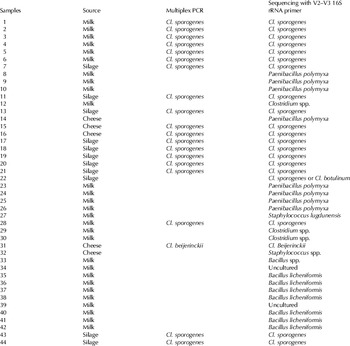
Most probable number (MPN) enumeration was performed on samples of silage (n=11), raw milk (n=28) and Grana Padano cheese (n=5), without late blowing defect, with five tubes per dilution series and three dilutions. The culture medium used for MPN was prepared with milk supplemented with yeast extract (1·0%), sodium lactate (3·36%), sodium acetate (1·0%), cysteine (0·2%) with vaseline/paraffin (1:1, wt/wt) seals. The heat treatment applied to the inoculated milk medium was 80°C for 10 min. The incubation period was 7 d at 37°C. Forty-four bacterial strains isolated from gas positive tubes were used to check the reliability of the multiplex PCR assay (Table 1).
Samples used for multiplex-PCR validation

DNA extraction
For DNA extraction, 1 ml of overnight cultures (approximately 1–3×10⁹ CFU/ml) for all the reference strains and for the silage, milk and cheese isolates with bacterial morphology similar to that of Clostridium spp. and presence of endospores, were analysed and the protocol described in Cremonesi et al. (Reference Cremonesi, Castiglioni, Malferrari, Biunno, Vimercati, Moroni, Morandi and Luzzana2006) was used, without pre-treatment step.
PCR primer design
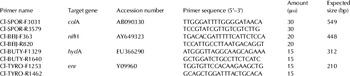
Based on published DNA sequences available in GenBank database, four primer pairs specific to the clostridia species Cl. beijerinckii, Cl. butyricum, Cl. sporogenes, Cl. tyrobutyricum were designed using the Primer3 program (http://frodo.wi.mit.edu/primer3/, June 2011). All the primers used in this study, ranging from 20 to 22 mers, are shown in Table 2 and were designed in order to have similar melting temperatures and minimal interactions resulting in differentially sized products distinguishable in agarose gel electrophoresis. The target genes were chosen among the sequences available on the NCBI (http://www.ncbi.nlm.nih.gov/sites/entrez, accessed June 2011). The primers were synthesised by Invitrogen (Minneapolis, MN, USA) and were resuspended to a final concentration of 100 pmol/μl in sterile double-distilled water.
Primers and target genes used in this study

colA, collagenase; nifH, nitrogenase iron protein; hydA, hydrogenase; enr, 2-enoate reductase
DNA amplification
The multiplex PCR was performed using ∼40 ng of the DNA template, 1·25 U of GoTaq DNA Polymerase (Promega), 10 μl of 5× Colorless GoTaq Reaction Buffer (Promega), 6 μl of MgCl2 25 mm, 1 μl of dNTPs Mix (10 mM each), the primer pairs amount described in Table 2 and double-distilled water to the final volume of 50 μl. Reactions were carried out in a GeneAmp PCR System 2700 thermal cycler (Applied Biosystems, Foster City, CA, USA) with the following conditions: initial denaturation at 94°C for 2 min followed by 30 cycles of 94°C for 1 min, 56°C for 1 min and 72°C for 1 min. Final extension was carried out at 72°C for 5 min. The amplified PCR products were distinguished by gel electrophoresis in a 3% agarose gel (GellyPhor, Euroclone, Milan, Italy), stained with ethidium bromide (0·05 mg/ml; Sigma Aldrich, Milan, Italy), and visualised by UV transilluminator (BioView Ltd, Nes Ziona, Israel). A 100 bp DNA ladder (Finnzymes, Espoo, Finland) was included in each gel electrophoresis.
Specificity and sensitivity test
The specificity of the assay was tested using the DNA of target (artificial balance mixes composed by three out of four DNA of typed strains) and non-target reference strains. Serial dilutions of a genomic DNA pool obtained from the Clostridium target reference strains, starting from 200 to 0·39 ng were used to test the sensitivity of the assay. The PCR products were quantified using the Agilent BioAnalyser 2100 applied to the DNA 7500 LabChip kit (Agilent Technologies, Palo, Alto, CA, USA).
Sequencing
Forty-four isolates from silage, raw milk and cheeses (Table 1) were used to check the reliability of the multiplex PCR assay. PCR with universal primers HDA1 and HDA2 amplifying the V2-V3 16S rRNA gene region was performed as described by Walter et al. (Reference Walter, Tannock, Tilsala-Timisjarvi, Rodtong, Loach, Munro and Alatossava2000) and sequences were analysed by Primm s.r.l. (Milan, Italy). The resulting chromatograms were analysed by the software Bioedit and a similarity search with the nucleotide sequence database at NCBI by BLASTN.
Results
Multiplex PCR optimisation
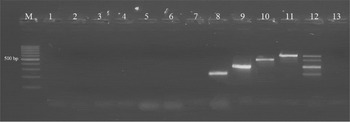
The multiplex PCR method provides an approach enabling a simultaneous and specific detection of more than one Clostridium spp. The primers designed in this study had the same melting temperature of 59–60°C but different amplification products of 549, 448, 312 and 210 bp for Cl. sporogenes, Cl. bejierinkii, Cl. butyricum and Cl. tyrobutyricum respectively, easily interpretable during the agarose gel electrophoresis. Each primer pairs of the multiplex PCR, tested individually by using reference strains with known genotype and artificial balance mixes, showed good specificity, amplifying PCR products of the expected size with no additional or non-specific products. The concentration of each primer set was adjusted and PCR conditions were modified obtaining equal yields for all the amplification products. Strains belonging to Lactobacillus, Streptococcus, and Enterococcus genera, such as Lb. helveticus, Lb. delbrueckii subsp. lactis, Lb. delbrueckii subsp. bulgaricus, Lb. fermentum, Ec. faecalis, Ec. faecium, Ec. durans, Str. thermophilus, Lc. garvieae, Lc. lactis subsp. cremoris, Lc. lactis subsp. lactis, Cl. baratii, Cl. perfringens, Cl. difficile, B. cereus, B. licheniformis, P. polymyxa, Staph. aureus, Esch. coli, List. monocytogenes, Sal. enterica, which can coexist with our target, were used as negative controls and did not generate false-positive results (examples in Fig. 1).
Examples of multiplex PCR results obtained using target (DNA of typed strains) and non-target reference strains. From lane 1 to lane 7 Cl. difficile, Cl. perfringens, L. delbrueckii subsp. lactis, Str. thermophilus, L. monocytogenes, Cl. baratii, St. aureus, respectively; lane 8, Cl. tyrobutyricum (210 bp); lane 9, Cl. butyricum (312 bp); lane 10, Cl. beijerinckii (448 bp); lane 11, Cl. sporogenes (549 bp); lane 12, Cl. tyrobutyricum (210 bp), Cl. butyricum (312 bp), Cl. beijerinckii (448 bp) and Cl. sporogenes (549 bp); lane 13: negative control (PCR master mix without DNA). M: 100 bp DNA ladder (Finnzymes).

Sensitivity
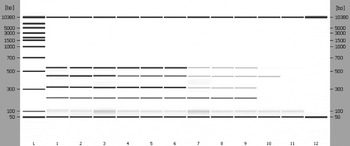
The analysis of serial dilutions, made from genomic DNA pool obtained from reference strains of the target species, gave correct amplification from 200 ng down to 0·78 ng of DNA (Fig. 2), corresponding approximately to 102 CFU/ml. For Cl. beijerinckii (448 bp) a signal was obtained down to 0·39 ng (Fig. 2). A detection limit of 100 CFU/g available for Clostridium sensitivity in cheese samples was established by Le Bourhis et al. (Reference Le Bourhis, Doré, Carlier, Chamba, Popoff and Tholozan2005) with the development of a TTGE protocol.
Sensitivity of the multiplex PCR: analyses of genomic DNA pool obtained from the Cl. sporogenes (549 bp), Cl. beijerinckii (448 bp), Cl. butyricum (312 bp) and Cl. tyrobutyricum (210 bp) reference strains. The concentration of each DNA fragment was calculated using the Agilent 2100 Bioanalyser software. The ‘gel-like image’ provided by the instrument shows the multiplex PCR results obtained using 200 ng (lane 1), 100 ng (lane 2), 50 ng (lane 3), 25 ng (lane 4), 12·5 ng (lane 5), 6·25 ng (lane 6), 3·125 ng (lane 7), 1·56 ng (lane 8), 0·78 ng (lane 9), 0·39 ng (lane 10), 0·195 ng (lane 11) of the genomic DNA pool from the reference strains. Lane 12: negative control (PCR master mix without DNA). Lane L: DNA 7500 ladder.

Multiplex PCR validation
Forty-four bacterial strains isolated from gas positive tubes were used to check the reliability of the multiplex PCR assay (Table 1). For 20 samples out of 44 analysed, the results obtained by multiplex PCR were confirmed by sequencing of V2-V3 16S rRNA region. For the remaining 24 samples, the sequencing revealed the aligned 16S rRNA sequences to be Paenibacillus polymyxa (8 samples), Clostridium spp. (4 samples), Bacillus spp. (B. licheniformis, 8 samples), Staphylococcus spp. (2 samples) and uncultured (2 samples). Like clostridia, P. polymyxa and B. licheniformis are spore-forming, able to produce gas and their original habitat is soil.
Discussion
In the last decade, different molecular methods have been applied for a better understanding of the late blowing spoilage process. Previously developed protocols (Klijn et al. Reference Klijn, Bovie, Dommes, Hoolwerf, Van Der Waals, Weerkamp and Nieuwenhof1994; Pecoraro et al. Reference Pecoraro, Tatzel and Wallnoefer1999) have the main disadvantage of being specific for a single species, which means that for a complete study of the Clostridium spp. ecology in raw milk or cheese with late-blowing defect, a set of specific probes must be available to identify all the agents responsible for the alteration.
The routine diagnostic methods used by analytical laboratory for detecting Clostridium spp. require several days for a visible response. For this reason it is difficult to satisfy the requirements of cheese-makers as the milks from various sources have already been mixed and passed onto the production process by the time a positive result is obtained.
The protocol was first optimised by using reference strains to determine the best experimental conditions for the multiplex assay. Also strains belonging to Lactobacillus, Streptococcus, and Enterococcus genera were tested since they are present in milk and cheese environment, where it can be necessary to perform a detection of Clostridia species. The optimised protocol can distinguish the four target Clostridia species and no amplifications were obtained among other Clostridium spp. (Cl. difficile, Cl. perfringens) or non-target species. For this assay, target genes such as colA (Cl. sporogenes), a collagenase that catalyses the degradation of collagen, nifH (Cl. beijerinckii), an enzyme responsible for nitrogen fixation, hydA (Cl. butyricum), an enzyme that catalyse the reversible oxidation of hydrogen, and enr (Cl. tyrobutyricum), an enzyme that participates in phenylalanine metabolism, have been chosen among the sequence available on the NCBI (http://www.ncbi.nlm.nih.gov/sites/entrez); these genes, less conserved than 16S rRNA, have been shown to be useful for the discrimination of closely related bacterial species.
As previously described (Ingham et al. Reference Ingham, Hassler, Tsai and Ingham1998; Le Bourhis et al. Reference Le Bourhis, Doré, Carlier, Chamba, Popoff and Tholozan2007), the analysed samples revealed the presence of Clostridium spp. in silage, raw milk and cheese. The prevalent species detected with multiplex PCR was Cl. sporogenes isolated from silage (10 samples), raw milk (7 samples) and hard cheese (3 samples). Similar results were also obtained from Lycken & Borch (Reference Lycken and Borch2006) who isolated 124 Clostridia from 42 cheeses and 33% were identified as Cl. sporogenes. More recently Garde et al. (Reference Garde, Arias, Gaya and Nunez2011), using the ARDRA technique, analysed 57 Manchego cheeses and out of 223 isolates from spoiled cheeses, 78·9% were identified as Cl. sporogenes while 10·3, 9·0 and 1·8% were Cl. bejierinckii, Cl. tyrobutyricum and Cl. butyricum respectively.
This is the first study which allows the detection and differentiation of four clostridial species with a single test. It is noteworthy that clostridia such as Cl. butyricum and Cl. beijerinckii cannot easily be identified by normal culture and biochemical techniques but can readily be differentiated by this multiplex PCR. Furthermore, similar to Cl. tyrobutyricum, P. polymyxa, isolated from 7 milk and 1 cheese samples, is spore-forming, is able to produce gas but not to make milk coagulation. This multiplex PCR, joined with an efficient extraction protocol, provides a simple promising alternative to traditional microbiological methods for a rapid, sensitive detection of four different species of Clostridia, Cl. tyrobutyricum, Cl. sporogenes, Cl. butyricum and Cl. beijerinckii, in animal feeds and in dairy products for monitoring the products from ‘farm to table’.