On the afternoon of 27 August 1921, the Resident of Batavia, J.D. Hunger, declared Pasar Gambir (Gambir Market) open for the year. Unlike previous versions of the annual festivities, this particular staging boasted a week-long line-up of exciting programmes, informative government departmental exhibitions, carnival games and rides, and competitions that promised to draw European and local visitors alike. This was not the first time the Koningsplein (King's Square) in Weltevreden, a subdistrict of central Batavia, hosted the event. To those living in Batavia, however, the name ‘Pasar Gambir’ had long been associated with a one-day ‘jaarmarkt’ (fair) or ‘kermis’ (carnival) held at the end of August to mark Queen Wilhelmina's birthday.Footnote 1 The year 1921, therefore, was special in that it signified the beginning of Pasar Gambir as a full-fledged colonial spectacle in the Dutch East Indies.
Plans to expand the day-long jaarmarkt began on 19 May 1921 when Hunger formed Het Pasar Gambir Comité (The Pasar Gambir Committee, henceforth the Comité). Under the chairmanship of W.P.A. Kloprogge, the Assistant Resident of Batavia, the Comité mainly consisted of prominent Dutch civil servants and had the task of organising a Pasar Gambir inspired by its one-off, modest jaarmarkt-tentoonstelling (fair-cum-exhibition) form in 1906.Footnote 2 When Pasar Gambir opened its gates to the public in 1921, the resulting jaarmarkt-tentoonstelling surpassed even its pre-First World War antecedent.
Occupying 20 hectares of space, the spectacle included an extensive complex of temporary buildings constructed out of materials like bamboo and attap, while decorative ornaments in orange—the Dutch national colour—supplemented its architectural grandeur. At night, electric lamps illuminated these structures, casting a magnificent silhouette against the Batavian night sky. J.H. Antonisse, the man who designed the Pasar Gambir buildings, deliberately incorporated different styles of indigenous architecture every year.Footnote 3
Stands and kiosks selling a myriad of products or housing carnival games lined the Koningsplein. Theatres, cafes, and a cabaret nestled in the open under a palm grove kept European visitors entertained.Footnote 4 For the colonised, there were showcases of indigenous crafts and agricultural produce, an open air cinema playing native films, and popular traditional competitions like panjat pinang (pole climbing). Grand displays of fireworks exploded over the Koningsplein to mark the start and the end of Pasar Gambir.Footnote 5 When the 1921 Pasar Gambir brought in a net profit of ƒ1,884,838.50 and attracted 335,000 visitors, Hunger moved to make the Comité permanent and declared Pasar Gambir an annual affair.Footnote 6 The spectacle of 1921 set the precedent for subsequent Pasar Gambir not only as a means to celebrate native culture, but also as a space that embodied influences of Dutch customs and Western modernity in the colony.
Scholars such as Paul Greenhalgh, Thomas Richards, and Robert W. Rydell have comprehensively examined the didactic colonial expositions that remained popular in the West throughout the nineteenth and early twentieth centuries, beginning with the Great Exhibition held at the Crystal Palace in London in 1851. Social scientist Tony Bennett has since identified this Euro-American desire to display objects and cultures for the benefit of the extended general public as ‘the exhibitionary complex’. According to Marieke Bloembergen, the exhibitionary complex, which manifested itself in colonial spectacles, was instrumental in representing and articulating the belief in societal progress that dominated Western thinking in this period. Bennett elaborates that within the context of these expositions, the seemingly primitive colonised ‘other’ on display was pivotal in supporting the rhetoric of social evolution and modernity by serving as its counterpoint.Footnote 7
While colonial exhibitions as an invented tradition of the West have been well analysed, the same cannot be said of instances where this exhibitionary complex had either been adopted by non-Westerners or transplanted into colonised settings. The handful of studies done on this subject reveals that attempts to adapt or appropriate this complex to suit circumstances different from the Euro-American originals resulted in a distinct set of challenges. Maurizio Peleggi observes that as Siamese authorities participated in international exhibitions, they encountered the predicament of balancing between ‘pandering to Western curiosity for the exotic and, at the same time, producing evidence of their accomplishments on the way to progress’. On the consumption end, Gyan Prakash points to the presence of an ‘unresolvable dilemma’ in British-led exhibitions staged in colonial India. Prakash claims that by acknowledging that colonised Indians were sufficiently intelligent to comprehend intended Western messages of progress in these exhibitions, the colonisers invalidated the ‘very strategy of hierarchizing and displaying’ the ‘native’ as backward, objectified living exhibits used exclusively to strengthen European claims of power and racial supremacy. In the Dutch East Indies itself, Joost Coté argues that the 1914 Semarang International Colonial Exhibition illustrated how spectacles in the colony introduced ‘ambiguities not present in metropolitan equivalents’, thereby undermining their intended purpose to reinforce the colonial order.Footnote 8
This article addresses the dearth of scholarly literature that analyses how the Western exhibitionary complex functioned in a colonised environment. As a derivative of colonial exhibitions in the metropoles, Pasar Gambir remains a largely unexplored topic. Until recently, only journalists of contemporary Indonesian publications such as Kompas, TEMPO and Republika have briefly written about the history of this annual event.Footnote 9 To my knowledge, only Yulia Nurliani Lukito, a scholar of Indonesian architecture, has done an in-depth study of Pasar Gambir as a cultural staple of 1920s and 1930s Batavia. Lukito adopts the hybridised architecture of the yearly spectacle, which combined ‘Indies vernacular’ architecture with Western architecture, as the starting point of her analysis.Footnote 10 She argues that Pasar Gambir was a laboratory of modernity not simply because it exhibited and was physically constructed using the most advanced technology of the day, but also because the sharp distinction between the ‘Dutch as coloniser’ and the ‘native as colonised people’ was temporarily blurred as they mingled relatively freely in the Koningsplein during the week-long affair.Footnote 11
Unlike Lukito who utilises the hybridised architecture of Pasar Gambir as the entry point of her analysis, this article instead foregrounds the hybridity of Pasar Gambir as a jaarmarkt-tentoonstelling. Ultimately, I argue that in imbuing the Western exhibitionary complex with market-like characteristics, the hybridity of Pasar Gambir allowed the colonised to undercut Dutch efforts to utilise this spectacle to project and validate their superiority and benevolence. As such, an analysis of local sentiments articulated in vernacular newspapers suggests that instead of temporarily rendering the delineation between the coloniser and the colonised vague, active participation by the colonised at Pasar Gambir reinforced the gulf that distinguished the former from the latter.
As an economic space that was heavily fragmented into many stands run by vendors selling various items, food, and entertainment, Pasar Gambir combined the Western exhibitionary complex with the bazaar economy phenomenon traditionally popular in the East.Footnote 12 Clifford Geertz, who based his theory partly on Javanese markets, characterises the latter as an economy where the total flow of commerce is divided into a huge number of small, isolated person-to-person transactions conducted through a variety of small enterprises. Geertz claims that the Persian word ‘bazaar’ has become synonymous with the oriental market in the English language. Thus, Pasar Gambir was also a proverbial marketplace that corresponded to J.S. Furnivall's mid-twentieth century description of the role of the market in the Dutch East Indies’ plural society. Furnivall described the market as the one place where various sections of the colonial-era plural society met on common ground, but he argues that such economic-driven interactions did not generate social and political consequences.Footnote 13
Writing in the late 1990s, James Siegel pointed out, however, that the marketplace is not simply an economic institution. In the early twentieth century, Indies Chinese nationalists turned to the market to validate and communicate their ‘modern’ and ‘Chinese’ self-image. By deliberately choosing Melayu Pasar (‘bazaar Malay’) as their lingua franca in the marketplace and producing novels and short stories in this language, these nationalists wished to demonstrate that Indies Chinese had assimilated themselves into local society without becoming ‘Javanese’ or ‘Dutch’. Nonetheless, their decision to exploit the marketplace to establish their communal identity was unsatisfactory. As the Dutch began to purify Melayu, the colonisers denigrated ‘bazaar Malay’ and characterised it as substandard.Footnote 14 Hence, in appropriating Melayu Pasar as their lingua franca, local Chinese failed to elevate their status and validate their self-image as a modern and progressive community. Unlike Furnivall, Siegel's approach allows the marketplace to be discussed not only as an economic entity, but also as a place that has social and political ramifications. This article takes after Siegel's argument by asserting that the Dutch colonisers utilised Pasar Gambir to transmit messages of power to vindicate their claims of superiority and benevolence, yet they did so with limited success.
Aside from echoing these familiar marketplace dynamics, the prominence that the annual Pasar Gambir placed on nijverheid (industry) and onderwijs (education) in its first decade as a full-fledged colonial spectacle reflected the context of 1920s Dutch East Indies. While the Dutch government announced its answer to ‘the white man's burden’ in the form of the Ethical Policy, first articulated in the Speech from the Throne in 1901, the policy was not uniform in character throughout its implementation over the next four decades.Footnote 15 Nonetheless, at its core, this fresh ideological justification for Dutch imperial rule resulted in a collective desire and consciousness amongst the colonial administration to develop colonised lands and peoples in the archipelago by boosting native welfare through means such as education, industrialisation, and agricultural improvements.Footnote 16 The development of native industries by way of education became even more crucial at the end of the First World War, which had disrupted international business and underscored the desirability of a largely self-reliant Dutch East Indies economy.Footnote 17 To this end, a separate nijverheid division was established in 1918 within the Departement van Landbouw, Nijverheid en Handel (Department of Agriculture, Industry and Commerce) to engender more effective cooperation between the government and local firms as well as assist the growth of local industry, which was perceived to still be at its infancy.Footnote 18 As a colonial spectacle that took place within what historian Takashi Shiraishi termed ‘zaman bergerak’ (an age in motion), Pasar Gambir mirrored this very evolution of the Ethical Policy in the interwar period, given the strategic emphasis on nijverheid and onderwijs found in every iteration of the colonial spectacle from 1921.Footnote 19
This article therefore examines the first decade of the jaarmarkt-tentoonstelling that lasted from 1921 to 1930, where the emphasis of Pasar Gambir was on organising exhibitions to help the indigenous population bolster their businesses and industries. It begins by scrutinising empire-building motivations behind the production of Pasar Gambir. This is followed by an analysis of how the colonised consumed Pasar Gambir and selectively imbibed intended messages of Dutch supremacy and benevolence as they subjectively experienced the jaarmarkt-tentoonstelling. Finally, this article examines the consequences of the hybridity of Pasar Gambir as a marketplace and a fair rather than an exact replica of colonial exhibitions in the West. Using the case study of the Chinese ‘half boycott’ in 1925, this section contends that Pasar Gambir's hybridised form provided an opportunity for non-Dutch communities to disseminate alternative messages through their participation in, or withdrawal from, the spectacle.
Producing Pasar Gambir
Between 1921 and 1930, Pasar Gambir offered a wide array of entertainment catering to the diverse interests of its European and non-European visitors. While each staging varied in architecture and programme, the rhetoric behind the production of Pasar Gambir remained constant.Footnote 20 An analysis of the programme booklets and local press coverage reveals the desire of the colonial government to use Pasar Gambir as a vehicle to strengthen the sense of belonging of the colonised to the Dutch Empire, reinforce racial hierarchy in the colony, and fulfil their perceived ethical obligations to improve the welfare of their subjects. As such, the yearly spectacle was fundamentally an empire-building project built on the colonisers’ wish to display their benevolence, reassert their racial dominance, and co-opt the colonised into the empire.
It was no accident that every Pasar Gambir coincided with the reigning Dutch Queen Wilhelmina's birthday, which fell on 31 August. As the lyrics of a staple Pasar Gambir children's song suggests, the primary aim of organising this annual spectacle was to serve as a ‘Peringatan lahirnja, Sri Baginda Radja, Poeteri Wilhelmina’ (reminder of Her Majesty Queen Wilhelmina's birth).Footnote 21 The practice of celebrating royal birthdays in the colonies was not unique to the Dutch Empire. Those who resided in British colonies also celebrated the monarch's birthday to demonstrate allegiance to the Crown.Footnote 22 Similarly, in commemorating the queen's birthday, Pasar Gambir was meant to invoke the imperial reference, that is, the Dutch East Indies’ subordinate position to the metropole in the Netherlands.
Although Pasar Gambir exhibited and promoted the crafts and businesses of many indigenous communities, celebrating the birthday of Queen Wilhelmina continued to be its focal point. At around 11 o'clock in the evening of 31 August, those present in the Koningsplein would be treated to a fireworks display. Earlier in the day the Comité organised special activities for all visitors regardless of race such as ‘algemeene volksspelen’ (popular games for all), setting off firecrackers, and releasing birds into the air, which remains a local tradition carried out to get rid of bad luck on birthdays. When a particular year was a landmark one for the ruling monarch, the Comité factored this special circumstance in their plans for the corresponding Pasar Gambir. In 1923, the opening speech by the Governor General identified Pasar Gambir as one of the highlights of the year-long Bataviasche Jubileumfeesten (Batavian Jubilee Celebrations) to honour Queen Wilhelmina's twenty-fifth year on the throne. To mark this milestone, a special ‘militaire wapenfeesten’ (military weapons celebrations) accompanied the opening ceremony.Footnote 23
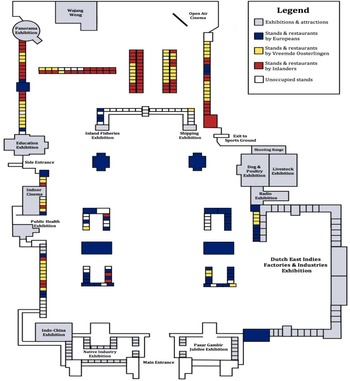
Honouring Queen Wilhelmina's birthday was not the only notable feature of every Pasar Gambir. Displays by colonial government departments also typified the annual spectacle. These included exhibits by the Afdeeling Inheemsche Nijverheid (Division of Native Industry), Hygiënische Commissie (Hygiene Committee), Departement van Onderwijs (Department of Education), and Commissie tot Ontwikkeling van de Fabrieksnijverheid in Nederlands-Indië (Commission for the Development of Manufacturing Industries in the Dutch East Indies). These displays were in prime spaces at Pasar Gambir's entrances, signalling their strategic importance to the Comité. Their descriptions in the programme booklets imply that participating departments used these exhibitions to create within the Koningsplein a blueprint for a better colony in accordance to the vision of the Dutch government outlined in the aforementioned Ethical Policy (see fig. 1).Footnote 24
Floor plan of Pasar Gambir in 1930 with stands and restaurants colour-coded according to the racial category of the business owners (adapted from Programma van den Pasar Gambir Jubileum 1921–1930).

As a response to the general public sentiment in the metropole ‘saturated with a sense of moral duty and a focus on individual development’ in the fin de siècle period, the Ethical Policy was not without its idiosyncrasies.Footnote 25 Scholars such as Bloembergen have argued that this moral mission possessed an internal contradiction since attempts to change the world of the colonised for the better were accompanied by calls to conserve their traditional way of life.Footnote 26 The ambitious colonial vision that emerged following post-First World War criticisms from Dutch politicians that the Ethical Policy had thus far failed to raise indigenous standards of living embodied this very contradiction.Footnote 27 In the 1920s, this vision culminated in the desire for a vibrant, plural, and modern colonial society and economy particularly in cosmopolitan urban centres. Indeed, scenes depicting traditional festivals and customs alongside those of development and progress, represented by tramways, steamships, and modern industry, became synonymous with colonial cities such as Batavia in the interwar period.Footnote 28 The ability of these seemingly incompatible ways of life to coexist therefore ran antithetical to J.H. Boeke's claims that the Dutch East Indies epitomised a dual society with two distinct systems—an established, imported and more advanced one alongside a divergent traditional one—neither of which successfully established itself as the colony's governing societal and economic system.Footnote 29
In many ways, the production and consumption of Pasar Gambir was a microcosm of 1920s colonial Dutch East Indies, by challenging Boeke's hypothesis while embodying the new colonial vision. As a colonial spectacle with unmistakably hybrid characteristics, Pasar Gambir exhibited both Western and local societal and economic elements, symbolically demonstrating that the two social systems were not as incompatible as Boeke claims them to be. Similarly, exhibition write-ups in the Pasar Gambir programme booklets intimate that the way colonial departments constructed and presented their spaces mirrored the rhetoric of the Ethical Policy, complete with its contradictory impulses. Exhibitions focused on introducing modern production techniques to the colonised existed alongside those that celebrated traditional indigenous arts and crafts. Nonetheless, at its core, the annual spectacle epitomises Dutch efforts to show they had accepted their moral obligation to look after the welfare of their subjects and were actively seeking ways to improve living conditions in the colony. In doing so, Pasar Gambir could be seen as a medium upon which the Dutch colonisers strove to project and fix their identity as a benevolent colonising power.
One way the Comité tried to fulfil this aim was by displaying indigenous arts and crafts as part of the ‘Tentoonstelling van Inheemsche Nijverheid’ (Native Industry Exhibit) in every Pasar Gambir. This exhibition aimed to showcase and promote the ability of indigenous craftsmen to make products admired by Europeans using only basic traditional tools. It presented a wide range of indigenous arts and crafts industries such as batik, wickerwork, and ivory hailing from all corners of the archipelago. In doing so, the Division of Native Industry responsible for this exhibition exploited Pasar Gambir as a marketing platform to boost demand for native arts and crafts in the long run.Footnote 30
Dutch efforts to help indigenous businesses did not just apply to the arts and crafts industries. The Department of Agriculture and Industry, for example, exhibited traditional tools used to harvest rice and contrasted them with modern machinery that accomplished the same job. The display sought to raise awareness amongst local farmers of new harvesting methods that were more efficient than the ones they inherited from past generations.Footnote 31 To encourage efficiency in rice production in the colony and stimulate demand for domestically grown crops, the Comité held competitions where local firms participated for a chance to have the rice they produced exported to overseas markets. Simultaneously, the Ambachtschool voor Inlanders (Technical School for Natives) held live demonstrations of their students at work to show off the quality of products natives could achieve should they choose to enrol in the school.Footnote 32 Such exhibitions and competitions were consistent with Dutch belief in their ethical duty to better the lives of the colonised. In this specific instance, they endeavoured to do so by empowering natives with opportunities and tools to improve long-term economic conditions in the colony with the overarching aim of embedding them more extensively within the modern international economy.
Not neglecting other aspects of native welfare, exhibits by the Hygiene Committee and Department of Education also featured regularly in Pasar Gambir. In the case of the Hygiene Committee, exhibitions were concerned with immediately addressing prevailing health concerns in the colony such as a high infant mortality rate in 1925 and rampant malaria in 1928. These exhibitions served a clear didactic purpose by providing pragmatic advice and feasible steps to reduce the likelihood of infant death or minimise the spread of malaria. As for the Department of Education, one of its most significant entries came in the form of a model classroom presented in 1930, complete with state-of-the-art paraphernalia needed to conduct effective lessons. These included an epidiascope and a gramophone to assist students’ learning.Footnote 33 These exhibitions captured the overriding intent of the Ethical Policy, which was to impress upon the colonised that the Dutch government genuinely cared about their well-being.
While all the aforementioned exhibitions in Pasar Gambir aimed to improve living conditions in the archipelago, they did so in varying ways. Through their expositions, the Department of Agriculture and Industry and Department of Education urged the colonised to abandon their old-fashioned practices and embrace modern knowledge and more efficient production methods. On the other hand, the Native Industry Exhibit promoted and emphasised the economic value of traditional methods of making indigenous arts and crafts. These two conflicting positions on customary modes of production reflected what Bloembergen identified as the internal contradiction of the Ethical Policy.Footnote 34 However, I contend that this observation revealed another crucial aspect of Dutch rule in the colony: it underlines the power of the colonisers to determine and categorise which traditional practices in the Dutch East Indies were of value and which were replaceable by the more efficient modern European techniques.
Dutch rulers, nonetheless, did not just categorise businesses and products according to an implicit set of criteria, which in this case were based on perceived economic value. Pasar Gambir illustrates that the colonisers, as represented by the Comité, also organised space and people in the Dutch East Indies. This time, Western beliefs in inherent racial differences dictated how the Comité delineated space and participation within the annual spectacle. A closer examination of Pasar Gambir suggests that prevailing colonial racism obsessed with fixing and naturalising differences between the coloniser and the colonised underpinned the production of the jaarmarkt-tentoonstelling.Footnote 35
The colonial government categorised those who lived in the Dutch East Indies into three bevolkingsgroepen (population groups), namely Europeanen (Europeans), Inlanders or Boemipoetera (Natives), and Vreemde Oosterlingen (Foreign Orientals).Footnote 36 From the moment visitors set foot in the Koningsplein, they were identified as belonging to one of these mutually exclusive racial categories, since the cost of entering Pasar Gambir depended on one's ethnicity. On most days, Europeans paid ƒ0.50 to enter while Vreemde Oosterlingen (the official Dutch term used to refer mainly to Indies Chinese) and Inlanders paid ƒ0.25 and ƒ0.15 respectively. This race-based price discrimination corresponded with the prevailing Dutch perception that Europeans could afford to pay more because they had a higher societal standing than the Vreemde Oosterlingen, who in turn were of a superior status to the Inlanders.Footnote 37
As a racialised space, Pasar Gambir was not very different from various world's fairs held in the West. In her analysis of the 1931 Paris Colonial Exhibition, Patricia Morton describes these exhibitions as tangible manifestations of the imperialist belief in innate white superiority over their colonised, non-Western counterparts. Within the walls of those exposition buildings, exhibition organisers objectified and presented elements of the ‘Other’ as colonial commodities for the consumption of Western visitors. Just as in Pasar Gambir, the colonising power employed space in these exhibitions to map the political hierarchies within the empire. ‘Modern’ sections highlighting European achievements were separated from and juxtaposed with ‘primitive’ colonial sections displaying native cultures and peoples to validate the premodernity of the colonies and their consequent inferior status within the empire. ‘Primitive’ peoples and cultures on display supported theories of Western advancement as they epitomised the point at which human history emerged from nature but had not properly begun its course towards modernity.Footnote 38 Such ‘primitive’ elements in the world's fairs reaffirmed imperialist belief in the progress of Western civilisation by serving as its premodern counterpoint.
Pasar Gambir also utilised spatial configuration to convey Dutch supremacy over local communities. Organisers divided the spectator area at the sportterrein (sports ground) in Pasar Gambir according to race. Only Europeans and Vreemde Oosterlingen could buy the ƒ0.25 tickets to stand and watch from a special demarcated zone, which presumably offered a better view of the games. Indigenous spectators paid ƒ0.05 to watch from the remaining parts of the grounds.Footnote 39 While Europeans and non-Europeans alike could hire stands from the Comité to sell and promote their products in Pasar Gambir, their race restricted the location of the stands they could hire. The more expensive stands available to Europeans for hire were located at prime positions near the entrance, followed by stands for non-Europeans selling all kinds of goods occupying the rest of the space.Footnote 40
Beneath the rhetoric of establishing a progressive colonial society which embraced both Western modernity and local traditions, therefore, the Comité continued to subscribe to and reinforce existing racial classification and hierarchy in the colony in its organisation of Pasar Gambir. While such an absolute demarcation of space no longer applied by 1930, the same general race-based arrangement persisted. Figure 1 provides a visual illustration of how the Comité organised space based on race. Restaurants and stands run by the colonised, particularly the Inlanders, were mostly relegated to the back of the Koningsplein while European businesses were placed near the entrances where there was more human traffic. The floor plan also shows that entertainment sites catering mainly to the colonised such as Wajang Wong, a classical Javanese dance theatrical performance, and the open air cinema, were located behind others like the indoor cinema and exhibitions by government departments, which included Europeans as their target audience. This observation is precisely why I find the words of prominent Indo-European writer and journalist, Tjalie Robinson, which romanticises Pasar Gambir ‘[o]mdat zij op zo schilderachtige en zo ondernemende wijze de ‘Euro-tropische’ gedachte gestalte gaf’ (because she gave shape to the ‘Euro-tropic’ idea in such a picturesque and enterprising way) unsatisfactory and problematic.Footnote 41 Far from Robinson's description of it being a progressive ‘meeting of East and West in one big “selamatan” [celebration]’, Pasar Gambir merely continued to reify the imposed racial hierarchy that had long governed the Dutch colony.
Nonetheless, although both Pasar Gambir and metropolitan colonial exhibitions underscored Western supremacy by essentialising the colonised and spatially separating them from the colonisers, there is a fundamental difference that distinguishes the two forms of exposition. Unlike the world's fairs, in Pasar Gambir, the colonised were not just the objects of consumption. They were also the targeted consumers of the spectacle. The Comité fashioned the jaarmarkt-tentoonstelling such that colonised communities could actively participate as stand holders and visitors. Native games like ‘adoe lari pakai karoeng’ (sack race), which regularly featured in Pasar Gambir, further underlined the intention of the Comité to ensure this yearly festival appealed to the natives.Footnote 42
The same cannot be said of international expositions in the West. At such spectacles, the main involvement of the colonised was to passively serve as living ethnographic displays for Western public consumption. During the 1883 International Colonial and Export Exhibition in Amsterdam, Dutch exhibition planners transported Javanese, Sundanese, and Sumatran peoples to the metropole.Footnote 43 They were to serve as ‘authentieke inwoners’ (authentic inhabitants) of the Dutch East Indies village that had been reconstructed as part of the Dutch colonial section.Footnote 44 The living village of 1883 set the precedent for Dutch colonial entries at subsequent world exhibitions where the colonisers regularly employed ‘mensvertoningen’ (human displays).Footnote 45 These natives were akin to inanimate anthropological artefacts showcased behind glass panels in that they had little to no agency over their participation in the spectacle. There was no room for the colonised to negotiate their involvement in these spectacles beyond fulfilling their intended purpose of becoming ‘living signs of themselves’.Footnote 46
Participation in Pasar Gambir was also racialised. The Comité held major competitions during Pasar Gambir twice: once for European participants and another time for the Inlanders. In football competitions, Bumiputera and Chinese teams competed in a category separate from their European counterparts.Footnote 47 This was consistent with how imperialists understood the colonisers and the colonised as inherently distinct and hierarchical sets of individuals. Combining them into one sporting category would result in an uneven playing field disadvantaging the colonised. From the standpoint of the colonisers, racialised participation in Pasar Gambir reified the unequal power relations of imperialism. It clarified in no uncertain terms that in the eyes of the colonial government, Europeans sat at the peak of the racial hierarchy in the colonial state, followed by the Vreemde Oosterlingen, and finally the Inlanders at the bottom rung of the Dutch East Indies’ race ladder.
Consuming Pasar Gambir
Despite being informed by the same racial ideology as colonial exhibitions in the West, Pasar Gambir was distinct in that the colonised were both the objects of consumption and the targeted consumers of the spectacle. As Coté observes in his study of the 1914 Semarang International Colonial Exhibition, the freedom to subjectively experience such expositions meant that the colonised could receive the intended messages of the organisers without necessarily submitting to the rhetoric of native subordination being propagated.Footnote 48 As Lukito notes, in their visits to Pasar Gambir the local middle class sought to assert their modernity by speaking Dutch and mimicking the behaviour of the Dutch in order to seemingly appear equal to the colonisers.Footnote 49 Indeed, in consuming Pasar Gambir, the colonised selectively imbibed or even subverted the empire-building messages the Comité intended to convey through the yearly fair-cum-exhibition. Beyond just emulating the culture and actions of the Dutch to appear as their equals, the Malay language press often went a step further by appropriating the yearly event to bolster claims of Dutch failings, asserting the moral superiority of the colonised over their colonisers.
Nevertheless, there were those among the colonised who still valued Pasar Gambir for its entertainment and economic and educational benefits. Every year, Batavian residents anxiously awaited the official opening of Pasar Gambir. Kaoem Moeda wrote that roads leading to the Koningsplein became congested hours before the jaarmarkt-tentoonstelling even opened its gates to the public as thousands made their way there to welcome the annual celebration. Such overwhelming enthusiasm for the arrival of Pasar Gambir indicates that the colonised truly embraced the week-long festival. To them, it offered real entertainment and held great economic potential for those wishing to improve their businesses in the long run. In this regard, Pasar Gambir conformed to the mould of metropolitan colonial exhibitions as a key social institution promoting ‘new principles of abundance, self-fulfilment, and unlimited possibilities’.Footnote 50 As a place that genuinely offered happiness and hope for the colonised, the production of Pasar Gambir contributed towards promoting progress and prosperity in the Dutch East Indies as espoused by the Ethical Policy.
Since 1921, Chinese and indigenous businessmen had always valued Pasar Gambir's power as a marketing platform to promote their products and services to a wider audience. The demand for stands among non-Europeans that year far exceeded the number the Comité had set aside for local firms.Footnote 51 Over time, as Pasar Gambir grew in popularity, so did interest among Chinese and indigenous merchants to showcase their businesses during the week-long festival. The reclametentoonstelling (advertising exhibition), introduced to Pasar Gambir in 1925, debunked any lingering perception that the spectacle was merely a site of entertainment. As a special segment that existed to allow companies to market their goods to visitors, the reclametentoonstelling underlined the emphasis the Comité placed on catering to the financial interests of those residing in the colony through Pasar Gambir.Footnote 52
Both the Chinese and indigenous communities perceived the exhibitions in Pasar Gambir as opportunities where they could access new knowledge to enhance their economic prospects. In 1930, Sin Po, a prominent publication catering to the interests of Indies Chinese, encouraged its peranakan Chinese readers to treat Pasar Gambir as ‘sematjem sekola’ (a kind of school). The article believed that if readers kept an open mind during their visits, they would encounter new opportunities for expanding their businesses. Likewise, Bintang Hindia wrote that through the Department of Agriculture and Industry's displays of modern agricultural technologies, indigenous farmers learnt how to improve their efficiency.
By endorsing Pasar Gambir as a didactic space full of economic potential, Batavian newspapers highlighted the convergence between how the colonised interpreted the jaarmarkt-tentoonstelling and the way the Comité had designed the spectacle. Participating colonial departments organised various exhibitions either to educate local communities or to aid their businesses. As such, Pasar Gambir was akin to its metropolitan equivalents in that they were all meant to ‘function as an instrument of popular education’ propagating Western notions of modernity and progress.Footnote 53 The above-mentioned articles in the Malay language press illustrated that many colonised individuals acknowledged and approved the colonial logic of progress and modernity that motivated the staging of Pasar Gambir for public consumption. In this sense, Pasar Gambir successfully communicated to visitors the dedication of the colonisers towards improving the lives of their subjects as outlined in the Ethical Policy.
Apart from serving a didactic function, Pasar Gambir had the capacity to generate profound personal meaning for individuals. For those who frequented Pasar Gambir with family and friends, the space became a powerful repository of shared fond memories. An article describing the scenes unfolding in the 1928 staging included a personal anecdote of a mother who wept at the sight of the spectacle as it caused her to reminisce about her late daughter. The fair, which brought so much joy for the mother who used to take her only child to the Koningsplein every year to ride the carousel and bask in the festivities, now represented nothing more than a reminder of what she had lost. For others, Pasar Gambir brimmed with optimism as best friends, lovers, children, parents, and grandparents continued to visit and make new, amazing memories with loved ones.Footnote 54 Regardless of the nature of the emotions it evoked, the journalist claims that Pasar Gambir permeated everyday life and left an indelible mark on anyone who lived in Batavia during this period.
A short story (cerpen, or cerita pendek) published over three issues of Bintang Hindia further encapsulated the sentiment that Pasar Gambir was more than just a celebration to mark Queen Wilhelmina's birthday. As a tale of romance and hope that utilised the jaarmarkt-tentoonstelling as its setting, ‘Tjinta di Pasar Gambir’ (Love in Pasar Gambir) demonstrated that the spectacle also captured the imagination of the colonised public. The cerpen followed the lives of Amat and Djajoes, two ordinary brothers from Weltevreden. On their way to the opening of Pasar Gambir, they became acquainted with a couple of beautiful, educated divorcées from a village in Buitenzorg (Bogor), who were in town to visit the annual spectacle.Footnote 55 As they toured the exhibition grounds together, Djajoes fell increasingly in love with one of the women and the two overcame many hurdles to begin a relationship that lasted beyond the conclusion of Pasar Gambir that year.Footnote 56
Taken at face value, this cerpen appears to tell a mundane love story. Its details, however, reveal a narrative that challenged societal expectations and norms. Djajoes and his lover hailed from very different backgrounds. The latter had been previously married, attended a Dutch-medium school, and lived away from Batavia. Djajoes was a regular, uneducated, single young man residing in the colonial capital.Footnote 57 By putting these outwardly incompatible characters together, the writer impresses upon readers that for the one week Pasar Gambir was held, anything was possible. As the setting of the story, the jaarmarkt-tentoonstelling proved pivotal in granting the couple their happy ending. It served as a shared space where individuals, who otherwise had little in common with one another, could meet and forge a meaningful connection that would possibly contest entrenched social practices and beliefs.
The cerpen genre featured prominently in the Indies newspapers and periodicals. The significance of cerpen as a form of veiled social commentary was not a foreign concept. Unlike Malay language novels published by the state-run Balai Pustaka (Bureau of Literature), the cerpen in newspapers existed outside the control of the colonial government. Maman Mahayana argues that ‘it was precisely the works of the writers who functioned outside Balai Pustaka that articulated existing social concerns as well as revealed the spirit of the time’. As a popular literary medium, cerpen played an important role at the beginning of the twentieth century insofar as it ‘brought out the issues of emancipation and education of indigenous peoples, and demonstrated the nationalist élan’.Footnote 58
‘Tjinta di Pasar Gambir’ may not have directly commented on native emancipation or indigenous nationalism, however, like other cerpen, it reflected prevailing public opinion and aspirations. It captured the general view that Pasar Gambir overflowed with hope, promise, and the potential for progress.Footnote 59 The narrative of social progress and modernity was embedded within Djajoes’ love story, which hinted at the erosion of cultural taboos that defined the boundaries of what was customarily regarded as an acceptable romantic relationship. In transcending the restrictions of tradition, the tale of Djajoes and his lover symbolised what had become possible and achievable within the modernising landscape of colonial Indies society.
Nevertheless, not every aspect of the consumption of Pasar Gambir by the local population adhered to how the Comité intended the jaarmarkt-tentoonstelling to be experienced. Numerous articles in the Malay language newspapers exposed the underbelly of colonial Indies society visibly displayed during Pasar Gambir. Such observations were ironic since the Dutch took pride in their ability to maintain ‘rust en orde’ (tranquillity and order) within the colony. Indeed, Benedict Anderson asserted that between 1910 and the Japanese invasion in 1942, the colonial government successfully imposed ‘rust en orde’ throughout the archipelago with the help of the Royal Netherlands Indies Army.Footnote 60 However, according to the vernacular press, the Comité struggled to keep petty crime, ranging from snatch thefts to counterfeit tickets, under control. There were even cases of break-ins targeting valuable products and cash kept overnight in the stands. While in some cases police officers on duty successfully arrested the culprits, many more were never punished or even caught.Footnote 61
A major brawl erupted between two colonial security forces during the 1925 staging of Pasar Gambir. An indigenous military officer for unknown reasons began to verbally provoke a policeman by claiming that his police force was useless and could only ‘menangkap njamoek’ (catch a mosquito). The policeman reacted to the military officer's insult by challenging him to a fight. While the confrontation initially only involved the two men, it escalated into a larger brawl as other members of the military and the police forces joined the fight to defend their own. In its immediate aftermath, the Comité doubled police surveillance on the exhibition grounds, thinking that the communists were responsible for the commotion. Although the clash technically occurred within the indigenous community, it did not stop Sin Po from writing a scathing piece mocking the incompetence of the colonial government since the security breach in Pasar Gambir resulted from ‘anak-anak gouvernemant sendiri’ (the government's own people).Footnote 62
The actions of some of the colonised were not the only reason Pasar Gambir attracted its share of negative publicity. Despite their air of moral superiority, the Dutch too could sometimes become a public nuisance in Pasar Gambir. It was common to read reports of fights breaking out between Dutch civilians and police officers in the Koningsplein for reasons as trivial as disagreeing over where the appropriate taxi pick-up zone was.Footnote 63 Curiously, accounts of disturbances caused by Dutch individuals could only be found in the vernacular press and not in the Dutch language press.
The difference in the contents of news on Pasar Gambir in the Malay language press compared to those in the local Dutch press highlighted the tension between the way the colonised internalised the jaarmarkt-tentoonstelling in actuality, and how the colonisers wished it to be consumed. Pasar Gambir was meant to reaffirm the subordinate position of the colonised through racialised participation and spatial configuration. Yet, as Coté notes, colonial spectacles held outside the metropoles were inclined to generate, unintentionally, a greater degree of ambiguity than those held in the West. Unlike the originals, these localised versions of the European exhibitionary complex involved the colonised not merely as objects of the spectacle but also as its active participants.Footnote 64 While the Comité could shape and direct the overarching rhetoric of Dutch superiority Pasar Gambir was meant to convey, it could not guarantee native visitors would recognise and imbibe this message. The Malay language newspapers critical of Dutch behaviour and failings in maintaining the security of Pasar Gambir demonstrate that colonised participants had not accepted Dutch assertions of supremacy and absolute authority in the colony.
Moreover, reports of inappropriate and scandalous conduct of the Dutch in Pasar Gambir suggest that the colonised did not just ignore Western visions of racial hierarchy. Some even went further by rejecting and subverting this social configuration to assert their own moral superiority over the colonisers. In 1925, Sin Po condemned ‘half-naked white female dancers’ in Pasar Gambir whose lack of modesty ‘terbitken perasahan djemoe pada bangsa Timoer’ (created a feeling of disgust among Easterners). The article concluded by adding that the locals were baffled by ‘itoe prampoean koelit poeti begitoe poenja tida taoe maloe sebagi itoe “toekang dansa” terseboet’ (those white women who were shamelessly working as such ‘dancers’).Footnote 65 To further underscore Dutch impropriety in Pasar Gambir, Sin Po recounted cases where Chinese patrons of the Groote Restaurant, a prominent Dutch-operated restaurant in Pasar Gambir, had been disrespectfully treated by Dutch waiters who rudely chased them out of the eatery with ‘perkatahan jang tida sedep didengernja’ (words that were unpleasant to hear).Footnote 66 During another staging of Pasar Gambir, Kaoem Moeda reported on a ‘scandal’ where an indigenous woman tried to emulate the Dutch by joining in their European dance routines. In the process, she violated ‘adat ke Timoeran’ (Eastern customs) that governed what was deemed to be socially appropriate public behaviour among men and women. The journalist ended his analysis of the incident by reminding indigenous people to preserve and take pride in their customs and to avoid being lured into the ‘keboesoekan’ (rottenness) of Western lifestyles.Footnote 67 In adopting an overtly judgemental tone towards indecorous Dutch actions or customs, such articles attempted to convince their readers that in reality ‘Easterners’ were morally superior to their European counterparts.
However, not all locals who participated in Pasar Gambir shared such highly critical views of the West. As a ‘celebration of crowd and modernity’, Lukito notably argues that Pasar Gambir was a space where the deeply entrenched gulf between the coloniser and the colonised was temporarily suspended and rendered vague.Footnote 68 Lukito observes that the local urban middle class in particular exploited the unique ‘space of encounter’ that Pasar Gambir afforded them to communicate their modern self-image within the increasingly advanced colonial society. These middle-class natives asserted their modernity by successfully emulating Dutch behaviour and customs—from dressing up as the Dutch would to speaking the language of the colonisers.Footnote 69 Hence, if the aforementioned coverage of Pasar Gambir in the vernacular press challenged Dutch claims of superiority by highlighting their incompetence, as well as their petty squabbles and ‘immoral’ behaviour, the local urban middle-class fairgoers did so by narrowing the cleavage between colonisers and colonised through their deliberate performance and embodiment of Dutch modernity within the confines of the annual fair.
In theory, the production of Pasar Gambir underscored, or was at least designed to reaffirm, native subordination to the benevolent Dutch Empire. In practice, this localised version of the colonial exhibition introduced uncertainties not found in its metropolitan equivalent. Unlike the world's fairs in the West, Pasar Gambir was deliberately designed to allow the colonised to subjectively experience the spectacle as active participants. Consequently, once the Comité granted the natives the agency to consume these exhibitions for themselves, it was not guaranteed that they could read or be trusted to read correctly imperialistic messages of white supremacy.Footnote 70 The Chinese ‘half boycott’ in 1925 epitomised this very problem.Footnote 71
Contesting Pasar Gambir
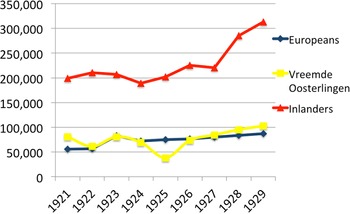
Five days after Pasar Gambir began in 1925, Sin Po speculated the annual festival had been ‘saparo diboycot’ (half boycotted) by the local Chinese. In an earlier report, the newspaper had stated that the Koningsplein was unusually ‘sepi’ (empty and quiet) for an opening day. Given that Pasar Gambir made a loss in 1925 and the number of Vreemde Oosterlingen who visited fell to 38,221 from 69,227 in 1924, Sin Po's early observations were not unfounded.Footnote 72 By analysing Sin Po's discourse on the boycott and the events leading up to it, this article contends that local Chinese used the boycott as an economic instrument to undercut the authority of the Dutch colonisers while amplifying the potency of pan-Chinese nationalism. As a marketplace rather than an exact replica of a world's fair, Pasar Gambir inherited qualities of the market as an institution where power devolved from the organisers to the buyers and sellers. The hybridity of Pasar Gambir as a part-market-part-exhibition enabled Indies Chinese to exploit their economic power and convey a nationalist agenda that contested its original purpose as an empire-building apparatus for the Dutch.
Established in 1910, Sin Po advocated a specific political inclination that was not necessarily shared by all Indies Chinese. Sin Po did not see Chinese and Indonesian nationalisms as mutually exclusive, conflicting ideas. By the 1920s, the publication demonstrated its sympathy towards the plight of the natives. In his memoir, Ang Yan Goan, the director of Sin Po from 1925 until its closure in 1959, lamented that much like the Chinese, the indigenous community experienced discrimination and unfair treatment under Dutch rule.Footnote 73 In an article entitled ‘Boemipoetera dan Tionghoa’ (Bumiputera and Chinese), the newspaper claimed that ‘Dalem banjak hal bangsa, Boemipoetera dan golongan Tionghoa boekan sadja bisa, tapi poen moesti bekerdja sama-sama’ (on many issues pertaining to the nation, Bumiputera and Chinese not only can, but must indeed work together). The article further articulated Sin Po's approval of ‘gerakan dari fihak Boemiputera boeat berkoeasa dalem negeri sendiri’ (the move on the part of Bumiputeras to gain control over their own country) and belief that it was the responsibility of local Chinese to stand alongside their indigenous counterparts in this endeavour.Footnote 74
As a publication that championed an anti-imperialist agenda, Sin Po was not a Dutch-friendly newspaper. From the beginning, Sin Po clarified that rumours of Chinese intention to boycott Pasar Gambir in 1925 had nationalistic underpinnings. Plans to boycott the jaarmarkt-tentoonstelling, however, cannot be analysed without considering what happened in Shanghai on 30 May that year. Although the incident took place in China, reports in Sin Po suggest that it strengthened support for pan-Chinese nationalism among diasporic Chinese communities in the Dutch East Indies.Footnote 75
In the afternoon on 30 May 1925, Shanghainese workers began to gather in Nanking Road with slogans of ‘Shanghai for the Shanghainese’. Their protest was a culmination of the rising costs of living and increasing tensions between workers and Japanese employers in Shanghai. Even though these workers indirectly attacked the administration of the International Settlement, it was the Japanese and not the British who bore the brunt of their anti-imperialist speeches and pamphlets. This reality changed when police officers under British Inspector Everson's command opened fire on the demonstrators, killing four outright and wounding others, five of whom later died. In return, the protestors reacted by urging all shops and businesses to close down immediately. This marked the start of the Shanghainese workers’ strikes that only began petering out in November 1925.Footnote 76
Chinese in the Indies generally responded to the events in Shanghai in two ways, none of which immediately entailed boycotting the impending Pasar Gambir. The first type of response took its cue from what Shanghainese students did when these students demanded that shops stop selling British and Japanese goods and urged the public to boycott these foreign firms. By mid-July, an unidentified source distributed circulars in Medan advising Indies Chinese to ‘kerdja sama-sama dengan kita poenja soedara di Tiongkok aken adaken gerakan boycott national … sama itoe doea negri’ (work together with our brothers in China and organise a national boycott movement against those two countries). A month later, a similar incident occurred in Yogyakarta where ‘tersiar soerat antjeman, dalam mana ada diminta, soepaja orang Tionghoa boycot barang-barang dan firma-firma Inggris’ (a warning letter was disseminated requesting that Chinese people boycott British goods and firms). Another Sin Po article reported an alleged Chinese boycott of British firms in Surabaya.Footnote 77
The second type of response among local Chinese involved providing financial support for the victims of the strikes in Shanghai with the launch of the ‘Fonds Shanghai’ (Shanghai Fund) campaign on 19 June. Sin Po's office served as a collection centre for donations received from Chinese in Batavia, and the newspaper published regular updates on the total amount received. Sin Po advertised Fonds Shanghai as ‘Fonds boeat orang-orang jang telah korbanken djiwa membelahken kapentingan bangsa dan negri’ (Funds for those who have sacrificed their lives to fight for the interest of the nation and the country). The newspaper applauded Chinese firms in Surabaya that required employees to donate 5 per cent of their income to help the ‘korban-korban dari pergerakan di Shanghai’ (victims of the movement in Shanghai).Footnote 78 The Fonds Shanghai campaign reinforced the Indies Chinese’ loyalty to China and their support for pan-Chinese nationalism.
The earliest rumours of a potential Pasar Gambir boycott stemmed from news that the colonial government planned to ‘adaken rintangan’ (create obstacles) for the Fonds Shanghai. In mid-July, a police officer visited the home of the coordinator of Fonds Shanghai in Jatiwangi to enquire about the purpose of the funds and the total amount he had received. Hence, there was indeed evidence that the Dutch colonisers were wary of this donation drive. Sin Po also warned that local Chinese expected the Dutch to remain neutral on the Shanghainese incident. Thus, hearsay that the colonisers planned to stop Indies Chinese from collecting for Fonds Shanghai was sufficient to give rise to ‘niatan memboycot’ (the intention to boycott) Pasar Gambir among this community.Footnote 79 Many Chinese felt that any moves by the Dutch to disrupt the Fonds Shanghai project would show that the latter sided with the British. More importantly, it symbolised a hostile attempt to control and undermine pan-Chinese nationalism.
Although plans to boycott Pasar Gambir were still related to the May incident in Shanghai, it should be distinguished from the aforementioned anti-British boycotts in Medan, Yogyakarta, and Surabaya. Unlike the latter, any boycott of Pasar Gambir was specifically levelled at the Dutch colonisers rather than the British to express discontent over rumours on possible Dutch actions against the Fonds Shanghai campaign. According to Sin Po, the boycott served to express the unwillingness of the Chinese to enliven any Dutch festival (‘bantoe rame Blanda poenja segala pesta’) in light of the colonisers’ reluctance to let them support the striking Shanghainese workers financially. Nonetheless, in the weeks leading up to Pasar Gambir, news reports on an impending Chinese boycott remained nothing more than ‘kabar angin’ (rumours).Footnote 80
On 29 September 1925, the day after Pasar Gambir began, Sin Po noted that ‘kaloe dibandingken dengen taon-taon jang soeda betoel sadja Pasar Gambir ada djaoe lebih sepi’ (if compared to previous years, it is true this Pasar Gambir is a lot emptier and quieter). The article elaborated that ‘teroetama penonton bangsa Tionghoa ada sedikit sekali’ (there were very few Chinese visitors in particular). The newspaper also reported that Gambir Park was more crowded than Pasar Gambir on the evening of 28 August. To Sin Po, this proved Pasar Gambir was not empty ‘lantaran “tanggoeng boelan”’ (just because it was the end of the month and people were running out of disposable income), but because Batavians deliberately chose not to come to the opening of Pasar Gambir. Even on 31 August, traditionally its most crowded day, there were far fewer Chinese visitors compared to the previous four stagings. All these observations led Sin Po to conclude that the abrupt decline in Chinese participation in Pasar Gambir in 1925 ‘ada berhoeboeng dengen pemboycottan jang doeloe banjak diomongin’ (is related to talks of the much discussed boycott).Footnote 81
The statistics also supported Sin Po's initial speculations that local Chinese ‘half boycotted’ the 1925 Pasar Gambir. From 1924 to 1925, there was a 45 per cent fall in Chinese visitors while the numbers for their European and Inlander counterparts remained relatively constant. As fig. 2 illustrates,Footnote 82 the significant drop in Chinese or Vreemde Oosterlingen attendance in 1925 was an aberration in the overall trend of increasing visitor numbers between 1921 and 1929.Footnote 83
The number of European, Vreemde Oosterling, and Inlander visitors to Pasar Gambir between 1921 and 1929.

The poor Chinese participation in 1925 had financial consequences for Pasar Gambir, which experienced a loss of ƒ11,438.19. This was the first and only loss recorded between 1921 and 1930. Not only did fewer Chinese come to the spectacle, Chinese merchants also showed that they ‘tida begitoe banjak minat djoealan di Pasar Gambir’ (were not very keen on doing business in Pasar Gambir). Hence, of the money the Comité received that year, only a small percentage came from Chinese.Footnote 84
Non-Sino-centric newspapers took notice of the boycott following its role in causing a decline in Pasar Gambir's revenue that year. Bintang Hindia explained to its readers that the failure of Pasar Gambir to generate a profit in 1925 was because ‘orang T.H. mengorbankan gadjinja 2 boelan gadjih oentoek Sjanghaifonds’ (Chinese people sacrificed two months’ salary for the Shanghai Funds). This, according to the article, was ‘tanda jang menggembirakan orang T.H., karena dari sitoe ternjata lebih menghargai kebangsaan dari pada keriangan’ (a sign that should make the Chinese happy as it shows that they prioritised nationalism over amusement).Footnote 85 In 1927, Bataviaasch Nieuwsblad belatedly attributed Pasar Gambir's loss in 1925 to the decline in Chinese visitors. Curiously, though, the newspaper simply claimed that this was because they ‘herdachten te zelfder tijd het overlijden van Dr Sun Yat Sen’ (were simultaneously commemorating the death of Dr Sun Yat Sen) and gave no further elaboration.Footnote 86
The colonial government utilised Pasar Gambir to reaffirm the subordinate position of the colony to the Netherlands. Through their boycott, however, local Chinese contested the effectiveness of Pasar Gambir in serving this specific function. This community used the boycott as an economic instrument to reinforce their agency as active members of the pan-Chinese movement rather than subservient and passive colonial subjects. Those who boycotted demonstrated that loyalty towards their own race outweighed any allegiance they had to the Dutch Empire. The boycott's efficacy in communicating unhappiness with Dutch disapproval of Fonds Shanghai and the pan-Chinese agenda relied on two factors: Pasar Gambir's quasi marketplace structure and Chinese dominance in the Dutch East Indies economy.
The questionable efficiency of Pasar Gambir as an empire-building apparatus resulted from its hybridised jaarmarkt-tentoonstelling structure. As an indigenised version of the world's fairs that were in vogue in the West, like other colonial practices, Pasar Gambir displayed a unique cultural configuration in which the original European elements had been infused with existing local practices and given new meanings. When Dutch colonisers transferred the European exhibitionary complex to a non-European and colonised setting, this Western habit of showcasing colonised cultures and peoples became imbued with market-like characteristics.Footnote 87 As a part-market-part-exhibition, Pasar Gambir inevitably inherited qualities associated with the market as an entity. These features of a marketplace allowed Indies Chinese to undermine Dutch success in projecting their imperial prowess and supremacy through Pasar Gambir.
In this article, a marketplace refers to a social space where repeated transactions occur between buyers and sellers. Actors in the market are involved in day-to-day social relationships based on power and dependence on one another.Footnote 88 Within such a setting, power does not solely lie in the hands of a single group of individuals. The genesis of a specific market might have been contingent on the actions of the group who initially constructed and organised it. In its everyday operations, however, power devolves from organisers of the space to the buyers and sellers in that market. Since monetary exchange defines a market as an entity, the agency of individuals in this space rests on their ability to participate by buying and/or selling products and services.Footnote 89 In 1925, local Chinese arguably flaunted their agency in the marketplace by refusing to join in the monetary exchange that took place in Pasar Gambir. In doing so, they successfully underlined their collective power as actors in the market and the colony.
By 1925, the concept of the boycott as a collective movement motivated by social and/or political concerns was certainly familiar to those living in the Dutch East Indies. In 1912, Sarekat Islam (SI) organised its first boycott against a Chinese firm after it tried to increase profit margins by forcing indigenous batik suppliers to lower the selling price of their batik cloth. Subsequently, the central committee of SI received numerous requests to organise boycotts against other firms that appeared to have engaged in unfair commercial practices.Footnote 90
Likewise, boycotts were not alien to supporters of Chinese nationalism. During the early twentieth century, China often turned boycotts into economic weapons to defend its sovereignty or protect Chinese interests abroad. For China, the pressure of economic resistance proved to be more efficient than resorting to arms. In 1905, the nation initiated an anti-American boycott to protest against stringent immigration rulings that banned Chinese labourers from entering the United States. While it had no apparent influence upon US trade, the boycott visibly softened American enforcement of the Chinese Exclusion Act. Following this, China had repeatedly wielded her chosen economic weapon against foreign powers as witnessed in the anti-Japanese boycotts of 1908 and 1909, and the 1919 boycott that resulted in the return of Shantung from Japan. Finally, in an episode that was of immediate relevance to the boycott of Pasar Gambir, Shanghainese students formed a Boycott Committee to propagate and supervise Chinese boycotts of British and Japanese goods following the 30 May 1925 incident.Footnote 91
Nonetheless, the success of the Indies Chinese’ boycotts rested upon the colonial government's economic dependence on this community. The economic significance of the Chinese in the colony empowered them to communicate their allegiance to China. Their prominent economic position in the Dutch East Indies had been in the making for centuries. James Rush traced the pervasive Chinese economic presence, especially within Java, to Chinese-run revenue farms during the seventeenth to nineteenth centuries. In the most extreme cases, their monopolistic acquisitions of opium farms enabled Chinese elites to dominate virtually all non-European economic activity in Java. The wealth and power of the opium farmers were simply the tip of the comprehensive social and economic networks among Indies Chinese. Each opium farmer was entrenched in an extensive web of economic relationships where hundreds of other Chinese, even several links removed from the centre, enjoyed their patronage in the form of credit, employment, or influence. Hence, revenue farms became a pivotal source of wealth and power that consequently allowed Chinese merchants to further penetrate the markets of Java. While the end of opium farms during the Ethical Policy years proved catastrophic to the local Chinese economy and social order, Rush argues that the community continued to possess a strong foothold in the colony.Footnote 92 The events at Pasar Gambir in 1925 support Rush's conclusion. When Chinese merchants refused to fully participate in the 1925 Pasar Gambir, it resulted in a rare financial loss for the annual fair.
The use of the boycott by local Chinese paralleled the way China traditionally employed this technique. In the Pasar Gambir context, the boycott expressed the agency of local Chinese against Dutch threats to curb pan-Chinese nationalism in the colony. The fact that Bintang Hindia, a non-Chinese periodical identified as the ‘propagator of Indonesian nationalism’, recognised and applauded the strength of Chinese nationalism demonstrated the success of the boycott as a calculated move.Footnote 93 In boycotting Pasar Gambir, the Indies Chinese imposed a different interpretation of the jaarmarkt-tentoonstelling. Rather than confirming Dutch supremacy, the fallout of the ‘half boycott’ forced the colonisers to acknowledge their reliance on the economic power of local Chinese to make Pasar Gambir a financial success.
Conclusion
This article has shown that even though the staging of Pasar Gambir took its cue from the popular colonial exhibitions in the West, it was not an exact replica of its metropolitan equivalents. As the Comité appropriated the European exhibitionary complex and adapted it to suit the context of colonial Dutch East Indies, Pasar Gambir became imbued with carnivalesque and market-like features. Thus, this article has argued that the structure of Pasar Gambir as a part-exhibition-part-marketplace entity negated the efforts of the colonisers to utilise the festival in the same way they used colonial exhibitions in the metropole: to espouse the existing colonial order with Europeans at its apex and the colonised ‘other’ at the bottom of the established racial hierarchy.Footnote 94 By virtue of its location and hybridity, Pasar Gambir encouraged the colonised to actively consume and subjectively experience the spectacle. In doing so, the Dutch colonisers inadvertently presented an opening for the colonised to redefine what the spectacle symbolised and to disseminate their own nationalist interpretations of this annual tradition. The case of Pasar Gambir therefore highlights the agency the colonised potentially possessed within colonial exhibitions; this is a crucial fact that is often overlooked in other studies which portray colonial spectacles elsewhere strictly as zero–sum events where colonisers benefited at the expense of essentialised colonised subjects.Footnote 95