The world is currently facing a global health crisis caused by the spread of severe acute respiratory syndrome coronavirus 2 (SARS-CoV-2). This new virus has caused more than 600 million confirmed cases of coronavirus disease (COVID-19), leading to more than 6 million deaths worldwide. The main cause of these deaths is the development of severe acute respiratory syndrome. Reference Ha and Sn1
One of the most relevant findings regarding COVID-19 is that pulmonary damage and low blood oxygenation lead to acute respiratory distress syndrome during the course of the disease. Reference Alayash2 Previous reports have described the effect of the patient’s position on central apnea in case of airway disturbance. Reference Joho, Oda, Hirai and Inoue3 These studies reported an increase in oxygen saturation after changing from the supine to the lateral or prone position; these results suggest that respiratory control instability and decreased pulmonary oxygen storage are associated with the supine position. Reference Koulouras, Papathanakos, Papathanasiou and Nakos4 Furthermore, the myocardial damage described in COVID-19 patients could improve with the expansion of the left heart chambers’ capacity associated with the prone position. Reference Pump, Talleruphuus and Christensen5
To investigate COVID-19 physiopathology, we analyzed the respiratory patterns and the hemodynamic variations related to postural changes in inpatients with COVID-19.
Materials and Methods
We conducted a prospective study, performing cardiorespiratory polygraphy and hemodynamic evaluations on inpatients with moderate-to-severe COVID-19 who showed improvement in oxygen saturation when switched from supine to prone position.
The inclusion criteria were:
-
Age > 18 years
-
COVID-19 disease confirmed by a positive polymerase chain reaction test from a nasopharyngeal swab
-
Any improvement in respiratory function according to oxygen saturation related to postural changes
-
Moderate-to-severe respiratory COVID-19 disease assessed by oxygen saturation values: severe disease ≤ 94% and moderate disease > 94% 6
-
Patients’ (or their legal guardians’) consent and signatures on the informed consent document to accept participation in this study
The exclusion criteria were:
-
History of chronic lung disease and/or heart disease before diagnosis with COVID-19
-
Current tobacco abuse or previous tobacco abuse within the past 10 years
Study Protocol
Respiratory parameters were evaluated by cardiorespiratory polygraphy, with oronasal flow and airflow limitation recorded through an infranasal thermistor, surface electrodes to assess heart rate, and thoracic-abdominal respiratory bands to determine the ventilatory effort. This setup allowed the acquisition of oxygen saturation readings by pulse oximeter simultaneously with the other respiratory variables. The recording was performed using the Nox T3 respiratory polygraph (Nox Medical®). The filter setting was low-pass and high-pass filters of 70 Hz and 0.3 Hz, respectively, in the electrocardiograph recordings and 15 Hz and 0.1 Hz, respectively, to assess oronasal flow and ventilatory efforts. We used a “notch” filter at 50 Hz.
Hemodynamic parameters were determined using the HOTMAN® system (HOTMAN® System, Hemo Sapiens Medical Inc., San Ramón, CA, USA), a thoracic electrical bioimpedance measuring set that collects data on blood volume, inotropic and chronotropic states, and vascular resistance. Measurement of these hemodynamic parameters was performed through the generation of a very low current circulating between 2 pairs of solid gel electrodes. We placed 8 surface electrodes, with 4 located in the supraclavicular region, and recorded blood volume and vascular resistance as the alveoli were filled with air (non-conducting medium), and the electrical current was conducted mainly through the thoracic aorta and the venae cavae. The other 4 electrodes were placed in the costal area bilaterally, which recorded the electrocardiogram and the voltage of the electrical current that crossed the thorax. Reference Faini, Omboni and Tifrea7
The examination lasted a total of 60 minutes. We recorded changes in variables for a minimum of 30 minutes in the supine position and 30 minutes in the prone position.
Variables
The main respiratory variables were oronasal flow, oxygen saturation, and airflow limitation. Regarding the hemodynamic variables, we analyzed heart rate (beats per minute), cardiac index (L/min/m2), stroke index (ml/beat/m2), stroke systemic resistance index (dyn·sec·cm−5·m2 = FΩ), left stroke work index (g·m/m2), inotropic state index (sec−2), ejection phase contractility index (s−2), and thoracic fluid content (KΩ−1). The device also allowed analysis of blood volume, inotropism, chronotropism, vasoactivity, hemodynamic state, and blood pressure as a percentage based on normal values, classified into 3 groups: hypo, normo, and hyper. Reference Fadl Elmula, Rebora and Talvik8
Statistical Analysis
Qualitative variables were expressed as a frequency distribution, and quantitative variables were expressed as a median and interquartile range (IQR). Student’s t-test was used for parametric samples and the Mann–Whitney test was used for non-parametric samples. The threshold of statistical significance was set at 2-sided P ≤ 0.05. Statistical analysis was performed using Stata16 software (StataCorp LLC, College Station, TX, USA).
Ethics
The research ethics committee of La Princesa University Hospital (local reference number 4096) approved this study, and it was conducted following the legislation regarding confidentiality.
Results
In total, 10 patients were recruited. They had a median age of 55.0 years (IQR: 15.0); 6 of them were women and 4 were men. All patients required supplemental oxygen as part of their treatment, with a wide variety of modalities; some patients required oxygen administered through a nasal cannula and others through an oxygen mask or high-flow oxygen device. More details can be found in Supplementary Table 1.
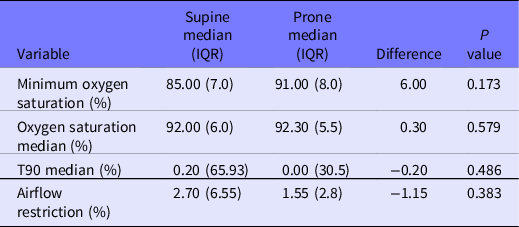
Regarding respiratory variables, no statistically significant differences between supine and prone positioning were found. As for oxygen saturation, we observed a trend toward a higher median minimum oxygen saturation (minSatO2) in the prone position (91.00% [IQR: 8.00]) compared with the supine position (85.00% [IQR: 7.00]) (P = 0.173) and a higher median of median oxygen saturation (SatO2m) in the prone position (92.30% [IQR: 6.00]) than in the supine position (92.00% [IQR: 5.50]) (P = 0.579) (Supplementary Figure 1). Furthermore, the median T90 (time with oxygen saturation below 90%) was higher in the supine position (10% [IQR: 58.70]) than in the prone position (0.00% [IQR: 19.50]) (P = 0.486), although this was statistically insignificant. A trend toward a reduction in airflow restriction in the prone position (1.55% [IQR: 2.80]) compared with the supine position (2.70% [IQR: 6.55]) (P = 0.383) was evident (Table 1; Supplementary Figure 2).
Respiratory parameters in the prone and supine postural positions

IQR, interquartile range.
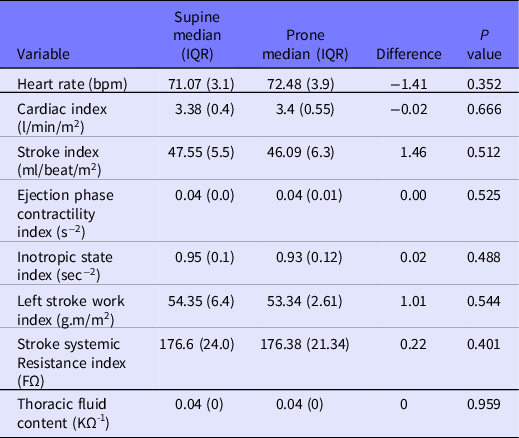
Regarding the hemodynamic variables, we observed slight decreases in all parameters in the prone position; however, the differences were not statistically significant (Table 2). The hemodynamic state and its modulators were expressed as a percentage compared to normal values. The distribution of these parameters among the different groups is shown in Supplementary Figure 3. Regarding the hemodynamic state, 36.4% of patients were in the normo-hemodynamic state group in the supine position and 54.5% were in the normo-hemodynamic state group in the prone position (P = 0.668). A decrease in vascular resistance was observed in the prone position (18.2% of vasoconstriction) compared with the supine position (36.4% of vasoconstriction); however, this difference was not statistically significant (P = 0.871).
Hemodynamic parameters in the prone and supine postural positions

IQR, interquartile range.
Discussion
Our report indicated a trend toward increased oxygen saturation and decreased airway resistance in patients with COVID-19 infection in the prone position. Moreover, our report revealed a trend between prone position and a normo-hemodynamic state with less vasoconstriction, which was observed using a non-invasive hemodynamic and oxygen transport management system. However, none of these findings were statistically significant.
COVID-19 patients often suffer from clinical symptoms compatible with central apneas/hypopneas due to the lack of thoracic-abdominal efforts and the deficit of respiratory changes in response to oxygen deficiency. Similarly, other data suggest the presence of obstructive apneas/hypopneas given the reported improvements related to positional changes, probably because of the decreased collapse of the upper respiratory tract. Reference Szollosi, BAppl, Thompson and Naughton9 Previous research described physiological changes in the prone position related to analytical respiratory variables, mainly PaO2 (partial pressure of oxygen), FiO2 (fraction of inspired oxygen), PaO2/FiO2 ratio, and SatO2; these studies reported relevant improvements in the prone position, such as a 5% increase in mean SaO2 from 90% in the supine position to 95% in the prone position. Reference Altinay, Sayan and Turk10,Reference Ehrmann, Li and Ibarra-Estrada11
Our data showed a trend toward higher airflow restriction in the supine position compared to the prone position (2.7% vs 1.5%, respectively). We also observed an increase in median minimum oxygen saturation, although statistically insignificant. This trend is aligned with results reported by Gürün et al. Reference Gürün Kaya, Öz and Erol12 that show improvement in oxygenation after the change from supine to prone positioning. This change might be due to less collapse of the upper respiratory tract, a decrease in the difference in the dorsoventral transpulmonary pressure, improvement of pulmonary perfusion, and caudal displacement of the diaphragm and increase in functional residual capacity. Reference Gürün Kaya, Öz and Erol12
Previous literature has described an expansion of left atrial diameter in the prone position, facilitating venous return, increasing cardiac output, and decreasing mean arterial pressure. Reference Joho, Oda, Hirai and Inoue3,Reference Gürün Kaya, Öz and Erol12 However, our results did not reveal statistically significant hemodynamic changes with prone positioning, and only a non-significant improvement in hemodynamic state was observed. One plausible explanation could be the interaction between SARS-CoV-2 and angiotensin-converting enzyme 2 (ACE 2). ACE 2 is expressed in type I and II alveolar cells, where it acts as the main receptor in the respiratory tract for viral entry. However, this receptor is also highly expressed in cardiac cells. The interaction of ACE 2 with the virus could cause excessive activation of the renin-angiotensin system, resulting in harmful cardiovascular effects. Reference Viveiros, Noyce and Gheblawi13,Reference Scialo, Daniele and Amato14
We evaluated cardiovascular and pulmonary function using 2 diagnostic techniques that to our knowledge have not been described in the literature for COVID-19 patients. These 2 approaches, cardiorespiratory polygraphy and thoracic electrical bioimpedance, may be useful in evaluating physiological variables in postural changes in cardiorespiratory diseases such as COVID-19 moving forward. The main limitations of this study include the small sample size and the 1-hour duration of analysis per patient, both of which may have affected the statistical significance of our results. Other limitations include the exclusion of patients with pre-existing chronic lung disease and/or heart disease as well as the absence of a control group. However, this study adds 2 novel techniques to this field that researchers may wish to further utilize in a more robust study.
Conclusion
This brief report describes the effects of prone positioning on respiratory and hemodynamic variables in 10 patients with moderate or severe COVID-19 using cardiorespiratory polygraphy and thoracic electrical bioimpedance.
Supplementary material
To view supplementary material for this article, please visit https://doi.org/10.1017/dmp.2023.152
Acknowledgments
The work of ER-V has been funded by a Rio-Hortega grant CM19/00149 from the Ministerio de Economía y Competitividad (Instituto de Salud Carlos III) and co-funded by The European Regional Development Fund (ERDF), “A way to make Europe.”
Author contributions
LL-V contributed to the conception and the design of the work, the acquisition, analysis and interpretation of the data, and drafting of the manuscript. ER-V contributed to the conception and the design of the work, the acquisition, analysis and interpretation of the data, drafting of the manuscript, and critical revision of the manuscript for intellectual content. ER-M and EZG contributed to the analysis and interpretation of the data for the manuscript and the critical revision of the manuscript for intellectual content. EDLRS contributed to the acquisition, analysis and interpretation of data, and drafting of the manuscript. JMG-R contributed to the conception and the design of the work and the critical revision of the manuscript for intellectual content. RW-R contributed to the conception and the design of the work, the acquisition, analysis and interpretation of the data, and the critical revision of the manuscript for intellectual content.
Competing interests
All authors declare no competing interest.