Introduction
The semideciduous seasonal forests (Veloso et al., Reference Veloso, Rangel-Filho and Lima2001), also known as semideciduous dry forests, constitute a forest formation type of the Cerrado biome that occurs typically in the interfluves and are not associated with watercourses (Ribeiro & Walter, Reference Ribeiro, Walter, Sano, Almeida and Ribeiro2008). This type of forest has dominant trees showing seasonal deciduousness related to a climate with well-defined dry and rainy seasons or to a sharp temperature variation (Veloso et al., Reference Veloso, Rangel-Filho and Lima2001; Ribeiro & Walter, Reference Ribeiro, Walter, Sano, Almeida and Ribeiro2008).
In the state of Mato Grosso, Brazil, most of the seasonal forests, especially those that are evergreen or semideciduous, are concentrated in the central-north region of the state: an area of ecological tension between the Amazonian Forest and the Cerrado biomes. Here the vegetation is a mosaic of forest and Cerrado (savanna) in which the latter is generally dominant (Ratter et al., Reference Ratter, Richards, Argent and Gifford1973; Ivanauskas et al., Reference Ivanauskas, Monteiro and Rodrigues2004a; Marimon et al., Reference Marimon, Lima, Duarte, Chieregatto and Ratter2006). These forests are located in the region known as ‘the arc of deforestation’ (Fearnside, Reference Fearnside2005; Nogueira et al., Reference Nogueira, Nelson, Fearnside, França and Oliveira2008) and are being drastically reduced in area, as they occur on relatively fertile and humid soils very attractive for agriculture. They are considered the most threatened forest types in the state (Alencar et al., Reference Alencar, Nepstad, McGrath, Moutinho, Pacheco, Vera Diaz and Soares Filho2004).
According to Alencar et al. (Reference Alencar, Nepstad, McGrath, Moutinho, Pacheco, Vera Diaz and Soares Filho2004), the Cerrado and the deciduous and semideciduous seasonal forests originally covered 5% of Mato Grosso state, with only 14% in protected areas, while the seasonal forests that occur in the transition area between Cerrado and Amazonian Forest covered 41% (which can be calculated as 362,500 sq. km), with only 17% protected. In spite of their threatened status, these seasonal forests are still poorly known and their remnants often compose part or all of the protected reserves of private properties, making them vulnerable to continuous disturbances (Santos-Silva et al., Reference Santos-Silva, Martins, Meira Neto and Souza2004). Moreover, the seasonal forests of the Cerrado are not recognised as important formations of the biome, in contrast to other forests protected by law, such as the gallery forests that form compulsory preservation areas (Felfili, Reference Felfili and Costa2003).
The studies carried out in the semideciduous seasonal forests of Mato Grosso are still rare and little published, especially those of the Cerrado–Amazonian Forest transition area. Those that exist are discussed later in this paper (see Annex). Moreover, most of the studies made have been based on single surveys and thus give no information on floristic and structural changes of the communities over time.
The aim of the present study was to evaluate, over a five-year period (2003–2008), the changes in floristic composition, richness, diversity and ecological groups present in the woody community of a semideciduous seasonal forest in the Cerrado–Amazonian Forest transition area.
Material and Methods
Area of study
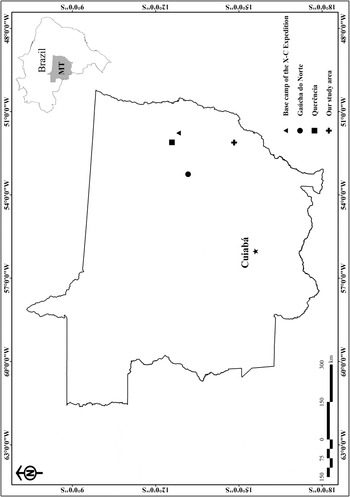
The study was carried out in a semideciduous seasonal forest located at Vera Cruz Farm (14°49′32″S 52°06′20″W), in the municipality of Nova Xavantina, eastern Mato Grosso, Brazil (Fig. 1). The study area covers part of the farm’s protected reserve, which occupies a continuous preserved area of 5000 hectares without signs of disturbance by fire or selective logging (Marimon, Reference Marimon2005). The climate of the region is of the humid tropical type (Aw of Köppen) (Köppen & Geiger, Reference Köppen and Geiger1928), with well-defined dry and rainy seasons (Silva et al., Reference Silva, Assad, Evangelista, Sano, Almeida and Ribeiro2008) and mean annual rainfall of 1500 mm (Marimon et al., Reference Marimon, Felfili and Lima2002). The soil is a Dystrophic Red-Yellow Latosol (Oxisol) type, with medium texture, good drainage, plain relief, high acidity, high levels of exchangeable Al, low levels of Ca and Mg, intermediate levels of K and high concentrations of Fe and gravel (Marimon, Reference Marimon2005).
Map of the state of Mato Grosso indicating the location of our principal study site and some of the other areas discussed in the text.

The region of our forest was explored by the Roncador-Xingu Expedition in December 1943, with the objective of occupying areas geographically isolated in the centre of Brazil. According to the explorers’ records, it was exhausting and difficult to traverse the forests due to the occurrence of a ‘thick vegetation, where it was necessary to cut down gigantic trees in order to open trails’ (Carpentieri, Reference Carpentieri2008). Nowadays the region is occupied by farms whose economic activity is based on beef cattle and cultivation of soya and cereals, while the remaining forested areas are the protected reserves of these properties.
In our forest the tree stratum varies between 9 and 22 m, with generally erect trees, and some emergents, principally of Hymenaea courbaril (species authors are given in Table 1). During the rainy season the crowns touch and the canopy percentage cover varies between 70 and 95%, while in the dry season it can fall to less than 50% due to the deciduousness of many of the species. Twelve species of woody lianas have been recorded and they gave total sums of 115.1 individuals/ha in 2003 and 161.1 individuals/ha in 2008.
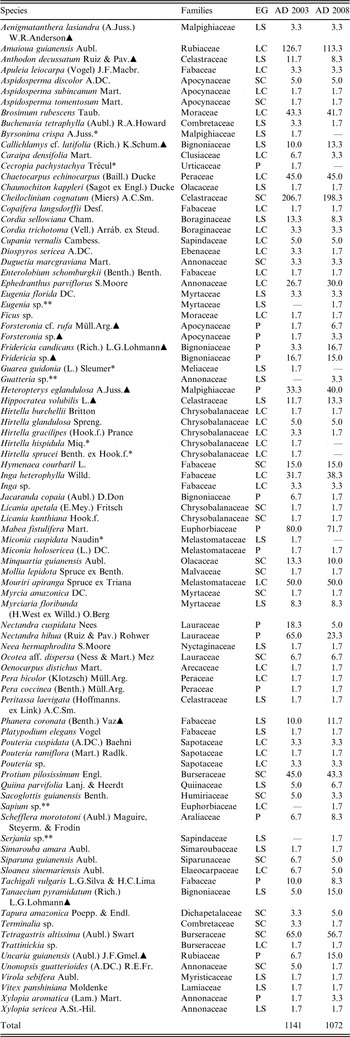
Species of the semideciduous forest recorded in Nova Xavantina-MT in 2003 (Marimon, Reference Marimon2005) and 2008

EG = ecological group, P = pioneer, LS = late secondary, LC = light demanding climax, SC = shade-tolerant climax. AD = absolute density (individuals/ha). * = recorded only in 2003, ** = recorded only in 2008. ▴ = liana.
The forest was surveyed by 60 contiguous permanent plots of 10 × 10 m giving a total area of 0.6 ha. In the first inventory (2003) all individuals ≥ 5 cm diameter at breast height (dbh) were given numbered aluminium tags, registered and identified. In 2008 the plots were re-surveyed, the surviving individuals were recorded and recruits that had reached the minimum inclusion criteria were tagged, registered and identified.
Specimens were collected for identification and incorporation in the NX Herbarium, State University of Mato Grosso, Nova Xavantina Campus. Identification was carried out by comparison with fertile material in the herbaria (NX and that of the University of Brasília, UB) and by consulting specialists and literature. The botanical classification system used was the Angiosperm Phylogeny Group (APG III, 2009) and its revision; names were updated from the Tropicos database, Missouri Botanical Garden (Mobot, 2009).
The potential number of species in the area was estimated, for both inventories, through the MMruns estimator, using the EstimateS 8.0 software (Colwell, Reference Colwell2008). The estimator was chosen based on a performance evaluation of a number of estimators, using the regression analysis of the observed and estimated values for the area, where the estimator’s measure of precision was based on the r 2 regression value and on the bias measure, according to the scaled mean error, SME (Brose et al., Reference Brose, Martinez and Williams2003). Regression analyses were made using the R 2.10.1 (R Development Core Team, 2009) software. The difference in the species richness between the two inventories was evaluated using the species rarefaction method of the EcoSim 7.0 software (Gotelli & Entsminger, Reference Gotelli and Entsminger2001), with 1000 randomisations and 95% confidence interval. The P value was calculated from the species average and variance, based on the normal distribution Z test (Zar, Reference Zar1999).
The species diversity was determined by the Shannon index (H′) (Magurran, Reference Magurran1988) and the equability by the Pielou index (J′) (Ludwig & Reynolds, Reference Ludwig and Reynolds1988), using the FITOPAC 1 software (Shepherd, Reference Shepherd1994). The H′ values of both sampling periods (2003 and 2008) were compared using the Hutcheson t test (Zar, Reference Zar1999). The floristic similarity of both inventories was calculated using the indexes of Jaccard, Sørensen and Morisita (Brower & Zar, Reference Brower and Zar1977; Kent & Coker, Reference Kent and Coker1992).
Results and Discussion
The changes in number of species between the sampling years were small. In the first inventory (2003) 84 species were recorded, while in 2008 there were 82 species (Table 1). A pattern of small alterations in the number of species over time was also observed in other studies in semideciduous, deciduous and gallery forests, as by Paula et al. (Reference Paula, Silva, Souza and Santos2002) in Viçosa, Minas Gerais state, over a period of 14 years; by Werneck et al. (Reference Werneck, Franceschinelli and Tameirão-Neto2000) also in Minas Gerais, over four years; by Pinto & Hay (Reference Pinto and Hay2005) in Mato Grosso state, over three years, and by Miguel & Marimon (Reference Miguel, Marimon, Santos and Galbiati2008), in Nova Xavantina, Mato Grosso state, over seven years.
According to Swaine et al. (Reference Swaine, Lieberman and Putz1987), tropical forests that are free from large disturbances or anthropic interferences usually show small changes in floristic composition, as observed in our case. Small disturbances, such as the opening of gaps due to natural tree fall (Marimon et al., Reference Marimon, Felfili, Marimon Júnior, Franco and Fagg2008), allow entrance of coloniser species and lead to maintenance of species richness, a pattern also observed by Oliveira-Filho et al. (Reference Oliveira-Filho, Mello and Scolforo1997) in a semideciduous forest in southeastern Brazil.
In our study six species registered in 2003 (Marimon, Reference Marimon2005) had disappeared in 2008 (Cecropia pachystachya, Guarea guidonia, Hirtella sprucei, H. hispidula, Byrsonima crispa and Miconia cuspidata). On the other hand, the second inventory registered four new species (Guatteria sp., Sapium sp., Eugenia sp. and Serjania sp.) (Table 1). These percentages of lost (c.7% of the total) and new species (c.4%) are within the limits registered for other Brazilian studies (Pinto & Hay, Reference Pinto and Hay2005). According to these authors, the loss of species in forests, shown by recurring inventories in the same area, is usually between 0 and 8% and the registration of new species between 3 and 13%. In our forest, the overlap between the percentages of lost and new species indicates temporal maintenance of diversity, with expected small changes in floristic composition over the period.
Besides two individuals of a Guatteria species, all the species lost or new in the second inventory were represented by single individuals. The appearance or loss of species in recurring inventories is normally as one would expect of rare species. According to Swaine et al. (Reference Swaine, Lieberman and Putz1987) such species may suffer local extinction because of environmental fluctuations and reappear in other surveys, by the recruitment from seed and seedling banks or by the growth of young plants that did not reach the minimum criteria of inclusion in the previous survey.
In the present study, 33 species occurred as single individuals in both inventories, representing 39.2% and 40.2% of all the species registered in 2003 and 2008, respectively (Table 1). The high proportion of rare species confirmed the observations of Felfili & Felfili (Reference Felfili and Felfili2001) for the majority of tropical environments. According to these authors, the number of species is high, but their occurrence is very unequal, with few species abundant and many rare.
Although changes in occurrence were limited to rare species, differences were also found in the population size of some of the commoner species. Heteropterys eglandulosa and Inga heterophylla increased, while others such as Nectandra cuspidata and N. hihua showed serious declines (Table 1). Such changes may indicate major trends over time that would become evident in future surveys.
In our forest, the families with the highest number of species changed little between the surveys. In both inventories, the families with higher species richness were Fabaceae (including Faboideae, Mimosoideae and Caesalpinioideae, although this may have to be revised on the grounds that the Caesalpinioideae are a polyphyletic group) (10.7% and 10.9% of the total in 2003 and 2008, respectively), Annonaceae (7.1% and 6%), Apocynaceae (5.9% and 6%), Bignoniaceae (5.9% and 6%) and Chrysobalanaceae (8.3% and 6%) (Table 1). The largest genera were the same in both inventories: Hirtella with five species in 2003 and three in 2008, Aspidosperma and Pouteria with three in both surveys, and Arrabidaea, Cordia, Forsteronia, Inga, Licania, Nectandra, Pera and Xylopia, with two species each in both surveys (Table 1).
Among the species recorded in the present study, 80% were reported for the Cerrado biome (Mendonça et al., Reference Mendonça, Felfili, Walter, Silva Júnior, Rezende, Filgueiras, Sano, Almeida and Ribeiro2008) while 65% were also recorded in the Amazon (Ivanauskas et al., Reference Ivanauskas, Monteiro and Rodrigues2004a; Kunz et al., Reference Kunz, Ivanauskas, Martins, Silva and Stefanello2008; Mobot, 2009; NYBG, 2009). Pinto & Oliveira-Filho (Reference Pinto and Oliveira-Filho1999) studied a valley forest in Mato Grosso and also registered strong affinities with the vegetation of other biomes. According to Oliveira-Filho & Ratter (Reference Oliveira-Filho and Ratter1995), the floristic richness of Central Brazilian forests can be assigned, at least in part, to the strong contribution of several vegetation types, especially from Amazonian and Atlantic forests. In the present study, the Amazonian Forest, due to its geographical proximity, seems to have contributed significantly to the species composition of our forest.
In both inventories the estimated species richness, according to the best estimator, was substantially similar to the observed one, since the sampling included nearly 90% of the potential number of species in the area in 2003 and 2008. This result indicates that the sampling effort was sufficient to include most of the species of the environment during the whole period of study. The slight difference between the estimated and observed richness (< 10% of the species) may be caused by changes in abundances due to random factors in a community with a high proportion of rare species (around 40%).
The species richness analysis in both inventories, considering the same number of individuals in order to adjust the sampling effort, gave 82 species for both surveys (Z = 0; P > 0.05). This indicates that the forest did not show variation in species richness, and that the higher species number in the first inventory may be simply because of the greater number of individuals sampled. The floristic similarity of both inventories carried out in our forest was, as expected, high (Jaccard = 0.91, Sørensen = 0.95 and Morisita = 0.82).
The values of H′ calculated for both sampling periods (2003 = 3.34 and 2008 = 3.37) did not differ statistically (P > 0.05) and the equability practically has not changed (2003 = 0.75 and 2008 = 0.76). The equability indicated a rather uniform distribution of individuals among the species, and the ecological dominance of some species, such as Cheiloclinium cognatum (Table 1). Kunz et al. (Reference Kunz, Ivanauskas, Martins, Silva and Stefanello2008) found 49 species in an evergreen seasonal forest in the southern Amazonian border and showed that some species were represented by large populations, a pattern that also occurred in our forest.
Other studies also established small changes in species diversity over time, as Pinto & Hay (Reference Pinto and Hay2005) found in a valley forest over three years, Werneck et al. (Reference Werneck, Franceschinelli and Tameirão-Neto2000) in a deciduous forest over four years and Miguel & Marimon (Reference Miguel, Marimon, Santos and Galbiati2008) in a gallery forest over seven years. In these cases, the pattern of small changes in species diversity over time is typical of areas free from large disturbances, as stressed by Werneck et al. (Reference Werneck, Franceschinelli and Tameirão-Neto2000).
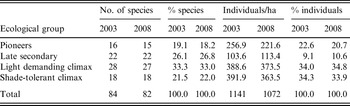
In our forest, the species are unevenly distributed between the different ecological groups (Table 2). The low proportion of pioneer species in relation to late secondary and climax species, in both inventories, suggests that it is in an intermediate stage of succession, a pattern similar to that observed by Paula et al. (Reference Paula, Silva, de Marco, Santos and Souza2004) analysing the ecological succession in a semideciduous seasonal forest in southeastern Brazil.
Number and percentage of species and individuals per ecological group of the semideciduous forest in Nova Xavantina-MT in 2003 (Marimon, Reference Marimon2005) and 2008

In spite of the appearance of four new species and the loss of six in the second inventory (Table 1), the number of species in each ecological group has hardly changed during the observed period (Table 2), indicating a condition of stability. It is important to point out, however, that this does not, necessarily, indicate a completely static community, as small changes have occurred in numbers in each ecological group during the period (Table 2). The late secondary species increased while other ecological groups decreased in number of individuals between inventories (Table 2).
In protected tropical forests the number of individuals of pioneer species usually decreases over time (Werneck et al., Reference Werneck, Franceschinelli and Tameirão-Neto2000; Paula et al., Reference Paula, Silva, de Marco, Santos and Souza2004). Werneck et al. (Reference Werneck, Franceschinelli and Tameirão-Neto2000) emphasised that the pioneer group reduction, in both quantity and species diversity, indicates that the community is probably recovering through natural succession from some disturbance. In the case of our forest, the reduction in density of pioneer species indicates little disturbance, as also observed by Ivanauskas et al. (Reference Ivanauskas, Rodrigues and Nave1999) in another Mato Grosso seasonal forest. It is to be hoped this process will continue in the future.
Conclusions
The changes in floristic composition between both inventories were small and the gains and losses of species were limited to those with low abundance in the area. The small difference in the number of species did not reflect significant changes in species richness and diversity during the period of study. The results show that the floristic composition is now in a condition of dynamic equilibrium. However, the forest cannot be described as a floristically completely static community, as small changes are occurring slowly, the typical pattern of constant successional changes that forest communities are subject to over time.
Acknowledgements
The authors are grateful to Mr Jairo Machado for authorising this study in Vera Cruz Farm; to Dr Eddie Lenza, Dr Fernando Pedroni and Dr José R. R. Pinto for their critical reading of the manuscript; to Dr Christopher W. Fagg for checking the English; to the biologists Edmar A. Oliveira, Leandro Maracahipes, Pábio H. Porto and Claudinei O. dos Santos for their help in the field; to CAPES for a scholarship grant to the first author, and to PELD-CNPq (Transição Cerrado–Floresta Amazônica: bases ecológicas e sócio-ambientais para a conservação/N° 558069/2009-6) for financial support.
Annex
The authors decided that it would be appropriate to follow their account of community dynamics in a forest of the Cerrado–Amazonian Forest transition with some notes reviewing works on the vegetation of this transition and to make a plea for its further study and conservation.
Notes on the transition forests of Mato Grosso
The present study is on a southern peripheral area of seasonal semideciduous forest in the transition zone between the Cerrado biome and the Amazonian Forest biome. This transition zone is extremely large and the work of Alencar et al. (Reference Alencar, Nepstad, McGrath, Moutinho, Pacheco, Vera Diaz and Soares Filho2004) estimated that its seasonal forests originally covered 41% of Mato Grosso state (i.e. an area of approximately 362,500 sq. km).
Despite this type of vegetation covering such a large area, very few studies have been made in transition forest. Probably the first intensive work was done by the joint British-Brazilian Xavantina-Cachimbo (X-C) Expedition of 1967–69 who set up their base camp in the transition between Cerrado and Amazonian forests at 12°49′S 51°46′W (approximately 260 km north of Nova Xavantina, Mato Grosso, on the highway BR 158) (see Fig. 1). The forest close to the transition was largely evergreen and of the type known to the very few native inhabitants of the area in those days as ‘mata seca’ (= dry forest), a term also used by Pires (Reference Pires1974) and Pires & Prance (Reference Pires, Prance, Prance and Lovejoy1985) for this peripheral Amazonian forestFootnote 1. A detailed description of the vegetation was published (Ratter, Reference Ratter and Ferri1971; Ratter et al., Reference Ratter, Richards, Argent and Gifford1973), as well as of the soils (Askew et al., Reference Askew, Moffatt, Montgomery and Searl1970a, Reference Askew, Moffatt, Montgomery and Searl1970b, Reference Askew, Moffatt, Montgomery, Searl and Ferri1971). The latter were extremely dystrophic under both forest and Cerrado. This transition area still existed until approximately 2002 when a team from the State University of Mato Grosso, Nova Xavantina Campus carried out a detailed survey of it (Marimon et al., Reference Marimon, Lima, Duarte, Chieregatto and Ratter2006). The results corresponded closely to those of the X-C Expedition carried out approximately 35 years previously, but the forest had expanded c.7 km into the Cerrado during that time. Unfortunately the area has since been cleared so no further observations are possible there.
The vegetation/soils team of the X-C Expedition returned to the area in 1972 to extend their study and concentrated on the taller ‘dry forest’ lying in the Rio Suiá-Missu area some 35 km northwest of the original expedition area. This forest was continuous with that studied previously but lay in the Rio Xingu drainage as opposed to that of the Rio Araguaia and was taller with a more luxuriant aspect. Species lists and a description of the vegetation were given in Ratter et al. (Reference Ratter, Askew, Montgomery and Gifford1978).
At the end of intensive study at Suiá-Missu the X-C group carried out a reconnaissance northwards along the highway BR 158 (at the time in 1972 a near-deserted track) as far as Fazenda Caaporã (c.12°30′S 55°50′W) lying 55 km north of the base camp of the X-C Expedition. Very large conspicuous trees to 25 m or more of Aspidosperma discolor A.DC. with its latticed trunk, Buchenavia capitata (Vahl) Eichl., Apuleia leiocarpa (Vogel) Macbr., Enterolobium schomburgkii (Benth.) Benth., Trattinickia burserifolia Mart., Vochysia ferruginea Mart., Schefflera morototoni Maguire, Steyerm. & Frodin, and a Dacryodes sp. occurred as emergents. On revisiting these areas in the late 1990s, and even more so in 2008, we found that these forests had been cleared for cattle pastures. However, very large blocks of thousands of hectares remained as reserves, but unfortunately they were widely spaced and had no interconnecting corridors.
More recently further studies have been made in the same area by TROBIT (Tropical Biomes in Transition, a project funded by the UK Natural Environment Research Council and employing a very multinational team) working in co-operation with the State University of Mato Grosso, Nova Xavantina Campus (UNEMAT, NX) and other Brazilian organisations. The study areas chosen were the reserves of large ranches (fazendas) and the biology reserve of UNEMAT, NX. The fieldwork was carried out in 2008 and is now in process of publication.
A survey of an area of ‘dry forest/mata seca’ (Floresta Estacional Perenifólia) was carried out at Querência, Mato Grosso (12°35′S 52°12′W), lying 230 km almost due north of Nova Xavantina (Kunz et al., Reference Kunz, Ivanauskas, Martins, Silva and Stefanello2008) (see Fig. 1). The point-centred quarter method (an excellent technique for yielding representative results rapidly) was used with 200 points, giving 800 trees surveyed. The species list is instantly recognised as very typical by anyone familiar with these transition forests but has a stronger Amazonian element (e.g. Diplotropis spp.) and fewer Cerrado/Cerradão species than the ‘dry forests’ surveyed further south.
A major survey was conducted in southern Amazonian transition forest at Gaúcha do Norte, Mato Grosso (13°10′S 53°15′W) (see Fig. 1) by Ivanauskas et al. (Reference Ivanauskas, Monteiro and Rodrigues2004a, Reference Ivanauskas, Monteiro and Rodrigues2004b). This area lies 196 km southwest of those of our original studies (Ratter et al., Reference Ratter, Richards, Argent and Gifford1973, Reference Ratter, Askew, Montgomery and Gifford1978; Marimon et al., Reference Marimon, Lima, Duarte, Chieregatto and Ratter2006) and like the Suiá-Missu area is in the drainage of the Rio Xingu. The vegetation was intensively analysed in three closely situated ranches and shows about 50% of tree species in common with our study area.
Ackerly et al. (Reference Ackerly, Wayt Thomas, Cid Ferreira and Pirani1989) communicated the results of the 1985 Project Amazonia Expedition to Mato Grosso, concentrating exclusively on the forest–Cerrado transition zone. The work was carried out in September–October 1985 and targeted 60 localities throughout the state to reflect the diversity of natural habitats. This selection was aided by the Projeto RADAM maps that had become available at that time. The method used was to classify the species present in each locality into the following categories: Planaltine taxa, taxa of the transition zone, Amazonian taxa, widespread taxa, and others. The text provides species lists for each category and the sites in which they occurred. The results showing the proportion of these categories at each site are very effectively illustrated by using bar graphs on an outline map of Mato Grosso. Almost all sites showed a mixture of categories, with, as might be expected, a preponderance of ‘Amazonian’ in the northwest and ‘widespread’ in the east. The paper with its list of floristic categories provides good data for classifying communities in this transition area and it would be feasible to do further work based on this technique.
In the areas of Mato Grosso that we know there has been an enormous destruction of the natural environment for agriculture, both for cattle raising and for arable. This applies to all vegetation types but here we shall confine ourselves to the so-called ‘dry forest/mata seca’, the native transitional forest with many Amazonian species. It is probable that it was the form of Amazonian forest most widespread during drier periods when the temperate parts of the world were suffering glaciations and conditions were unsuitable for wetter rainforests. For instance, Whitmore (Reference Whitmore, Whitmore and Prance1987) points out that in past times of drier climate transition forests became more extensive, yet this formation is poorly known and today is the one most rapidly disappearing at the hand of man. In the light of this it is important that those forests should be further studied, understood and conserved. Such a study would still be very practical using the large reserves of the enormous fazendas that occupy most of its areas. We feel that this is an extremely urgent research and conservation priority.