Introduction
Although the Kosova war ended in 1999, long-term consequences such as missing family members, limited employment opportunities and migration to cities continue (Shahini & Landsman, Reference Shahini and Landsman2008). Traditionally, a collectivist society, Kosova has become a more individualistic society with a widening generation gap and increased group tension. All these factors have potentially negative effects on mental health.
When Wenzel & Rushiti (Reference Wenzel and Rushiti2006) surveyed mental disorders in Kosova (N = 1161, ages 15–65), prevalence was 23% for PTSD, 43% for depression and 44% for emotional distress. Higher prevalence was found in people who had been raped, had experienced murder of friends/relatives, had limited education, lived in rural areas, and had experienced combat. Although Kosovar mass media indicate growing rates of suicide, divorce, drug use, youth trafficking youth violence since the war, no epidemiological study has been conducted to determine the prevalence of children's mental health problems and associations with demographic factors.
Referral, reporting and treatment systems for mental health problems in Kosova are still poorly developed. Kosovar researchers face major challenges in collecting epidemiological data because of limited resources. Epidemiological research on child mental health in developing countries is most feasible when an instrument is available that can be administered by non-professionals or self-administered, can be understood by people with varying levels of education, is inexpensive and simple to use, can be easily scored and interpreted, and has been shown to work well in many different societies. Since it meets these criteria, the Child Behaviour Checklist (CBCL/6–18) (Achenbach & Rescorla, Reference Achenbach and Rescorla2001) has been successfully used for epidemiological research on children's behavioural/emotional problems in many societies, including those in Central/Eastern Europe.
Rescorla et al.'s (Reference Rescorla, Achenbach, Ivanova, Dumenci, Almqvist, Bilenberg, Bird, Chen, Dobrean, Döpfner, Erol, Fombonne, Fonseca, Frigerio, Grietens, Hannesdottir, Kanbayashi, Lambert, Larsson, Liu, Leung, Metzke, Minaei, Mulatu, Novik, Oh, Roussos, Sawyer, Simsek, Steinhausen, Weisz, Weintraub, Wolanczyk, Yang, Zilber, Zukauskiene and Verhulst2007) multicultural comparisons of CBCL scores in 31 societies included samples from several Central/Eastern European societies, including Poland, Lithuania and Romania. Rescorla et al. (Reference Rescorla, Ivanova, Achenbach, Begovac, Chahed, Drugli, Emerich, Fung, Haider, Hansson, Hewitt, Jaimes, Larsson, Maggiolini, Markovic, Mitrovic, Moreira, Oliveira, Olsson, Ooi, Petot, Pisa, Pomalima, Rocha, Rudan, Sekulic, Shahini, Silvares, Szirovicza, Valverde, Vera, Villa, Viola, Woo and Zhang2012) reported CBCL comparisons for 69,866 children in 42 societies, the 31 societies compared previously plus 11 additional societies, among which were Kosova, Serbia and Croatia. The results indicated good fit of the CBCL syndrome model using confirmatory factor analyses (CFA), small-to-medium effect sizes (ESs) for societal differences in scale scores, and large correlations across societies for mean item ratings. A limitation of these studies is that a few findings were reported separately by country, effects of socioeconomic status (SES) or urban–rural residence were not tested, and prevalence rates for scores above a clinical cutpoint were not reported.
Despite the fact that CBCL data from several Central/Eastern European societies were included in the Rescorla et al. studies, only a few publications in English have reported detailed findings for these societies. In a Lithuanian study (Zukauskiene et al. Reference Zukauskiene, Ignataviciene and Daukantaite2003), younger children (ages 6–11) obtained higher scores than older children (ages 12–14) on Externalising and Total Problems, and children from lower SES families obtained higher CBCL scores than children from more advantaged families. In a Croatian study (Rudan et al. Reference Rudan, Begovac, Szirovicza, Filipović and Skocić2005), boys obtained higher scores than girls on Social Problems, Attention Problems, Delinquent Behaviour, Aggressive Behaviour, Externalising and Total Problems. Lithuania's mean Total Problems score was higher and Croatia's was lower than the US Total Problems score.
Aims of the study
To conduct the first epidemiological study of children's mental health in Kosova, we surveyed parent-reported behavioural/emotional problems using the CBCL. We contextualised Kosovar findings in two ways. First, we compared Kosovar findings with findings from five other Central/Eastern European societies. Because these five formerly East Bloc countries have much in common with Kosova, they provide a good comparison set for analysing Kosova's CBCL results. Second, we compared Kosova's findings with those for the USA, where the CBCL was developed. Because Kosova differs from the USA in many ways (size, ethnicity, region, economy, political system, etc.), it is important to test how different CBCL findings are for the two societies.
Our study had four specific aims: (1) to compare mean item ratings on the CBCL with those in other societies; (2) to test the fit of the CBCL 8-syndrome model to Kosovar item data and compute alphas for each scale; (3) to test effects of age, gender, urban–rural status and parent education on CBCL problem scale scores in Kosova; and (4) to determine prevalence rates for scores above a deviance cutpoint based on multicultural norms appropriate for Kosova.
Method
Procedure
Kosova is divided in 30 municipalities. Based on school lists provided by the Ministry of Education, four schools were randomly selected from municipalities with >300 000 inhabitants and four schools from municipalities with <300 000 inhabitants from four major regions of the country (Pristina, Mitrovica, Gjakova and Prizreni.). In each municipality, one urban school and one rural school were selected. The study was implemented only with Kosovar Albanian children, as Serbian children attend separate schools.
Prior to beginning data collection in Kosova, the research project was presented for IRB approval to the Medical University of Pristina Ethical Review Committee. The procedures proposed complied with the Helsinki Declaration of 1975, as revised in 2008. Data were collected in the other societies following approval by the relevant IRB committees in each investigator's institution. After the Medical University of Pristina IRB committee approved the project, and approval for the study had been obtained from the Kosova Ministry of Education, the selected schools were contacted and invited to participate in the research. The research team met with each school director or deputy director to explain the aim of the study. In Kosova's schools, classes in the same grade are labelled by alphabet letter (e.g., 2A, 2B, etc.). These labels are arbitrary and do not reflect ability groups. With agreement of the school directors, the research team selected the ‘A’ class in each grade in each school for participation in the study. Each director selected the parent deemed to know the child best to complete the form.
Consent letters were distributed during a parent meeting held at each school, or else sent home by the school office if the parent did not attend the meeting. Each parent returned the signed informed consent form plus the completed questionnaire to the child's teacher in an unmarked sealed envelope. Adolescents gave verbal consent for parental completion of the CBCL. The completion rate was 67%.
Participants
CBCL data were obtained for 1374 Kosovar children ages 6–18 (boys = 50.4% and girls = 49.6%, mean age = 10.8, SD = 2.9; 60% urban, 40% rural). Mean age was slightly higher in urban children relative to rural children (10.9 years v. 10.5 years), t (1362) = 2.52, p = 0.01. Age was dichotomised as 6–11 (n = 856) and 12–18 (n = 518), consistent with previous CBCL research.
From the Rescorla et al. (Reference Rescorla, Ivanova, Achenbach, Begovac, Chahed, Drugli, Emerich, Fung, Haider, Hansson, Hewitt, Jaimes, Larsson, Maggiolini, Markovic, Mitrovic, Moreira, Oliveira, Olsson, Ooi, Petot, Pisa, Pomalima, Rocha, Rudan, Sekulic, Shahini, Silvares, Szirovicza, Valverde, Vera, Villa, Viola, Woo and Zhang2012) 42-society data file, we extracted the data for 2479 children from Poland, 2920 children from Lithuania, 990 children from Romania, 2372 children from Croatia, 488 children from Serbia and 1788 children from the USA, Poland, Lithuania and Croatia had national school-based samples, Romania and Serbia had regional school-based samples, and the USA had a national household-based sample. Completion rates ranged from 70% (Serbia) to 98% (Croatia).
Measures
CBCL: The 2001 version of the CBCL (Achenbach & Rescorla, Reference Achenbach and Rescorla2001) was translated by a professional translator, an independent translator performed a back-translation, the back-translation was checked by the author of the CBCL, and revisions were made to address any problems/ambiguities noted. Like the English CBCL, the Albanian adaptation was written a about a fifth-grade reading level.
The 2001 version of the CBCL was used in all societies except Croatia, where the 1991 (Achenbach, Reference Achenbach1991) version was used for 85% of the participants. Both versions contain 118 problem items. The six items changed when the CBCL was revised in 2001 were not analysed for Croatia. The CBCL is self-administered, with parents responding to the items on a three-point scale (0 = not true, as far as you know, 1 = somewhat or sometimes true, or 2 = very true or often true) based on the past 6 months. The competence items of the CBCL were not used in the present study. The problem portion of the CBCL requires 10–15 min to complete.
The 2001 problem scales for the CBCL were computed from the 118 problem items (minus the six changed items for Croatia only): eight empirically based Syndromes (Anxious/Depressed, Withdrawn/Depressed, Somatic Complaints, Social Problems, Thought Problems, Attention Problems, Rule-Breaking Behaviour and Aggressive Behaviour), three broad-band scales (Internalising, Externalising and Total Problems) and six DSM-oriented scales (Affective Problems, Anxiety Problems, Somatic Problems, Attention Deficit/Hyperactivity Problems, Oppositional Defiant Problems and Conduct Problems).
CBCL findings have been reported in thousands of research publications over the past three decades. Achenbach & Rescorla (Reference Achenbach and Rescorla2001) reported strong test–retest reliability (e.g., mean r = 0.90 for empirically based scales) and internal consistency (e.g., alpha = 0.97 for Total Problems score). With respect to validity, Achenbach & Rescorla (Reference Achenbach and Rescorla2001) reported that all 120 problem items significantly differentiated between children referred for mental health or special education services in the past 12 months and non-referred children, as did all problem scales. Additionally, many studies have demonstrated significant associations between CBCL scales and corresponding psychiatric diagnoses, such as ADHD and depression.
Demographic measures
Kosovar parents completed a questionnaire regarding religion, family income, number of children, marital status and parental education/occupation. Monthly income was categorised: 0–85 euros (€) = people without job and any income, 86–150€ = people with social assistance, 151–250€ = low salary, 251–450€ = average salary in Kosova, >400€ = high salaries. In the public sector, the highest salaries are about 800€ per month.
Data analyses
Scale scores were positively skewed, as is typical for problem scores in population samples where most children have relatively few problems. However, because general linear models are very robust with respect to deviations from normality, especially with large samples manifesting the same skew pattern (Kirk, Reference Kirk1995), we analysed untransformed raw scores.
All statistical analyses were performed with SPSS, except for the CFA, which utilised MPlus (Muthén & Muthén, Reference Muthén and Muthén2007). First, mean item ratings for the Kosovar sample were correlated with those from the five Central/Eastern European societies and the USA. Second, the CBCL 8-syndrome model was tested for the Kosovar item ratings using CFA, and Cronbach's alphas for each CBCL problem scale were computed and compared with alphas from the six other societies. Third, we used analyses of variance (ANOVAs) to test effects of gender, age, and region on Kosovar CBCL scores. Associations of CBCL scores with SES were also tested. Fourth, we compared CBCL scores from Kosova with those from the five other Central/Eastern European societies as well as with those from the USA. Finally, we determined prevalence for scores above the deviance cutpoint for Total Problems. Because of the large number of statistical tests, we used an alpha level of p < 0.001 to determine significance for all analyses and report ESs expressed as η 2 rather than F and p values for ANOVA results.
Results
Demographic characteristics
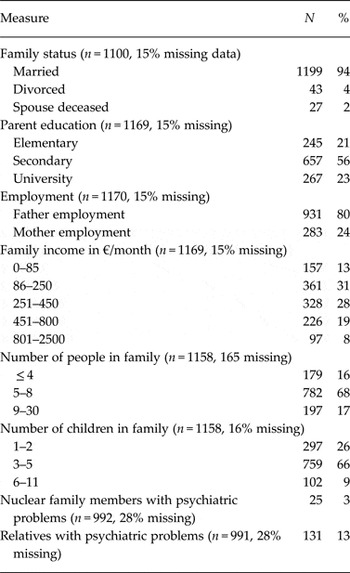
As seen in Table 1, most parents were married, families were large, and only 23% of parents had a university degree. Most fathers were employed (80%), but most mothers were not (24%). Overall, 44% of participants had incomes below the level considered a minimum standard of living. As some families may have had undeclared remittances from abroad, parental education was used to index SES. Psychiatric disorder was reported for 3% of nuclear family members.
Demographic characteristics of the sample (N = 1374)

Note. Percentages provided are based on cases with data for that variable.
Mean item ratings results
When mean item ratings for Kosova were correlated with those obtained in the other societies, rs were 0.69 with Poland, 0.81 with Romania, 0.76 with Lithuania, 0.78 with Croatia (based on 112 items) and 0.77 with Serbia, all close to the mean r of 0.74 reported for 42 societies by Rescorla et al. (Reference Rescorla, Ivanova, Achenbach, Begovac, Chahed, Drugli, Emerich, Fung, Haider, Hansson, Hewitt, Jaimes, Larsson, Maggiolini, Markovic, Mitrovic, Moreira, Oliveira, Olsson, Ooi, Petot, Pisa, Pomalima, Rocha, Rudan, Sekulic, Shahini, Silvares, Szirovicza, Valverde, Vera, Villa, Viola, Woo and Zhang2012). The r with the USA was 0.67, slightly lower than those with the Central/Eastern European societies but still a large effect (Cohen, Reference Cohen1988). These results indicate quite strong comparability between Kosova, five other Central/Eastern European societies, and the USA regarding which CBCL items tended to receive high, medium or low mean ratings.
CFA and Cronbach's alpha results
Following Ivanova et al. (Reference Ivanova, Achenbach, Rescorla, Dumenci, Almqvist, Weintraub, Bilenberg, Bird, Chen, Dobrean, Döpfner, Erol, Fombonne, Fonseca, Frigerio, Grietens, Hannesdóttir, Kanbayashi, Lambert, Larsson, Leung, Liu, Minaei, Mulatu, Novik, Oh, Roussos, Sawyer, Simsek, Steinhausen, Weisz, Weintraub, Winkler Metzke, Wolanczyk, Yang, Zilber, Zukauskiene and Verhulst2007), we used CFAs to test the fit of the Kosovar data to the 2001 CBCL 8-syndrome model using the MPlus WLSMV estimator on tetrachoric correlations (ratings of 0 v. 1 and 2). Results indicated good fit of the USA 8-syndrome model (RMSEA = 0.018, TLI = 0.950, CFI = 0.951) to Kosovar data. All Kosovar items loaded significantly on their predicted factor, with mean item loadings ranging from 0.61 (Social Problems) to 0.71 (Aggressive Behaviour), consistent with the loadings reported by Rescorla et al. (Reference Rescorla, Ivanova, Achenbach, Begovac, Chahed, Drugli, Emerich, Fung, Haider, Hansson, Hewitt, Jaimes, Larsson, Maggiolini, Markovic, Mitrovic, Moreira, Oliveira, Olsson, Ooi, Petot, Pisa, Pomalima, Rocha, Rudan, Sekulic, Shahini, Silvares, Szirovicza, Valverde, Vera, Villa, Viola, Woo and Zhang2012).
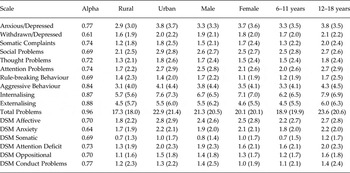
Table 2 shows the Cronbach's alpha coefficients for the 17 CBCL problem scales in Kosova. Alphas were 0.96 for Total Problems, 0.87 for Internalising, and 0.88 for Externalising. They ranged from 0.61 (Withdrawn/Depressed) to 0.84 (Aggressive Behaviour) for the 14 syndrome and DSM-oriented scales. These alphas were very consistent with those reported by Rescorla et al. (Reference Rescorla, Achenbach, Ivanova, Dumenci, Almqvist, Bilenberg, Bird, Chen, Dobrean, Döpfner, Erol, Fombonne, Fonseca, Frigerio, Grietens, Hannesdottir, Kanbayashi, Lambert, Larsson, Liu, Leung, Metzke, Minaei, Mulatu, Novik, Oh, Roussos, Sawyer, Simsek, Steinhausen, Weisz, Weintraub, Wolanczyk, Yang, Zilber, Zukauskiene and Verhulst2007, Reference Rescorla, Ivanova, Achenbach, Begovac, Chahed, Drugli, Emerich, Fung, Haider, Hansson, Hewitt, Jaimes, Larsson, Maggiolini, Markovic, Mitrovic, Moreira, Oliveira, Olsson, Ooi, Petot, Pisa, Pomalima, Rocha, Rudan, Sekulic, Shahini, Silvares, Szirovicza, Valverde, Vera, Villa, Viola, Woo and Zhang2012). Correlations between Kosova's 17 alphas and those obtained for the other societies (Poland = 0.90, Lithuania = 0.90, Romania = 0.88, Croatia = 0.86, Serbia = 0.86 and USA = 0.77) indicate that the rank ordering of alphas for Kosovo was very similar to those found for the five other European societies and somewhat less similar to the rank ordering for the USA. Mean alphas across all 17 scales ranged from 0.72 in Croatia to 0.77 in the USA, with Kosova having a mean of 0.75.
Scale Alphas and Means (SDs) of CBCL problem scales by region, gender and age group

Effects of gender, age and region on CBCL scores
The 2 (gender) × 2 (age group, 6–11, 12–18 years) × 2 (region, urban v. rural) ANOVA on Kosovar Total Problems scores indicated significant main effects for age group (ES = 1%) and region (ES = 2%), but non-significant effects for gender and for all interactions. As shown in Table 2, Total Problems scores were higher for older children and those living in cities than for younger children and those living in rural areas. When parental education was included as a fourth factor (N = 1169), the same age and region effects were found and parental education had an ES of 1%. The highest Total Problems scores were for children whose parents had elementary education only (25.5, SD = 21.5), next highest for children whose parents had secondary education (20.5, SD = 20.6), and lowest for children whose parents had university education (10.1, SD = 19.1). Similar age and region effects were found in the multivariate ANOVAs (MANOVAs) for the other 16 scales, with older children scoring significantly higher than younger children on many scales and urban children scoring significantly higher thanthe rural children on most of the scales. Boys scored significantly higher than girls on Externalising, Attention Problems, Rule-Breaking Behaviour and DSM-Conduct Problems.
Mean problem score comparisons with other societies
When we compared Kosova's Total Problems score with those for Poland, Lithuania, Romania, Croatia, Serbia and the USA, the societal ES of 5% indicated some variation in mean scores across the seven societies. Student–Newman–Keuls post hoc comparisons indicated that Kosova's mean Total Problems score of 20.67 (SD = 20.28) was significantly higher than Croatia's (18.77, SD = 15.24) and Serbia's (17.02, SD = 14.92), and significantly lower than the Total Problems scores of the other four societies: Poland (22.89, SD = 19.68), Lithuania (30.67, SD = 20.35), Romania (25.35, SD = 18.60) and the USA (25.52, SD = 20.11). As the Total Problems score can range from 0 to 236, even the 10 point difference between Kosova and Lithuania is quite small. Furthermore, the SDs in all six societies were large, indicating much more variation within societies than between the seven societies on Total Problems.
Children scoring in the deviant range
Based on data for 31 societies, Achenbach & Rescorla (Reference Achenbach and Rescorla2007a ) constructed high, medium and low multicultural norm groups for the CBCL based on the omnicultural mean (25.09, SD = 6.3). Kosova was one of 22 societies falling in the middle norm group, defined by Total Problems scores within 1 SD (i.e. 6.3 points) of the omnicultural mean. This group's norms were therefore used to determine deviance on Total Problems for Kosovar children, defined as scores at or above the 84th percentile (cutpoints: boys age 6–11 = 39, girls age 6–11 = 38, boys age 12–18 = 40, girls 12–18 = 36). For ages 6–11, prevalence of deviance was 16.8% for both boys and girls, close to the 16% expected with a cutpoint at the 84th percentile. However, for ages 12–18, prevalence of deviance was 24% for boys and 22% for girls, somewhat higher than what would be expected. Prevalence of deviance was significantly higher in urban than rural areas (23 v. 10%, χ 2 (1) = 37.2, p < 0.001), consistent with the ANOVA results. Additionally, prevalence of deviance was significantly associated with parental education, χ 2 (2) = 10.8, p < 0.004 (elementary = 25%, secondary = 19%, university = 14%).
Discussion
Our study constitutes the first national epidemiological survey of children's behavioural/emotional problems in Kosova. To set Kosovar findings in context, findings were compared with those from five other former East Bloc countries. Additionally, we compared Kosovar findings with those from the USA, where the CBCL was developed. Because the USA and Kosova differ in so many ways, it was important to see how different CBCL findings were in the two societies.
Kosova's mean Total Problems score of 20.67 fell in the middle range of the other five Central/Eastern European societies. The mean score differences were quite modest, particularly considering that the SDs in each society were large (15–20 points). Kosova's mean item ratings and Cronbach's alphas were very similar to those of the other five Central/Eastern European societies. These results indicate that CBCL findings in Kosova were very similar to those found in other Central and Eastern European societies.
When Kosovar findings are considered with respect to USA findings, more similarities than differences were found, despite the many differences between the societies. The CBCL syndrome model fit Kosova's data well. Scale alphas and mean item ratings were highly correlated between the two societies, and Kosova's mean Total Problems score was only about 0.25 SD. lower than the US mean.
Kosova experienced a traumatic war in the 1990s. Additionally, it is transitioning from being collectivistic to individualistic and has experienced increased urban-to-rural migration, environmental pollution, crime and violence, discrimination, divorce and economic inequality. These societal factors may help explain why problem scores were higher for those living in cities rather than in rural areas. Similar results have been reported for the Polish sample (Wolanczyk, Reference Wolanczyk2002).
Older children had significantly higher problem scores than younger children in Kosova, unlike results in the other six societies or in the 42-society comparisons (Rescorla et al. Reference Rescorla, Ivanova, Achenbach, Begovac, Chahed, Drugli, Emerich, Fung, Haider, Hansson, Hewitt, Jaimes, Larsson, Maggiolini, Markovic, Mitrovic, Moreira, Oliveira, Olsson, Ooi, Petot, Pisa, Pomalima, Rocha, Rudan, Sekulic, Shahini, Silvares, Szirovicza, Valverde, Vera, Villa, Viola, Woo and Zhang2012). The Kosovar adolescents were 5 or 6 years of age during the war years of 1998–1999. Because the younger children were born later, they were less likely than adolescents to have experienced life stresses, family disruptions, economic difficulties and migration due to the war. Furthermore, the transition from collectivism to individualism might be expected to have a bigger impact on adolescents, who are developing their own identities, than on younger children, who are still strongly embedded in their immediate families.
Somewhat higher CBCL problem scores in children from lower SES families have been demonstrated in many societies (Achenbach & Rescorla, Reference Achenbach and Rescorla2007b ). However, in our study, the mean Total Problems score was twice as high for children whose parents had only elementary or secondary education relative to those with university education, a larger difference than typically found for SES effects. There are several possible reasons for this finding. It may be that the economic resources associated with more advanced educational attainment may have provided important protection from stress and/or treatment for distress for children living through the trauma and dislocation of war and post-war reconstruction. It is also possible that parents with less education had more social/behavioural/emotional issues than parents with more education, which might have resulted in elevated CBCL scores. Finally, one might speculate that parents with less education had more difficulty reading and interpreting the CBCL questions, which might have yielded higher scores.
Our mental health findings for Kosovar children suggest less psychopathology than Wenzel & Rushiti (Reference Wenzel and Rushiti2006) reported. This may be because most of Wenzel's participants were primarily adults who had been exposed to the war, whereas only the adolescents in the present study had been exposed to the war. Second, Wenzel used self-report instruments to make diagnoses, whereas we used parents' CBCL ratings of children to identify maladjustment. Third, Wenzel's study was conducted closer in time to the war, whereas our study's data collection was 10 years after the war. Although it is difficult to directly compare the results from Wenzel's study with ours because the methodology and participants were different, one might speculate that adults and older adolescents might manifest more negative mental health consequences from Kosova's troubled past and difficult present circumstances than do children, who may be somewhat buffered from external stressors by virtue of their age and dependent status in their families.
It is important to highlight that all of our multicultural comparisons of CBCL scores (Rescorla et al. Reference Rescorla, Achenbach, Ivanova, Dumenci, Almqvist, Bilenberg, Bird, Chen, Dobrean, Döpfner, Erol, Fombonne, Fonseca, Frigerio, Grietens, Hannesdottir, Kanbayashi, Lambert, Larsson, Liu, Leung, Metzke, Minaei, Mulatu, Novik, Oh, Roussos, Sawyer, Simsek, Steinhausen, Weisz, Weintraub, Wolanczyk, Yang, Zilber, Zukauskiene and Verhulst2007, Reference Rescorla, Ivanova, Achenbach, Begovac, Chahed, Drugli, Emerich, Fung, Haider, Hansson, Hewitt, Jaimes, Larsson, Maggiolini, Markovic, Mitrovic, Moreira, Oliveira, Olsson, Ooi, Petot, Pisa, Pomalima, Rocha, Rudan, Sekulic, Shahini, Silvares, Szirovicza, Valverde, Vera, Villa, Viola, Woo and Zhang2012) have revealed greater within than between society variation in problem scores. Even among Kosovar Albanians, a relatively small demographic group, we found significant differences in CBCL scores associated with age, gender, urban v. rural residence, and parental education/SES. No doubt other variables we did not measure in this study (e.g., IQ, temperament, educational attainment and adaptive skills) would also explain some of the variance we found in CBCL scores.
The Central and Eastern European societies compared in this study shared a long period of Communist rule followed by dramatic political, economic and social changes. Additionally, in all of the six societies, cultural influences from Western Europe and the USA have become increasingly strong with the opening up of their economies and media and the increasing geographic and economic mobility of citizens. These factors might help to explain why Kosova's CBCL results were so consistent with those of the other Central/Eastern European countries and of the USA.
Findings from our study must be considered in the context of some important limitations. Although we used standard epidemiological methods, the response rate was relatively low (67%). Because families with more problems are likely to be non-responders, Kosova's problem scores might have been higher had the response rate been higher. Second, a somewhat different picture might emerge we were to compare reports from teachers and from adolescents themselves with parental reports, or had we used a different set of problem items. Additionally, it would have been interesting to compare Kosovar results with those of a non-European society with a recent history of armed conflict and comparable poverty level, but this was beyond the scope of the present study.
Despite these limitations, our study has numerous strengths. It is the first national epidemiological study ever undertaken to survey mental health in Kosovar children and adolescents. The sample size was large, represented a full SES range, and included both urban and rural families. Another important strength is that we were able to conduct direct statistical comparisons between Kosova and five other Central/Eastern European societies, as well as with the USA. Our findings therefore provide a good baseline from which to study mental health in Kosovar children and adolescents in future research. The study also provides normative information about Albanian children in Kosova that may be useful for professionals working with Albanian immigrant children in other societies.
An important epidemiological finding in our study is that Kosovar children with less educated parents seemed to be at particular risk for emotional/behavioural problems. An implication of this finding is that school, medical and mental health professionals should take proactive steps to improve psychological functioning in Kosovar children from low-income families who are manifesting behavioural/emotional problems, because they seem to be at particularly elevated risk.
Acknowledgements
The authors thank the students of Faculty of Psychology in Prishtina volunteered their time to conduct this epidemiological survey, the school personnel who facilitated the research and the parents who provided the data.
Financial Support
This research received no specific grant from any funding agency, commercial or not-for-profit entity.
Conflict of Interest
The second author receives royalties from sale of the English-language version of the Child Behaviour Checklist in the USA. The other authors have no conflict of interest.
Ethical Standards
The authors assert that all procedures contributing to this work comply with the ethical standards of the relevant national and institutional committees on human experimentation and with the Helsinki Declaration of 1975, as revised in 2008.