





Introduction
Bone is a composite material consisting of organic components, primarily collagen fibrils, embedded within an inorganic apatite matrix. Collagen is widely used for radiocarbon (14C) dating because of its resistance to chemical weathering and diagenesis. However, collagen is destroyed at high temperatures and is therefore unsuitable for cremated remains. In contrast, bone apatite contains structurally bound carbonate (∼1 wt%C), which can be used for 14C dating of cremated bone. In addition, strontium (Sr) can substitute for calcium (Ca) in apatite, forming a biogenic uptake system that has been widely applied to archaeological applications, including reconstructions of ancient human mobility and provenance (e.g. Hodell et al. Reference Hodell, Quinn, Brenner and Kamenov2004; Prince et al. Reference Prince, Burton and Bentley2002; Thornton Reference Thornton2011). Cremated bone exposed to temperatures exceeding 600 °C typically exhibits highly crystalline apatite that is relatively resistant to exogenous contamination (Lanting et al. Reference Lanting, Aerts-Bijma and van der Plicht2001). Nevertheless, carbon derived from the atmosphere and/or fuel wood may be incorporated into the apatite structure during cremation (e.g. Munro et al. Reference Munro, Longstaffe and White2008; Snoeck et al. Reference Snoeck, Brock and Schulting2014), potentially affecting 14C ages. Experimental and case studies therefore remain essential for evaluating the reliability of cremated bone dating. For example, Minami et al. (Reference Minami, Mukumoto, Wakaki and Nakamura2019) demonstrated that highly crystalline cremated bone, estimated to belong to the Buddhist monk Jokei (AD 1155–1213), recovered from an urn at Jisho-in Temple, Nara Prefecture, Japan, yielded reliable 14C ages and was resistant to soil-derived diagenetic alteration.
Beyond chronological applications, apatite also preserves dietary information. Sr/Ca and Ba/Ca ratios and strontium isotopes (δ88Sr) in apatite can be used as biochemical indicators of trophic level and/or dietary preferences (e.g. Burton and Price Reference Burton and Price1990; Burton et al. Reference Burton, Price and Middleton1999). The decrease in Sr/Ca and Ba/Ca ratios of bioapatite with increasing trophic level, known as “biopurification”, has been widely observed (e.g. Elias et al. Reference Elias, Hirao and Patterson1982; Gilbert et al. Reference Gilbert, Sealy and Sillen1994). Moreover, recent studies suggested that strontium stable isotopes (δ88Sr) of bioapatite could be an indicator of trophic level (e.g. Knudson et al. Reference Knudson, Williams, Buikstra and Tomczak2010; Tütken et al. Reference Tütken, Held, Herrmann and Galer2015). δ88Sr values, normalizing the data to the strontium carbonate standard NIST987, are defined as δ88Sr = (((88Sr/86Srsample)/88Sr/86SrNIST987) – 1) × 1000 (‰), and decrease along the food chain because organisms preferentially incorporate the lighter isotope of strontium (Knudson et al. Reference Knudson, Williams, Buikstra and Tomczak2010).
Japan has maintained a cremation tradition since ancient times, with the practice becoming widespread following the introduction of Buddhism around AD 700 during the Nara period. Consequently, large numbers of archaeological cremated human remains are found throughout the Japanese archipelago, many of which remain undated. One such case is the Ishibotoke-dani site associated with Binman-ji Temple in Taga Town, Shiga Prefecture. This medieval burial site lies adjacent to the temple precinct, where numerous cremated individuals, thought to include monks and temple affiliates, have been excavated. The presence of stone Buddhas and related ritual deposits further suggests that the area functioned as a mortuary space for both religious personnel and local residents (Taga Town Board of Education 2005).
Binman-ji Temple itself developed from the 12th century onward and rose to regional prominence. During the 14th century (Nanboku-cho period), it aligned politically and militarily with the Ashikaga clan, maintaining close ties with both Ashikaga shogunate and the Kyogoku clan. Archaeological investigations have revealed castle remains dating to the Sengoku period, as well as townhouse features, including buried jars and puddled floor structures, indicative of an urbanized settlement (Taga Town Board of Education 2006). These findings suggest that the temple complex evolved into a socio-economically diverse community. However, because Binman-ji was destroyed by fire in the late 16th century and few historical documents survive, the identities and social composition of individuals associated with the temple, including those interred at Ishibotoke-dani, remain poorly understood.
The objective of this study is therefore to establish the chronological framework and reconstruct dietary profiles of cremated individuals from the Ishibotoke-dani site through combined 14C dating and Sr-based dietary proxies. By integrating chronological and biogeochemical evidence, this research aims to better characterize the buried population and to elucidate the social role and historical development of the Binman-ji temple community.
Samples
The Ishibotoke-dani site associated with Binman-ji Temple is located on the eastern side of Lake Biwa and comprises seven areas (A–G). In this study, Areas A, F, and G, situated at lower elevations along the slope, as shown in Figure 1, were analyzed. A distinctive grave type was identified in Area A, although social status differences among the buried individuals remain unclear. Remains of a road extending from the lower hall were found in Areas A and G, suggesting that these functioned as burial grounds from the early phase of the Ishibotoke-dani site (Taga Town Board of Education 2005). Multiple graves, together with numerous pottery, ceramics, and cremated human bones, were identified in all areas. Typological analysis indicates production dates from the 12th to 16th centuries, with over 80% concentrated in 13th and 14th centuries, implying continuous use of pottery and as funerary. Spatially, materials from Areas A, D, and F mainly date to the 13th–14th centuries, whereas those from Area G extend into the 15th century (Taga Town Board of Education 2006). Most of the bones were white, although some exhibited blackened portion. Cremated bone samples A12 in Area A, D3 in Area D, F1 and F3 in Area F, and G3 in Area G were excavated from urns, whereas the others were recovered from the soil (see Table 1). As the urns in which the cremated bones were buried were not sealed or broken, the cremated bones were mixed with the soil. Sample F3 contained remains of at least seven individuals, whereas the others represented single individuals. Sex and approximate age were estimated for some samples, with most identified as middle-aged men, alongside women and children shown in Table 1 (Taga Town Board of Education 2008).
(a) Location of the Ishibotoke-dani site associated with Binman-ji Temple in Taga Town, Shiga Prefecture, situated on the eastern shore of lake Biwa, where cremated bones were collected, and Kusatsu, where fish were collected; (b) location of the study areas (Areas A, D, F, and G). Contour interval in (b): 1 m.

Trace element concentrations, δ88Sr and δ13C values, and 14C ages in cremated bones from the Ishibotoke-dani site, associated with Binman-ji Temple in Taga Town, Shiga Prefecture. For the bone samples A7-1, F1, and F5, both the white and blackened portions were analyzed. Samples labeled “W” represent the white portions of the bone fragments, whereas those labeled “B” represent the blackened portions of the same fragments. Samples not labeled with either “W” or “B” are all white bone samples. Data marked with an asterisk (*) are from Minami and Wakaki (Reference Minami and Wakaki2021). For the soil samples, “bulk” indicates the whole sample, whereas “ex” indicates the exchangeable fraction extracted with 1M CH3COONH4.

Table 1. Long description
A table comparing trace element concentrations, isotope values, and radiocarbon dates in cremated bones and soil samples from the Ishibotoke-dani site. The table has 47 rows and 16 columns. Column headers are Sample name, Burial style, Number of body, Sex, Age group, Fe (ppm), Ca (%), Sr (ppm), Ba (ppm), δ88Sr(‰), δ13C vPDB (‰), 14C date (BP), and Lab. code (NUTA2-). Row labels include sample names like A7-1W, A7-1B, A8-1*, and so on. The table presents data on cremated bones and soil samples, with some samples analyzed for both white and blackened portions. Notable trends include variations in trace element concentrations and isotope values across different samples and burial styles. The data also includes radiocarbon dates and laboratory codes for each sample.
A modern fish, soils, and plant samples were also analyzed for comparison with the bone results. The fish, a 27-cm-long black bass, was collected from the lakeshore near Kusatsu (Figure 1). The soil samples were collected from Area A at the Ishibotoke-dani site. After collection, the samples were sieved using a 180 μm mesh. Plant samples (leaf, branch, and weed) were collected from four locations within an approximately 50 km2 area surrounding Binman-ji. Sample 1P1 was a branch, 6P1 was a dead leaf, and the remaining samples were weeds.
Methods
14C dating
Approximately 1 g of the Ishibotoke-dani cremated samples was placed in a sample vial and the vial was put in a flask containing 60 mL of 0.1 M CH3COOH. The flask was connected to a vacuum line, and the inside of the flask was evacuated and reacted with CH3COOH for 1 h. The sample was placed in a centrifuge tube, washed repeatedly with Milli-Q water, and freeze-dried apatite (Minami et al. Reference Minami, Mukumoto, Wakaki and Nakamura2019). About 200 mg sample of cremated bone was treated with dehydrated 97% phosphoric acid for ∼12 hr to extract CO2 produced from the bone apatite.
For the fish, only the vertebrae were separated and subjected to collagen extraction after lipid extraction using chloroform/methanol (2/1, v/v) and then combusted at 850 °C in a sealed quartz tube together with CuO, Cu, and Ag wires to produce CO2 (Minami and Nakamura, Reference Minami and Nakamura2005).
The purified CO2 was sealed with iron powder and hydrogen and reacted at 620 °C for 6 hr to produce graphite. Graphite was introduced into a target holder, and 14C dating was performed using a Tandetron accelerator mass spectrometer (HVEE model 4130-AMS) at Nagoya University. Stable isotope analyses of δ13C for the cremated bone samples were conducted using a stable isotope ratio mass spectrometer (DELTA V Plus, Thermo Fisher Scientific) equipped with a gas bench at Shoko Science Co., Ltd., Japan.
Sr isotope and trace elemental analyses
The CH3COOH-treated cremated bones and the fish bone were heated at 825 °C for 5 hr in a muffle furnace to remove the organic matter. Subsequently, 10–50 mg of each sample was digested with HCl, heated on a hot plate, and then dried.
For the soil samples, both bulk and exchangeable fraction (ex), extracted using 1 M CH3COONH4 solution, were analyzed. First, exchangeable Sr (ex) was extracted by adding 5 mL of 1 M CH3COONH4 to 200 mg of sample and leaving for 24 hr, followed by centrifugation (3000 rpm, 10 min) and drying of the supernatant. Then, 100 mg of the residue was digested with 1 mL HNO3, 1 mL HClO4, and 3 mL HF at 160 °C and subsequently dried. Plant samples (500–1000 mg) were digested with 6 mL HNO3. After initial NO2 release, the temperature was gradually raised to 80 °C until complete decomposition and drying were achieved.
The dried fractions were redissolved in 2% HNO3 after adding a few drops of concentrated HNO3. Element concentrations were measured by ICP-MS (Agilent 7700) at the Kochi Core Center. Sr was separated using Sr Spec resin (Eichrom), and δ88Sr values were determined by DS-TIMS (Wakaki et al. Reference Wakaki, Obata, Tazoe and Ishikawa2017) using TIMS (Thermo TRITON) at the Kochi Core Center.
Results
XRD analysis
To confirm the crystallinity of the bone samples, powder X-ray diffraction measurements were carried out on cremated bone samples. All XRD patterns of the cremated bones, except for the blackened portions, showed sharp peaks. Minami et al. (Reference Minami, Mukumoto, Wakaki and Nakamura2019) performed XRD measurements on modern boar bones heated at different temperatures and demonstrated that the spectra of bones heated above 750 °C exhibited sharp peaks with higher crystallinity index (CI) values (> 0.9), as defined by Person et al. (Reference Person, Bocherens, Saliège and Paris1995). The white portions of cremated bone samples in this study showed high CI values (CI: 1.20–1.35), similar to those of boar bones heated above 750 °C, whereas the blackened portions showed low CI values (CI: 0.27–0.78). This suggests that the cremated bone samples from the Ishibotoke-dani site, except for the blackened portions, were heated above 750 °C and could retain original isotopic information. Therefore, in the following discussion, only the results obtained from the white bone fragments are considered.
14C dating
Results of 14C dating for the cremated bones are listed in Table 1. The 14C ages were calibrated with OxCal 4.4, based on the calibration curve data of IntCal20 (Reimer et al. Reference Reimer, Austin, Bard and Bayliss2020) (Figure 2). The measured 14C ages range from 896 ± 36 to 547 ± 39 BP, corresponding to calibrated ages mainly between the 12th and 14th centuries. The cremated bones from Area A ranged between the 12th and 14th centuries, while those from Area D were dated to the 13th century. The cremated bones excavated from grave 3 in Area F, where several people were thought to have been buried, were dated from the 12th to 13th centuries. Area G, which is assumed to be a relatively early construction site, was dated mainly to the 14th century, which was more recent than Area D. These results are consistent with the documented period of activity of Binman-ji (v), as indicated by historical records and the ages of urns excavated from each survey area. However, none of the cremated remains analyzed in this study were dated to the 15th or 16th century.
Calibrated 14C ages with 2σ uncertainty of the Ishibotoke-dani cremated bones.

As the Ishibotoke-dani site investigated in this study is located near Lake Biwa, freshwater reservoir effects may influence the 14C ages. Carbon in collagen is derived primarily from dietary protein; therefore, δ1 3C and δ1 5N reflect dietary habits, particularly protein sources. The 14C ages of fish bone collagen shown in Table 1 indicate a freshwater reservoir effect of approximately 100 years. In contrast, carbon in carbonate hydroxyapatite is mainly derived from inorganic carbon in the body and is influenced by the metabolism of major dietary components—carbohydrates, lipids, and proteins—as well as exchange with body fluids and respiration. The δ1 3C values of hydroxyapatite, mainly ranging from −31.5‰ to −20.0‰, also suggest that the age offset due to the reservoir effect is limited. Given these considerations, no correction for the reservoir effect has been applied in this study; therefore, the true ages may be slightly younger than those reported here. Further research is needed to better constrain this effect.
Trace element concentration
The trace element concentrations of cremated bones, modern fish bone, plants, and soil samples are also presented in Table 1. Blackened bone fragments, which experienced lower burning temperatures and exhibit lower crystallinity than white bones, show notably higher Ba and Fe concentrations than white bones, indicating that black fragments have been more strongly affected by soil contamination. Minami et al. (Reference Minami, Mukumoto, Wakaki and Nakamura2019) reported the Ba enrichment in cremated bones is likely related to soil contamination, as Ba concentrations in soil are an order of magnitude higher than those in bone. This implies that buried cremated bones may not preserve their original (biogenic) log(Ba/Ca) values. Because the influence of soil contamination cannot be excluded, log(Ba/Ca) values are omitted from further discussion in this study.
Cremated bones showed log(Sr/Ca) values ranging from −3.53 to −2.96 (Figure 3). The bulk soil fractions exhibited higher ratios, with log(Sr/Ca) = −2.19 to −1.86, whereas exchangeable Sr (ex) fractions showed lower ratios, roughly comparable to those of plants (log(Sr/Ca) = −3.00 to −2.21). Compared with the cremated bones of Jokei, assumed to represent a vegetarian diet (log(Sr/Ca) = −2.79), the Ishibotoke-dani cremated bones exhibit a more carnivorous trend in log(Sr/Ca).
(a) log(Sr/Ca) and (b) δ88Sr values of cremated bones, modern fish bone, soil, and plant samples. Data of Jokei are from Minami et al. (Reference Minami, Mukumoto, Wakaki and Nakamura2019).

Sr isotope ratio
Results of the δ88Sr analyses of the cremated bones are also presented in Table 1. The cremated bones show δ88Sr values ranging from −0.389‰ to −0.130‰. Compared with modern animals, the cremated bones fall within the range typical of omnivores. The cremated bones attributed to Jokei exhibit δ88Sr values between −0.140‰ and −0.125‰, indicating a more herbivorous dietary tendency relative to the Ishibotoke-dani cremated bones and modern animals (Figure 3). Among the survey areas, cremated bones from Areas A and G show a relatively wide range of δ88Sr values, with some samples comparable to those of Jokei. In contrast, cremated bones from Area F exhibit a narrower δ88Sr range than those from the other areas.
Discussion
Diet estimation by log(Sr/Ca) and δ88Sr
Compared with previously reported log(Sr/Ca) data, the cremated bones from the Ishibotoke-dani site indicate a more carnivorous dietary signal. The Ishibotoke-dani samples also show δ88Sr values comparable to or lower than those of the cremated bones of Jokei, whose diet has been interpreted as predominantly vegetarian. Experimental studies on pigs demonstrate that bone δ88Sr values are approximately 0.32‰ lower than those of their diet (Lewis et al. Reference Lewis, Pike, Coath and Evershed2017). Assuming a similar trophic offset in humans, the δ88Sr results suggest that many individuals buried at the Ishibotoke-dani likely consumed at least some animal protein. Although Buddhism includes precepts against killing, and animal flesh was widely regarded as impure in the medieval period, dietary practices within temples were often more flexible. Nakazawa (Reference Nakazawa2018) reported that meat consumption among monks was not uncommon. It is therefore plausible that individuals associated with Binman-ji also consumed meat. Moreover, given the site’s proximity to Lake Biwa, fish would have been an accessible and likely dietary resource. Strict adherence to vegetarian precepts was probably limited to a relatively small number of monks.
Another factor that may have contributed to the observed variations in Sr/Ca values and δ88Sr is differences in staple foods. Historical studies indicate that rural lords stockpiled large quantities of rice, whereas lower-ranking populations relied more heavily on cereals and legumes. Rice was also collected as annual tribute, suggesting that poorer communities may have depended on minor grains as staple foods. It is possible that poor peasants consumed cereals rather than rice as their main staple food. Different species may show different Sr/Ca values and δ88Sr, even when growing in the same area. In this study, plant samples (leaves, branches, and weeds) collected from an approximately 50 km2 area surrounding Binman-ji exhibited variations of ∼0.8 in log(Sr/Ca) and ∼0.4‰ in δ88Sr, indicating substantial variability within a relatively small local area. These results demonstrate that Sr/Ca and δ88Sr values of plants can vary within the local area. Therefore, log(Sr/Ca) and δ88Sr values may reflect both dietary inputs and local environmental variability. Future studies should investigate differences in Sr/Ca values and δ88Sr between rice and minor grains.
Differences in the nature of the buried persons by survey area
Grave types at the Ishibotoke-dani site vary by survey area, suggesting differences in the social or institutional backgrounds of the buried individuals. Here we focus on Areas A, F, and G.
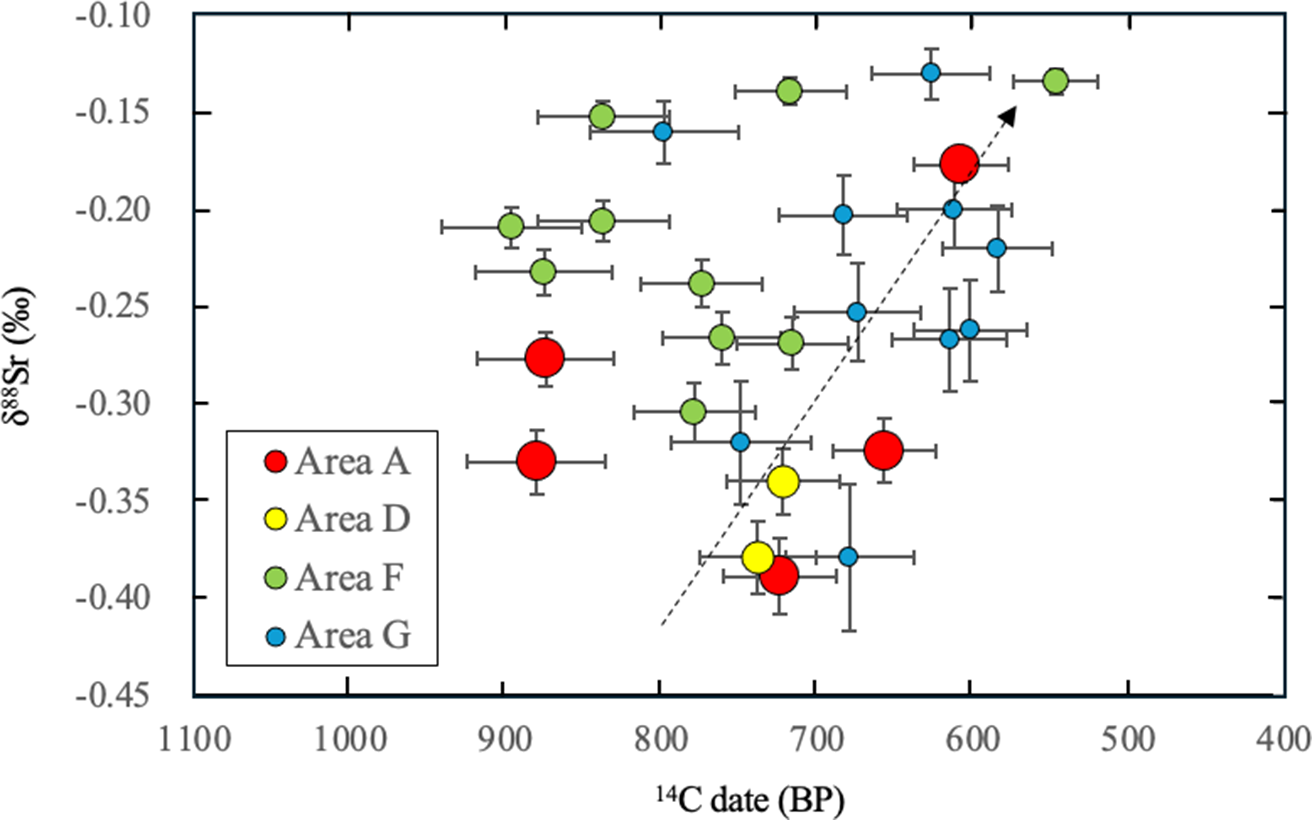
Area A represents the earliest sector of the site. Among the analyzed graves, Nos. 6–10 were arranged in sequence, whereas Grave 12 was constructed at the periphery of the mound. Radiocarbon dating indicates that most cremated remains date to the 12th–13th centuries, with only Grave 8 dating to the 14th century. Isotopically, Grave 8 exhibits relatively high δ88Sr values, suggesting a more herbivorous dietary signal, whereas the earlier graves show lower δ88Sr values indicative of more carnivorous tendencies. Given the distinctive grave architecture, Area A is interpreted as a burial ground for influential members of Binman-ji. One possible interpretation is that high-status monks or warrior affiliates—who may have consumed meat—were buried here during the 12th–13th centuries, while later burials in the 14th century may include monks who more strictly observed ascetic or dietary precepts.
Area F includes Grave 3, in which remains of multiple individuals were interred within a single urn and dated to the 12th–13th centuries. The δ88Sr values from this grave show little variation compared with other areas, suggesting burial of a group that shared broadly similar dietary practices. Cremated bones from Graves 1 and 5, as well as the most recent individual from Grave 3, date to the 13th century, indicating that Area F was used primarily during this period.
Area G, like Area A, is thought to have been used since the early phase of the Ishibotoke-dani cemetery; however, most analyzed remains date to the 14th century. At the other temple sites, earlier graves were sometimes disturbed and overbuilt by later cemeteries. Area G may therefore represent a newly established burial ground constructed on top of older deposits. The δ88Sr range is wide, from values comparable to the vegetarian signal of Jokei to a more carnivorous signature, indicating that individuals of diverse dietary backgrounds were interred. Their social status, however, was likely lower than those buried in Area A.
Historical records suggest that Binman-ji remained active until the latter half of the 16th century. However, no cremated remains dating to the 15th century or later were identified in this study, and few urns from this period have been reported. In contrast, numerous stone Buddhas, which are commonly associated with 16th-century graves, have been found at the site. This discrepancy may indicate a shift in mortuary practice, whereby stone markers were erected at Ishibotoke-dani while the bodies themselves were buried elsewhere.
Temporal changes in diet inferred from δ88Sr of cremated bones
The δ88Sr values were higher in the 14th century cremated bones than in those from the 12th and 13th centuries (Figure 4). Development of Binman-ji began in the 13th century, and by the 14th century the temple is known to have maintained armed forces. The higher isotopic tendency observed in the 14th century suggests that a more diverse range of individuals became associated with the temple during this period, from monks engaged in ascetic practices to armed monks and warriors.
Temporal changes in δ88Sr values of the Ishibotoke-dani cremated bones.

Temples and shrines were highly influential institutions in medieval Japan. Until the Nara period, most temples and shrines received financial support but were not directly controlled by the state. Following the collapse of the Ritsuryo system around the 9th century, temples became increasingly tied to aristocratic power. Furthermore, between the 11th and 12th centuries, donations to temples and shrines expanded, and major temples began to establish their own branch institutes, thereby achieving greater financial independence and political power. During the medieval period, temples belonged to a variety of people. In some cases, the children of emperors or powerful nobles were ordained and granted special monasteries; in other cases, children of local lords or influential farmers who donated their land as manors were ordained to prevent plunder by the central government. In addition, merchants and artisans entered temples and shrines as low-ranking priests to avoid taxation. Other members of temples and shrines included monk-soldiers as well as monks who did not observe the precepts, were married, or consumed meat (Ito Reference Ito2000). Taken together, the results of this study suggest that the higher δ88Sr values in the 14th century reflect the growing social and functional diversity of individuals affiliated with Binman-ji, as well as the heterogeneous populations integrated into the medieval temple community.
Conclusions
The 14C dates of the cremated bones from the Ishibotoke-dani site indicate clear chronological differences among the burial areas: Area A dates from the 12th to 14th centuries, Area F from the 12th to 13th centuries, Area D to the 13th century, and Area G mainly to the 14th century. These results are consistent with the historically documented period of activity of Binman-ji Temple (12th–16th centuries).
The cremated bones from the Ishibotoke-dani site show log(Sr/Ca) values ranging from −3.53 to −2.96. Compared with present-day animals, the cremated bones exhibit a more carnivorous trend in log(Sr/Ca) than those thought to belong to Jokei, a monk known to have abstained from meat consumption, indicating a degree of reliance on animal protein. Furthermore, the δ88Sr values (−0.389‰ to −0.130‰) of the Ishibotoke-dani cremated bones are lower than those of Jokei. The isotopic differences suggest that most individuals buried at the Ishibotoke-dani site consumed mixed diets that may have included animal protein and possibly aquatic resources.
In addition, examination of δ88Sr variation in relation to burial age reveals that individuals dated to the 14th century and later exhibit higher δ88Sr values than those dated prior to the 14th century. Given that the Binman-ji Temple is known to have expanded from the 13th century onward, this increasing isotopic diversity likely reflects the influx of individuals from broader and more varied social backgrounds accompanying the temple’s growth.
Acknowledgments
We thank Mr. R. Sawada and Mrs. H. Mukumoto for their experimental supports, Professor Emeritus T. Nakamura for conducting the 14C measurements, and A. S. Goto for preparing the fish sample, all from Nagoya University. We are also grateful to the staff of the Taga Municipal Museum for their assistance with sampling at the Ishibotoke-dani site. This study was supported by the Japan Society for the Promotion of Science, Grant-in-Aid for Challenging Exploratory Research (Nos. 18H007565 and 21H04359).



 Open access

