Introduction
Recently, ageing populations, growing diversity and the consequences of these processes for societies have gained public and scientific attention. It has been pointed out that by now also migrants have grown old in different country contexts (for Europe, Amrhein et al., Reference Amrhein, Heusinger, Ottovay and Wolter2015; for the United Kingdom (UK), Evandrou, Reference Evandrou2000; Botsford et al., Reference Botsford, Clark and Gibb2011; for the United States of America (USA), Dilworth-Anderson et al., Reference Dilworth-Anderson, Williams and Gibson2002; Knight and Sayegh, Reference Knight and Sayegh2010). As old age is a risk factor for care dependency (Colombo et al., Reference Colombo, Llena-Nozal, Mercier and Tjadens2011) and the health status of migrants in Europe is on average lower than in the majority population (Solé-Auró and Crimmins, Reference Solé-Auró and Crimmins2008; Aichberger et al., Reference Aichberger, Schouler-Ocak, Mundt, Busch, Nickels, Heimann, Ströhle, Reischies, Heinz and Rapp2010; Lanari et al., Reference Lanari, Bussini and Minelli2015), the probability of care-giving within migrant families increases heavily. In many European countries informal care is an important part of the overall care provision (Genet et al., Reference Genet, Kroneman and Boerma2013) and thus knowledge about the care-giver's health is needed to reduce health-care costs and to enable care-givers to continue care-giving if they want to. To date, most research focuses on informal care-giving in the majority population. Given the ongoing discussion about culturally sensitive care, studies focusing on the intersection of ageing and diversity are vitally important, in order to derive social policy measures and support for all kinds of care-givers (Lawrence et al., Reference Lawrence, Murray, Samsi and Banerjee2008; Knight and Sayegh, Reference Knight and Sayegh2010).
When talking about migrant care-givers in Europe, the history of a specific country needs to be taken into account. Some countries, like Belgium or Germany, have a similar history of labour market-related immigration, whereas others like Spain or Italy have themselves long been countries of emigration. However, since the 1980s those Southern European countries can be considered as countries of immigration, too (Geddes and Scholten, Reference Geddes and Scholten2016). In the UK, France and the Netherlands migration is strongly entangled with the countries’ history of colonisation (Warnes et al., Reference Warnes, Friedrich, Kellaher and Torres2004; Solé-Auró and Crimmins, Reference Solé-Auró and Crimmins2008). Since 1990 migration processes in Europe have changed towards a higher degree of inner European migration and less guest worker-related migration or migration related to the former colonies (Geddes and Scholten, Reference Geddes and Scholten2016). To date, 4.1 per cent of the EU-28 (28 member states of the European Union) population are people with citizenship of a non-member country (Eurostat, 2018). In summary, countries are differently shaped by migration although some similarities exist. This should be borne in mind when analysing informal care-giving and health outcomes for migrants across Europe.
The relationship between informal care-giving and health can be described with the ‘stress process’ (Pearlin et al. Reference Pearlin, Mullan, Semple and Skaff1990) and the ‘sociocultural stress and coping model’ (Knight and Sayegh, Reference Knight and Sayegh2010). In both models it is assumed that the burdensome care-giving situation influences the health of the care-giver. The stress process takes into account that care-givers may experience health outcomes of care-giving differently due to differences in, for example, socio-economic status, coping behaviour, and social and formal support. Moreover, within the framework of the socio-cultural stress and coping model cultural differences are considered. It is assumed that cultural differences are expressed in different norms and values regarding care-giving which then influence social support as well as coping styles and thus lead to different health outcomes of care-giving.
In view of these approaches, migrant informal care-givers could experience care-giving differently – positively or more negatively – compared to non-migrant care-givers. On the one hand, first-generation migrants could find it harder to buffer negative health outcomes of care-giving due to on average lower resources, e.g. financial means (Hunkler et al., Reference Hunkler, Kneip, Sand, Schuth and Börsch-Supan2015). On the other hand, they could be better off, due to their specific coping mechanisms and the stronger social support they might get due to their origin (Knight and Sayegh, Reference Knight and Sayegh2010). Last but not least, differences in the relationship of care-giving and health between migrants of different countries could be an expression of adverse circumstances in the country context in which care is given (Verbakel, Reference Verbakel2014), as European countries emphasise formal and informal support differently (Haberkern and Szydlik, Reference Haberkern and Szydlik2008; Stolz, Reference Stolz2015). Although previous research on care-giving in the majority population showed that the link between country contexts in which care-givers are supported more and health outcomes of care-giving is rather weak (Kaschowitz and Brandt, Reference Kaschowitz and Brandt2017), this might be different for migrant care-givers. In countries in which formal care provision is more pronounced, migrant care-givers might be less burdened because it is more likely that they are supplied with specific support, compared to those care-givers in countries where the level of formal care supply is low.
Until now, evidence on care-giving and health concerning migrants is scarce. Previous results – mainly from the USA – suggest that migrant care-givers have disadvantages regarding physical health but advantages regarding psychological health compared to non-migrant care-givers (Pinquart and Sörensen, Reference Pinquart and Sörensen2005). However, these studies often lack a longitudinal perspective and suffer from small sample sizes. Additionally, it is questionable whether such results can be transferred to migrant care-givers in Europe, as origin and context differ considerably.
To address the question of whether the origin and thus the culture in the different countries matters for health outcomes of care-giving, this study examines the health of migrant and non-migrant care-givers across Europe. In the first part of the analysis, the relationship between care-giving and the self-perceived as well as the mental health of migrants and non-migrants is compared. To address the issue of selection into care-giving based on health longitudinal models are applied. In the second part of the analysis, the paper investigates whether the relationship between care-giving and health varies across different welfare states. To do so, the relationship between care-giving and health for individuals of different origin across five country groups is compared. To date, no prior study has addressed these questions from this perspective.
The remainder of this paper is structured as follows. The article first discusses theories and empirical evidence with regard to the care-giving process and health outcomes for care-givers in and from different contexts and derives the hypotheses. Then the data and methods used to answer the research questions are described. The results are presented in the following section, and the article concludes with a discussion of the results and policy implications.
Pathway from care-giving to health
A common framework used to study care-givers’ health is the stress process. Regarding this process, the health status of a care-giver is the result of the interplay of characteristics related to care-giver and care recipient like age and gender, socio-economic status, care-giving needs, as well as social and formal support, and coping strategies. Care-givers might be stressed by the condition of the care recipient but at the same time this burden could be eased by social support or the exertion of coping strategies, which include behaviour and practices to handle stress. As those factors vary individually, health outcomes can vary individually, too (Pearlin et al., Reference Pearlin, Mullan, Semple and Skaff1990). Although this approach does not explicitly take into account the role of different origin and culture, it still might be useful to explain health outcomes of care-giving for migrants. This becomes apparent when taking previous empirical results on migrants across Europe into account.
As for social support, it has been shown that across Europe the support frequency in migrant families is higher (Bordone and de Valk, Reference Bordone and de Valk2016) – although the social network of migrants might have changed through immigration as migrants left parts of their families (Ciobanu et al., Reference Ciobanu, Fokkema and Nedelcu2016). In terms of care-giving and in the view of the stress process this higher support frequency suggests that migrants have higher care-giving frequencies – which could lead to more stress – but are supported by their network more generously – which could ease the care-giving burden.
Furthermore, studies have shown that migrants across Europe on average have a lower socio-economic status (European Commission, 2011; Hunkler et al., Reference Hunkler, Kneip, Sand, Schuth and Börsch-Supan2015). This could limit their possibilities to make use of other formal sources of help to lower their physical care-giving burden. Additionally, migrant care-givers and care recipients are expected to already have health difficulties as previous results suggest that elderly migrants are in worse health (Solé-Auró and Crimmins, Reference Solé-Auró and Crimmins2008; Aichberger et al., Reference Aichberger, Schouler-Ocak, Mundt, Busch, Nickels, Heimann, Ströhle, Reischies, Heinz and Rapp2010; Lanari et al., Reference Lanari, Bussini and Minelli2015), have a lower wellbeing (Sand and Gruber, Reference Sand and Gruber2018) and make use of health-care services more often (Solé-Auró et al., Reference Solé-Auró, Guillén and Crimmins2012), which contradicts a persistent ‘healthy migrant effect’ (e.g. Fennelly, Reference Fennelly2007). This lower health status could further worsen during the care-giving process.
Still, care-giving could lead to positive health outcomes, especially with respect to mental health, which is taken into account by cultural approaches, e.g. the socio-cultural stress and coping model. In this model it is assumed that cultural values of migrants, different to those of the majority population, influence coping styles and social support, which then account for different health outcomes of care-giving (Aranda and Knight, Reference Aranda and Knight1997; Knight and Sayegh, Reference Knight and Sayegh2010). Such cultural values include the opposing dimensions of familism and individualism, with migrants supposedly following the former (Aranda and Knight, Reference Aranda and Knight1997). In general, familism describes the identification of individuals with their families, high solidarity among family members, and strong normative feelings of obligation, dedication, reciprocity and attachment to family members (Knight and Sayegh, Reference Knight and Sayegh2010). In terms of care-giving, such familialistic values are supposed to lead to higher frequencies of social support and positive coping strategies – as care-giving is the fulfilment of familial solidarity (Aranda and Knight, Reference Aranda and Knight1997). Indeed, empirical studies showed that in England migrant care-givers from different ethnic backgrounds, e.g. South Indian or Black British, tend to be orientated towards a familialistic or collectivist view on care-giving more than other British care-givers (Willis, Reference Willis2012). Hence, the willingness to provide care for family members is motivated by affection, not by necessity, and care-giving within families is considered to be something positive (Willis, Reference Willis2012). However, supposing obligation is the main driver of support, then this could outweigh positive mental health effects of expressing solidarity with the family (Knight and Sayegh, Reference Knight and Sayegh2010).
In terms of origin, it is often said that the familism and individualism schemes can be linked to specific countries (Willis, Reference Willis2012). In this sense, individuals from traditional countries – i.e. Eastern, Central and Southern European countries – would bring along values of collectivism compared to individuals from modern countries – i.e. from Northern or Western European countries (Willis, Reference Willis2012). Given the specific history of migration and thus the often heterogeneous migration population in each country, it is likely that not only one type of cultural value with respect to care-giving exists in the migrant population. Furthermore, values can change over the course of time and the integration process, and values can differ from generation to generation (Goodenough, Reference Goodenough1999).
Besides personal characteristics, orientations and support, the country context is of importance for care-giving and health. Some European countries focus more on formal care, others rely more on informal care. These different approaches result in different measures provided for informal care-givers as well as in different levels of formal assistance. Based on two dimensions, the availability of ambulant formal care and the legal duty to provide care for relatives, Haberkern and Szydlik (Reference Haberkern and Szydlik2008) characterise countries either as service-based or family-based. In service-based countries formal help is offered quite extensively and addressed towards each individual, whereas in family-based countries the family has to provide help first. Taking this into account, countries like Italy, Spain and Germany are characterised as family-based, whereas Sweden and the Netherlands are considered to be service-based countries (Haberkern and Szydlik, Reference Haberkern and Szydlik2008).
Between these poles of generous welfare states and less-generous welfare states in terms of formal care supply, Stolz (Reference Stolz2015) adds two other types of care-specific welfare states. These are a ‘francophone Western European type’ characterised by high support of formal and moderate support of informal care, and a ‘Central European type’, which is described by moderate support of formal, but high support of informal care provision. Belgium and France can be assigned to the former, whereas Austria and Germany can be assigned to the latter. With regard to England, the article follows Comas-Herrera et al. (Reference Comas-Herrera, Wittenberg and Pickard2010) and Moffatt et al. (Reference Moffatt, Higgs, Rummery and Rees Jones2012). They describe the English care system as mixed because the system relies ‘heavily on informal care provided mainly by close relatives’ (Comas-Herrera et al. Reference Comas-Herrera, Wittenberg and Pickard2010: 387), but emphasises support for informal care-givers.
Generally, it is important to account for specific socio-demographic differences when studying the relationship between care-giving and health, e.g. for age and gender. These characteristics are important since older people and women give care more often (Lin et al., Reference Lin, Fee and Wu2012; Haberkern et al., Reference Haberkern, Schmid and Szydlik2015) and sex differences in health can be found across the lifecourse (Bambra et al., Reference Bambra, Pope, Swami, Stanistreet, Roskam, Kunst and Scott-Samuel2009). Furthermore, education, employment and income can explain the health status, as well as informal care demand and supply (Avendano et al., Reference Avendano, Jürges and Mackenbach2009; Broese van Groenou and de Boer, Reference Broese van Groenou and de Boer2016). The same applies to partners, who can be protective for each other's health but are also an important source for care-giving (Tolkacheva et al., Reference Tolkacheva, Broese van Groenou, de Boer and van Tilburg2011; Litwin et al., Reference Litwin, Stoeckel and Roll2014). As discussed above, a different origin can influence care-giving behaviour differently, and it can ease the burden of care-giving (Knight and Sayegh, Reference Knight and Sayegh2010; Bordone and de Valk, Reference Bordone and de Valk2016).
Evidence on the health status of migrant care-givers
There is clear evidence that care-giving is related to poor health. For most European countries and for the USA it has been shown that care-giving is even detrimental for the care-givers’ mental health (e.g. Coe and Van Houtven, Reference Coe and Van Houtven2009; Jenkins Rahrig et al., Reference Jenkins Rahrig, Kabeto and Langa2009; Kaschowitz and Brandt, Reference Kaschowitz and Brandt2017). However, the context matters, as health outcomes of care-giving differ with respect to socio-demographic characteristics, the care-giving setting, whether care-giving takes place inside or outside the household (Kaschowitz and Brandt, Reference Kaschowitz and Brandt2017), motives to give care (Broese van Groenou et al., Reference Broese van Groenou, de Boer and Iedema2013), the embeddedness in supportive networks (Tolkacheva et al., Reference Tolkacheva, Broese van Groenou, de Boer and van Tilburg2011) and the regional availability of formal care (Wagner and Brandt, Reference Wagner and Brandt2018). For migrant care-givers results are less clear-cut and to compare the previous empirical results is challenging, as data and methods as well as the contextual setting vary.
Based on a literature review of cross-sectional research, mainly from the USA, Dilworth-Anderson et al. (Reference Dilworth-Anderson, Williams and Gibson2002) study formal and informal support and conclude that ethnic minority care-givers use more informal than formal support. Migrants’ care-giving networks consist of close as well as distant family members. Such high informal care use might be explained by norms and values like familial obligations, by inhibitions to make use of formal care supply, by lower financial resources or by inappropriate formal care offers.
In their meta-analysis based on US studies, Pinquart and Sörensen (Reference Pinquart and Sörensen2005) show that ethnic minority care-givers have higher support frequencies, a higher subjective wellbeing and lower levels of burden, but seem to be in worse physical health compared to their non-migrant counterparts. Concerning care-giving for people with dementia, Botsford et al. (Reference Botsford, Clark and Gibb2011) find for the USA and the UK similar levels of depression and burden across different cultural groups, but again evidence is provided that ethnic minority care-givers are less depressed compared to care-givers in the majority population.
Contrary to this, Cichy et al. (Reference Cichy, Stawski and Almeida2014) find that African-Americans providing support state lower wellbeing compared to European-American adults. This is supported by Sayegh and Knight (Reference Sayegh and Knight2011), who focus on the role of familialism and cultural justification for the health of informal care-givers in the USA. They find that African-American care-givers feel more obligation, which suggests a higher care-giving burden.
Willis’ (Reference Warnes, Friedrich, Kellaher and Torres2012) results, based on a qualitative research design, suggest that the motives to give care differ between migrant and non-migrant care-givers. Ethnic minority care-givers in Britain tend to give collectivist reasons for care-giving rather than White British participants who gave individualistic reasons. This might be due to different ethnic identities which individuals develop in the immigration process.
The results of the different studies and reviews, based mainly on the North American context, predominantly show that minority care-givers have an advantage with regard to psychological health, but are disadvantaged regarding their physical health. Although, empirical studies from the USA rely on the concept of ethnicity which differs from the concept of migration used in this study, they can be seen as a starting point to compare how people in rather disadvantaged circumstances experience care-giving. It is assumed that the health of migrant care-givers across Europe differs from that of non-migrant care-givers due to the availability of resources, which can mediate health outcomes of care-giving. Such resources comprise coping strategies and social support but also financial means or educational levels. It is refered to the hypothesis as ‘migration matters’ (Hypothesis 1). Still, competing outcomes are possible. Migrant care-givers can be in better mental health compared to non-migrant care-givers due to other coping mechanisms and more social support, but they can be in worse physical health because their financial means might not allow them to include formal care. Considering the role of current circumstances, it is expected that migrant care-givers in countries which encourage family care are in worse health compared to those in countries with more generous services for care recipients. This is because support measures provided by the state can alleviate burden. In more generous states individuals can include other non-familial support much more easily and such support is most likely to meet their specific needs (‘welfare state matters’, Hypothesis 2).
Method
Data
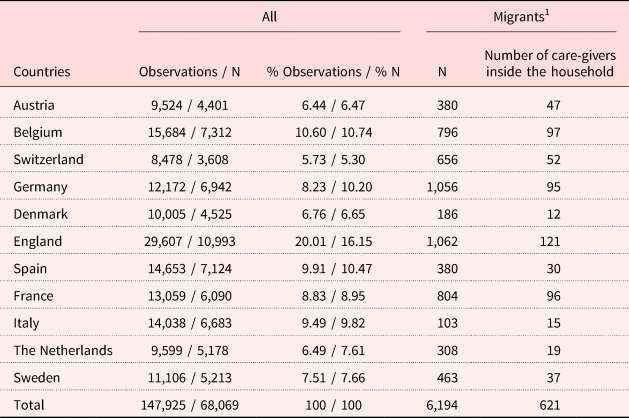
This analysis is based on data from Waves 1, 2, 4, 5 and 6 of the Survey of Health, Ageing and Retirement in Europe (SHARE; for details, see Börsch-Supan et al., Reference Börsch-Supan, Brandt, Hunkler, Kneip, Korbmacher, Malter, Schaan, Stuck and Zuber2013) and on data from Waves 2–6 of the English Longitudinal Study of Ageing (ELSA; for details, see Marmot et al., Reference Marmot, Oldfield, Clemens, Blake, Phelps, Nazroo, Steptoe, Rogers and Banks2015). Both data-sets focus on individuals in Europe aged 50 and older and cover a broad array of topics including social support, especially care, a various amount of health measures as well as information on migration. Given the research interest – health outcomes of care-giving for migrants and non-migrants in different welfare states – they are the only feasible data sources to study this topic. ELSA and SHARE were designed based on the Health and Retirement Study (HRS), which is a nationally representative, population-based sample of adults aged 50 and older in the USA. As such they are part of the ‘HRS-Family-of-Studies’, a collection of surveys aiming to enable cross-country research by harmonising their surveys (more information on these studies is available at https://g2aging.org/). Combining SHARE and ELSA, the data covers 11 countries (Austria, Belgium, Denmark, England, France, Germany, Italy, Switzerland, Netherlands, Sweden and Spain; see Table 1) of different welfare state types as classified by Esping-Andersen (Reference Esping-Andersen1990), Haberkern and Szydlik (Reference Haberkern and Szydlik2008) and Stolz (Reference Stolz2015).
Sample characteristics

Notes: 1. Not born in the respective country. Numbers presented for those observations which are part of at least one regression model.
Source: Survey of Health, Ageing and Retirement in Europe (SHARE) Waves 1, 2, 4–6 (until Wave 5 for the Netherlands); ELSA Waves 2–6; own calculations.
Dependent variables
Self-perceived health and depressive symptoms
To examine the health status of care-givers a general self-perceived health measure and two depression scales, both self-reported measures commonly used in sociological papers on ageing and health, are used (e.g. Litwin et al., Reference Litwin, Stoeckel and Roll2014; Lanari et al., Reference Lanari, Bussini and Minelli2015). The question about self-perceived health is the same in both data-sets (‘Would you say your health is … Excellent, very good, good, fair or poor?’). This measure is used to capture physical health as it has been shown to be related to objective health and can predict mortality (Idler and Kasl, Reference Idler and Kasl1995; Assari et al., Reference Assari, Moazen-Zadeh, Lankarani and Micol-Foster2016). Concerning the depressive symptoms for SHARE, the EURO-D scale, based on the EU initiative to compare symptoms of depression (Prince et al., Reference Prince, Reischies, Beekman, Fuhrer, Jonker, Kivela, Lawlor, Lobo, Magnusson, Fichter, van Oyen, Roelands, Skoog, Turrina and Copeland1999), and for ELSA the Center for Epidemiological Studies Depression Scale (CES-D scale; Radloff, Reference Radloff1977) are used. The EURO-D is an additive scale of 12 questions which comprise depression, pessimism, suicidality, guilt, sleep, interest, irritability, appetite, fatigue, concentration, enjoyment and tearfulness. Respondents are asked to answer if they experienced these symptoms in the last month or not. Higher values indicate more depressive symptoms. Usually, someone is considered to be depressed if he or she reports four or more depressive symptoms (Castro-Costa et al., Reference Castro-Costa, Dewey, Stewart, Banerjee, Huppert, Mendonca-Lima, Bula, Reisches, Wancata, Ritchie, Tsolaki, Mateos and Prince2007). The EURO-D scale is widely used and considered to be highly reliable (Prince et al., Reference Prince, Reischies, Beekman, Fuhrer, Jonker, Kivela, Lawlor, Lobo, Magnusson, Fichter, van Oyen, Roelands, Skoog, Turrina and Copeland1999; Courtin et al., Reference Courtin, Knapp, Grundy and Avendano-Pabon2015). The CES-D consists of eight questions asking if someone felt depressed, felt that everything was an effort, felt that his or her sleep was restless, was happy, felt lonely, enjoyed life, felt sad or was unable to get going (Courtin et al., Reference Courtin, Knapp, Grundy and Avendano-Pabon2015). Other than in SHARE, the respondents are asked if they experienced these symptoms in the last week. Usually, a person who reports three or more symptoms is considered to be depressed (Courtin et al., Reference Courtin, Knapp, Grundy and Avendano-Pabon2015). To account for differences in the two scores separate models for ELSA and SHARE were estimated (see Method).
All outcome measures were recoded so that positive values on the scale indicate better health. Thus, the self-perceived health scale runs from ‘poor’ (1) to ‘excellent’ (5) health and the depressive scales from ‘depressed’ (0) to ‘not depressed’ (12, EURO-D; 9, CES-D).
Explanatory variables
Migration status
It is distinguished between migrants and non-migrants, using the information on whether someone was born in the respective country or not. Thus, the focus is on first-generation migrants only. Those migrants are more likely to be in charge of care-giving at least for their spouse/partner as their own parents live far away (Ciobanu et al., Reference Ciobanu, Fokkema and Nedelcu2016), and second-generation migrants can be identified in SHARE only from Wave 5 onwards (Hunkler et al., Reference Hunkler, Kneip, Sand, Schuth and Börsch-Supan2015). Furthermore, the information on country of origin, that is in which country someone was born, is included. This information was clustered into 20 areas and introduced in the models to take into account that migrants in Europe stem from different country contexts. There are 6,194 first-generation migrants in the sample (Table 1). Most of them are from Europe followed by migrants from Africa and Asia.
Care-giving
This analysis focuses on informal care-giving inside the household. In SHARE, this refers to help given regularly on an almost daily or daily basis in the past 12 months inside the household; in ELSA, the information whether someone helped someone in the past week and if he or she lived together with this person were used. Individuals who received care in the household were excluded as those individuals could bias the comparison with non-care-givers. There are 621 migrant care-givers in the sample (Table 1) – in the authors opinion enough to employ cross-sectional as well as longitudinal models. For the models on the country level, the countries were sorted into groups of similar welfare states in order to increase power in the regression models. Those five country groups were a Central (Austria, Germany), a Western (Belgium, France, Switzerland), a Southern (Italy, Spain) and a Nordic (Denmark, Netherlands, Sweden) type, as well as Mixed (England).
Controls
In the regression models it was controlled for further influences that can be considered to be important factors related to both care-giving and health. These are age, sex, education (primary or less, secondary, tertiary, other – which also includes individuals with a foreign certificate and individuals who are still in school), employment status (not employed including retired, unemployed, permanently sick or disabled, home-maker and other/employed), income position (ten deciles, where each decile gives the relative income position of a person, e.g. the first income position means that somebody belongs to those 10% who have the lowest income), household size, spouse/partner in household, country, wave, migration status and country of origin [clustered into 20 regions according to the United Nations Statistics Division (2018): five African regions (east, middle, north, south and west), three American regions (central, south and north), five Asian regions (central, east, south, south-east and west), four European regions (east, north, south and west), a Caribbean region, a Polynesia region, as well as Australia and New Zealand].
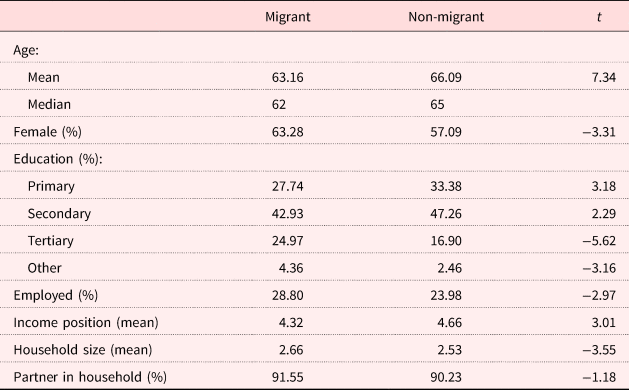
Migrant and non-migrant care-givers in the sample slightly differ with respect to socio-demographic characteristics. Migrant care-givers were on average younger, more often female, higher educated, more often employed, lived in larger households and more often together with their partner but had a slightly lower income position than non-migrant care-givers. These small differences between migrant and non-migrant care-givers were significant with an exception for partner in the household (Table 2). The significance was tested using a two-tailed t-test. For the categorical variables, differences in the share of a specific category between the two groups are tested.
Socio-demographic characteristics of care-givers by origin

Notes: Person-year data. t-Statistic for two-tailed t-test. Numbers presented for those observations which are part of at least one regression model.
Source: Survey of Health, Ageing and Retirement in Europe (SHARE) Waves 1, 2, 4–6; English Longitudinal Study of Ageing (ELSA) Waves 2–6; own calculations.
Method
In this analysis pooled ordinary least square (POLS) models and fixed-effects longitudinal models (FEM) were estimated. Precisely, two types of cross-sectional model were estimated to test the proposed hypotheses. The first POLS model captures differences in the relationship between care-giving and health for migrants and non-migrants (‘migration matters’). In the second model the relationship between care-giving and health was examined separately for each country and migration status (‘welfare state matters’). Estimating POLS models one has to take into account that observations of the same individual at different times are correlated. Thus, it is important to employ clustered standard errors correcting for this (Brüderl and Ludwig, Reference Brüderl, Ludwig, Best and Wolf2014). It was necessary to exclude England from the overall model (Model 1, ‘migration matters’, Tables 3 and 4) and to estimate separate models for SHARE and ELSA (Model 2, ‘welfare state matters’, Table 5), due to the differences in the health measures mentioned earlier as well as in the definition of care-giving.
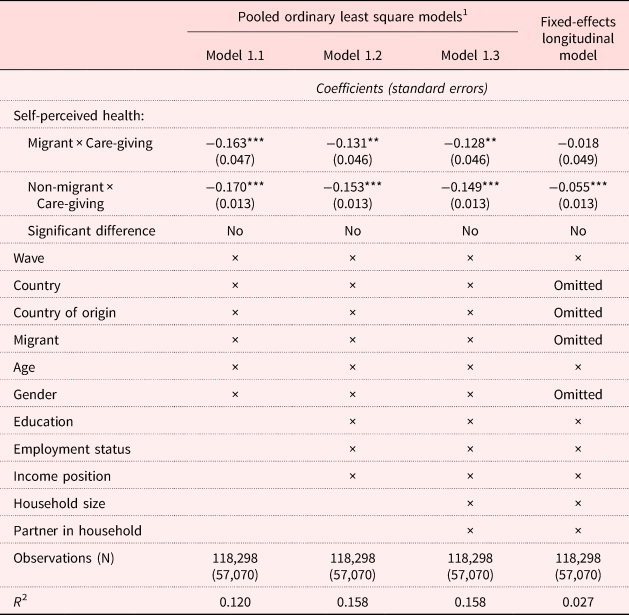
Regression results for care-giving and self-perceived health by origin (‘migration matters’, Model 1)

Note: 1. Clustered standard errors at the individual level.
Source: Survey of Health, Ageing and Retirement in Europe (SHARE) Waves 1, 2, 4–6; own calculations.
Significance levels: ** p < 0.01, *** p < 0.001.
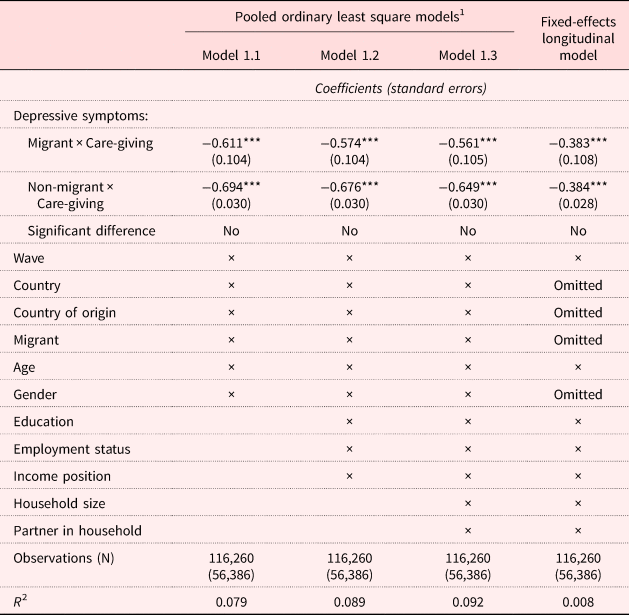
Regression results for care-giving and depressive symptoms by origin (‘migration matters’, Model 1)

Note: 1. Clustered standard errors at the individual level.
Source: Survey of Health, Ageing and Retirement in Europe (SHARE) Waves 1, 2, 4–6; own calculations.
Significance level: *** p < 0.001.
Regression results for care-giving and health by origin and country groups (‘welfare state matters’, Model 2)

Note: 1. Clustered standard errors at the individual level. Separate model for England (Mixed). Controls: wave, country, country of origin, migrant, age, gender, education, employment status, income position, household size, partner in household.
Source: Survey of Health, Ageing and Retirement in Europe (SHARE) Waves 1, 2, 4–6; English Longitudinal Study of Ageing (ELSA) Waves 2–6; own calculations.
Significance levels: * p < 0.05, ** p < 0.01, *** p < 0.001.
For the model type ‘migration matters’ (Model 1, Tables 3 and 4) a stepwise framework was utilised. The interest of the analysis is in the relationship between care-giving and health for migrants and non-migrants across Europe and it is assumed that differences in this relationship might be attributed to differences in the attitude towards care-giving or to differences in the availability of resources, it might not be possible to find any differences between the groups if one controls for such resources all at once. First, the controls wave, country, country of origin, migration status (yes/no), age and gender were introduced. Then information about education, employment status and income were added. In the last step information on the household level such as household size and whether there is a partner in the household were introduced. For the second model type (‘welfare state matters’), the main interest was in the comparison across country groups so all controls were introduced together.
Results
Descriptive statistics
Interestingly, compared to non-migrants, migrants gave care inside the household less often in Denmark, the Netherlands, France, England, Spain and Italy (Figure 1). A possible explanation is that migrants in these countries may not be in charge of care-giving yet, as they are on average about three years younger than the majority population in the respective country (Table 2).
Percentage of care-giving by origin.

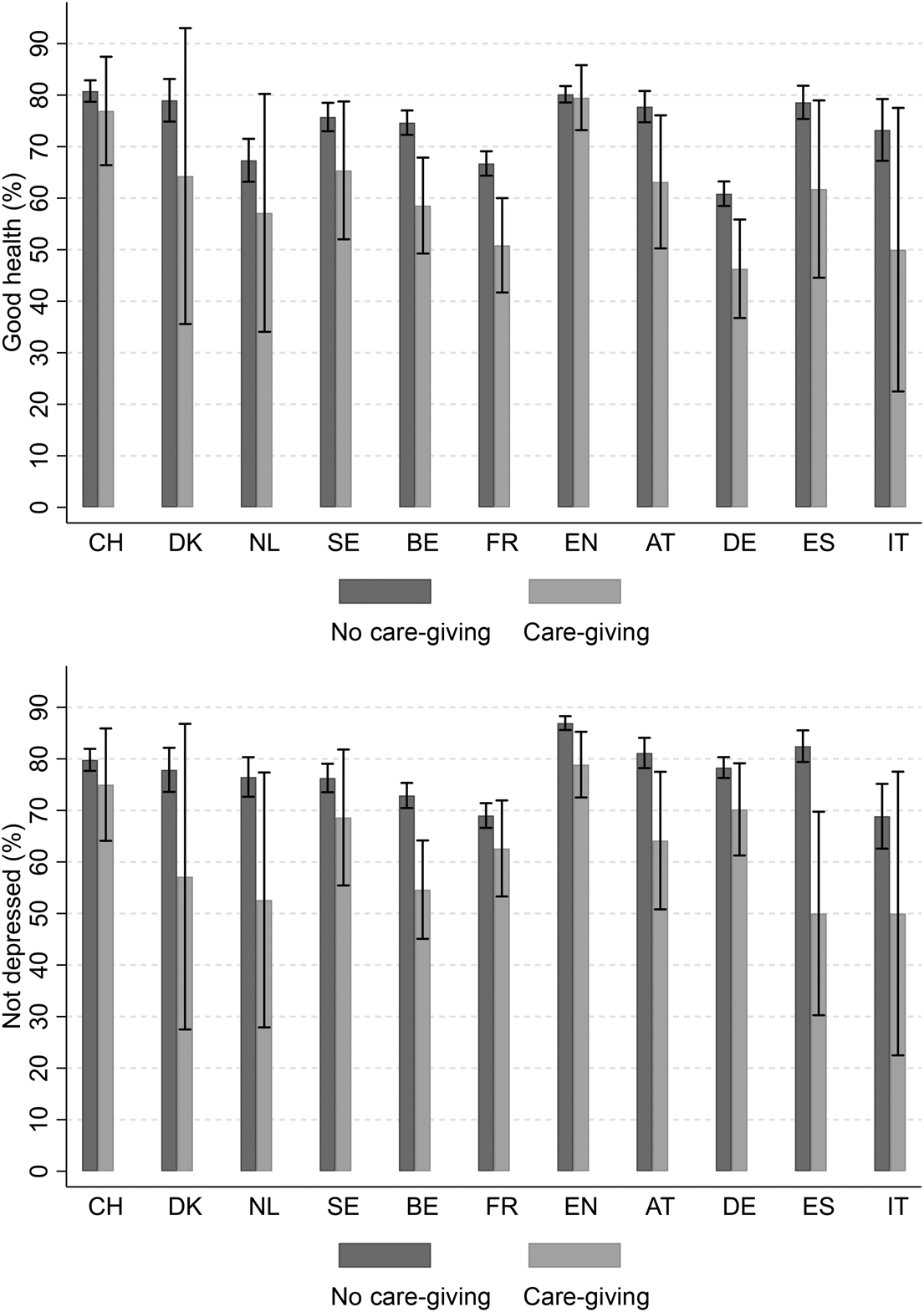
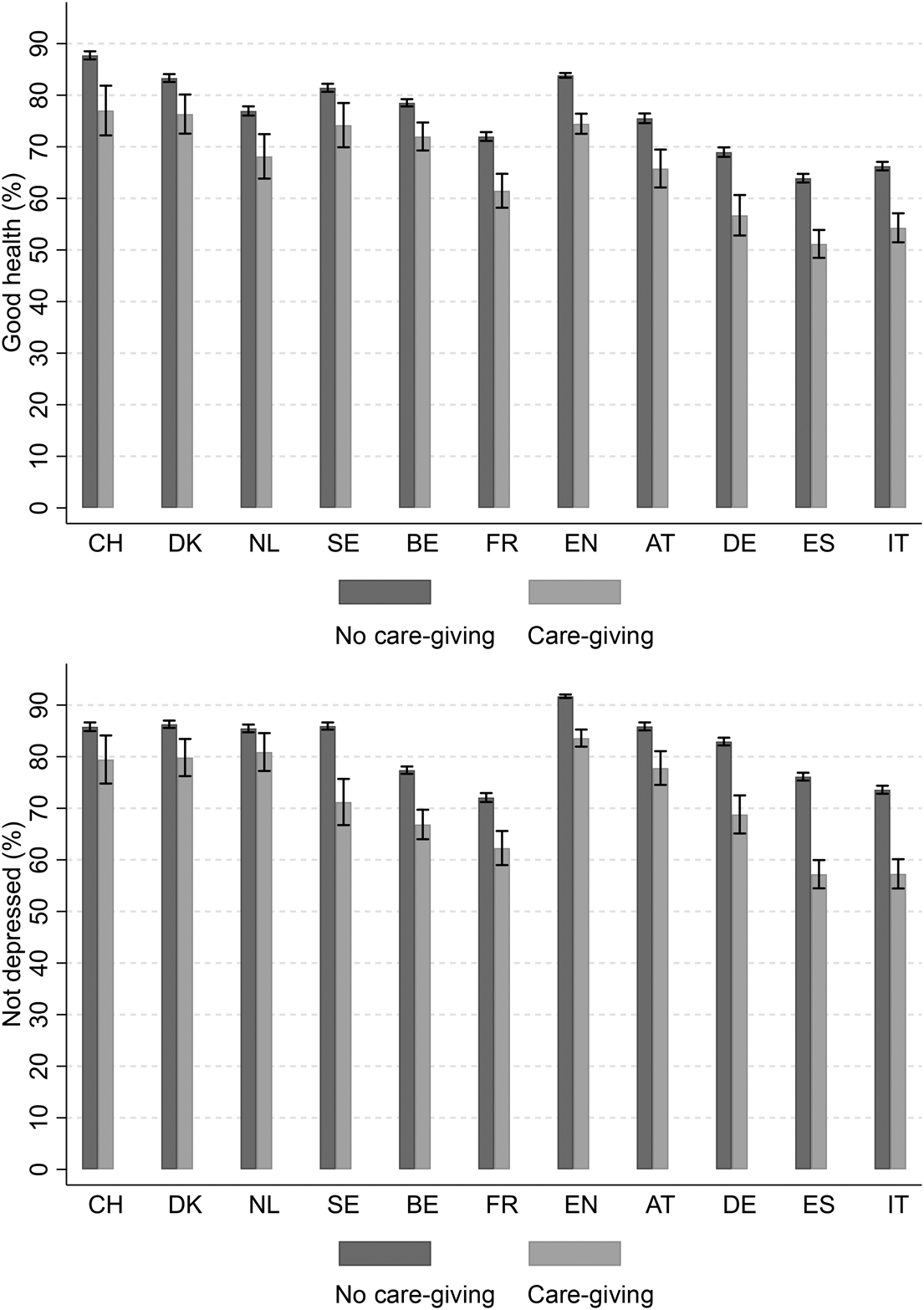
In a next step the health status of migrant care-givers and migrant non-care-givers was compared (Figure 2) as well as the health status of care-givers and non-care-givers (Figure 3). These descriptive statistics showed that care-givers of any type – migrant care-givers and non-migrant care-givers – reported worse self-perceived health and more depressive symptoms than non-care-givers of the respective type (Figures 2 and 3). Furthermore, in most countries migrant care-givers also reported worse self-perceived health and more depressive symptoms compared to non-migrant care-givers. This did not apply to England and Spain – where migrant care-givers were in better self-perceived health – and France and Germany – where migrant care-givers reported slightly fewer depressive symptoms than non-migrant care-givers. Across Europe clear country differences concerning self-perceived health appeared. Migrants in Germany reported the lowest health status.
Health status of migrant informal care-givers.

Health status of non-migrant informal care-givers.

These first descriptive results showed that migrants in Europe indeed have a lower health status than non-migrants and that country differences exist. Other than expected, support in migrant households does not exceed that of their non-migrant counterparts. However, the descriptive results give only a first impression of the relationship between care-giving and health for migrant care-givers across Europe. Since there are differences between migrants and non-migrants, e.g. in sex and age composition, regression analyses were conducted to account for such differences.
Regression results
Table 3 shows the results for the model ‘migration matters’ (Model 1) and the outcome ‘self-perceived health’. The pooled models (POLS) revealed for all model types (Models 1.1, 1.2 and 1.3) that migrant as well as non-migrant care-givers in all countries of SHARE investigated here were in significantly worse health compared to non-care-giving individuals of the respective type, that is migrant non-care-givers and non-migrants who do not give care. One can see that the coefficients for care-giving were slightly larger, in absolute terms, for non-migrant care-givers than for migrant care-givers. This difference was stable across all model specifications but never statistically significant, which indicates that the relationship between care-giving and health was similar for migrants and non-migrants.
To address the problem of endogeneity, a longitudinal model was employed (FEM; Table 3). This model uses only intra-individual changes in care-giving and health and helps to come closer to an answer to the question of whether health effects of care-giving occur or whether the results presented so far rather reflect selection into care-giving of people in poor health. Applying the FEM there was still a negative relationship between care-giving and health for both groups under study. The care-giving coefficients were clearly smaller than in the POLS models and stayed significant only for non-migrant care-givers. This results shows that, for non-migrant care-givers taking up care goes along with a decrease in self-perceived health. In contrast, the negative but very small and insignificant coefficient for migrant care-givers in the longitudinal model suggests no health effects for migrant care-givers. Thus, the negative and significant correlation found in the POLS models seems to be due to selection of migrants in poor health into care-giving. Comparing the care-giving coefficients, no significant difference between health outcomes for migrant care-givers and non-migrant care-givers was found as the point estimates are different but not significantly different. This may be due to the fact that the estimates for the small number of migrants are relatively imprecise.
Concerning depressive symptoms, the results revealed that migrant as well as non-migrant care-givers – compared to non-care-givers of the respective type – were in significantly worse mental health (Table 4). This is true for all model specifications. In each of the POLS models the coefficients of care-giving for migrants were less negative compared to those for non-migrant care-givers. Again the coefficient size for both care-giver types decreased, in absolute terms, with the inclusion of further controls. Similar to the outcome ‘self-perceived health’ discussed above, no significant differences in the relationship between care-giving and mental health between migrant and non-migrant care-givers were found. The results of the fixed-effects model showed that taking up care is significantly associated with an increase in depressive symptoms for both migrant care-givers and non-migrant care-givers. This suggests negative mental health effects for both groups under study. Interestingly, the sizes of the care-giving coefficients for both groups were almost numerically identical and again not significantly different.
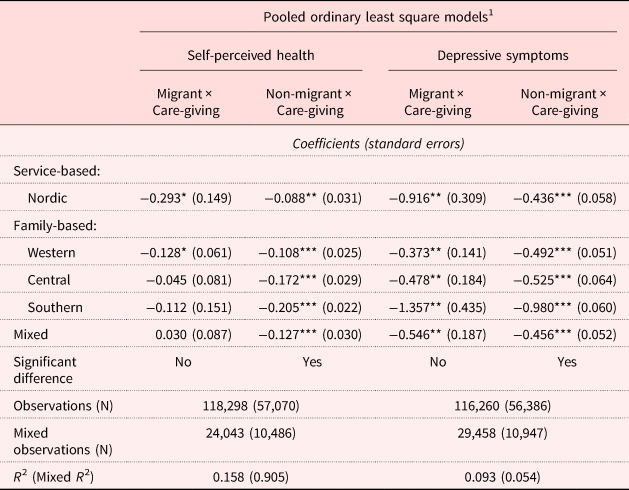
In a next step, the health status of care-givers across Europe was compared to detect differences with respect to the country context. Table 5 shows the results for the model type ‘welfare state matters’ (Model 2) and the outcome ‘self-perceived health’ as well as depressive symptoms.
Across Europe non-migrant care-givers in all country groups were in significantly worse health than non-care-givers. Furthermore, the differences between the country groups were significant, showing that the relationship between care-giving and self-perceived health is not the same for individuals in the different welfare states under study. The results suggest that care-giving in countries categorised as Southern and Central welfares states is most detrimental. For migrant care-givers in the different European contexts the results mostly showed a negative relationship between care-giving and health too, but this relationship was significant only for care-givers in the Nordic and Western countries. Although there is quite some variation in the care-giving coefficient size across the country groups, no significant differences were found.
A slightly different picture was revealed for care-giving and mental health (Table 5). In all country groups non-migrant care-givers and migrant care-givers reported significantly more depressive symptoms than non-care-givers of the respective type. The care-giving coefficient for non-migrant care-givers was the largest in Southern countries and the lowest in England. For non-migrant care-givers significant differences in the relationship between care-giving and health between the different countries were found. Interestingly, for migrant care-givers the size of the care-giving coefficient was the highest, in absolute terms, in Southern and Nordic countries, followed by England, Central and Western countries. Probably due to the smaller sample sizes the large differences in the coefficient size between the country groups were not significant.
Discussion
Recently, it has been pointed out that the probability that migrants across Europe have to deal with informal care-giving is rising considerably (Willis, Reference Willis2012; Amrhein et al., Reference Amrhein, Heusinger, Ottovay and Wolter2015). Until now, most evidence on care-giving and health has dealt with health outcomes of care-giving irrespective of the individual background. However, health outcomes of care-giving could be different for migrants due to differences compared to the majority population in health, social support, education, financial status and cultural values (Koopmans, Reference Koopmans2009; Bordone and de Valk, Reference Bordone and de Valk2016; Sand and Gruber, Reference Sand and Gruber2018). Previous evidence from the USA suggests that ethnic minority care-givers experience worse physical health than mental health problems (Pinquart and Sörensen, Reference Pinquart and Sörensen2005). These results do not necessarily apply to migrant care-givers in Europe, as diversity and history of migration are different compared to the USA. Furthermore, across Europe there is a broad variation in welfare state contexts which is related to a different level of support for care-givers. This could then be related to different health outcomes of care-giving (Haberkern and Szydlik, Reference Haberkern and Szydlik2008; Stolz, Reference Stolz2015). Additionally, previous results were mostly based on cross-sectional data and methods, and therefore causal conclusions cannot be drawn from that.
The aim of this analysis was to evaluate differences between migrant and non-migrant care-givers in Europe, as well as to examine differences across countries. The analysis was based on the European comparative longitudinal data of SHARE and ELSA. First, the relationship between care-giving and health for migrant and non-migrant care-givers was examined. In the next step, also longitudinal models were applied to address individual changes in care-giving and health. Second, the relationship between care-giving and health in five country groups was compared.
The descriptive statistics revealed that care-givers of each type were in worse self-perceived health and reported more depressive symptoms than their non-care-giving counterparts. Of those giving care, migrants were in worse mental and physical health in all countries but England, Spain, France and Germany. For both outcomes, the negative correlation between care-giving and health remained when controlling for socio-demographic differences between care-givers and people who did not provide care. Other than expected and irrespective of the outcome used, no differences in the relationship of care-giving and health between migrant and non-migrant care-givers were found. This could be accounted for by the fact that lower resources, which make care-giving more burdening, and care-giving norms, which make care-giving less burdening, balance each other out. Another explanation could be that care-giving by migrants is in large part driven by feelings of obligation, which contradict positive perceptions of care-giving.
Furthermore, the longitudinal results suggest that taking up care deteriorates mental health for all groups of care-givers under study. This indicates, other than expected, that migrants in Europe do not employ specific coping mechanisms which might prevent care-givers from experiencing mental health burden. With respect to self-perceived health, adverse effects were found only for non-migrant care-givers. For migrant care-givers the results rather indicate selection processes, i.e. migrants in bad self-perceived health are more likely to take up care inside the household. Taken together, neither the cross-sectional results nor the longitudinal results support Hypothesis 1 (‘migration matters’).
The analyses on the country level showed, that non-migrant care-givers and migrant care-givers in all groups of countries under study reported significantly more depressive symptoms compared to their non-care-giving counterparts. Since there are country differences the results showed that the relationship between care-giving and depressive symptoms is not the same across Europe. As expected, the negative relationship between care-giving and depressive symptoms is most evident in the Southern welfare states for non-migrant care-givers. However, for migrants care-giving seems to be very detrimental in both Southern and Nordic welfare states. Thus, for migrant care-givers the evidence suggests that family-based contexts as well as service-based contexts can be disadvantageous (‘welfare state matters’, Hypothesis 2).
The results differ slightly with respect to self-perceived health. For most countries a negative relationship between care-giving and self-perceived health was found. This relationship was significant for non-migrant care-givers in all country groups and significant for migrant care-givers in Nordic and Western countries. With respect to self-perceived health the evidence suggests that family-based contexts are more disadvantageous than service-based contexts for non-migrant care-givers. However, for migrant care-givers service-based contexts seem to be most detrimental (‘welfare state matters’, Hypothesis 2).
The results are in line with research on care-giving and health which finds negative outcomes of care-giving for the majority population (Coe and Van Houtven, Reference Coe and Van Houtven2009; Jenkins Rahrig et al., Reference Jenkins Rahrig, Kabeto and Langa2009; Kaschowitz and Brandt, Reference Kaschowitz and Brandt2017). They are also in line with Cichy et al. (Reference Cichy, Stawski and Almeida2014) and Sayegh and Knight (Reference Sayegh and Knight2011), who find evidence for lower wellbeing and stronger feelings of obligation, which could lead to higher care-giving burden for ethnic minority care-givers. As the analysis showed that migrants were mentally burdened by care-giving the results contradict the findings of Pinquart and Sörensen (Reference Pinquart and Sörensen2005). Furthermore, they seem to speak against theories which suggest that migrants might have (group) specific coping mechanisms which prevent mental health burden (Aranda and Knight, Reference Aranda and Knight1997; Knight and Sayegh, Reference Knight and Sayegh2010).
The limitations of this study concern operationalisation and methods used. This analysis focused on the more intensive type of care-giving – care-giving inside the household – but did not take care-giving outside the household into account. It must be pointed out that care-giving inside the household covers mainly support for the care-giver's spouse or partner in the household: this applies for both migrant and non-migrant care-givers. Furthermore, migrant care-givers investigated here are especially unlikely to give care to their older parents as they most likely live far away. Another feature of SHARE that makes the group of migrants a selective one is that they are interviewed in the language of the country in which the interview is carried out. Furthermore, there are different groups of migrants in the countries stemming from different contexts – this was taken into account by controlling for country of origin.
Due to the small number of migrants in the sample, longitudinal models could not be applied for all model types and it could not be examined whether migrants in the different countries experience mental health burden due to care-giving. For the same reason it was not distinguished between people who were not born in the respective country (migrants) and their children (second-generation migrants). Furthermore, England was excluded from the overall models (‘migration matters’) due to the differences in the measurement of the outcomes (depression scale and self-perceived health in Wave 3) as well as controls (no information on country of birth).
Nevertheless, the data used in this analysis are the only available to analyse care-giving, health and migration across Europe. The analysis highlights the importance of taking various country contexts into account. There is evidence that the mechanisms between care-giving and health are not different for migrant and non-migrant care-givers across Europe. However, some country contexts seem to be more detrimental for migrants than for non-migrants. Interestingly, this applies also to welfare states which are considered to be care-giver friendly because they provide more formal assistance for care-dependent individuals. Considering this, policy makers in all welfare states should take into account the changing composition of care-givers and develop measures to provide them with the support they need to fulfil this demanding and socially important task. Again, this study showed that care-giving is highly demanding and health measures to support care-givers are important, especially in times of growing diversity and ageing.
Data
This paper uses data from SHARE Waves 1, 2, 4, 5 and 6 (DOIs: 10.6103/SHARE.w1.600, 10.6103/SHARE.w2.600, 10.6103/SHARE.w4.600, 10.6103/SHARE.w5.600, 10.6103/SHARE.w6.600), see Börsch-Supan et al. (Reference Börsch-Supan, Brandt, Hunkler, Kneip, Korbmacher, Malter, Schaan, Stuck and Zuber2013) for methodological details. The SHARE data collection has been primarily funded by the European Commission through FP5 (QLK6-CT-2001-00360), FP6 (SHARE-I3: RII-CT-2006-062193, COMPARE: CIT5-CT-2005-028857) and FP7 (SHARE-PREP: No. 211909, SHARE-LEAP: No. 227822, SHARE M4: No. 261982). Additional funding from the German Ministry of Education and Research, the Max Planck Society for the Advancement of Science, the US National Institute on Aging (U01 AG09740-13S2, P01 AG005842, P01 AG08291, P30 AG12815, R21 AG025169, Y1-AG-4553-01, IAG BSR06-11, OGHA 04-064, HHSN271201300071C) and from various national funding sources is gratefully acknowledged (see www.share-project.org). The ELSA data were made available through the UK Data Archive. ELSA was developed by a team of researchers based at the NatCen Social Research, University College London and the Institute for Fiscal Studies. The data were collected by NatCen Social Research. The funding is provided by the National Institute of Aging in the USA, and a consortium of UK government departments co-ordinated by the Office for National Statistics. The developers and funders of ELSA and the UK Data Archive do not bear any responsibility for the analyses or interpretations presented here.
Acknowledgements
The author is grateful for comments by the editor and two anonymous referees. The author also thanks the participants at conferences in Stirling and Athens for their suggestions.