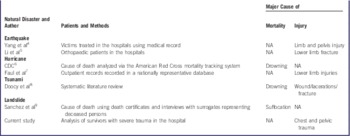
Natural disasters are inevitable and generate an enormous number of patients with trauma. It is estimated that over the past 20 years, natural disasters have claimed more than 3 million lives worldwide, affecting at least 800 million people,Reference Peek-Asa, Kraus and Bourque 1 with earthquakes, typhoons, hurricanes, and floods being mainly representative of such disasters.Reference Mahoney and Reutershan 2 , Reference Ragan, Schulte and Nelson 3 From the point of view of trauma care, there is no doubt that earlier rescue and quicker treatment are essential and that recognition of injury patterns should contribute to better outcomes. However, the details of injury mechanisms have not been well studied, even if the injury pattern and cause of death are assumed to differ in each type of natural disaster (Table 1).Reference Yang, Wang and Zhong 4 - Reference Sanchez, Lee and Young 9 In the usual setting of a disaster, patients are triaged at the scene and transported to numerous medical services. Therefore, inclusive analysis of an entire cohort of patients is difficult. However, such data analysis is of great importance in understanding the characteristics of injury patterns, thus enabling more efficacious treatment for rescued survivors.
Differences in Injury Pattern and Cause of Death in Several Types of Natural DisastersFootnote a

a Abbreviation: CDC, Centers for Disease Control and Prevention; NA, not available.
Landslides constitute one of the more frequent and threatening natural disasters worldwide. In East Asian countries, landslides after heavy rainfalls lead to multiple losses of life and economic losses in the billions of dollars annually.Reference Lee 10 , Reference Alkhasawneh MSh and Tay 11 Considerable geological research has therefore been conducted regarding the prediction of landslides. However, in terms of the care of the victims, little has been published regarding injury patterns resulting from landslides.Reference Kennedy, Petley and Williams 12
In the present study, we gathered data on the victims of a landslide disaster and analyzed the injury patterns in those who were first transported to the only medical hospital on the isolated island where the landslide occurred. Our aim was to delineate the injury patterns observed and to discuss how to minimize the damage caused by landslide disasters.
Methods
Natural Disaster: Landslide in Oshima, Tokyo, Japan
At around 3:00 AM on October 16, 2013, a landslide occurred at the thin volcanic ash layer of the hillside surface on Oshima Island (coordinates: 34°44’N, 139°22’E, 100 km south of Tokyo, 22 km east of the Izu Peninsula, and 36 km southwest of Boso Peninsula), Japan, after heavy rainfall (which reached up to 549.5 mm in 6 h, with a 24-hour total of 824 mm) related to Typhoon Wipha.
Clinical Data
Ethical considerations were reviewed by institutional review boards at Oshima Medical Center, and this study was approved. A total of 49 victims with landslide-related injuries were identified.
Analysis
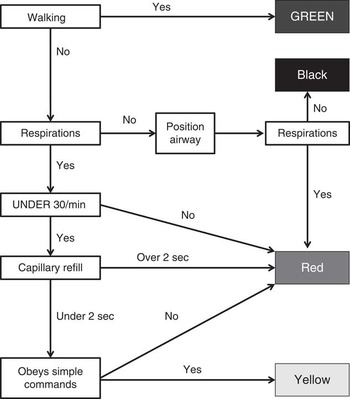
First, the data of all patients were collected and analyzed, including age and triaged color based on the Simple Triage And Rapid Treatment method (START triage).Reference Super 13 Detail of the diagnostic process using START triage is shown in Figure 1. Next, according to age, the patients were divided into 3 groups: children and adolescents (1–19 years), adults (20–59 years), and elderly (≥60 years). Last, the data of patients who were transported to the hospital were analyzed, including age, triaged color according to START triage,Reference Super 13 location of injuries, and Injury Severity Score (ISS).Reference Baker, O’Neill and Haddon 14
The Diagnostic Process Using START (Simple Triage And Rapid Treatment) Triage.

Results
Age Distribution of Patients
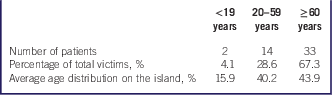
The patients ranged in age from 5 to 89 years, with an average age of 61.0±19.3 years. The elderly accounted for 67.3% of patients, which is higher than the average elderly proportion on the island (Table 2).
Age Distribution of the Patients Compared to the Average on the Island

Distribution of Triaged Color According to Age
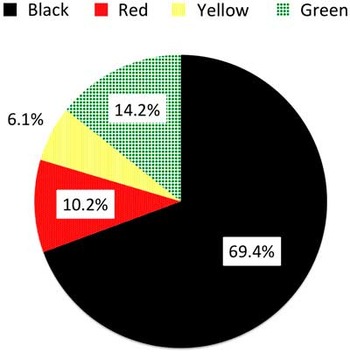
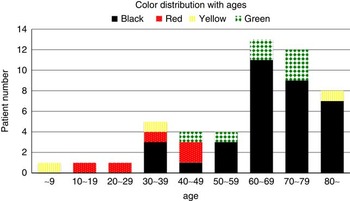
Black accounted for 69.4% of all patients (Figure 2). The distribution of triaged color according to age is shown in Figure 3. In patients older than 60 years, 79.4% were triaged as black. By contrast, 43.8% of patients younger than 59 years were triaged as black. The relative risk for black triage patients >60 years old was 1.81-fold that in those <59 years old.
Distribution of Triage Color in Disaster Victims.

Distribution of Triage Color by Age.

Analysis of Injury Patterns in Patients Treated in the Hospital
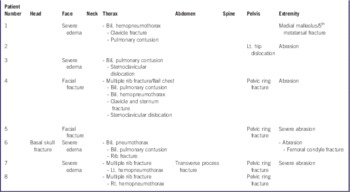
Fifteen patients (average age, 43±23.2 years) were treated in the hospital. Five patients were color triaged as red, 3 as yellow, and 7 as green. The average ISS was 14.1 points. Seven patients triaged as green had superficial dermabrasions or bruises and a low ISS (1 point). However, 8 patients triaged as red and yellow had severe chest or pelvic injury with a high ISS score (average, 25.6 points; range, 4–45; Table 3). Of these patients, 75% had severe chest injury including multiple rib fractures, hemopneumothorax, and pulmonary contusion, with 75% of those having severe pelvic injury, including pelvic fracture and hip dislocation. The percentage of chest or pelvic injury was 100% in patients triaged as red or yellow. Moreover, traumatic asphyxia was diagnosed in 62.5% of the patients having severe facial edema with petechiae and purpura. Contrary to our expectation, there were no abdominal injuries and very few limb fractures among the patients treated in the hospital (one patient with a fracture of the condyle of the femur and one patient with a fracture of a medial malleolus and a fifth metatarsal).
All Injuries in the 8 Patients Triaged as Red and YellowFootnote a

a Abbreviations: Bil, bilateral; Lt, left; Rt, right.
Discussion
According to Peek-Asa et al,Reference Peek-Asa, Kraus and Bourque 1 natural disasters over the past 20 years—mainly earthquakes, typhoons, hurricanes, and floods—have claimed more than 3 million lives worldwide, have affected at least 800 million people, and have resulted in property damage exceeding US $500 billion.Reference Mahoney and Reutershan 2 , Reference Ragan, Schulte and Nelson 3 Landslides also represent one of the most aggressive natural disaster scenarios to cause loss of life worldwideReference Sanchez, Lee and Young 9 , Reference Kennedy, Petley and Williams 12 , Reference Kariya, Sato and Mokudai 15 and constitute a frequent problem in Japan following heavy rainfall, occurring approximately 500–2500 times per year.Reference Motoki, Shunji and Kotaro 16
From the point of view of emergency rescue and care, it is obvious that the earliest possible rescue and prompt treatment are vital for survivors. For effective management, the recognition of injury patterns in each disaster setting is important. However, details of the injury mechanisms in various natural disaster settings have not been well studied, even if the injury patterns and causes of death are assumed to differ for each type of natural disaster.
Concerning the analysis of injury patterns in other forms of natural disasters, Li et alReference Li, Jiang and Chen 5 reported injury patterns caused by an earthquake in Yushu, China, in 2010. They analyzed 585 fractures in 582 orthopaedic patients and concluded that the most common injury was limb fractures (42%), with chest trauma seen in only 34 patients (5.8%). The Centers for Disease Control and Prevention reported mortality associated with Hurricane Sandy (October–November 2012) and concluded that drowning (34.2%) was the most frequent directly related mechanism of death. 6 When compared with these analyses (Table 1), it is clear that the injury patterns associated with landslides differ from those observed in other natural disasters.
In this study, we evaluated victims of a landslide on an isolated island and analyzed the pattern of injury in survivors who were transported to the only available medical facility. Our data showed that compression of the trunk, including the chest and pelvis, was the main injury; 100% of the patients who were triaged as red and yellow had chest or pelvic injury without any abdominal injury, and 62.5% of the patients had severe facial edema with petechiae and purpura as well as traumatic asphyxia. It is hypothesized that the earth and sand rolls up the body and compresses the broadest part of the body (ie, the chest and pelvis), causing lethal injury resulting from multiple rib fractures, hemopneumothorax, pulmonary contusion, and pelvic fracture. As a consequence, the victims are faced with a risk of death from hypoxia and hypovolemia. This implies that the injuries resulting from the landslide are violent and can become lethal within a relatively short period in the absence of any emergency treatment. Of course, those injury patterns in patients who were treated in the hospital might not completely represent the total injury pattern caused by the landslide disaster, because we did not evaluate the patients who were triaged as black at the disaster site, and the sample size was too limited to draw conclusions. However, we believe that our analysis is useful for the presumption of the injury pattern by landslide, and further study should be undertaken.
In a study that included 400 households, Agrawal et alReference Agrawal, Gopalakrishnan, Gorokhovich and Doocy 17 performed a stratified cluster survey for injuries after landslides caused by several consecutive days of heavy rain in Uganda in 2010 and demonstrated that among those injured in the landslide, broken bones and fractures (44.4%) were the most common type of injury, followed by bruises and abrasions (27.8%). Their results are quite contradictory to the results in the present study. The discrepancies in findings may be explained as follows. First, our analysis was a hospital-based survey and the data were analyzed in patients who were treated in a well-equipped hospital within 12 hours after the landslide. Thus, our data focused more on patients in critical situations such as red and yellow color-triaged patients. We believe that our data demonstrate more direct effects of a landslide. By contrast, the report by Agrawal et al, which of course is of great scientific value for the analysis of different injury patterns between landslide and flood, might underestimate the severity of injuries caused by those disasters because the study was performed as an interview survey of survivors a certain period of time after the disaster.Reference Kariya, Sato and Mokudai 15 Second, the findings in our study may have been affected by the timing of the landslide event, at 3:00 AM, when most of the victims were presumed to be asleep. The onslaught of earth and sand on victims while they were lying prone may have been an influential factor in our analysis.
To minimize potential damage resulting from a landslide disaster, we consider it most important that the possibility of a landslide be monitored and that evacuation be advised in advance when the risk is high. Because such landslides can cause life-threatening injury, such trauma will be difficult to treat in situations lacking a fully equipped medical service. Second, it is necessary to rescue the victims as quickly as possible when a landslide occurs. The time available for effective rescue after a landslide might be much shorter in comparison with other natural disasters such as earthquakes. Although all of our patients in critical condition who were quickly transported to our institution survived, a delay in starting initial treatment might have led to preventable trauma death. Indeed, 69.4% of victims in our study were triaged as black, and there were no survivors as early as 1 day after the incident. By contrast, it is well known that after an earthquake, survivors can still be rescued several days after the event. Third, medical practitioners such as prehospital and in-hospital specialists should have knowledge of the specific injury patterns inherent in landslide scenarios. In addition to the standard trauma care, it is suggested that intense attention be paid to the treatment of chest and pelvic trauma and that those treatments should not be delayed.
The strengths of this study were as follows. First, the analysis was of patients with severe trauma caused by a landslide disaster. To date, no articles have analyzed patients in critical condition as the result of a landslide. Second, we managed to analyze all patients who needed emergency medical care, because our institution is the only medical hospital on the isolated island where the landslide occurred.
Limitations
In addition to those strengths, our study had several limitations. First, we did not conduct an analysis of victims triaged as black. Thus, our findings in survivors might be difficult to generalize to all landslide victims. However, such an analysis harbors ethical problems and is deemed nearly impossible. We believe that our analysis of victims with critical conditions treated in the nearest hospital is applicable to the presumption of cause of death. Second, the small number of patients analyzed regarding the trauma pattern associated with the landslide makes it difficult to draw definitive conclusions. However, the trend demonstrated in the trauma pattern of our study seems clearly different from those observed in other natural disasters.
Conclusion
The trauma suffered by victims of a specific landslide disaster was potentially lethal. Although such disasters are not preventable, advance evacuation of the populace, immediate medical response, and medical practitioners’ knowledge of the specific injury patterns associated with landslides are vital for successful trauma management.
Acknowledgments
We thank Mrs. Hiroko Fuyuki, all nurses, and medical staff at Oshima Medical Center for their dedicated work during the disaster. We also express the greatest gratitude to Mr. Yusuke Suzuki for his great contribution to the organization of all volunteer activities.