A woman is always accompanied, except when quite alone, and perhaps even then, by her own image of herself. While she is walking across a room or weeping at the death of her father, she cannot avoid envisioning herself walking or weeping. From earliest childhood she is taught and persuaded to survey herself continually. She has to survey everything she is and everything she does, because how she appears to others – and particularly how she appears to men – is of crucial importance for what is normally thought of as the success of her life.
– John Berger, Ways of Seeing Footnote 1
Being deframed so to speak, from everything familiar, makes for a certain fertile detachment and gives one new ways of observing and seeing. It brings you up against certain questions that otherwise could easily remain unasked and quiescent, and brings to the fore fundamental problems that might otherwise simmer inaudibly in the background.
– Eva Hoffman, “The New Nomads”Footnote 2“Forced journeys”
When objects of cultural significance are lost, stolen, or forcibly removed from their rightful ownership or proper context, their meaning is transformed. This meaning changes in the realm from which they are absent as well as in the new contexts in which they might exist with new possessors, ignorant of their prior separation from rightful owners. This journal volume seeks to illuminate and engage issues of dispossession and restitution of cultural objects from victims of Nazi persecution and the shifts in the legacies of these objects in light of their complex material lives. The fate of these objects can be understood as a microcosm of the tragic fate of the millions of people who perished as a result of the Nazi genocidal campaign.
While the impact on the material lives of objects is indicative of the scope of Nazi atrocities, for the hundreds of thousands of people fortunate enough to escape the Holocaust and other Nazi aggressions against specific ethnic, religious, sexual, or political identities, they lost not only possessions and material culture but also a sense of homeland and belonging as they were forced to negotiate new lives as refugees. Though their biographies were altered in differing ways and to varying degrees based on the moment, location, and particular conditions that totalitarian rule inflicted upon the individual, many who fled mainland Europe in the wake of Nazism lived the rest of their lives negotiating the shifts in identity that these “forced journeys” necessitated.Footnote 3 In this context, this article engages approaches of material culture and art historical analysis to examine the effects of exilic translocation as a result of the Nazi regime on artistic practice through the lens of one Austrian artist, Marie-Louise von Motesiczky. Motesiczky’s forced emigration to Britain profoundly influenced the subject matter of the artwork she went on to create as a woman artist.
One aspect of her practice – the self-portrait – is particularly indicative of the female experience of emigration. I will examine the evolution of her technique and compositional devices to probe how the politics of gendered spectatorship permeated her work and how she was then able to reassess and reconstruct the self-image in a new location. Motesiczky’s artistic practice will be located in a particular historical context as a result of this specific event of displacement, while also considering broader conditions of gendered ways of seeing and being seen that persist across female experience. With aspects of resistance and collective belonging mediating the experience of exile, how do images in which the artist represents herself strive to interact with the viewer as she assimilates into a new culture?
It is important first to establish the lexicon that will be employed to investigate Motesiczky’s experience of exile and emigration and its impact on her creation of visual language in the realm of the self-portrait painting as a female artist. Motesiczky fled Austria in 1938, at the age of 31. She would reside in England from 1939 until her death at the age of 89 in 1996. To describe her 57 years in England as only exile seems to infer that her status in England was somehow liminal or semi-realized, defined more by her absence from a place than her presence. The problems of semantics persist in that “neither the term exile, nor the term emigration is entirely straightforward.”Footnote 4 There is a point at which the state of involuntary exile of various kinds, like that brought on by the persecution of the Nazi regime, was transformed for many into a process of emigration, where the agency of the individual in their location is somewhat restored. One understands oneself as an “émigré,” then even perhaps as an “immigrant,” correlating a state of being to an actualizing identity defined by a relationship to the new place rather than solely by the circumstances of flight from which that state of being arose. Where the exilic anticipates a reversal of the dislocation, the émigré is characterized as much by the facts of her translocation as by the conditions of settlement, adaptation, and possible assimilation in the new location.
Of course, in a fully globalized world and economy, issues of migration and exile remain tremendously significant today. The discourse around these issues has been shaped by voices including Edward Said, who sees exile as an intrinsic condition of modern Western culture.Footnote 5 Most scholarly literature dealing with the specific experience of the artist displaced as a result of exile has focused disproportionately on male figures.Footnote 6 The catalogue that accompanied Stephanie Barron’s seminal 1997 exhibition “Exiles and Émigrés: The Flight of European Artists from Hitler,” for example, pays homage to efforts of female agents, activists, and financiers who enabled the flight of dozens of contemporary artists from Nazi persecution, but, consistent with the grand narrative of Western art of the twentieth century, the key figures dislocated by Fascism in Europe whose stories have garnered the most attention are overwhelmingly male.
In recent years, museum exhibitions on the topic have been more inclusive and reflective of diverse geographic and personal experience. The Ben Uri Gallery’s 2010 exhibition “Forced Journeys: Artists in Exile in Britain circa 1933–45” situated an understanding of what constitutes British art in the context of contributions by migrants to Britain who arrived under duress as a result of the Third Reich, while creating space in this narrative for many women artists as primary agents in reconstituted émigré communities. The Tate Modern’s “Migrations: Journeys into British Art” in 2012 explored the institution’s collections to highlight how British art has been impacted by successive waves of forced, as well as voluntary, global migration from the 1500s to the present as well as to reposition relevant artworks that posited, chronicled, aestheticized, or documented the facets of individual and community translocative experience.
Departing from the groundwork of the Tate Modern’s show, Frauke Josenhans’s Reference Josenhans2017 exhibition “Artists in Exile: Expressions of Loss and Hope” at the Yale University Art Gallery reached beyond the terrain and temporal parameters of Nazi-occupied Europe to achieve a transnational understanding of the experiences of displacement or migration in artistic practice and also carved out a place for examining that which might be significant and unique about the experience of the female émigré. The conditions of Marie-Louise von Motesiczky’s particular exile, emigration, and adaptation into a life in England were engaged with in the Tate Liverpool’s retrospective of her work in 2006 and were explored in more depth in Jill Lloyd’s illuminating The Undiscovered Expressionist: A Life of Marie-Louise von Motesiczky (2007) as well as in Ines Schlenker’s exhaustively researched 2009 Catalogue Raisonné. Footnote 7 After briefly outlining the biographical details of Motesiczky’s early life and flight into exile, this article will focus on the self-portrait as an aspect of Motesiczky’s practice that provides insight into how she negotiated loss, absence, and isolation as a refugee and how these qualities were reconciled with what was gained in transition as an émigré artist – a re-formation of the self, and especially the female self, as one of her most significant, poignant, and radical subjects.
Marie-Louise von Motesiczky: Early life in Vienna
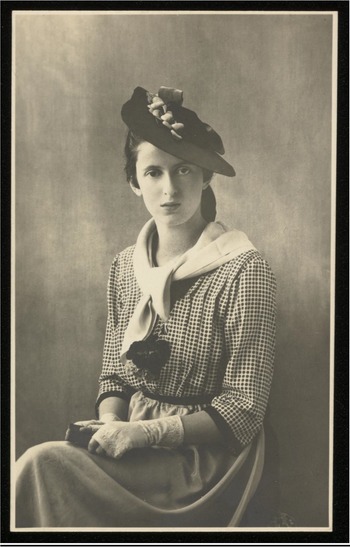
Born in 1906 to a wealthy, assimilated Jewish family, Motesiczky enjoyed a lively social life among the prominent figures of intellectual and cultural Vienna in the waning years of the Habsburg dynasty (see Figure 1).Footnote 8 Her early life was auspiciously peripatetic, reflecting the scope of her family’s social networks across Europe and her mother’s support of her artistic ambitions (Motesiczky’s father had died when she was the age of three). Attendance at art schools in Vienna, Paris, and the Netherlands was punctuated by summers spent in a villa in the village of Hinterbrühl in the Wienerwald, 30 kilometers outside the city and visits to and from influential relatives and acquaintances. At the age of 14, Motesiczky was introduced to the renowned German figurative painter and draughtsman Max Beckmann (1884–1950) by her cousin Irma and Irma’s husband, the journalist and Frankfurter Zeitung publisher Heinrich Simon (1880–1941). She came to know Beckmann’s work more intimately through visits to the Simons’ home in Frankfurt, where a number of works by the artist were held in their collection.Footnote 9
Unidentified photographer. Marie-Louise von Motesiczky as a Young Woman Wearing a Hat, Gloves and Polka-dot Blouse, circa 1920s. Black and white film, 131 x 82 mm (courtesy of Tate Archive, TGA 20129/6/4/29/19, presented by the Trustees of the Marie-Louise von Motesiczky Trust, March 2012; copyright Marie-Louise von Motesiczky Charitable Trust, 2021).

Beckmann made a number of visits to the Motesiczky home in Vienna in the early 1920s, and, in 1924, first encountered the woman who would become his second wife, Mathilde “Quappi” von Kaulbach (1904–86) in the living room of the Motesiczky home.Footnote 10 In 1927, Beckmann invited Motesiczky to study under his tutelage at the Städelschule in Frankfurt.Footnote 11 As art historian Ernst Gombrich observed, Motesiczky’s early works, especially the portraits, noticeably “reflect something of the hard-edged, almost sculptural manner of her uncompromising master.”Footnote 12 The style, tone, and use of color in Beckmann’s practice had a profound and evident influence on Motesiczky’s painterly approach, not so much through critical guidance in the classroom but, as Motesiczky recalled in her 1966 dedication to Beckmann, through the “overwhelming” opportunity to see works by the artist directly following their creation, simply by being part of Beckmann’s Frankfurt circle: “I still believe today that the best form of teaching is identification, a transformation into one’s role model – be it one of the present or the past.”Footnote 13
Like Beckmann, Motesiczky considered self-portraits “occasions for self-questioning, self-affirmation and self-discovery.”Footnote 14 In her early self-portraits, which are more than an expression of self-investigation, she demonstrates above all a keen awareness of spectatorship. In this, she departs from her mentor and carves out a completely autonomous undertaking with her self-portraits. Motesiczky’s renderings of the self are less in conversation with any works by Beckmann about metaphysical or formal possibilities of representation than with contemporaneous female artists like the early Worpswede-circle Expressionist painter Paula Modersohn-Becker (1876–1907) or Blaue Reiter artist Gabriele Münter (1887–1962). Both Modersohn-Becker and Münter were also initially received in the shadow of their more celebrated male colleagues, but their powerful figuration, distinctive use of line, and vibrant colors advanced the possibilities of the female self-portrait as a form, not to mention shifts in subject matter, with Modersohn-Becker, for example, being the first female Modern European artist to paint herself nude, as Motesiczky would shortly do thereafter.
Into exile
As it did for many other German-speaking avant-garde artists, the Nazi rise to power cut short Motesiczky’s burgeoning artistic endeavors in Central Europe. The day after the Anschluss of Austria on 12 March 1938, Marie-Louise von Motesiczky and her mother, Henriette, left for the Netherlands. Evident from correspondence between Marie-Louise and her brother, Karl Motesiczky (1904–43), a more permanent emigration and divestment of financial assets seemed already to have been anticipated by Marie-Louise and Henriette by January 1939.Footnote 15 Upon the dissolution of the Austro-Hungarian Empire in 1918, citizens were made to choose which of the successor states’ nationalities they would retain. The Motesiczkys opted for Czech passports; this decision would prove a crucial one, easing their travel within Europe in the years 1938–39.Footnote 16 Karl helped to organize the shipment of valuable possessions and furniture to his sister and mother, and, later in 1938, he was even able to send Marie-Louise’s early artwork to the Netherlands, with advice from the art dealer and gallerist Otto Kallir (1894–1978), a cousin by marriage to the Motesiczkys, so she might exhibit her work in exile.Footnote 17
While in temporary exile in the Netherlands, Motesiczky received her first solo exhibition, which opened on 7 January 1939 at the galleries of Kunsthandel Esher Surrey in The Hague.Footnote 18 Several of her early self-portraits were included in the show. On 17 January 1939, a critic from the Avondpost, a Dutch evening news circular, noted that it was a shame the artist had to wait until she was forced into exile to receive such a fittingly public display for her work.Footnote 19 Shortly after the opening of the exhibition, Motesiczky and her mother emigrated permanently to Britain. On the advice of their lawyer, the Motesiczkys travelled first to Switzerland and then on to England. On account of the Munich Pact of 1938 whereupon France and England had capitulated to the annexation of the Sudetenland, after Germany invaded Czechoslovakia, Czech nationals were treated as citizens of an occupied country and were allowed to stay in the United Kingdom without a visa.Footnote 20 “It was very fortunate that mother and I and my former nanny were settled in England before the war began. Had we not then crossed the Channel, who can tell what fate would have overtaken us.”Footnote 21 More than 300 visual artists would ultimately seek such refuge in Britain between 1933 and 1945.Footnote 22
Though Motesiczky and her mother escaped mainland Europe ahead of that fearful fate, her brother did not. Karl had declined to leave Austria and even attempted to continue his medical studies at the University in Vienna despite the rise in anti-Semitic persecution and the implementation of the Nuremberg Race Laws in Austria in May 1938. He joined the anti-fascist resistance and used the family’s residence in Hinterbrühl as a meeting point for other opponents of Nazism and a refuge for Jews fleeing persecution. His activities were ultimately reported to the Gestapo, and he was arrested in October 1942. Karl Motesiczky was deported to Auschwitz in February 1943, having been held by the Gestapo in Vienna since his initial arrest. Four months later, Karl perished in Auschwitz as a result of typhoid in June 1943. He was posthumously awarded the honor medal as righteous among the nations by Yad Vashem in Jerusalem for his resistance activities.
The self-portrait: Assessed and reassessed
Motesiczky’s self-portraits reached a dramatic turning point after her emigration. In particular, how the rendered figure of Marie-Louise engages (or does not engage) with the spectator. How might this have been catalyzed by modifications of her perceptions of self in her new environment? In order to avoid seeing the exilic experience only as one of alienation from one’s “original” self, it is critical to acknowledge the fluid and flexible nature of identity, which allows for the existence of a dialectic between “pre- and post-” exile compositions, instead of merely defining the new experience in terms of how it breaks from the old.Footnote 23 To investigate the transformation of Motesiczky’s work without attributing all subsequent changes solely to the translocation of exile, it is also useful to maintain a less binary understanding of the experience of exile in general. Acclaimed writer and scholar Eva Hoffman, born in Poland in 1945 to Jewish parents who survived the Holocaust in hiding, whose emigration to Canada as a teenager informed her engagement with the topic, wrote: “[w]e need to develop a model in which the force of our first legacy can be transposed or brought into dialogue with our later experiences, in which we can build new meanings as valid as the first one.”Footnote 24 Motesiczky’s condition as an artist in exile can then be seen not as a burden to overcome but, rather, as an impetus for reassessment of the self and reengagement with the self as an object of painterly investigation and spectatorial consideration.
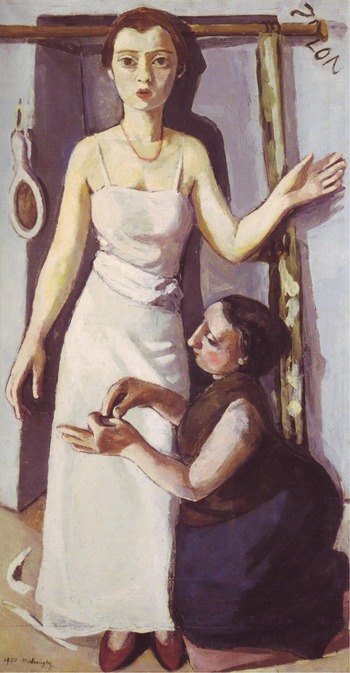
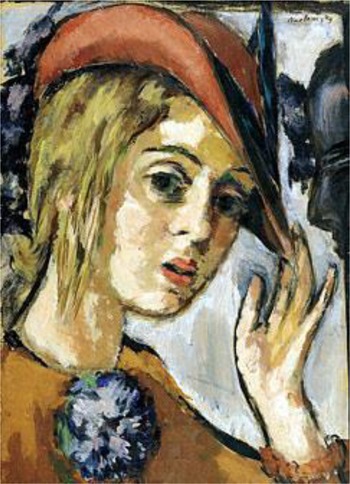
To question the persuasiveness of Motesiczky’s rendering of her female form transcendent to the exilic experience, it is first useful to illuminate the frameworks of Motesiczky’s early self-portraiture. Whereas Beckmann’s self-image can be defined by the representation of the self in an aspirational theatrical or enigmatic guise (Self-portrait with Champagne [1919, Staedel Museum, Frankfurt]; Self-portrait as a Clown [1921, Museum von der Heydt, Wuppertal]; Self-portrait in Front of a Red Curtain [1923, private collection, New York]), Motesiczky’s self-portraits of the 1920s and early 1930s appear to distinguish themselves in their straightforward readability – not only through the influence of a post-World War I Neue Sachlichkeit (New Objectivity) sensibility upon her mostly realistic use of pictorial space and orderly depiction of bodily form but also in her eschewing of a reliance upon allegorical facade. If we probe further into the narrative of her scenes, however, the early self-portraits reveal Motesiczky’s reliance on an inadvertent device that functions quite differently than Beckmann’s guises. In Self-portrait with a Comb (1926; Österreichische Galerie Belvedere, Vienna), she appears at her toilet; she lounges as a canonical Olympia in Nude on the Balcony (1929, private collection, London); in a dress shop in At the Dressmaker’s (1930, Collection Fitzwilliam Museum), she subjects herself to sartorial scrutiny and presentation (see Figure 2); she fashions herself coquette like in Self-portrait with a Red Hat (1938, private collection, United States) (see Figure 3). Do these scenarios betray that Motesiczky only dared portray herself “masquerading in a female guise”Footnote 25 – that is, as the compliant object in the traditional depiction/reception dialectic of the visualized female form? As the agent of this objectification, Motesiczky would undermine her attempt to conduct probing self-investigations with these works. By examining how she engaged the spectator, specifically his “gaze,” and how this changed after her emigration, we can understand how her agency was retained.
At the Dressmaker’s (Bei der Schneiderin), 1930. Oil on canvas, 115 x 61 cm (courtesy of the Collection Fitzwilliam Museum, Cambridge; Copyright Marie-Louise von Motesiczky Charitable Trust, 2021).

Self-portrait with Red Hat, 1938. Oil and charcoal on canvas, 51 x 36 cm (courtesy of a private collection, United States; copyright Marie-Louise von Motesiczky Charitable Trust, 2021).

Engaging the “gaze”
The self-portrait is a vehicle through which an artist can construct an identity by combining self-reflection, including interpretation of memory, with an interaction with the spectator. The concept of “the gaze” “alert[s] to the fact that a work of art, like a person, can seem to gaze or be gazed at.”Footnote 26 This underlines the importance of understanding the reciprocal nature of the gaze; it is a conversation between artist and viewer that is particularly well suited to the medium of the self-portrait. Further examining spectatorship with respect to Motesiczky’s self-portraiture, specifically in the context of film theorist Laura Mulvey’s problematizing of the “male gaze” in her groundbreaking essay “Visual Pleasure and Narrative Cinema,” reveals how Motesiczky’s translocation to England may have changed her practice as a painter and, specifically, how it seems to have released her self-portraiture and its subject (the artist herself) from participation in a traditional, at times subrogated, conversation with the viewer.Footnote 27
As analyzed by Shulamith Behr in her study of the self-portraits of Gabriele Münter, “in general, traditional representations of women assign them the role of the object, not the agent of art. As a part of this objectification, the image of the female was a construct arising from masculine desire.”Footnote 28 This reductive construct, as the female figure has often been rendered within pictorial narratives, has also extended to a woman’s actual agency within her artistic community. Even in the more progressive groups of artists in early twentieth-century Europe, female members of the Expressionist and Dada collectives, for example, were often relegated to the role of muse, maternal figure, or, at best, facilitator in historiographical reconstructions of group dynamics.
Although Motesiczky was not part of a larger circle of artists in Vienna, her self-portraiture clearly evinces the challenges she faced in negotiating the territory between concurrent roles of woman and artist, especially as both the female agent of a self-portrait and the subject of its visual scrutiny. To explore her resulting strategies, it is worthwhile to look further at psychoanalytical writing contemporary to Motesiczky’s early career – in particular, Joan Riviere’s Reference Riviere, Burgin, Donald and Kaplan1929 essay “The Masquerade of Womanliness.”Footnote 29 Riviere underwent analysis with both Ernst Jones and Sigmund Freud, and the beginning of her now-canonical treatise provides an analysis of Jones’s own ideological engagement with concepts of female sexuality. Her core idea, however, is that women adopt a mask of womanliness to deal with anxiety and a fear of perceived retribution from men. The lens of Riviere’s theory reveals that, though Motesiczky’s technique has the confidence of her male counterparts in an attempt to reconcile her gender with her professional identity, she adopts a “mask of womanliness” in the narrative and scenic constructions of the early self-portraits to mitigate their ambiguity, reinforcing the scope of her role as object rather than agent. The concept of the mask would be significantly nuanced by theorists like Mary Ann Doane in her Reference Doane1982 essay “Film and the Masquerade: Theorizing the Female Spectator,” which deploys Riviere’s “mask of womanliness” as a tool to deconstruct gender performativity.Footnote 30 Motesiczky chooses to portray herself interlocking with the male gaze in an effort, as Shulamith Behr posits, “to find a balanced relationship between a serious engagement [with her craft] and a socially acceptable image.”Footnote 31
In Nude on the Balcony (1929, private collection, London), the title of which disguises the fact that it is indeed a self-portrait, Motesiczky used a large mirror to paint herself nude.Footnote 32 She managed to observe her body in parts, resulting in the slightly distorted, doll-like rendering of the figure.Footnote 33 The scene is filled with light, and, in the center, the nude figure lies on a pink chaise. The geometrical configuration of Marie-Louise’s arm is as evocative of the womanly gesture of Alexandre Canabel’s Venus (1863, Musée d’Orsay, Paris), as it is of Pablo Picasso’s Les Demoiselles d’Avignon (1907, Museum of Modern Art, New York). Motesiczky’s lounging nude departs from those of Édouard Manet’s Olympia (1865, Musée D’Orsay) or the “odalisques” of Jean-Auguste-Dominique Ingres, however, by showing the available female not as a “kept” woman but, rather, as one who is in possession of her own desires. Echoed in the hearts decorating the railing of the balcony, and emphasized by the plentitude of space next to the figure on the chaise, the absence of another person is palpable. The nude on the balcony might be waiting for a lover or imagining one yet to come.
Why then choose to depict herself in such a classicizing role as the lounging nude? While hinting at agency and desires of the female subject, Nude on the Balcony allows for the exemplification of figurative experimentation within ostensibly traditional subject matter. In light of Riviere, this implementation of a mask in the form of an easily readable scene of the female figure could be understood as a defense against incurring retribution from male colleagues, teachers, and spectators for too overtly depicting un-attenuated agency as a woman artist. In her early works, the act (and implications) of simply being seen occupies the intentionality of the self-portraits.
The narrative Motesiczky’ weaves in At the Dressmaker’s is also revealing of these mechanisms of experimentation within ostensible tradition (see Figure 2). Here, Beckmann’s stylistic influence is evident in Motesiczky’s technique. Compositionally, in terms of the rendering of the figure in a long, narrow format, Beckmann’s influence is also perceivable, however, as are other precursors to which both artists paid deference, including the Spanish Old Masters. Motesiczky recalled that, when she visited the Louvre with Beckmann, he commented on the ideal beauty represented in the elongated figures of El Greco.Footnote 34 She tried to emulate this depiction of this idealized human form in the female figure that dominates At the Dressmaker’s. The large eyes, rendered out of the face in an almost sculptural, and certainly “primitivizing” manner, appear to stare directly at the figure’s own reflection in an implied mirror. A self-portrait should convey something beyond the “masklike rigidity and marionette-like stiffness” of the mirror image.Footnote 35 Yet it is exactly the rigidity of Motesiczky’s stance and fixity of her gaze that indicate that this work is an investigation of the mirrored self-image.
The small mirror that hangs in the background of this scene underlines the vanity inherent in the act of staring at one’s own image. In the context of a narrative composition so self-aware, however, something more deeply connected to the primal act of looking appears to be at work. Psychoanalyst Jacques Lacan famously describes the “mirror phase” in psychological development as the result of recognizing one’s self-being “joyous [for children] in that they imagine their mirror image to be more complete, more perfect than they experience in their own body.”Footnote 36 The mirror also stands in for the process of the development of subjectivity – the self as constituted in relation to the existence of someone else. For the female subject, it is not the existence of someone else that constitutes the self but, rather, the act of being perceived by someone else, especially the male other. The construction of the female self thus becomes a performance of the act of being seen, as encapsulated by John Berger’s argument opening this article.Footnote 37 In this respect, Motesiczky’s choice of placement for the mirror is of utmost significance: the mirror reminds us of the spectator. The act of the viewer seeing the form of Motesiczky cannot be extricated from how she sees herself (being seen).
Self-portrait with Red Hat, however, is the definitive example of Motesiczky’s fashioning a self-image in deference to the spectator (see Figure 3). Painted during the artist’s exile in the Netherlands, Motesiczky pictured herself fashionably dressed, a purple flower pinned to her bright red top. A red bracelet sits on a delicate wrist, whilst her hand, which curiously only has four digits, flirtatiously tugs at the brim of her hat. Both Ines Schlenker and Jill Lloyd suggest that one could even interpret this little gesture as “a farewell to the country she had been forced to leave behind.”Footnote 38 Attention is drawn away from the alluring female figure, however, by the partial shadow of a face lurking in the background. Motesiczky has identified the figure as a forsaken “heartthrob who was not supposed to be recognized.”Footnote 39
The concept of “the gaze” in the filmic context sees not only the female subjected to the scrutiny of the male viewer but also the man depicted within the narrative, with whom the viewer identifies.Footnote 40 The inclusion of an unidentifiable second figure in a self-portrait, like the dark figure lurking in Self-portrait with a Red Hat, can also be found in self-portraits by Brücke artist Ernst Ludwig Kirchner (1880–1938), who often portrayed himself with a female figure, appearing semi-detached from the narrative of his self-investigation. As in the filmic construct implied by Margaret Olin, the third figure creates a triangle of spectatorship whose apex is the objectified female.Footnote 41 The dark figure in Self-portrait with a Red Hat invades the conversation between the figure of Motesiczky and the viewer, intensifying the feeling that she is the object of a masculine gaze internal to the pictorial realm. The viewer is then either passively complicit in this invasion of the traditional bi-party spectatorial dialogue of the self-portrait or they are made to bear witness to the depicted reality that the figure of the woman is perpetually subject to the specter of a male observation.
Renegotiating identity and refuting the “gaze”
Isolation is a word. It sounds sad, but it can also be something very beautiful.
– Marie-Louise Motesiczky, “Etwas Über Mich”Footnote 42Although stylistic developments cannot be solely attributed to a new environment, for some artists, as argued by Frauke Josenhans, “separation from the familiar, either willing or unwilling, inspire[s] innovations in form and technique.”Footnote 43 The circumstances of Motesiczky’s emigration seem to have triggered an alternation in both the strictness of subject matter and compositional strategies. Not only informed by her interest in the self-portraits of Rembrandt and Vincent Van Gogh but also influenced by her new artistic connections in England, her late self-portraits engage in renewed self-questioning.Footnote 44 The effects of living in a radically different social and cultural environment, as well as in relative self-described emotional isolation, led to an increased concern in her self-portraits for the transience of physical beauty and, eventually, the chronicling of age and degeneration of manual artistic skill. When Max Beckman arrived in his much-desired “exile” in the United States after the war, his approach to self-portraiture and the concerns he attempted to address were similar to those of Motesiczky.Footnote 45 While chronicling age may have become a subject of Motesiczky’s work had she remained in Austria, the isolation experienced in England, and the vast amounts of time spent alone with her aging mother, certainly heightened her awareness of ephemerality.
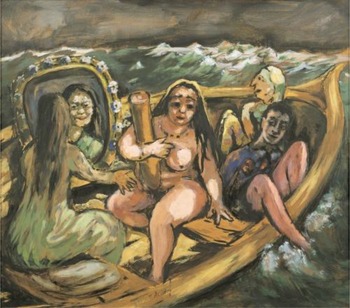
Most significantly and perhaps in this vein, her self-image as an émigré abandons concern for affirmation from the spectator. The image of Motesiczky after her emigration largely refuses to participate in the aforementioned “gaze” as she previously had. Changes can also be observed technically in terms of her confident application of paint, expressive brushwork, and more relaxed use of line. Her subject matter embraces imaginative and fantastical scenes or the project of making a visual document of the investigation of the self. The experience of exile also led Motesiczky to combine these sensibilities for the first time to explore her own self-image directly through narrative allegory, a device that she had eschewed in her pre-emigration practice. The first of what Jeremy Adler and Birgit Sander call her Fantasy Paintings, The Travellers (1940, University of Iowa Stanley Museum of Art) directly examines the personal aspects of fleeing one’s homeland – with the inclusion of figures who have been recognized as Motesiczky’s mother, brother, and nursemaid, Marie Hauptmann – as well as the universal experience of flight as a refugee (see Figure 4).Footnote 46
The Travellers, 1940. Oil on canvas, 66.7 x 75.3 cm. Signed and dated, lower right (courtesy of the University of Iowa Stanley Museum of Art, Iowa City; copyright Marie-Louise von Motesiczky Charitable Trust, 2021).

The conjured scene is symbolic but immediately readable. Four figures are perched precariously in a small wooden boat that traverses a tumultuous body of water. A young woman, positioned away from the viewer, regards her image in a large decorative mirror that appears to have accompanied the group on their journey. It is in the reflection that her face can be observed. The eye is most drawn to the central figure – a woman, clad in nothing but a jewel necklace, steadies herself with one hand, while, in the other, she clings desperately to an oversized sausage. Crunched into the prow of the boat, an ethereal figure with anonymously rendered facial features turns away from the scene and stares outward, perhaps toward the unknowable future. A male figure, representing Motesiczky’s brother, Karl, sits in the base of the boat but dangles a foot irreverently into the cresting waves; in color and form, he is at once within the scene and apart from it, hinting at the tenuousness of his presence (as we know, Karl did not accompany the family on this journey but remained in Austria, where he would perish in the Holocaust).
Motesiczky’s willingness to engage with the direct depiction of an exiled family driven from their home, where both their core identities and individual artistic character had been placed under duress, may be attributable to Motesiczky’s renewed acquaintance in England with the painter Oskar Kokoschka (1886–1980), whose flight from Nazi persecution led him also to settle in the milieu of Austrian émigrés in North London. Kokoschka engaged with his forced exile in multiple pictorial representations, also self-portraits, most notably Self-portrait of a Degenerate Artist (1937, Scottish National Gallery of Modern Art). Kokoschka’s own shift toward allegorical and politically metaphorical painting in the context of his exile included his creation of works like Loreley (1941–42, Tate Gallery, London) and The Crab (Self-portrait as a Swimmer) (1939, Tate Gallery, London).
Motesiczky’s The Travellers has also been received in the context of Max Beckmann’s more enigmatic triptych Departure (1932–35, Museum of Modern Art, New York). Not produced contemporaneous to his own flight from Germany into exile, which began in the Netherlands and was followed by emigration to the United States several years later, Departure was in fact completed in Berlin, where Beckmann had first sought the refuge and more relative anonymity of the capital city after the Nazi rise to power and his removal as a “cultural Bolshevik” from his professorship at the Städelschüle in Frankfurt. During this time, he grappled with the ultimate viability of existence as an avant-garde artist in the Third Reich. Beckmann’s triptych ultimately entered the collection of the Museum of Modern Art (MoMA) in New York in 1942 to rapturous reception, an emblem of the defense of what then MoMA director Alfred H. Barr termed the enterprise of “Free German Art.”Footnote 47
When directly compared with Departure, it is clear that, for Motesiczky, the problem of portraying oneself in the context of exile, and later as an émigré, had less to do with taking on themes of historical, philosophical, or religious subject matter through mythical role play and masquerade than with the experience of the individual: the endeavor to project a state of mind or emotional condition onto an external bodily appearance.Footnote 48 With Self-portrait in Green (1942, Collection Mirli and Daniele Grassi, Belgium), however, she reached a crucial turning point in her approach to the self-portrait and recognition of its spectatorship or gaze. Like Albrecht Dürer or Rembrandt, Motesiczky takes on the front-facing self-portrait to address the spectator directly and draw attention to the voyeuristic quality of his gaze.Footnote 49 The power of the bearer of the gaze is exposed. Motesiczky’s self-image seems to say to the viewer that, if a reciprocal conversation of looking must exist, then it will now take place on her terms. This self-assuredness is indicative of how Marie-Louise von Motesiczky conducted her career after her emigration. She participated in exhibitions where possible but did not engage with the commercial art world in a systematic way in her lifetime. Her work in England seems to have been made primarily to fulfill an artistic impetus, not for financial gain or to present herself in a certain way to the world.
When charting the technical distance between Self-portrait in Green of 1942 and the self-portrait that preceded it, Self-portrait with a Red Hat of 1938, one sees that Motesiczky’s self-image has come to be less defined by a decisive use of line, and more by color and texture of paint. Compositionally, while Self-portrait with a Red Hat is completely occupied with the nature and dialectic of “the gaze,” Self-portrait in Green emotes tensions beyond the spectatorial dialogue and shows that something more inwardly probing is at work. Motesiczky’s mentors and colleagues – Beckmann and Kokoschka chief among them – also continued to tackle the challenges of the self-portrait in exile, though we see their respective experiences, techniques, and guises at the forefront. Kokoschka engaged directly with his status as a so-called “Degenerate” artist – engendering an exilic dialogue directly confronting the circumstances of loss and place inflicted upon him as he fled the European mainland as a result of Nazi persecution.
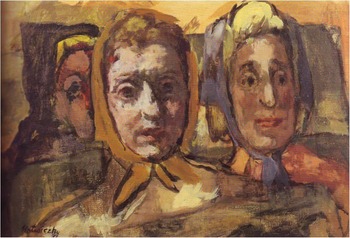
In a work that follows the more overtly narrative exposition of transitory experience seen in The Travellers, and the inward-looking pursuit of Self-portrait in Green, Motesiczky next approached the new aspects of her present environment. In England in the 1940s, Motesiczky would likely have been exposed to an emerging commodity fetishism in advertising, featuring image tropes that included the doting middle-class housewife. Her interest in these images is reflected in Three Heads (1944, Amersham Museum) (see Figure 5). This landmark work ties together the self-investigation of Self-portrait in Green with Motesiczky’s consideration of the constructs of new elements of visual culture as well as her concern for the challenges of social assimilation in English society. Efrat Tseëlon presents a discussion of visual appearance and psychology that can be applied to these problems of cultural adaptation for émigrés:
In a secure environment one feels approved, accepted, loved, inconspicuous – in short, confident and psychologically invisible. In an insecure environment one is on display, on show, being examined, and measured. One is invaded by scrutinizing looks, attention or comments; over-shadowed by other people’s better presentation, or judgment. It is a feeling of being threatened or psychologically visible. Footnote 50
Three Heads (Drei Köpfe), 1944. Oil on canvas, 42 x 62 cm (courtesy of the Amersham Museum; copyright Marie-Louise von Motesiczky Charitable Trust, 2021).

Having arrived in England as an upper-class Austrian-Jewish intellectual, Motesiczky now depicts herself as an English housewife conforming to a necessity of propriety, donning a head scarf on a public bus journey through Amersham, a small town in Buckinghamshire 30 miles outside of London, where the Motesiczkys spent the war years. This self-portrait represents not only the adoption of an archetypal guise of public dress but also acts as a chronicle of the new social circumstances in which exile placed Motesiczky. Acutely aware of contemporary fashion, Motesiczky significantly departed with Three Heads from the atmospheres of At the Dressmakers and Self-portrait with Red Hat, where the mirror and the spectator are the authoritative forces in the dialogue of looking and assessing the posed female body, either on passive display or in coquettish exchange. The forms of the three women émigrés prioritize a more complex consideration for the psychological state of visibility through foreignness over the previous dialectic of the “gaze” that sought from the viewer aesthetic approval of the female subject, which was certainly a departure from the present female subjects who seek to remain unnoticed in an act of belonging. Motesiczky has abandoned the smooth paint application and the highly developed surface reminiscent of 1920s Neue Sachlichkeit in exchange for quick and economical brushstrokes that convey the uncertainty of her visual assimilation and serve to reveal unabashedly a vigorous technical process.
In exile, Motesiczky’s concern for physical appearance as it related to social status and cultural assimilation became coupled with the process of, and an interest in chronicling, aging. The oft-present mirror stops functioning as an apparatus for scrutinizing physical beauty and becomes a tool for probing what lies beyond outer appearances in the process of a “gaze”-less self-evaluation. Self-portrait with Pears (1965, Lentos Kunstmuseum, Linz) is one such rigorous study of the transience of beauty and the possibilities to which one is opened during the process of physical aging. Self-portrait with Pears and, for example, At the Dressmakers are both meditations on the act of looking before a reflective surface, but Self-portrait with Pears communicates an inner conversation, not an outer engagement with the process of being seen. The viewer is present as the mirror becomes a tool for capturing Motesiczky’s likeness, but the viewer is not invited to scrutinize the sitter’s appearance; they may bear witness to the aging process, and an acceptance thereof, but their approval is not sought. The figure of Motesiczky does not even look at herself in the mirror; vanity is futile, and the outside world is not needed to validate the process of introspection in which she is engaged.
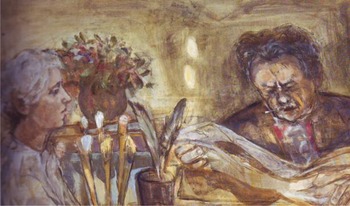
With Self-portrait with Canetti (1960s, Manchester Art Gallery), Motesiczky provides an illuminating scene depicting her periodic romantic partner and confidant of over 40 years, Elias Canetti (1905–94), a writer of Bulgarian-Viennese and Jewish origins, who also settled in the Austrian community of intellectual exiles in North London after fleeing Nazi persecution on the continent (see Figure 6). Though theirs was a companionship that spanned multiple decades, it was fraught by the fact that Canetti remained married to his wife, Veza (Venetiana) Taubner-Calderon (1897–1963) until her death in the 1960s. That time period approximates the dating of this double portrait of Motesiczky and Canetti, in which Motesiczky endeavors to wrest control for the female subject of the relational dynamics in a male-female relationship portrait, even if this was not possible in her real-world relationship. She creates a composition in which there appears to be no visual whole but, rather, two separate worlds coexisting alongside one another. Motesiczky gives several visual clues that create fragile threads of a narrative, encouraging the viewer to string the fraught scene together with the scattered fragments of meaning.
Self-portrait with Canetti (Selbstporträt mit Canetti), 1960s. Oil on canvas, 51 x 82 cm (courtesy of the Manchester Art Gallery, Manchester; copyright Marie-Louise von Motesiczky Charitable Trust, 2021).

On the left of the pictorial frame, an ethereal, snowy-haired Motesiczky, dressed in a white smock, sits in profile between a vase of flowers and a container with paintbrushes – her attribute as an artist. She stares directly at the figure of Canetti, but her face betrays little emotion. Though the paint application is generally thin – in the realm of the image “belonging” to Motesiczky – exposed canvas surrounds her figure creating an impression of light and air. Next to the brushes on the table stands a cup containing two feather quills, the attribute of Canetti, the great writer. The quills slightly dwarf the brushes, and the implements of the sitters’ respective crafts appear to form the essential divide between them. The figure of Canetti, brow furrowed, is deeply engrossed in reading the newspaper and takes no notice of Motesiczky. Whereas the form of Motesiczky is neatly situated between flowers and brushes, creating a sense of calm balance on her side of the scene, the backdrop behind Canetti is a gloomy shadow created by a washy application of dark color.
The darkness of the picture plane that surrounds Canetti’s figure draws the viewer’s eye to his half of the scene, making Motesiczky the main agent of gazing, not the object of the viewer’s gaze. She faces completely toward Canetti, away from the viewer. This positioning seems to act as a signal; just as the biblical figure of John the Baptist is often depicted pointing to Christ, Motesiczky tells her viewer to look to Canetti: scrutinize him, his figure, his environment, his scenic behavior vis-à-vis the composed figure of her attentive stance. When examining her position in relation to Canetti, Motesiczky seems to portray herself as the lesser “saint” or lesser artist in this case. In this vein, the textual Motesiczky helps the artist reclaim the agency of the viewer, by default vested with the authority to pass judgment on the female figure. The viewer is instead forced to gaze at the male figure of Canetti, but in lieu of his participation in the gaze, the viewer judges him as instructed by Motesiczky, who, no longer an object and subject of the male gaze, is both autonomous and active in the scene she creates and the dialectic it generates.
Conclusions
Although the technique of Motesiczky’s early self-portraits poised her to conduct probing self-investigations informed by tenets of the New Objectivity movement and its reifying of the figurative in service of critique, her early works fall short of breaking certain conventions of portraying the female figure as object. Motesiczky’s was not the provocative, androgynous “New Woman” depicted by a number of other Jewish women painters of the inter-war era – for example, the German-Swedish artist Lotte Laserstein (1898–1993), who was also forced to flee the Nazi Reich. Motesiczky sacrificed a degree of agency to adopt a “masquerade of womanliness.” By integrating a multifaceted view of exilic experience, it is possible to understand how the circumstances of Motesiczky’s exile in England enabled her to renegotiate female identity and agency as woman artist, liberating her from the constraints of her earlier concerns that reinforced the authority of a pictorial spectator. This liberation, which can be seen in both the technique and, especially, the composition of her self-portraits such as Self-portrait in Green or even Self-Portrait with Straw Hat (1937, private collection), allowed her to view the figure in pictorial space and her role fashioning it not through the conversation of the male gaze but, rather, by turning inward to exploit the value of an extra-spectatorial dialogue with oneself.
Czech-born philosopher Vilém Flusser (1920–91), who fled Nazi Europe for London in 1940 and taught in the 1960s in Brazil, returning to Europe after the Brazilian military government dismissed him from his university post, saw exile as “the incubator of creativity in the service of the new.”Footnote 51 As an émigré artist, Motesiczky was able to examine issues of identity and belonging at a time of renegotiation and adaptation, creating new considerations for both the potency of the aging female artist and the essential ephemerality of physical beauty as perceived by a (male) viewer, which had, to a degree, clearly occupied the younger artist’s work. She also used her evolution to address the complexity of intimacy and unfulfillment in her 40-year-long relationship with Elias Canetti. Using Self-portrait with Canetti, she reclaimed the power of the “gaze,” which troubled her early works, for the female agent as sitter and agent as artist. Only after her emigration and the individual challenges she faced did Motesiczky exert these original artistic concerns, probing into the tumult of an artist’s life as an émigré and revealing, uninfluenced by a concern for the de facto authority of a spectator, unfettered expression as woman agent. The later Motesiczky does not ask the spectator to evaluate her outward appearance; she appears to ask herself: what does it mean to be a woman, an artist, and an émigré?
While this represents only one example of the effects of exilic translocation as a result of the Nazi regime on one female artist – in particular, her negotiation of the self-portrait after emigration – it is evident that there is a universality in the experience of this forced migration. The lives of Jewish refugees were transformed by the genocidal actions of the Nazi regime, and the material lives of their cultural property were irreversibly impacted. As Eva Hoffman posits, “[b]eing deframed so to speak, from everything familiar, makes for a certain fertile detachment and gives one new ways of observing and seeing.”Footnote 52 For certain émigré artists, resettlement in a new environment generated a reassessment of certain codified concerns of representation, enacting a liberatory potential that must also form part of our understanding of the agency reclaimed by Jewish émigrés after the Holocaust.