

Introduction
Wetlands are highly productive natural systems (Tiner Reference Tiner1989, Keddy Reference Keddy2010) that provide multiple ecosystem services such as climate regulation, nutrient cycling, and provisioning of food and freshwater (M.E.A. 2005, Nellemann and Corcoran Reference Nellemann and Corcoran2010). However, some studies estimate that at least 50% of the world’s wetlands have been destroyed (M.E.A. 2005, Davidson Reference Davidson2014), with Europe presenting the highest value: 75% of all wetlands disappeared over the last 100 years (Owen Reference Owen2007). The main reason for such destruction is the conversion of wetlands into agricultural and industrial areas, but also water drainage, and indirect pollution from agricultural, industrial and urban effluents (Van Asselen et al. Reference van Asselen, Verburg, Vermaat and Janse2013, Dodman et al. Reference Dodman, Citegetse, García Moreno, van Kleunen, van Roomen, van Roomen, Nagy, Citegetse and Schekkerman2018). Due to wetland degradation, many waterbird species declined and changed their distribution range (Luthin Reference Luthin1987, Boere et al. Reference Boere, Galbraith, Stroud and Thompson2006, Okes et al. Reference Okes, Hockey and Cumming2008). However, since the1980s some of these species began to recover, showing positive population trends and recolonizing areas within their distribution range, despite only marginal restoration of wetlands (Wetlands International 2016). European wetlands received more protection in recent decades owing to the Water Framework Directive (2000/60/EC). Several waterbirds, however, began to recover long before the implementation of this directive, which suggests alternative causes for population recovery.
Understanding the habitat requirements of these species is fundamental for their conservation, particularly in critical phases of their lives, in order to establish sound management plans. Altricial birds that are fed by parents after hatching, experience the highest mortality following independence (Sullivan Reference Sullivan1989, Daunt et al. Reference Daunt, Afanasyev, Adam, Croxall and Wanless2007, Lok et al. Reference Lok, Overdijk, Tinbergen and Piersma2013b). And one of the main factors for this high mortality during the first months after independence is low foraging efficiency and consequent starvation, either by inefficient searching and/or handling proficiency, competition with adults, or low ability to locate suitable feeding patches (Wunderle Reference Wunderle1991, Kershner et al. Reference Kershner, Walk and Warner2004, Daunt et al. Reference Daunt, Afanasyev, Adam, Croxall and Wanless2007). Juveniles often show a different spatial and temporal ecology from adults (Goss-Custard et al. Reference Goss-Custard, Durell, McGrorty and Reading1982, Wunderle Reference Wunderle1991, Kershner et al. Reference Kershner, Walk and Warner2004), either by displaying preferences towards different habitats (Fayet et al. Reference Fayet, Freeman, Shoji, Padget, Perrins and Guilford2015), exploring wider areas (Zango et al. Reference Zango, Navarro-Herrero, García-Vendrell, Safi and González-Solís2020) or by foraging for longer periods (Daunt et al. Reference Daunt, Afanasyev, Adam, Croxall and Wanless2007). It is therefore important to better understand habitat use during this critical phase to better inform the conservation of waterbird species during such key life stage.
The population of Eurasian Spoonbill Platalea leucorodia, like other migratory waterbird species, decreased drastically in Europe in the early 20th century, and by 1950 only two breeding colonies were still active: one in Spain and other in the Netherlands (Triplet et al. Reference Triplet, Overdijk, Smart, Nagy, Schneider-Jacoby, Karauz and Pigniczki2008). After intense recovery programmes, the East Atlantic population (that breeds along the East Atlantic European coast and winters from France to coastal West Africa, as south as Senegal) is currently increasing (Overdijk Reference Overdijk and Navedo2013, Champagnon et al. Reference Champagnon, Pigniczki and Kralj2019), and the species is now classified as ‘Least Concern’ (LC) in the European Red List (BirdLife International 2015). The (re)colonization of breeding areas is currently ongoing in Europe and, in most cases, this occurred following habitat conversion or restoration at traditional breeding locations (Tucakov Reference Tucakov2004, Marion Reference Marion and Navedo2013, Ramo et al. Reference Ramo, Aguilera, Figuerola, Máñez and Green2013). In Portugal, despite the existence of few historical breeding records from the 17th century (Tait Reference Tait1924), the species was classified as a non-breeder until 1988, when the first successful breeding event was registered in Paúl do Boquilobo (Pereira Reference Pereira1989). Since then, the breeding population of spoonbills increased from 43 pairs in 1996 (Farinha and Encarnação Reference Farinha, Encarnação and Aves1996, Equipa Atlas Reference Atlas2008) to 540 in 2014 (Farinha and Trindade Reference Farinha and Trindade1994, Farinha and Encarnação Reference Farinha, Encarnação and Aves1996, Equipa Atlas Reference Atlas2008, Encarnação Reference Encarnação2014) and expanded northwards. The number of breeding colonies also increased to 10, as recently as 2014 (Encarnação Reference Encarnação2014), when the newest colony in the country was established.
Juvenile spoonbills fledge between 35 and 54 days (Cramp and Simmons Reference Cramp and Simmons1977, Triplet et al. Reference Triplet, Overdijk, Smart, Nagy, Schneider-Jacoby, Karauz and Pigniczki2008), and during the post-fledging period perform exploratory movements in the vicinity of the colony, that can reach distances of more than 100 km (Hancock et al. Reference Hancock, Kushlan and Kahl1992, Aguilera Reference Aguilera1997, Volponi et al. Reference Volponi, Emiliani and Fasola2008, Jelena et al. Reference Jelena, Antun, Tibor and Otto2012). Following this period, juveniles either migrate to southern wintering areas or remain in the vicinity of the colony, particularly birds originating from southern Europe (Bauchau et al. Reference Bauchau, Horn and Overdijk1998, Triplet et al. Reference Triplet, Overdijk, Smart, Nagy, Schneider-Jacoby, Karauz and Pigniczki2008, Volponi et al. Reference Volponi, Emiliani and Fasola2008, Lok et al. Reference Lok, Overdijk and Piersma2013a). To understand the habitat requirements of juvenile spoonbills during a key phase of their life, (after leaving the breeding colony), we attached GPS/GSM tags to pre-fledglings from a Portuguese colony (Ria Formosa, Algarve) and tracked their movements and ontogeny of habitat use up to their first year of life. Our specific objective was to identify the most important habitats for juvenile spoonbills during their dispersal phase from the natal colony. This information is essential for the development of conservation strategies that may benefit this and other waterbird species with similar ecological requirements.
Methods
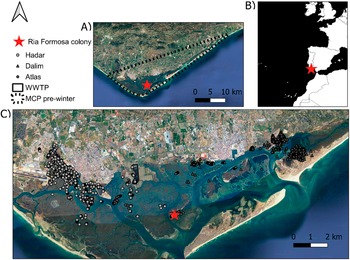
Fieldwork was carried out in the Ria Formosa Natural Park (36°59’N, 7°55’W), a lagoon system separated from the Atlantic Ocean by a system of small islands and sandbanks composed by several habitats such as marshes, fresh and brackish lagoons, saltpans, dune banks and agricultural fields (Figure 1). The Ria Formosa Natural Park was established in 1987, later becoming a Special Protection Areas (SPA) for birds under the European Bird Directive (2009/147/EC), being thus part of Natura 2000 Network, and is also a Ramsar site since 1981. Even though Ria Formosa has historically been an important area for spoonbills, both as wintering and as a stopover site, the species only started breeding locally in 1993, in a small marsh island within the lagoon (Farinha and Trindade Reference Farinha and Trindade1994). This spoonbill breeding colony has its limits established by the water line around the island at low tide and during the study period the number of nests fluctuated between 66 and 116 (in 2018 and 2020, respectively; J. Silvério pers. comm.).
A) and B) Location of Ria Formosa colony in Portugal (star) and representation of the Minimum convex polygon (MCP – dashed black line) considering all locations attained from juvenile spoonbills in the vicinity of Ria Formosa during pre-winter (see text for details); C) Locations of three selected juvenile spoonbills tracked with GPS/GSM tags in Ria Formosa during pre-winter, and the location of the wastewater treatment plant (WWTP) most used by spoonbills.

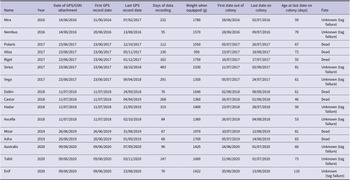
From 2016 to 2020 we captured 16 pre-fledglings (two in 2016, five in 2017, four in 2018, two in 2019 and three in 2020; Table 1) from the nests by hand (making sure such procedure was harmless to the bird) and tagged them with solar-powered GPS/accelerometer GSM tags (Movetech Telemetry, www.movetech-telemetry.com) attached using a backpack harness made of Teflon ribbon. We recorded biometric measurements (tarsus and head/bill length) to back-calculate hatch date based on Lok et al. (Reference Lok, Overdijk and Piersma2014). Chicks were measured and selected for tagging based on their development stage (35 ± 2 SE days). The weight of the tags, harness and rings was 33 g, thus below the 3% threshold of the body mass of the tagged spoonbills (mean body mass 1,524 ± 217.53 g; n = 16) to avoid adverse effects (Phillips et al. Reference Phillips, Xavier and Croxall2003, Casper Reference Casper2009). Tracked spoonbills were named instead of simply using a code (Table1). Tags recorded a burst of 10 seconds of GPS fix (with an associated error of ≤3 m) and 3D accelerometer data at 1 Hz every 30 minutes. We kept only one GPS point per burst and removed GPS locations that used less than four satellites for geopositioning to avoid uncertainty. Accelerometer data were used to determine probable mortality events when inactivity was recorded, and to confirm flying fixes as indicated by the GPS metadata, that were removed from the present analysis. During most of the nocturnal period (between 21h00 and 05h00) only one GPS fix was collected at 01h00 to save battery. QGIS, version 3.10, combined with R software (R Core Team 2019), version 3.6, were used to perform all the spatial data analysis and visualization of geographical data.
Tracking details of juvenile spoonbills from Ria Formosa equipped with GPS/GSM tags.

Habitat selection and usage
All analyses of habitat use start when juvenile spoonbills left the colony for the last time, i.e. when no subsequent returns to the colony where recorded. We defined this period as After Leaving the Colony (ALC). The last position of each spoonbill considered for analysis was the last location of the bird (when it either died or the tag failed) or the last location in Europe (if the bird migrated to Africa), until the maximum period of one year since chick hatching.
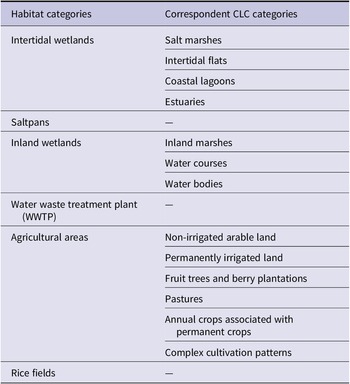
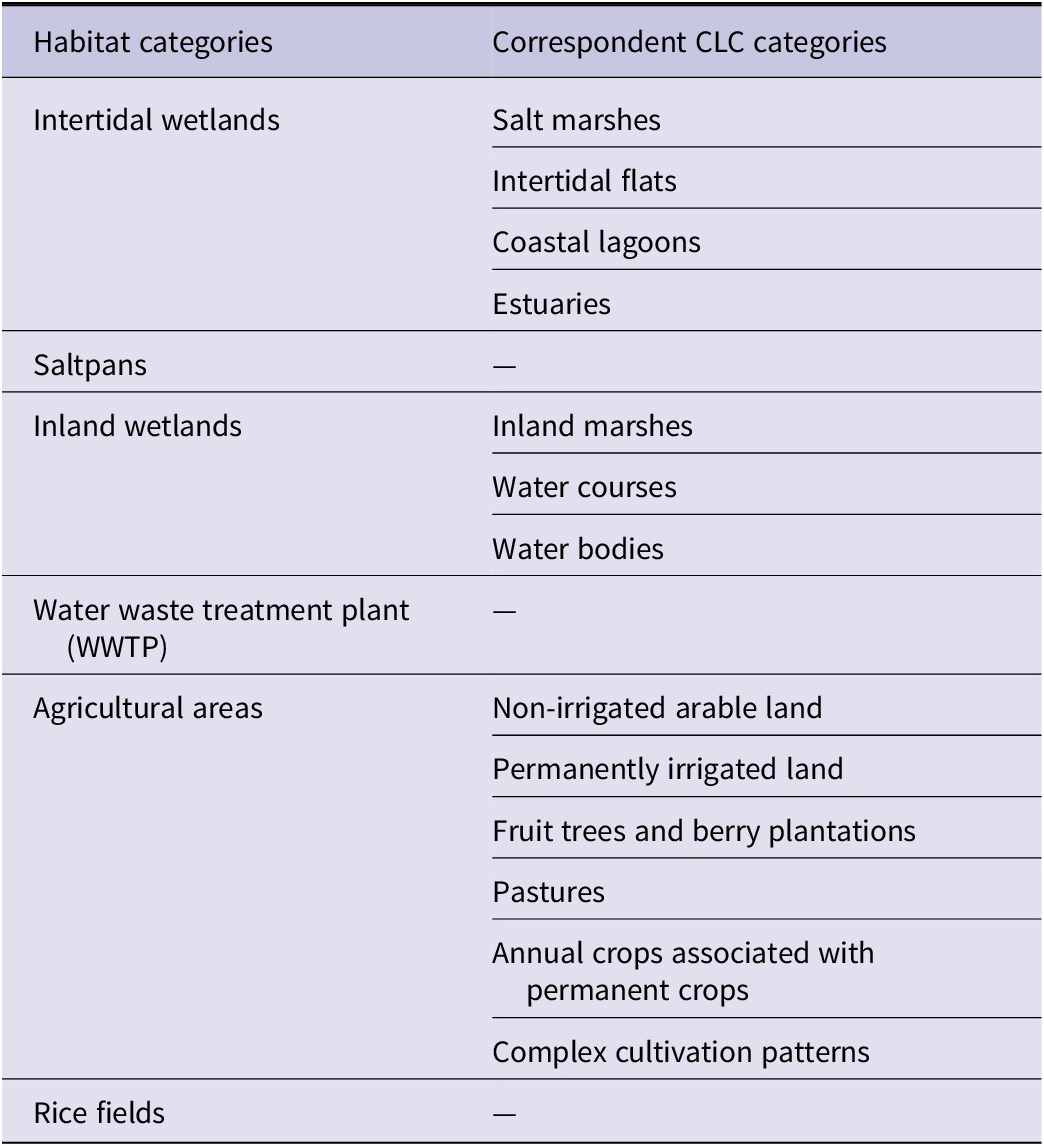
To study habitat usage by juvenile spoonbills we used Corine Land Cover 2018 (CLC), with data accessible from Copernicus Land Cover monitoring services (Bossard et al. Reference Bossard, Feranec and Otahel2000). The CLC map was complemented with satellite images (Google 2020) to reclassify incorrectly classified points due to cell size. CLC identifies 44 land use types and those present in the study area were grouped into higher levels of organization resulting in six final habitat categories (Table 2). We excluded from the analysis a few fixes that occurred in urban areas (n = 32; 0.06%), considering those to be an error in GPS localization.
Corine land cover (CLC) corresponding to habitat categories analysed.
To assess how the use of different habitats varied for each individual ALC we quantified the weekly frequency of usage of each habitat by dividing the number of locations in a given habitat in a week, by the total number of locations in that week. Because juveniles in their first year are likely to be exploratory, we did a revisitation analysis to identify the most important habitats for juvenile spoonbills, using the package ‘Recurses’ in R (Bracis et al. Reference Bracis, Bildstein and Mueller2018). This package allows calculation of the number of times the trajectory of an individual enters a circular area centred in each position of the trajectory, that is, how many times one individual revisits the same location. As we did not know which habitats were revisited the most, nor the activities performed in those areas by spoonbills, we did not have any a priori consideration of the size of the radii to use in order to define the area around locations. Hence, we did a preliminary analysis of radius size, testing radii ranging from 10 m to 1,000 m through a sensitivity analysis (see Appendix S1 in the online supplementary material) and established that 100 m was appropriate, as higher values did not produce different results. We defined a minimum threshold of 60 minutes (between two consecutive locations) to ensure that revisitations were independent (if the individual left the defined radius but returned within 60 minutes, for example during a bout of foraging movements, it was not considered a new revisitation, but as part of the prior visit). We selected the locations that had a ratio of relocations in the 75th percentile of total relocations of each individual, as an indication that those were chosen as suitable to feed or rest (Bracis et al. Reference Bracis, Bildstein and Mueller2018) rather than only exploratory.
To evaluate if the most revisited habitats changed during the first year of life, we divided the study period into two, following the delimitation of yearly periods suggested for spoonbills from the nearest breeding colony in Odiel, Spain (Aguilera Reference Aguilera1997): a) “pre-winter”, defined as the period between ALC and 30 September, encompassing the more exploratory phase of juveniles, when large migratory movements are more likely to occur; and b) “winter”, from 1 October to 31 January. As we collected virtually no information from nine spoonbills (Nembus, Polaris, Dalim, Ascella, Mizar, Azha, Australis, Tabit and Enif) in winter in Europe, these individuals were excluded from the analysis for this second period.
In order to assess if habitats in Ria Formosa were used in accordance with their availability, we performed a second order selection of habitat (Johnson Reference Johnson1980). We estimated the availability of each habitat type comprised in the minimum convex polygon (MCP) of the positions of all spoonbills during “pre-winter”, when the majority of spoonbills remained in Ria Formosa, close to the breeding colony (excluding the positions of Polaris, Sirius Mizar, and Azha after they left the vicinity of Ria Formosa). We used the package ‘phuassess’ (Fattorini et al. Reference Fattorini, Pisani, Riga and Zaccaroni2017) in R, to test the probability of the null hypothesis being true, that is, habitats were used in the same proportion of their availability, thus being neither preferred or avoided (Aebischer et al. Reference Aebischer, Robertson and Kenward1993, Fattorini et al. Reference Fattorini, Pisani, Riga and Zaccaroni2014).
Results
GPS/GSM tags recorded on average 166.4 ± 29.2 SE days of tracking, with the maximum period corresponding to 16 months, and the minimum to 55 days, in cases when the bird died or the tag failed (Table 1). Spoonbills left the colony for the first time on average at 50.6 ± 1.8 SE days of life, and their final visit to the colony occurred at the age of 67.6 ± 3.98 SE days (Table 1). Of all the spoonbills tracked, five migrated to North Africa: Polaris, Ascella, Sirius (only in its second winter), Australis and Tabit, while the remaining birds stayed in Iberia. Seven spoonbills died during the tracking period. Survival in early winter varied between 0.31 and 0.62 until December (considering tag failure as either death or alive), and in late winter varied between 0.8 and 1 until March (with only one tag failure during the coldest months of the year). Mortality was identified by multiple overlapping GPS fixes in the same location, and confirmed by the 3D accelerometer showing static readings. Based on the accelerometer data we were able to determine date, and approximate hour of death. Because the analysis only started when spoonbills left the colony (ALC) and ended when either the juvenile died, migrated to Africa, or completed one year of life, the number of days considered for analysis is smaller than the total tracking period (on average: 120.3 days ± 25.83 SE, ranging from 10 to 297 days). Enif was thus excluded from the subsequent analysis as only 10 days of data were recorded after it left the colony (ALC). Each tag collected on average 23.23 ± 0.51 SE points per day, from which 20.88 ± 0.51 SE were collected during the day and 7.38 ± 0.42 SE during the night.
Habitat selection and usage
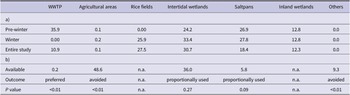
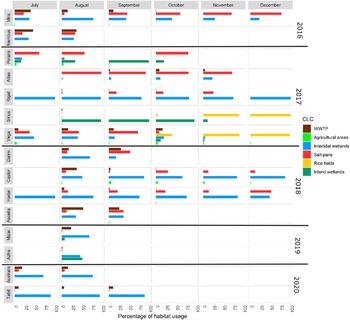
Juvenile spoonbills selected a broad range of habitats, with large variation between weeks (Figure 3). The most revisited habitats were intertidal wetlands (30.7%) followed by rice fields (27.5%) and saltpans (18.4%; Table 3a). However, when considering only the pre-winter period, Wastewater treatment plant (WWTP) was the most revisited habitat (35.9%), despite accounting for only 0.2% of the habitats present in the vicinity of colony within the area comprised by the MCP. This was followed by saltpans (26.9%), present in 5.8%, and by intertidal wetlands (24.2%), one of the most common habitats in the area (36.0%). Agricultural areas are the most available habitat, and rice fields and inland waters were absent of the 242.4 km2 (MCP) around the colony.
Habitat use by juvenile spoonbills from a colony in Ria Formosa, Portugal: a) Percentage of juvenile spoonbills revisitation of each habitat type for the study periods (see text for details). Only locations with a ratio of relocations in the 75th percentile of total relocations of each individual were considered. b) Result of the second order habitat selection proposed by Fattorini et al. (Reference Fattorini, Pisani, Riga and Zaccaroni2014). Habitat type availability in Ria Formosa (restricted to the minimum convex polygon, see text for details) by juvenile spoonbills.

Overall, available habitats were thus not used in accordance with their availability (Table 3b). Intertidal wetlands (P = 0.27) and saltpans (P = 0.09) were used in proportion to their availability, whereas agricultural and other habitats (mostly urban areas) were avoided (both P < 0.01). WWTP was the only preferred habitat (P < 0.01). During winter, intertidal areas were the most important habitat (33.4%), followed by saltpans (27.8%) and rice fields (25.9%). In total, anthropogenic habitats available in the vicinity of the colony accounted for 64.0% of the area comprised within the MCP, whereas this was only 36.0% for natural habitats. Anthropogenic areas (created and/or manipulated by humans, including saltpans, WWTP, rice fields and other agricultural areas), were used more than natural areas (56.9% vs 43.1%). In addition, during pre-winter, this difference was even larger, as 63.0% of the revisited habitats are classified as anthropogenic.
When considering annual tendencies (Figure 3), saltpans were used more in the first years of the study period (annual percentage in chronological order: 37.7%, 25.5%, 20.9%, 1.2%, 4.2%) and intertidal wetlands in the most recent years (annual percentage in chronological order: 42.1%, 25.9%, 66.0%, 56.4%, 83.5%). WWTP were used in all years but only until November whereas rice fields started to be used only in October.
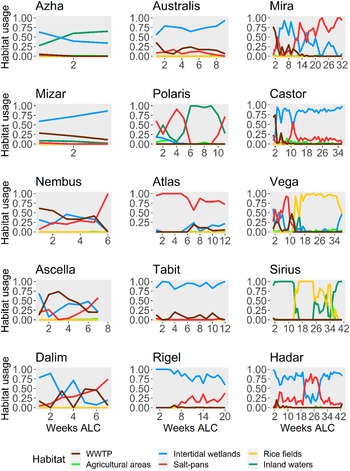
Individual habitat usage fluctuated considerably during the first weeks following ALC (Figure 2). For individuals tracked more than 20 weeks, it appears that between week 12 (Castor) and 20 (Mira) two habitats became clearly dominant, with their usage being mirrored, and all other habitats becoming considerable reduced (Figure 2). This pattern was also apparent for some individuals from a much earlier stage (e.g. Atlas, Rigel and Hadar, from week 2).
Frequency of habitat usage by tracked spoonbill juveniles from Ria Formosa per week, starting after leaving the colony (ALC) for the last time.

Percentage of habitat usage of each spoonbill in each month. Years are referenced to aid comparisons.

Discussion
Habitat selection and usage
Juvenile spoonbills born in Ria Formosa rely not only on intertidal habitats but also on anthropogenic habitats, such as saltpans, rice fields and Wastewater treatment plants. The importance of intertidal wetlands, a category that encompasses several natural habitats (Table 2), was to be expected since it is well known that spoonbills use these for obtaining food. For example, in the Wadden Sea, spoonbills mainly feed their chicks with marine prey instead of freshwater prey (Jouta et al. Reference Jouta, De Goeij, Lok, Velilla, Camphuysen, Leopold, Van Der Veer, Olff, Overdijk and Piersma2018). Also in the German Wadden Sea, both adults and juveniles selected tidal creeks for foraging during breeding and post-breeding (Enners et al. Reference Enners, Guse, Schwemmer, Chagas, Voigt and Garthe2020). In our study, we did not differentiate habitat usage by behaviour, and this may explain the utilization of a larger array of habitat types that fulfil other requirements, like roosting. Alternatively, the use of different habitats may be a function of their availability since anthropogenic habitats were very common in the study area (Table 3). Nevertheless, such habitats appeared to be a good substitute for natural ones, considering the survival found in our study, which did not differ substantially from the results from a well-studied population (early winter: 0.31–0.62 vs 0.33 ± 0.03 CI and late winter: 0.8–1 vs 0.58 ± 0.05 CI; Lok et al. Reference Lok, Overdijk, Tinbergen and Piersma2013b). It should be noted that there are two WWTPs (the only preferred habitat) in the area: Faro-Olhão (the most used by spoonbills in this study) and Olhão-Poente; both with maturation ponds that are extensively used by several species of waterbirds all the year around (Matos et al. Reference Matos, Ramos, Calado, Ceia, Hey and Paiva2018, Rias Reference Rias2019). This is a known alternative habitat for waterbirds, including spoonbills (Frederick and McGehee Reference Frederick and McGehee1994, van Dijk and Bakker Reference van Dijk and Bakker1998, Newman and Lindsey Reference Newman and Lindsey2011) that may be attracted by the constant water levels. Nonetheless, juveniles using these areas may be more exposed to pathogens and toxins such as those causing botulism outbreaks (Hamilton Reference Hamilton2007, Murray and Hamilton Reference Murray and Hamilton2010), not only due to the presence of these substances in the water but also because of the usual large congregation of birds in these sites that facilitates the propagation of diseases (Anza et al. Reference Anza, Vidal, Laguna, Díaz-Sánchez, Sánchez, Chicote and Florín2014). Interestingly, this habitat was not used in winter which leads to the question of why this apparently suboptimal habitat was used by juveniles in pre-winter. It is possible that continued water availability in WWTP explains this since its usage coincides with the driest season, when water levels are lowest in more natural habitats, or it may be related to density-dependence factors. The period when WWTP was most used (pre-winter) coincided with the period of highest abundance of spoonbills in the south of Portugal (Alves et al. Reference Alves, Lourenço, Dias, Antunes, Catry, Costa and Fernandes2012), potentially also reflecting the lower capacity of juveniles to compete for the most favourable natural habitats (Goss-Custard et al. Reference Goss-Custard, Durell, McGrorty and Reading1982, Cresswell Reference Cresswell1994, Durell Reference Durell2000).
Saltpans were often revisited in pre-winter, but also in winter, and are a common habitat in Ria Formosa. These habitats may be suitable for juveniles since they also have managed water levels, with some being used to produce salt and others converted to aquaculture. In fact, saltpans replaced coastal wetlands in many areas throughout the world, and constitute an important habitat for many waterbird species (Rufino et al. Reference Rufino, Araujo, Pina and Miranda1984, Velasquez Reference Velasquez1992, Warnock et al. Reference Warnock, Page, Ruhlen, Nur, Takekawa and Hanson2002), including spoonbills (Aguilera et al. Reference Aguilera, Ramo and Court1996, Fonseca et al. Reference Fonseca, Grade and Cancela da Fonseca2004, Pigniczki and Végvári Reference Pigniczki and Végvári2015).
Rice fields were only used in winter, and even though this was one of the most revisited habitats, it was only used by two individuals, Vega and Sirius, which dispersed beyond Ria Formosa lagoon system, where rice fields are absent. Vega dispersed to the west of Ria Formosa and Sirius to Spain. During pre-winter they were not used, likely due to the hot and dry autumn in the Iberia peninsula which often leaves rice paddies totally dry in autumn and completely dependent on precipitation patterns. Rice fields have been widely identified as substitute foraging habitat for waterbirds (Fasola and Ruiz Reference Fasola and Ruiz1996, Czech and Parsons Reference Czech and Parsons2002), mostly when flooded, which in the Iberian peninsula occurs especially during winter and migratory periods (Elphick Reference Elphick2000, Alves et al. Reference Alves, Lourenço, Piersma, Sutherland and Gill2010, Toral and Figuerola Reference Toral and Figuerola2010). Despite rice fields being an alternative habitat for waterbirds, usually most species prefer natural areas when available (Campos and Lekuona Reference Campos and Lekuona2001, Tourenq et al. Reference Tourenq, Bennetts, Kowalski, Vialet, Lucchesi, Kayser and Isenmann2001). However, the fact that rice fields had a lot of revisitations only by two individuals, and was the main habitat revisited by Vega, may indicate that it can also be a good substitute habitat for juvenile spoonbills, at least in winter.
Ontogeny of habitat use
In the first weeks after leaving the colony, the proportion in which each habitat was used varied among weeks and individuals. Still, considering over 20 weeks of tracking, a clear pattern of habitat selection emerges, showing a tendency towards each individual using only two habitat types. The decrease in the number of different habitats used during the weeks after leaving the colony may result from the start of a more specialized phase and the end of the most exploratory phase of the juvenile spoonbills, which occurs at the beginning of the post-fledging period. Alternatively, the use of a higher number of habitats in the initial months may be the result of higher competition with adults at the beginning of the post-fledging period, when more northerly breeders arrive in the area to spend the non-breeding season or to refuel on their way to Africa, potentially leading juveniles to spread over several habitats (Goss-Custard et al. Reference Goss-Custard, Durell, McGrorty and Reading1982, Wunderle Reference Wunderle1991, Cresswell Reference Cresswell1994). Juvenile spoonbills’ patterns of habitat use were very diverse across the entire study period but also within each study year. The fact that some juveniles were able to use habitats less used by others may suggest competition avoidance (Bolnick et al. Reference Bolnick, Svanbäck, Fordyce, Yang, Davis, Hulsey and Forister2003, Araújo et al. Reference Araújo, Bolnick and Layman2011). On the other hand, given that they were able to exploit several different habitat types, it suggests that this species may cope relatively well with habitat change and even habitat loss (Durell Reference Durell2000), at least in areas where alternative anthropogenic habitats can buffer the loss of natural areas. In fact, other studies already suggested an opportunistic foraging behaviour by spoonbills (El-Hacen et al. Reference El-Hacen, Piersma, Jouta, Overdijk and Lok2014, Enners et al. Reference Enners, Guse, Schwemmer, Chagas, Voigt and Garthe2020) and our study also seems to corroborate that. The fact that saltpans were mostly used by juveniles born in 2016–2018 and less used by juveniles born in 2019–2020 may indicate that in those early years, saltpans had more attractive conditions. Unfortunately, we do not have information on water levels on those habitats to be able to assess this. It may also be a consequence of the small sample size in each year, which limits the variation between individuals. Another result that suggests opportunistic habitat use by juvenile spoonbills is the difference between the three spoonbills that remained in Ria Formosa (Castor, Hadar and Mira) and the two that remained in the Iberian Peninsula but left the vicinity of the colony (Vega and Sirius). The first group used the same two habitats in different proportions (Figure 2): saltpans and intertidal wetlands (two available habitats in Ria Formosa), while the second group used other two different habitats: inland waters and rice fields (not available in Ria Formosa). In fact, rice fields only started being used by tracked spoonbills in October, most likely when these start being flooded, once Sirius had already dispersed to areas with rice fields by August, but only started using them in October. Polaris went to the same area as Sirius but migrated to Africa in September, which likely explain why it did not use rice fields.
One limitation of our work was the absence of extended nocturnal tracking, especially when studying the use of intertidal wetlands, but the use of those areas may be more limited by tidal movements than by daylight hours, and since the study spanned several months, the results should present little tidal bias. In order to better understand drivers of differences in habitat usage along the first year of independence, it would be important to obtain information relative to the use and habitat selection of adult spoonbills, to test if competition may be forcing juveniles into poorer habitats. Moreover, it will be important to quantify water availability in several habitat types and its variability throughout the year, to ascertain if juveniles are using anthropogenic habitats due to water scarcity in natural habitats. Furthermore, determining which activities are performed in different habitats will likely provide a better interpretation of the current patterns of habitat usage, particularly in assessing if anthropogenic habitats are used for foraging or mostly for other activities (e.g. roosting, preening, etc.)
In summary, we show that juveniles are able to use several habitat types, including anthropogenic habitats, which supports the idea that the development of spoonbill colonies in Portugal is driven, at least partially, by the capacity of individuals of this species to explore new habitat types (Shultz et al. Reference Shultz, Bradbury, Evans, Gregory and Blackburn2005), which was also the case in Serbia, where spoonbills are now using fish farms (Tucakov Reference Tucakov2004). This work highlights the need to further protect and restore natural intertidal wetlands but also to identify and manage anthropogenic habitats important to spoonbills. The fact that anthropogenic habitats were used by spoonbills, which is considered a specialist species (Swennen and Yu Reference Swennen and Yu2005, Pigniczki Reference Pigniczki2017), highlights their opportunistic behaviour on habitat selection and may indicate that these habitats can also be favourable to other waterbird species with similar ecology.
Acknowledgements
We are grateful to Ria Formosa’s wardens, Silvério and Capela, for the help with the fieldwork and for monitoring the colony. To Vitor Encarnação for the information about Portuguese colonies, and to all the people that helped in the fieldwork. We thank the reviewers whose suggestions contributed to improving this work. We received the support of Portuguese national funds provided by ‘Fundação para a Ciência e a Tecnologia, I.P.’ (FCT/MCTES), to MSR (SFRH/BD/145942/2019), JAA (SFRH/BPD/91527/2012), through the strategic project UIDB/04292/2020 granted to MARE, through project LA/P/0069/2020 granted to the Associate Laboratory ARNET, and through UIDP/50017/2020+UIDB/50017/2020+ LA/P/0094/2020 granted to CESAM. Permits for bird sampling issued by the national authority for wild bird handling & ringing ICNF were granted to JAA (113/2016, 119/2017, 97/2018) and PMA (202/2015, 189/2018, 191/2020).
Supplementary Materials
To view supplementary material for this article, please visit http://doi.org/10.1017/S0959270922000326.