





Introduction
On a beautiful, sunny morning in 2017, I walked past Ayi Mensah, a peri-urban area on the outskirts of Accra, and I was intrigued by the view of an enclosed area adjacent to the Ayi Mensah police station. It was a new development with Ayi Mensah Park boldly inscribed on the billboard alongside the slogan ‘love where you live’. A few metres away was the old Ayi Mensah settlement with dilapidated structures. I pondered this contrast, asking myself why there was a gated community in a village and how residents viewed this development. Finally, when I decided to pursue a doctoral degree, I saw it as an opportunity to explore and answer my questions. As part of my preliminary fieldwork, I attempted to gain access to the Ayi Mensah Park gated community but was unsuccessful. After several days of denials, I finally gained access while in the company of my supervisor. The initial denials indicate the privatized nature of these developments and the extent of exclusion outside the gate. After gaining access, we were welcomed by green parks adorned with beautiful flowers overlooking the main entrance. The pavements were brightly lit and clean, unlike the dusty streets of the old Ayi Mensah town. Within this beautifully planned gated community, it appears that every sensory pleasure has been carefully designed to create a picturesque living environment. However, outside the gate lies a landscape of social exclusion and residential segregation, indications of the housing inequalities prevailing in many African countries.
Africa’s major cities, including Accra, where approximately 90 per cent of the world’s population is expected to reside by 2050 (UN-DESA 2019), are gradually being transformed by growing private and foreign investment in the real estate sector (Gillespie Reference Gillespie2020). This transformation results from rapid urbanization and the high demand for urban housing, infrastructure and services (Ablo and Bertelsen Reference Ablo and Bertelsen2022; Herbert and Murray Reference Herbert and Murray2015). Recognizing the urgent need to address the pressing challenges of urbanization, many African governments have embarked on ambitious urban policies and visions aimed at transforming urban and peri-urban areas into modern landscapes characterized by high-rise buildings, master-planned cities and gated communities (Côté-Roy and Moser Reference Côté-Roy and Moser2019; van Noorloos and Kloosterboer Reference van Noorloos and Kloosterboer2018). In view of this, many governments have transitioned from providing housing to facilitating and promoting private sector investment. These shifts led to the introduction of private market initiatives to formalize urban land (Amanor Reference Amanor and Takeuchi2022; Kugbega Reference Kugbega2020), which, in turn, led to the proliferation of private real estate developers and foreign investment in the housing sector. Importantly, this article examines how these developments are transforming land-based livelihoods in peri-urban areas that hitherto served as homes for low-income people.
With an urbanization level of 56.7 per cent (Ghana Statistical Service 2021), Ghana’s peri-urban and rural areas are increasingly subjected to uncontrolled land acquisition and speculation (Ablo et al. Reference Ablo, Asem, Yiran, Owusu, Kapfudzaruwa, Kudo, Matsuyama and Allasiw2020; Follmann et al. Reference Follmann, Kennedy, Pfeffer and Wu2023). As people migrate from rural to urban areas, more land is needed to accommodate the growing urban population, putting undue pressure on the peri-urban interface that supplies land for residential and commercial development. With Greater Accra Region’s (GAR’s) urbanization level of 91.7 per cent (Ghana Statistical Service 2021), Ghana’s capital city, Accra, has experienced pronounced urban sprawl as growth in its peri-urban areas is characterized by unplanned settlements, low-density development, inadequate housing and waste management, and traffic congestion, among other issues (Afriyie et al. Reference Afriyie, Abass and Adjei2020; Ofoli et al. Reference Ofoli, Ablo and Wrigley-Asante2024; Cobbinah and Aboagye Reference Cobbinah and Aboagye2017; Ablo and Yekple Reference Ablo and Yekple2018). Additionally, the availability of cheap land in peri-urban areas (Asafo Reference Asafo2020; Yeboah Reference Yeboah2003), coupled with increasing land formalization, has made these areas sites of accumulation, in which historically customary lands used for agricultural purposes are appropriated for development by real estate companies and private developers. While private individuals’ interest in peri-urban land is geared towards housing development, often built incrementally (Asibey et al. Reference Asibey, Abdulai, Iddrisu, Blija, Adutwum, Tagnan, Kpeebi and Tornyeviadzi2023), real estate companies’ interests are usually driven by profit generation and entrepreneurs’ ambitions to develop exclusive neighbourhoods for the wealthy and for middle-income earners. Studies have shown that land formalization, which involves securing land tenure through land title registration, has significantly increased real estate development activity and transformed the land-based livelihoods of people in peri-urban Accra (Yekple et al. Reference Yekple, Overå and Ablo2026; Ablo and Bertelsen Reference Ablo and Bertelsen2022). Examples of housing projects transforming land-based livelihoods on the outskirts of Accra include the Appolonia City of Light project (a private gated city), with 2,325 acres of land under construction (Ablo and Bertelsen Reference Ablo and Bertelsen2022), the Ningo-Prampram urban extension project (Grant et al. Reference Grant, Oteng-Ababio and Sivilien2019) and Ayi Mensah Park (Yekple et al. Reference Yekple, Overå and Ablo2026; Reference Yekple, Overå and Hidle2024). These housing facilities are high-class residential areas with restricted access (Grant Reference Grant2005), which, according to Nielsen et al. (Reference Nielsen, Sumich and Bertelsen2021), constitute a monumental affirmation of a particular and visible form of detachment and separation in many African cities. This form of detachment is not only an ‘aesthetic of imagination’ that radiates through African cities to transform them (Nielsen et al. Reference Nielsen, Sumich and Bertelsen2021); it also disrupts the customary land tenure system that governs land, thereby transforming people’s livelihoods (Ablo Reference Ablo2024).
There are numerous studies on urban expansion and housing provision in Ghana’s real estate sector. Many of these studies focus on the financial trajectories, governance structures, rationale and physical spaces of these housing units (Ablo Reference Ablo2023; Anokye et al. Reference Anokye, Tanyeh and Agyemang2013; Asiedu and Arku Reference Asiedu and Arku2009; Ehwi Reference Ehwi2023; Ehwi et al. Reference Ehwi, Morrison and Tyler2021; Fält Reference Fält2019; Korah Reference Korah2020; Yeboah et al. Reference Yeboah, Maingi and Arku2021; Grant Reference Grant2005). Other studies have examined how real estate developers navigate Ghana’s plural land governance systems to acquire land for development (Yekple et al. Reference Yekple, Overå and Ablo2026) and the perceptions, emotions and attitudes of residents living in the environs of gated communities (Yekple et al. Reference Yekple, Overå and Hidle2024). Ablo and Bertelsen (Reference Ablo and Bertelsen2022) also explored how the construction of the Appolonia City of Light project altered the social relations to land and livelihood activities in peri-urban Accra. Given the increasing activities of individual and private developers, particularly real estate developers in peri-urban Accra, and the large tracts of land required for development in areas such as Ayi Mensah, this article contributes to the literature on urban development by examining how land privatization and acquisition affect residents’ land-based livelihood activities and how residents respond to these changes.
Ayi Mensah is a peri-urban area in the GAR of Ghana, undergoing rapid development and spatial transformation driven by land privatization and increased investment in the housing sector. By focusing on land privatization and the socio-economic outcomes of real estate developments, this article sheds light on a fundamental feature of privatized urbanization, often linked to dispossession, whether through forced evictions of peasants or through voluntary market-led processes (Ablo Reference Ablo2024; Kan Reference Kan2019). Based on semi-structured interviews, informal conversations and observations, this article argues that expropriating agricultural land, particularly for luxury residential purposes, entails a market-led dispossession that detaches residents from lands that had hitherto served as sources of livelihood. This land dispossession and the subsequent construction of ultramodern housing units are forms of detachment that disrupt land tenure arrangements and transform livelihood activities in peri-urban Accra.
Primary data were collected in 2020 and 2021. The first fieldwork consisted of twenty-two household interviews, which provided relevant contextual information on the study area and residents’ livelihood activities.Footnote 1 Additionally, I conducted sixteen in-depth interviews and six informal conversations.Footnote 2 Participants for in-depth interviews included three community leaders, two clan heads (from Oyarifa), three officers at state institutions and eight community members. These participants were selected based on their leadership position, knowledge of the land tenure system and historical knowledge of the Ayi Mensah community. Informal conversations with residents were conducted by the roadside, sometimes while participants attended to their goods. Furthermore, I conducted field observations in the Ayi Mensah area to gain an overview of the activities of individual developers and real estate developers, as well as residents’ livelihoods, which were recorded as field notes. Additionally, secondary data, such as maps, web pages, newsfeeds, YouTube documentaries and journal articles, were used to understand Ayi Mensah as a place and the activities taking place there.
In the following section, I discuss how the economic and structural dynamics of accumulation by dispossession reconfigure people’s livelihoods. I then describe Ayi Mensah, highlighting its land use and changes in livelihoods. Subsequently, I discuss how land acquisition for private development not only disrupts the customary land tenure arrangements between landowning families and residents but also detaches people from their livelihoods. The article ends with a discussion of how residents made a living amid land dispossessions.
Land dispossession and livelihood changes: a conceptual perspective
Success in the housing sector, particularly in real estate development, hinges heavily on access to and use of land, and in ways that impact local livelihoods. Over the years, large-scale land acquisition for agricultural and real estate purposes has been the subject of intense media and academic debates and scrutiny, given the problematic, fraudulent and violent nature of these land transactions and the large tracts of land involved (Ablo and Bertelsen Reference Ablo and Bertelsen2022; Boamah and Overå Reference Boamah and Overå2016; Ablo Reference Ablo2024). While Collier (Reference Collier2008) views large-scale land transactions as essential catalysts for improving livelihoods and increasing global food supply, van Noorloos and Kloosterboer (Reference van Noorloos and Kloosterboer2018) and Ablo (Reference Ablo2024) view these land deals as forms of dispossession that negatively affect livelihoods. Many of these land deals and their associated socio-spatial transformations have been analysed through the lens of accumulation by dispossession (ABD), which typically involves the forceful eviction of people. However, as this article will show, ABD can also occur voluntarily without coercion in contemporary societies.
ABD is the continuation and proliferation of accretion processes that Marx designated as primitive accumulation during England’s Industrial Revolution, with its associated land enclosure and peasant dispossession (Harvey Reference Harvey2007: 34). According to Harvey (ibid.: 35), ABD involves a range of practices: (1) the commodification and privatization of land and the forceful expulsion of the peasant population; (2) the conversion of various forms of property rights into exclusive private properties for profitable use; (3) the suppression of rights to the commons; and (4) the commodification of labour power and the suppression of livelihoods. Such practices are prevalent in many Ghanaian rural and peri-urban communities, where rapid urbanization and economic liberalization have exposed livelihood activities to competing land uses. Scholars such as Kan (Reference Kan2019) and Akram-Lodhi (Reference Akram-Lodhi2012) have shown that ABD can occur through voluntary market-led processes, in which landowners may sell or lease their land; in such cases, they are not coerced to sell to any particular entity or at any price. Kan (Reference Kan2019) argued that it is through such primary economic mechanisms that dispossession is unfolding in contemporary societies, as shown later in this article. Additionally, Ablo (Reference Ablo2024) argued that dispossession occurs not only through physical eviction or land grabs but also through the disruption of society’s socio-cultural structure when capital is inserted into the economy. Thus, when rural life encounters capitalist production systems, the result is a change in the institutional configuration that shapes access to land (Obeng-Odoom Reference Obeng-Odoom2015). Based on these considerations, this article views dispossession as an economic process that disrupts customary land tenure systems, detaches people from their land-based livelihoods, and thereby reconfigures their livelihood activities.
In Ghana, as in other African countries, customary land relations are based on a differentiation between allodial and user rights, which profoundly influence land access and tenure security (Amanor Reference Amanor, Ubink and Amanor2008; Berry Reference Berry2013; Lund Reference Lund2013). Allodial land rights are vested in chiefs, clans and family heads, who, through their political hegemony, are granted ultimate control over land; as such, they manage land on behalf of their communities, clans and members (Amanor Reference Amanor, Ubink and Amanor2008; Reference Amanor and Takeuchi2022; Berry Reference Berry2013; Boni Reference Boni, Ubink and Amanor2008; Tonah Reference Tonah, Ubink and Amanor2008). This right means that community members and settler farmers hold only user rights to land, conferring on them the right to use the land for livelihoods, but not to sell (Amanor Reference Amanor, Ubink and Amanor2008). Such user rights deny the peasantry secure land rights, leaving them vulnerable to encroachment and to dispossession by traditional leaders, who can assume ownership of the entire land at any time (Berry Reference Berry2013). As Ubink (Reference Ubink2008) and Lund (Reference Lund2013) show for some peri-urban areas in Ghana, customary landowners in peri-urban Accra use their claims as allodial titleholders to appropriate settler farmers’ lands and lease them to private individuals and real estate developers through market-led economic processes, as Kan (Reference Kan2019) and Akram-Lodhi (Reference Akram-Lodhi2012) have indicated. In her analysis of patterns of accumulation and governance in central Ghana, Berry (Reference Berry2013) noted that the combination of customary, state-leveraging and market strategies in land access promotes accumulation among well-positioned actors, as Yekple et al. (Reference Yekple, Overå and Ablo2026) have also shown. In most instances of ABD, Ablo and Bertelsen (Reference Ablo and Bertelsen2022) observed that community lands are used to the benefit of powerful elites – such as transnational organizations, states and local elites – to the detriment of the poor. The effect is that most assets previously held by local communities are privatized, thereby marginalizing people whose livelihoods depend on land. Given people’s varying levels of agency and resources, some lose out, while others create and capitalize on new livelihood opportunities.
Based on the concept of ABD, this article shows that the acquisition of land for the development of private housing units in peri-urban areas constitutes a form of detachment that reconfigures residents’ relationships with land and transforms their livelihoods. While Amin (Reference Amin2004) noted that such changes occur at multiple levels, this article focuses on the individual level. This individual-level analysis helps highlight people’s different perspectives on livelihood activities and changes in Ayi Mensah. Additionally, it examines residents’ past and current livelihood activities, which could provide insights into the spatial transformation of this peri-urban space. In brief, the article argues that the expropriation of agricultural land, particularly for luxury residential purposes, entails market-led dispossession that detaches residents from lands that had hitherto served as sources of livelihood. It further shows that residents respond by diversifying their livelihoods and by exploiting new opportunities.
Ayi Mensah: an emerging urban space
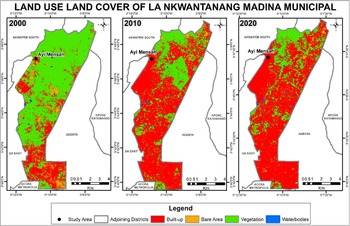
Ayi Mensah is situated in the La-Nkwantanang Madina Municipal Assembly (LaNMMA) of the GAR of Ghana (see Figure 1). The LaNMMA has a population of 244,676, representing 4.5 per cent of the region’s total population (Ghana Statistical Service 2021). About 84.6 per cent of the population in the municipality resides in areas classified as urban, with pockets of rural settlements such as Ayi Mensah rapidly developing into peri-urban areas (Ghana Statistical Service 2021; 2014). Ayi Mensah was selected due to increasing urbanization, population growth and investment in the real estate sector. These pressures transform the land-use patterns and landscapes of these areas from agrarian to built-up (see Figure 2). Data from the municipal assembly show ten real estate projects dotted around Ayi Mensah. Three of these are gated communities with restricted access, while the remaining seven are open access. The ten real estate projects are at different stages of development and are situated on land areas ranging from 10 to 20 acres. Three estates are located near the old Ayi Mensah settlement: Ayi Mensah Park, New Oak Estate and Kumsark Estate (see Figure 3).
Map of LaNMMA showing Ayi Mensah and other towns. Source: RS/GIS Lab, University of Ghana.

Land use change in LaNMMA. Source: RS/GIS Lab, University of Ghana.

Aerial view of Ayi Mensah showing the old village and three estates. Source: Modified from Yekple et al. (Reference Yekple, Overå and Hidle2024).

Land-use change and livelihood transformation
Land acquisition for housing development in Ayi Mensah has reconfigured land tenure arrangements and rural livelihoods. As 80 per cent of land in Ghana is held by customary institutions (traditional leaders, families and clans) (Anim-Odame Reference Anim-Odame2021), sections of the land in the Ayi Mensah area belong to the Ga traditional area – or, more precisely, to the people from Oyarifa in LaNMMA of Ghana, who are descendants of La and Teshie, two coastal towns located in the south-eastern part of the Greater Accra region (see Figure 1). Although the land belongs to the Ga, people from a variety of ethno-linguistic groups (Akans, Ewes and Fulanis) live in this area.
According to historical accounts from participants, Ayi Mensah was founded in 1785 by two hunter friends, Ayi and Mensah, from a coastal town in the Greater Accra region of Ghana. After obtaining the landowners’ approval, the two friends built a hut on a portion of the land now known as Ayi Mensah to serve as temporary accommodation after their hunting expeditions. Other people joined the two friends on their expedition and temporarily settled in the area.
Ayi Mensah emerged from a network of social and cultural relations and interactions that extend beyond the boundaries of the GAR and Ghana. Informants’ accounts indicate that, from the early 1940s, Ewes from the Volta region of Ghana and Southern Togo settled in this area to seek employment in Accra. The first Ewe person to reside in Ayi Mensah was a corn and cassava mill operator employed by the Ga chief of the village at the time. As more family members joined, the chief granted them portions of land on which to dwell and farm. This section of the town later became known as ‘Ayigbe town’Footnote 3 (meaning ‘Ewe people’s town’) because Ewes from the Volta region largely inhabited it. In 1972, Ewes from Southern Togo arrived and were allocated land for habitation and cultivation. This section became known as ‘Togo town’. On the other side of the road is ‘Zongo town’, which is mainly inhabited by Fulani Muslims. The first Fulani to inhabit this section is believed to have arrived around the 1930s from Niger. As settler farmers, with user rights to the land (Amanor Reference Amanor, Ubink and Amanor2008), the chief and traditional elders tasked all sections of the Ayi Mensah old settlement (Ayigbe town, Togo town and Zongo town) with protecting the lands surrounding the community from encroachment. However, during the onset of structural adjustment policies in the 1980s, landowners exercised their allodial rights to land and began selling and leasing surrounding land to private individuals and corporate bodies, as witnessed in other parts of Ghana (Amanor Reference Amanor and Takeuchi2022; Berry Reference Berry2013). Currently, only sections of land in the old settlement are owned by the descendants of the first inhabitants.
Despite its congested nature in terms of the built environment, the Ayi Mensah old settlement (marked in Figure 3 Footnote 4 ) continues to serve as a sought-after place for migrants, particularly Ewe migrants from the Volta region and Togo seeking greener pastures in Accra. As Berry (Reference Berry2013) and Lund (Reference Lund2013) found in other traditional areas of Ghana, the chief, family and clan heads from Oyarifa – the custodians who hold allodial title to the land in Ayi Mensah – make all decisions regarding land sales and leasing within and around the community. This was echoed by an elder: ‘Our forefathers gave the Ayi Mensah old settlement land to some Ewe migrants years ago to farm and settle on. Only the land where their houses are located belongs to the residents and so cannot be sold by us [the elders] or the residents themselves.’ Therefore, residents lack the right to sell or lease land, thereby shaping their current socio-cultural relations with the land. Even within their community, they do not have the right to lease any portion of land inherited from their forefathers. Thus, the non-forceful nature of land dispossession witnessed in Ayi Mensah has disrupted the community’s socio-cultural structure and residents’ land tenure arrangements, as Ablo (Reference Ablo2024) has shown for Appolonia. Changes in this land tenure system have compelled residents to accept any development in the area.
Like many communities on the outskirts of Accra, the Ayi Mensah area was agrarian, with livelihoods revolving around farming (crops cultivated include maize, cassava and plantain), the rearing of livestock (fowl, goats, sheep and cattle), processing of gari (a staple food made from ground and roasted cassava), wildlife hunting, and the making of pestles and mortars (household tools used for pounding palm nuts and fufu, the staple dish made from cassava and plantain) (see Figure 4). These activities were conducted on both subsistence and commercial bases, with the old settlement serving as a market centre for residents of Kitase and other towns on the Akwapim Ridge.
Agricultural products and rock slabs on sale.

However, rising land values, competition over landholdings and land privatization (Berry Reference Berry2023), coupled with increased activities of private and real estate developers, have altered tenure arrangements among landowners, traditional leaders and community members in the Ayi Mensah old settlement. The result is the depletion of vegetative cover in the Ayi Mensah area (see Figure 2), a lack of farmland, and increased landslides and erosion along the Ayi Mensah section of the Akwapim Ridge. Continuous weathering and geological processes along the ridge break down rocks into layers and pieces, resulting in the accumulation of numerous rock slabs at the foot of the ridge. These rock slabs provide a new source of income for some residents, who sell them to supplement their primary income (see Figure 4). The continued sale of what used to be farmland to private and real estate developers also marginalizes a segment of Ayi Mensah residents, particularly women engaged in gari processing, as their primary source of livelihood is disrupted.
The emergence of real estate housing projects
Fuelled by the emergence of a growing middle-income class and their rising housing demand, small-scale private and multinational corporations are leading the drive to address housing deficits in many African cities through private urban development (Fält Reference Fält2019; Watson Reference Watson2014). Ayi Mensah is not spared from such development. Over the years, it has expanded beyond the old settlement due to increased activity by private individuals and real estate developers, as well as the 2008 expansion and construction of the Accra–Aburi road, which improved accessibility to the community. While exploring the Ayi Mensah area, one can observe housing inequality between real estate housing units and low-income neighbourhoods. Housing units such as Ayi Mensah Park gated community, New Oak Estate and Kumsark Estate are built based on Western designs, while Ayi Mensah old settlement is poorly constructed, with no space for parks and gardens and no children’s playground.
The Ayi Mensah Park gated community is a foreign Ghanaian venture, while New Oak and Kumsark are owned and developed by Ghanaian developers. Although the construction of Kumsark Estate commenced around 2012, Ayi Mensah Park in 2017, and New Oak Estate around 2021, the lands on which these estates stood were acquired from the traditional owners in the 1990s. This means that residents’ access to farmland began to dwindle during the period of structural adjustment and neoliberal policies (Gillespie Reference Gillespie2016; Grant Reference Grant2005), which saw the commodification and privatization of various stool and family lands (Yeboah Reference Yeboah2000). The presence of these ultramodern housing projects in a previously rural setting is a physical manifestation of enclaving, which, for Nielsen et al. (Reference Nielsen, Sumich and Bertelsen2021), constitutes a monumental affirmation of a particular form of detachment that reconfigures residents’ relationships with their environment and livelihoods.
Commenting on the importance of the road network to the development of the Ayi Mensah area, a resident expressed her joy at the road expansion. She said:
The road network has made it easy to go to Madina and Accra at any time of the day and week. In the past, that was extremely difficult, but now it is easy to go out and come back any time without fear of not getting a car.
A community leader added:
The construction of the dual-carriage road from the Akwapim Ridge through Ayi Mensah and Oyarifa to Accra opened the place for development. As a result, more private individuals who bought land but left it idle started developing their lands.
Thus, the networks of social relations, movements and communications made Ayi Mensah a unique point of intersection. Whether immediate or distant, the movement of family members and the convergence of different ethnic groups (Ewe, Fulani, Ga, Akan) at this site, plus the presence of real estate housing facilities that house a relatively diverse high-income group of residents, show the complex, ethnically diverse and heterogeneous nature of Ayi Mensah.
Changing social relations to land
Given the historical antecedents of land ownership, the land tenure arrangement between landowners and residents provided security and land use rights. However, as capital separates people from land, this alters the institutional configuration that shapes access to land (Obeng-Odoom Reference Obeng-Odoom2015). Additionally, rising land values in Ghana have frequently led to competition over landholdings and disagreements over who controls access to land, how landed wealth is distributed, and how land in general is governed (Berry Reference Berry2023). In this subsection, I present illustrative cases that demonstrate residents’ changing relationships with the land and their environment, and how each member responded to these changes.
During a group interview in September 2021 at a cassava-grinding shop, seven women (six adults and a teenager) recounted how the sale of land and the activities of private and real estate developers affected their livelihoods, particularly by disrupting gari processing (see Figure 5). One of the adult women noted:
All the farmland in and around Ayi Mensah had been sold by its owners to private and real estate developers. We no longer cultivate cassava as we did about twenty years ago. Instead, we purchase the crop at higher prices from farmers in other villages in the Eastern or Volta regions of Ghana.
Group of women peeling cassava.

Transportation from these locations increases production costs, thereby raising the item’s final cost. Another woman added: ‘At times, we are contracted and paid by other women to peel cassava, as you see us doing. We do this to supplement our primary occupation, which is petty trading.’
Kwame, a thirty-five-year-old man, expressed anger, particularly towards real estate developers who destroyed crops on farmland before constructing ultramodern housing units without compensating farmers. Aside from being a mason, he makes pestles and mortars for sale and takes care of his wife’s petty trade when she is away. Kwame recounted:
I had been in the pestle-and-mortar business since age fifteen and had also engaged in farming as a teenager. However, the land where I used to farm has been sold [leased] to private and real estate developers, who have cleared it and constructed housing units.
Additionally, he noted that the tree species used to make pestles and mortars have been depleted, making raw materials for the pestle business scarce. According to him, raw pestle materials were now bought from farming communities in the Volta region (a four- to five-hour drive from Ayi Mensah) at higher prices, lowering his profit margin. Kwame added: ‘My wife, who sells fruits, cassava, sweet potatoes and cocoyam, must now travel to Koforidua [approximately a two-hour drive] or to the Madina market [a thirty-minute drive] to purchase these items at higher prices.’ Kwame then echoed: ‘The community is rapidly developing and will soon reach Kweiman, a nearby neighbourhood [see Figure 1], because of increasing population growth and the growing activities of private individuals and real estate developers.’
Ahmed is a pensioner born in Ayi Mensah. He indicated that Ayi Mensah has evolved over the past thirty years, particularly in its physical size and population. According to him, this development was driven by the increasing activity of individual builders and real estate developers, as well as the relatively cheap cost of land and rental facilities in the area. Like other residents, Ahmed’s family (nuclear and extended) farmed on the land where Ayi Mensah Park now stands. However, their farming activities gradually ended when the land was leased to a private individual in the 1990s. This private individual and his son collaborated with BlackIvy, the US-based parent company of IndigoHomes, to build the Ayi Mensah Park estate (see Yekple et al. Reference Yekple, Overå and Ablo2026). Because there was virtually no arable land, Ahmed moved to Accra Central in search of employment. After several years of manual labour, Ahmed worked at a state institution until his retirement, after which he returned to Ayi Mensah. When I met Ahmed, he was rearing sheep and goats on a small scale to supplement his meagre pension. He feeds the animals with cassava and plantain peels, which he gets from ‘chop bar’ (local restaurant) operators, neighbours or women who peel cassava (as in Figure 5).
Madam Ayele is an older woman in her seventies who has resided in Ayi Mensah for over forty years. Ayele was originally from a coastal town but relocated there with her husband. She and her now late husband were farmers, cultivating cassava, maize and other vegetables for sale and household consumption. She said:
I was processing gari and making pestle and mortars for sale. However, from the 1980s, when farmland became scarce due to land sales to private individuals, I farmed on people’s undeveloped land, including estate land, until the owners were ready to develop it. Due to increasing land scarcity, I stopped farming and started making and selling kenkey [a staple food made from fermented maize].
The high demand for this staple food, coupled with the presence of the Ayi Mensah toll booth, made the area a favourable location for her business.
As discussed above, land tenure arrangements in Ayi Mensah are such that residents of the old settlement have no say in how land is allocated, as they have only usage rights. As a result, farmlands and forests that were crucial to residents’ livelihoods were leased and converted to private use, including for real estate development, to meet increasing land demand. As in other peri-urban areas of Accra, land privatization and expropriation have not only dispossessed people but have disrupted the social relations and land tenure arrangements that protected livelihoods (Ablo Reference Ablo2024) in Ayi Mensah. Agricultural activities, which were the primary source of income, have been eroded by the increasing demand for land for residential development. Women, whose livelihoods centred on gari processing and pestle-and-mortar making, were most affected by the lack of financial resources to access cassava and other tree species elsewhere for their businesses and for alternative artisanal skills.
Clearly, land privatization and high profits from land sales, as in other parts of Ghana (Ablo et al. Reference Ablo, Asem, Yiran, Owusu, Kapfudzaruwa, Kudo, Matsuyama and Allasiw2020; Follmann et al. Reference Follmann, Kennedy, Pfeffer and Wu2023; Gillespie Reference Gillespie2020), have disrupted the land tenure arrangements among landowning families, traditional leaders and residents of Ayi Mensah. The subsequent development of housing facilities, which is transforming the area’s landscape into several segregated spaces, leaves residents dispossessed and separated from their agricultural lands. This corroborates Harvey’s (Reference Harvey2007) argument that, as capital accumulates, there is dispossession of vulnerable social groups, in this case residents of Ayi Mensah, particularly women – whose livelihoods depend on the availability of farmland – as wealth is centralized in the hands of a few private individuals, local elites and real estate developers, who acquired large acres of land using personal resources (Yekple et al. Reference Yekple, Overå and Ablo2026). Although this detachment poses a significant threat to agricultural livelihoods and increases residents’ and communities’ vulnerability to poverty (Ablo and Bertelsen Reference Ablo and Bertelsen2022), it also offers new or alternative livelihood opportunities. In the following section, I present illustrative cases of how some residents leveraged the opportunities created by the spatial transformation in Ayi Mensah to improve their standard of living.
Taking advantage of new income-generating opportunities
Learning on the job
When construction at Ayi Mensah Park commenced, labourers from different places and diverse artisanal fields, including students, converged to take advantage of the employment opportunities created by the estate developers. Kobla, a twenty-eight-year-old man, decided to acquire a skill while working on the construction site. He was born in Ayi Mensah, but his parents were from the Volta region of Ghana, and he was residing in a brick house in the old settlement with his uncle and grandfather at the time of the interview. As a young boy, Kobla accompanied his father and grandfather to the farm, where they cultivated cassava and maize for household consumption and sale. Back then, women would buy cassava and process it into gari, the main economic activity in the town. However, as the Ayi Mensah area began to develop, there was virtually no land left to farm. The unavailability of arable land raises questions of how residents adapt their livelihoods over time amid ongoing urban development.
After completing junior high school, Kobla decided to learn a vocation due to a lack of funds to continue his education. He trained as an electrician and depended on this trade as his main source of income. Working as an electrician was tough, as he struggled to make ends meet due to his small customer base. In 2017, when work started at Ayi Mensah Park, he joined the workforce as a labourer, just like other young men from the settlement. Kobla worked for two months as a labourer but stopped because the work was too demanding. He then decided to attach to a particular department on the construction site instead of being a mere labourer. After consultation and payment of GHC 500 (US$80Footnote 5 ) to the department’s head, he was accepted for training as a steel bender. Thus, he worked and learned on the job. Even though there were issues with their wages, he continued to work because he regarded the future benefits of his training as more important than his salary. Smiling, he said, ‘I thank God I took that bold decision to learn a craft instead of being a mere labourer like my other colleagues. I can now boast of being an electrician and a steel bender, and I frequently secure contracts from recognized organizations.’ As we see, Kobla’s decision-making and negotiation skills were crucial to achieving his goal as a steel bender.
Economic gains
Other residents also took advantage of the opportunities offered by estate developers to raise funds for their tertiary education. Kofi is one of those young men. Born in a coastal town in the Volta region, Kofi moved at the age of sixteen to live with his uncle in Ayi Mensah. Kofi was twenty-two when I met him and an undergraduate. He worked as a labourer at Ayi Mensah Park for one year during the construction stage. Even though there were issues with wage payments, Kofi still earned some income, which helped him finance his education. According to him, the community has ‘gone global’ due to the presence of the gated community, specifying that ‘the village is now on Google Maps’. To him, this has made the settlement gain global recognition. Kofi also demonstrated his resilience by continuing to work despite the uncertainty surrounding his unpaid salary.
Kodzo, who was in his fifties, was born in Ayi Mensah, but his parents were from a village in the Volta region. He was working as a security guard in a nearby community. During our first interaction in 2020, he had three single-room apartments under construction. By September 2021, he had rented out all three apartments and was excited about it. He had to demolish his grandparents’ old mud huts before building the apartments with modern concrete blocks. He then gradually built a modern apartment for his household and to rent to others. He said, ‘The community has developed with several real estate housing projects, elevating Ayi Mensah’s image and status. Moreover, due to the improved road network and modern housing facilities, people now prefer to live in and around the settlement.’ The result of this preference is high demand for rental accommodation. Despite the land tenure system that restricted his access to the surrounding land, Kodzo could mobilize financial resources from his salary and from land he inherited from his grandfather to build new rental apartments.
Ama, a fifty-year-old petty trader, also leveraged the growing customer base to expand her business. Ama has lived in Ayi Mensah for ten years with her husband. When I met her, she was selling fruit and fried yams. In her words, ‘When my husband purchased the land where our house currently stood, we did not immediately develop it because the area was bushy and underdeveloped. However, in 2010, we mobilized resources and started building on the land.’ This decision was triggered by the increasing activities of private and real estate developers in response to the Accra–Aburi main road expansion project, completed in 2008. Ama added, ‘After completing one room, we moved in and built the rest of the apartment incrementally.’ Ama used to sell her fruits at Madina, Peduase and Aburi, but at the time of our interaction she was selling from the roadside in Ayi Mensah because of an expanding market. She was excited about her increasing customer base and the aesthetic transformation of the Ayi Mensah area.
When quitting becomes the best solution
Atsu, a forty-six-year-old carpenter, was born in Ayi Mensah, but his parents were from a village in Togo. He was married and had three children, aged eight to sixteen. About twenty years ago, he used to farm on people’s undeveloped lands. He cultivated mainly maize and cassava for household consumption and for sale. He made pestles and mortars by harvesting the raw materials from the forest around the Ayi Mensah old settlement. However, the depletion of these tree species affected his business. Atsu also worked as a labourer at the Ayi Mensah Park gated community during the construction phase, but he stopped because of issues with his wages. He explained:
When construction began, we were paid for the first six months, then the payments were stopped. When I complained, the supervisor asked me to continue working and [said] that I would be paid. After two more months of working without pay, I stopped because I have a family to feed. I cannot go out every day and come home empty-handed.
Despite this challenge, he acquired some skills, saved money from his first six months’ wages, and began building two single rooms.
As shown, residents responded differently to the changing land tenure arrangement in their peri-urban space. Even though the activities of private and real estate developers entail detachment from their source of livelihood, some residents saw it as an opportunity to diversify their livelihoods. According to Abdulai et al. (Reference Abdulai, Ahmed and Kuusaana2022), when people are in distress and their livelihoods are under threat, they often resort to diversification. Livelihood diversification is thus a form of adaptation strategy that manifests as individuals’ engagement in multiple livelihood activities (Iddrisu et al. Reference Iddrisu, Abass, Serbeh, Dumedah, Kwadwo, Alhassan, Kpevu and Gyasi2024; Kolog et al. Reference Kolog, Asem, Mensah-Bonsu and Atinga2024). Residents’ responses also align with Simone’s (Reference Simone2019) work on ‘improvised lives’, in which people in urban peripheries, under precarious material and legal circumstances, strive to create opportunities that maximize the resourcefulness of the spaces they occupy. Simone (Reference Simone2019: 5) explains that improvisation is a strategy of endurance that allows residents to navigate their environment and ‘write themselves into a milieu that otherwise might seem to marginalize them’. In a recent study, Yekple et al. (Reference Yekple, Overå and Ablo2026) found that residents in Ayi Mensah express a range of emotions – happiness, excitement, admiration, pride, disappointment, anger, apathy and frustration – towards the presence of gated communities in this peri-urban area and the land dispossession processes that preceded their development. These varied responses align with Massey’s (Reference Massey1994; Reference Massey2005) view that places, built with both material and immaterial elements, are perceived, experienced and valued differently by people over time. Kabeer (Reference Kabeer, Berik and Kongar2021) indicated that these varied responses are influenced by people’s positionalities – gender, age, class and ethnicity. For instance, the decision to learn a different craft rather than remain a mere labourer reveals some residents’ aspirations, negotiation skills in their responses and interactions with their changing environment (Kabeer Reference Kabeer, Berik and Kongar2021). In contrast, the decision to resign and remain unemployed reveals other people’s resilience levels (ibid.). These varied responses are partly due to Kobla’s and Atsu’s positionalities, including age differences (twenty-eight and forty-six) and differing levels of family responsibilities (single, no children versus married, three children). Also, the decision to demolish old structures (built of mud bricks) and construct new homes in response to rising rental prices and demand for residential apartments shows some residents’ changing spatial relations and new forms of attachment to Ayi Mensah. A tour through the old settlement shows several mud-brick structures pulled down, with new ones built of cement blocks springing up. Thus, just as private and real estate actors are dynamically reproducing and reconfiguring Ayi Mensah’s residential landscape, residents are also diversifying their livelihoods by creating and venturing into new ones.
Conclusion: new opportunities amid land dispossession
Given the increasing housing demand and investment in the housing sector by local and multinational corporations (Sawyer et al. Reference Sawyer, Schmid, Streule and Kallenberger2021; van Noorloos and Kloosterboer Reference van Noorloos and Kloosterboer2018; Watson Reference Watson2014), this article has examined the livelihood changes of residents in peri-urban areas, where the bulk of these developments are occurring. The development of housing projects, particularly real estate housing units, emerged through political and economic processes of globalization, neoliberalism and structural adjustment reforms and policies that encourage private sector investment in the housing sector (Yeboah et al. Reference Yeboah, Arku and Maingi2022; Ablo Reference Ablo2024). Additionally, many African countries have seen the emergence of these housing projects due to the desire for affluent living by the emerging middle-income population, the fear of crime in inner cities, and African governments’ inability to plan and manage rapidly growing cities (Hapsariniaty et al. Reference Hapsariniaty, Sidi and Nurdini2013; Low Reference Low, Low and Smith2013; Ablo and Bertelsen Reference Ablo and Bertelsen2022; Gillespie Reference Gillespie2020).
From an ABD conceptual perspective, this article contributes to the urban development and land change literature by examining how land privatization and the acquisition of land for the development of real estate housing facilities have fundamentally reconfigured customary land regulations and, in turn, transformed rural livelihoods in Ayi Mensah. Drawing on narratives from community members, the article demonstrates that changes in land tenure arrangements lead to varied experiences and interactions here. Residents responded differently as they identified, recognized, created and took advantage of new livelihood opportunities. Moreover, the relationships between residents and the custodians of the land have been reconfigured to serve a specific purpose: capital accumulation and private development. This reconfiguration takes the form of land privatization and the expropriation of agricultural land to create a conducive environment for capital accumulation. As Ablo and Bertelsen (Reference Ablo and Bertelsen2022) found for Appolonia, the acquisition of land to accommodate the growing urban population has reconfigured the socio-cultural setting of Ayi Mensah, thereby shaping access to land. An area that hitherto served as a home for low-income people now accommodates both rich and poor, with the former residing in real estate and the latter in traditional housing units.
Although the dynamics of land acquisition in the real estate sector often lead to dispossession (Ablo Reference Ablo2024; Ablo and Bertelsen Reference Ablo and Bertelsen2022; van Noorloos and Kloosterboer Reference van Noorloos and Kloosterboer2018), these developments also create new economic opportunities, as some cases demonstrate. This finding corroborates Asiedu and Arku’s (Reference Asiedu and Arku2009) study that reveals that gated housing estates provide substantial employment opportunities for surrounding residents. Additionally, this article shows that residents’ separation from their farmlands through the development of real estate housing facilities is a form of detachment occurring in the Ayi Mensah area, corroborating Nielsen et al. (Reference Nielsen, Sumich and Bertelsen2021). Following Anderson (Reference Anderson2023) and Cockayne and Ruez (Reference Cockayne and Ruez2023), who argue that detachment often has an element of attachment, the article further shows that new forms of attachment are inevitably emerging as residents are detached from their lands: for instance, the need to deal with traders elsewhere to obtain agricultural and forest products to make household tools and food items. Thus, as housing projects built on Western-style designs or ‘fantasy plans’ (Watson Reference Watson2014) are developed in what were rural areas, they reconfigure not only the socio-spatial fabric of these places but also set in motion a detachment process that disengages people from their agricultural lands and livelihoods, and creates new livelihood opportunities.
Edwige E. Y. Yekple is a PhD candidate at the Department of Geography, University of Bergen, Norway. Her doctoral project explores how real estate developers navigate Ghana’s institutional framework for land administration to access land and the spatial, socio-economic and affective implications of their interactions for residents.



 Open access

