Type 2 diabetes is placing increasing pressures on healthcare systems worldwide (1;Reference Massi-Benedetti16), including Ireland where the treatment of the disease accounts for 4.1 percent of the total annual healthcare expenditure (Reference Nolan, O'Halloran, McKenna, Firth and Redmond19). Given rising prevalence levels and the already significant resource constraints facing healthcare systems, there have been calls for alternative approaches to care for people with diabetes to be developed and tested (Reference Caro and Fisher5). Within this context, peer support interventions have been proposed as a means of supplementing formal medical care by encouraging individuals to assume responsibility in the management of their own illness. Evidence on clinical and cost-effectiveness is required before any such interventions can be recommended.
A recent study examined the clinical effectiveness of a peer support intervention for diabetes management in Ireland (Reference Smith, Paul, Kelly, Whitford and O'Shea E, O'Dowd21). Full details of the study methods are published elsewhere (Reference Paul, Smith, Whitford, O'Shea, O'Kelly and O'Dowd20). In brief, a cluster randomized controlled trial (RCT) recruited 20 practices and 395 patients with type 2 diabetes in Irish general practice (Current Controlled Trials ISRCTN42541690). All practices introduced a structured diabetes care system involving regular 3–6 monthly recall of patients with an annual audit of risk factors. Practices were subsequently randomized by an independent statistician to the control group, where patients (n = 203) received standardized diabetes care, or to the peer support intervention group (n = 192), where peer support was provided in addition to standardised care. The intervention ran over a 2-year period and contained the following elements: recruitment and training of peer supporters (n = 29), nine group meetings led by peer supporters in the participant's own general practice, and retention plans for the peer supporters. Further details on the nature of the intervention are provided in Supplementary Table 1, which can be viewed online at www.journals.cambridge.org/thc2012001. Over a mean follow-up of 24 months, while there was a trend toward improvements of clinical outcomes, the trial did not show statistically significant differences between the intervention and the control groups in the primary clinical outcomes: HBA1c (Intervention: 7.06 percent versus Control: 7.12 percent); systolic blood pressure (Intervention: 136 mm Hg versus Control: 136 mm Hg); cholesterol (Intervention: 3.99 mmol/l versus Control: 4.32 mmol/l); and well-being score (Intervention: 23.7 versus Control: 23.2) (Reference Paul, Smith, Whitford, O'Shea, O'Kelly and O'Dowd20).
In addition to clinical effectiveness, any decision regarding the adoption of a healthcare program in a resource constrained health system will depend upon its expected cost-effectiveness (12); that is, on whether it generates improvements in patients' health at an acceptable cost. The calculation and reporting of incremental cost-effectiveness ratios, where incremental costs are divided by incremental effects, is an important element of the evaluation process, particularly when there is an absence of clinical effectiveness between intervention and control. This study reports the results of an economic evaluation to examine the cost-effectiveness of a group-based peer support intervention in general practice, including quantification of the uncertainty surrounding the incremental results.
METHODS
The economic evaluation comprised a trial based component and a model based component. Evidence collected by means of questionnaires, chart searches, and consultation records alongside the RCT provided the basis for the analysis over the trial follow-up period of 24 months. Details on the baseline characteristics of the practice and patient populations are presented in Supplementary Table 2 (www.journals.cambridge.org/thc2012001). Compared with the intervention group, participants in the control group were, on average, younger (63.2 years versus 66.1 years: p-value = .02) and a lower percentage were married or cohabiting (59 percent versus 68 percent: p-value = .02). There were no significant differences between treatment groups with respect to gender, socioeconomic characteristics, duration of illness, diabetes treatment regime (oral, diet, or insulin therapy) or in the number of additional co-morbidities. Observed differences in baseline characteristics were controlled for in statistical analysis. Thirty-two patients in the intervention group and twenty-six patients in the control group were lost to follow-up, leaving 337 (85 percent) patients in the final trial based analysis. The statistical analysis was conducted on an intention to treat basis, and in accordance with current guidelines for cluster RCTs (Reference Campbell, Elbourne and Altman4).
The United Kingdom Prospective Diabetes Study (UKPDS) Outcomes Model, which forecasts long-term health outcomes and cost consequences over the lifetime of a patient with type 2 diabetes (Reference Clarke, Gray and Briggs10), was used to extend the time horizon of the evaluation. In the context of chronic disease, the appropriate time horizon of analysis is the patient's lifetime, as healthcare programs have long-term implications for both costs and outcomes (Reference Drummond, Sculpher, Torrance, O'Brien and Stoddart12). This model has been validated using published clinical and epidemiological studies (17) and has been adopted for the evaluation of a wide range of diabetes related interventions.
Within trial and beyond trial results were combined to estimate the overall lifetime impact of the treatment alternatives and an incremental analysis was undertaken. The perspective of both the healthcare provider and the patient was adopted and health outcomes were assessed in terms of quality-adjusted life-years (QALYs). All future costs and benefits were discounted at an annual rate of 3.5 percent (18).
Model Input Parameters
The UKPDS Outcomes Model has been described in detail elsewhere (Reference Clarke, Gray and Briggs10). To summarize, the model uses probabilistic discrete time computer simulation based on an integrated system of parametric proportional hazards risk equations to estimate the relationship between exposure over time to glycemia and other risk factors to the development of diabetes related complications. The diabetes related complications predicted by the model include fatal or non-fatal myocardial infarction, other ischemic heart disease, stroke, heart failure, amputation, renal failure, and eye disease. Utility decrements and treatment costs associated with these complications may be incorporated to allow for the resulting impacts on quality adjusted life expectancy and healthcare costs to be estimated. Individuals whose current risk factor profile is poorly managed are modeled as being at an increased risk of experiencing future complications leading to a decline in quality adjusted life expectancy and an increase in healthcare costs.
In the current study, the model was used to extrapolate the longer term effects of impacts on the primary clinical outcomes observed over the course of the trial. The model was run for both intervention and control patient groups. For each group, the required input parameters were obtained from trial data and entered into the model. As HBA1c, total cholesterol and systolic blood pressure were primary outcomes in the clinical study; their inclusion incorporated the relative effectiveness of the treatment alternatives in the beyond trial analysis. A Generalized Estimating Equations (GEE) multivariate regression model (Reference Hardin and Hilbe14), controlling for treatment arm, baseline value and clustering, was used to estimate the input parameters of interest in each case, using the method of recycled predictions (Reference Glick, Doshi, Sonnad and Polsky13). An important assumption of the analysis relates to the duration of the treatment effect. While the model was run for 40 years to capture a lifespan time horizon, it is not appropriate to assume that the treatment effect, in terms of the trends in primary outcomes observed over the course of the trial, would sustain for the remainder of the individual's lifetime. For the base-case analysis, a conservative approach was adopted that assumed no additional treatment effect beyond the end of the trial. This assumption was varied in subsequent sensitivity analysis.
The approach adopted with respect to the remainder of the model input parameters was guided by the view that the effectiveness of the alternative treatment alternatives should be incorporated solely through their impacts on the primary clinical outcomes. Input parameters for age, duration of diabetes, HDL cholesterol, weight, and height were estimated from pooled data for both intervention and control patients at baseline. Smoking status was obtained for each group separately from baseline data. Finally, it was assumed for the model that all patients were Caucasian, and had no history of diabetes related complications including atrial fibrillation or peripheral vascular disease. Full details on the input parameter data adopted for the analysis are presented in Supplementary Table 3 (www.journals.cambridge.org/thc2012001).
Costs
Four broad cost components were included in the analysis, all of which were expressed in 2008 Euros (€). The first related to the cost of implementing the intervention in clinical practice. This included the resources expended in the course of peer supporter recruitment, peer supporter training, peer support meetings, general program implementation, practice and patient recruitment, and social events. Study payments to GP practices were not included in the evaluation as these were not considered a genuine opportunity cost. While peer supporters received compensation for travel expenses, they were not reimbursed for their time input. For the purposes of the economic evaluation, however, an attempt was made to explicitly account for peer supporter time input in the delivery of the intervention. In the base-case analysis, we valued peer supporter time at the national average industrial wage. In sensitivity analysis, we applied three standard alternative values based on the economic literature for the valuation of volunteer time including: zero, 25 percent of the average industrial wage, and 33 percent of the average industrial wage.
Second, the costs related to the use of primary and secondary healthcare services over the course of the trial were estimated. This included the costs of general practitioner and practice nurse consultations, hospital admissions, diabetic day care centre and outpatient consultations, dietician visits, chiropodist visits, accident & emergency visits, and diabetic treatments including oral medications, insulin therapies, and self monitoring equipment. Third, the costs to patients, in terms of time input and travel expenses over the course of the trial, were estimated. Fourth, the healthcare cost per predicted diabetes related complication in the model was estimated for the Irish healthcare setting.
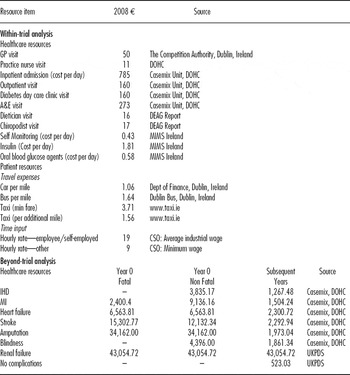
Unit cost estimates for the relevant resource use items were based on national data sources and where necessary were up-rated to Euros (€) in 2008 prices using an appropriate indices (7;8) (see Table 1). Two cost variables were estimated for the statistical analysis: total healthcare cost; and total cost, comprising of healthcare and patient costs. To facilitate the calculation of the totals variables, imputation, conditional on age, gender, duration of diabetes, and treatment arm, was undertaken to estimate missing values for individual cost components.
Categories of Resource Use and Unit Cost Estimates

Note. All prices reported in 2008 Euros (€). Sources: CSO, Central Statistics Office; DOHC, Department of Health and Children; MIMS, Monthly Index of Medical Specialities, Ireland; DEAG, Diabetes Expert Advisory Group Report; UKPDS, United Kingdom Prospective Diabetes Study.
Quality Adjusted Life Years (QALYs)
The health outcomes of treatment were expressed in terms of QALYs. Projected life expectancy from the end of the trial was adjusted using the default utility weights in the UKPDS outcomes model, based on EuroQol EQ-5D data for the original UKPDS cohort (Reference Clarke, Gray, Briggs, Stevens, Matthews and Holman9), to incorporate the impacts on health related quality resulting from predicted future diabetic complications.
Analysis
Cost-effectiveness was assessed by relating the mean differential cost per patient between the intervention and control strategies to their mean differential effectiveness (Reference Drummond, Sculpher, Torrance, O'Brien and Stoddart12). Uncertainty in the analysis was explored using modeling techniques and standard one-way sensitivity analysis. A probabilistic sensitivity analysis was undertaken, the results of which were mapped onto the cost-effectiveness plane and used to generate cost-effectiveness acceptability curves (CEACs). The latter present the probability that an intervention is cost-effective at a range of potential threshold values for how much a healthcare system is willing to pay for health gain (Reference Drummond, Sculpher, Torrance, O'Brien and Stoddart12). In addition, several one-way sensitivity analyses were undertaken. First, the duration of treatment effect was varied to 3 years, 5 years, and for the remainder of the patient's lifetime. Second, the discount rates were varied to 0 percent and 5 percent. Third, peer supporter time input was valued at zero, and 25 percent and 33 percent of the average industrial wage.
RESULTS
The results for each component of the analysis are presented in the following section.
Costs
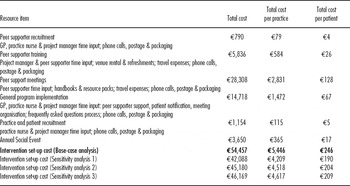
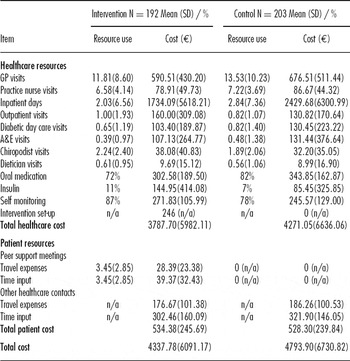
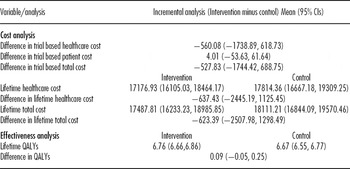
The total cost of implementing the intervention was €54,457, giving a mean cost per patient of €246. When peer supporter time was valued at zero, and 25 percent and 33 percent of the average industrial wage the equivalent cost estimates were €42,088 and €190, €45,180 and €204, and €46,169 and €209, respectively (see Table 2). The key elements of resource use over the trial follow-up period and the resultant healthcare, patient, and total costs are summarized in Table 3 (see Supplementary Table 4 [www.journals.cambridge.org/thc2012001]), for the baseline results). The incremental cost analysis results are presented in Table 4. The difference in mean healthcare, patient, and total costs across treatment groups at trial follow-up was estimated, adjusting for variations in the costs that occurred in the 12 months before baseline. To account for the skewed and hierarchical nature of the cost data, a GEE regression model, with an identity link function, an exchangeable correlation structure, and a Gamma variance function was adopted for the analysis. The results indicate that the intervention was associated with a reduction in mean healthcare cost of €560.08 (95 percent confidence interval [CI], −1738.89 to 618.73), an increase in mean patient cost of €4.01 (95 percent CI, −53.63 to 61.64), and a reduction in mean total cost of €527.83 (95 percent CI, −1744.42 to 688.75). Estimates of overall lifetime healthcare and total costs, comprising of within trial estimates and long-term projections, indicate that the intervention was associated with mean lifetime savings per patient of €637.43 (95 percent CI, −2455.19 to 1125.45) in healthcare costs and €623.39 (95 percent CI, −2507.98 to 1298.49) in total costs compared with control. Neither the results from the within trial nor the lifetime analyses were statistically significant at the 5 percent level.
Intervention Set-Up Costs

Note. Base-case analysis: peer supporter time valued at average industrial wage (€19/hour); sensitivity analysis 1: peer supporter time unvalued (€0/hour); sensitivity analysis 2: peer supporter time valued at 25% of average industrial wage (€4.75/hour); sensitivity analysis 3: peer supporter time valued at 33% of average industrial wage (€6.27/hour).
Within Trial Analysis: Follow Up (24 months) Resource Use and Cost

Note. Completeness of data at follow up: Intervention patients: 82% completeness for data on primary care visits, 81% for days in hospital, 78% for outpatient, 77% for diabetic day care visits, 74% for dietician visits, 76% for chiropodist visits, 82% for A&E visits, 83% for diabetic treatment, and 85% for self monitoring. Control patients: 82%, 82%, 78%, 77%, 67%, 70%, 80%, 78%, and 84%, respectively.
To calculate total cost values, imputation was undertaken to estimate missing values for individual cost components. Imputation was conditional on age, gender, duration of diabetes, and treatment arm.
Incremental Cost-Effectiveness Results

Note. Within Trial Analyses: Multilevel GEE regression model, with identity link function, Gamma variance function (Gaussian for Patient Cost), and exchangeable correlation structure. All models estimated controlling for treatment group and baseline cost for the 12 months before the trial.
Beyond Trial Analyses: Based on 10,000 Monte Carlo simulations in the UKPDS Outcomes model and 1,000 Monte Carlo simulations to combine within and beyond trial results
QALYs
The results from the incremental effectiveness analysis are detailed in Table 4. These indicate that the intervention was associated with an average increase in QALYs of 0.09 (95 percent CI, −0.05 to 0.25) per patient compared with control. This result was, however, not statistically significant at the 5 percent level.
Cost-Effectiveness
Overall, on the basis of expected cost-effectiveness, the intervention dominates control: that is, it generates higher mean QALYs and results in lower mean costs. The uncertainty in the analysis was explored using probabilistic sensitivity analysis (see Supplementary Figure 1, Supplementary Figure 2, and Supplementary Table 5; all of which can be viewed online at www.journals.cambridge.org/thc2012001). Assuming a healthcare provider perspective, the probability of the intervention being cost-effective at cost-effectiveness threshold values of €5,000, €15,000, €30,000, and €45,000 was 87 percent, 91 percent, 92 percent, and 91 percent, respectively. In Ireland, no single cost-effectiveness threshold value has been proposed for health technology appraisal (Reference Barry and Tilson2). Assuming a broader societal perspective, the equivalent probabilities were 83 percent, 90 percent, 89 percent and 89 percent, respectively. The results of the one-way sensitivity analyses reveal that altering the assumptions of the base-case analysis did not impact, to a great degree, the likelihood of the intervention being cost-effective.
DISCUSSION
An economic evaluation was undertaken to examine the cost-effectiveness of a group-based peer support intervention for patients with type 2 diabetes in general practice. The analysis was based largely on data collected alongside a clinical trial, supplemented by projections from the UKPDS Outcomes Model. On average, the intervention was associated with cost savings of €637.43 per patient in healthcare costs and €623.39 per patient in total costs, and improved health outcomes by 0.09 QALYs per patient.
These findings supplement those from the parallel clinical study which reported that, while there was a trend toward improvements in clinical outcomes, the intervention did not significantly improve mean HBA1c, blood pressure, cholesterol, or well being scores (21), partly because these were reasonably well controlled in this population at baseline. This study builds upon the clinical analysis by estimating final cost and effectiveness endpoints for the treatment alternatives under consideration. Though statistically insignificant, the primary clinical outcomes which made up the risk factor profiles for the intervention group were superior to that of the control group at trial follow-up. In the model, this translated into a reduced risk of future diabetes-related events, resulting in a gain in QALYs and a reduction in healthcare costs. However, as was the case in the clinical study, there were no statistically significant differences between groups in either final cost or effect endpoint.
We examined the uncertainty in cost per QALY figures using CEACs, which present the weight of evidence in favor of the intervention relative to the control. These indicate that the probability of the intervention being cost-effective remained appreciably higher than 80 percent across a wide range of threshold values. It is ultimately the remit of the relevant decision makers to determine whether a reported level of certainty is sufficient to justify the adoption of an intervention in clinical practice. These results confirm the importance of estimating the incremental cost-effectiveness ratio in all circumstances, except where equivalence in effect has been proven, and quantifying the uncertainty surrounding the incremental cost-effectiveness ratio estimate (Reference Johnston, Gray, Moher, Yudkin, Wright and Mant15).
Importantly, the difference in costs over the course of the trial was the main driver in the cost-effectiveness results. We find that the combined cost savings arising from observed differences in utilization of primary and secondary care services offset the additional implementation and patient costs attributable to the intervention, leading to an overall reduction in costs for the intervention relative to control. Indeed, while the clinical trial was not powered to detect differences in hospital admissions across treatment groups, there was some evidence to suggest that inpatient days were less for the intervention than the control. Future trials of such interventions should consider the inclusion of hospital admissions as a primary clinical outcome for analysis though this would require much larger sample sizes.
There were several limitations in the analysis. The generalizability of the adopted modeling framework, which was estimated for a UK population, to the Irish setting was deemed acceptable. Nonetheless, the limitations of the UKPDS Outcomes Model are well established and are applicable to this study (Reference Clarke, Gray and Briggs10). Specifically, only the first event is predicted in any single category of diabetes-related complications. Some of the complications are represented in the model using a single state, which is unlikely to fully describe the complex process of disease progression. Not all relevant complications are included in the model including peripheral neuropathy, hypoglycemia and hyperglycemia. The potential for reduced incidence in these outcomes from peer support and the resulting benefits in terms of health-related quality of life and reduced treatment costs are, therefore, not captured in the analysis.
Our analysis was further limited by a lack of available evidence for some model input parameters, including the history of diabetes related complications and ethnicity, which were not collected in the trial. However, we do not believe the absence of these parameters undermines the results. An important assumption of the analysis related to how long the treatment effect persists following the end of the trial. We adopted a conservative approach in the base-case analysis, in that we assumed the impact of the peer support intervention did not extend beyond the end of a trial. The results of the sensitivity analysis indicate that the cost-effectiveness results improve when a longer term treatment effect is assumed.
Given the importance of the peer supporter in the delivery of the intervention, we take the view that their time input should be valued accordingly. In the cost analysis, we adopted a human capital approach to value peer supporter time input. It has been argued that this approach overestimates the true opportunity cost of work time as, in reality, additional work can be undertaken by co-workers during the period of absence (Reference Drummond, Sculpher, Torrance, O'Brien and Stoddart12). Moreover, as the majority of peer supporters were older (Mean Age (SD): 63 (Reference Clarke, Gray and Legood11)) and given that peer support meetings were held outside of standard working hours, it could be argued that it is leisure time rather than work time which is of relevance. In sensitivity analysis, we applied several alternative values based on the economic literature for valuing volunteer time. These approaches, all of which attached a lower valuation to peer supporter time input, had the joint effect of reducing the implementation costs of the intervention and improving its likely cost-effectiveness.
In the effectiveness analysis, the QALY estimates do not include impacts on health related quality of life over the course of the trial, as the measurement instrument adopted could not be transformed into utility weights. Furthermore, diabetes related complications were not included as a primary outcome in the clinical trial. Instead, we attempt to capture the impact of such complications through the patient's need to access the health care system over the course of the trial and in particular their number of hospital admissions. As a result, the effect of diabetes-related complications is incorporated in the analysis by means of the calculation of trial based costs. In addition, we used UK data to detail the treatment process to cost the diabetes related complications included in the model (Reference Clarke, Gray and Legood11), as national data were not always readily available. Similarly, the adopted utility weights were obtained from UK data sources (Reference Clarke, Gray, Briggs, Stevens, Matthews and Holman9). There is little evidence that significant differences exist between patients with type 2 diabetes in Ireland and the United Kingdom. Furthermore, in the adopted approach, it was not possible to take account of the correlation between the trial-based costs and clinical outcomes.
There is also the question of whether the non-significance of the results arises from the fact that the study was statistically underpowered. Health economists conducting analyses alongside clinical trials are often faced with inappropriate sample size constraints (Reference Briggs3), thereby raising the possibility that important economic differences between treatment arms cannot be detected at conventional levels of power and significance. To overcome this problem, it is best to present the weight of evidence relating to the cost-effectiveness of the intervention rather than relying on showing significance at conventional levels (Reference Briggs3). This is most readily achieved through the estimation of CEACs.
Finally, as the objective of the economic evaluation was to compare the costs and outcomes of the alternative treatment strategies under consideration, we did not consider the impact of the intervention on the health of the peer supporter themselves. It is important to note that the peer supporters showed some decline in well-being score (Intervention: 27 versus Control: 24.1) at follow-up, although this may be a chance finding as numbers were small (Reference Smith, Paul, Kelly, Whitford and O'Shea E, O'Dowd21).
CONCLUSION
This study adds to the limited literature on the cost-effectiveness of primary care interventions which seek to improve self management in patients with type 2 diabetes (Reference Brownson, Hoerger, Fisher and Kilpatrick6). To date, little is known about the cost-effectiveness of peer support for diabetes management. In line with the clinical analysis, our results show no significant differences between the intervention and control arms in terms of final cost or effectiveness endpoints. However, CEAC estimates suggest that the intervention was more cost-effective than the control, with probability values higher than 80 percent across a wide range of potential threshold values. This, combined with the observed trends toward improvements in clinical outcomes and reduced costs, suggests that further studies should be undertaken to examine the clinical and cost-effectiveness of peer support models for patients with type 2 diabetes and to clarify which patients may benefit most from this type of care.
SUPPLEMENTARY MATERIAL
Supplementary Table 1
Supplementary Table 2
Supplementary Table 3
Supplementary Table 4
Supplementary Table 5
Supplementary Figure 1
Supplementary Figure 2 www.journals.cambridge.org/thc2012001
CONFLICT OF INTEREST
All authors have received a grant to their institute from Health Research Board.
CONTACT INFORMATION
Paddy Gillespie, PhD, Post-Doctoral Researcher in Economics, Eamon O'Shea, PhD, Professor of Economics, Irish Centre for Social Gerontology, School of Business and Economics, National University of Ireland, Galway, Ireland
Gillian Paul, PhD, Research Project Manager, Tom O'Dowd, MD, Professor in General Practice, Department of Public Health and Primary Care, Trinity College, Dublin, Ireland
Susan M. Smith, MD, MSc, Senior Lecturer in Primary Care, Royal College of Surgeons, Dublin, Ireland