Ultrafine-grained (UFG) metals and alloys produced by severe plastic deformation (SPD) techniques[Reference Valiev, Islamgaliev and Alexandrov1] often demonstrate high strength but relatively low ductility. Specifically, variations in the SPD processing regimes are required for the creation of other microstructural features, such as specific grain boundaries or nanoparticles, in order to simultaneously increase the strength and ductility in UFG metals.[Reference Zhu and Liao2, Reference Valiev3] This restricted ductility limits the use of these materials in many structural applications and, in particular, it prevents any significant enhancement of the fatigue properties which are critical in, for example, the production and utilization of medical implants manufactured from UFG titanium alloys.[Reference Semenova, Valiev, Yakushina, Salimgareeva and Lowe4, Reference Valiev, Semenova, Latysh, Rack, Lowe, Petruzelka, Dluhos, Hrusak and Sochova5]
Many different procedures are now available for the processing of metals using SPD techniques.[Reference Valiev, Islamgaliev and Alexandrov1, Reference Estrin and Vinogradov6] Nevertheless, more emphasis has been placed on making use of the relatively simple technique of equal-channel angular pressing (ECAP) in which a billet, in the form of a rod or bar, is pressed through a die constrained within a channel that is bent internally through a sharp angle.[Reference Valiev and Langdon7] An alternative processing procedure was introduced about 40 years ago for the continuous extrusion-forming of metal wires[Reference Green8, Reference Etherington9] and this procedure, known as the Conform process, was subsequently further developed as ECAP–Conform in which an ECAP step, consisting of a sharp abutment, was introduced into the exit channel of a conventional Conform facility.[Reference Raab, Valiev, Lowe and Zhu10] The advantage of ECAP–Conform is that it permits the production of a UFG microstructure in long rods, generally with lengths up to a few meters, and this suggests the procedure will be attractive for use in commercial applications.[Reference Xu, Schroeder, Berbon and Langdon11, Reference Valiev and Langdon12] Recent investigations demonstrated that the processing of titanium via the ECAP–Conform process, combined with subsequent drawing, gives long rods with UFG structures.[Reference Polyakov, Gunderov and Raab13–Reference Gunderov, Polyakov, Semenova, Raab, Churakova, Gimaltdinova, Sabirov, Segurado, Sitdikov, Alexandrov, Enikeev and Valiev15]
It is well known that the annealing of UFG materials may lead to a recovery of the non-equilibrium grain boundaries and, as a consequence, to an enhancement in the overall ductility.[Reference Valiev, Islamgaliev and Alexandrov1] For example, in experiments on nanostructured Ti processed by high-pressure torsion it was shown by atomic resolution microscopy that there is an ordering of the defect structures of the boundaries and in the near-boundary areas without any concurrent grain growth during short-term annealing at a temperature of 573 K.[Reference Valiev, Sergueeva and Mukherjee16] Such structural changes have a major influence on the mechanical behavior of nanostructured Ti leading to a significant increase in strength and ductility after the annealing process. This result confirmed the important role played by the boundary structure in the mechanical behavior of UFG Ti. Nevertheless, in UFG Grade 4 titanium (Ti), produced via the ECAP–Conform technique in combination with subsequent drawing, a high strength was achieved but the ductility was severely restricted.[Reference Semenova, Polyakov, Raab and Lowe14] In order to increase the ductility, an annealing at the low temperature of 623 K was undertaken and this led to a recovery of the boundaries without any concomitant grain growth.[Reference Semenova, Salimgareeva, Da Costa, Lefebvre and Valiev17] Based on these results, the present investigation was undertaken with the objective of evaluating the influence of a low-temperature annealing on UFG Grade 4 Ti processed by ECAP–Conform and drawing.
The experiments were conducted using Grade 4 Ti produced by Dynamet Inc. (Washington, PA, USA) in the form of hot-rolled rods with a diameter of 15 mm and an average grain size of ~25 µm. The chemical composition of the material, in wt.%, was 0.36% O, 0.15% Fe, 0.05% C, 0.007% N, and 0.0021% H with Ti as the balance. The rods were processed using the ECAP–Conform facility in Ufa with an angle of 120° in the ECAP abutment and with each rod processed through a total of six passes using route BC in which the rods are rotated by 90° in the same sense between each pass.[Reference Furukawa, Iwahashi, Horita, Nemoto and Langdon18] This channel angle with six passes leads to a total strain of ~4.[Reference Iwahashi, Wang, Horita, Nemoto and Langdon19] In these experiments, the Grade 4 Ti was fabricated to have two different structures that are designated UFG-1 and UFG-2. The UFG-1 structure was produced by performing ECAP–Conform at 473 K and then drawing at 473 K to a total accumulated strain of ~80%. The UFG-2 structure was produced in the same way but with an additional annealing at 623 K for 1 h.
The microstructures of these materials were analyzed by transmission electron microscopy (TEM) on the cross-sectional planes and on longitudinal sections. The samples for foils were cut using electrical discharge machining, mechanically thinned to thicknesses of ~100 µm and then electropolished using a TenuPol-5 facility with a solution of 5% perchloric acid, 35% butanol, and 60% methanol and a polishing temperature within the range of −20 to −35 °C. The microstructures were examined using a JEOL JEM 2100 microscope operating with an accelerating voltage of 200 kV. Mechanical tensile testing was conducted both at room temperature and at 623 K using initial strain rates from 10−5 to 10−3 s−1 with an Instron testing machine operating at a constant rate of cross-head displacement. The tensile specimens had cylindrical gauge sections with initial lengths of 15 mm and diameters of 3 mm. Three specimens were tested for each condition. The strain rate sensitivity, m, was determined by comparing the results at different strain rates and using the relationship m = ∂ ln σ/∂ ln ɛ˙, where σ is the flow stress and ɛ˙ is the strain rate.
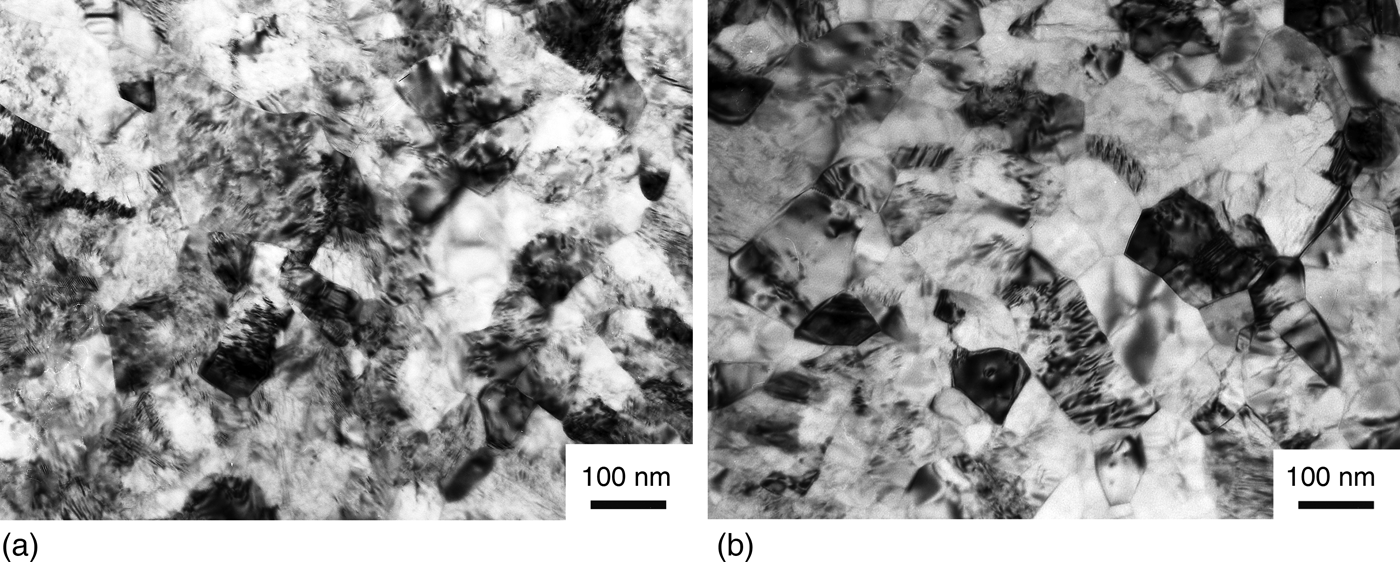
Figure 1(a) displays a typical TEM image of the cross-section of the UFG-1 microstructure produced by ECAP–Conform and drawing. The microstructure is characterized by a high density of dislocations with an indistinct contrast of grain and subgrain boundaries and an average size of ~180 nm. This contrasts with Fig. 1(b), which shows UFG-2 after additional annealing where the average grain and subgrain size are again ~200 nm but the boundaries are sharper, they have a distinct contrast in this bright-field image and clearly they are more equilibrated. The total density of the lattice dislocations is lower in Fig. 1(b) due to recovery during heating.
Bright-field TEM images of Grade 4 Ti (a) UFG-1 and (b) UFG-2.

The results of the mechanical testing of samples in (a) the as-received coarse-grained (CG) state and in the (b) UFG-1 and (c) UFG-2 states are shown in Fig. 2 for tests conducted at room temperature (293 K) and 623 K at strain rates from 10−5 to 10−3 s−1. For the CG state, there is a maximum tensile strength of ~780 MPa at 293 K and a slight softening with decreasing strain rate at both testing temperatures but with the values of the total elongations relatively independent of the strain rate. By contrast, for UFG-1 and UFG-2, an ultimate tensile strength (UTS) of ~1300 MPa was achieved at room temperature due to the very significant reduction in the grain size to ~180 nm but the values of the uniform and overall elongations decrease by comparison with the CG state where this is consistent with the early localization of deformation typical of UFG materials. After testing with a strain rate of 10−3 s−1, the uniform and overall elongations were ~2.1 and 10.8% for UFG-1 and ~2.9 and 12.8% for UFG-2. A reduction of the strain rate to 10−5 s−1 increased these values in UFG-2. For simplicity, Fig. 3 provides a comprehensive summary of the values of the UTS and the uniform elongation (UEL) for UFG1 and UFG2 as a function of the imposed strain rate when they are tested at a temperature of 293 K. It is readily apparent that the decrease in the total dislocation density and the change in grain boundary structure both contribute to the enhanced ductility in UFG-2 after annealing.
Stress–strain curves at room and elevated temperatures with strain rates of 10−5 –10−3 s−1 for Grade 4 Ti (a) CG, (b) UFG-1, and (c) UFG-2.
Dependences of UTS and UEL on the strain rate for Grade 4 Ti UFG-1 and UFG-2 at 293 K.
In the tests conducted at 623 K, the strength level in the UFG Ti as well as in the CG material dropped by about 40%. There was also a noticeable difference in the mechanical behavior of UFG-1 and UFG-2. Specifically, the UTSs of UFG-1 and UFG-2 were about two times higher than in the CG sample and the overall elongations of the UFG samples also increased significantly. Thus, at a strain rate of 10−5 s−1 the elongation to failure of UFG-1 was about 18% and the elongation of UFG-2 was slightly larger than 50% which suggests the possibility of a grain boundary sliding contribution during deformation.
It is important to note that the UEL of these samples tends to be lower at elevated temperatures than at room temperature. This behavior in the stress–strain curves is due to a change in the deformation mechanism controlling plastic flow and specifically it is related to the activation energy for grain boundary sliding. For example, in superplasticity the total elongation is very high but the magnitude of the UEL may be relatively low because of the occurrence of softening during the initial straining.
It is known that the stability of plastic flow during tension is controlled in part by the strain rate sensitivity, m. Specifically, the values of m increase when the grain boundary sliding contributes to the deformation and in superplastic microcrystalline metals with grain sizes of ~2–10 µm the value of m is high because intergranular sliding is the dominant deformation mechanism.[Reference Langdon20] In practice, the increasing ductility with increasing m is a direct consequence of the well-established relationship between these two parameters.[Reference Woodford21] It is important, therefore, to determine the strain rate sensitivities in the present experiments.
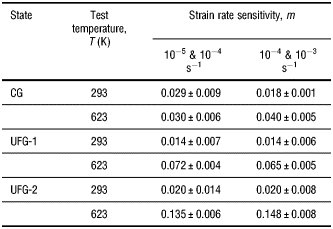
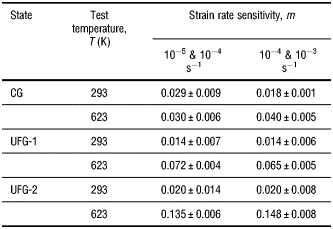
Figure 4 plots the flow stress against the strain rate for various samples tested at the two different temperatures and the calculated values of m are recorded in Table 1 where these values were obtained from two adjacent strain rates differing by one order of magnitude. First, it is noted that the values of m in Table 1 are similar over both strain rate ranges. Second, the values of m are very small in the CG material with values of ~0.020 at 293 K and ~0.035 at 623 K. This behavior is typical of the conventional coarse-grained Ti. However, for the samples with the UFG structures, where the grain sizes are of the order of ~200 nm, the flow stresses in Fig. 4 are much higher and it is evident from Table 1 that the strain rate sensitivity in UFG-2 is low and ~0.020 at 293 K but increases to ~0.14 at 623 K. Conversely, for UFG-1 the value of m at 623 K is only ~0.070 and the elongation to failure is much lower at 18%. Thus, the difference in the strain rate sensitivity for UFG-1 and UFG-2 is almost twofold at 623 K.
Dependence of flow stress on the strain rate for CG, UFG-1, and UFG-2 Grade 4 Ti at 293 and 623 K.
Strain rate sensitivity of CG and UFG Grade 4 Ti.
The results of this work demonstrate the potential for achieving a good balance between strength and ductility in UFG Ti through the use of low-temperature annealing. Specifically, annealing at 623 K is effective in producing a recovery of the grain boundary structure as demonstrated by the more equilibrated boundaries visible in UFG-2 in Fig. 1(b). It is important to note that the additional annealing produced no reduction in the UTS because the size of the grains or subgrains was retained at close to ~200 nm. Furthermore, there was an increase in the overall ductility of UFG-2 at 293 and 623 K by comparison with UFG-1, which suggests the initiation of some deformation from grain boundary sliding under these conditions. This latter conclusion is supported by the earlier observations of grain boundary recovery and special relief in samples of nanostructured Ti processed by high-pressure torsion and tested at room temperature after low-temperature annealing.[Reference Valiev, Sergueeva and Mukherjee16]
The influence of the grain boundary structure on the mechanical behavior of grains at elevated temperatures is an important result of this work. In particular, the UFG-2 samples demonstrate high elongations (up to >50%) at a strain rate 10−5 s−1 and 623 K compared with UFG-1 where the elongations are <20%. It is well known that the UFG metals processed by SPD develop superplasticity at relatively low temperatures and high strain rates.[Reference Valiev, Salimonenko, Tsenev, Berbon and Langdon22–Reference Kawasaki, Balasubramanian and Langdon27] Thus, the results of the present work demonstrate that the ductility of the UFG metals may be effectively enhanced by changing the nature of the grain boundaries through low-temperature annealing.
In summary, these results show that a combination of ECAP–Conform and drawing produces a UFG structure in Grade 4 Ti with a grain/subgrain size of about 180 nm and this gives exceptionally high strengths of up to ~1300 MPa. Subsequent low-temperature annealing at 623 K for 1 h enhances the elongation to failure from 11 to 13% at a strain rate of 10−3 s−1 at room temperature without any decrease in the UTS because the very small grain size is retained. There are differences in the mechanical behavior of the UFG material when tensile testing is conducted at 623 K and these differences are due to changes in the grain boundary structure and the strain rate sensitivity of the material. Specifically, the material subjected to annealing gives high elongations of up to >50% when testing at a strain rate of 10−5 s−1 at 623 K and this is associated with an increased value for the strain rate sensitivity.
Acknowledgments
This work was supported in part by the International Science and Technology Center under Project 4003P, in part by the ViNaT project (Contract no. 295322, FP7-NMP-2011-EU-Russia) and in part by the European Research Council under ERC Grant Agreement No. 267464-SPDMETALS. We thank the Royal Society of the U.K. for providing support under International Joint Project No. JP091299 which permitted AVP to conduct research at the University of Southampton.