Food security, defined by the United Nations Committee on World Food Security, means that “all people, at all times, have physical, social, and economic access to sufficient, safe, and nutritious food that meets their food preferences and dietary needs for an active and healthy life.” Reference Boussard, Trouvé and Choplin1 The magnitude and frequency of disasters are expected to increase and will disproportionately affect populations vulnerable to multiple health and social risks. Reference Coleman2,Reference Bergstrand, Mayer and Brumback3 During disasters, disruption to the food environment is widespread, exacerbating food insecurity, especially among vulnerable populations. Reference Keim4,Reference Clay5 Food insecurity has been associated with poor nutrition, cardiovascular disease, poor quality of life, higher rates of infection and developmental problems in children, poor self-rated physical and mental health, and poor functional health and restricted activity. Reference Seligman, Laraia and Kushel6–Reference Ryu and Bartfeld9 In the United States, food insecurity disproportionately affects households in rural areas, headed by a single adult with children, predominantly Black, non-Hispanic households, and households with children under the age of 6; many of the same groups that are socially vulnerable to disasters and other emergencies. Reference Keith-Jennings, Llobrera and Dean10,Reference Lurie, Manolio and Patterson11
Alleviating limited access to food that arises during disasters is the focus of many recovery efforts. 12,13 Globally and historically, food aid during disasters has focused on preventing caloric restriction and micronutrient deficiencies that could result in undernutrition amid increasing burden of diet-related noncommunicable diseases that could be further distressed by the disasters and exacerbate pre-existing vulnerabilities if there is no comprehensive feeding plan. Reference Seal and Thurstans14–Reference Young and Harvey16 In the United States, the Department of Agriculture (USDA) is designated to work with the Federal Emergency Management Agency (FEMA) to delegate responsibility for coordinating state government and nongovernment organizations to determine the feeding and nutritional needs of the population in the affected areas in disasters. Reference Abernathy17 Nonetheless, in the United States there is scant evidence on how to effectively meet food and nutrition needs in disaster response. Without an evidence base, disaster programs and policies run the risk of missing vulnerable populations or providing foods that do not meet actual needs. For instance, after Superstorm Sandy in New Jersey, modifications to allow purchases for USDA Supplemental Nutrition Assistance Program (SNAP) beneficiaries were made without an understanding of the needs of the population affected or availability of eligible and appropriate foods. 18 SNAP is a federal program that provides food assistance benefits for individuals with a financial need. Information on the types of foods available and accessible in markets before, during, and after disasters is one way of assessing the food environment to improve response effectiveness. This manuscript presents 2 independent rapid assessments of the food environment following hurricanes, critiques and summarizes lessons learned, and provides recommendations for assessing food environments across the disaster management life cycle.
Methods
Two independent studies used structured observation protocols during quick response disaster research in North Carolina after Hurricane Florence and Puerto Rico after Hurricane María. Quick response research aims to understand an event as it is unfolding. Key organizations and actors can be identified, and observations provide essential information on the issues most salient in a particular event. Reference Stallings, Rodriguez, Quarantelli and Dynes19 While the studies are not identical in their design and execution, both used the Nutrition Environment Measures Survey (NEMS) instrument offering an opportunity to examine food availability in disaster affected communities and to discussion the limitations and needed research in this area. Below, the methods used in each setting are described.
Eastern North Carolina After Hurricane Florence (2018)
Setting and Study Design
Hurricane Florence made landfall as a Category 1 hurricane in Wrightsville Beach, North Carolina, on September 14, 2018. Data collection focused on New Bern, North Carolina, in Craven County as they experienced 10-18 inches of rainfall and over 10 feet of storm surge during the hurricane event. 20 A longitudinal critical incident case study commenced on September 19 with the first wave of data collection using a quick response research method as the event was still unfolding and follow-up at 6-wk, 4-mo, and 1-y postevent. Critical incident case studies have been conducted following past disaster events as they aim to “determine the causal antecedents of an event and those critical actions or inactions taken by actors or agents that contributed to the event’s or outcome’s occurrence.” Reference Weatherbee, Mills, Durepos and Wiebe21,Reference Weick22 Data collection included semi-structured interviews with individuals affected by the hurricane, farmers, and representatives of organizations involved in food related response, observation guides for emergent food response sites and grocery stores, a health and demographic survey, protocols for photographic documentation and field notes, and the NEMS-Stores (NEMS-S). Reference Glanz, Sallis and Saelens23 The NEMS-S is a validated food environment assessment tool designed to assess the availability of healthy foods in stores. The NEMS-S data are the focus of the present analysis.
NC Protocol and Adaptations
The NEMS-S, a store observation tool was used to document the price, quality, and availability for specific foods available following Hurricane Florence. Reference Glanz, Sallis and Saelens23 Items in the NEMS-S aim to capture the differences between healthier and less-healthy options for 10 categories of foods. During interviews with emergency food response workers, the research team learned that community members relied on convenience stores for food so the NEMS-S was used to document food availability in grocery and convenience stores. In addition, information about the accessibility of the retail establishment were recorded using a semi-structured observation protocol for systematic consideration of the environment, photographs were taken of the storefront and grocery sections (listed on the study protocol to ensure consistency), and observations relevant to the food environment were captured through field notes that were voice recorded after completing observations and assessments at each store site. Reference Clay5
Data Collection and Analysis
Due to the emergent nature of the event, just-in-time training was conducted with experienced research assistants on data collection protocols. All field research assistants had experience conducting field work following hurricanes. The NEMS-S was collected for 10 stores at 1 wk, 6 wk, 4 mo, and 1 y post disaster onset. Stores adjacent to residential areas impacted by flooding were selected for assessment, and the research team intentionally selected a range of store types, that is, national chains, locally owned, and convenience stores. NEMS-S data were entered into SPSS for analysis of availability, price, and quality of food across the 4 waves of data collection. The D’Youville College Institutional Review Board approved this research protocol.
Rural Municipality in Puerto Rico After Hurricane María (2017)
Setting and Study Design
Hurricane María made landfall in Puerto Rico on September 20, 2017, collapsing the power grid and potable water systems, disrupting the food supply chain with repercussions that lasted for months. 24 The disaster occurred within the context of a disproportionate burden of diet-related chronic diseases in the archipelago. 25,Reference Colón-Ramos, Rodríguez-Ayuso and Gebrekristos26
A case-study approach was used to conduct a rapid assessment of the food environment approximately 6 wk after the hurricane from November 10-16, 2017, in a rural municipality. This municipality was purposefully selected because of feasibility (the principal investigator [PI] is native to this municipality) and because it afforded a representation of the experience of an average rural household in Puerto Rico during Hurricane María, as detailed elsewhere. 24,Reference Echevarria27 The municipality (population 30,402) 28 is located in the mountainous area of Puerto Rico’s main island, has a median household income of $15,000 (which is also the average median household income of Puerto Rico), and sustained significant infrastructure damage, including major roads that were washed away during Hurricane María. Reference Echevarria27,29,30 The case study approach is most appropriate for: (a) studies that ask “how” questions (ie, how was food availability disrupted by the disaster?); (b) where the investigator has little control over events, such as in disasters; and (c) where the focus of the study is on a contemporary phenomenon within a real-life context. Reference Yin31 The data described here were collected as part of a larger assessment that used observation guides, photographic documentation, and field notes of the overall food environment, including foods delivered during the disaster response. Reference Colón-Ramos, Roess and Robien32
Puerto Rico Protocol and Adaptations
The NEMS for Corner Stores (NEMS-CS), a limited version of the NEMS assessment for convenience stores, was used to document the prices, quality, and availability for specific foods. Given the high burden of diet-related chronic diseases in the archipelago, the objective of the rapid assessment was to document the availability of foods within the food group recommendations of the latest Dietary Guidelines for Americans (DGA). 33 Therefore, the NEMS-CS was adapted in the following ways, according to the Puerto Rican diet Reference Colón-Ramos, Pérez-Cardona and Monge-Rojas34 in this disaster event: (1) frozen dinners were removed, assuming that a major power outage would limit the availability of frozen dinners. (2) The category of “hot dogs and ground beef” was replaced by “animal proteins” including canned, frozen, or fresh options. Low sodium and low sugar alternatives were captured and research assistants could note if lower fat options were present. (3) Breads and baked goods were grouped under “grains and starches” to align with the DGAs. Subcategories were added for rice and dry beans. (4) Bottled water was added to “beverages” due to reports about the shortage of drinking water after the disasters. Reference Sutter and Smith35 (5) Chips and candies were added due to anecdotal reports that the emergency relief was providing these foods in abundance. Reference Dewey36 The protocol directed research assistants to document by means of unstructured observations any other relevant note regarding food options, the appearance of the stores or empty shelves. The adapted NEMS-CS was been uploaded to a mobile epidemiologic data collection application (Magpi), and paper copies of the instrument were also printed and provided to research assistants.
Data Collection and Analysis
The PI (U.C.R.) used her professional network to identify and recruit local students from various universities in Puerto Rico (4 of these students were native to the study municipality). All assistants received 8-h of in-person training on how to conduct the structured observations using both the mobile application and hard copies of the instrument, in case persistent power outages would limit the teams’ ability to recharge mobile phones. The training was conducted at 1 of the universities and in 1 large supermarket in the San Juan area (2 h away from the study municipality). All structured observation data collected during this training was checked for agreement immediately, and any issues were resolved and clarified before commencing data collection in the study municipality.
During the data collection period (5 d), the team met daily during the early morning at the study municipality to discuss which stores would be surveyed that morning. At this time, the research assistants from the study municipality had identified daily, and mapped all food venues that were open for data collection (including restaurants, bakeries, pharmacies, food vendors), and then provided the map coordinates and food venue names to the rest of the team. The other research assistants who were conducting the observations would then visit those food venues to collect data by means of the mobile application and to duplicate this information in the paper surveys immediately after entering data in the application. In the early afternoon, the team would meet again to review data, resolve any issues with the observations or data collection procedures, and make a plan for the following day, until all food venues in the municipality were surveilled.
This study was reviewed by institutional review board of the George Washington University, which was determined that it did not meet the definition of human subjects’ research.
Data from the mobile application was uploaded automatically when the mobile phones were within wireless connection and exported into Excel® (Microsoft Corporation, Redmond, WA). Later, a research assistant at the university entered the data from the paper surveys into the database. Finally, a research assistant reviewed all paper surveys for additional comments/observations that would corroborate the information from the mobile phone application and entered it into the database.
Results
Below the key findings on availability, quality, and prices of selected foods for each case study are summarized.
Eastern North Carolina After Hurricane Florence
Food Availability
A total of 10 stores were analyzed across 4 waves of data collection in New Bern, North Carolina. The first wave of data collection took place in September 2019 immediately after Hurricane Florence. Wave 2 was collected November 2018 and wave 3 in January 2019. The final wave of data was collected in September 2019 during the week Hurricane Dorian was expected to hit the area, but ultimately did not disrupt the area significantly. Across all 4 waves, 50% or more stores carried low-fat milk, as well as various fresh fruits and vegetables. The price of oranges and apples increased between September and November 2018. Across all 8 measures analyzed (Table 1), availability increased between wave 1 and wave 2. Milk, bread, and meat had the lowest supply in stores immediately following Hurricane Florence. In subsequent waves, these items were more readily available in stores. In wave 4, food supplies are lower again, likely due to disaster preparedness shopping for Hurricane Dorian.
Food availability in the year following Hurricane Florence in New Bern, North Carolina

a Data collected during the week of Hurricane Dorian, disaster preparedness supply and demand are impacting availability and price.
Unstructured Observations
Following Hurricane Florence, the research team noted several types of foods and products that were in demand among disaster affected individuals but in limited supply, unavailable, and not captured by the unadapted NEMS: ready-to-eat meals or ready-to-heat foods; infant formula, and snacks and meal replacement or supplement drinks often used by the elderly or diabetics; and cleaning and hygiene products were sold out due to widespread household damage, especially in smaller stores. The team also observed large empty shelf spaces with foods labeled that were not there, suggesting a disruption in specific types of foods that the markets typically carry and that were not available immediately after the disaster. Store staff expressed concerns about data collection to research assistants while completing the assessments, usually in the larger stores with associates wanting to get a manager’s approval, watching from nearby, or offering commentary on their own observations.
Puerto Rico After Hurricane María
Food Availability
A total of 37 food stores were assessed (the only full supermarket in the municipality; 25 small grocery stores (with 1.2 cash registers on average); 12 convenience stores located in bakeries and pharmacies, all with 1 cash register). To provide a context, 24% of the stores assessed had electricity and 63% were running on generators. In addition to these 37 stores, an additional 37 carry-outs, food trucks, and full-service restaurants were open for business at the time of data collection, but these were not included in the current analysis because they only sold prepared meals. In addition, 22 food venues were observed that had not yet opened for business after the Hurricane at the time of data collection.
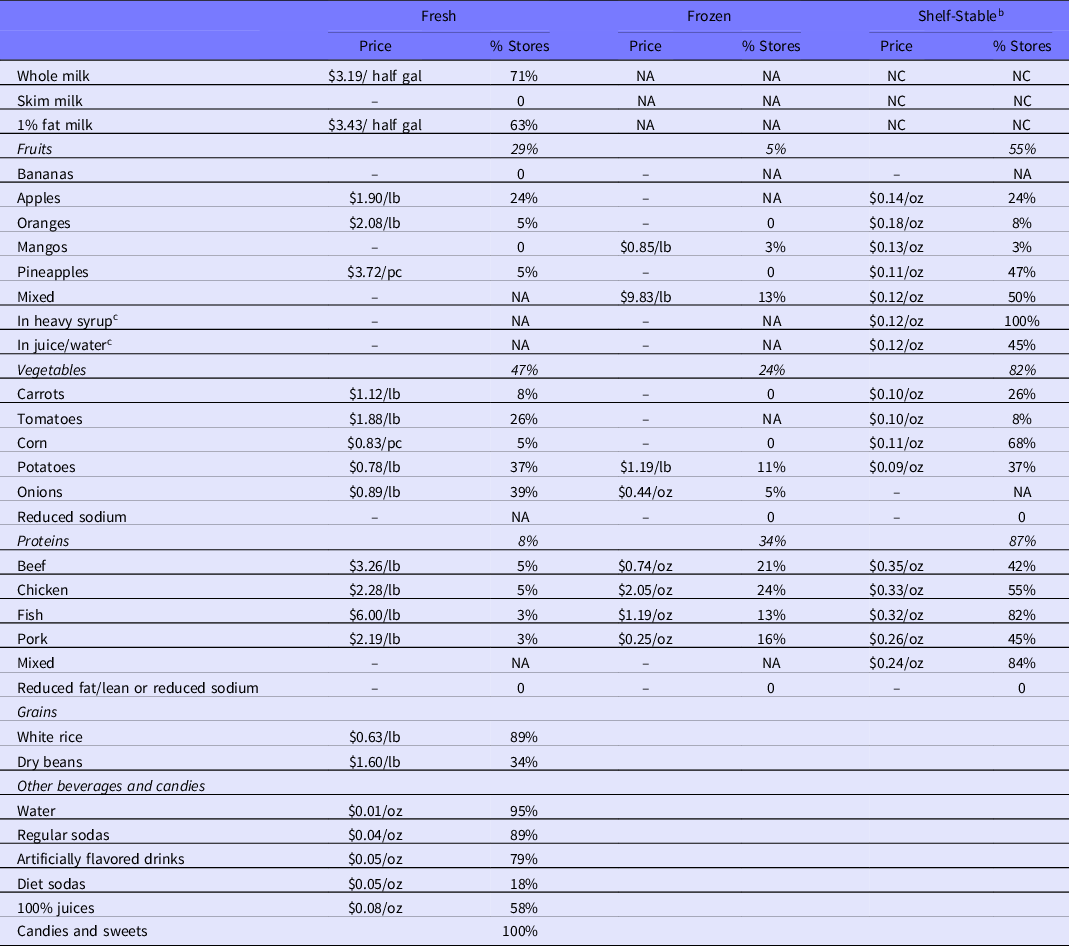
Results of availability and pricing of selected foods are presented in Table 2. Most stores carried fresh whole milk, and the lowest fat milk option available was 1% (carried in 63% of stores). The prices for the lower-fat milk option were on average 24 cents higher for a half gallon compared with whole-fat milk. Overall, there was more availability of canned fruits (55%), vegetables (82%), and proteins (87%) compared with fresh or frozen options, as expected due to the challenges of lack of electricity. Apples, which are an imported good to Puerto Rico, were the fruit most available, and no stores had fresh bananas or mangoes. All of the stores carried fruit canned in heavy syrup, and 45% carried the healthier option of canning or prepackaging fruit in 100% juice or water. There were no healthier alternatives for canned vegetable and protein options (lower fat or lower sodium). White rice and dried beans, a staple of Puerto Rican diet, were carried in 89% and 34% of stores, respectively. All stores carried candies, and the majority carried regular soda (89%), artificially-flavored drinks (79%), and water (95%). The more healthful alternatives to soda and flavored drinks were less available: diet soda 18% of stores, 100% juices 58% of stores, and these options were on average slightly more expensive per ounce.
Price and availability (% stores) of fresh, frozen, and canned foods in food retail following Hurricane Maria in study municipality in Puerto Rico

Abbreviations: NA, not available/applicable; NC, not captured by instrument.
aData collected from 37 food retail stores in November 2017.
b Shelf-stable includes canned, jarred, cups or boxed.
c Calculated from the total number of stores that had canned fruit.
Unstructured Observations
Research assistants noted several additional items: widespread availability of boxed milk, such as ultra high-temperature processed (UHT) milk; canned unsweetened milk (eg, evaporated milk), powdered milk in various options (lactose-free, low-fat, or fat-free), as well as farm-fresh eggs, which do not require refrigeration. Other fresh, canned or frozen options that were not observed systematically were noted; these included fresh and frozen berries, fresh lettuce, plantains, avocadoes, canned peaches, frozen vegetables, such as green peas, green beans, among others. Empty shelf spaces were also observed, typically where fresh and frozen foods, cleaning supplies (bleach), flashlights, candles, matches, and gas stoves were typically stocked.
Discussion
Two independent studies assessed the food environment posthurricanes using a similar established observation protocol. Reference Glanz, Sallis and Saelens23 During Hurricane Florence data collection, the research team operationalized the NEMS-S on a short timeline to conduct quick response disaster research over 4 waves of data collection during the community response and recovery process. In Puerto Rico, a 1-time rapid assessment was conducted approximately 6-wk after Hurricane María using an adapted NEMS-CS to capture availability, quality, and price of canned items as well as frozen and fresh, for the DGA food groups. 33
A key finding from both studies is the availability of unhealthful food options at lower prices than the healthful alternatives in both settings. The instrument in Puerto Rico allowed for documentation of greater availability of canned items compared with fresh or frozen, with more availability of canned items that are high in sodium, fat (for meats), and added sugars (for fruits in heavy syrup). This type of information is useful to identify gaps in food availability to improve response activities to fill gaps, such as ready-to-eat foods when power and water are unavailable.
While the use of an observation protocol, such as NEMS, was helpful in identifying availability and price of selected items following hurricane events, some of the more important findings are related to the “lessons learned” after the application of this instrument post disaster. First, data on food availability in stores before a disaster event are important to routinely document so that the scale and types of disruption in food availability that may be caused or exacerbated by the disaster event can be monitored. Second, several adaptations are necessary to capture availability, price, and quality of food items within food groups that may be important in the disaster context. In both North Carolina and Puerto Rico, the availability of ready-to-heat and ready-to-eat foods and shelf-stable foods were noted as an important component for the postdisaster setting but are missing from the current NEMS instruments. Furthermore, in both settings, the availability of food preparation equipment and supplies (matches, cooking stoves, gas), hygiene supplies (bleach, soap), and assessment of empty shelf-space were identified as important for food preparation and consumption in a disaster setting. Third, a longitudinal application of the food environment observation protocol, such as the 4 waves of data collected in Eastern North Carolina, can shed light on food availability, price, and quality changes throughout the phases of the disaster management cycle. Reference Lindsay37 While this would not provide a complete picture of food availability and issues, it would contribute to a more complete picture of food systems disrupted by a disaster.
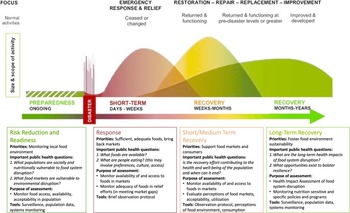
Taking these lessons learned from the 2 case studies and the potential changes in food environment throughout the phases of disaster management (Figure 1), food environment assessment priorities can be framed in alignment with each phase of the Federal Emergency Management Agency (FEMA) National Disaster Recovery Framework. 38 This framework highlights preparedness for a disaster event taking place in the time before an event occurring and 3 phases of response and recovery starting with the short-term, or those first days and weeks after a disaster strikes when community functioning is disrupted or has ceased and response agencies and community organizations and members are working to stabilize community functioning.
Food security priorities aligned with the FEMA disaster recovery continuum 38 .

In the preparedness phase for disasters with warning time (ie, hurricanes), the priority is monitoring of the food environment at baseline in coordination with state/territorial and community organizations, to increase awareness about the food and nutritional needs of at-risk communities. A food environment assessment would help to characterize risk factors in the population, including groups who may be socially or nutritionally vulnerable to disasters and contribute to population level health surveillance used to monitor potential disruptions to household food access caused by a disaster. Identifying food venues, such as grocery stores, corner stores, food pantries, and other vendors, that may be vulnerable to disruptions in a disaster is critical to understand food availability and acceptability in at-risk populations and to bolster availability of acceptable foods in accessible locations.
In the response phase, the priority is ensuring sufficient nutritionally adequate foods for disaster-affected populations. The primary goal during response is monitoring what foods are available as a proxy for what people are actually consuming. Understanding what foods are available through retail and emergency food sources, where they can be accessed, and who is both able to access and use food sources is important for ensuring sufficient supplies and mobilizing to address gaps. Given the increasing incidence of diet-related noncommunicable diseases and frequency and magnitude of disasters, there is an urgent need for emergency response, even at this early phase, to better align with the DGA to support the health of survivors. Furthermore, given our findings in both disaster settings that stores are saturated with unhealthful options, an assessment of the food environment at this stage to identify availability of foods can contribute to improved response that meets community dietary needs. Assessment of ready-to-heat and ready-to eat foods, shelf-stable food items (noting availability of healthful options) for each food group, and potentially also special needs foods for extremely vulnerable populations (ie, for elderly, infant, and toddler foods) becomes a priority so that disaster-affected households can better manage their health. The longer it takes to achieve stabilization; the more important it becomes to shift focus to nutritional foods for these vulnerable groups. During this phase, brief observation protocols are needed to monitor the retail and emergency food environment for food accessibility, availability, and acceptability, which are important constructs for food and nutrition security.
During short- and medium-term recovery, the focus of disaster response efforts is on restoring functioning of the community and supporting the restoration of food markets and consumers becomes paramount. This is where shelf-stable space becomes most important, as well as repeated observations for monitoring of the food environment. Evaluating how recovery efforts are contributing to the health and well-being of the population and determining when emergency food response efforts can end and nondisaster food markets can resume is the priority. Ceasing emergency food provision too early could increase food insecurity while operating emergency food aid too long could adversely impact the local food system economically creating a different set of challenges. During this phase, it is important to monitor food accessibility and availability in local markets and to evaluate perceptions of food markets, acceptability, and use in the population. This may be captured through observations, and there may be access to disaster affected individuals for surveys of local food environment perceptions to identify availability and use of available foods. Perceived availability, access, and quality are often stronger predictors of actual health outcomes than the assessments conducted by means of observations of the food environment. Reference Gustafson, Sharkey and Samuel-Hodge39 Actual consumption patterns or sales data may also be captured at this point to assess use of the foods that is available in the markets.
Finally, long-term recovery is when response and recovery efforts focus on restoration of pre-event functioning and improvements to reduce future disaster risk. As predisaster levels of functioning return, fostering sustainability in the local food environment becomes the priority. In this phase, it is important to consider long-term health consequences of food environment disruption and identify opportunities to bolster the food system and community resilience. Health impact assessments of food system disruption and monitoring nutrition-sensitive and -specific policies and programs will enable identification of opportunities for improving programs and policies to better meet community food needs during disasters and disruptions. Population surveys and surveillance data provide indicators of long-term health consequences of disruption and monitoring systems for changes in supply, demand, and functioning will point to leverage points in the community for improving food security outcome. The authors acknowledge that these phases are not a linear process but that a community will progress through this process at different speeds and within a disaster affected community there could be different groups of people or places grappling with different phases or in multiple phases at once. 38
Limitations
There are several limitations to note for each study presented here. First, the 2 case studies were not planned together, therefore, the methodologies have limited comparability. Given there is limited research on food availability in disaster contexts and that the 2 case studies used the NEMS assessments, considering these findings together adds to the body of research on food security in disaster settings. As a result of planning this analysis after the studies were conducted, the reader must pay close attention to study design, units for food prices, and recognized the limitations of comparing across case studies. Nonetheless, the 2 case studies are not presented to be comparable, but rather to point out the importance of this topic during disasters and to suggest methods to fill in this knowledge gap. In the current case studies, observation guides, field notes, and other data collection methods were paired with the standardized NEMS assessments to understand the disaster context. Observer bias may be introduced with the use of structured and semi-structured observation protocols for collecting qualitative data; however, all research assistants were rigorously trained to ensure adherence to protocols and information was triangulated with multiple types of data. Finally, in the Puerto Rico case study, modifications were made to the NEMS-CS to collect culturally relevant information not included on the validated NEMS-CS. This approach had the benefit of collecting the validated measures while adding culturally relevant items in response to the local setting. The additional measures have not been validated, but the research team is seeking additional resources to do validation work on a disaster specific instrument. It is also worth noting that food availability is an important aspect of the food environment, but does not encompass other constructs that are important for food and nutrition security which should also be monitored (as proposed in the framework); these may include consumer perceived food access (ie, can they afford and access the foods? Can they use electronic benefit transfers to purchase the foods during power disruptions? etc…), consumer purchasing behaviors before and during disasters, among others.
Conclusions
Lessons learned from the application of an observation protocol to assess the food environment in 2 postemergency settings heighten the need for a new observation protocol instrument to assess the postdisaster food environment, specifically capturing: 5 different food groups to be in alignment with the DGA, healthful and unhealthful options (as measured in the NEMS), shelf-stable versus other formats (fresh, frozen), ready-to-eat, ready-to-heat, cooking facilities and supplies (for hygiene and cooking).
Acknowledgments
U.C.R. acknowledges the support of Dr. Amira Roess from George Mason University, the University of Puerto Rico (UPR), specifically, Dr. Emma Fernández Repollet, Director of the Research Centers in Minority Institutions; Dr. Cynthia M. Perez, Professor of Biostatistics and Epidemiology in the Graduate School of Public Health, with this research study; Professor Alícia Díaz Boulón, from the Dietetics Program at the UPR; the Office of the President at the Universidad Sagrado Corazón for identifying student data collectors. The following assisted with various aspects of data collection and/or analysis: Jose Carlos Sánchez Cintrón, Nélida Ramos Torres, Lyana Nieves, Desirée Quiñones, María Portela, Joselyn Reyes, Nathalie Ramos, Nicolette Bestul, and Claudia Jaime Antuñez de Manolo. L.A.C. acknowledges our community partners in New Bern, North Carolina that welcomed us into their community and championed this research, the study participants that shared their experiences to advance science and make things a little bit easier for communities experiencing disasters in the future, and the research team members that participated in field data collection: Abbey Hotard, Tara Kruse, Alex Greer, Aimee Mankins, Sarah Wise, Danielle King, Nikki Testa, Analeeza Leggett, Amber Khan, and Samantha Penta.
Funding statement
Research in Puerto Rico was funded by a grant from the University of Colorado Natural Hazards Center through its Quick Response Grant Program, which is funded by National Science Foundation grant number CMMI1333610. Research in North Carolina was supported by the Gulf Research Program of the National Academies of Sciences, Engineering, and Medicine under the Grant Agreement number 200009650.