In recent decades retail and consumption studies have developed a grand narrative for early modern historians. Researchers have conducted intense debates over changes in material cultures, global trade and the ramifications for consumers. The eighteenth century, being a period of important transitions, has served as a focal point for these discussions.Footnote 1 The concepts of consumerism and luxury were developed, and consumer sensations such as comfort and pleasure were discovered, along with cultural values such as respectability.Footnote 2 Exotic hot drinks, tobacco, cotton and porcelain from the Far East, as well as its European substitutes, figure prominently in the master narratives of this period,Footnote 3 as do the commercial networks that connected the buyers and sellers involved in the markets for these consumer novelties.Footnote 4 However, as Jan de Vries has acknowledged, past historians instinctively prioritised the study of novelties and patterns of market growth, while the study of more traditional consumer patterns and objects disappearing from the market was marginalised, if they were considered at all.Footnote 5 Recent research has, on the other hand, sought to re-assess the importance of alternative commercial arenas and the circulation of second-hand goods in particular.Footnote 6 This article, which considers the market for pre-owned paintings in the Southern Netherlands during the eighteenth century, is exactly located at the crossroads of these two points of departure. We report on a study of the commercial culture associated with the resale market for paintings, a traditional luxury product. This part of the material culture of the Low Countries came under pressure in the eighteenth century. The fifteenth- and sixteenth-centuries' market in Dutch paintings is often seen as a precursor to modern consumer behaviour, but by the 1700s such works of art were no longer considered to be prominent positional goods or cultural markers.Footnote 7 Both in the Northern and the Southern Netherlands paintings lost much of their attraction as interior decoration. Artists, and their guilds, suffered as a result of the considerable drop in the demand for new paintings. Paradoxical as it may seem, this Age of Enlightenment also witnessed the marked rise of specialised and culturally refined art auctions. The Southern Netherlands was our conscious choice for a case-study as it allows us to consider the rise of the art auction in a region that had an abundant local supply of Old Master paintings in the early 1700s, but was left bereft of most of its artistic legacy by the nineteenth century. The main ambition of our study was to relate shifts in consumer preferences to the definitive emergence of the art auctions as a form of commercial institution. The evidence we have gathered from a substantial sample of elite auctions in the Southern Netherlands between 1739 and 1794 has allowed us to conduct an analysis of supply, demand and price patterns, and this allows us to meticulously rebuff the reigning qualitative paradigm on eighteenth-century auctions. On a deeper level, we also seek to question the significance of the specialised art auction as a commercial institution in the eighteenth century.
1. NEOPHILIA AND OLD MASTER PAINTINGS
Although Dutch art dealers paved the way during the Netherland's seventeenth-century Golden Age, the specialised art auction did not finally emerge as the dominant market form for the sale of pre-owned paintings until the following century.Footnote 8 Specialised art auctions gained momentum in the Southern and Austrian NetherlandsFootnote 9 from the middle of the eighteenth century onwards, as they did elsewhere in Europe.Footnote 10 Previous studies of the international art market have attributed the growth of the commercial network of auctions to the individual agency of pioneering auctioneers such as Jan Pietersz. Zomer in Amsterdam, Edme-François Gersaint in Paris, and James Christie in London. These men gained control over this market segment at the expense of the guild-related officials who had traditionally held the monopoly over sales on the second-hand market.Footnote 11 While we do not wish to completely discard the entrepreneurship of such men from any explanation for the rapid rise of the specialised art auction, we wish to argue that the latter has to be understood first and foremost as an immediate response to the changes in consumer preferences underway during the eighteenth century. We argue that the increasingly dominant craze for novelty in this era exerted an influence upon markets for pre-owned consumer goods, paintings in particular, and this influence is often ignored.
Neophilism, the love of the new, was one of the most remarkable characteristics of eighteenth-century consumer and material culture. Consumer fascination with ‘le plus nouveau et galant’ meant that the ‘newest and most fashionable’ goods drove the markets and shortened the perceived cultural life cycle of material goods. In addition, products were increasingly fabricated from lighter and less durable materials, and this also shortened their life cycle. Product and process innovations ensured that consumer goods were produced more cheaply, which allowed people from across an increasingly wider social spectrum to participate in the joy of consumerism. As the wheel of European material culture turned gradually from the durable to the fashionable, markets in second-hand goods were inevitably confronted with a structural challenge; they became relatively marginalised, both economically and socially, as a direct result of the influx of cheaper and less durable goods.Footnote 12 In the seventeenth and early eighteenth centuries, estate sales, auctions and second-hand shops were known as respectable venues for polite shopping, where people from different social classes could meet and exchange objects.Footnote 13 Increasingly however, over the eighteenth century, these types of venue came to be considered as inferior and ‘down market’. It is our hypothesis that this relative marginalisation of mainstream second-hand markets contributed, paradoxically, to the emergence of specialised resale markets for products with a high residual value, such as books, musical instruments, carriages and works of art.Footnote 14 Ultimately, the marginalisation of the general second-hand goods market ensured that diverse categories of specific ‘old things’ became valuable and desirable again. In short, it was precisely because the markets for pre-owned goods noticeably lost social prestige and popularity in the eighteenth century that a separate, more prestigious network of specialist, frequently held art auctions was able to develop. Unsurprisingly, the new generation of auctioneers spared neither cost nor effort to elevate the auction sales into worthy social and cultural events, part of a ‘polite economy’. The new auctions were certainly nothing like the earlier, chaotic events where all sorts of household wares were hawked at public marketplaces.
From the 1760s onwards art auctions in both Brussels and Antwerp were held in new spaces at prestigious locations, but the geography of auctions developed along somewhat different lines in each of these cities. Of the 14 Antwerp auctions in our dataset, 10 were organised in public or semi-public salesrooms. Although the average prices of paintings sold in such auction halls did not differ significantly from those raised when the sale was conducted elsewhere, it is clear that in Antwerp the largest and most prestigious painting collections were sold at auctions conducted in the houses of their previous, but now deceased, owners.Footnote 15 Besides practical considerations, such ‘on the spot’ auctions would have been preferred by the auctioneers as they imparted a sense of distinction to the proceedings.Footnote 16 The picture in Brussels was rather different; here only 5 of the 23 sales in the dataset took place in a public auction hall, and it is clear that in Brussels sales of paintings previously owned by someone who had recently died were deliberately organised in the residence of the deceased.Footnote 17 Despite the fact that the geography of auctions crystallised differently in the two cities, Brussels and Antwerp shared the same underlying logic: art benefitted from being auctioned off separately from the ordinary goods on offer at mainstream second-hand markets. Even in the early 1740s, for example, the Antwerp auctioneer Joannes van Lemens was already garnering a conspicuously lower yield from his sales at the guild-related, open-air Vrijdagse Markt (‘Friday Marketplace’), in comparison with the sales he conducted in the Kolveniershof (‘Chamber of the Arquebusiers’ or ‘Harquibusiers’) and other new-style auction halls. Footnote 18 When the small art collection of Antwerp printer Jean-François Van Soest went under the hammer in 1771, it was divided into two; first ‘several poor paintings’ changed hands at the Vrijdagse Markt for the sum of only 9 guilders, but afterwards his more valuable works of art were sold for more than 600 guilders in the Kolveniershof.Footnote 19 When an anonymous traveller from London visited the Vrijdagse Markt in 1785, he remarked – rather disdainfully – on the pictures ‘sold there for a crown a-piece, the frames of which cost double that price’.Footnote 20 These anecdotes not only offer us examples of the specialisation of the ‘up market’ second-hand sector described above, they also neatly summarise the fate of the more traditional second-hand markets as well. In the eighteenth century the latter's role as a forum for luxury sales was largely played out, and it is not far-fetched to see the specialised auction industry as an institutional answer to the challenge set to those offering valuable older goods by the economic and social marginalisation of traditional resale which had, in turn, been caused by shifting consumer preferences.
The distinctive character of art auctions was imparted by their spatial setting, but also by the auctioneers’ novel use of discourse. The fact that the bulk of both the announcements of forthcoming auctions placed in the otherwise Flemish daily newspapers and the auction catalogues were composed in French, the language of the urban elite in the Austrian Netherlands, speaks volumes about the type of clientele that the auctioneers hoped to address. Furthermore, in the auction catalogues examined as part of our research, the number of words used to praise paintings grew considerably as the eighteenth century advanced.Footnote 21 For example when, in 1739, a painting by Rubens went under the hammer in Brussels, it was briefly described in the accompanying catalogue as Méléagre & Atalante avec un Sanglier (‘Meleager & Atalanta with a Boar’).Footnote 22 The same work re-entered the auction market in 1775. This time the catalogue's author proved to be somewhat more thorough in his description:
Meleager & Atalanta. Atalanta, having slain the Calydonian boar, is in the act of receiving the head & the hide from Meleager: this tableau is painted with as much power as expression [and] has much merit in the eyes of Connoisseurs. It is engraved as a print by C. Blommaert & by Pigas.Footnote 23
The implicit and explicit variations in these descriptions are particularly revealing about the development of a true art auction culture after 1750. Not only did the author from 1775 describe the subject with a greater sense of detail; he also managed to convey the artist's powerful and expressive brushwork. He also mentions in passing that the painting in question is held in high regard by art connoisseurs – giving his arguments an obvious authority – before closing with a reference to two engravings that serve as objective guarantees of quality while also amplifying the reliability and reputation of the auctioneer. This type of artistic discourse is a clear indication of the cultural élan, which had developed very quickly around art auctions.
The rapidly developing auction markets in Antwerp and Brussels can be written seamlessly into a broader European historiography. Although London auctions of top-of-the-range collectibles expanded considerably after the start of the renowned Sotheby's (1744) and Christie's (1766),Footnote 24 Paris is still acknowledged for the distinctive cultural esteem surrounding its high-status auctions. Inspired by earlier Dutch examples, the French dealer Gersaint carefully constructed a specific commercial culture from the 1730s onwards. He understood the value of printed catalogues as an interesting medium in which to articulate a civilised manner of thinking and talking about art.Footnote 25 In the second half of the eighteenth century, Gersaint's followers Rémy, Paillet and Lebrun extended his vision of the high-end auction experience. They built distinctive salesrooms across Paris that were designed as theatres, where buyers could participate in a cultural event in which seeing and being seen were considered just as important as the actual acquisition of pre-owned art.Footnote 26 However, previous historical studies of the introduction of this commercial culture into Paris, and elsewhere in Western Europe, have never questioned whether these developments had a concrete effect on the market for second-hand works of art. The time has come to thoroughly question the impact that the spatial and discursive shifts outlined above had on actual acquisition practices and on the value of paintings. We must also reflect on the degree to which changing preferences for pre-owned paintings articulate the broader changes underway in consumer culture during the eighteenth century.
2. COLLECTIONS UNDER THE HAMMER: A PRICE ANALYSIS
In order to be able to map price patterns and consumer preferences for second-hand paintings, we constructed a database containing no fewer than 5,558 documented sales transactions taking place during 41 art auctions in Antwerp and BrusselsFootnote 27 between 1739 and 1794.Footnote 28 The catalogues of the 41 auctions selected for study represent approximately half of the surviving 81 eighteenth-century auction catalogues from the two cities, which include complete and/or partial annotations listing those buying paintings, and correspond to a quarter of all 168 extant auction catalogues from both cities. The oldest auction catalogues in our database date from 1739 and 1741, but there is then a gap until 1758. From then on, through to and including 1794, the catalogues in the sample are distributed relatively proportionately over time and space (Appendix 1).
As, on average, each catalogue in our sample contains 135 lots of paintings,Footnote 29 it must be concluded that our research captures the most prestigious art collections.Footnote 30 As a source, the sample of surviving catalogues is not unbiased, as it was the largest and most sensational auctions, in particular, which provided auctioneers with the opportunity to both annotate and archive their catalogues. In Antwerp, the auctioned collections had previously belonged to distinguished individuals such as the merchant James Dormer, whose paintings were divided into 156 lots; the canon Pierre André Joseph Knijff (524 lots); and Count Charles De Proli, a major captain of finance and commerce (168 lots). In Brussels noblemen such as the Prince de Rubempré (240 lots), the Count de Calemberg (72 lots), and the Knight de Verhulst (280 lots) had their pictures put up for auction after their death. Furthermore, the distribution of the catalogues studied reflects the fact that Brussels dominated the art market. Only one third (36 per cent) of the catalogues studied bore a mark from Antwerp, exactly the same percentage for that matter, as the global rate of preservation for all auction catalogues in Brabant.Footnote 31 Thanks to the presence of its court and its distinctive consumer culture, Brussels had overtaken Antwerp in the urban hierarchy of the Southern Netherlands in the late seventeenth century. It also overtook Antwerp as a city of art and culture.Footnote 32 The higher level of conspicuous consumption in Brussels, as the capital city, could help to explain the slightly higher average and median auction prices paid for paintings at the city's auctions. Yet, apart from collections for sale in Antwerp being rather larger, none of the differences between the art markets in the two cities proved to be statistically significant.Footnote 33
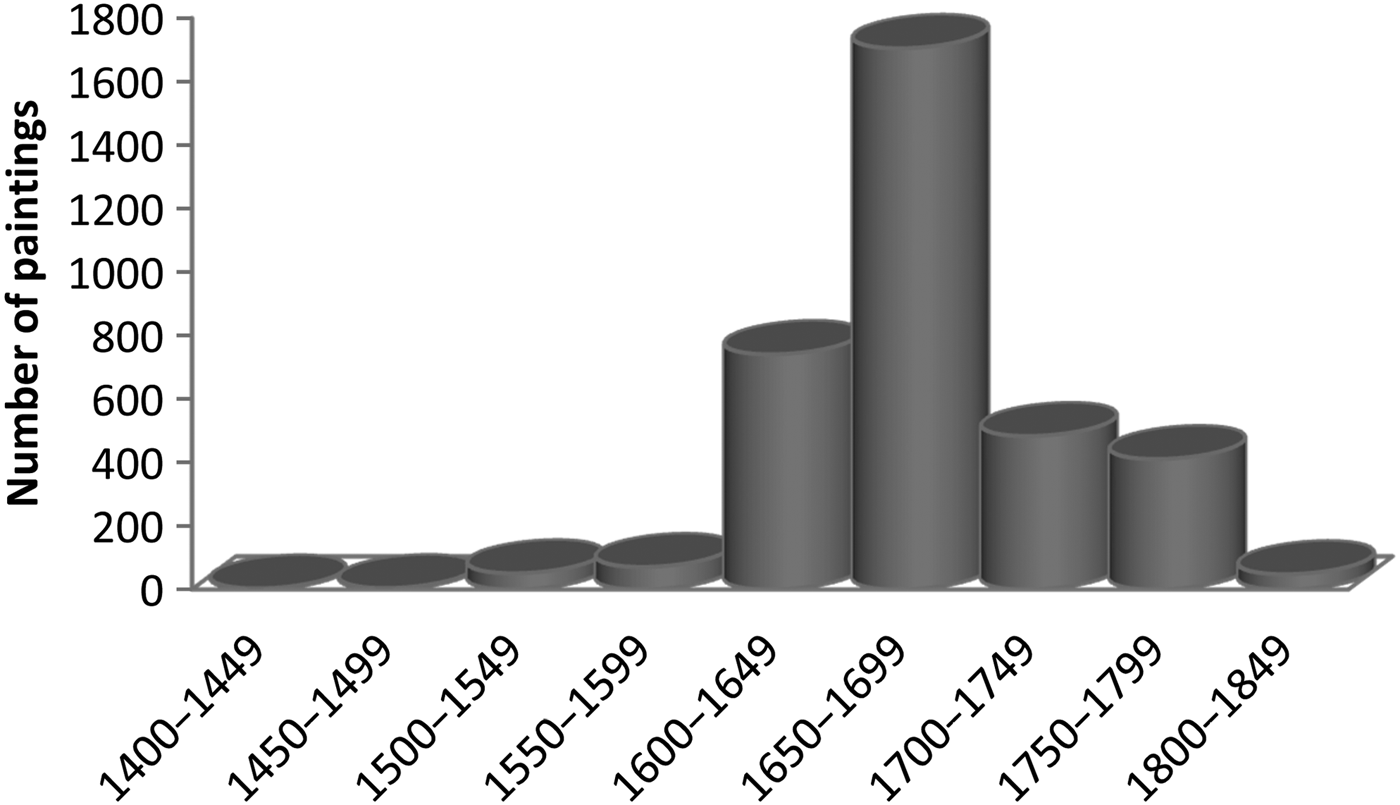
In contrast to the paintings supplied to the auction market in Paris, for example, which in the eighteenth century contained scarcely any ‘modern’ pieces,Footnote 34 nearly a quarter of the works for sale in the same period in Brussels and Antwerp were by ‘contempory’ artists (Figure 1). Nevertheless, art auctions remained the primary source of Old Master paintings in the Austrian Netherlands. The lion's share of the collections being sold in the eighteenth century comprised works by painters from the seventeenth century, such as the renowned artists from Antwerp: Rubens, van Dyck Teniers the Younger and their contemporaries.Footnote 35
The number of paintings offered for sale at 41 auctions in Antwerp and Brussels between 1739 and 1794, corresponding to the date of the artist's death.

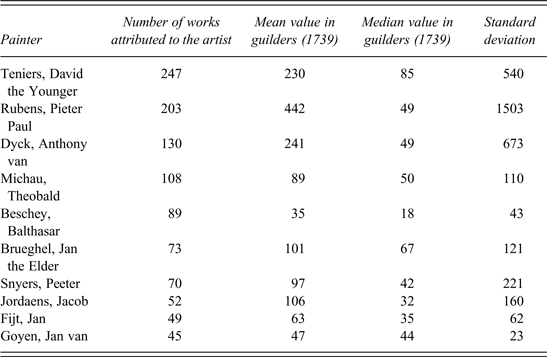
As expected, the majority of paintings sold in Brussels and Antwerp came from Flanders and, to a lesser extent, from Holland. The top ten artists in terms of works sold were almost all masters from the Antwerp school (Table 1).Footnote 36 Only Jan van Goyen, a landscape painter from The Hague, broke up the Flemish monopoly. With the exception of a few hundred French and Italian pieces, works by ‘foreign’ masters were not usually found for sale at auctions in Antwerp and Brussels.Footnote 37 It is not easy, however, to draw firm conclusions concerning the actual number of paintings by acknowledged masters, or the prices fetched by their works, based upon attributions in printed catalogues.Footnote 38 Auction masters were not averse to luring in clients with highly dubious attributions both in newspaper advertisements and in the auction catalogues that they had printed. Thus, for example, the advertisement in the local Gazette van Antwerpen (‘Antwerp Gazette’) announced that, on 7 July 1784, the auction at the Kolveniershof would supposedly be selling:
a very fine Collection of Paintings of prominent Masters, such as P. P. Rubens, A. van Dyck, David Teniers, Henry van Baalen, Peeter Neefs, Ph. Wouwerman, van Delen, Paul Veronese, Momper, Horemans, Michau, Breugel de Naples, Huchtenbourg, E. van der Neer, B. Peeters, Ostade, Terborgh, and other miscellaneous renowned Masters. Also a fine book of prints, la Galerie de Luxembourg [the Luxembourg Gallery], Peinte par [Painted by] P.P. Rubens, Paris 1710.Footnote 39
The ten top-selling individual artistsa at the 41 auctions listed in the Database of Auction Catalogues (Antwerp and Brussels, 1739–1794)

a The artists to whom a work is attributed in a catalogue.
Source: Database of Auction Catalogues (see Appendix 1).
The auctioneer was clearly name-dropping in order to catch the attention of potential clients. The fact that Rubens’s name headed the list as chief ‘bait’ would not have been coincidental. Nevertheless, although this newspaper advertisement made mention of the approaching sale of authentic paintings by the master's hand, when the auction catalogue was printed Rubens’s name was mentioned only twice. One work was rather tellingly described as only de l'école de P. P. Rubens (‘of the school of P. P. Rubens’) and a second piece was said, with some reservation, to be by P. P. RUBENS, où dans sa manière (‘P. P. RUBENS, or in his manner’).Footnote 40 Such examples illustrate how attributions in advertisements and catalogues need to be treated with caution as they do not offer a firm basis from which to chart differences in the prices offered for the works of particular artists.
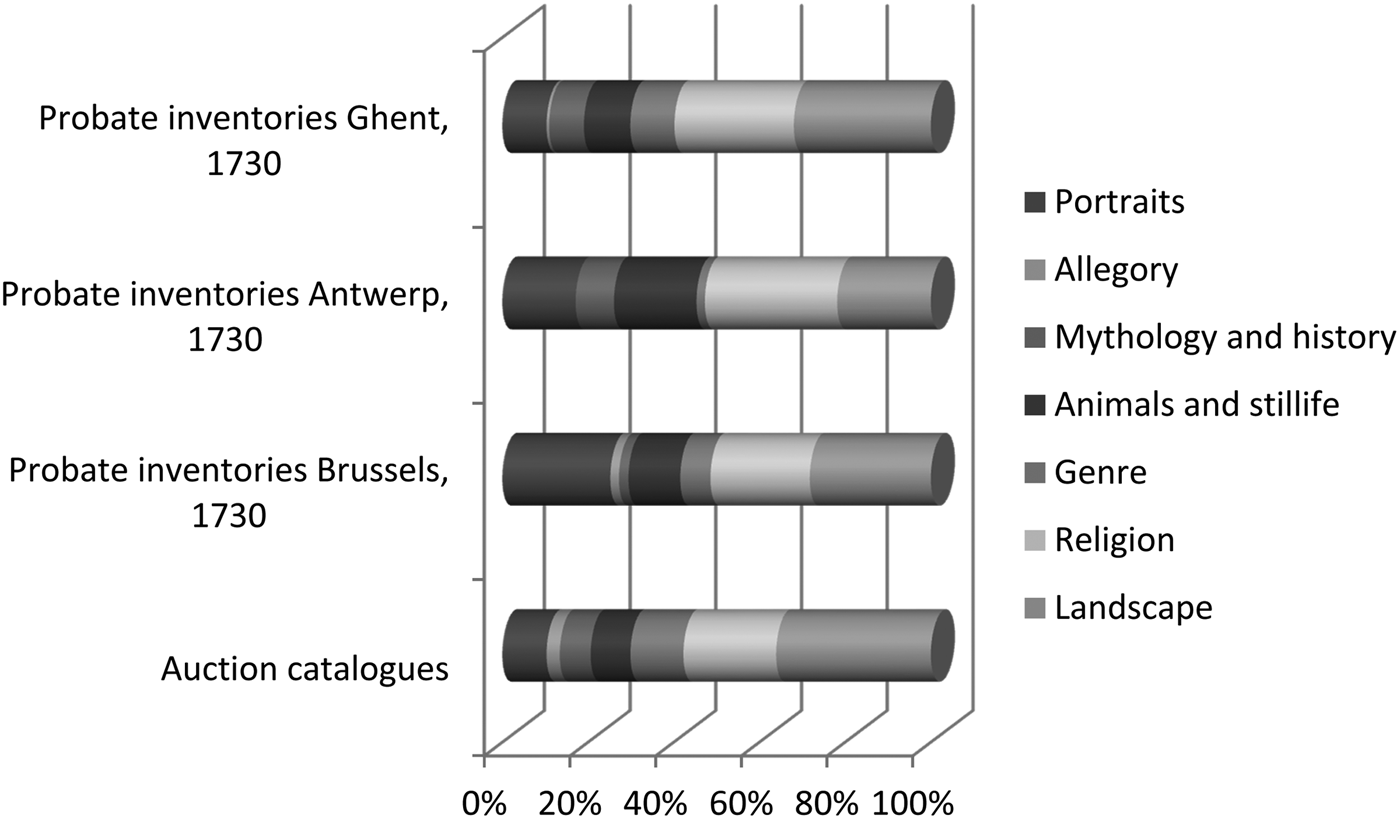
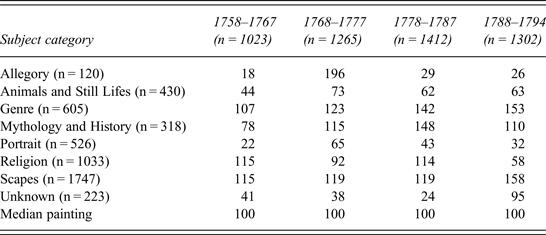
The subject matter of the paintings supplied to auctions deserves to be considered more closely. In Figure 2 the thematic subdivision of paintings in the auction catalogues is compared to the thematic preferences in post mortem probate inventories. When we compared the types of painting for sale in the public forum with those works in private possession, details of which are known through the considerable body of research undertaken on the ownership of paintings listed in probate inventories, it is clear that significantly fewer portraits were offered for sale at auctions of luxury goods than might be expected given the numbers privately owned. This is hardly surprising; emotional considerations, including an awareness of lineage, easily explain why portraits might remain in a family's possession relatively longer than other paintings. Conversely, ‘genre’ paintings are over-represented in art auctions, although it is generally known that this vague category of art work was poorly reported and difficult to trace in Brabantine probate inventories. The other categories of painting were, however, supplied to the auction markets in numbers that more or less reflected the numbers of paintings with the same subject type in private possession in the Dutch cities for which some information is available, such as Antwerp, Brussels and Ghent. In terms of the themes depicted, the supply of paintings remained fairly stable throughout the study period.Footnote 41
The distribution of the subject matter of the paintings listed in the 41 auction catalogues included in the Database of Auction Catalogues (Antwerp and Brussels, 1739– 1794), compared to paintings listed in the probate inventories of Ghent, Antwerp and Brussels in 1730.

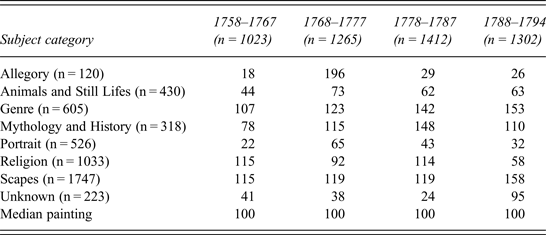
The price analysis shown in Table 2 demonstrates that, despite their potential artistic qualities, portraits often did not achieve very high prices when sold as pre-owned paintings.Footnote 42 This, again, is in line with our observations on the rather peculiar, personal character of portraits.Footnote 43 Table 2 shows that prices for genre paintings, land, sea and cityscapes, and, to a lesser extent, pieces on religious or mythological subjects remained relatively buoyant throughout the period studied. Except in the decade between 1768 and 1777, allegorical paintings and works depicting fauna and flora did not perform as well as those in other categories.Footnote 44 The prices fetched by ‘unknown’ paintings were also low, which seems logical, given that paintings unworthy of a detailed description were hardly likely to fetch a high price. The decline in the value of religious paintings between 1778–1787 and 1788–1794 is conspicuous in Table 2. It is tempting to speculate that a more secular spirit might have seized those buying art during this period.Footnote 45 However, after the Jesuit order was disbanded in the Austrian Netherlands in 1777, followed by other religious orders in 1785, auctions in the Austrian Netherlands were saturated with religious paintings as the orders were forced to sell their art collections, and this is likely to have played a large role in the decline in prices for this kind of work.Footnote 46
The median price of paintings, per subject category, expressed as a percentage of the median price for all paintings offered for sale at the 41 auctions listed in the Database of Auction Catalogues (Antwerp and Brussels, 1758–1794)
Source: Database of Auction Catalogues (see Appendix 1)
At a deeper level our price analysis uncovered a structural discrepancy between the reality of the market in art and academic theory relating to the value of paintings. Influential seventeenth-century writers such as Félibien, Van Hoogstraten and De Lairesse had propagated a well-thought-out hierarchy of genres, in which paintings with more ‘intellectual’ subjects taken from history or mythology along with allegories were deemed far more valuable and important, and thus ‘superior’ to genres such as animal painting and still life.Footnote 47 Although the academic views on the value of paintings held sway in artistic circles throughout the eighteenth century, the preferences of the public buying art at auctions in the Austrian Netherlands seem to have considerably diverged from the established theoretical canon, as they much preferred landscapes, cityscapes and scenes from everyday life, and were not willing to pay high prices for allegorical painting.
3. CONSUMER DEMAND AND ITS EFFECT ON AUCTIONSFootnote 48
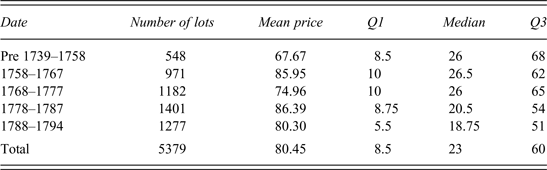
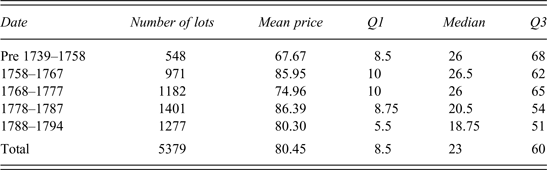
During the eighteenth century, paintings sold at auctions of luxury goods in the Austrian Netherlands changed hands for the tidy sum of 80 guilders, on average, at 1739 prices (Table 3). The effect of exceptional sales becomes clear, however, when it is realised that the median price for a painting was only 26 guilders. Twenty-five per cent of the paintings sold fetched less than ten guilders. Even the average prices, although driven up by a few outlying extreme values, were very modest, given the patterns of consumption maintained by the well-off burghers who frequented the top auctions in the Austrian Netherlands. They, for example, bought silver pocket watches or wigs priced at around 15 guilders, or a harpsichord for 50 guilders.Footnote 49 Quite a few of those who attended auctions would have owned either a carriage or a chaise, vehicles that could easily cost 2,000 guilders, and which incurred an additional cost of around 280 guilders per year for the hay and fodder for the horses.Footnote 50 In comparison with such sums Old Master paintings were being auctioned off at rather modest prices. That it was relatively inexpensive, in comparison with other expenditure on luxury goods, to buy paintings at top tier art auctions in Brabant was rather unexpected and an important finding from our price analysis.
Analysis of the catalogue prices (nominal prices) paid for lots of paintings at the 41 auctions listed in the Database of Auction Catalogues in guilders (Antwerp and Brussels, 1739–1794)
Source: Database of Auction Catalogues (see Appendix 1).
Although an average painting was affordable, aspiring elite collectors often sought to buy whole collections, and this would be a far from inexpensive undertaking. In order to render all paintings comparable we have converted all the prices discussed below into 1739 prices, as this was the earliest date in our database. Using 1739 prices an average collection of paintings was worth no less than 11,781 guilders, although even within the small group of auction catalogues surveyed there was wide variation in the sums recorded. The median collection went under the hammer for 7,147 guilders; a small fortune and the near equivalent of four luxury carriages. Thus although individual paintings were relatively affordable, the overall prices fetched by large collections highlights the wealth of the auctioneers’ clientele, and the luxurious nature of the goods for sale in the catalogues selected for this research project.
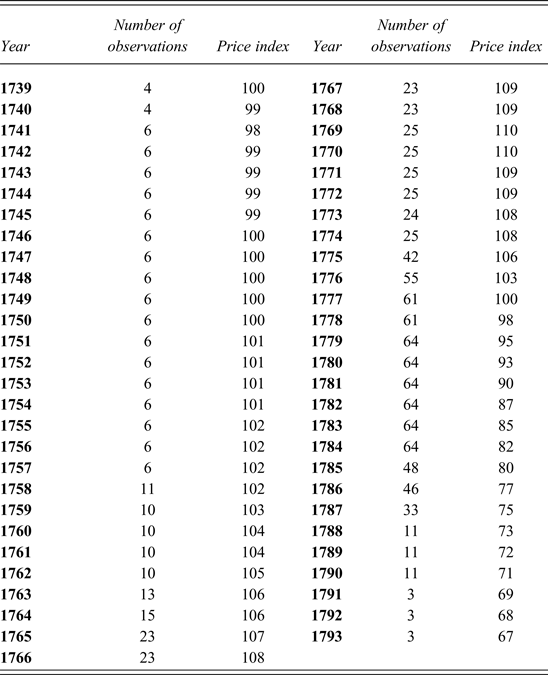
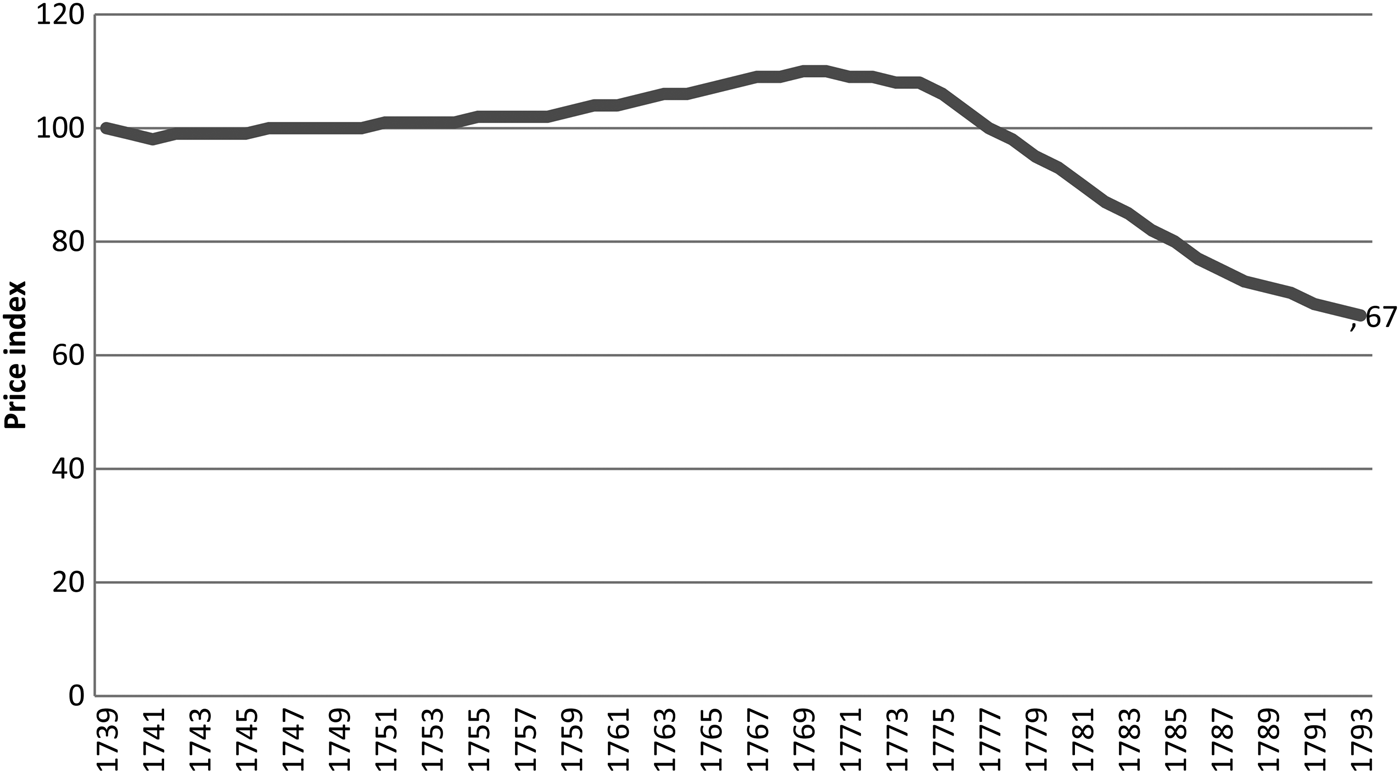
A second important finding from our analysis was also intriguing: the prices fetched at the auction markets of Antwerp and Brussels in the eighteenth century revealed a significant stability over an extended period, followed by a substantial downturn at the end of the century. In spite of the growing numbers of widely advertised auctions, with their increasingly luxurious commercial settings and ever more thorough and detailed catalogues using increasingly snobbish, refined and culturally elevated vocabulary, the prices paid for paintings on the auction markets in the Austrian Netherlands barely moved at all, let alone upwards. Between 1758 and 1794 the average price of a painting fluctuated, almost invariably, around 80 guilders. Generally speaking, the first quartile, median and third quartile prices displayed the same, invariant pattern.Footnote 51 After 1775, however, the price index collapsed (Figure 3 and Appendix 2).
The prices paid each year for paintings resold at the 41 auctions listed in the Database of Auction Catalogues (Antwerp and Brussels 1739–1794), indexed against the 1739 price (1739 price is set to 100).

4. A DEALER'S MARKET?
The stability of the prices paintings fetched at auction until 1775 and their subsequent sudden decline raise important questions about the nature of the auction markets and, more specifically, about their customers. It is anything but easy, however, to check what influence various categories of buyers – such as dealers, collectors or private individuals – had on the development of prices, and whether such categorisation was even possible or at all meaningful. An important initial indication was provided by checking whether, and to what extent, the auctions in Antwerp and Brussels were attended by the same buying public. Thanks to the paved roads that had been installed and the widespread advertisement of auctions through fliers and newspapers, potential buyers were, in principle, able to move easily between the various markets in the Austrian Netherlands.Footnote 52 As early as 1707 the art dealer Gillis van der Vennen wrote to his partner Francisco-Jacomo van den Berghe in Ghent that he was going to Amsterdam for ‘a nice auction’, mentioning in passing that ‘[I] believe, Sir, you will have seen it in the Dutch Courant.’Footnote 53 Half a century later, an art auction organised by Petrus Joannes Snijers in Antwerp was advertised not only in the local Gazette van Antwerpen (‘Antwerp Gazette’) but also in papers in the prince-bishopric of Liège and in the Dutch Republic.Footnote 54 Such examples seem to suggest that the auctioneers sought to bring in customers from well outside the city gates, even from beyond the borders of the Austrian Netherlands.
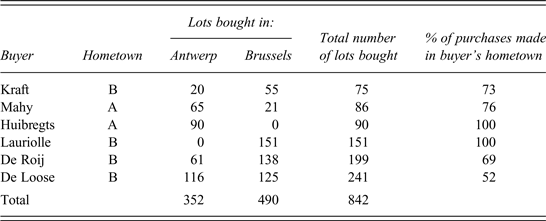
Our database shows, however, that in practice those buying at the auctions were not drawn from one unified market. Even the most frequent buyers usually went hunting for paintings in their hometown (Table 4).Footnote 55 Even major buyers – individuals purchasing 50 or more of the paintings in our sample – operated within their local area.Footnote 56 The auction market for Old Master paintings in the Austrian Netherlands in the second half of the eighteenth century was, therefore, anything but geographically integrated. By and large, the network of auctions formed a dealer's market, but most dealers operated on a local scale.Footnote 57
The number of lots of paintings bought by top buyersa at the 41 auctions listed in the Database of Auction Catalogues (Antwerp and Brussels, 1739–1794)b
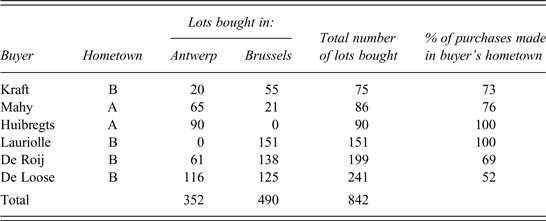
a A top buyer was defined as an individual buying at least 75 lots of paintings
b Annotations referring to buyers in auction catalogues usually only offer surnames, with no additional information. Common names in the local art world such as Beschey, Myin or Stevens probably refer to multiple buyers, as they appear throughout our sample (across the 1739–1794 period) and it is impossible to identify their individual purchases.
Source: Database of Auction Catalogues (see Appendix 1).
The combination of price stagnation and the relative dominance of local buyers raises additional questions about the demand for Old Master paintings previously held in the leading collections. It is known that in the eighteenth century private demand for paintings was more modest than it had been in the seventeenth century. In both Brussels and Antwerp, the loss of interest in works of art amongst the urban elite became increasingly pronounced from the end of the seventeenth century onward.Footnote 58 During the eighteenth century demand for art in the two cities continued to decline. In Le peintre Amateur et Curieux (‘The Amateur and Inquisitive painter’) of 1763, the Brussels-born painter and writer Guillaume-Pierre Mensaert found occasion to complain about the sale of the renowned De Fraula-collection. He wrote that the members of the first and second orders – in other words, the nobility and clergy – had lost their interest in art at a time when they, of all people, should have been supporting the fine arts:
Yet that which astonishes me most is that, while having in [Brussels] any Number of persons very much in the position of buying that which presents the more beautiful and the more rare in painting, I cannot comprehend how they have been able to let a collection as beautiful and as sought-after as was that of the said Sir Fraula go abroad.Footnote 59
The original art sector was hit especially hard by the diminishing local demand for paintings, but even the market in second-hand art works shared the blow as the possession of paintings in the Austrian Netherlands stagnated.Footnote 60 Art guides suggest that the number of ‘genuine’ collectors in Brussels halved within a short period of time, to 27 by the end of the 1770s.Footnote 61 This situation helps to explain why prices fetched by paintings at auction remained stable; the decrease in local demand meant that prices did not increase, despite the lustre of the new-style art auctions. Furthermore, after 1776 the mass sales of forfeited collections of religious art stifled any hope for a rapid price recovery, although these collections included a great number of top pieces by Rubens, van Dyck and Jordaens.Footnote 62
5. ART EXPORTS
Decreasing demand from the local elites forced auctioneers in Antwerp and Brussels to explore new markets. To an increasing extent, both the auctioneers and the dealers buying paintings turned to international markets. Here again, the surviving auction catalogues and newspaper advertisements bear discreet witness to the changing horizons of the auctioneers. Particularly after 1780 the latter began to aim their printed commercial materials towards amateurs étrangers (foreign amateurs). They offered to provide special sales facilities to attract such clients. The forewords in diverse Antwerp catalogues refer explicitly to the possibility of foreign purchases through intermediary agents within the Austrian Netherlands.Footnote 63
Although our sample of 41 catalogues and more than 5,500 lots of paintings does not cover the high-end auction market in the Austrian Netherlands in its entirety, it does suggest a conspicuous absence of direct foreign purchasers at Antwerp and Brussels art auctions. It is unlikely that the few known British, French and Dutch buyers recorded in the auction catalogues could have been responsible for the departure of tens of thousands of paintings from the Austrian Netherlands over the final decades of the eighteenth century. Instead, the art auctions held in Brussels and Antwerp functioned as an intermediary market. In addition to the many local individuals who continued attending auction, local dealers and major buyers in particular purchased paintings to augment their stock, which they then sold on to foreign collectors or their agents in private transactions conducted both at home and abroad. When the Duchess of Northumberland visited Antwerp in 1775, she tried to purchase paintings from at least four private collectors and dealers. Ten years later Joshua Reynolds called upon at least three dealers during his stay in the city. While these foreign collectors did not attend local art auctions, the private dealers they visited were all frequent buyers at Antwerp's auctions.Footnote 64
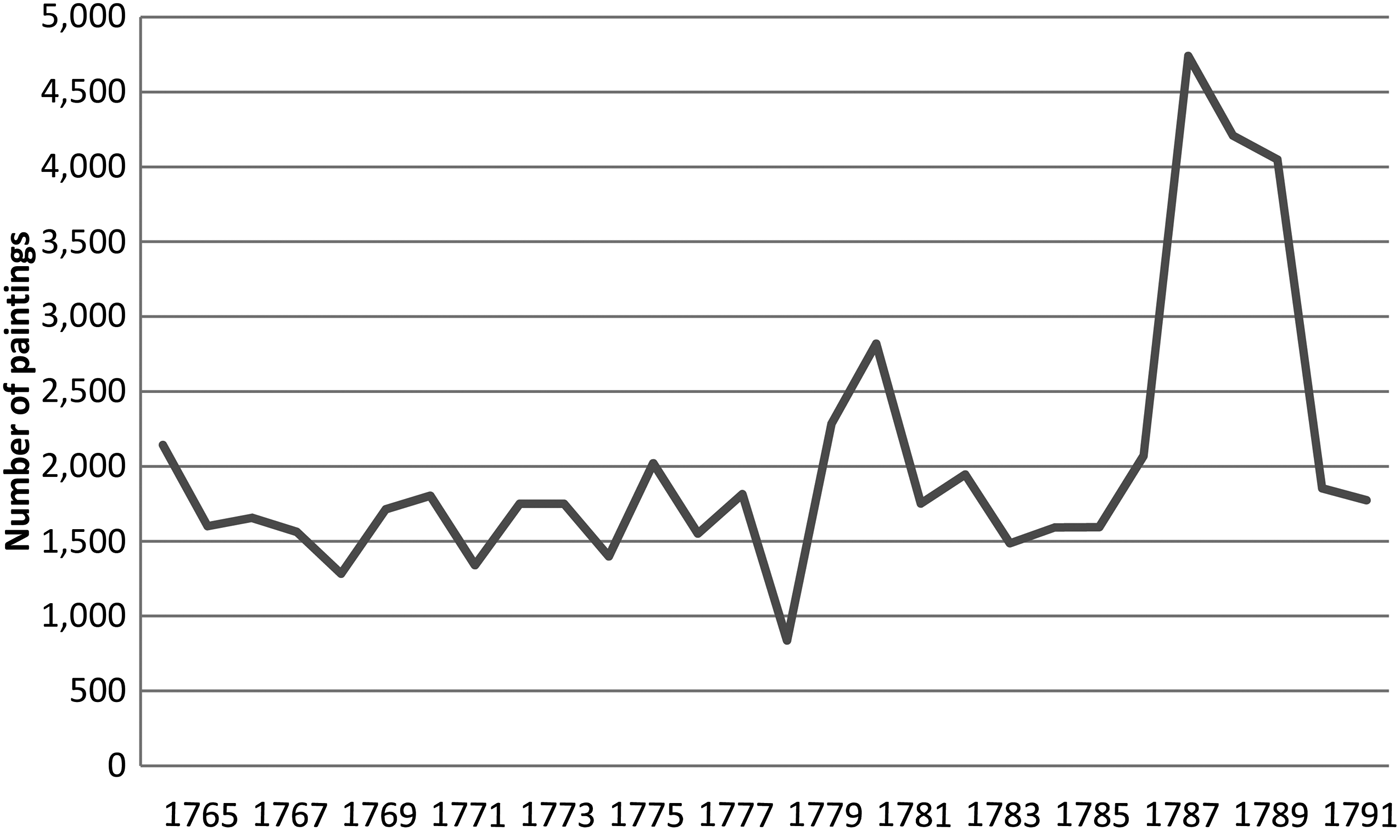
Their conscious reorientation toward foreign buyers may indicate that art dealers had the opportunity to request premium prices for their sales abroad. It is, at present, difficult to find evidence that will confirm or refute this hypothesis; further research is required. Statistics from the customs agencies of the Austrian Netherlands do appear to support the hypothesis. It is certainly true that after 1780 the foreign market for art gained in importance. After the notorious auction of Jesuit paintings in 1777 and the subsequent private sale of unauctioned lots in 1779,Footnote 65 customs officials registered a conspicuous spike in the number of exported paintings. The number of art exports from the Austrian Netherlands reverted to previous levels until the late 1780s, when figures soared once again (Figure 4).Footnote 66 Officially, no fewer than 32,000 paintings left the country between 1777 and 1791.Footnote 67 It should be noted that these are only official figures; they did not take smuggling or under-reporting into account.Footnote 68 Auctions facilitated the international trade in paintings, and one consequence of this was the diaspora of Flemish art across Europe.Footnote 69
The number of paintings exported from the Austrian Netherlands between 1765 and 1791.

Given the influence that dealers wielded over the art market, the great stability in the prices paid for paintings in the 35 years after 1739 is hardly surprising. While local demand was in decline there were a growing number of international clients seeking to buy paintings of Dutch Old Masters. Additional research is necessary to understand whether the lack of any upward movement in price points to the fact that dealers on the art market in the Austrian Netherlands were deliberately keeping the price of pre-owned paintings low.Footnote 70 The price balance was disturbed after 1775, when the emerging auction markets in the Austrian Netherlands were saturated by the sudden influx of paintings confiscated from large religious collections. The resulting decline in prices provided a particularly large additional stimulus for Flemish art to be sold abroad. It is perhaps not surprising then, that the prices paid for Flemish and Dutch paintings soared at Parisian auctions from the 1770s onwards. Even when the French market became relatively saturated with paintings from the ‘Northern’ school in the early 1780s, they continued to fetch considerable prices.Footnote 71 After 1789 there was a significant decrease in the export of paintings and the prices they fetched at auction, most likely a result of the political and economic turmoil following the French Revolution.
6. CONCLUDING REMARKS
The case studies from Antwerp and Brussels presented above explain how changes in consumer behaviour affected the fate of art auctions in the eighteenth century on at least two levels. First of all, the art auction evolved as a form of commercial institution in response to the growing consumerism of the eighteenth century. Until the end of the seventeenth century, the circulation of second-hand goods had generally been held in high esteem, but the rise of a neophiliac consumer culture meant that the markets involved were faced with an influx of cheaper, less durable, pre-owned goods. The relative economic and social marginalisation of these markets that followed spurred a segmentation that increasingly saw goods with a high residual value being sold at special sales in luxurious venues. In Antwerp and Brussels the art auctions showed apparently healthy development, as the auctioneers modelled their sales on those of their successful contemporaries; dealer-auctioneers such as Gersaint and his followers Rémy, Paillet and Lebrun in Paris, and James Christie in London, offering a rich array of medium to large collections of paintings which, to an increasing extent, went under the hammer at specialist sales events. This new form of art auction took place in the homes of deceased collectors or in specialised sales halls. In both cases the venue set these sales apart from the ‘down market’ selling culture that was still the tone of traditional, public second-hand markets. The development of art auctions was further accompanied by an expanding, and increasingly more refined, spectrum of printed matter relating to the sales, including posted bills, flyers, newspaper advertisements and elaborate auction catalogues. In the Austrian Netherlands the increasingly sophisticated artistic discourse, composed in French, included printed materials highlighting the auctioneers’ desire to address buyers from the urban elite and the nobility. In short, as in other European cities, the art auction in the Austrian Netherlands entirely broke through as the dominant market form for the resale of paintings, and growing neophilia greatly encouraged this evolution.
Secondly, consumer demand not only explained the emergence of the specialised auctions, it also drove price patterns in the art market. Over the eighteenth century, paintings in the Low Countries lost an enormous amount of their gravitas as pieces of interior decoration. Even in the select, luxury auctions being surveyed, the overwhelming majority of paintings changed owners for relatively modest prices. The resale price of individual paintings owned by the wealthy citizens of Brussels and Antwerp often did not represent much more than the equivalent of, for example, a handsome pocket watch. Not only did the sales of original paintings fall victim to changing consumer priorities in the eighteenth century, the prices at auction were also hit by the decrease in interest in Old Master paintings relative to other objects of interior decoration. As a result prices at auction were markedly stable throughout the larger part of the eighteenth century. Interestingly enough, buyers at art auctions failed to follow academic theory; ‘high brow’ historical and mythological pieces fetched considerably lower prices at auction than ‘genre’ paintings or land or cityscapes. At a basic level, genre denotes those images in the visual arts concerned with the realistic depiction of everyday life. Scenes featuring peasants, low-lives and city dwellers are considered most typical of this iconographic genre. Genre also denotes the manner in which topics were painted. More specifically, images featuring figures set in contemporary everyday surroundings, and laden with morally-didactic and comic undertones are characteristic of the genre mode of the period.Footnote 72
Even the very highly valued paintings were relatively cheap as consumer products, they held little investment value and followed a stable price pattern during a major part of the eighteenth century. Moreover, when thousands of paintings flooded the Flemish auction market in the 1770s and 1780s, following the disbanding of the Jesuits and other monastic orders, and demand from the influential French market was disturbed by the French Revolution, the art markets in Antwerp and Brussels became completely saturated. In the last quarter of the eighteenth century, in particular, there was a conspicuous decline in the prices being fetched at the most prestigious art auctions. The specific way in which art auctions developed in Antwerp and Brussels offered opportunities to foreign collectors in the last quarter of the eighteenth century. The perceived quality of the relatively cheap paintings available in Antwerp and Brussels turned these cities, and others like them, into ideal locations for foreign art lovers and dealers to conduct business. Local auctioneers realised all too well that such foreign clients offered the means to counteract the contraction in local demand. It says a great deal that from 1780 onwards, the auction houses in the Austrian Netherlands explicitly addressed étrangers in their advertisements and catalogues. Nevertheless, international purchases were generally made through local agents who, by and large, operated within their home town.
It would be worth placing these results from the Austrian Netherlands into a broader European perspective by means of a comparative study. It would be intriguing, for example, to track down just how much profit those exporting paintings and the intermediary dealers were making from sales abroad. A systematic, comparative analysis is needed to ascertain the extent to which the auction markets across Europe were communicating with each other.Footnote 73 In anticipation of such research, it seems reasonable to assume that the stability of the prices paid for paintings in Antwerp and Brussels (in the Austrian Netherlands more generally) and their subsequent marked downturn, encouraged the increasing export of Flemish art to countries such as France and England during the mid- to late-eighteenth century.
During our study period, the Austrian Netherlands appear to have been in possession of all the right ingredients for the development of an especially feverish and expansive auction market. At a certain level, this is indeed what happened. Thousands of paintings changed hands at auctions held in customised settings in the region during the eighteenth century. Yet this did not necessarily mean that the organisers of the sales succeeded in fetching high prices for the works of art being sold nor that the cultural construction put on the values attained fuelled an increase in prices. In the Austrian Netherlands the development of the art auction into a fully-fledged public spectacle and an increasingly refined commercial arena was still in its infancy.
ACKNOWLEDGEMENTS
The authors wish to thank Ann Coenen for sharing her data on the statistics of the Austrian customs agencies, as well as Jord Hanus for his comments on an earlier version of this text. John Eyck carefully translated the original text.
APPENDIX 1
A description of the 41 auction catalogues listed in the Database of Auction Catalogues (Antwerp and Brussels, 1739–1794)

APPENDIX 2
Painting Price Index on the Antwerp and Brussels auction markets (1739–1794)
One painting cannot be compared directly to another, and this makes the construction of a price index problematic. Nevertheless, in order to compare paintings from different time periods it is important to standardise price trends. Therefore, the need to establish a reliable sales price for each painting sold on the second-hand market is paramout. In order to reconstruct the evolution of the prices paid for paintings sold at the auctions in Antwerp and Brussels, we analysed the prices of paintings that were sold more than once in each of the 41 catalogues listed in Appendix 1. We restricted this exercise to 88 lots of paintings that were resold after a period of at least five years since they had previously been on the market. Some lots were observed as being resold more than once. The values for the years in between two sales were first of all translated into compound growth rates. Then for each year a median compound growth rate was calculated for all those paintings for which re-sale information was available in that specific year. Setting the median compound growth rate in 1739 to 100 and indexing the growth rates in each of the following years against this then calculated a final price index. Until the end of the 1750s the index, which can only be interpreted as indicating a trend, is based on only a handful of cases. After that the number of observations increases considerably thanks to the growing number of annotated auction catalogues.