Presiding over the November 2016 meeting of the International Political Economy Society, which followed that year's US presidential election by only three days, David Lake began by saying, “To our theories, this result unfortunately comes as no surprise.” And indeed the field at large has believed that the growing “populist”Footnote 1 backlash against the Liberal International Order (LIO)—not just the Trump victory but Brexit, the election of illiberal governments in Hungary, Poland, Turkey, the Philippines, and Brazil (to name only a few), and growing support for anti-immigrant and illiberal parties and candidates in many other democracies—has followed almost inevitably from the very changes the LIO has wrought, including of course increased trade and migration but also one major concomitant, rising economic inequality within states. According to our traditional economic theories,Footnote 2 advanced and even middle-income countries are abundantly endowed with human capital, and poorly endowed with low-skill labor. And it is a rudimentary implication of international economics that, in those countries, expanded trade—or, even more, immigration of low-skill workers—will benefit the highly skilled and harm the less educated. Inequality will rise, and—perhaps the most prescient conclusion of the traditional analysis—partisanship will correlate increasingly with possession of human capital: opposition to the LIO will be strongest among the least educated and will decrease monotonically with more years of schooling.
The evidence, which we survey briefly, admits of no doubt that in almost all of the wealthier (and not a few semiwealthy) countries, inequality has risen, often quite sharply; returns on educationFootnote 3 have risen markedly; and education, even more than occupational status, has emerged as one of the most important predictors of electoral support for antiglobalization parties. What our theories however did not anticipate, and so far cannot explain, may well prove to have been even more important:
1. Not all who are well endowed in human capital, but chiefly a very thin upper layer—the top 1 percent, or even 0.1 percent—have harvested most of the gains from globalization.
2. The antiglobalization movements we observe
• adopt a populist rhetoric that often excoriates not just globalization or immigration but also allegedly nefarious elites, who conspire, both domestically and across borders, to enrich each other at the expense of their fellow citizens;Footnote 4
• benefit chiefly parties of the radical Right; and
• have in important cases attracted non-negligible support among university-educated segments of the electorate, albeit far less than among the less skilled.Footnote 5
We suggest that the extreme inequality and the anomalies are related, and that some insights from recent work in international economics may help explain them. Three advances in trade theory predict extreme inequality. “New new” trade theory (NNTT), with its emphasis on superstar firms, offers a natural framework. So too does an “enriched” neo-H-O-S-S (Heckscher-Ohlin-Stolper-Samuelson) perspective that explores how superstar workers arise in the context of heterogeneous talent.Footnote 6 Finally, economic geography, explored thoroughly by Broz, Frieden, and Weymouth in this issue, shows how globalization gives rise to superstar cities.Footnote 7 These three trade theories predict top-heavy inequality primarily by allowing for unit heterogeneity—an assumption that the actors our traditional theories treated as identical actually differ in important ways. Firms within sectors differ in productivity, workers within a factor class differ in innate talents, and regions within countries differ in agglomeration economies.
None of this suggests, of course, that rising inequality is the only, or even necessarily the most important, cause of the growing popular backlash against the LIO. Skill-biased technological innovation and resistance to cultural change also matter, as we discuss more fully later. We do find, however, at least from a cursory analysis of European elections, that backlash against shocks from immigration and imports is conditional on high inequality, disappearing where inequality is low; and we suspect that rising “top-heavy” inequality is related to a particularly prominent strain, within the antiglobalization movements, of anti-elite and anti-expert sentiment.
We go on to suggest why rising inequality matters, not only as a source of opposition to the LIO but as an impediment to economic growth and an exacerbant of domestic polarization and international conflict.
We assess the implications of top-heavy inequality for the LIO. What remedies have been proposed? And if they lack sufficient political support, what sources of resilience can sustain the LIO under top-heavy inequality? Relatedly, we return to the question of why antiglobalization sentiment has benefited the political Right more than the Left. Finally, we chart a course for future research on models of top-heavy inequality, and discuss how they illuminate “blind spots” in the literature on international political economy.
First, however, we survey briefly the extent of growing economic inequality in advanced economies and its seeming relation, chiefly through a human-capital channel, to antiglobalization and anti-elite attitudes and voting.
Convergence Across Countries, Divergence Within Them
The triumph of the LIO in the 1980s and 1990s—the collapse of Communism, the dismantling of trade barriers, the strengthening of institutions of international governance—coupled with, and facilitated by, breakthrough innovations in transport, communication, and finance, affected economic inequality in two ways that standard factor-endowment theories predicted: inequality declined significantly between countries, thus beginning to erode three centuries of the Great Divergence between rich and poor nations; but inequality within countries, especially among the advanced economies, increased almost as sharply.
• Between countries. As late as 1990, the richest 10 percent of the world's population earned on average over ninety times what the poorest decile received; only twenty years later, that ratio had fallen to sixty-five times,Footnote 8 or only slightly more than the within-country ratio of Brazil, where in 2008 the average income of the richest decile was about fifty times that of the poorest.Footnote 9
• Within countries. Beginning even earlier, inequality of incomes, whether measured as the Gini index or the share of total income accruing to the top decile, has risen in virtually all of the advanced economies,Footnote 10 and indeed in many of the middle-income ones.Footnote 11 Bourguignon notes that the collapse of the Soviet empire and the opening of China, India, and Latin America injected roughly “a billion workers, for the most part unskilled, into international competition.”Footnote 12 That will have drastically lowered the global capital-labor ratio and hence further raised returns on human and physical capital, while reducing those on low-skill labor, in virtually all but the poorest, most labor-abundant countries.
In short, across much of the globe, the enormous overall gains from trade have benefited the highly skilled, the inventive entrepreneurs, and the owners of capital; the incomes of the less skilled and the capital-poor have risen more slowly, stagnated, or actually declined—exactly the development whose early manifestations alarmed Dani Rodrik two decades ago.Footnote 13
Surely not all of the rise in inequality stems from globalization.Footnote 14 Many analyses attribute much of the widening within-country gap—in the US, perhaps as much as four-fifthsFootnote 15—not to globalization but to skill-biased technological innovation.Footnote 16 Bourguignon contends, to be sure, that innovation has been largely endogenous to globalization: wider markets and intensified competition have raised the returns on cost-reducing innovation.Footnote 17 Cheaper labor, however, whether from offshoring or the competition of low-wage imports, might be expected to curtail the demand for labor-saving technologies, not to increase it.Footnote 18 A stronger case is implied by “new new” trade theory: if managerial pay correlates closely with firm size, and if the most successful firms in a globalized economy tend to be the largest, it follows that globalization contributes directly to the rise in top incomes.Footnote 19 Perhaps most importantly, however, whatever skill-biased innovation may have contributed to the gains of the top quintile or decile, it can say little about the gains of the top 1, or 0.1, percent of the distribution.Footnote 20 Trade, as we argue, can more readily explain those disproportionate gains.
Rising Skills Premia
Also consistent with mainstream theory were the rising returns on education and the widening gap between high- and low-skill workers’ attitudes toward trade and migration. Exactly as theory would lead us to expect, antiglobalization sentiment rose sharply, and was increasingly concentrated, among voters with the least human capital—that is, the less educated.
Returns on education have indeed risen sharply. In the US in the 1970s, workers with a college degree earned only about a quarter more than ones of comparable ethnicity and age who had completed only high school; by 2010, that gap had risen to almost 50 percent.Footnote 21 The “raw” difference in annual earnings (i.e., without controlling for ethnicity and age) between college graduates and those who have completed only high school is now 64 percent in the US, and on average in the OECD economies 45 percent.Footnote 22
At the same time, less educated voters have mobilized strongly against globalization in almost all of the advanced economies. In the US, whites with less than a college education, having up to the year 2000 differed little in their partisanship from whites with university degrees, began to tilt Republican in the early 2000sFootnote 23 and supported Trump in 2016 by a margin of more than two to one (64 to 28 percent).Footnote 24 In the Brexit referendum, similarly, 70 percent of voters with only a General Certificate of Secondary Education, roughly equivalent to a US high-school diploma, supported leaving the European Union, while those with university degrees voted by almost the same margin (68 percent) to remain.Footnote 25 And a recent International Monetary Fund working paper finds that since 2002 tertiary (i.e., university or equivalent) education has correlated, more than any other single variable, with not voting for a populist party in European parliamentary elections—an effect that has grown only stronger since 2012.Footnote 26
The Riddle of the 1 Percent
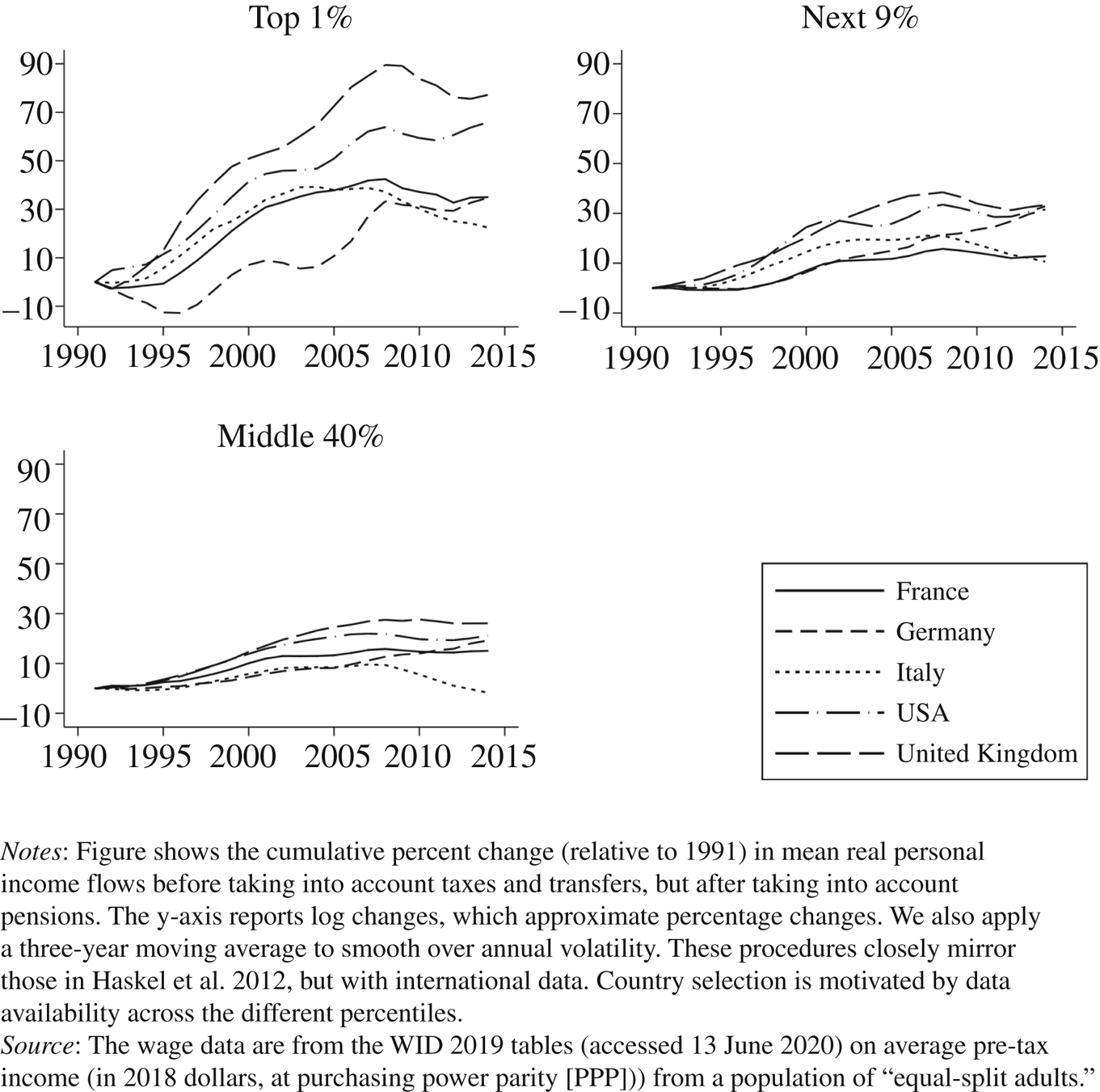
In many ways, then, a standard factor-proportions picture of globalization's distributional and political effects holds up. What it cannot explain, as economists have by now noted repeatedly,Footnote 27 is why so much of the bounty has gone to the top 1 percent and why even the remainder of the top decile, let alone the highly educated generally, have benefited comparatively little. This pattern is reflected in average real income trends since 1991 across five advanced economies (Figure 1). Much of the real income growth of the top 10 percent owes to gains by the top 1 percent (compare panels 1 and 2); the next 9 percent (i.e., the remainder of the top decile) have seen a comparatively paltry increase. At the same time, the incomes of next 9 percent, which stagnate or even decline after about 2000, mirror those of the middle 40 percent (compare panels 2 and 3). Taken together, the three panels demonstrate the extent to which a narrow elite has risen above the rest of society's otherwise skilled workers.
Percent changes in real income, by percentile

Haskel and colleagues more vividly make this case in the US with data on returns on education, finding that the median income of the top 1 percent had risen by 60 percent between 1990 and 2010, while the returns on university education, even for holders of advanced degrees, had declined in real terms after about 2000, virtually erasing their modest gains from the previous decade.Footnote 28
The seemingly inexorable rise of the 1 percent, when contrasted with the relative stagnation of the rest of the top decile, and of owners of human capital in the middle 40 percent, raises at least three questions. Can our standard theories be modified to explain this “top-heavy” form of inequality? Would such a modified theory still provide a plausible link to globalization? And does such a theory help us understand the simultaneously anti-elitist and antiglobalization character of recent populist movements?
Heterogeneous Workers, Firms, and Regions: Three Ways Globalization Affects Top-Heavy Inequality
We argue that the top-heavy inequality we observe is consistent with three recent advances in trade theory. Each highlights how the bulk of globalization's gains concentrate in a narrow subset of superstar workers, superstar firms, or superstar cities. An “enriched” H-O-S-S model shows how globalization concentrates wages in a small share of highly talented workers. New new trade theory implies that globalization concentrates profits in a few multinational corporations. Finally, economic geography, extensively reviewed by Broz, Frieden, and Weymouth (in this issue), predicts that globalization concentrates economic growth in a few metropolitan regions.Footnote 29 By producing far more extreme inequality than traditional models suggest, these theories may help explain the puzzling composition of antiglobalization interests and why these movements adopt a populist tone that demonizes elites.
In presenting these advances, we spare the reader their mathematical exposition and instead focus on their sometimes subtle intuitions. We then explore their similarities and differences, as well as how they illuminate the puzzles of LIO backlash.
Neo-H-O-S-S
The first advance injects new life into the increasingly disesteemed, yet still heavily used, factor-endowments framework of Heckscher-Ohlin and Stolper-Samuelson. It turns out that modest enhancements introduced by Haskel and colleagues yield productive insights into the puzzles of LIO backlash.Footnote 30 The key amendment introduces heterogeneous workers with varying degrees of innate talent. To state briefly the salient and surprising implications of that model, a drop in the relative price of labor-intensive goods, whether induced by globalization or by technology, can not only reduce the wages of low-skill workers, as in traditional models, but also distribute almost all of the resultant gains to a thin layer of highly talented people—and, at least as importantly, induce stagnation, or actual decline, in the earnings of highly skilled but less talented workers.Footnote 31 And, once we observe that such a shift is both quite recent and plausibly linked to globalization, we may have shed some light on (a) the rabidly anti-elitist and antiglobalization tinge of the populist movements, (b) why such movements have recently peaked, and (c) why they gain (and may well continue to gain) support not only from the “usual suspects” among low-skill workers but also from those with moderate or even relatively high endowments of human capital.Footnote 32
For those who appreciate a more rigorous introduction, we offer a graphical exposition of the “richer” H-O-S-S model in online Appendix A2. More intuitively, the key to understanding that model is what happens to high-skill workers when the relative price of capital rises.Footnote 33 First consider the unsurprising fact that within most firms, sectors, and professions, some workers possess natural talent while the majority are perfectly average. Naturally, the most talented employees are far more productive than their average colleagues, even when everyone works with the same amount of capital. In Hollywood, for example, all actors may read the same script, but only A-list talent like Meryl Streep, Denzel Washington, or Tom Hanks can turn that script into an Oscar-winning performance.
In the classic model, trade lowers wages and raises the relative cost of capital; in the enriched model, the owners of capital make up for that higher cost by lowering the wages of mediocre employees and raising the wages of superstars. Capital owners become less able to afford mediocre workers whose productivity cannot keep up with rising capital costs. Instead, they hire the superstars, whose superior productivity can more than cover the increased costs of capital.
Consider the Hollywood example that Haskel and colleagues used, where film scripts represent intellectual capital, indeed the most important form of capital for the entertainment industry. As the world's tastes and purchasing power increase demand for Hollywood entertainment, the price of scripts rises—those of stellar scripts, most of all. As that price rises, studios or streaming services become less and less likely to hire actors of only middling quality to perform such a script. The studios’ investment in a high-quality script will pay off, and bring their film the requisite audience, only if it stars actors of extremely high talent: Robert Downey Jr., Scarlett Johansson, or Samuel L. Jackson (or all three in the same film!).Footnote 34
Admittedly, this analysis assumes, rather than explains, that we can attribute the rise of the top 1 percent to differences in talent but a lot of evidence supports the thesis. For one thing, in almost all countries—including such improbable cases as France and Spain—half to two-thirds of the income of the top 1 percent consists of salaries (compensation for work). Rarely, in any present-day advanced economy, do returns on capital constitute more than a quarter of the incomes of the top 1 percent (in the US, it is less than 15 percent), Thomas Piketty's arguments notwithstanding.Footnote 35 As one observer notes, “The fact that so many of [today's] top earners work for a living is striking,”Footnote 36 given that a century ago the great majority of elite incomes came from investments in property, bonds, or equities. For another, the model accurately predicts the kind of “fractal” inequality that so far has seemed to prevail almost everywhere in advanced and semi-advanced economies.Footnote 37 That is, inequality seems to have grown not only between, but within firms and occupations: the top lawyers, academics, physicians, middle managers, and even shop floor workers, have begun to earn far more than the median member of their profession, or even the median co-worker of equal qualifications in their firm.
Once we grant that such differences in talent can become important, the model suggests that any globalization-induced rise in the relative price of capital-intensive goods (or, equivalently, decline in the relative price of labor-intensive products) in advanced economies will depress (or threaten to depress) the wages not only of low-skill workers but also of high-skill ones of less than superlative talent. It thus raises the prospect that the growing resistance to global markets may be embraced, sooner rather than later, not only by low-skill workers but by a growing segment of those with higher education or advanced training.
New New Trade Theory
“New new” trade theory (NNTT) offers an alternative firm-centric view of top-heavy inequality.Footnote 38 Whereas neo-H-O-S-S focuses on how workers of different talents select into different sectors, NNTT focuses on how firms of different productivity levels sort into import-export activities. One of its salient implications is that increases in foreign trade concentrate the distribution of profits into the largest and most productive firms in each sector.Footnote 39
The intuition is simple: import and export activities require large upfront costs, such as setting up global logistics networks and investing overseas—costs that only the largest firms can afford. The benefits of trade, access to larger markets, for example, then make these large firms even larger, which subsequently allows them to out-compete their smaller domestic rivals. Armed with global economies of scale, superstars like Walmart and Amazon flood the domestic market with low-cost goods and services. This squeezes out the smallest firms, for example, local mom-and-pop establishments, while reducing the profits of the midsize firms, whose middling productivity permits them to sell only domestically. In sum, NNTT implies, and offers evidence to show, that superstar firms in each sector reap the lion's share of the gains from globalization.
In its earliest formulation, NNTT implied no wage inequality, because it assumed workers to be homogeneous. Recent advances draw implications for wage inequality by allowing some profits to pass through to workers—what the literature calls rent-sharing. One modification allows firms to screen, and bargain over quasi-rents with, workers of varying abilities.Footnote 40 More productive exporting firms pay higher wages to attract higher-ability talent. In the end, rent-sharing allows inequality in firm profits to spill over into inequality in workers’ wages.Footnote 41
NNTT implies that globalization-induced inequality should manifest itself principally at the level of the firm, pulling up the compensation of all workers in the larger and more successful firms, and leaving behind all of those employed in smaller, domestically oriented firms (or those unemployed through the demise of the smallest firms). This is exactly what Helpman and colleagues find in Brazil, where 70 percent of overall inequality occurs within sectors and occupational categories; similar results were obtained by Akerman and co-authors in an analysis of wage inequality in Sweden from 2000 to 2007.Footnote 42
Economic Geography
Economic geography explores the origins and effects of one of society's most readily observable features: the unequal distribution of economic activity across space, a phenomenon commonly called agglomeration.Footnote 43 Broz, Frieden, and Weymouth (in this issue) document how globalization's effects appear most clearly at the level of communities, and operate through the mechanisms specified by economic geography.Footnote 44 Here we complement their account by situating economic geography within only the broader set of trade models that contribute to extreme inequality. Globalization, we contend, exacerbates regional inequality by inflicting economic stagnation and decline on all but a handful of superstar cities. The mechanism works through the joint effect of agglomeration forces and trade costs. Globalization facilitates the lowering of trade costs (not just those of transportation and communication, but also costs imposed by tariff policies), and this frees up firms to locate in the places that confer the greatest advantage.
The literature identifies many advantages to urban agglomerations. Large cities increase access to suppliers of intermediate inputs, as well as to transportation infrastructure, large pools of specialized talent, and diverse consumers. Moreover, they facilitate the exchange of information about changes in competition, technology, and consumer tastes.Footnote 45 Some locations also offer a fixed advantage such as access to deep ports or natural resources. Overall, large cities exist and continue to grow because they confer some large basket of benefits on those who locate there.Footnote 46 The link to globalization seems obvious: the cheaper transportation becomes, and the farther tariff barriers fall, the easier it is for firms and workers to realize the benefits of agglomeration.
For regional inequality to speak to the puzzle of earnings inequality, it must be true that changes in regional growth both reflect and pass through to the wages of resident workers. We find this plausible and consistent with evidence of the stark spatial inequality in returns on skills. A growing literature documents the “end of spatial wage convergence” since 1980, with the bulk of wage gains going to high-skill workers concentrating in just a handful of large cities.Footnote 47 However, enormous wage inequality within the largest cities suggests that between-region inequality provides only a partial picture. In reality, heterogeneity among workers and firms likely overlaps with, and is accentuated by, the effects of large cities.
Notable Similarities and Differences
All three advances in trade theory point to the same pessimistic outcome, that globalization produces extreme inequality, where a narrow segment of society benefits to the exclusion of the rest. Each theory identifies a different set of “superstars” within this narrow segment: workers with superlative talents, extraordinarily productive firms, or urban agglomerations. Despite varying mechanisms, each arrives at the conclusion of extreme inequality by introducing some form of unit heterogeneity—an assumption that the actors we once treated as identical actually differ from one another in important ways. Workers of similar education differ in innate talent; firms in the same sector vary in productivity; and regions in the same country vary in their advantages of agglomeration. This heterogeneity suggests a radically different perspective on the politics of globalization, one where we should not be surprised that populist protectionist movements arise; that they vilify elites; or that, despite finding their base constituency among low-skill workers, they enjoy nontrivial support from high-skill workers across many sectors.
We highlight two differences among these theories. First, they arrive at the implication of extreme inequality by varying degrees of theoretical complexity. In this regard, neo-H-O-S-S offers a clear advantage: its general framework requires no added assumptions about heterogeneous firms, economies of scale, locational mobility, or rent sharing.
Second, and at least as important, is the empirical accuracy of key theoretical assumptions. In the case of NNTT, evidence for the crucial rent-sharing assumption is decidedly mixed.Footnote 48 For economic geography, countries almost certainly differ in the degree to which factors are spatially mobile. The neo-H-O-S-S model of differently talented workers will enjoy the most traction in longer-run analyses of wage outcomes, where factors are fully mobile across sectors and regions. Overall, the evident variance in empirical support for different modeling assumptions should caution users to validate these assumptions in their particular research contexts.
Finally, these unit heterogeneity models are not mutually exclusive—they likely reinforce one another in interesting ways. The most talented workers can earn the highest wage by working for the largest firms that can afford them. Regional agglomeration facilitates this advantageous match by locating these superstar workers and superstar firms in the same city. Thus, the top-heavy inequality we observe may very well arise at the intersection of heterogeneous workers, firms, and regions.
Hypothesis
Under any of the three trade theories described here, globalization produces top-heavy inequality, wherein a thin margin of workers benefits while the rest are left behind. This drives a populist strain of backlash that views globalization as a struggle of the masses versus the elites. To our mind, this casts a different light on recent research that sees the backlash as a response to shocks from immigration or imports. To state our key hypothesis:
H when top-heavy inequality is high, shocks from trade, whether in goods, services, or factors of production, increase public support for populist parties. Footnote 49 In the absence of top-heavy inequality, however, such shocks have no effect on support for populism. Footnote 50
This assumes that inequality reflects the long-run wage effects of trade and migration. That is, if our trade theories accurately predict wage outcomes, then we should observe extreme, or top-heavy, inequality. As previously discussed, even though much of the inequality we observe does reflect trade patterns, inequality also derives from other sources, such as technological change.Footnote 51
Inequality and Antiglobalization: Evidence from European Elections
We offer a very preliminary test of this hypothesis in the context of two recent studies of populist far-right vote shares in Europe. Their wide empirical coverage, spanning between them twenty-eight countries over twenty-six years (1988 to 2014), affords a high degree of external validity, at least among economically developed nations in recent decades. Also, the two studies focus on different aspects of globalization-related shocks, one on immigration and the other on imports. Finally, both papers offer rigorous research designs. In further examining and extending their findings, we introduce as few modifications as possible to the original designs.
Immigration and Inequality
The study by Georgiadou, Rori, and Roumanias (hereafter GRR) requires the least modification.Footnote 52 It explores the role of immigration shocks and inequality in all national and European Parliament elections in the twenty-eight member states of the European Union between 2000 and 2014. In particular, the authors study, at the level of Eurostat's NUTS-2 regions,Footnote 53 the vote shares obtained by “populist radical right” parties,Footnote 54 which rose dramatically in the wake of the 2008–09 financial crisis (from 0.05 to 0.15 mean vote share across all countries).
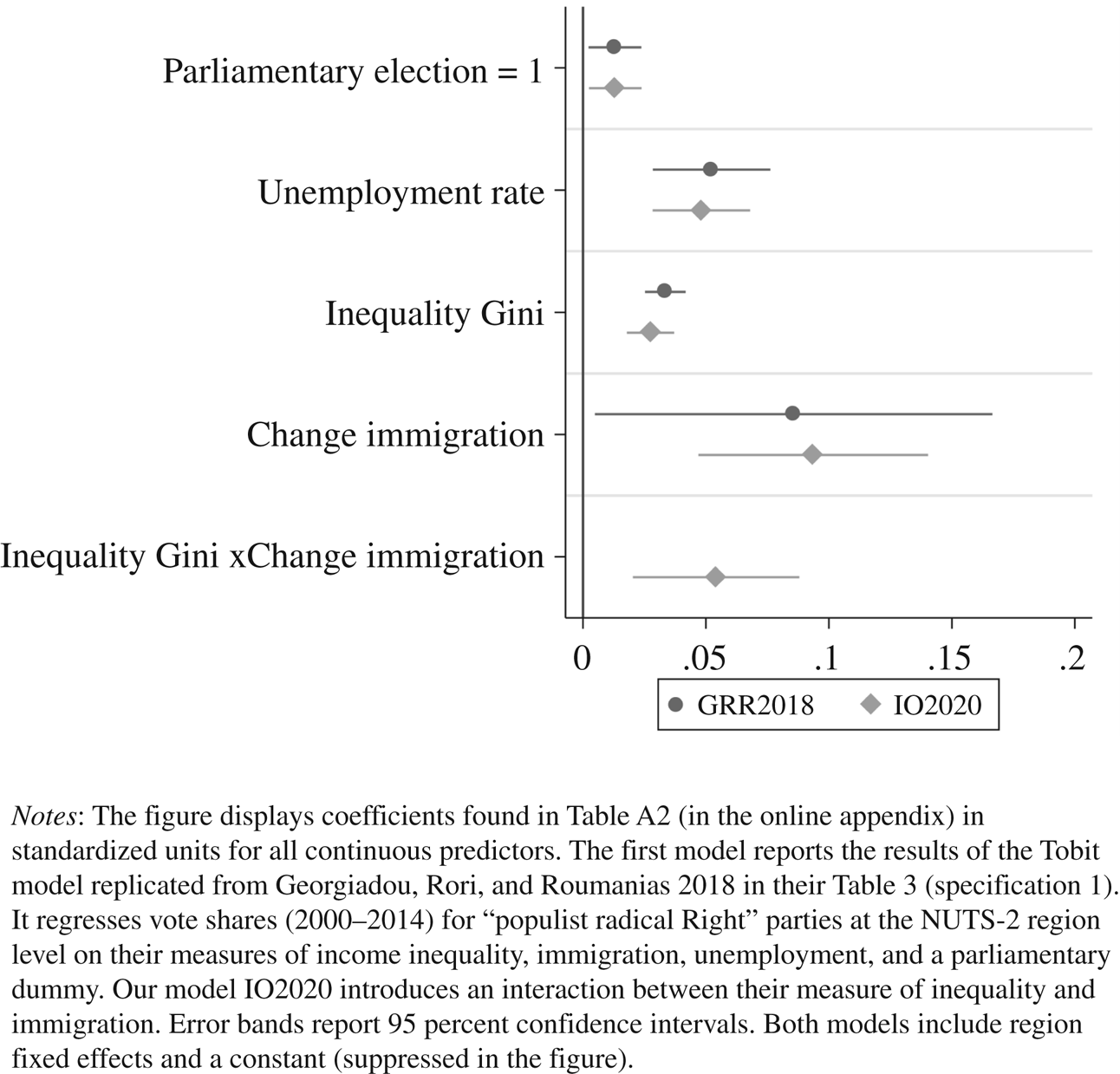
In their original analysis, GRR find a positive association between right-populist vote share and both inequality and immigration, controlling for unemployment, immigration, and economic growth.Footnote 55 Figure 2 replicates this result under the model labeled GRR2018.Footnote 56
Populist vote shares

IO2020 extends that model simply by interacting their measures of inequality and immigration. We report the coefficients in standardized units for visual comparability and ease of interpretation. These models are also posted in Table A2 in the online appendix. Two findings follow from our analysis. First, GRR's original finding remains intact: an increase of one standard deviation in national-level inequality, all else equal, is associated with a 2.8-percentage-point increase in populist vote shares (p < .01). Since this exercise holds immigration constant, it suggests that inequality independently undermines support for the LIO. This likely reflects, as we discuss later in the paper, inequality's well-known effects on economic growth, polarization, and external conflict.
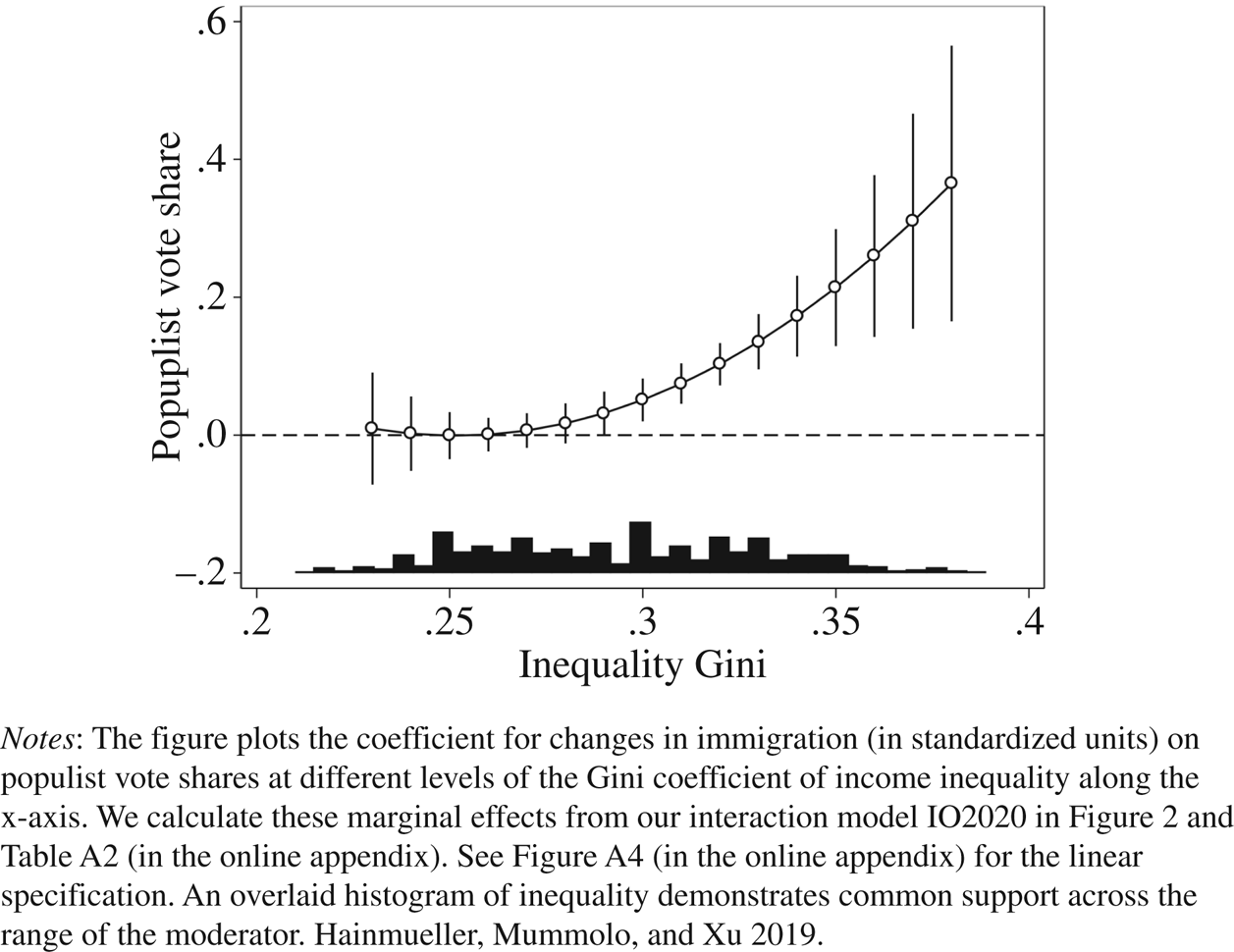
Second, our interaction model produces strong evidence for our key hypothesis, that surges in populist support from immigration shocks (which GRR found to have a modest and imprecisely estimated effect) are important but highly conditional on the level of inequality: magnifying backlash at extreme levels and nullifying backlash at lower levels. We visualize this result in a marginal effects plot in Figure 3. The differences in magnitudes are impressive. A one-standard-deviation (0.3 percentage point) increase in the share of migrants in the local population is associated with precisely zero change in vote shares for populist parties at even moderate levels of inequality (Gini < 0.29). At high levels of inequality (Gini > 0.34), the same one-standard-deviation increase in the share of migrants relates to a twenty-point increase in vote share for populist parties. These magnitudes are striking, given that the average NUTS-2 vote share for these parties is 6 percent, with a maximum of 54 percent. Rising immigration, it seems, poses a populist threat to the LIO only when paired with an income distribution that is, or has become, highly unequal.
Marginal effect of immigration on populist vote shares, by level of inequality

Imports and Inequality
That inequality mediates shocks from immigration raises the obvious parallel question: does it similarly mediate import-related shocks? To this end, we repeat the earlier analysis, this time employing the data set from Colantone and Stanig (hereafter CS), who examine “China trade shocks” in the European context: fifteen Western European countries over the years 1988 to 2007.Footnote 57 They report strong effects of Chinese imports on vote shares for radical Right partiesFootnote 58 at the level of the electoral district.Footnote 59 We replicate their principal results, including their two-stage least squares estimators,Footnote 60 in specifications 1 and 2 of Table A3 (in the online appendix).
The CS data set does not include a measure of income inequality. To test our interactive hypothesis, we employ inequality measures from the World Inequality Database.Footnote 61 We report top 1 percent shares of post-tax income at the country level.Footnote 62 We also apply logarithmic transformations to address issues of fit resulting from extreme outliers.Footnote 63 Finally, we adopt a multilevel estimator that serves our particular data needs.Footnote 64 The results rely on this preferred hierarchical estimator.Footnote 65 Table A3 (in the online appendix) documents how these modifications affect the original CS findings.Footnote 66
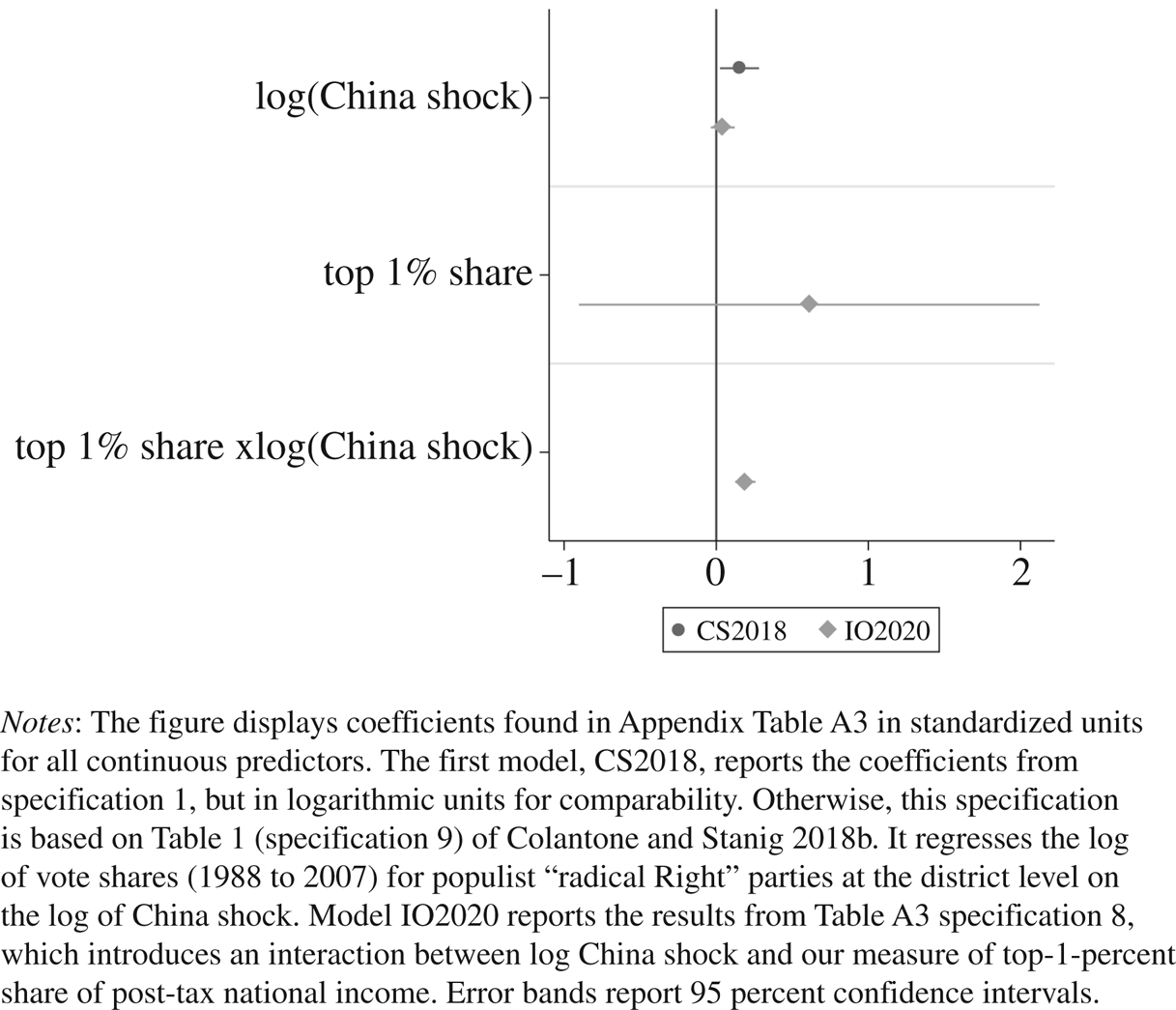
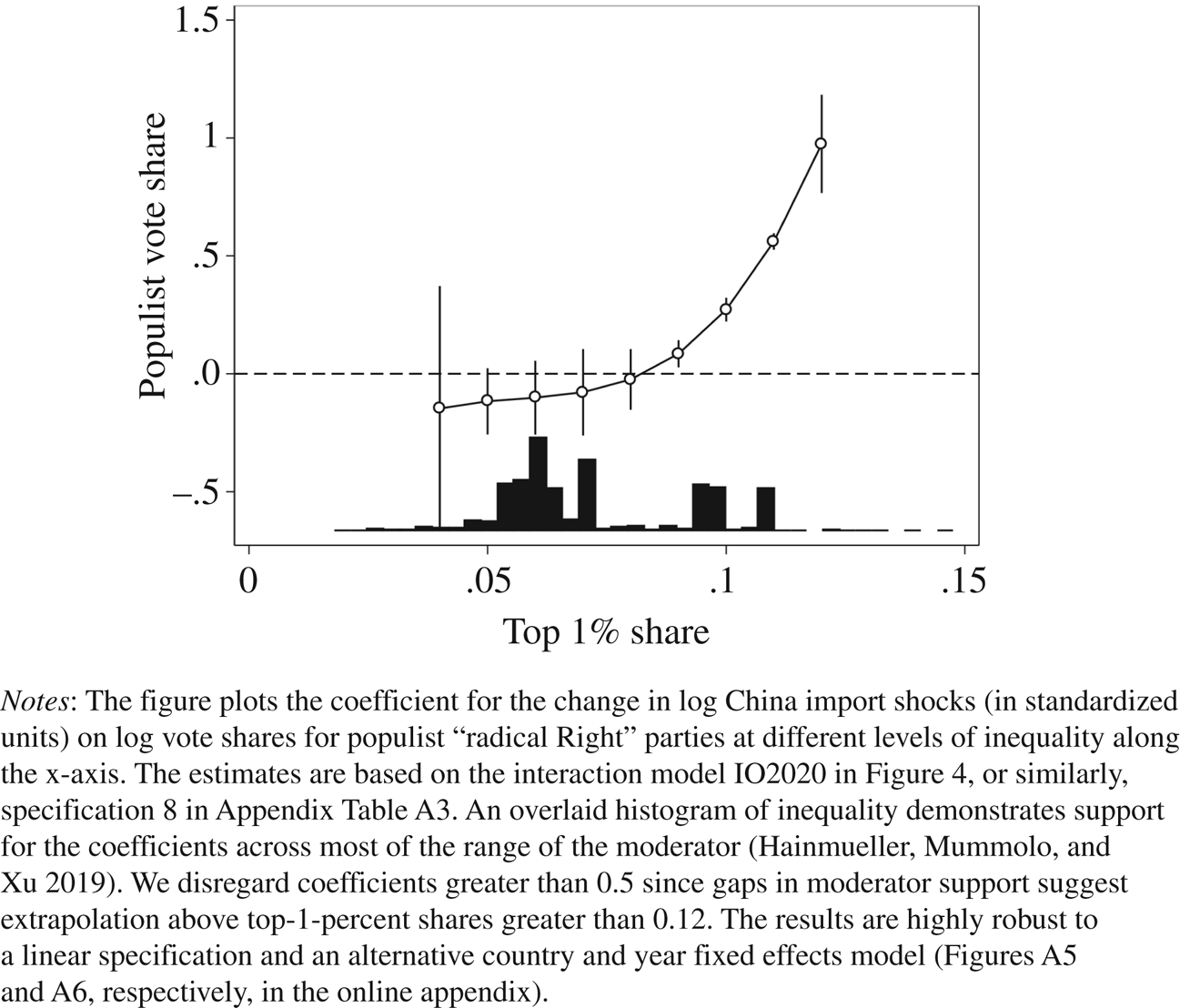
The results for import shocks closely mirror those for immigration. Figure 4 plots the coefficients of our preferred model (IO2020) alongside a baseline model in CS (CS2018). As expected, the positive association between Chinese imports and populist vote shares is highly conditioned by inequality. The coefficient on the China shock remains significant only when interacted with top-1-percent income shares. The marginal effects plot in Figure 5 translates this into real-world terms. At low to medium top-heavy inequality (top 1 percent shares < 0.09), a one-standard-deviation increase in imports (approximately 170 EUR per NUTS-2 worker) relates to no statistically significant change in district vote shares for populist parties—that is, no populist backlash from rising imports. However, in countries where the top 1 percent earns approximately 10 percent or more of national income, the same magnitude of imports is associated with a 25-to-50-percent increase in district vote shares, on average, for right-populist parties.
Populist vote shares

Marginal effect of trade on populist vote shares, by level of inequality

In combination with the results from immigration shocks, this analysis provides strong support for our hypothesis that the politics of LIO backlash are best understood from the perspective of the three recent advances in trade theory that predict top-heavy inequality. Trade in goods, or in factors of production, in the context of heterogeneous firms, workers, and regions, produces top-heavy inequality that, we argue, sets the stage for a particularly populist form of backlash. We provide suggestive evidence from European elections that is largely consistent with this; migration and imports drive support for populist parties only where we observe high inequality.
Possible Remedies and Sources of Resilience
An optimistic reading of this analysis is that national redistribution provides an effective remedy against right-populist backlashes. This finding is consistent with the “compensation hypothesis,” that government redistribution to globalization's losers increases public support for trade.Footnote 67 Our paper contributes to this literature by suggesting that redistribution targeted at top-heavy inequality (superstar earners, regions, and firms) to the benefit of otherwise skilled workers in smaller firms and cities would be especially effective.
However, democracies famously fail to address rising inequality with redistribution.Footnote 68 This leads us to a more pessimistic conclusion that, even though lower inequality increases support for globalization, there is little evidence that governments will redistribute in countries with already high top-heavy inequality. We therefore agree with Atkinson that more redistribution of the large gains from globalization would be both possible and effective; but mass support for it, paradoxically, is weak.Footnote 69 There is hope for other policy suggestions, as well. Investment in education, even if it could achieve the requisite political support, would fail to address the central problem: outsized gains from “superstar” talent, cities, and firms. Global forms of redistribution, such as the world “Tobin tax” on cross-border financial transactions, promise to tax capital without encouraging capital flight. However, such visions have been dismissed as “utopian.”Footnote 70 They would also raise the substantial issues of global governance that Rodrik's “globalization trilemma” has highlighted: who would enact such a tax, and to whom would the revenues flow?Footnote 71
Instead, governments are far more likely to enact protection—restrictions on imports and immigration that reduce welfare but undeniably also reduce inequality. Williamson shows that the choking-off of US immigration from the 1920s to the 1960s contributed significantly to the “great leveling” of American inequality, including the Great Migration of African Americans out of the US South, as Northern employers began to substitute Black for immigrant labor.Footnote 72 Restricting low-wage imports would of course have a similar effect. These options offer the losers from globalization only a larger slice of a (likely much) smaller pie.
If governments under pressure from top-heavy inequality continue to substitute protectionism for redistribution, can the LIO that stands for globalization nonetheless be sustained? We see two possible sources of resilience. First, powerful interests in the LIO can be expected to defend it.Footnote 73 Second, international institutions still matter. The retreat of the US, as a principal guarantor of the LIO, poses an undeniable threat to its institutions and to the peace and cooperation they foster. However, IR research cautions against premature reports of its demise. Despite declining US support, international institutions will continue to serve vital functions for their members—functions that make these institutions “sticky” in the face of shocks.Footnote 74 More recent scholarship in this vein suggests that the international institutions that were hardest to create, and whose rules are flexible, are the most likely to weather the shock of declining US support.Footnote 75 To the extent that other institutions were created with less effort and exhibit less flexibility, however, other powerful states will seek to install alternatives that better serve them.
Limitations and Future Research
Future research in this area will need to address at least three shortcomings of our analysis: imprecise measurement, identification, and external validity. First, our national-level measures of inequality cannot discriminate among the three possible trade theories, since all predict top-heavy inequality. One solution would require decomposition of earnings into worker, firm, and region heterogeneity.Footnote 76 Future measures should also be mindful of several indirect routes by which inequality undermines the LIO, independent of globalization shocks. It slows economic growth,Footnote 77 probably by restricting the formation of human capital.Footnote 78 It exacerbates domestic polarizationFootnote 79 and, seemingly, induces aggressiveness in foreign policy, especially among less well-off voters.Footnote 80 And, to the extent that it installs governments of the Right, it further increases inequality.
Second, the lack of a careful identification strategy leaves much for future research, which must isolate the variation in top-heavy inequality that is independent of technological change (as discussed earlier), institutions, and redistributive politics, among other sources of endogeneity. Instrumental variable approaches, such as those featured by Enamorado and colleagues, offer one promising direction.Footnote 81
Future research will also need to account for non-economic aspects of globalization and inequality. Our analysis assumes that inequality operates narrowly through economic mechanisms. We doubt that material interests alone explain the variance in attitudes to globalization.Footnote 82 Surely status anxiety and cultural threats matter too in ways not reflected in the theory here.Footnote 83 We know that some voters do not consider trade salient enough,Footnote 84 or find it too complicated,Footnote 85 for economics alone to determine vote preferences. Relatedly, attitudes on trade and migration partially reflect sociotropism and out-group anxieties.Footnote 86 Nonetheless, an at least equally large literature confirms that economic shocks accurately predict election outcomes,Footnote 87 and our own analysis shows that these economic shocks especially drive voting where inequality is high. Clearly, both economic and cultural factors matter, probably in mutually reinforcing ways. To know for sure, future research will need to test our three trade theories with individual-level data.Footnote 88 What we contribute to this important debate is a way to sharpen the way international political economy thinks about the economic side of globalization politics.
Third, future research will need to investigate whether these results extend, as recent research suggests,Footnote 89 to low- and middle-income countries.Footnote 90 We also expect, although we lack the data to prove it, that our analysis does not extend to support for left-populist parties.
Why does rising inequality move many voters toward right-wing populism rather than left-wing populism? Put simply, the Left's failure to enact adequate redistributionFootnote 91 has pushed many of its own voters to support right-wing parties whose protectionist policies offer a plausible alternative to redistribution.Footnote 92 In the US, the pattern of “Obama-to-Trump” voters, particularly among less educated workers, is well documented.Footnote 93 In Germany, the right-populist Alternative für Deutschland received about 15 percent of its support from traditional left-wing parties in 2017, and similar patterns seem to have driven support both for France's Le Pen and for the right-populist FPÖ (Freedom Party) in Austria.Footnote 94 In all three cases, manual workers demonstrably form the core of right-populist support.Footnote 95 These shifts from redistributive to protectionist parties, we suspect, are exacerbated by the Left's growing association with elitism, expertise, and globalization: all things that those farther down in the income distribution have come to distrust, or even to despise.
Conclusion
The openness to trade in goods, services, and factors of production the LIO has so effectively advanced over decades has concentrated real income growth in a very thin layer of workers. While this rise in top-heavy inequality doubtless has other causes, chief among them skill-biased technological innovation, trade openness has contributed mightily, particularly since the “China shock” of 2001;Footnote 96 and certainly the populist movements that reject the LIO cast openness to trade and migration as the chief villain.
The ways in which rising inequality has threatened the LIO expose lacunae in international political economy's intellectual apparatus—“blind spots” that require remediation. Most importantly, our basic economics are, if not wrong, at least outdated. The field's adherence to classical trade models blinds us to the distributional effects revealed by top-heavy inequality: far more people lost from globalization, and fewer gained, than traditional theories (factor proportions and specific factors) suggested. While economists rapidly updated their trade models to account for the emerging reality of extreme inequality, political science largely stayed the course—and ran the danger, now realized, of misapprehending the domestic politics of globalization.
The trade literature offers three explanations for top-heavy inequality. The “enriched” Heckscher-Ohlin model of Haskel and colleagues shows how only a thin layer of extraordinarily talented individuals within the larger set of high-skill workers unambiguously benefits from a rise in the relative price of a skill-intensive product; the wages of both the less talented high-skill and the low-skill workers stagnate or fall.Footnote 97 New new trade theory shows how a similarly narrow subset of very large and productive firms, and their employees, absorb the bulk of trade's gains at the expense of all other firms. Finally, economic geography suggests that trade concentrates economic growth in a few large metropolitan regions while inflicting stagnation and decline elsewhere. Each offers a pessimistic view of the politics of globalization in which variously defined superstars gain a far larger share than the society at large.
We validate these theories of top-heavy inequality with data on local election outcomes from as many as twenty-eight countries over twenty-six years. We find that public support for right-populist parties rises dramatically with exposure to imports and immigration, but only in those countries with high top-heavy inequality. The fact that the huge gains from trade and technology have flowed to such a small elite, while earnings in other categories have stagnated, may go far to explain why the antiglobalization movements blame not only crucial elements of the LIO, but increasingly a small and nefarious global elite, for what one politician luridly portrayed as the “carnage” among many regions and sectors of the advanced economies.
That these movements, with rare exceptions, seek relief in restrictions on trade and migration from populist movements of the Right, rather than in redistribution or training, probably owes much to the failure of the political Left to redistribute sufficiently.Footnote 98 That so much of these parties’ electoral support, both in Europe and in the US, comes from manual workers and former supporters of the political Left lends credence to this conjecture.
The ill effects of rising inequality, however, extend well beyond the rising tide of antiglobalization movements and politicians. They extend to slower economic growth (bound to exacerbate existing resentments), increased political polarization, and even a heightened risk of international conflict.
While eminent scholars have advanced quite plausible and growth-enhancing remedies for rising inequality, none elicits, or seems likely to elicit, sufficient political support. Tragically, inequality will likely be reduced, in any serious way, only by what Scheidel has accurately counted as one of history's “great levelers,” our current high-mortality pandemic.Footnote 99 While COVID-19 mercifully inflicts nothing approaching the death toll of history's worst plagues, in the long run its combined effects of labor shortage, capital abundance, and panicky deglobalization will likely result—despite short-term unemployment and recession—in greater equality (but also less prosperity) in the advanced economies, greater inequality in the less developed countries, and greater between-nation inequality. Those developments may partially reduce developed-country hostility to the LIO; but, to survive, the LIO will have to find stronger sources of resilience among business elites and political leaders.
We thus conclude by disagreeing with Lake's morning-after observation about the 2016 election. While it seemed that the populist backlash came as “no surprise” to the field of international political economy, some of its most important aspects, including the link to top-heavy inequality and the rejection of elites and expertise, were neither foreseen nor understood by our conventional theories. As Abraham Lincoln said during an earlier time of trial, “As our case is new, we must think anew and act anew.”Footnote 100
Replication Data
Replication data are available at <https://doi.org/10.7910/DVN/TYX3UE>.
Supplementary Material
Supplementary material for this article is available at <https://doi.org/10.1017/S0020818321000163>.
Acknowledgements
For helpful comments and criticisms, we are grateful to participants at authors’ conferences in Madison and Berlin, to participants in a panel at the 2019 Annual Meeting of the American Political Science Association, and to the editors and two anonymous referees at International Organization. For excellent (and unremunerated) research assistance, Rogowski expresses his gratitude to Alec Genie.
Funding
This material is based in part on work supported by the National Science Foundation Graduate Research Fellowship Program under Grant No. 2018241622. Any opinions, findings, and conclusions or recommendations expressed in this material are those of the author(s) and do not necessarily reflect the views of the National Science Foundation.