“What does it mean to reconstruct a dance?” wonders Martin Nachbar in his text “Training Remembering.” Following Henri Bergson, he proposes an explanation in terms of images that are actualized in ways that involve not only the visual sense, but also hearing, touch, and proprioception. Remembering something is actualizing it through the senses. Such sensory actualization is instrumental not only to literally remember moments from our own past, but also to our modes of engaging with the thoughts, ideas, experiences, and creations of others. In this process, Nachbar observes, our own body, with its movement knowledge and experiences, becomes the frame through which remembering takes shape, while at the same time this frame may be questioned and trained anew within the process.
The following is an elaboration of the idea that sharing thought takes place through such embodied thinking-through of the ideas of others, starting from the artistic practice of re-enactment. The term re-enactment is used to name a diversity of practices of redoing the past, both in the arts and outside of the arts—from the careful restaging of historical battles by thousands of often deeply involved amateurs, to living history projects, to historical reality television, to artistic works that redo performances from the past. What these practices share is that, in them, the past is actualized through the bodies of those involved in the redoing. What exactly is remembered in the process is a subject of discussion. To some, re-enactment promises an understanding of historical events that is more “in the flesh,” thus allowing for insight into what it meant to actually be within the historical situation. There is certainly a lot to be learned from trying to work with historical materials and techniques, and exploring the implications of the material conditions of the past. For example, reconstructing a sixteenth-century ship, and trying to sail it and live on it, may indeed confront researchers with aspects of the past that are absent from the material found in archives and history books. The same goes for performing music on historical instruments or performing Shakespeare in the reconstructed Globe theater rather than on a proscenium stage. However, there are, as many have pointed out, also reasons to be careful with re-enactment as a method of investigating the past. Re-enactment all too easily promotes a conflation of past and present, as well as a mixing up of positions within—and with regard to—past and present situations. Usually, visitors to historical villages and participants in re-enactments of historical battles are invited to experience the re-enactment not as the past experienced from the present, but as if being the past, thus suggesting that the re-enactment would provide direct access to past events and experiences. Re-enactment thus seems to promise an embodied understanding of the past, while in fact what is experienced is one's own embodied experiences in the here and now, and not those of a historical agent.
Reflecting on the pros and cons of re-enactment as a method of historical research, Alexander Cook observes that actually:
… projects of reenactment are not in any direct sense about the period or the events being reenacted. Rather they are about a modern set of activities that are inspired by an interest in the past. They are about placing modern individuals in dialogue with a historical imaginary. (Cook Reference Cook2004, 494)
The major novelty and potential of re-enactment as an investigative practice therefore, Cook argues, lies in the inevitable foregrounding of the present—that is, not in showing us a spectacle from the past but in showing the spectacle of people attempting to explore the past (Cook Reference Cook2004, 494). This, Cook argues, should be highlighted in the practice of re-enactment as well as the documentation of these practices.
Cook is writing about re-enactments of historical situations outside the arts. What he is arguing for is actually already a prominent feature of many re-enactments taking place within the arts. Many re-enactments of artistic work explicitly include traces of, and reflection on, the attempts to relate to the past. A well-known example is Martin Nachbar's re-enactment of Dore Hoyer's cycle of dance solos titled Affectos Humanos (Human Affects) in his Urheben Aufheben. In his remembering of Hoyer's work, as well as in the text “Training Remembering,” Nachbar reflects extensively on how actualizing Hoyer's work through his body made him very much aware of the historical distance between her and him. What he is tracing in redoing her work is not Hoyer's feelings or experiences, but how actualizing her work involves figuring out the physical logic through which the various elements of the choreography (and Hoyer's mode of moving) are connected. His own body, movement knowledge, and experience are a means to this end. Re-enacting here appears as a method to trace this logic through his own embodied perspective: from his own embodiment (including how his body is cultured by training and other practices), he reaches out to her work in his attempt to actualize it, and what he experiences in the attempt is not what she must have felt but, instead, his own bodily experiences resulting from trying to work out the artistic logic of her creation.
In Urheben Aufheben, Nachbar stages himself in dialogue with the historical imaginary, in this case the artistic imagination that is Hoyer's Affectos Humanos. More than a reconstruction of what this work may have looked like, Nachbar's performance is a mode of engaging with it and responding to it. Following a suggestion by a Dutch dance initiative named Cover, this text proposes the idea of “covering” as practiced in the context of music as a perspective on artistic practices of re-enactment like Nachbar's.Footnote 1 The term “cover” points to a field in which the object of the re-enactment is artistic creation rather than a historical event. And it also points to how re-enacting artistic creations results in new works: covers. Covers exist in a specific relationship to the original work, the cover being a remake of, or response to, the original work from the position of another artist at a later moment in time. The notion of cover also points to how this relationship is mediated by recordings and documentation. The term “cover version” originates from the 1960s when it was introduced to describe a rival version of a tune recorded to compete with an already released original version. That is, the notion of cover is closely connected to recordings and the recording business, not to music or songs as live performance.
The “idea” of the cover and of covering, I want to argue, highlights how re-enactment is an actualization of a work from the past, from a position in the present. The idea of the cover also points to how such a re-actualization might be conceived of as a rethinking of the original work. Many covers in popular music quite explicitly present the musical idea of the original in a new way. The cover, one might argue, is a different actualization of the artistic idea of which the original is expressive. This idea is sometimes transformed in the process. Parts of it may even be left out. Nevertheless, the cover evokes the idea of the original by reworking it.
“Idea” here does not refer to the composition as the expression of the individual ideas of the singer-songwriter as represented by the original version. Rather, the idea as that which the work is expressive of is closer to the Deleuzian and Guattarian notion of the concept as a heterogenesis, as an ordering of the work's components. The concept of, for example, a bird, is found “in the composition of its postures, colors and songs: something indiscernible that is not so much synesthetic as syneidetic” (Deleuze and Guattari Reference Deleuze and Guattari1994, 20). The concept is “an incorporeal, even though it is incarnated or effectuated in bodies” (Deleuze and Guattari Reference Deleuze and Guattari1994, 21). They also call the concept “an act of thought” (Deleuze and Guattari Reference Deleuze and Guattari1994, 21). Deleuze and Guattari introduce this notion of the concept in their What Is Philosophy?, a book in which they set out to answer the question “What is it that I have been doing all my life?” (1994, 1). They explain philosophy as a particular mode of thinking (as distinct from thinking as it takes place in science and in the arts). In art, science, and philosophy, acts of thought are performed in different ways. More than a book about philosophy, therefore, What Is Philosophy? is a book about thinking: about how thinking proceeds through concepts (in philosophy), sensations (in art), and knowledge (in science). These are the contractions through which thought happens as a result of the way concepts, sensations, and knowledge are incarnated or effectuated in our bodies. Our bodies—in their encounters with philosophical or scientific writing, or with works of art—re-enact, one might say, the acts of thought these writings and artworks are expressive of and in this way actualize them.
The idea that re-enactment might be a fundamental feature of thinking is central to Robin G. Collingwood's philosophy of history in his The Idea of History (1994, originally published in 1945). Historical understanding, Collingwood argues, is not a matter of describing events from the past but of explaining what happened as the result of actions and decisions of historical agents. When speaking about history, we speak about the history of how human beings found themselves in particular situations, and how they dealt with the situations they found themselves in. In The Idea of History—which, as Guiseppina D'Oro (Reference D'Oro2000, Reference D'Oro2004) rightly points out, in certain respects is not so much a philosophy of history as it is a theory of mind—Collingwood explains the possibility of such historical understanding from our capacity to re-enact the thoughts of others. Through re-enactment, we are able to share the thoughts of others, and through sharing these thoughts, we can begin to understand the logic of the actions that resulted in history as we know it.
Collingwood illustrates his point with the example of the Codex of Emperor Theodosius, ruler of the Eastern Empire in the fifth century. Theodosius’ Codex was an attempt to install a formalized form of law in the Empire. In order to understand what this codex was and meant within the historical situation, Collingwood argues, a historian must envision the situation with which the emperor was trying to deal, and “then he must see for himself just as if the emperor's situation were his own, how such a situation might be dealt with” (Collingwood Reference Collingwood1994, 283). He must imagine “the reasons for choosing one [course of action] rather than another and thus he must go through the process which the emperor went through in deciding on this particular course” (Collingwood Reference Collingwood1994, 283).
Collingwood's theory of re-enactment has been criticized for mixing up the ideas of the historian re-enacting the situation from the past with those of the historical agent involved in the historical situation—i.e., for reasons very similar to those also brought against the practice of re-enacting historical battles and other historical situations. This is problematic indeed. However, read as a theory of mind, and disconnected from the attempts to explain the decision-making behavior of historical agents, Collingwood's ideas about re-enactment still make sense and are surprisingly close to contemporary enactive approaches to perceptual cognition [for example Alva Noë's in Action in Perception (2004)] as well as to Deleuze and Guattari's (1994) elaborations of thinking referred to above. Mind is not a thing or substance, but a process—an activity. Mind exists in the activity of thinking, and in this activity thought is formed. And although thinking is an individual activity located in time and space, thought is not. Thought is the idea that can be abstracted from the context of its occurrence. This idea can be re-enacted and, in this way, shared by others.
For Collingwood, this possibility of abstraction and re-enactment is related to the rationality of thought. He makes a distinction between rational processes (associated with the mind) and psychological or neurological processes (associated with the body). This does not mean that he believes that mind and body exist in separation, nor that rational acts can exist independently of physiological processes, but rather that the same thing can be studied from different points of view (D'Oro Reference D'Oro2000, 90). The rational structure of an argument can be conceptually separated from the embodied context of its appearance. Here, Collingwood's example is Archimedes and his idea of special gravity, which, as history tells us, occurred to him while taking a bath. Although the historical, physical, and psychological circumstances of this moment in the bath were instrumental in Archimedes getting the idea, the idea of special gravity exists—and has its significance independent from these circumstances (Collingwood Reference Collingwood1994, 446). Precisely for this reason, Archimedes’ thought can be reenacted by others, and such a re-enactment does not require that we take a bath as well. We do not have to feel what Archimedes felt or to know about the connection between the idea of special gravity and the historical situation on which Archimedes got this insight, even though these may have been important to how Archimedes came to the idea.
A substantial difference can be noted between Collingwood's example of the emperor Theodosius and his example of Archimedes. The difference is that, in the case of the emperor, re-enactment is presented as a way to understand how the emperor came to his decisions, i.e., re-enactment is presented as a means to understand how the thought emerged as the result of acts of thinking by an individual at a specific time and place. In the case of Archimedes, re-enactment is presented as an explanation precisely—not of how we can know what Archimedes was thinking, but of how we can participate in Archimedes’ thought. This participation in his thought happens through re-enacting it; i.e., by placing ourselves in the position of the thinker of this thought, and, from there, grasping the logic of its coherence. We will never know whether we are thinking the same thing as Archimedes, but through re-enacting the logic of his thought, we are able to share this thought.
It is in this latter sense that Collingwood's theory is a philosophy of mind rather than a philosophy of history, and it is as philosophy of mind that his idea of re-enactment provides such an interesting perspective on re-enactment in the arts as a rethinking of artistic thought as embodied in a work of art. Understood as a theory of mind, Collingwood's ideas about re-enactment allow for an understanding of re-enactments in the arts in terms of a thinking-through of the artistic thought a work of art is expressive of, where thought does not refer to representational content but to the logical coherence that is proposed by the work. At the same time, the artistic practice of re-enactment may contribute to a fleshing out of Collingwood's idea of the re-enactment of thought in the direction of Nachbar's Bergsonian understanding of remembering—of thought that is incorporeal even though it is incarnated or effectuated in bodies.
Uncovering Human Affects
Urheben Aufheben begins with Nachbar entering an empty stage, pushing a blackboard on wheels on which is written “Urheben Aufheben—An Applied Research.”
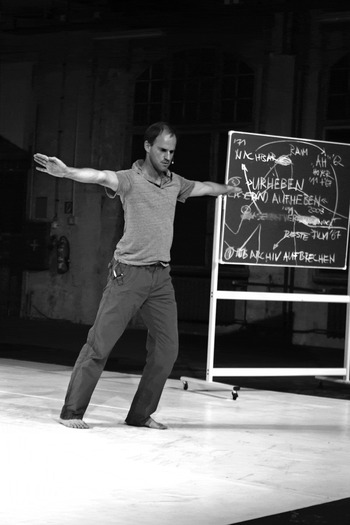
He reads this text, takes a piece of chalk, and adds “1. Entering the archive,” and then reads again: “Step one: Entering the archive.” He describes how he went to the archive to do research on Dore Hoyer and her Affectos Humanos, who Dore Hoyer was, how he got to know her work, why he decided to perform it, and what he had to do to be allowed to perform it. He discusses how he found out that the decision about who can, and cannot, perform Affectos Humanos is to be made by Waltraud Luley, a then [in 1999] eighty-four-year-old, retired dance pedagogue from Frankfurt/Main, Germany. She is the official custodian of Hoyer's work. Although she found Nachbar a bit too young for the Affectos Humanos, she said, “Well Mister Nachbar, I suggest you work on one or two of the dances and then you call me again, so that we make an appointment to work on the material.” So they did. In between these recollections of the process of learning the dances and reflections on what happened, Nachbar performs parts of them (see Photo 1). One part, the one called “Love,” he cannot show. He explains: “The thing with Love is that I am not done with it, at least not so far as to be able to show it here tonight. But what I can do is tell you what Dore Hoyer did in the part of the film called ‘Love.’”
Martin Nachbar in Urheben Aufheben. Photo: Renata Chueire.

Nachbar's performance thus quite literally shows what Cook describes as the spectacle of him attempting to explore the past, and being in dialogue with the historical imaginary. The performance also shows how this made him aware of the difference between Hoyer's past and his present. Being trained mostly in release techniques and contact improvisation, he found it difficult to embody and actualize Hoyer's expressive style of moving. The performance of Urheben Aufheben constantly stages and highlights the distance (and the difference) between Hoyer's original, and Nachbar's redoing of the work—exposing the work involved in trying to relate to the past.
With this strategy, Nachbar presents a radicalized version of the kind of distancing and highlighting of mediation that Mark Franko also observes in Susanne Linke's redoing of the same works by Hoyer in 1988 (Franko Reference Franko1989). He describes how Linke began her reconstruction of Affectos Humanos by walking to a costume rack placed on the stage and donning Hoyer's costume for the first solo in full view of the audience. Thus, at the outset, “she established a distance between herself as reconstructor, and the artist whose work was to be reconstructed” (Franko Reference Franko1989, 56). “This reconstruction,” Franko observes, “avoided simulation of the original as the reconstructor alternately embodied, stood apart from and commented upon it” (1989, 56).Footnote 2
Franko's observations on Linke's redoing of Dore Hoyer's work are the beginning of his article “Repeatability, Reconstruction and Beyond,” in which he argues for a distinction between reconstruction and reinvention as two ways of engaging with historical material in performance. Reconstruction aims at reproducing in the present a work from the past that no longer exists. He says, “Its master conceit is to evoke what no longer is with the means of what is present” (Franko Reference Franko1989, 58). Reinvention, on the other hand, “sacrifices the re-production of a work to the replication of its most powerful intended effects” (Franko Reference Franko1989, 58). Reinvention is a kind of deconstruction of a work from the past, worked out through an analysis of primary sources such as libretti, pictorial representation, and dance theory. This deconstruction does not aim at reproducing the work from the past in the present, but works toward the creation of a new work, and mediates in a reconsideration of historical sources through the practice of choreography. “The move from reconstruction to reinvention is also a move toward the creation of choreography that actively rethinks historical sources” (Franko Reference Franko1989, 60).
In his text, published in 1989 and therefore well before the current fascination with re-enactments, Franko argues for choreography as a practice of critical investigation that engages with the kind of artistic thinking embodied in a historical work. The works presented in the Cover project do something similar. They too engage with the work of choreographers of previous generations. They too may be understood as a kind of investigation and a rethinking of the meaning of history from the present. However, there are also important differences. Covers differ from reinventions in the sense that the new work is not a reinvention of the older one from a rethinking of its source material, but a response to the work as it has come to us through repertoire and recording.
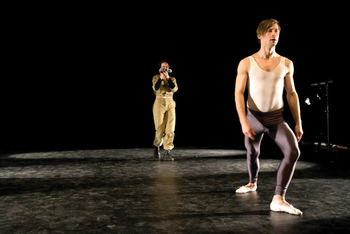
A cover is not an imitation or redoing of a live performance of a song, but a redoing of a song as it is known through recording. The notion of cover thus, much more than reenactment, points to the ways in which recordings and documentation mediate in our understanding of past performances, and the artistic ideas expressed in them. Many artistic re-enactments explicitly acknowledge this situation and reflect on it. Martin Nachbar describes in his performance Urheben Aufheben how he encountered Dore Hoyer's work through a film he found by chance in a library in Brussels, which had acquired the tape from the German Dance Archive in Cologne. Another interesting example is the performance I Live (2008), which is a cover by Daniel Almgren-Recen of the work Live (1979) by Dutch choreographer Hans van Manen (see Photo 2). Live is an early example of a choreography about the interaction between live and mediated dance.
Daniel Almgren-Recen and Bojana Mladenovic in I Live. Photo: Nellie de Boer.

Live consists to a large extent of a duet between a female dancer and a cameraman. The performance explored the (then) radically new technological possibility of live video. The images shot by the cameraman were projected live on the back wall of the stage. The performance stages the transformation from live performance to media image, as well as the interaction between live performance and media. Live did so at a moment when many aspects of mediatization that today have become incorporated in our modes of living, thinking, and imagining were still at an early stage. Almgrem-Recen was born in the year that Live was created. His remake includes his attempts to reconstruct the work from the images shot by the cameraman during the performance, as well as a new series of images of him dancing, and shot by a female camera person. Almgrem-Recen is from a generation of dance-makers who grew up with video, DVD, digital cameras, and more recently, YouTube and Vimeo. Creating images is part of his way of relating to what he encounters, and recorded images are prominently part of how he relates to present and past events. For his generation, relating to recorded material is part of their mode of thinking, including their mode of thinking dance. The creation of covers, one might argue, is an integral part of such modes of thinking.Footnote 3
Used as an alternative for re-enactments in the arts, the term “cover” highlights that what is re-enacted here is works—artistic creations by other artists, as distinct from re-enactments of historical events or situations such as famous battles, or life in a historical village. A cover is a remake of or response to an earlier artistic creation from the position of another artist at a later moment in time. This response is not about a reinvention of the originally intended aims and effects, but rather a rethinking or, as Nicole Beutler puts it, a rearticulation of artistic thought as it unfolds in the original work. Nicole Beutler made this observation in the context of an interview about her re-doing of Lucinda Childs’ choreography for Radial Courses (1976) and Interior Drama (1977), presented together under the title Dialogue with Lucinda at the 2010 Cover Festival.Footnote 4
Beutler had seen Child's works when she was much younger, and then had found it difficult to relate to them. Creating her redoing of these works was a way of working through these dances and what they are about. First she had her dancers learn the original choreography, and then she deconstructed and rearticulated Child's danced statements. She isolated parts of the original, took some things out, changed speed and tempo at other places, and added new elements. She used a similar strategy in her version of Michel Fokine's famous Les Sylphides for three female dancers.
Working through the themes and variations, the compositions, and the stylistic specificities of creations of successful predecessors is an old and much respected practice in the history of Western music. Reworking successful compositions of others—and rearticulating them—is a proven method of developing one's own understanding of the medium and its possibilities, and has been practiced by generations of artists as a means for developing their own artistic thinking. This happens not only in music, but also in the visual arts. A famous example of this practice is Manet's Le déjeuner sur l'herbe (1862–1863), a painting that has been reworked by many artists (including Picasso, who painted no less than twenty-seven versions of it). Less known is that Le déjeuner sur l'herbe was itself a reworking of the engraving The Judgment of Paris (ca. 1515) by Raimondi who, in his turn, based his composition on a work by Raphael. Such reworking of artistic thought is not a matter of reinterpreting the content of the painting as representation. Rather, such reworking is an exploration and re-articulation of the thought expressed in its compositional logic.
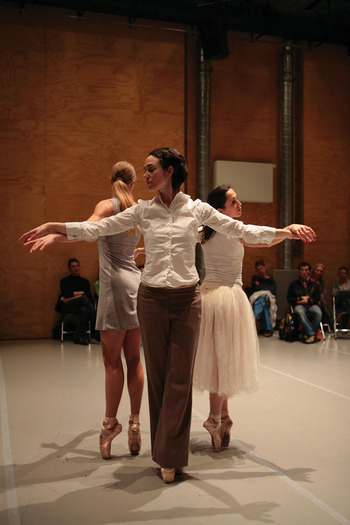
With her re-articulation of Les Sylphides, Beutler highlights aspects of this logic that otherwise are easily overlooked. By reducing the number of dancers to three and isolating movement phrases, she draws attention to how much of this ballet consists not of movement but of fixed poses: how this dance involves quite a bit of standing still for many of the dancers—for quite some of the time. By resituating the original setting behind the proscenium arch to an open space in which the audience sits around the dancers, Beutler's cover version literally redirects the attention of the audience, and explicitly includes the spectator in the picture (see Photo 3).
Marta Reig Torres, Bojana Mladenovic, and Charlotte van den Reek in Nicole Beutler's Les Syphides. Photo: Anja Beutler.

One can simply not see the dance without also seeing at least part of the audience to whom the performance is addressed. The proximity of the dancers (often only at arms length)—the sound of their pointe shoes scraping the floor, the sound of their breathing, and the clear visibility of the effort involved in their movements—all this confronts us with aspects of their physicality that remain easily obscured in the dreamlike spectacle of the original, seen at a distance. Instead of a unified and abstracted romantic femininity, Beutler's version shows us three different types of femininity: one dancer is wearing a rehearsal tutu that reminds us of the costumes worn in the original ballet, one is wearing a contemporary dress, and one is clad in trousers. Experienced ballet audiences might also notice how the specificities of the trained body are highlighted by the combination of three bodies, each with a different relationship to academic ballet practice.
Beutler's recreation of Les Sylphides thus presents a beautiful example of re-enactment in the terms suggested by Cook. The prominently visible presence of the audience surrounding the dancers highlights how this re-articulation of the ideas embodied in the original happens from the here and now, and in relation to our twenty-first-century modes of looking. Her re-articulation of Les Sylphides also demonstrates that re-enacting the thought that is embodied in and by the work is not a matter of working out what the historical agent, Fokine, who created the original, was thinking. To speak to Collingwood's distinction, Beutler was not tracing and re-articulating the specificities of what Fokine was thinking, but the logic of the artistic thought that he produced.
Enacting Thought
For Collingwood, this distinction between thinking and thought is important to explain how people can have the same thought, and also how thought can be shared. Guiseppina D'Oro (Reference D'Oro2000), in her elaboration of the notion of thought in Collingwood, gives the example of ten people trying to decide the course of action to take in response to Iraq's invasion of Kuwait. If all ten individually came up with the view that economic sanctions ought to be applied, the group would be putting forward not ten solutions but one. All ten will have individually performed different acts of thinking to come up with the same thought. Our ability to share this thought does not depend on this thought being true or even verifiable, but on our ability to grasp and mentally re-enact its internal consistency (D'Oro Reference D'Oro2000, 98).
Collingwood (Reference Collingwood1994) describes such mentally re-enacting a thought as the placing of oneself in the position of the thinker of this thought. Taking up this position follows from grasping the internal consistency of the thought, and thus placing oneself in the position from where it all makes sense. As Collingwood's example of Archimedes demonstrates, the position of the thinker is not that of the historical person Archimedes with his individual psychology, but rather it refers to a position implied within the logic of the thought. To take up this position is to grasp the thought's logical consistency, and thus to re-enact the act of thought. What is re-enacted is not some kind of representational content, but the act of the rational structure of the argument. Collingwood's reflections can serve as a further example:
In its immediacy, as an actual experience of his own, Plato's argument must undoubtedly have grown out of a discussion of some sort, though I do not know what it was, and been closely connected to such a discussion. Yet, if I not only read his argument but understand it, follow it in my own mind re-enacting it with and for myself, the process of argument which I go through is not a process resembling Plato's, it is actually Plato's so far as I understand him correctly. The argument simply as itself, starting from these premises and leading through this process to this conclusion, the argument as it can be developed either in Plato's mind or mine or anyone else's is what I call thought in its mediation. (Collingwood Reference Collingwood1994, 301)
For Collingwood re-enactment is an activity of the mind reproducing the logical structure of an argument. This rational structure—the thought—is reproduced in the mind, while at the same time it exists somehow independently of this mind (namely as Plato's or Aristotle's), or someone else's thought. Collingwood's theory of re-enactment thus points in the direction of an understanding of thinking that happens in interaction with the outside and through the outside—thinking that, to speak with Deleuze and Guattari, happens “in between” and as an act both in response to, and directed towards, the outside. In this thinking, thoughts are structures of relationships that somehow travel and are actualized in our response towards, for example, Plato's texts. Collingwood's model of thought is rational argumentation, and the medium through which thoughts travel in his account is language. His ideas however seem to allow for further elaboration to include the possibility of thought as something that could be embodied in media other than language as well, and structured according to different types of logic. Here, interesting points of connection emerge between Collingwood's notion of re-enactment and Hubert Damisch's account of painting as a mode of thinking-through space, position, and positionality in his The Origin of Perspective (Reference Damisch1995).
Perspective, Damisch argues, is not merely a pictorial technique that can be used to construct the illusion of a three-dimensional space on a two-dimensional canvas or paper. Much more than that, perspective is a paradigm, or ground structure, underlying modes of thinking that are much more widespread than perspectival painting. These are modes of thinking that are constitutive of how we imagine space and time, as well as our position in space and time, and in relation to what we see. Perspective in painting, Damish argues, is an expression of a culturally and historically specific mode of thinking of which these paintings present an exploration. They are thought experiments executed in the medium of painting. These paintings explore new modes of thinking space, time, and our position within it—new modes of thinking that emerged in the early Renaissance, and only after that would become engrained in our understanding of space, time, and self—up to a point that we are no longer aware anymore of their specificities.
Damisch thus presents an understanding of perspectival paintings as instances of artistic thinking that explore conceptions of space and propose these to a viewer. Such understanding, Damisch's analysis demonstrates, involves more than rational thinking. It involves handing oneself over—as viewer—to the address presented by the logic of the work, and trying to position oneself in relation to it in such a way that various elements of this logic come together, thus showing that such thought is not a matter of representation, but of action. To speak with Collingwood, grasping the logical coherence of what the paintings propose means re-enacting their logic, just as understanding Archimedes’ proposition about special gravity meant to imaginarily re-enact the logic of this thought.
Such a taking up of a position from where it all comes together, one might argue, is actually also what Nachbar does in his attempts to re-enact Hoyer's work. Nachbar describes his attempts to re-enact Hoyer's work precisely in terms of grasping its internal consistency through his body. In this process, what he feels and experiences, like the individual spatio-temporal practices of thinking described by Collingwood, is instrumental in figuring out this internal consistency, while at the same time the internal consistency that is the thought he tries to re-enact exists independently of his feelings and experiences. Here, it seems, Nachbar's account of his experiences suggests the possibility of expanding Collingwood's ideas to include bodily practices of grasping internal consistency as well, thus allowing for an understanding of abstraction and rationality not as a matter of the mind to be distinguished from the body, but as a matter of a thinking body.
Nachbar's account of his experiences suggests that the position of the thinker of the thought embedded in the work is not a matter of taking up a pre-given in an already given logic, but rather that such a position emerges from his actualization of the work through his body. This position of the “I” of the thought emerges, to speak with Deleuze and Guattari, as an “eject” from the unfolding of Nachbar's actualization of Hoyer's work. This “I” has no independent existence, but must be reconstituted by the thinker in her actualization of the thought. In this respect, Deleuze and Guattari argue, art is just as much a practice of thinking as philosophy and science are, with the difference between them being the kind of contractions through which thinking proceeds. “Contractions” here refers to modes of relating, bringing together, of making distinctions. Deleuze and Guattari speak of contemplations, or internal creative sensations. Such contemplations are not only a matter of ideas and concepts, but also of sensations through which we contemplate the elements of matter.
Nachbar's reflections on his experiences in redoing Hoyer's work point to how the internal creative sensations that are constitutive of his reconstitution of her work involve his body, not as passive receptor but as active force exploring the internal coherence of Hoyer's creation. His account of remembering Hoyer's artistic thought confirms Alva Noë's observations on the intimate intertwining of perception, cognition, and bodily skills. “To be a perceiver is to understand, implicitly, the effects of movement on sensory stimulation,” explains Alva Noë in his Action in Perception (Noë Reference Noë2004, 1). Perception requires sensory stimulation, and thus depends upon our bodily capacities to receive such stimulation. However, sensory stimulation alone is not enough for perceptual experience. It depends on skills, and these skills are sensorimotor skills. “Perceptual experience acquires content thanks to our possession of bodily skills. What we perceive is determined by what we do (or what we know how to do); it is determined by what we are ready to do” (Noë Reference Noë2004, 1). Furthermore, perception is a way of thinking about the world. It is not only a skillful activity. It is also a thoughtful activity. “The root of our ability to think about the world is our ability to experience it; but experience is a mode of skillful encounter” (Noë Reference Noë2004, 208). As a result, “our relation to the world through thought and our relation to it through experience, differ not in kind but in degree.” (Noë Reference Noë2004, 207)
Nachbar observes that during the second half of the twentieth century, a development in dance set in thanks to which “technique was understood no longer as the repetition of situations in order to form bodies within a certain movement repertory (in other words establishing certain movement habits), but as the production of corporeal sensations and perceptions” (see “Training Remembering” in this issue, page XX). This development turned the dancing body from “a style-fulfilling machine to be trained” into “an instrument of sensations to be tuned.” In this situation, and for a specific group of dance makers, dance became a mode of investigating dance, as well as other things. Within this context, Nachbar proposes to understand his own engagement with Dore Hoyer's work as a practice of embodied research in which his body, with its movement knowledge and experiences, becomes the frame through which he remembers Hoyer's creation. Through his body, he engages with the logic that structures her creation and actualizes this structure—rethinks it—just as the thought of Archimedes can be rethought by another body trying to make sense of what he once wrote down. We will never know whether we are thinking the same thing as Archimedes or Hoyer. What we can know is whether and how these thoughts proposed by them make sense to us.