I. INTRODUCTION
A. Production of AlN crystals
Aluminum nitride (AlN) has a wide band gap (6.3 eV), allowing it to emit radiation with a wave length of 210 nm, which corresponds to the deep ultraviolet region. This light emitting property has many potential technological applications, such as for the replacement of fluorescent light, the decomposition of hazardous materials, microfabrication, and even high-density optical recording once high performance has been achieved. Reference Taniyasu, Kasu and Makimoto1 However, threading dislocations (line defects) are frequent in AlN crystals owing to the mismatch between its lattice constant and that of the substrate, as well as between their thermal expansion coefficients, as heterogeneous substrates such as silicon carbide and sapphire are usually used for the fabrication of AlN-based devices. The development of a cost-effective process for producing self-standing AlN substrates is expected to solve these problems.
A number of processes for the production of single-crystal AlN are currently being investigated. A representative approach is the sublimation method, Reference Makarov, Avdeev, Barash, Bazarevskiy, Chemekova, Mokhov, Nagalyuk, Roenkov, Segal, Vodakov, Ramm, Davis, Huminic and Helava2–Reference Sumathi, Barz, Gille and Straubinger4 in which AlN raw materials are sublimed at temperatures greater than 2273 K, and single-crystal AlN precipitates on substrates such as SiC or AlN. For instance, Makarov et al. Reference Makarov, Avdeev, Barash, Bazarevskiy, Chemekova, Mokhov, Nagalyuk, Roenkov, Segal, Vodakov, Ramm, Davis, Huminic and Helava2 reported the crystallization of AlN at 2323–2523 K at a growth rate of 50–150 μm/h by sublimation. A chemical vapor deposition method for producing AlN has also been developed. Reference Eriguchi, Hiratsuka, Murakami, Kumagai and Koukitu5–Reference Wakigawa, Nagano, Kangawa and Kakimoto7 Nagashima et al. investigated a crystallization process that involved AlCl3 (the Al source) and NH3 (the nitridation agent). They termed this process as hydride vapor phase epitaxy and reported that crystallization occurred at 1653 K at a growth rate of 85 μm/h. Reference Nagashima, Harada, Yanagi, Kumagai, Koukitsu and Takeda6 Fukuyama et al. investigated a process that involved the reduction and nitridation of sapphire at 1873–1948 K using mixed N2–CO gas coexisting with graphite; AlN thin films with excellent crystal qualities were obtained. Reference Fukuyama, Kusunoki, Hakomori and Hiraga8,Reference Fukuyama, Nakamura, Aikawa, Kobatake, Hakomori, Takada and Hiraga9 In addition to gas-phase reactions, solution growth methods have also been investigated. Reference Kangawa, Toki, Yayama, Epelbaum and Kakimoto10,Reference Adachi, Tsuda, Sugiyama, Iida, Tanaka and Fukuyama11 However, none of the currently available processes satisfy all the requirements in terms of the growth rate, crystal quality, and crystal size.
B. Production of AlN from Al metal
AlN(s) decomposes into Al(g) and N2(g) at 3073 K, Reference Predel and Madelung12 which means that AlN does not exist as a thermodynamically stable liquid even at high temperatures. Therefore, AlN crystals cannot be grown from its melt using techniques such as the Czochralski method. Thus, the production and crystal growth of AlN should be carried out simultaneously. Al metal is a good candidate as an Al source for AlN production. It has been reported that the nitridation of metallic Al with N2 occurs at temperatures greater than 1423 K, although milder conditions are desirable for crystal growth. Reference Kameshima, Irie, Yasumori and Okada13 In a few studies, AlN was successfully formed at 1273 K by adding an alloying element such as Li, Mg, or Si to Al. Reference Scholz and Greil14–Reference Haibo, Chen, Heping, Agathopoulos, Fabrichnaya and Ferreira16 Using Li, the nitridation of Al alloys can be induced at 1073 K under certain conditions. Reference Komeya, Matsukaze and Meguro17 However, this route is not suitable for the production of high-purity AlN because the removal of the nitride of alloying elements from AlN is difficult.
It is noteworthy that the nitridation, albeit partial, of an atomized Al powder for the preparation of Al/AlN composites has been reported at the low temperature of 823 K, by adding Mg as an alloying element. Reference Kimura, Kondoh and Watanabe18,Reference Kondoh, Kimura and Watanabe19 The nitridation of Al plates at 813 K by supplying Mg as vapor has also been reported, Reference Hall, Schaffer, Ning, Mcphee and Miller20–Reference Kent, Drennan and Schaffer22 and thick AlN layers (>400 μm) have been obtained. Reference Kent, Schaffer, Sercombe and Drennan21 The nitridation of atomized Al powder at 873 K by mixing yttria powder under pressurized nitrogen atmosphere (0.5 MPa) has also been reported. Reference Okada, Toriyama and Kanzaki23 The aim of these studies was to produce sintered body substrates, but they provide important information on the reaction mechanisms involved in low temperature nitridation.
In this study, the authors investigated the production of AlN from high-purity Al at low temperatures. The method used is advantageous because (i) the operational temperature is lower than for conventional methods, (ii) the degree of oxygen contamination of the resulting AlN is low, and (iii) the synthesis and crystal growth of AlN occur simultaneously.
II. PRINCIPLE
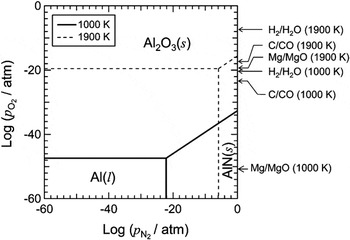
The chemical potential diagrams for the Al–O–N system at 1000 and 1900 K are shown in Fig. 1 as calculated from the thermodynamic data. Reference Barin24 The corresponding oxygen partial pressures, determined by the H2/H2O, C/CO, and Mg/MgO equations in nitrogen atmosphere, are also shown in the figure. The activities of Al, Al2O3, and AlN are assumed to be unity. The partial pressures of CO, H2, and H2O in nitrogen atmosphere are assumed to be 0.1 atm. Al2O3 is thermodynamically stable in a N2 atmosphere (p N2 ≈ 1) down to an oxygen partial pressure of 2.2 × 10⁻³³ atm at 1000 K and 2.3 × 10⁻¹⁶ atm at 1900 K. The nitridation of Al2O3 occurs at 1900 K owing to carbon reduction, as demonstrated by Fukuyama et al. Reference Fukuyama, Kusunoki, Hakomori and Hiraga8,Reference Fukuyama, Nakamura, Aikawa, Kobatake, Hakomori, Takada and Hiraga9 However, the Al2O3 thin film that is formed at once is chemically stable and very resistant at low temperatures, and prevents further oxidation because of its very low oxygen diffusion coefficient. The diffusion of nitrogen is similarly hindered by the Al2O3 film, and the growth of AlN crystals is extremely slow, even if the area of stable AlN is relatively large, as shown in Fig. 1.
Potential diagrams for the Al–O–N system at 1000 and 1900 K. Reference Barin24 The activities of Al, Al2O3, and AlN are unity. The partial pressures of CO, H2, and H2O in nitrogen atmosphere are assumed to be 0.1 atm.

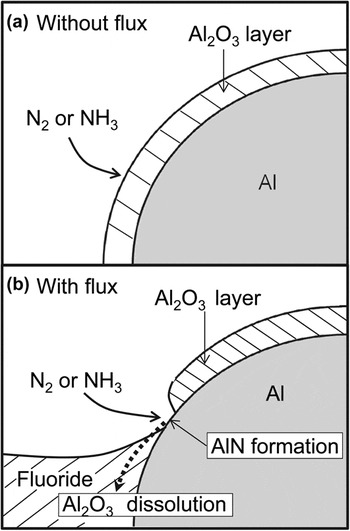
The following methods have been considered to ensure the nitridation of Al metal following the removal of the Al2O3 film: (i) reducing Al2O3 by decreasing the oxygen partial pressure and (ii) dissolving Al2O3 using a solvent such as an erosive molten salt. Al2O3 is not reduced by H2 and CO gases, and a stronger reductant is required. However, reductants such as Mg act as contaminants because they form impurities such as Mg3N2 in the AlN crystals. Therefore, the authors used different molten fluorides to dissolve Al2O3 and remove the Al2O3 film. Reference Robert, Olsen, Danek, Tixhon, Ostvold and Gilbert25 A schematic illustration of the nitridation process is shown in Fig. 2. The Al2O3 film on the surface of the Al sample is dissolved by wetting the surface with a molten fluoride mixture. The nitridation process occurs quickly because a fresh Al surface appears and is in direct contact with the nitridation agent.
Schematic illustration of the reaction interface as estimated (a) without a flux and (b) with a flux (molten fluoride).

III. EXPERIMENTAL
A. Sample preparation
The following Al sources were used in this study: (i) an Al rod (99.99%, 5.6 mm in diameter, 10 mm in length), (ii) Al powder (99.99%, particle diameter of 100–200 μm), and (iii) Al thin plates [surface area of approximately 8 × 8 mm, thicknesses of 0.075 mm (99%), 0.10, 0.50, and 1.0 mm (99.999%)].
AlF3 and KF dried in an Ar atmosphere were mixed to a eutectic composition (KF–45 mol% AlF3, eutectic point: 833 K) Reference Phillips, Warshaw and Mockrin26 and the mixture was heated to 1173 K and held at this temperature for 1 h. Once the melt had been prepared and allowed to cool, the solidified salt was crushed and used in the experiments. LiCl–41 mol% KCl was also used for the sake of comparison. This salt was prepared by mixing LiCl and KCl and then purifying the mixture using HCl. Reference Sato27 KF and LiF–50 mol% KF (eutectic point: 765 K) Reference Sangster and Pelton28 were also used in a few of the experiments. These salts were preprocessed in the same manner as KF–45 mol% AlF3.
B. Experimental apparatus and procedure
1. Nitridation of Al rod
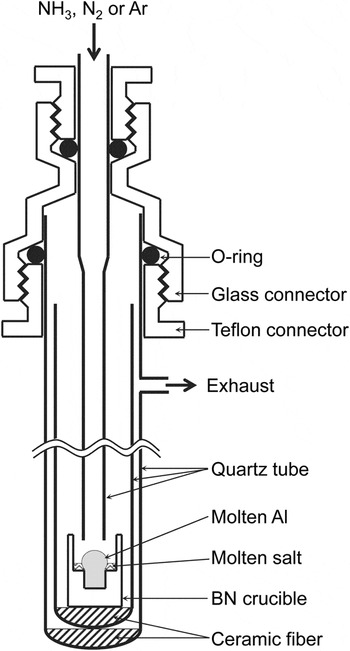
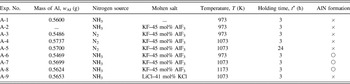
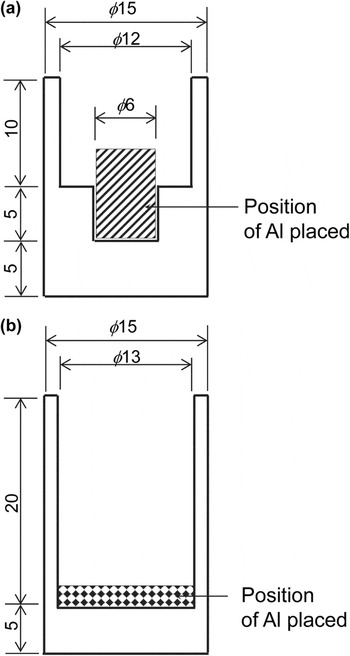
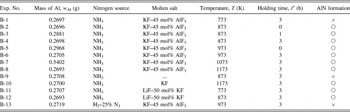
The experimental apparatus used and the corresponding experimental conditions are shown in Fig. 3 and Table I, respectively. The experimental apparatus was set up in a glove box (less than 1 ppm moisture). A crucible made of hot-pressed BN was placed on the bottom of a quartz inner tube installed in a quartz outer tube. The shape and dimensions of the BN crucible are shown in Fig. 4(a). The Al rod was placed in a hollow made in the center of the BN crucible. The salts were fed onto the Al rod. A gas-blowing tube made of quartz was positioned just above the BN crucible. The experimental apparatus was placed in a vertical electric furnace, and gas tubes were connected to the apparatus.
Experimental apparatus used for producing AlN from Al metal and NH3, N2, or H2–25% N2.

Experimental conditions and results for the production of AlN using an Al rod.

BN crucibles used for producing AlN from (a) an Al rod (bulky Al), (b) Al powder or thin Al plates. Unit of dimensions: mm.

Once the apparatus had been filled with dried Ar (99.9999% purity), it was heated to specific temperatures (973–1173 K) at a rate of 10 K/min under Ar flow. N2 (99.9999% purity) or NH3 (99.999% purity) was introduced and blown onto the sample at a rate of 80 mL/min; the flow rate was regulated with a mass flow controller. On completion of the nitridation processing, the nitridation gas was replaced with dried Ar, and the sample was cooled at a rate of 2 K/min. The sample recovered in the glove box was observed and weighed. The products formed were pulverized with a mortar, placed on a glass holder, and covered with a polyimide film to prevent them from reacting with air. The phases of the products were determined by x-ray diffraction (XRD) analysis.
2. Nitridation of Al powder
The experimental conditions used are listed in Table II, while the shape and dimensions of the BN crucible are shown in Fig. 4(b). The Al powder was placed on the flat bottom of the BN crucible, and the salts were mixed with the Al powder.
Experimental conditions and results for the production of AlN using an Al powder.

The apparatus was heated to specific temperatures (773–1173 K) at a rate of 10 K/min under Ar flow. In the middle of the heating process, NH3 (99.999%) or H2–25% N2 was introduced at 673 K to prevent the agglomeration of Al drops after melting. Nitridation was conducted for 0–3 h (0 h means that the sample was cooled immediately after its temperature had reached a given value), after which the nitridation gas was replaced by dry Ar. The sample was then cooled at a rate of 2 K/min. The sample recovered in the glove box was placed in a nickel crucible, which was sealed inside a stainless steel container. The container was evacuated to 10 Pa to remove the fluorides, heated to 1273 K with an electric furnace, and held at this temperature for 2 h. It was possible to separate the product by vacuum distillation since the vapor pressures of KF, AlF3, and AlN are 500, 830, and 1.2 × 10⁻¹⁰ Pa, respectively at 1273 K. The sample was recovered in the glove box after vacuum distillation and weighed. The phases of the products were determined by XRD analysis. The morphologies and compositions of the products were analyzed using a scanning electron microscopy-energy-dispersive x-ray spectroscopy (SEM-EDX) system.
3. Nitridation of Al thin plates
The experimental apparatus and the shape of the BN crucible used were the same as those used in the case of the Al powder. The Al plate was placed on the bottom of the BN crucible. KF–45 mol% AlF3 was fed onto the Al plate. Next, the sample was heated at the rate of 10 K/min, and NH3 was blown onto the sample initially at 673 K. Nitridation was carried out at 873 K for 3 h. The analytical method used to determine the phases of the products was the same as for the Al powder.
IV. RESULTS AND DISCUSSION
A. Nitridation of Al rod
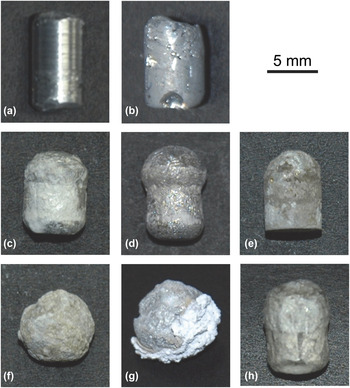
Images of the sample before and after the nitridation experiment are shown in Fig. 5. The formation of AlN was confirmed by XRD analysis; the results are shown in Table I. Al melting was observed when NH3 was used without fluoride (Exp. A-1); however, the shape of the Al rod remained almost unchanged [Fig. 5(b)]. A white powder formed on the Al rod was found to be aluminum oxide. AlN was not produced when NH3 was blown on KF–45 mol% AlF3 alone (Exp. A-2).
Photographs of the Al rod sample at different stages of the nitridation process. (a) Al rod; (b) no flux, NH3, 973 K, 3 h (Exp. A-1); (c) N2, 973 K, 3 h (Exp. A-3); (d) N2, 1073 K, 3 h (Exp. A-4); (e) N2, 1073 K, 24 h (Exp. A-5); (f) NH3, 973 K, 3 h (Exp. A-6); (g) NH3, 1073 K, 3 h (Exp. A-7); and (h) LiCl–KCl, NH3, 973 K, 3 h (Exp. A-9).

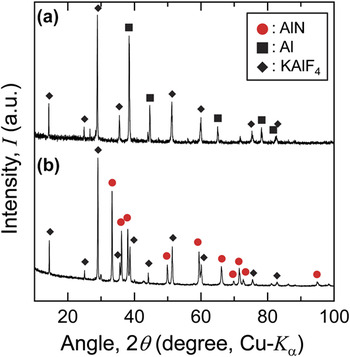
In the experiments in which N2 was used with fluoride (Exps. A-3 to A-5), an Al drop formed out of the hollow of the BN crucible [Figs. 5(c)–5(e)], indicating that the molten Al deformed readily after the removal of the Al2O3 film. However, AlN was not detected [Fig. 6(a)].
XRD patterns of the Al rod sample after nitridation at 1073 K using a molten fluoride mixture. Nitrogen source: (a) N2 (Exp. A-4), (b) NH3 (Exp. A-7). Reference patterns (Nos. in JCPDS database) – AlN: 25-1133, Al: 4-787, KAlF4: 40-549.

When NH3 was blown onto KF–45 mol% AlF3 (Exps. A-6 to A-8), the Al sample shrank [Figs. 5(f) and 5(g)] and AlN was formed on it [Fig. 6(b)]. Thus, NH3 but not N2 is effective for forming AlN under the investigated conditions. The standard Gibbs free energy changes of nitridation using N2 and NH3 are shown below.
 $${\rm{Al}}\left( {\rm{l}} \right) + {1 \mathord{\left/ {\vphantom {1 2}} \right. \kern-\nulldelimiterspace} 2}{{\rm{N}}_2}\left( {\rm{g}} \right) = {\rm{AlN}}\left( {\rm{s}} \right);\quad \Delta {G^0} = - 203.2\,{{{\rm{kJ}}} \mathord{\left/ {\vphantom {{{\rm{kJ}}} {{\rm{mol}}}}} \right. \kern-\nulldelimiterspace} {{\rm{mol}}}}\;{\rm{at}}\;1073\,{\rm{K}}\quad ,$$
 $${\rm{Al}}\left( {\rm{l}} \right) + {\rm{N}}{{\rm{H}}_3}\left( {\rm{g}} \right) = {\rm{AlN}}\left( {\rm{s}} \right) + {3 \mathord{\left/ {\vphantom {3 2}} \right. \kern-\nulldelimiterspace} 2}{{\rm{H}}_2}\left( {\rm{g}} \right);\quad \Delta {G^0} = - 273.6\,{{{\rm{kJ}}} \mathord{\left/ {\vphantom {{{\rm{kJ}}} {{\rm{mol}}}}} \right. \kern-\nulldelimiterspace} {{\rm{mol}}}}\;{\rm{at}}\;1073\,{\rm{K}}\quad .$$
Both reactions have a large driving force; however, the rate of the nitridation reaction seems to be very low when N2 is used. Okada et al. successfully obtained nitrided Al atomized powder under pressurized nitrogen atmosphere (0.5 MPa); therefore, even in this reaction system, Al nitridation might be achieved by pressurizing the nitrogen atmosphere. In fact, the pressure of nitrogen thermally dissociated from NH3 reaches 1.8 MPa at 1000 K Reference Barin24 and the rate of nitridation reaction might be increased under a pressurized atmosphere.
When NH3 was blown onto a LiCl–KCl eutectic (Exp. A-9), the shape of the Al rod hardly changed [Fig. 5(h)] and AlN was not produced. This suggests that the Al2O3 film covering the Al rod was not dissolved by the LiCl–KCl eutectic (the solubility of alumina in LiCl–KCl at 773 K is about 3 × 10⁻⁶ mol/L). Reference Inman, Legey and Spencer29 Thus, both fluoride and NH3 are required to form AlN under the investigated conditions. Kent et al. Reference Kent, Drennan and Schaffer22 reported the reaction mechanism governing Al nitridation at low temperatures in the presence of Mg in detail. In the process, Mg reduces Al2O3 thin films formed on the Al sample to MgO or spinel. A Mg-containing nitride film is also formed, but cracks form through which Al moves outward. The results from the present study suggest that the Al2O3 thin film is dissolved by the molten fluoride mixture and that Al migrates outward through the exposed surface forming nodules.
The reaction rate, ε (%), could not be determined from the mass content in the BN crucible, owing to the samples undergoing a significant degree of vaporization. Therefore, the reaction rate was evaluated using the following equation:
 $${\rm{\varepsilon }} = {{w_{{\rm{Al}}}^{\rm{0}} - {w_{{\rm{Al}}}}} \over {w_{{\rm{Al}}}^{\rm{0}}}} \times 100\quad ,$$
where w
Al is the residual mass of Al after rinsing with deionized water and
 $w_{{\rm{Al}}}^0$
is the initial mass of Al. The reaction rates at 973, 1073, and 1173 K were 24.0%, 25.8%, and 27.7%, respectively. Thus, the reaction rate increased slightly with increasing temperatures, but remained lower than 30%.
B. Nitridation of Al powder
The formation of AlN was confirmed by XRD analysis; the results are shown in Table II. AlN was not produced at 773 K (Exp. B-1). This was probably because KF–45 mol% AlF3 was a solid (eutectic temperature: 833 K) and could not dissolve the Al2O3 film formed on the Al particles. On the other hand, AlN was produced at 873 K (Exps. B-2 to B-4). Nitridation was found to occur even in the case of solid aluminum, once the Al2O3 film had been dissolved. Further, it is considered that nitridation started immediately after the melting of the fluoride mixture because AlN formed even at a holding time of 0 h at 873 K (Exp. B-2).
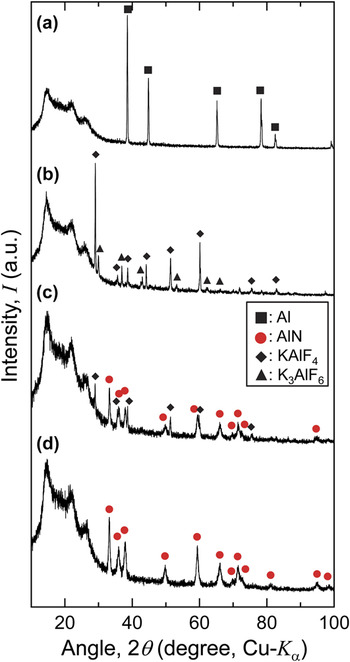
The results for the experiment performed at 973 K for 3 h (Exp. B-6) are shown in Fig. 7. The XRD patterns of the Al powder and the fluoride eutectic are shown in Figs. 7(a) and 7(b). The patterns of the Al powder after nitridation as well as those after vacuum distillation are also shown in the figure. AlN and fluorides were detected after nitridation, while the Al peaks decreased significantly in intensity. The formed AlN was found to separate readily from the salt, because only AlN was detected after vacuum distillation.
XRD patterns of (a) Al powder, (b) KF–45 mol% AlF3, (c) Al powder sample after nitridation at 973 K for 3 h using NH3 (Exp. B-6), (d) sample after the vacuum distillation of the flux. Reference patterns (Nos. in JCPDS database) – AlN: 25-1133, KAlF4: 40-549.

AlN was also successfully produced using KF (Exp. B-10), and the AlN was recovered by rinsing KF with water instead of using vacuum distillation. Nitridation at low temperatures using KF is almost impossible because the melting point of KF is 1130 K. Reference Komeya, Matsukaze and Meguro17 However, the process is an attractive one for removing salts because of the high solubility of KF in water. In the qualitative analysis of the AlN powder product by SEM-EDX, aluminum and nitrogen were detected, but fluorine and other elements were not. The detection limits of EDX analysis for C–F and Na–U are approximately 1 mass% and 0.3 mass%, respectively. These results, therefore, show that the AlN powder obtained was of high purity. The composition of the powder determined using the ZAF quantification method was 51 mol% Al–49 mol% N, in agreement with the XRD analysis. On the other hand, AlN was produced at temperatures as low as 773 K (Exps. B-11 to B-12) using LiF–50 mol% KF (eutectic point: 765 K), indicating that the Al2O3 film on the Al sample was dissolved by the molten fluoride mixture.
When H2–25% N2, which has the same stoichiometric ratio as NH3, was blown on the sample (Exp. B-13), AlN was not produced. NH3 decomposes thermodynamically into N2 and H2 at temperatures greater than 456 K. Reference Barin24 However, it might not have decomposed completely kinetically under the investigated conditions, such that NH3 molecules or certain radicals formed as the decomposition products of NH3 might have reacted with the Al sample.
In this case, the reaction rate, ε'(%), was evaluated using the following equation because the fluorides vaporized readily.
 $${\rm{\varepsilon }}\prime = {{{{\left( {{w_{\rm{r}}} - w_{{\rm{Al}}}^{\rm{0}}} \right)} \mathord{\left/ {\vphantom {{\left( {{w_{\rm{r}}} - w_{{\rm{Al}}}^{\rm{0}}} \right)} {{M_{\rm{N}}}}}} \right. \kern-\nulldelimiterspace} {{M_{\rm{N}}}}}} \over {{{w_{{\rm{Al}}}^{\rm{0}}} \mathord{\left/ {\vphantom {{w_{{\rm{Al}}}^{\rm{0}}} {{M_{{\rm{Al}}}}}}} \right. \kern-\nulldelimiterspace} {{M_{{\rm{Al}}}}}}}} \times 100\quad ,$$
where w
r is the mass of the substances remaining after the vacuum distillation process,
 $w_{{\rm{Al}}}^{\rm{0}}$
is the mass of the Al sample before the experiment, M
N is the atomic weight of nitrogen, and M
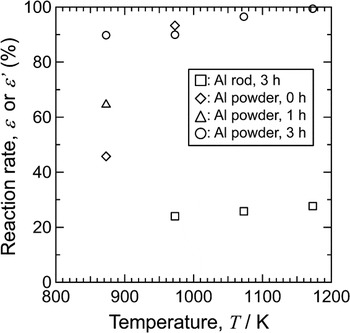
Al is the atomic weight of aluminum. The reaction rates for the experiments in which NH3 was used with KF–45 mol% AlF3 (Exps. B-2 to B-8) are shown in Fig. 8. The reaction rates for the experiments in which an Al rod was used (Exps. A-6 to A-8) are also shown in the figure. The reaction rates obtained for the Al powder were significantly higher than those for the Al rod.
Reaction rate for AlN production using NH3 and KF–45 mol% AlF3. The time in the figure indicates the holding time at a given temperature.

The reaction rate was 46% when the sample was cooled immediately after its temperature reached 873 K (holding time = 0 h), while the reaction rate at 873 K was 90% when the holding time was increased to 3 h, indicating that a high reaction rate could be obtained even for solid aluminum. Furthermore, the reaction rate reached 99% at 1173 K. This indicates that the nitridation reaction occurs more readily at higher temperatures.
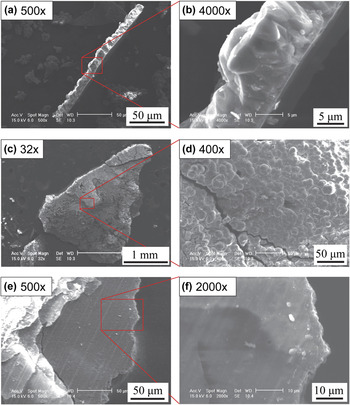
SEM images of AlN obtained at 873–1173 K using NH3 and KF–45 mol% AlF3 (Exps. B-4, B-6 to B-8) are shown in Fig. 9. Granular, rod-like, and plate-like AlN crystals were observed at all temperatures. The frequency of occurrence of the different crystal types increased in the following order: granular, rod-like, and plate-like. The diameter and length of the rod-like AlN crystals were of the order of several hundreds of nanometers to several micrometers and several micrometers to several dozens of micrometers, respectively. The size of the crystals increased with the reaction temperature. However, at 1173 K, the rod-like crystals disappeared, and most of the crystals were granular.
SEM images of AlN produced from the Al powder after nitridation for 3 h using NH3 and KF–45 mol% AlF3. (a) 873 K (Exp. B-4), (b) 973 K (Exp. B-6), (c) 1073 K (Exp. B-7), and (d) 1173 K (Exp. B-8).

C. Nitridation of Al thin plates
A thin and transparent film was formed on the Al thin plates and its AlN composition was confirmed by SEM-EDX. White powder aggregates were also observed on this film. The Al plates with thicknesses of 0.075 and 0.10 mm transformed completely into AlN, while those with thicknesses of 0.50 and 1.0 mm did not. The plate initially of 0.50 mm thickness decreased to 0.28 mm in thickness, while that initially of 1.0 mm thickness decreased to 0.77 mm, indicating that the nitride layer was almost 0.2 mm thick.
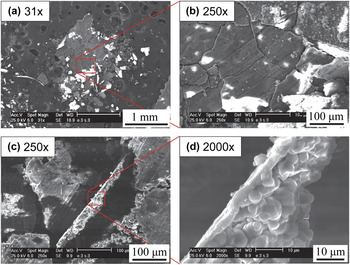
SEM images of the AlN films produced on the Al plates with thicknesses of 0.075 and 0.10 mm are shown in Figs. 10 and 11, respectively. The high contrast regions in the images are due to charging of sample surface. The SEM samples were carefully deposited by gold before the analysis to suppress charging of sample surface, but charging sometimes occurred. The AlN samples obtained in this study seem to be easily charged although the reason is unclear. A flat film (2–5 μm in thickness) consisting of granules was observed on both plates. In other words, the morphology of the AlN film was not significantly affected by the thickness of the Al plate. The size in the plane direction was approximately 0.5–1 mm. This suggests that AlN films might grow on the Al plates as a template and peel off when the films reach a thickness of 2–5 μm.
SEM images of AlN produced from a thin Al plate (0.075 mm in thickness) after nitridation at 873 K for 3 h using NH3 with KF–45 mol% AlF3 (Exp. C-1).

SEM images of AlN produced from a thin Al plate (0.10 mm in thickness) after nitridation at 873 K for 3 h using NH3 with KF–45 mol% AlF3 (Exp. C-2).

V. CONCLUSIONS
In this study, the authors investigated a technique for producing AlN from Al metal through nitridation at low temperatures. The nitridation of Al (in rod, powder, and thin-plate forms) was facilitated by dissolving the Al2O3 film formed on the Al sample with a molten fluoride mixture (KF–45 mol% AlF3, KF, or LiF–50 mol% KF). As a result, AlN was successfully formed by supplying NH3 gas to the Al sample (in both solid and liquid forms), which was wetted by the molten fluoride mixture. AlN was not formed when N2 or H2–25% N2 gas was supplied, even when a molten fluoride mixture was used. The nitridation reaction rate increased with increasing temperatures, reaching 99% at 1173 K for a reaction time of 3 h when an Al powder was used. AlN thin films 2–5 μm in thickness were formed on Al thin plates (0.075–1.0 mm in thickness).
ACKNOWLEDGMENT
This work was financially supported by a Grant-in-Aid for Exploratory Research (Grant No. 22656170) from the Ministry of Education, Culture, Sports, Science and Technology (MEXT), Japan.