


Voters care about the economy. But are they mainly concerned with personal economic well-being, as claimed by the pocketbook hypothesis (Goodhart and Bhansali 1970; Kramer 1971), or with the performance of the economy in general, as specified by the sociotropic hypothesis (Kinder and Kiewiet 1979)? Are there differences between men and women? Governments care about being reelected. They use their position to manipulate economic policy in order to gain votes. Are they successful in engineering a favorable business cycle? And do voters reward such efforts?
This study revisits the issue of economic voting in the context of the 1996 Presidential election in Russia. The election was branded as a referendum on political and economic reforms, as a choice between capitalism and communism. In the early 1990s, Russian families lived through the creation of a new nation, double-digit negative GDP growth rates, the first-generation reforms of price liberalization and large-scale privatization, and the collapse of the system of secure regulated lifetime employment. In the absence of market-oriented institutions, enterprises reformed reluctantly, new businesses emerged only slowly, and the state sector ran into severe budget problems. The nonpayment of wages, which are the main source of livelihood for over two thirds of Russian families, became widespread in 1995. The weak performance of progovernment parties in parliamentary election in December 1995 created uncertainty about the outcomes of the 1996 presidential election. Polls showed reformist President Boris Yeltsin trailing his Communist opponent Grennady Zyuganov by a wide margin. The volatile political climate triggered a further decline in economic output, as enterprises and investors postponed decisions while awaiting the outcome of the July election. Tax evasion rose sharply, fueled by the promise of tax amnesties after the election. The parliament adopted increases in minimum wages and social benefits, which were unaffordable in view of the shortfall of revenue collection. The central government's attempt to payoff public sector workers was frustrated by lack of control over local government finances. With enterprises and government unwilling or unable to effect salary payments, the wage arrears crisis worsened from month to month. At the time of the 1996 presidential election, almost every other worker was owed wages.
This paper draws on this pivotal episode to expand the empirical research on voting behavior in Russia in three regards. First, the analysis quantifies the impact of wage arrears on voting of workers in the 1996 presidential election. The unit of analysis is the voter. This allows the study to exploit the heterogeneity of the voter sample and to reflect closely individual and household circumstances. The sample is not representative of the entire electorate but of a specific group of voters: workers and adults living together with workers. The focus is on one crucial election issue: wage arrears.1
Although pension and child arrears were also widespread at the time of the election, the RLMS does not provide information on the amount of such arrears. This data limitation explains the focus on worker households.
The use of economic shocks to identify causal relationships is well established in economics. To give only one example, a number of papers have looked at the impact of rainfall variation on consumption (Paxson 1992), child health (Hoddinott and Kinsey 2001), and murder rates (Miguel 2003).
Second, the study asks what accounts for the remarkable failure of the Yeltsin government to pay off wage arrears in time for reelection in spite of considerable efforts. Wage arrears were the economic tradeoff of a larger, labyrinthine problem that ranged from low enterprise profitability and tax and interenterprise arrears to political pressures for benefit increases. The crisis illustrates important limitations in the scope of incumbents to manipulate successfully the business cycle.
Third, the study illustrates the use of matching estimation for investigating voting behavior. This methodology originated in labor economics from contributions by Ashenfelter (1978), Ashenfelter and Card (1985), and Heckman and Robb (1985), and has become part of the standard toolkit for impact evaluations of programs. The data come primarily from the 1995 and 1996 rounds of the Russian Longitudinal Monitoring Survey (RLMS), which is a high-quality nationally representative panel survey of households. It contains extensive information on a wide range of economic and noneconomic individual, household, and community characteristics.
LITERATURE
The empirical evidence on economic voting is far from consistent and varies across countries, time periods, and type of data. A priori, there are reasons both for and against expecting a large impact of wage arrears on voting behavior. Various arguments suggest that personal finance might have a limited effect on the election outcome. The dominant interpretation of the 1996 presidential election outcome is that Yeltsin won as the “lesser of two evils.” McFaul (1996) argues that this was Russia's last “revolutionary election” where voters were asked to choose between two fundamentally different systems. Voters opted for “reform over regress.” Similarly, Brudny (1997) highlights Yeltsin's ability to turn the election into a referendum on communism rather than his own record. Rose and Tikhomirov (1996) emphasize that the two-round election format imposed a “forced choice” on Russian voters.3
Although much of the literature focuses on the first round of the election, the RLMS provides information on the voter choice only for the second round. The second-round Yeltsin vote is likely to include supporters who voted for another candidate in the first round or who were motivated primarily by hostility toward Zyuganov. This suggests that the impact of wage arrears on the second-round results might be smaller than that on the first-round results.
Further, voting against the incumbent may be viewed as a particular form of protest. Yet, one of the remarkable features of the Russian wage arrears crisis is the absence of any sustained protest movement. Even at the peak of the crisis, no more than 1% of working population were engaged in some type of protest.4
In Russia, 0.7% of the workforce went on strike during 1995, and 1% during 1996. In the 3 months prior to the 1996 election, only 23,000 workers went on strike. In OECD countries, it is not uncommon for around 5% of the workforce to undertake strike action every year (Russian Economic Trends 1997). Robertson (2005) provides a detailed discussion of strikes and protests in Russia during the 1990s.
Finally, the Yeltsin government undertook a range of efforts to generate a favorable business cycle for reelection. Investigating regional differences in voting during the four national elections in Russia during 1993 to 1996, Treisman (1999) suggests that central officials succeeded in buying themselves local support by the instruments of public spending, bilateral negotiation, and economic concessions. High regional-level public spending and presidential decrees or government resolutions promising regional aid during the first 6 months of 1996 proved effective in boosting the Yeltsin support during the 1996 elections (Treisman 1996). In a companion paper, Treisman and Gimpelson (2001) show that Russian politicians attempted to manipulate the economy to win votes in various ways during these four elections. During the 5 months before the 1996 presidential elections, the real minimum wage increased by 0.16 standard deviations (SD), and real federal spending on transfers to regions by 0.63 SD compared to the same period in other years during 1992 to 1998.
Conversely, a range of factors suggest a strong role for wage arrears to affect voter choice. Typical findings of economic voting research suggest that the economy matters for voting. Voters assess the performance of the government primarily retroactively, emphasize recent events, react more strongly to a worsening than to an improvement in the economic situation, and punish incumbents more often in situations where clear responsibility can be attributed for the state of the economy (Lewis-Beck and Paldam 2000). Wage arrears rose sharply in the run-up of the election, representing a case of a recent severe grievance. Although the causes of the wage arrears crisis might have been difficult to assess, the strong position of the President relative to the parliament in the Russian political system and the two-way contest in the second round would presented voters with a perfect opportunity to attribute blame without fear of direct personal repercussions. Indeed, analyses of the December 1995 parliamentary elections (Clem and Craumer 1995; Colton 1996; Warner 1997) and presidential popularity during the 1990s (Willerton 2003) suggest that economic factors account for voting behavior also in Russia. Tucker (2004) finds systematic evidence of economic conditions affecting election results during the postcommunist elections in Russia, as well as Poland, Hungary, Slovakia, and the Czech Republic. Parties that are primarily identified with the “Old Regime,” such as Russia's Communist Party, enjoy more electoral success in the presence of more economic losers. Treisman (1999) demonstrates that the extent of wage arrears had a significant impact on regional voting decisions in the 1996 presidential election: higher back payments owed were associated with more frequent voting against Boris Yeltsin.
However, these analyses focus on interregional differences only. Russian regions vary widely in terms of ethnicity, religion, industrialization, level of modernization, and natural resource endowments. These differences are partly linked to historic factors going back to the imperial era or the late Soviet epoch (Treisman 1999). Thus, divergent patterns of voting at the regional level could simply mirror such cleavages. Given that wage arrears vary greatly across region (Desai and Idson 2000), separating the impact of wage arrears from other regional determinants is bound to be difficult. This paper focuses on individual-level data. It compares voting behavior of adults within the same region, blending out regional differences. The objective is not to provide a comprehensive analysis of the election results but to identify the impact of wage arrears on individual voting. The study restricts attention to the group of voters who were potentially directly affected by wage arrears: workers in public or private enterprises and institutions. The analysis draws on a rich household survey to match each worker with wage arrears to another worker without wage arrears who shares the same individual and household characteristics. The difference in voting across these two groups of workers quantifies the impact of wage arrears.
DATA
The analysis uses the 1995 and 1996 rounds of Russian Longitudinal Monitoring Survey (RLMS). The survey contains information about participation in the first and second rounds of the 1996 presidential election of 8,294 adults, and the vote cast during the second-round.5
Russia's presidential elections follow a two-round system. If no candidate receives an absolute majority of the votes in the first round, then the two candidates with the highest support in the first round compete for presidency in a second round. The first round was held on June 16, 1996, and offered a choice among 10 candidates. Yeltsin obtained 35% of the vote, and Zyuganov 32% of the vote.

WAGE ARREARS
Origin
Wage arrears are wage entitlements of workers that enterprises fail to pay in time. According to official data, wage arrears increased first modestly from June 1995 to February 1996, and then rose sharply from April to November 1996.6
The official wage arrears data has a number of limitations (Russian Economic Trends 1996). First, the sectoral coverage is incomplete and evolving over the years. Information up to end 1994 includes enterprises in industry, construction, and agriculture. Transport was added in 1995. The sectors health care, education, culture, and science were added in 1996. Wage arrears in the excluded sectors (finance, trade, and public administration), which accounted for about one fifth of official employment, were probably limited. Second, data for the commercial sectors refer only to large- and medium-sized enterprises. Third, the data refer only to civilian employment and do not cover the military sector where wage arrears were likely to be more substantial. Finally, the breakdown of wage arrears into public and nonpublic sector wage arrears became available only in 1996.
A combination of mutually reinforcing factors contributed to the wage arrears problem (Desai and Idson 2000; Ivanova and Wyplosz 2001). At the microeconomic level, it reflects the failure to enforce hard budget constraints at the enterprise level. At the macroeconomic level, the payment crisis emerged against a backdrop of strict disinflation policies, pursued since the end of 1994. The government shifted from monetary financing of the deficit to bond financing, created a flourishing bond market of short-term bills, and anchored the exchange rate in a corridor vis-a-vis the U.S. dollar. These policies facilitated the emergence of a payment crisis for three reasons. First, the real exchange rate appreciated as the programmed rate of exchange rate depreciation was typically below the rate of inflation. This led to an overvaluation of the ruble, which contributed to the low competitiveness of Russian enterprises. Second, with firms struggling to find customers, the government's political imperative was to provide support to enterprises and avoid large-scale layoffs. With monetary financing of budget revenue shortfalls ruled out, the government replaced explicit subsidies to the enterprise sector, which had been faced out in the first half of the 1990s, by implicit subsidies. They came in two main forms: tax arrears without the enforcement of bankruptcy; and energy inputs through the main public energy monopolies at below world market prices. The flipside was an increase in public debt and the rise in payment arrears to public sector workers, pensioners, family with children and other welfare recipients. Third, the payment crisis reached systemic dimensions as a result of thick market externalities and network effects. Enterprises could legitimize running up wage and tax arrears by pointing to the government's own track record of unpaid bills. The more enterprises engaged in nonmonetary transactions, the more difficult it became for fundamentally viable enterprises to find firms willing to pay in cash.
The 1996 Crisis
Between January 1996 to June 1996, wage arrears increased by over 20% in real terms. From a political economy perspective, the sharp rise in wage arrears preceding to the 1996 presidential elections is puzzling (Thames 2001). Wage arrears had emerged as a key campaign issue. Yeltsin championed the cause of payment of wage arrears and issued orders to pay off wage arrears.7
Yeltsin disbursed around 500 million dollars of central funds to pay federal wage arrears and to help regional authorities to prop up falling social welfare systems (Oxford Analytica, March 21, 1996). He ordered the Central Bank to release 1 billion dollars to pay for campaign pledges (Oxford Analytica, May 3, 1996; Moscow Times, June 25, 1996).
Treisman and Gimpelson (2001) argue that the government was successful in reducing the growth rate of wage arrears. During the 5 months before the 1996 presidential elections the seasonally adjusted real growth of wage arrears decreased by 0.30 SD compared to the same period in other years during 1992 to 1998.
In January 1996, wage arrears from institutions and enterprises directly funded from the budget accounted for just over one tenth of all wage arrears. Hence, paying back wages of teachers, health workers and civil servants could only made a dent in the wage arrears stock unless private wage arrears ceased to rise. Public sector wage arrears continued to increase though at a slower pace than private-sector wage arrears. Even this modest success was short-lifted, as public sector wage arrears rose faster than enterprise wage arrears after the elections, boosting the share of budget wage arrears out of total wage arrears to one fifth by end 1996.
A deteriorating economic situation and worsening payment discipline fueled the growth in nonbudgetary wage arrears. The decline in the economy accelerated as enterprises and investors postponed decisions while awaiting the outcome of the presidential elections.9
Real GDP and industrial production fell by 6% in 1996, compared to a reduction of 4% in 1995. The decline peaked around the time of the presidential elections, with real GDP declining by 9% in June and July 1996 compared to the same period in 1995 (Russian Economic Trends 1997).
The failure to pay off budgetary wage arrears was linked to poor tax collection, weak enforcement of payment orders and rising entitlement. Tax revenues collapsed due to the economic slowdown, tax reforms, tax amnesties and exemptions, and tax evasion through underreporting of production, use of barter transactions and capital flight (Grafe and Richter 2001). Although only 73 enterprises accounted for about 40% of all outstanding tax arrears, regional governments colluded with these companies, often the only major employer in the region, and showed little intention to enforce settlements of tax arrears.10
Motivated by the experience of Russia and other countries, Cai and Treisman (2004) show that in a decentralized political system with weak central government enforcement capacity interjurisdictional competition may increase the incentive for local governments to compete for capital by shielding firms from central tax collectors and regulators. Ponomareva and Zhuravskaya (2004) argue that for a given level of enterprise liquidity, federal tax accumulated faster in regions where governors were politically strong.
On the expenditure side, the absence of centralized control made it difficult to impose fiscal discipline.11
In the terminology of normative political economy, this in an example of a feasibility constraints, or ex ante political constraints, that can block decision making and prevent reforms from being accepted (Roland 2002).
Voting
Wage arrears are associated with a lower Yeltsin vote. The Yeltsin vote, calculated as the the share of the Yeltsin vote out of the total votes cast in support of either Yeltsin or Zyuganov in the second round of the 1996 presidential election, declines in the months of wage arrears at the time of the RLMS interview. About two fifth of the worker sample report no wage arrears at the time of the interview. For this group, the Yeltsin vote reached almost 75%. The support drops systematically with the amount of monthly wage arrears: to 66% among the 15% workers with 1 month of wage arrears; to 58% among the 30% workers with 2 to 3 months of wage arrears; to 50% among the 11% workers with 4 to 5 months of wage arrears; to 46% among the 4% workers with 6 to 9 months of wage arrears; and to no more than 30% to the 4% workers with more than 9 months of wage arrears.
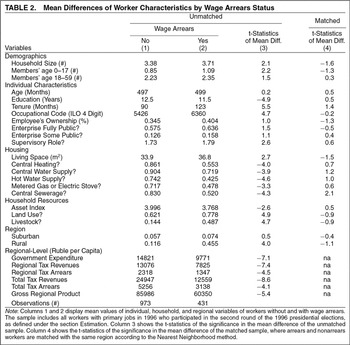
However, this systematic correlation of support for Yeltsin and wage arrears does not establish a causality of wage arrears for the Yeltsin vote. There are important differences between workers with and those without wage arrears which suggest that the gap in the Yeltsin vote might not be due exclusively to wage arrears. Columns 1 and 2 of Table 2 display mean levels of individual, household and region-level characteristics for arrears and nonarrears workers. Workers with wage arrears are more likely to be male, less educated, and live in larger households with fewer economic resources in poorer and more rural areas. The differences are especially pronounced for economic and fiscal level region variables (column 3 of Table 2). Matching estimation, introduced in the next section, allows to identify the impact of wage arrears on the Yeltsin vote purged for such differences.

MATCHING
Methodology
The basic estimation issue is a missing data problem.12
This section draws heavily on Blundell and Dias (2002), in addition to Blundell et al. (2001) and Jalan and Ravallion (2003).

where
is the individual specific treatment effect, the functions g0 and g1 relate regressors X to outcomes (V0, V1), and the error terms (U0, U1) are of mean zero and uncorrelated to the observables X. Equation 1 highlights that arrears status Ait is assumed to have a direct impact on voting.
The matching estimator relies on comparing voting choices for arrears (or treatment) and nonarrears (or control) groups. Treated individuals are paired with nontreated individuals on the basis of observable features, so that the only remaining observable difference between the two groups is the arrears status. Arrears and nonarrears voters can be matched across multiple factors using propensity scores P(Xi)=P(Ai=1 | X), defined as the likelihood of arrears status. Standard practice is to calculate propensity scores for each individual as the predicted values from logit (or probit) models. P(X) is used to construct the comparison group for each treated voter based on some distance measure. The selected set of nontreated observations are then weighted according to a specific scheme. The estimate of the matching estimator
is obtained as

where Wij is the weight associated with each comparison observation j for individual i, and wi represents the reweighting to reconstruct the outcome distribution for the treated sample. The matching estimator identifies the “treatment effect on the treated,” which is the impact of wage arrears on voting of the arrears individuals. Two assumptions need to hold. First, given the propensity score, the arrears assignment has to be independent of the vote. This rules out that there are unobservable factors that affect both the arrears status and the vote. More formally, the conditional independence assumption (Rosenbaum and Rubin 1983) states

where V0 represents the vote without arrears. A priori, it may seem implausible that Equation 2 is violated in the current context. Employers are not likely to assign wage arrears in relation to a worker's political opinion. Further, there is no financial reward for voting, so feedbacks operating from voting to economic determinants can be ruled out. However, if wage arrears are associated with certain characteristics of the worker, and these characteristics also affect voting behavior, then Equation 2 could be violated. The estimation approach discussed in the next section addresses this concern in three ways. First, the matching procedure draws on a wide range of variables, covering a range of individual, household, and region characteristics that could act as possible proxies for otherwise omitted variables. Second, I test the sensitivity of the findings to a number of alternative matching approaches, including matching workers within regions only to rule out differential regional-level shocks. Third, one set of matching results will condition the impact estimates on the incidence of wage arrears in 1995, when two in five workers had wage arrears. As long as the determinants of wage arrears in 1995 are not systematically different from wage arrears in 1996, then matching workers by wage arrears incidence in 1995 should ensure comparability.
A second assumption ensures that the observable characteristics X of the nonarrears group cover the same range as those of the arrears group (common support). For a given X, voters can be observed both with and without arrears:

With the nonarrears subsample being about twice as large as the arrears subsample, imposing common support leads to only a small reduction in sample size.
Estimation
The first consideration is the definition of treatment and control group. The treatment group should contain workers with wage arrears on July 3, 1996, the date of the second round of the 1996 presidential election, and the control group workers without wage arrears on July 3, 1996. The wage arrears status at RLMS interview day might differ from the one at election day. Some workers might have accrued new wage arrears since election day, others might have been paid back wages. The first fact would imply a type 2 error (wrongly classifying workers without arrears at election day as arrears workers), the second factor type 1 error (wrongly classifying arrears as nonarrears workers). Both factors would imply a bias toward zero in the impact estimates of wage arrears, as they would tend to narrow the gap in the Yeltsin vote between arrears and nonarrears groups. Because wage arrears were rising from June 1996 to November 1996, type 2 error is more likely to be relevant.
Although the RLMS does not provide information about the full history of wage payments over the last months, it does include information about the number of months of outstanding wage arrears. To eliminate type 2 error, arrears workers are defined as those workers with monthly wage arrears in excess of the number of months between interview and elections days. To limit type 1 error, the nonarrears group includes only those who report no outstanding wage arrears at the interview day. For example, a worker interviewed on October 3, 1996, belongs to the treatment group if his or her stock of wage arrears exceeds 3 months. These definitions result in a sample of 668 arrears workers and 1492 nonarrears workers. The subsample of workers participating in the second round of the 1996 presidential election includes 431 arrears workers and 973 nonarrears workers.
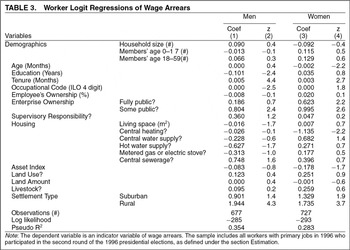
Workers are paired based on the propensity score derived from logit regressions of the wage arrears. In view of the large regional differences, as shown in column 3 of Table 2, arrears workers are matched to nonarrears workers who are located in the same region. The explanatory variables are individual and household characteristics that are unlikely to have changed between election day and interview day and that are likely determinants of wage arrears. The literature suggests that wage arrears are related mostly to the characteristics of firm productivity and profitability and the regional economic situation.13
Layard and Richter (1995) interpret wage arrears as a way to reduce wage costs without costly layoffs in face of a general structural economic adjustment, whereas Alfandari and Schaffer (1996) view them as a ploy by enterprises to extract government subsidies. Clarke (1998) and Ivanova and Wyplosz (2001) emphasize that wage arrears are only one element of a wider arrears crisis with fiscal origins. Lehmann, Wadsworth, and Acquisti (1999) and Earle and Sabirianova (1999) argue that local labor market characteristics account for the persistence of wage arrears.
Even without taking into account wage arrears, Brainerd (1999) argues that wage inequality in the first half of the 1990s rose in Russia due to higher returns to skills and lower wage premiums for older worker. Lehmann and Wadsworth (2003) estimate that measures of earning dispersion increase by about 30% once wage arrears are accounted for.

Nearest neighborhood matching pairs each arrears worker with the closest match from the control group. Matching leads to close similarity across the groups. Before matching, the average propensity score of arrears worker is 0.618 compared to 0.298 for nonarrears workers. After matching, the average propensity scores across the two groups almost coincide, with a mean value of 0.509 and a standard error (SE) of 0.015 for arrears workers and nonarrears workers. The density functions after matching coincide closely over the entire support. The mean differences across a wide range of variables are substantially smaller compared to the unmatched samples (column 4 of Table 2).
RESULTS
Economic Impact
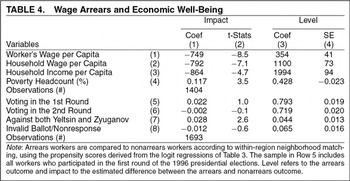
The wage arrears crisis in 1996 had dramatic effects on living standards. Table 4 introduces the format that will be used for the subsequent tables. Level refers to the arrears outcome; and impact, to the estimated difference between the arrears and nonarrears outcome. At the time of the 1996 RLMS interview, the wage income of arrears workers in the last month dropped by almost 70%. The impact equals to −749 rubles (column 1 of Row 1), as wage arrears are estimated to reduce per capita wages of workers from, 1103 rubles (nonarrears outcome) to 354 rubles (arrears outcome). This reduction is equivalent to about $900 in purchasing power parity.15
All ruble values refer to prices as of June 1992. As wage arrears tended upwards between July and October 1996, the impact statistics of wage arrears are likely to be somewhat overestimated compared to those at the time of the presidential elections.

Turnout
A priori, it is not clear whether wage arrears boost (mobilized by an economic issue) or reduce (apathy with the political process) voter turnout. Participation among workers was around 77% to 79% in the first round (row 5), about 10% higher than that for the electorate as a whole (Table 1). It fell to 72% in the second round, as the number of candidates was reduced from 10 to 2. Although wage arrears did not change the turnout or the share of the invalid ballots, they increased the vote against both candidates from 1.6% to 4.4% in the second round. This suggests that Zyuganov failed to capture part of the protest vote of arrears workers.
Pocketbook
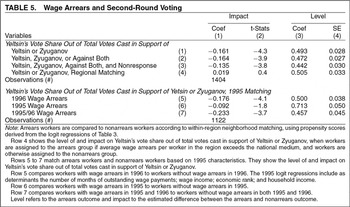
Wage arrears lowered the support for Yeltsin. Yeltsin's vote share out of the total votes cast in support of either Yeltsin or Zyuganov in the second round of the 1996 presidential election fell from 65% to 49% among arrears workers (row 1 of Table 5). The coefficient is statistically significant at the 1% level. Given that almost every other worker had wage arrears and workers represented just over half of the electorate, wage arrears reduced, ceteris paribus, the share of the Yeltsin vote for the population as a whole by about 4 percentage points.

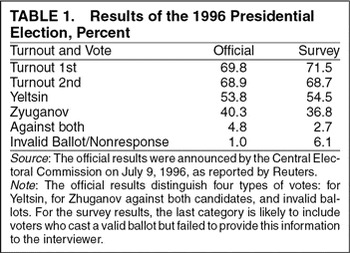
Table 1 highlighted differences in official and RLMS voting results. I employ two additional vote indicators to address this issue. The first measure is calculated as the share of the Yeltsin vote out of the total votes cast in support of either Yeltsin or Zyuganov or against both candidates. The second indicator is calculated as Yeltsin's vote share out of the nonresponse and the total votes cast in support of either Yeltsin or Zyuganov or against both candidates. By construction, Yeltin's vote share drops as the definition of the anti-Yeltsin vote is widened (column 3 of rows 1, 2, and 3). Nevertheless, the impact estimates for the three indicators are similar in size and not statistically different (columns 1 and 2 of rows 1–3).
Is the reduction in the Yeltsin vote due to concern about the personal financial situation (pocketbook) or due to the mishandling of the general economic situation (sociotropic)? The typical approach to testing the sociotropic model is by assessing whether voters take into account their attitudes toward the national economy. Although information on such attitudes is not available in the RLMS, I can test a special variant of the sociotropic hypothesis: are voters who live in a region with wage arrears above the national medium less likely to support Yeltsin than voters who live in a region with wage arrears below the national medium.16
The tested hypothesis differs from the standard sociotropic hypothesis in three ways. First, the indicator is objective (level of wage arrears) rather than subjective (attitudes toward national economy). Second, it concerns wage arrears rather than the overall national economy. Third, it groups voters into categories at the regional level rather than at the household level.
Another test of the pocketbook hypothesis draws on the variation in the amount of wage arrears across arrears workers. Some workers suffered more than others from longer periods of wage arrears. Because longer spells of nonpayment of wages imply a larger deterioration in personal finances, the pocketbook hypothesis would suggest that the reduction in the Yeltsin vote increases with the amount of wage arrears. The reduction in the Yeltsin vote was indeed directly related with the month of wage arrears: the more months of wage arrears, the larger the drop in the share of the Yeltsin vote. For example, increasing wage arrears from 0 to 4 months on election day implied an additional drop of 20% in the share of the Yeltsin vote out of the votes cast in support of Yeltsin or Zyuganov.
Retrospection
The analysis so far looked at the impact of wage arrears by separating workers depending on their wage arrears status at the time of the elections. However, as discussed in Section 1996 Crisis, Yeltsin launched an extensive, although ultimately unsuccessful, campaign to pay off wage arrears in the months leading up to the election. This suggests that the control group contains workers whose wage arrears were paid off only recently. Whereas the RLMS does not identify this subgroup, I can use the 1995 RLMS to incorporate information about wage arrears in autumn 1995. About two fifths of the workers already had wage arrears at that time. Did 1996 wage arrears affect voting when 1995 wage arrears are controlled for? And did 1995 wage arrears affect voting behavior over and above the impact of 1996 wage arrears?
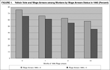
This section addresses these questions by exploiting the panel nature of the RLMS. Figure 1 displays Yeltsin's vote share for workers depending on their wage arrears status in 1995 and 1996. For a given level of 1995 wage arrears, Yeltsin's vote share is lower for workers with 1996 wage arrears than for workers without 1996 wage arrears. Furthermore, for a given level of 1996 wage arrears, wage arrears in 1995 reduce Yeltsin's vote share by about 15%. This suggests that 1995 wage arrears are an important determinant of 1996 voting behavior, with an independent effect on voter preferences beyond the 1996 wage arrears status.

Yeltsin Vote and Wage Arrears among Workers by Wage Arrears Status in 1995 (Percent)
Before exploring the impact of 1995 wage arrears on voting, it is useful to confirm the main result on 1996 wage arrears with the 1995 to 1996 worker panel. I modify the matching procedure compared to Section Estimation in three aspects. First, arrears and nonarrears workers are matched based on characteristics as of 1995 rather than those as of 1996. This ensures that the determinants of the propensity scores are exogenous to 1996 wage arrears. Second, the logit regressions include additional variables: the number of months of outstanding wage payments in 1995, affecting two in five workers; wage income and self-assessed economic rank of the worker; and household income. This ensures that treatment and control groups are closely matched for 1995 wages and 1995 income, so that any difference in voting behavior in 1996 is the result of 1996 wage arrears. Third, attrition between the 1995 and 1996 surveys reduces the sample of workers participating in the second round of the 1996 presidential election to 349 arrears workers and 773 nonarrears workers. The overall impact of wage arrears on Yeltsin's vote share is similar to the cross-sectional estimate (row 5 of Table 5).
To identify the impact of the 1995 wage arrears, the definition of arrears and nonarrears groups is adjusted as follows. The treatment group includes workers with wage arrears in 1995 and no wage arrears in 1996, and the control group covers workers with no wage arrears in both 1995 and 1996. Wage arrears in 1995 reduce Yeltsin's vote share by about 9%, which is about half the impact of 1996 wage arrears (row 6 of Table 5). If 1995 wage arrears affect 1996 voting behavior over and above 1996 wage arrears, workers with wage arrears in both 1995 and 1996 should show a larger reduction in Yeltsin's vote share than those with wage arrears in only 1995 or only 1996. This is indeed the case (row 7 of Table 5). Wage arrears in both 1995 and 1996 lower Yeltsin's vote share by 23%, which is about 6% higher than 1996 wage arrears and 14% higher than 1995 wage arrears. The evidence is consistent with an important role of retrospective voting.
Attitudes
One of the channels by which wage arrears might affect voting behavior is through changes in attitudes toward government and taxation. The 1996 round of the RLMS asked respondents whether they agree or disagree with the following statements:
Government is caring: “The people who govern the country don't care what will become of people like you”; and Government should restrict rich: “The government needs to restrict the income of the rich.”
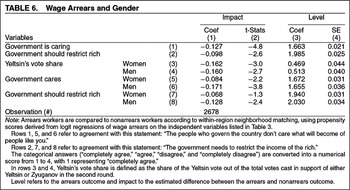
Workers with wage arrears are 12.7% more likely to agree with the statement that the government is caring, and 9.8% are more likely to agree with the statement that the government should restrict the incomes of the rich (rows 1 and 2 of Table 6). As a result, about 3 in 4 workers with wage arrears agree that the government needs to restrict the income of the rich, and about 9 in 10 workers with wage arrears believe that the government does not care about people like themselves. These findings are consistent with the results on voting. Wage arrears lead more voters to believe that the government is indifferent to the well-being of the public and to favor income restrictions for the rich. The first attitude implies a larger dissatisfaction with the Yeltsin government; and the second, greater support for one of Zyuganov's key policies.

Gender
Do men and women differ in voting behavior and policy attitudes? The effect of wage arrears on voting is similar on men and women (rows 3 and 4 of Table 6), but is larger on male than female attitudes (rows 5 to 8 of Table 6). Although the sign is the same for men and women, the effect is about twice as large on male than on female workers. The differential impact on men and women is unlikely to be accounted for by differences in the size of the wage arrears shock. The absolute and proportional contraction of wages, whether at the worker or household level, is similar for men and women. This suggests that women are less likely to modify attitudes toward government and taxation in relation to their personal financial situation, even though they are as ready as men to hold an incumbent President accountable for changes in their pocketbook.
CONCLUSION
This paper investigated the impact of wage arrears on the 1996 presidential election in Russia using matching estimation. As a result of the difficult economic transition, weak fiscal management and political uncertainty, Russia's wage arrears crisis accelerated just at the time of this pivotal election. The second-round runoff between incumbent President Yeltsin and his Communist challenger Zyuganov was cast as a fundamental choice between capitalism and communism. Yet, voting was overshadowed by an important financial issue: about one in two workers were owed wages when they went to the polling station. The size of the wage shock was substantial. Total per capita wages dropped, and poverty increased, by about two fifths. There are four main findings.
First, wage arrears lowered the Yeltsin support, as predicted by the pocketbook hypothesis. The Yeltsin vote fell from 65% to 49% among workers with wage arrears. Voters punished strongly the incumbent for the deterioration in their personal economic situation, even though Yeltsin's fundamental political and economic vision contrasted starkly with the opponent Zyuganov. The drop in the Yeltsin vote rose with the amount of wage arrears. Wage arrears also increased the votes cast against both candidates but had little effect on turnout. These findings are robust to alternative definitions of the voting indicator and matching techniques.
Second, this episode illustrates two limitations of political business cycles to deliver election victories for incumbents: endogeneity of the economy and retrospective voting. The election triggered uncertainty and political opportunism that contributed to a slump in the economy, a fiscal crisis linked to deteriorating tax collection and rising wage and benefit entitlements, and an erosion of central authority over local governments. These factors resulted in a sharp rise in wage arrears in the months leading up to the vote. Although the government widely publicized its efforts to address the wage arrears problem, workers were not persuaded by announcements alone and judged the government by the actual success in paying off the wage debt. The workers took into account their current and past situation. Workers with wage arrears in 1995 were less likely to vote for Yeltsin than workers without wage arrears in 1995, even if their wage arrears were paid off at the time of the election.
Third, wage arrears affected attitudes on government and taxation consistently with the impact on voting. Wage arrears led more voters to believe that the government “doesn't care” and to favor income restrictions for the rich, a key campaign slogan of the Communist opposition.
Fourth, although female workers with wage arrears reduced the Yeltsin vote by as much as men in response to wage arrears, their attitudes on government and taxation changed about one half less than those of male workers. This suggests that working women, compared to working men, base voting choices, but not general political attitudes, more readily on their pocketbook.



Comments
No Comments have been published for this article.