I
The author of ‘the first treatise on museums’ published in southern Germany in 1565 states that feather-work from the sixteenth-century Americas should be displayed together with fine textiles.Footnote 1 At the same time, feathered items arriving from Peru were also displayed as textiles in Spanish collections.Footnote 2 With a focus on Spanish Peru, this article discusses the early modern nexus between feather-work and textiles. While Peruvian feathered artefacts have previously been defined as prototypes of pre-Columbian objects,Footnote 3 this article presents new textual, visual, and material evidence that shows its significance in the material culture of colonial Peru, which serves as a starting point for a broader debate on the material dynamics of cultural encounters in the Ibero-American world.
Here, I will chart the development of craft cultures beyond the Spanish conquest of the Americas by discussing Peruvian practices of feather manufacturing in relation to the production and usage of textiles in early modern Spain – an approach, I argue, which will enable the reconsideration of the dynamics of the Spanish Empire, whose far-reaching geographies were linked through circulating objects that constituted a shared material world.Footnote 4 In the particular case of feather-work, this was a world that jointly valued the aesthetics of knots and the intricacy of knotting.
‘History begins with bodies and artefacts’,Footnote 5 says anthropologist Michel-Rolph Trouillot. Objects such as feathered textiles were significant in the production of narratives about the conquest of the Americas. The sixteenth century was recently coined the period of the ‘first global dialogues’,Footnote 6 whose nexuses were largely characterized by a flourishing textile trade around the globe.Footnote 7 It is time to rebalance the voices, which we may hear in these dialogues, by questioning the epistemic qualities of colonial stories that rely solely on textual sources.
While the study of artefacts is predominantly associated with the history, archaeology, and anthropology of pre-Spanish Peru, historians focusing on the colonial period have tended to place emphasis on the study of texts over objects. Contrary to this approach, I follow Nicholas Thomas's plea for more nuanced, artefact-based narratives of cultural encounters as material processes of ‘emerging mutual knowledge’.Footnote 8
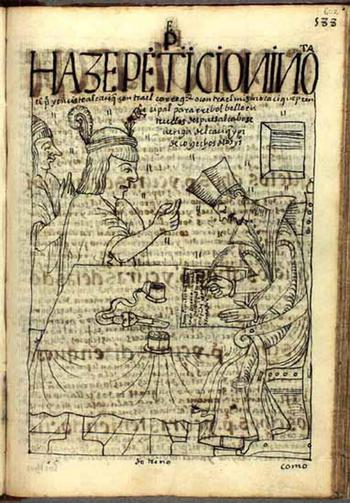
In this regard, research on feather-work is a particularly telling example. ‘Feathers are held in the global imagination as synonymous with Indians’, as recent literature and exhibitions show.Footnote 9 As a consequence, researchers on Peru have associated the crafting of feather-work with indigenous cultures in implicit or explicit opposition to what is considered ‘Spanish’. This mirrors the general trend of American feather-work widely discussed in relation to European textual or visual sources, which perpetuates the idea of (material/oral) ‘Indians’ with feathers on their heads, and (writing) ‘Europeans’ with feathers in their hands (Figure 1).
An indigenous–Spanish encounter in colonial Peru from the perspective of an indigenous chronicler: a cacique wearing a feather headgear stands in front of a Spaniard, who uses a feather to write a document. Guaman Poma, Nueva corónica y buen gobierno (1615), 588 [602]. Det Kongelige Bibliotek København, GKS 2232 4°. Published with the permission of the Royal Danish Library.

Just as recent studies on Peruvian textiles beyond the moment of conquest were able to address the material guise of the ‘colonial experience’,Footnote 10 this article discusses the material dynamics and dis/continuities of colonial conquests, and the early modern literacy of knots shared between Peruvians and Spaniards. Instead of differentiating between non-literate natives and literate Europeans, the article charts an early modern literacy of knots that connected material, oral, and writing cultures in colonial Peru.
Research on colonial feather-work has thus far focused on Mexico. Studies have shown that such artefacts gained cultural meaning through the ways in which people creatively engaged with materials. Mexican feather mosaics were part of a broader world of cultural exchange and material creativity – the driving force of which, Alessandra Russo notes, were the constant attempts to re-translate the materials, techniques, concepts, and experiences of these objects.Footnote 11
More recent studies have focused on the emotional and aesthetic significance of New World feathers in early sixteenth-century Europe. The arrival of Central and South American feathers and feather-work then prompted amazement among Europeans. In several accounts, they expressed their emotional responses to such objects in a language that centred on the concept of ‘ingenuity’. When Peter Martyr saw the first Mexican feather-work to arrive in Europe in 1519, he hardly found words to express his excitement:
I am at a loss to describe the aigrettes, the plumes, and the feather fans. If ever human wits attained honour in arts of this sort, these would rightly take the first place…I have examined a thousand figures which it is impossible to describe. In my opinion I have never seen anything which for beauty could more delight the human eye.’Footnote 12
Such descriptions of American feather-work were widely found across early modern Europe. Seeing New World artefacts that Hernán Cortés had presented to Charles V on display in Brussels in 1520, Albrecht Dürer wrote that he had ‘not seen anything in my whole life which pleased my heart as much’.Footnote 13 Likewise, Spaniards arriving in Peru in the 1530s wrote about being overwhelmed with speechless marvel when seeing feather-work textiles: ‘I shall not be able to describe the deposits which I saw of all the varieties of apparel which they made and used in this kingdom, for time would be lacking for seeing it all and understanding for comprehending such a great thing.’Footnote 14
European visual aesthetics on the ‘ingenuity’ of indigenous feather-work, I argue elsewhere, gained meaning within a culture of making that highly appreciated materials and crafts knowledge.Footnote 15 In order to reconstruct the matter of New World feather-work in the ‘period eye’Footnote 16 of late fifteenth- and early sixteenth-century Europe, I used the digital microscope as a heuristic tool of historical research to recalibrate the understanding of early modern miniature viewing conventions, and hence the matter of feathers in Europe's ‘material Renaissance’.Footnote 17
The present article builds upon this recent trajectory of research on early modern feather-work as it holds two main insights for the study of Peruvian material culture. First, it highlights the existence of Peruvian feather-work from the colonial period, and second, prompts a reconsideration of the material worlds of colonial societies. European and Spanish praise of New World feather-work as indigenous craft, discussed in recent literature, poses the question of how feathered items were experienced within colonial societies. To answer this question, I posit the concept of ‘period hands’. Manual dexterity, I argue, was a skill which linked indigenous and European societies that expressed knowledge and communicated cultural concepts via the transformation of materials into things.Footnote 18 Recent studies by Pamela Smith and Ulinka Rublack show that sixteenth-century Europeans were highly trained in observing, knowing, experiencing, and appreciating how things were made.Footnote 19 Intricate artisanal skills were not simply considered a symbol of cultural refinement, but they were integral categories of how people experienced subjectivity, community, and the divine in relation to materials, things, and the making of objects.
This observation, I argue, should lead to different approaches to colonial material culture in general and feather-work in particular. In order to overcome the bias of indigenous feather-work and Spanish texts, feathered artefacts have to be studied as objects that acquired meaning in cultures that valued the innovative usage of materials, and their transformation through intricate techniques. It is exactly in this material context that the early colonial rhetoric of ‘subtle ingenuity’Footnote 20 that was so admired by Martyr and Dürer has to be grounded.
Taking the cross-cultural ‘making’ of artefacts and appreciation of period hands into consideration entails readdressing non-European and European artefacts on the same analytical level. I argue that the appreciation of feather-work from early colonial Peru not only relied on the outstanding material properties of feathers – above all their iridescence and vibrancy – but above all on the dexterity of artisans arranging and using feathers for the composition of textiles. Relating feather-work with fibres, fabrics, and embroidery, this article reconsiders cultural contacts in sixteenth- and seventeenth-century Peru.
II
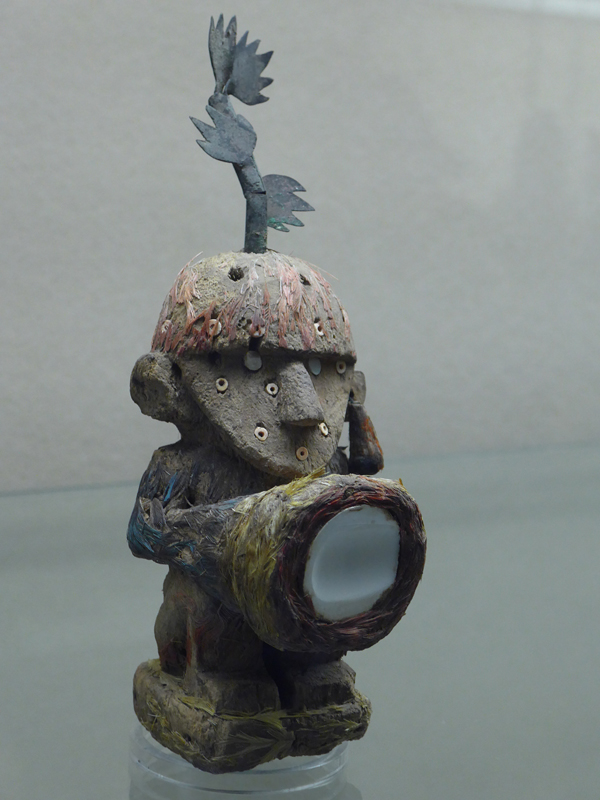
When Spaniards first arrived in the Andes, they encountered a long tradition of indigenous craft cultures that were specialized in processing feathers for religious and cultural contexts. Symbolizing ‘spiritual energy and supernatural force(s)’, feathers were integral religious items for societal elites in a variety of Andean cultures.Footnote 21 In Paracas, Nasca, Moche, Wari, Sicán, Chancay, Chimú, and Inca cultures alike, birds were tamed and hunted in order to collect feathers that were used for manufacturing headgear, panels, fans, and garments. In Trujillo, the Chimú praised birds as symbols of the divine and intermediaries between mundane and divine spheres.Footnote 22 Archaeologists have found a variety of pottery in avian shapes from the late Chimú period, ranging from wooden ear trinkets decorated with feathers, to feathered figurines holding shell pieces, presumably alluding to sacrificial practices (Figure 2).Footnote 23 Polychrome façade reliefs from the Huaca de la Luna, one of the main Chimú pyramids, prominently portray soldiers and deities in feather costumes and birds in cosmological scenes. Archaeologists also excavated fifteen garments with feathers consciously arranged in squares from the site. The tabards, headdresses, and loincloths were sacrificed in front of the very same altar that portrays feathered deities and go-betweens. Excavations carried out in 2011 also discovered Inca offerings, a clear hint at the continuity of such bird- and feather-related ritual practices beyond the conquest of the Chimú Empire by the Incas in the late fifteenth century.Footnote 24
Anthropomorphic wooden figure decorated with feathers. Chimú, Pachacámac, presumably c. 1100–1450. Museum Fünf Kontinente, Munich. © Photograph by author.

Feathers played an important role in Inca visual and material aesthetics. Adam Herring argues that ‘birds were identified with the upper world of air and sky, and with the ability to move between worlds’.Footnote 25 The excavation of sacred feather-work offerings in ceremonial sites in the Andean highlands underlines this interpretation.Footnote 26 Inca culture appreciated the iridescence and vibrancy of feathers, Inca chromatism valorized the vibrancy of colours. The metallic iridescence of brilliant feathers, caused by ‘optical interference and refraction from modified barbules with melanin pigmentation in the cortex’,Footnote 27 became emblematic of royal artefacts. In fact, Inca artisans even foregrounded the iridescence of feathers through supportive materials, such as seashells or metals.Footnote 28 In a society whose rulers fashioned themselves as sons of the sun, the shimmering surfaces and reflective qualities of metals and feathers alike were highly valued as material tools for legitimizing and performing power. Goldsmiths forged metals into the shape of feathers; and feathers adorned the symbols of powers of ‘golden kingdoms’.Footnote 29
Even in colonial times, Spaniards remembered such aesthetics of brilliance associated with the materiality of feathers. The chronicler Pedro Pizarro, for instance, described an Inca ceremony in Cuzco dedicated to the sun. Embodied as a small bundle, the deity of the sun was positioned and venerated on a small seat in the centre of the ceremonial square. The altar itself was decorated with ‘mantles of feathers, very colourful and very delicate’.Footnote 30 The material properties and texture of feathers were thus integral for what researchers called ‘the sensory materialism of Inca cultural experience’, also well known to Spanish observers in colonial Peru.Footnote 31
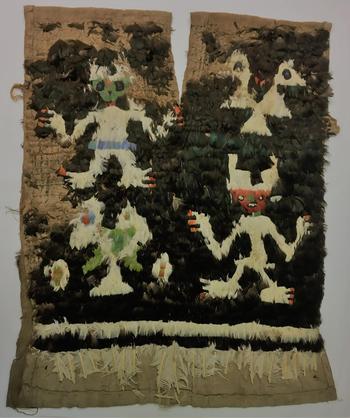
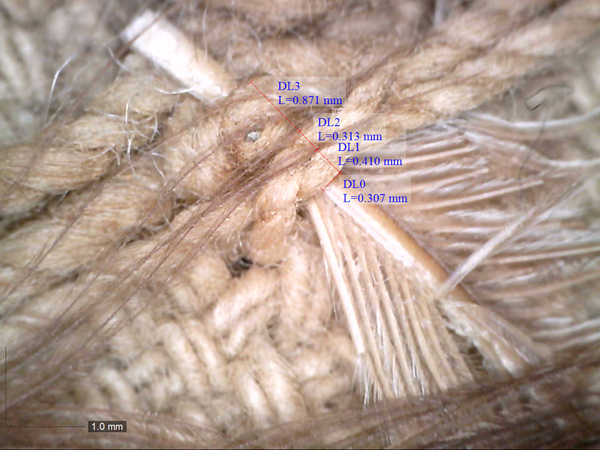
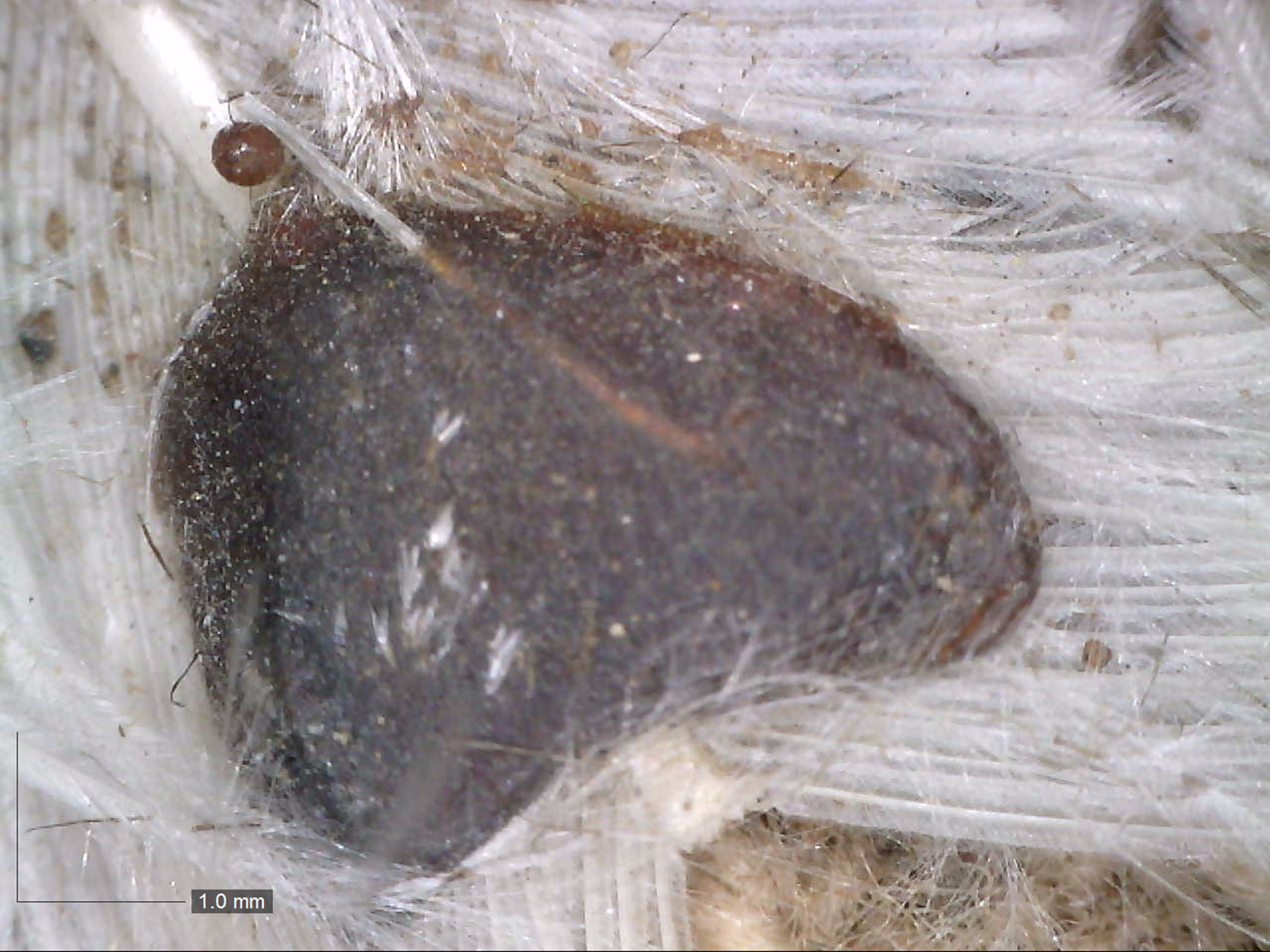
In order to achieve the desired affective spheres of feather-work, indigenous artisans applied intricate techniques of attaching and arranging feathers in a way that foregrounded their valued material properties. A detailed study of a sixteenth-century Peruvian tabard, presumably of Chimú or Inca origin and now preserved in the British Museum, illustrates the feather-worker's manual skills and material knowledge (Figure 3).Footnote 32 Here, feathers are used to decorate a tabard with a mosaic of human figures and bird motifs. The Dino-Lite USB microscope AM7013MZT – with a polarizer, adjustable zooming, and lighting options – reveals the artisanal techniques. The feathers were cut and arranged in lines on a cotton ground manufactured from single s-spun yarns, paired warp and weft, while quills were carefully split and snapped around a yarn. In this composition, feathers were fixed with thin knots in two or sometimes three lines (Figure 4). This ‘two-corded feather strings with double’ or sometimes even triple ‘knot(s) for attachment’ was a widespread technique amongst Chimú and Inca feather-workers.Footnote 33 In the case of the British Museum's tabard, the microscope reveals the strategic usage of tiny spots of adhesive, which were added at certain points in order to fix feathers in specific positions (Figure 5). Glue was applied to both the upper umbilicus of the feather and the actual knot in order to reduce movability. Most interestingly, adhesive was only applied to the feathers that formed the figurative motifs in order to ensure their fixed shape. The more flexible arrangements of other feathers, in contrast, supported the brownish background's metallic iridescence.
A Chimù or Inca feather-work tabard, fifteenth/sixteenth century, found in the British Museum's Americas collection in 1997; acquisition details unknown. British Museum, Am1997,Q.510. © Photograph by author.

Knotting techniques applied by Chimù or Inca feather-workers, including measurements of fibres and knots (DL0–3). Detail of British Musem, Am1997,Q.510. Photograph taken with a Dino-Lite USB microscope AM7013MZT, 52 magnification scale. © Photograph by author.

Adhesive used by Chimù or Inca feather-workers to fix the arrangement of feathers. Detail of British Museum, Am1997,Q.510. Photograph taken with a Dino-Lite USB microscope AM7013MZT, 52 magnification scale. © Photograph by author.

These findings from late fifteenth- and early sixteenth-century Peru reveal the material knowledge of indigenous feather-workers, who used their manual dexterity in order to foreground exactly those material properties of feathers which were culturally valued. The survival of various samples of feathers mounted on cotton strips with different kinds of knotting techniques underline the conscious material engagement of Inca artisans with feathers, as much as archaeological findings that discovered the usage of tapirage – the dyeing of a living bird's feathers – in ancient Peru.Footnote 34
Chimú and Inca loincloths show that indigenous feather-workers used their manual skills to manufacture feathered textiles with geometrical chessboard patterns, an arrangement that was associated with divinity, warfare, and power. For instance, feathers of the Muscovy duck, characterized by their dark and sparkling iridescence, were lined up in accordance to their colours in overlapping arrangements and knotted onto the cotton ground.Footnote 35 An analysis of Inca and Chimú feathered textiles thus reveals the intricate knotting techniques and immense artisanal knowledge of materials, through which indigenous feather-workers ensured the cultural significance of their work.
III
Spaniards admired New World feather-workers precisely for these artisanal skills. Martyr, for instance, lauded feather-work for ‘the diligence and zeal of the artist’, whose ‘workmanship…much exceeds the value of the material’.Footnote 36 When Francisco Pizarro's troops conquered the Inca Empire in the 1530s, they discovered plenty of delicate feathers. In the Inca storehouses of Cuzco, chronicler Pedro Pizarro writes about his experience of seeing such feathers for the very first time. He describes ‘deposits of turnsole feathers which looked like very fine gold, and other turnsole feathers were of a golden green colour’. Such material aesthetics were valued across the cultural divide, and Pedro Pizarro clearly observed such artefacts in detail and pursued further investigations about their properties and origin.
It was a very slender feather grown by some little birds hardly larger than a cigar, and because they are so small, they call them comine birds. These little birds grow this feather already called turnsole only upon their breasts, and the place where they grow is scarcely larger than a finger-nail.Footnote 37
Spanish conquistadores also encountered a huge number of feather-working artisans. The Sapa Inca Wayna Qhapaq, for instance, ordered 1,000 weavers and feather-workers of different ethnic backgrounds to be settled in Huancané, near Lake Titicaca, an area for which ceremonial oars decorated with feathers are preserved. Such strategic settlement politics without doubt served to foster and manage economic hubs for the manufacturing of feathered textiles. After the Spanish conquest, according to late sixteenth-century documents, the feather-workers left Huancané and returned to their different places of origin.Footnote 38 What happened to these individuals who had acquired and cultivated such highly specialized artisanal skills? Did they continue to use their manual dexterity to produce feather-work at a time when their craft mesmerized arriving Europeans?
Recent studies suggest a singular answer. In her seminal monograph on Peruvian feather-work, Heidi King defines it as an indigenous craft tradition that went extinct after the Spanish conquest, as concurred by number of other studies.Footnote 39 Despite the equation of feather-work and pre-Spanish Peruvian material culture, however, textual and material evidence prove that the appreciation of feather-work did not end with the arrival of the Spaniards. Rather, arriving Spaniards were keen to study the traditions and symbolic values of Peruvian feather-work in detail.
Chroniclers like Bernabé Cobo and Juan de Betanzos reported that feathered textiles were held in high esteem and ‘that commoners or even local leaders of high rank were prohibited from wearing feathers unless they had received them, for their services, from the Inca king himself’.Footnote 40 Garcilaso de la Vega also underlines the exclusive usage of feathers for the Sapa Inca and his close relatives. In fact, ‘the rank of the wearer was known from the quality of his dress’. Feathers, defined as ‘sacred’, served as mnemonic tools to denote high-societal status. He emphasizes that ‘birds were hunted with as much gentleness as possible, and as soon as the feathers were obtained they were released’. For this colonial writer, feathers were ‘imperial insignia’ that adorned the bodies of the Inca elite, and like gold or silver, were given to chosen people ‘to enrich their dresses and to serve as decorations’, one of ‘the customs of those departed kings’.Footnote 41
The symbolic value of feather-work in Inca society, which arriving Spaniards scrutinized in such detail, must have defined the cultural esteem of these materials during the early colonial period. In fact, Garcilaso uses his explanations on feathers serving as quasi-royal distinctions in Inca material culture to criticize the increasing social access to feather-work in early colonial Peru. ‘The truth is that foreign customs have caused the old distinctions of the head-dresses to become confused, by which families were known, and this has emboldened some to adopt one royal device, and some another, until now all pretend to be Yncas and Pallas.’Footnote 42
Inventories from colonial Peru confirm Garcilaso's observation that feathers served as mnemonic devices in order to materialize and claim indigenous heritage. When Don Joan Pascac Ynga issued his last will in Cuzco in 1590, the Inca descendant declared to have ‘nine large feathers of different colours’ among other feathers. This description stands in harsh contrast to the detailed mentioning of a large variety of textiles. However, Joan clearly aimed at a conscious distribution of those materials which he associated with his Inca heritage. He carefully recorded the Quechua name of certain feathers (Uayoctica) and stated that they shall be given to his ‘legitimate brother’, Don Alonso Quiguar Topa, together with a number of further objects that were associated with the family's Inca past.Footnote 43
Being related to an indigenous past, such objects were held in high esteem. Joan Enriquez Chuircho, who was born as a native in the valley of Xauxa, issued his last will in 1588 in which he declared possession of an indigenous feather shield (uracaua de plumerias) and other feathers (supatica).Footnote 44 Chuircho clearly labelled this indigenous gallantry in Quechua. In 1586, the first-generation Christian Joan Chauahalla stated that it is his ‘wish’ that his ‘four large, chromatic feathers’ shall be sent in equal parts to his two grandsons Mateo and Francisco.Footnote 45 Beatriz Nasmich, another first-generation Christian living in Cuzco, declared in 1562 to possess ‘some feathers’ that were given to her by the father of the yndio Martin Paca on the occasion of his death.Footnote 46
In Spanish Peru, feather-work remained in high esteem exactly because it mirrored a colonial society's multifaceted dynamics. Feathers were clearly linked to a culture of gift-giving that materialized indigenous memory. Bartolomé Corimanya, for instance, received feathers from a mestizo Joan Pacheco, who used to wear indigenous costumes.Footnote 47 For exactly this association of feather-work with indigenous material past, feathers were passed on over generations within families that cared about their Inca heritage. Feathers were also associated with indigenous belief systems. Seventeenth-century witchcraft trials preserved in the Archivo Arzobispal of Lima, for instance, document that Spanish authorities confiscated feather bundles, which shamans and healers used for religious, healing, and funeral ceremonies.Footnote 48
The Huarochirí manuscript, a late sixteenth-century Andean text on indigenous rituals, beliefs, and myths in the area of what is today San Damían, chronicles the religious appreciation of birds and feathers. The manuscript records the veneration of the mountain deity Paria Caca, the fivefold feminine power of Chaupi Ñamca, and the landscape ensemble of the sacred beings (huacas) in this local Andean context. Here, feather-work featured in the elaborated cults and ceremonies staged by the priests of the Checa community worshipping the mountain deity Paria Caca at the ritual centre of Llacsa Tambo, located near current Llaquistambo. During rituals with so-called targets, two effigy bundles symbolizing male and female powers, Checa men ‘would put on their best clothing and feather ruffs called tamta, and they'd begin to let fly at the targets’.Footnote 49 This sentence not only testifies to the fact that feather-clothing was considered luxurious, but the phrasing also shows that feathers, as a material associated with birds and their ability to fly, animated the ritual's actions and meanings.
Being of striking colour and brilliance, macaw feathers were prominent gifts for deities or those participating at such rituals. For instance, when ritual actions like javelin throwing resulted in a person's social, spiritual, or ritual promotion, a macaw wing was given to a huaca priest (yanca) representing the victorious thrower. The priest than climbed up the effigy and positioned the macaw wing where the lancer had thrown his spear. The feathers became a visual marker for further lancers.Footnote 50
When indigenous Concha settling in another reducción village nearby the Checa settlement attended such ceremonies at Llacsa Tambo, they carried ‘a macaw-wing display’. The wing-like feather-work staged their belonging and grandeur, and it was donated to the mountain deity at the rock of Llacsa Tambo. All participants of the ceremony stayed for a night, the manuscript states, watching the items and wondering ‘Will I be well this year?’Footnote 51 Feathered offerings thus gained important meaning related to spiritual and physical health, care, well-being, and prosperity in Andean ritual cycles and festive ceremonies that constituted a community of belonging.Footnote 52
Embedded in such ritual practices that were remembered and recorded in this late sixteenth-century manuscript, feathers were considered animated materiality deeply rooted in religious beliefs and ritual enactment. Feathers also feature prominently in the creation myths outlined in the Huarochirí manuscript. Colonial Andean religious belief assumed that during the creation of mankind ‘all the birds…were perfectly beautiful, parrots and toucans all yellow and red’.Footnote 53 In ancient times, ‘the master weaver would worship and call on’ specific huacas, such as the water deity Cuni Raya, ‘whenever it was hard for him (or her) to weave’. When a female weaver was sitting under a tree, another myth states, the very same Cuni Raya turned into a bird sitting in the tree above the weaver. The deity put its semen into a fruit that fell to the ground and was eaten by the weaving woman, who became pregnant ‘though she remained untouched by man’.Footnote 54 Birds, feathers, and weaving were thus prominently interlinked elements of stories that explained the origin of mankind in the cultural universe and memory of Andean communities in the colonial period.
When stars and zodiacs were named after birds like the condor, vulture, or falcon in the colonial period, indigenous communities remembered stories of deities petrifying birds or transforming their feathers into spear-like lances that served as protective shields.Footnote 55 They also remembered that formerly human huacas would have worn shields that were ‘decorated with likenesses of birds’.Footnote 56 Accordingly, some ritual healers called themselves ‘condor shaman’, ‘falcon shaman’, or a ‘swift's shaman’ who ‘flies in the form of a swift’.Footnote 57 Late sixteenth-century indigenous storytellers remembered ancient legends, in which deities and people transformed into birds and ‘darted away’, and godly avian avatars then could turn again into human beings that ‘began to roam around’ and act in the midst of communities.Footnote 58 Given the popularity of the birds, it is not surprising that artisans active in the colonial period made use of pre-Hispanic avian motifs, for instance, by transforming silver hummingbirds into a necklace.Footnote 59
Such practices and beliefs animated and ensouled feathers. The relationship between feathers and birds as well as Andean myths, environments, and human beings point to feathers’ embeddedness into an epistemology of life that explains how processes of making feather-work could be related to the experience of becoming, expressed, and shared by communities of practices. Especially in its close relationship to weaving, feather-working was a ‘practice’ which was ‘given sense through common interpretations of the world’.Footnote 60 And they survived – sometimes camouflaged, other times adapted – ‘far into the colonial era’, when people could associate owls with demons, or when they remembered another mythical story of a man who competed with his wife's brother in ‘outdoing each other in splendid costumes decorated with the exquisite feather-weavings called cassa and cancho’. The husband won after he was given ‘a snow garment’, a woven textile on which snowy white feathers were attached, from his father. According to the late sixteenth-century manuscript, the wearer of such a garment ‘dazzled all the people's eyes’.Footnote 61
The sensory excitement and physical mesmerization that feathered textiles likely caused in colonial Peru also made feathers and feather-work evoke emotional atmospheres and trigger evocative responses. Bartolomé Corimanya held altogether ‘four feathers of joy’ in his possession in Cuzco in 1627.Footnote 62 Twenty years later, Joan Tomas de Alva, citizen of Cuzco, likewise possessed ‘two feathers of joy’ given to him by a certain Pedro Gonsales.Footnote 63 Hence, feathers not only materialized the memory of social and familial relationships and enacted a lived presence of an indigenous past, but they were also clearly associated with emotional registers. Certain feathers served as attributes of exhilaration, merriment, and gaiety (regocijo) exactly because of their rarity. The cacique of Andahuaylas, for instance, possessed no more than two flamingo feathers that were traded over a distance of more than 300 km from Parinacocha.Footnote 64
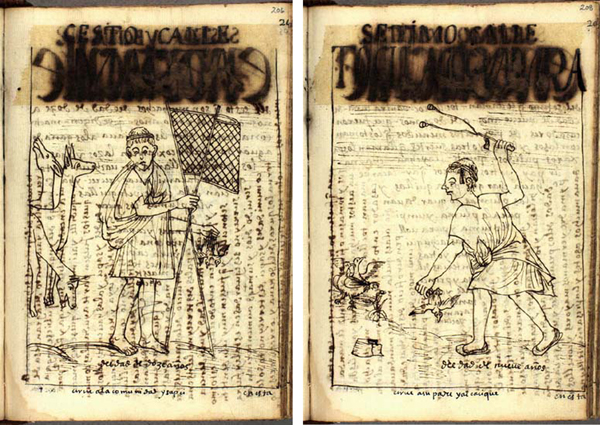
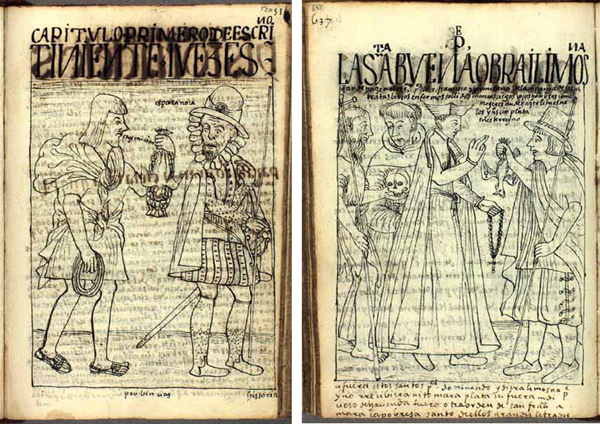
All this archival evidence points to the continuity of the usage of feather-work and trade with feathers beyond the Spanish conquest. Quechua nobleman Felipe Guaman Poma de Ayala illustrates that adolescent bird catchers worked for local caciques (Figures 6–7). The birds’ feathers were manufactured into fine feather textiles and other ‘gallantry’. Such birds continued to be precious trading goods after the Spanish conquest (Figures 8–9), simply because feathers remained an esteemed and prominent element of material culture in colonial Peru.Footnote 65 Anton Guallarima, a mason living in Lima in 1579, is a good example for the dual association of feather-work with an indigenous past and colonial present: he stored five feather-work items (plumajes) next to a silver ribbon used for a Mexican hat and ten Inca headgears (llautos).Footnote 66 The interpreter Juan Maldonado Cornejo, who lived in Cuzco in 1657, rated ‘a white and green feather panache from Castile’ among his most valuable possessions. The entry explicitly states the high cost of such items.Footnote 67
Adolescent bird catchers in Inca and colonial Peru. Guaman Poma, Nueva corónica y buen gobierno (1615), 204 [206], 206 [208]. Det Kongelige Bibliotek København, GKS 2232 4°. Published with the permission of the Royal Danish Library.

The exchange of birds between native/mestizo Peruvians and Spanish noblemen/friars in colonial Peru. Guaman Poma, Nueva corónica y buen gobierno (1615), 516 [520], 637 [651]. Det Kongelige Bibliotek København, GKS 2232 4°. Published with the permission of the Royal Danish Library.

Colonial society thus dynamized the cultural value of feather-work: on the one hand, it was clearly associated with an indigenous past, and on the other, feathers were increasingly valued as gallant objects. The high esteem in which the products of Spanish feather-workers were held in sixteenth- and seventeenth-century Iberia also effected the material world of the empire's colonial societies.Footnote 68 In Peru, for instance, Spanish noblemen used to wear prominent feathers on hats.Footnote 69 Theologians in Baroque Cuzco contested the traditional association of feathers with indigenous belief by reinterpreting (ostrich) feathers as symbols of the Virgin Mary.Footnote 70 Such material fashions and interpretative adaptations presumably promoted the continuity of feather-working craft exactly because of the fact that such items, as inventories illustrate, could not be mass produced.
The Museo de América in Madrid proves that feathers decorated domestic spaces in the seventeenth- and eighteenth-century viceroyalty of Peru. Knotted on tapestries of a size of 200 × 149 cm, and 238 × 160 cm, high-end feathered items displayed floral, geometrical, and avian motifs.Footnote 71 According to the late sixteenth-century Andean storytellers in the Huarochirí manuscript, indigenous lords of ancient times decorated their houses with similar feather-weavings so that the dwellings ‘were thatched with wings of birds…Seeing that this man (named Tamta Ñamca) lived so well, people who came from all the villages paid him homage and worshipped him.’Footnote 72 Colonial memories of such feather-tapestries’ ability to spark veneration and appreciation surely prompted the desire to possess and display similar feather tapestries for staging wealth and status – especially as it was customary that Spanish authorities also commissioned local weavers to produce fine tapestries displaying coats of arms.Footnote 73 The Cuzco-born Father Francisco de Avila, who read the Huarochirí manuscript in detail when preparing his ‘Treatise on the false gods’ published in 1608, commented on such feather tapestries stating that houses were decorated with yellow and red feathers.Footnote 74 The example of the Museo de América in Madrid shows that Peruvian feather-workers cultivated similar knotting techniques as pre-Columbian artisans when producing feathered tapestries in colonial times. The fact that the cotton ground was painted in the colours of the later attached feathers hints at the possible collaboration between the crafts of textile production and feather-working.Footnote 75
The British Museum holds another feather textile of 81 × 54 cm from sixteenth- or seventeenth-century Peru.Footnote 76 The artefact demonstrates, again, the intricate knotting techniques which craftsmen applied to make feather-work an art of cultural significance. The conscious arrangement of the feathers in accordance with their graduated sizing and colour emphasized the textile's colour vibrancy. A close analysis of the artefact reveals the continuities as well as discontinuities of material culture beyond the Spanish conquest. The supportive cotton yarn clearly changes as the ground is woven in a denser composition in contrast to the appreciation of ‘openweave’ aesthetics in Inca visual and material culture. The rather extensive usage of supportive colours and adhesive on the cotton ground of the tapestry similarly points to the artisans’ less intricate techniques.Footnote 77 The craftsmanship of feather-working, thus, clearly continued to exist in colonial Peru. The craft relied on the same principles of manual dexterity and material knowledge as before the arrival of the Spanish.
IV
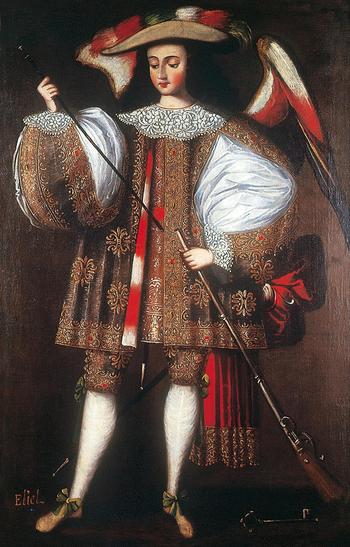
These findings regarding the continuity of feather-working in colonial Peru pose the question of how to understand this long-silenced material evidence. As researchers assumed the non-existence of colonial feather-work, feathers were widely interpreted as mere symbols of indigenous nostalgia and resistance. Art historians, for instance, considered the reference to feathers in portraits of armed angels (Figure 10), a widespread genre in seventeenth- and eighteenth-century Cusco, as a hint of indigenous belief and resistance.Footnote 78 Given the significance of knotting techniques for the making of feathered cloths, however, it does not seem to be a coincidence that these paintings show hats with dyed, stitched, and manually bended feathers alongside a detailed depiction of golden embroidered textiles. It is exactly this context, I argue, in which early modern feather-work has to be situated; and which reshapes our understanding of cultural contacts in colonial Peru.
Anonymous Cuzco School, Archangel Eliel with Harquebus, c. 1690–1720, Museo de Arte de Lima. © Wikimedia Commons, unidentified photographer.

Instead of comparing ‘indigenous objects’ solely with ‘European texts’, it is important to reconstruct the feather-work's embeddedness in early modern cultures of making. This allows researchers to compare Peruvian and Spanish objects on the very same analytical level. As crafted objects, Peruvian feather-work gained meaning within the material culture of textiles in general, and a broader literacy of knots in particular. Anthropologist Tim Ingold emphasizes the links between the cognitive achievements of knotting, weaving, and literacy by stating that ‘the verb “to weave”, in Latin, was texere, from which are derived our words “textile” and…“tissue”’.Footnote 79 Early modern English dictionaries define ‘texture’ as weaving or knotting, thus illustrating that Ingold's understanding was shared by early modern protagonists.Footnote 80 The writings of European, white men, however, should not serve as a precondition for the definition of cultural literacy. On the contrary, the Peruvian context allows researchers to rethink cultural contacts in the early modern period by conceptualizing the literacy of knotted feather-work from a very material point of view: the focus on the period hand.
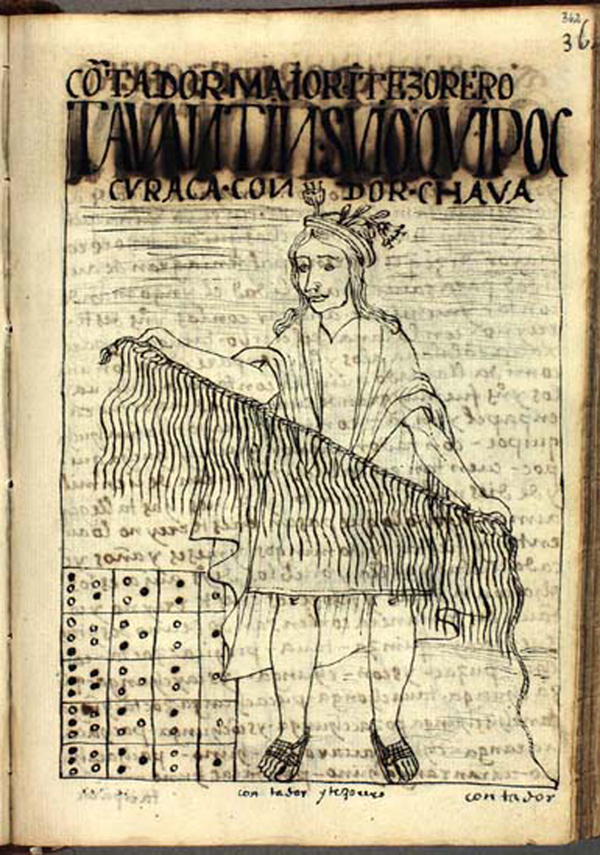
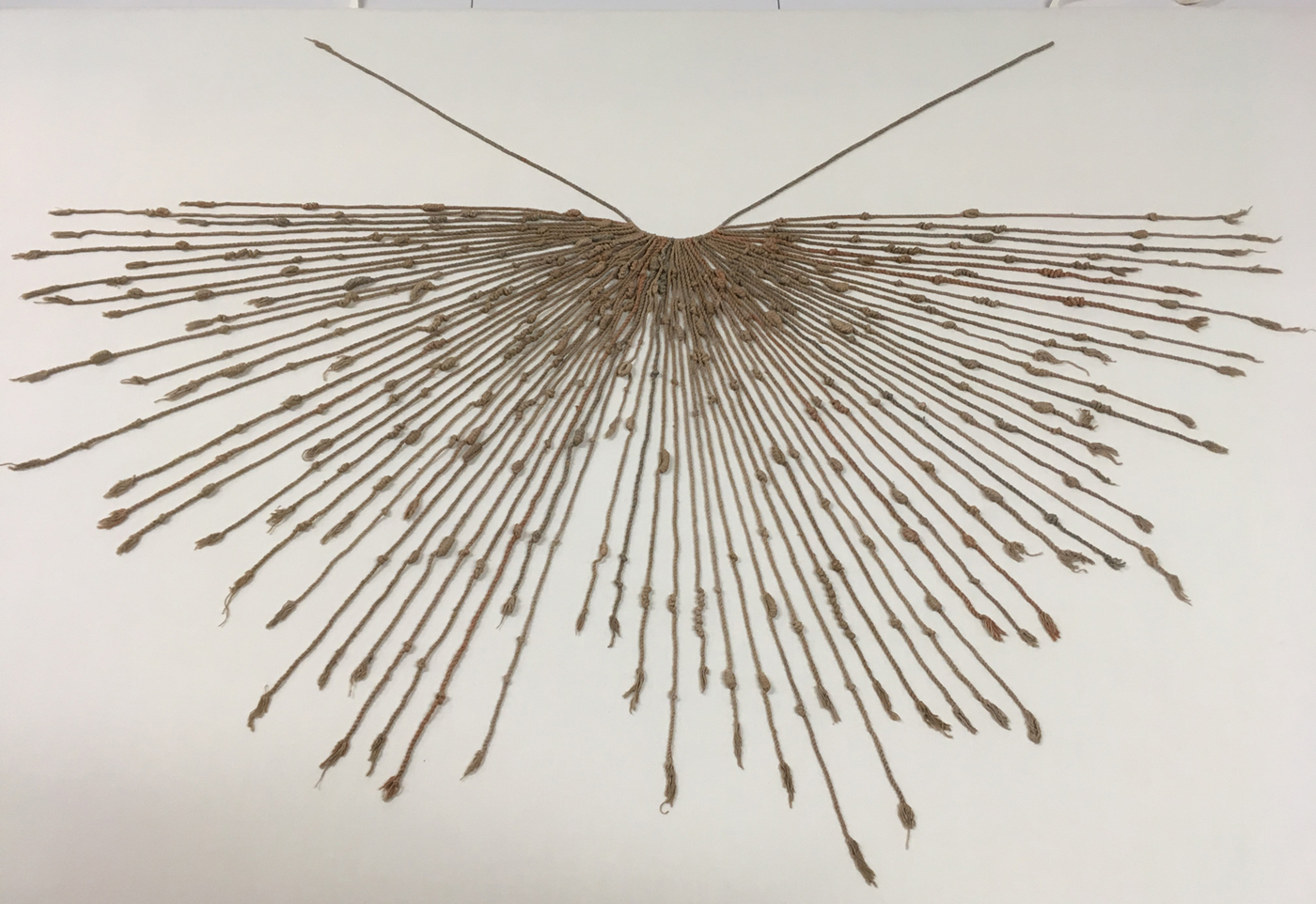
The feather-workers’ highly elaborated artisanal techniques, much praised by Europeans like Martyr, Dürer, or Pizarro, gained broader cultural meaning in pre-Spanish Peru: here, indigenous people cultivated a ‘literacy of knots’ in both textiles and khipus – a set of woollen or cotton strings and twisted cords that were knotted to a master cord. The Inca Empire's administration relied on the usage of these khipus. The usage of different colours, various types of knots, and the knots’ exact position made these a tool for the transmission of information and narratives that were only legible to privileged officials (Figures 11–12).Footnote 81 The Spanish admired such knotting techniques. As a chronicler states,
Those who were the accountants and understood the meaning of these knots could reckon by them expenditures or other things that had taken place many years before…By these knots they kept the account of the tribute to be paid by the natives of that district in silver, gold, clothing, flocks, down to wood and other more insignificant things, and by these same khipus at the end of a year, or ten, or twenty years, they gave a report to the one whose duty it was to check the account so exact that not even a pair of sandals was missing.Footnote 82
Spanish writings further underline the fact that the knotting activities of feather-workers took place within the broader chaîne opératoire of fine textiles. The Jesuit Bernabé Cobo wrote in the mid-seventeenth century, full of admiration, about the ‘excellent weaving’ that indigenous Peruvians produced with the simplest tools.Footnote 83 ‘The implements used to make these cloths are few and simple…The distaff for spinning…consists of nothing more than a small stick one tercia (eleven inches) long and no thicker than a finger.’ Also, ‘their looms are small and so inexpensive and crude that with two poles as thick as an arm and three or four cubits long the loom is set up’.
An official in charge of the khipus. Guaman Poma, Nueva corónica y buen gobierno (1615), 360 [362]. Det Kongelige Bibliotek København, GKS 2232 4°. Published with the permission of the Royal Danish Library.

A twisted and knotted cord segment (khipu) excavated in the Pacasmayo Valley (North Coast of Peru), c. 1430–1530. British Museum, Am1907,0319.286. © Photograph by author.

Cobo was especially taken by the manual skills of Peruvian cotton spinners, weavers, and feather-workers. They were so skilled, in his opinion, that ‘as long as they are not doing something (else) with their hands, walking does not interfere with their spinning’. All threads used are doubled and twisted. ‘With this and no other apparatus or implements, they make as tight a weave as our silks. And all their textiles…were finished on both sides, a job that requires great skill, and not surprisingly, it causes us to marvel.’ Above all, Cobo marvelled at the ‘fine and valuable’ cumbi, woven textiles ‘with feathers woven into and fixed over’. The Spanish admired the delicate fineness of these textiles, which were restricted to the usage of ‘the kings, the great lords, and all the nobility of the kingdom’. Cobo explains that the artisans ‘fastened’ the feathers ‘on the cloth with a fine, wool thread, laying them to one side, and making with them the…patterns’. Called cumbi camayos, male and sometimes also female craftsmen specialized in manufacturing these cloths and tapestries and continued their craft in colonial times, producing cumbi with the coat of arms of the commissioners. ‘However, the cumbi that they make today is nowhere near as fine as it was in ancient times.’
When describing the knotted feather-work as manufactured objects of marvel, produced through sheer manual dexterity despite the scarcity of tools, Cobo applied the common rhetoric of ingenuity readers were familiar with from the writings of Martyr. The latter admired various kinds of indigenous knotting techniques, such as how indigenous settlers in Hispaniola mastered the complex arte laboratas for attaching palm leaves on houses. Similarly, Martyr was amazed at the degree of manual dexterity necessary to manufacture fishing nets of unique quality.Footnote 84 But Cobo's descriptions were not mere tropes of ingenuity. They also refer to the excitement that seeing and touching such finely knotted feather textiles were able to evoke among Spaniards.
Pedro Pizarro, meanwhile, was struck by sheer amazement when seeing and studying the feathered items he found in the Inca storehouses in Cuzco. The golden turnsole feathers as well as ‘many other plumes of divers colours for the purpose of making clothing with which the Lords and Ladies bedight themselves’, for instance, were ‘twisted into a thin cord closely wound about a framework of maguey in such fashion as to form pieces more than a palm wide, and the whole was fastened upon certain chests’. Seeing such skilfully arranged feathers, as well as intricately crafted feathered textiles, made Pizarro ‘wonder how so many turnsole feathers could have been gathered together’. He marvelled at the ‘dexterity of the work’ especially as ‘the whole was so covered with these spangles (and similar materials such as feathers) that nothing of the closely woven network (which formed the basis of the garment) was visible’.Footnote 85
The Spanish interest in knots, indeed, resulted from the fact that indigenous and Spanish artisans alike cultivated the aesthetics of knots.Footnote 86 In this shared material world, highly esteemed knotting techniques and textures of textiles should lead to a reconsideration of Peruvian feather-work with regard to the period hand, and thus the manual dexterity, tangible production, and haptic perception of feather-work. Cobo compared feathered cumbi with European silk, silver cloth, and velvet. The feathers ‘were made on the cumbi itself’, he states, ‘but in such a way that the feathers stand out on the wool and cover it like velvet’.Footnote 87 This comparison was anything but a coincidence. The intricate knotting techniques and shiny surface of New World feathers and indigenous feather-work reminded many contemporaries of high-quality velvet.
Cormorants ‘that rest on the water’, wrote Gonzalo Fernández de Oviedo in his natural history in 1526, ‘appear to be a piece of velvet or black cloth’.Footnote 88 For expressing his astonishment and excitement when seeing splendidly coloured feathers in the Inca storehouses of Cuzco, Pizarro likewise applied the vocabulary used to classify textiles. He called these goldish-shiny items ‘turnsole feathers’ (plumas tornasol) – i.e. ‘feathers turned to the sun’ – a late fourteenth-century Castilian term used to describe Spanish luxury fabrics worn by the Iberian nobility.Footnote 89 Throughout the early modern period, this term was increasingly used to label ‘some of the finest and most subtle textiles produced by highland Andean weavers’. Elena Phipps shows that such textiles – ‘constructed of native camelid fiber warp and imported silk weft, in a simple warp-faced weave’ – increasingly ‘became an important component in high status native dress and exemplify the integration and adaptation of a European tradition within the Andean weaving vocabulary’.Footnote 90
This particular context made tornasol a powerful word for describing Peruvian feathers and feather-work. An early seventeenth-century Aymara dictionary defines tornasol (huateca isi) as ‘silk that when turned in one way appears as one color, and in another way, as another color’.Footnote 91 These were the visual effects that strikingly iridescent and coloured feathers produced when being handled by materially proficient Spaniards, like Pizarro, who applied textile-related vocabulary in order to capture the visual and emotional experience of seeing, touching, and using feathers. Similarly noteworthy is that indigenous artisans of other American contexts spun feathers with particularly shaped spindle whorls. Being found in recent archaeological excavations, for instance, in Mexican sites, such feather spindle whorls underline the close relationship between the manufacturing of feather-work and textiles.Footnote 92 In 1578, then, Jean de Léry also applied the same comparison between feathers and textiles when describing the ‘extreme beauty’ of Brazilian feather-work:
When these feathers have been mixed and combined, and neatly bound to each other with very small pieces of cane and cotton thread (there is no featherworker in France who could handle them better, nor arrange them more skilfully), you would judge that the clothes made of them were of a deep-napped velvet.Footnote 93
Léry's praise of artisanal ‘workmanship’ reveals how much Europeans marvelled and studied the knotting techniques of indigenous feather-work in relation to knotted and woven textiles with striking haptic qualities.
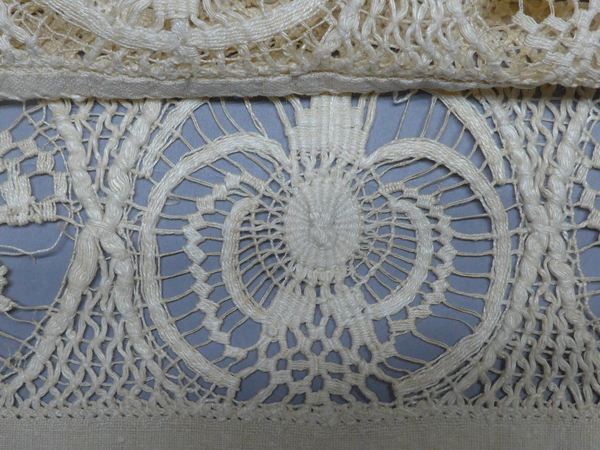
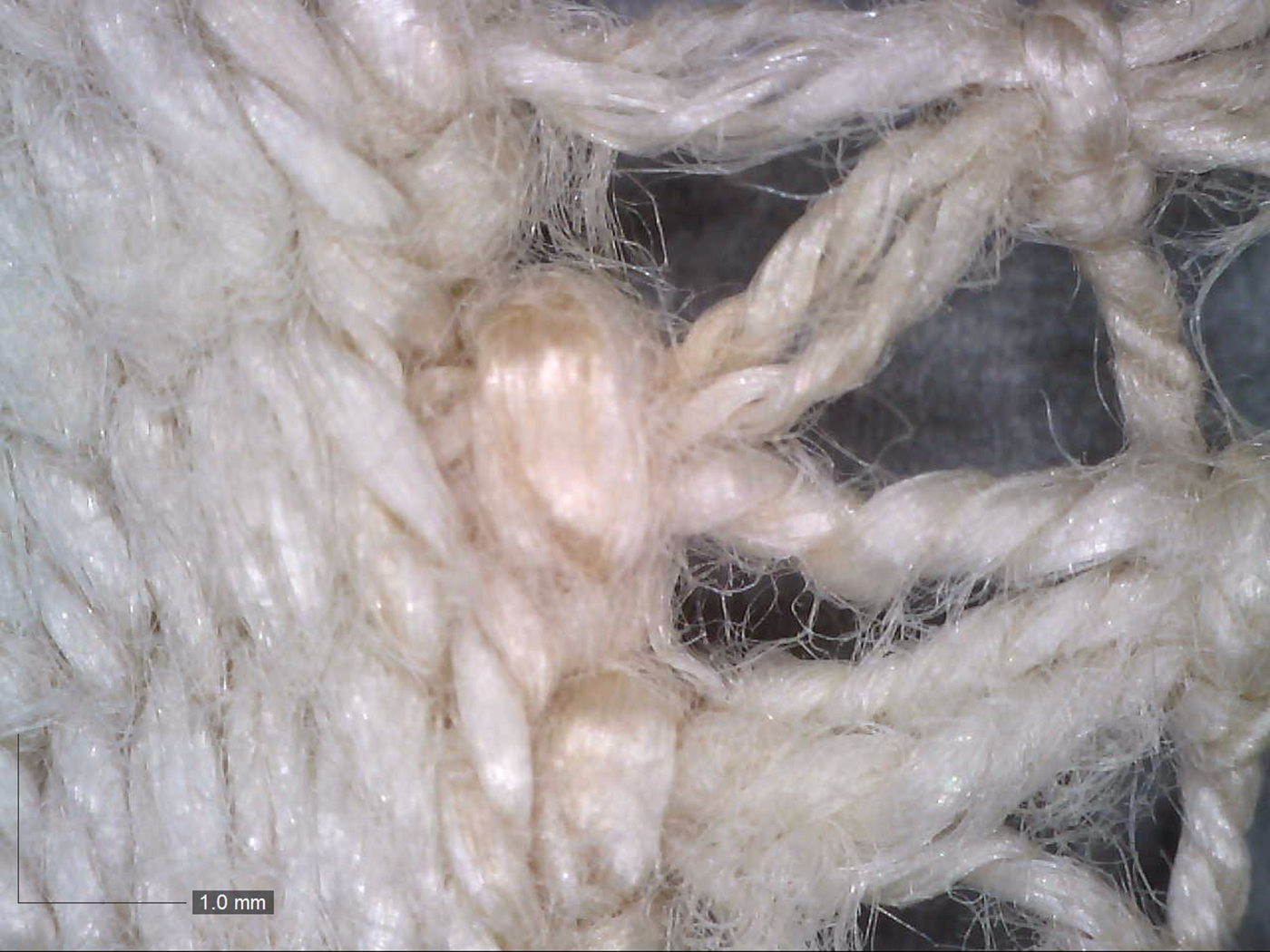
The emotional appeal of South American feather-work clearly has to be situated in the material culture of textiles. In his Agvdeza y arte de ingenio (1648), Baltasar Gracián refers to plumes and knots as mere metaphors, but these were the elements in which discourses on ingenuity took on their material guise.Footnote 94 In sixteenth-century Madrid, tailors started to theorize their craft as an art in relation to geometry and the drawing of patterns later on sewn together (traça).Footnote 95 Castilian artisans manufactured encaje de bolillos, cloths on which a variety of different kinds of knots composed a geometrically uniform pattern that resulted in fine lacework.Footnote 96 The fact that female artisans often started to learn the knotting techniques as children indicates the intricacy of such manual skills (Figures 13–14), which were also visible in Peruvian churches.Footnote 97 Many Spanish artisans skilled in silk and gold embroidery, often originally from Seville and Toledo, settled in Peru and established their workshops for which native Andeans are recorded as master embroiderers shortly afterwards.Footnote 98
Detail of a Spanish encaje de bolillos, c. 1600–1650 (224 × 74 cm). Museo Nacional de Artes Decorativas (Madrid), CE2048. © Photograph by author.

Early seventeenth-century Spanish lacework. Detail of Museo Nacional de Artes Decorativas (Madrid), CE2048. Photograph taken with a Dino-Lite USB microscope AM7013MZT, 52 magnification scale. © Photograph by author.

These artisans’ products were the textiles that Spaniards had in mind and were using when seeing and touching Andean weavings and knotted feather-work for the very first time. In the fifteenth century, Italian velvet-makers settled in Spain and manufactured an increasingly desired product for urban and courtly elites. When authors liken the craftsmanship of indigenous artisans to that of velvet-makers, it helps to bring to mind that velvets in Renaissance Spain were produced on looms whose patterns contained about 14,000 knots, each composed of around 600 threads.Footnote 99 As weaving was a complex cognitive achievement,Footnote 100 its comparison with feather-knotting made feather-work a similarly high-valued act of material processing. As contemporaries compared feather-work with velvets, Martyr's statement that nature cannot be imitated as perfectly with embroidery or wax as with feathers also implies that the arrival of New World feather-work meant the introduction of a serious competitor in the Spanish textile market.Footnote 101
It is thus not surprising that velvet-makers studied the material properties of feathers in detail. The Tuscan velvet and brocade merchant Simone dal Verde wrote from Valladolid in 1494 that he admired the
very large and beautiful parrots. Their feathers are green, red, black, and of other colors; and they have long tails, as green as parrots do. I measured one of them and found it to be from head to tail, that is, to the end of the tail, one braccio and a quarter long, or thereabouts…They (the returning Spaniards) say they (the Native Americans) keep them for their feathers with which they make certain plumes and other very beautiful adornments.Footnote 102
In response to this haptic excitement and material engagement with feathers, fibres, and fabrics, New World feathers travelled across the globe and European artisans, who studied feather-work in detail, specialized more and more in manufacturing feather-work themselves.Footnote 103 At the Spanish court, royal plumajeros stitched feathers to hats and costumes. The Madrid feather-worker Juan Pérez was thus not only a plumajero, but also a cordónero (cord- or thread-maker).Footnote 104 This observation is in accordance with other archival documentation. At the south German court of Stuttgart, for instance, archival evidence is proof that feather-workers were not only paid for preparing, cutting, dyeing, and stitching feathers, but also for twisting and manufacturing hat cords and silk cords between 1592 and 1629.Footnote 105 Due to this European and Spanish excitement for intricate techniques of knotted feather-working, this particular craft was able to survive Spanish conquest, despite the fact that Peruvian feather-work was widely associated with indigenous material culture.
V
In sum, early modern feather-work – Peruvian as well as European – was compared with and experienced in relation to embroidery and knotted textiles. This means that the period hand of early modern artisans working with feathers across cultures should be considered. The production of sixteenth-century feather triptychs by plumajeros, for instance, then has to be addressed in relation to embroidered retables manufactured in late fifteenth-century Spain.Footnote 106
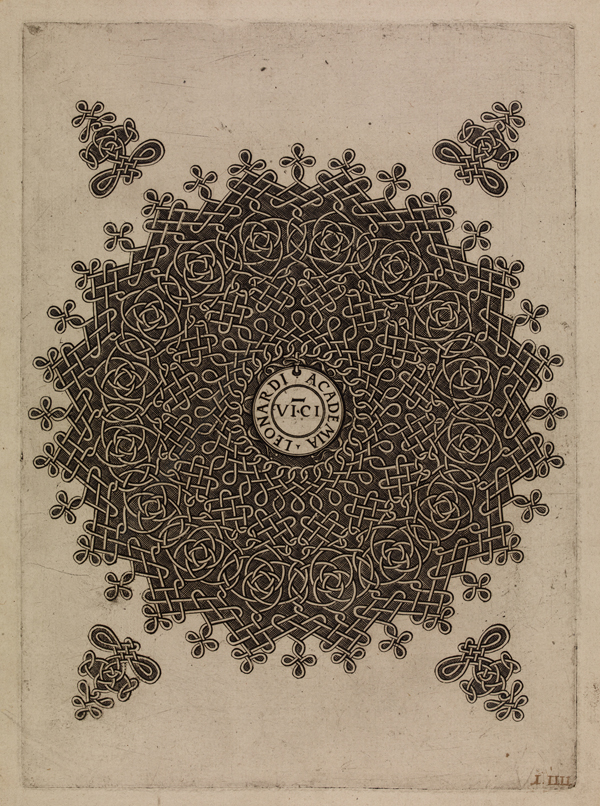
The aesthetics of knots were central for the concept of ingenuity that Europeans applied for the description of experiencing, seeing, and handling indigenous feather-work. Giorgio Vasari, for instance, lauded the ingenuity of Leonardo da Vinci, who ‘spent a great deal of time in making a pattern of a series of knots, so arranged that the connecting thread can be traced from one end to the other and the complete design fills a round space’.Footnote 107 These prints circulated widely amongst sixteenth-century craftsmen who trained their eyes and hands to translate these aesthetics into manufactured objects (Figure 15). Such designs of knotted interlace patterns were copied and adapted by Dürer, the same artist who praised intricately knotted feather-work from the Americas for its ‘subtle ingenuity’.
Knot design after Leonardo da Vinci, c. 1490–1500. @ The Trustees of the British Museum, 1877,0113.364.

The appreciation of feather-work as ingenious pieces was thus embedded in a material culture that conceptualized the aesthetics of knots in regard to ingenious hands. Joachim Camerarius praised Dürer, whose ‘hand so closely followed the ideas of his mind’; and Dürer himself, marvelling at the refined products of the hands of indigenous artisans, lauded the artist's ‘practiced hand’ in relation to ‘God's creating hand’.Footnote 108 Such rhetoric of praise was deeply rooted in pan-European humanist debates. Girolamo Cardano and Julius Scaliger, for instance, had fiercely discussed knots as examples of subtlety and ingenuity, thus, as properties of objects (Cardano) or the mind (Scaliger).Footnote 109 This intellectual background made feather-work central artefacts of taste, civility, and refinement – despite the pre-Spanish tradition of this craft.
These observations should lead to first, the acceptance and examination of the existence of feather-work in colonial Peru; and second, the study of these objects’ material composition and properties in a close material analysis using not only texts and images, but also technological devices like digital microscopes. Only the usage of the digital microscope can render the material details of such objects visible to the modern eye – which the period eye, trained in seeing miniature art, cherished as much as period hands.Footnote 110 Third, researchers have to see feather-work, which was indeed an integral part of the material culture of colonial Peru, in terms of knotted cultures. Early modern protagonists, in the Andes as well as in the Iberian Peninsula, considered the knotting techniques of feather-work as a refined skill. The manual dexterity of artisans, the texture of knotted objects, and haptic experience of engaging with feathered artefacts should prompt a rethink of the notion of literacy and cultural encounters in terms of material contacts.
We should no longer differentiate between non-literate Native Americans and literate Europeans, but between non-literacy and knot literacy. A literacy of knots, cultivated beyond the moment of conquest and shared across cultures, knotted together cultures whose material world bothered at least as much with words as with knots, with languages as with textiles, and with grammar as with techniques. In that regard, this article also shows how the study of early modern feather-work, and material culture more generally, ‘change(s) the very nature of the questions we are able to pose and the kind of knowledge we are able to acquire about the past’.Footnote 111