Narrative skills, including telling or retelling stories and answering questions about them, are a prerequisite of children's literacy and reading abilities, and thus are indispensable for academic learning (Bishop & Edmundson, Reference Bishop and Edmundson1987; Bliss, McCabe, & Miranda, Reference Bliss, McCabe and Miranda1998; Gutiérrez-Clellen, Reference Gutiérrez-Clellen2002; Hayward & Schneider, Reference Hayward and Schneider2000; McCabe, Reference McCabe, Cole, Dale and Thal1996; McCabe & Rollins, Reference McCabe and Rollins1994; Norris & Bruning, Reference Norris and Bruning1988; Swanson, Fey, Mills, & Hood, Reference Swanson, Fey, Mills and Hood2005; Torrance & Olson, Reference Torrance, Olson, Pellegrini and Yawkey1984; Wallach, Reference Wallach2008). In addition, narratives are implicated in positive social exchanges (Liles, Reference Liles1993); telling narratives can be thought of as a social activity that involves maintaining and monitoring listener involvement (Capps, Losh, & Thurber, Reference Capps, Losh and Thurber2000; John, Lui, & Tannock, Reference John, Lui and Tannock2003).
Given the importance of narratives for academics and for social relationships, narrative is increasingly addressed in assessments and interventions for children, including at-risk young children (Spencer & Slocum, Reference Spencer and Slocum2010) and bilinguals. Narrative assessments provide rich linguistic data and, furthermore, are ecologically valid (Botting, Reference Botting2002), providing a relatively natural context of data elicitation. They also reveal certain social–cognitive and metacognitive abilities (i.e., being organized, coherent, sensitive to the needs of the listener, and aware of others’ mental states; John, Reference John2001).
NARRATIVE DEVELOPMENT
Age differences
Narrative proficiency improves with age, getting more refined across the school years (Crais & Lorch, Reference Crais and Lorch1994). Berman and Slobin (Reference Berman and Slobin1994) indicated that 3-year-olds do not organize their narratives around a central theme but rather describe picture frames or isolated events. Age-related developmental shifts (e.g., in experience, feelings, thoughts, and the disappearance of childhood egocentrism) are reflected in children's personal narratives just after 4 years of age (Engel, Reference Engel1995). Children tell temporally organized stories, including beginnings, settings, and outcomes in their stories by 5 years old (Morrow, Reference Morrow1985). Complete story episodes that contain problems, character goals, plans to solve problems, and a logical ending appear at age 5–6 (Liles, Reference Liles1993). At age 7, children begin to tell stories with attempts and resolutions (Morrow, Reference Morrow1985; Stein & Glenn, Reference Stein, Glenn and Freedle1979; Westby, Reference Westby, Kamhi and Catts1991). Children further improve in the reporting of internal state responses between the ages of 6 and 11 years (Stein & Glenn, Reference Stein, Glenn and Freedle1979), and at age 9, they attribute inner states and affective responses to the protagonist more effectively than do younger children (Berman & Slobin, Reference Berman and Slobin1994).
Multiple studies have demonstrated developmental growth in narrative macrostructure (Heilmann, Miller, & Nockerts, Reference Heilmann, Miller and Nockerts2010; Muñoz, Gillam, Peña, & Gulley-Faehnle, Reference Muñoz, Gillam, Peña and Gulley-Faehnle2003; Ukrainetz et al., Reference Ukrainetz, Justice, Kaderavek, Eisenberg, Gillam and Harm2005). Muñoz et al. (Reference Muñoz, Gillam, Peña and Gulley-Faehnle2003) elicited fictional narratives (using the picture book Frog, Where Are You?) from children aged 4 and 5 years. Results indicated that the older children produced more complete episodes than did the younger children. More recently, Heilmann, Miller, and Nockerts (Reference Heilmann, Miller and Nockerts2010) elicited fictional narrative retellings from American children aged 5–7 years, and found that narrative macrostructure improved within this age range. Ukrainetz et al. (Reference Ukrainetz, Justice, Kaderavek, Eisenberg, Gillam and Harm2005) elicited fictional narratives from children aged 5–12 years, and discovered that narrative elements reflecting children's thoughts, insights, and perspectives about events (expressive elaboration) also tended to increase with age.
While monolingual children generally become better storytellers as they get older, the same may not necessarily be true of bilingual children, or changes in age may be moderated by other factors. For example, research with Spanish–English bilingual children aged between 5 and 8 years old living in the United States has shown that aspects of narrative abilities (i.e., narrative structure) are related not only to age but also to language proficiency (Gutiérrez-Clellen, Reference Gutiérrez-Clellen2002; Montanari, Reference Montanari2004).
Gender differences
Few studies have examined gender differences in story production or comprehension, but some of the literature on narrative development suggests there might be differences between girls and boys. During the preschool years, girls have been found to produce longer and more connected and coherent narratives (Eriksson et al., Reference Eriksson, Marschic, Tulviste, Almgren, Pereira and Wehberg2011; Roulstone, Loader, Northstone, & Beveridge, Reference Roulstone, Loader, Northstone and Beveridge2002; Sheldon & Engstrom, Reference Sheldon, Engstrom, Thornborrow and Coates2005). Sheldon and Engstrom (Reference Sheldon, Engstrom, Thornborrow and Coates2005) claim that girls are more aware of their own and other people's thoughts and feelings, and if this is the case, one might expect them to provide more subjective state mentions than boys do in their stories. Fivush, Haden, and Adam (Reference Fivush, Haden and Adam1995) found that at age 4, girls told longer personal narratives than boys did and used more internal state language, and observed such differences up to 7 years of age (Fivush, Brotman, Buckner, & Goodman, Reference Fivush, Brotman, Buckner and Goodman2000; Fivush & Buckner, Reference Fivush, Buckner, Fivush and Haden2003; Fivush et al., Reference Fivush, Haden and Adam1995). Lips (Reference Lips2001) and McEwen (Reference McEwen, Park and Kim1996), who studied school-age children, also reported that girls in their studies produced relatively more internal responses in their retellings.
Other studies show contrary or mixed results. In a study of children aged 6 to 11 (roughly half boys and half girls), no significant main effect of gender was found on retelling story grammar components; however, there was a significant two-way interaction between age group and gender (girls) in the reporting of attempts (John et al., Reference John, Lui and Tannock2003). In the same study, no age or gender differences were found in story length and story comprehension, though girls were more accurate in responding to inferential comprehension questions. In a study assessing the narratives of second-grade African American children, no gender differences were found in macrostructural components such as introductions, character development, and mental states (Hutchison, Reference Hutchison2012). However, Mainess, Champion, and McCabe (Reference Mainess, Champion and McCabe2002) examined the personal narratives of older African American children (11–15 years old) and found that girls produced more elaborate narratives than did boys (as measured by the complexity of their story propositions).
Narrative tasks
Two tasks commonly used to assess children's narrative skills are telling (story generation) and story retelling. In story generation, children are often shown pictures and asked to tell a story, which is scored on the basis of appropriate content, detail, and sequencing. In story retelling, children are typically asked to retell a story that has been read to them, and thus the task involves auditory verbal memory (John, Reference John2001). Some have argued that the demands placed on attention, memory, and interest by retelling a story make these tasks insensitive to young children's comprehension (Gibbons, Anderson, Smith, Field, & Fischer, Reference Gibbons, Anderson, Smith, Field and Fischer1986). However, others have found that retelling can enhance story comprehension and facilitate production of story structure and language complexity (Gambrell, Koskinen, & Kapinus, Reference Gambrell, Koskinen and Kapinus1991; Morrow, Reference Morrow1985). With respect to production, the “telling” format is potentially more difficult than a retell, because the child is required to generate his/her own story without the benefit of a prior script (Gagarina et al., Reference Gagarina, Klop, Kunnari, Tantele, Välimaa and Balčiūnienė2012a). In comparison to telling a novel story, retelling a story that has just been heard may be easier (Louchheim, Reference Louchheim2012), though retelling, like telling, necessitates pragmatic and metacognitive skills to organize the story and adapt it to the listener (John, Reference John2001).
NARRATIVE MACROSTRUCTURE AND COMPREHENSION
Regardless of whether narratives are personal or fictional, spontaneous or elicited, they all consist of two “structures”: macrostructure and microstructure. While microstructure deals with language itself, macrostructure pertains to the higher order organization of a text. Macrostructure, the focus of this study, is understood here as text organization, including episodic structure and story grammar components (Heilmann, Miller, & Nockerts, Reference Heilmann, Miller and Nockerts2010). Traditionally, story structure has been analyzed in terms of the elements of a complete episode, constituted by the character's purpose or goal, goal-oriented action, and a direct consequence; the sequences of these components create a meaningful text, which is a narrative (Trabasso & Nickels, Reference Trabasso and Nickels1992; Trabasso & Stein, Reference Trabasso, Stein, van den Broek, Bauer and Bourg1997).
In our study, we examined macrostructure for production as suggested in the Multilingual Assessment Instrument for Narratives (MAIN; Gagarina et al., Reference Gagarina, Klop, Kunnari, Tantele, Välimaa and Balčiūnienė2012a; see Foreword in this issue and the Method of this study). The MAIN components include story structure, story complexity, and internal state terms. Internal state terms reflect the child's understanding of the storyline, particularly her/his ability to spot and articulate the intentions and activities of protagonists (Curenton & Justice, Reference Curenton and Justice2004; Heilmann, Miller, Nockerts, & Dunaway, Reference Heilmann, Miller, Nockerts and Dunaway2010; Nippold, Ward-Lonergan, & Fanning, Reference Nippold, Ward-Lonergan and Fanning2005)-; they are an indispensable part of the macrostructure.
Narrative comprehension can also be assessed with the MAIN through questions that are asked after a child produces or retells a story. The comprehension questions target the main macrostructure component (the character's goal) as well as internal state terms (Gagarina et al., Reference Gagarina, Klop, Kunnari, Tantele, Välimaa and Balčiūnienė2012a). Well-designed goal structure elements in a story (such as those found on the MAIN) are intended to facilitate comprehension. In children, development of narrative comprehension processes reaches a critical period between 3 and 5 years of age. From age 6, these processes continue to be refined until age 9, when sensitivity to goal structures and inferences resemble adult comprehension (Burris & Brown, Reference Burris and Brown2014).
Compared to free recall questions (e.g., “What can you remember from the story?”), cued recall questions (e.g., “Who was in the tree?” or “Why did the mother bird leave the nest?”) are useful for retrieving information from mental representation and also facilitate accurate comprehension (Lorch, Milich, Astrin, & Berthiaume, Reference Lorch, Milich, Astrin and Berthiaume2006). In addition, there are studies claiming that retelling significantly improves children's story comprehension, remembering of story information, sense of story structure, and oral language complexity (John et al., Reference John, Lui and Tannock2003).
NARRATIVES OF TURKISH MONOLINGUALS AND BILINGUALS
Studies of narratives by Turkish-speaking bilinguals living in different countries have mostly focused on linguistic forms that contribute to the referential content of discourse. For example, the acquisition of cohesive devices has been studied in Turkish–Dutch bilingual children (Aarssen, Reference Aarssen1996; Backus, Reference Backus1992; Boeschoten, Reference Boeschoten1990), and clause linkage in narrative tasks has been investigated in Turkish–French bilingual children (Akıncı & Jisa, Reference Akıncı, Jisa, Göksel and Kerslake1998). Other studies have investigated the conversational occasions that lead to naturalistic narratives (Aksu-Koç, Reference Aksu-Koç, Berman and Slobin1994; Küntay & Ervin Tripp, Reference Küntay and Ervin-Tripp1997). However, very few studies have investigated narrative structure in Turkish-speaking bilingual children (Maviş et al., Reference Maviş, Gagarina, Tunçer, Ünal, Yeleğen and Akyıldız2012; Maviş, Tunçer, & Akyıldız, Reference Maviş, Tunçer and Akyıldız2011), namely, macrostructure components and comprehension, and development in these areas.
Maviş et al. (Reference Maviş, Tunçer and Akyıldız2011) studied whether Turkish monolingual and Kurdish–Turkish bilingual children living in Turkey demonstrate any differences with respect to narrative macrostructure when they were asked to tell a story. Six bilingual children between ages 3 years, 6 months (3;6) and 8;4 participated in the study, along with six age-matched Turkish-speaking children serving as monolingual controls. For the bilingual children, the age of their first language (L1; Kurdish) and their second language (Turkish) onset started with birth; however, they were not exposed to Turkish as often as they were to Kurdish, and the length of exposure to Turkish varied among the participants by age until they started formal schooling with their monolingual peers.
The children were shown the pictures of Baby Birds (i.e., a story of the MAIN) on a computer screen and asked to tell a story in Turkish. Their stories were subsequently analyzed for story structure, story complexity, and the use of internal (mental) state words. The children's responses to comprehension questions about the stories were also analyzed. The results demonstrated that both monolingual and bilingual children could answer some comprehension questions correctly by about 4 years old. The appropriate use of internal state terms appeared at age 6, regardless of mono- or bilingualism; however, age and internal state terms were not correlated. On the contrary, macrostructural components and comprehension improved with age.
A second study (Maviş et al., Reference Maviş, Gagarina, Tunçer, Ünal, Yeleğen and Akyıldız2012) compared three Turkish–German bilingual boys (ages 4–6 years) to three age-matched Turkish-speaking monolingual children living in Turkey. The bilingual children lived in Berlin, in a multiethnic neighborhood with a Turkish migration background, and attended monolingual German-speaking kindergartens. Their family language was Turkish (L1) and German was the (early) second language. The two groups of children told a story based on a set of six pictures (Baby Birds or Baby Goats) and retold a story based on another set of six pictures (Cat or Dog). These picture sets comprised the pilot version of the MAIN (the final version of the MAIN was used in the present study). In the telling task, the pictures were presented two by two. For the retell task, children saw the pictures on a computer screen and listened to the audio-recorded stories, and then retold the same story while looking at the pictures (again presented two by two). At the end of each task, children were asked comprehension questions about the stories. A nonparametric statistical analysis demonstrated no difference between the monolingual and bilingual groups regarding the macrostructure components (story structure, story complexity, use of internal state terms, and comprehension) on either the tell or the retell tasks. In addition, no significant difference was detected between tell and retell tasks for the macrostructure components. However, the children had more accurate answers to comprehension questions following the retell than to questions following the tell story (i.e., the story they generated).
In sum, these two studies provided some initial insights into the storytelling abilities of Turkish-speaking children, but the samples were limited, and the results can hardly be generalized. The present study aimed to expand upon these findings, and further investigate the effects of age and task on children's narrative skills.
THE CURRENT STUDIES
The two studies reported in the present paper were specifically designed to describe the production and comprehension of macrostructure (i.e., story structure and story complexity) and internal state terms in the narrative discourse of Turkish–German bilinguals.
The first research objective was to assess the effects of age on the production and comprehension of macrostructure components in the L1 (Turkish) of bilingual children living in Germany. Previous research has shown that narrative skills, measured by means of macrostructure, start to actively develop in preschool children (e.g., Berman & Slobin, Reference Berman and Slobin1994; Fiestas & Peña, Reference Fiestas and Peña2004). Thus, we predicted a positive effect of age on productive macrostructure and on comprehension, with a steeper increase in younger children and a somewhat flatter development in older children.
The second objective was to examine how gender impacts the production and comprehension of macrostructure. As discussed earlier, findings for gender effects are mixed, but we anticipated that if there were gender differences, they would favor girls.
The third objective was to determine if different narrative tasks affect macrostructure components. In our first study, we compared the same children's responses to comprehension questions in two conditions: after they heard a model story (“model” condition) and after a story they told following the model, but with a different picture set (“tell after model” condition). In the second study, we examined the differences between children's performance on a “tell with no model” task versus a “retell” task for both comprehension and production. We predicted that the retell would facilitate comprehension and the production of macrostructure components, and thus result in higher scores compared to the tell with no model task. Telling formats are presumed to be more difficult (Gagarina et al., Reference Gagarina, Klop, Kunnari, Tantele, Välimaa and Balčiūnienė2012a) but provide more information about children's independent narrative formulation abilities than retelling (Schneider, Hayward, & Dubé, Reference Schneider, Hayward and Dubé2006), whereas retelling makes the production of macrostructure components easier than generating (telling) a new story (Louchheim, Reference Louchheim2012). In Study 2, we additionally compared the group's performance in the tell with no model condition to the performance of Study 1 participants’ in the tell after model condition (see Method) to determine whether the model facilitated telling a story.
METHOD STUDY 1
Participants
The participants were 36 Turkish–German bilingual children: 21 girls and 15 boys aged from 2;11 to 7;11 (M = 59.0 months, SD = 19.0 months). All were Turkish–German simultaneous bilinguals who were born in Germany and had been living in that country since their birth, and were from Turkish families. Some children were attending monolingual German-speaking kindergartens/schools, and some of the younger children were attending bilingual day care centers in Berlin, Singen, and Konstanz. The children were typically developing according to their parents and teachers, and none of them had been diagnosed with a language disorder. Before testing, all parents provided written consent agreeing to participate in the study. The parents also completed a questionnaire on the bilingual background and medical history of the child.
Furthermore, cognitive and language assessments were available for the participants (data was collected in the context of other studies in which the same children had participated). The 15 younger children, including 6 boys and 9 girls (age range = 2;11–3;10) from the Berlin Interdisciplinary Alliance for Multilingualism study took the Snijders–Oomen Nonverbal Intelligence Test (Tellegen, Laros, & Petermann, Reference Tellegen, Laros and Petermann2007). The older groups (n = 21), including 9 boys and 12 girls with an age range of 4;3–9;2, took the TEDİL (Topbas & Güven, Reference Topbaş and Güven2011), an Early Language Development Test in Turkish, developed for 2- to 7-year-olds. Children were also assessed by language tests in their dual languages. For the Berlin Interdisciplinary Alliance for Multilingualism group, language proficiency in Turkish was tested via project-internal materials targeting productive and receptive lexicon, productive verb and noun morphology, and comprehension of different sentence types. All children were within the mean scores for age-matched bilingual children. In German, children were assessed with tests normed for 3- to 6 year-old bilinguals: the Linguistische Sprachstandserhebung—Deutsch als Zweitsprache (Schulz & Tracy, Reference Schulz and Tracy2011) and the Snijders-Oomen Nonverbal Intelligence Test (Tellegen et al., 2010).
All of the tests, both in Turkish and in German, were administered to the children to ensure that mental age was within normal limits and that their language levels were sufficient to participate in the study. On the basis of the assessment information, no children were excluded because they all met the inclusion criteria of the studies.
Materials
Pictured stimulus texts, the materials of the study, are from the MAIN, which is suitable for bilingual and monolingual children from 3 to 10 years of age. The development of the MAIN pictorial stimuli was a long and scrupulous procedure. All pictures were controlled for cognitive complexity and for the number of details, and the main protagonists of the stories were controlled for frequency in child-directed speech and for the language of acquisition. About 200 variants of images were made before the desired similarity in content was achieved and the stories became almost identical (for more information on the development of the pictorial stimuli, see Gagarina et al., Reference Gagarina, Klop, Kunnari, Tantele, Välimaa and Balčiūnienė2012a, pp. 21–48).
Two of the stories (Cat and Dog) are used to provide an adult model, and depending on the goals of the assessment, can also be used to elicit retelling. Two other stories are used to elicit story generation (i.e., telling, either with or without a model, again depending on the assessment goals): Baby Birds and Baby Goats. Each story has related comprehension questions. Thus, the MAIN can be used to assess production and comprehension across elicitation modes, but specific tasks can also be selected based on the goals of assessment. The MAIN design allows for the assessment of several languages in the same child. In this study, the Turkish version (Gagarina et al., Reference Gagarina, Klop, Kunnari, Tantele, Välimaa and Balčiūnienė2012b) was used.
Procedures
The children in Study 1 were administered a model and tell task, where the child first listened to a model story (either Cat or Dog) told by an examiner and then answered the comprehension questions about the model story. Next, the child told his/her own story looking at a different set of pictures (either Baby Birds or Baby Goats), and then answered comprehension questions about the story he or she had just told (see Figure 1).
Flowchart of narrative tasks in Studys 1 and 2. In Study 1, a total of 36 children had the same narrative tasks (model story comprehension and tell another story). Study 2 included 13 children, whose results were analyzed separately and also compared to 13 children in Study 1 on some tasks.

The audiorecorded data was transcribed into CHAT format according to CHILDES transcription conventions (MacWhinney, Reference MacWhinney2000), then analyzed and scored according to the coding and scoring procedures of the MAIN (Gagarina et al., Reference Gagarina, Klop, Kunnari, Tantele, Välimaa and Balčiūnienė2012a), described next.
Story structure
Because each story contains three episodes, comprising definitions of five components worth 1 point each (i.e., setting, goals, attempts, outcomes, and internal state terms), children can obtain 15 points for these components and a further 2 points by adding a setting component for time and place; the maximal structure score is thus 17.
Story complexity
One of three levels of structural complexity was considered, depending on which elements of the story structure were produced: sequences (include no goal [G]), incomplete episodes (include a G, but lack an attempt [A] or outcome [O]); and complete episodes (include all three GAO components, all of which are fundamental elements of narrative goal structure). Because narratives follow goal-directed patterns of actions and events, understanding the links between characters’ motives and narrative events is essential for a storyteller or the listener/reader.
It was agreed in MAIN not to impose any weighting system for structural complexity, but to simply record how often a child produced sequences or incomplete episodes (AO, single G, GA, GO) and complete episodes (GAO). The number of AO (1 point), single G, GA/GO (2 points) and GAO (3 points) sequences were then examined to establish the level of narrative skills of a child. An example of a GAO sequence from the Cat story follows:
• Kedi onu yemek istiyor. (G) (The cat wants to eat it)
• Kuşları yakalamaya çalışıyo (A) (Ø tries to catch the birds)
• Kedi kuşu almış (O) (the cat caught the bird)
For the story complexity component, the maximum score is 9 (if all three GAO sequences are produced).
Internal state terms
Internal state terms focus primarily on mental state verbs, including motivational verbs (e.g., want and need), experiential expressions (e.g., see, surprised, and thirsty), belief verbs (e.g., think and know), linguistic verbs/verbs of saying and telling (e.g., say, call, and shout) and emotion words (e.g., sad, happy, and angry). Each token in a child's story is awarded 1 point. Examples drawn from our data follow:
• Annesi korkuyo (The mommy gets afraid)
• Kuş da kediye kızmış (The birds gets angry at the cat)
• Kedinin ağaca tırmandığını görmüş (Ø saw the cat climbing the tree)
Comprehension
A total of 10 comprehension questions were used to evaluate comprehension: 3 of which targeted three goals in each episode, 6 related to the understanding of internal state terms as initiating event and reactions, respectively (2 × 3 episodes), and 1 last question targeting theory of mind.
Transcription and coding reliability
The narration sessions were audio- or videorecorded. Stories were transcribed, scored, and analyzed by the first and the second author in terms of macrostructure components. The audio-recorded data was transcribed by a graduate student assistant in speech–language pathology into CHAT format according to CHILDES transcription conventions (MacWhinney, Reference MacWhinney2000). The narratives were analyzed and scored by the second author for macrostructure components (model comprehension, tell comprehension, story structure, story complexity, and internal state terms) according to the coding and scoring procedures described in MAIN (Gagarina et al., Reference Gagarina, Klop, Kunnari, Tantele, Välimaa and Balčiūnienė2012a). Fifteen participants (nearly 42% of the all participants in the study) were selected and rescored by the student assistant. The interrater reliability was calculated by Pearson correlation coefficient between the first and the second rater, and was high (r = .92, p < .001). The reliability was also high for model story comprehension (r = .82, p < .001), story structure (r = .81, p < .001), internal state terms (r = .93, p < .001), and tell comprehension (r = .68, p = .005).
RESULTS STUDY 1
Age
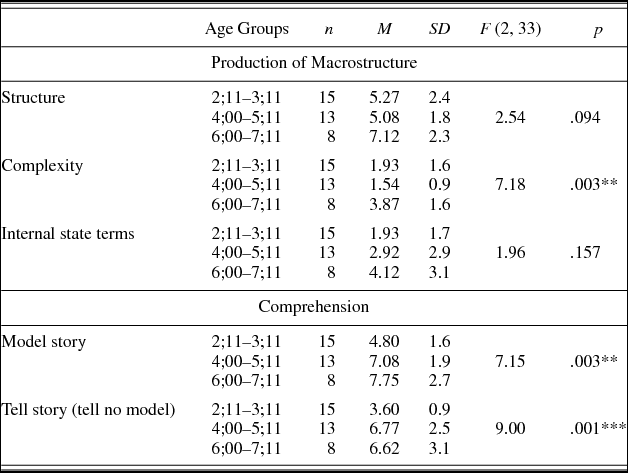
To investigate the effect of age on macrostructure measures and comprehension, the children (n = 36) were divided into three age groups: younger (age of 2;11–3;11), middle (4;0–5;11), and older (6;0–7;11; see Table 1). Alpha was set at 0.05 for all statistical analyses.
Effects of age on narrative production and comprehension in Study 1
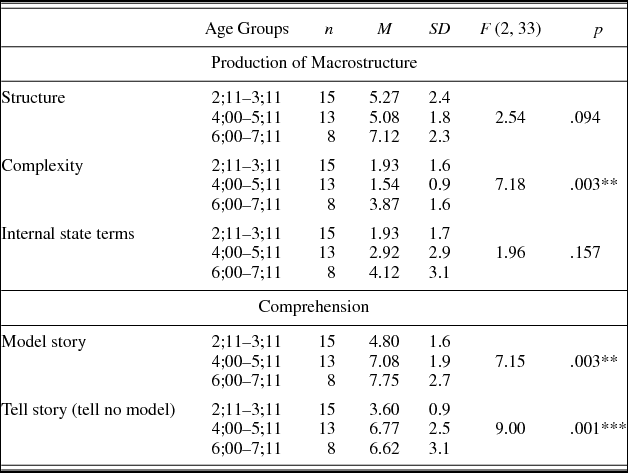
Table 1 demonstrates that story structure and internal state terms did not show significant differences between age groups, but a significant effect of age was observed on the complexity scores. Post hoc comparisons using the Tukey honest significant difference test indicated that the mean complexity scores of the younger children and the middle age group were significantly lower than the older children, but the younger and middle age groups did not significantly differ from each other.
The “model” story comprehension scores differed in the age groups. Tukey honest significant difference post hoc comparisons indicated that the scores of younger children were significantly lower than the middle age group and older children, respectively. However, the middle age group and older children did not significantly differ from each other. Another significant age effect was on tell story comprehension scores. Post hoc comparisons showed that the mean scores of younger children were significantly lower than the middle age group and older children.
We also investigated the relation between the age of Turkish–German bilingual children and the macrostructure measures by the analysis of Pearson correlation coefficients. For the production of macrostructure, age was moderately correlated with story structure (r = .414, p = .012) and story complexity (r = .508, p = .002). There was a positive but weaker relationship between age and internal state terms (r = .366, p = .028). A moderate positive correlation was also observed between age and responses to comprehension questions; that is, correct responses increased with age both in the model story (r = .540, p < .001) and in the tell story (r = .570, p < .001).
Gender
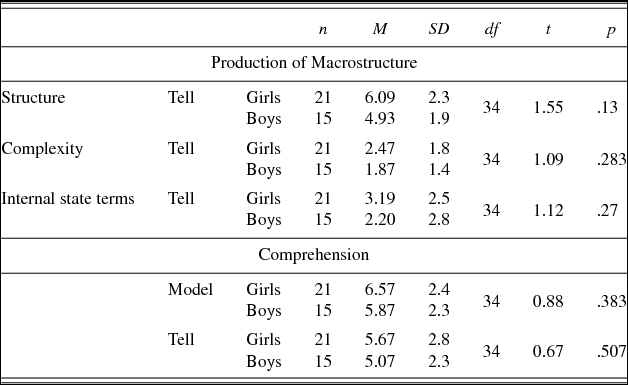
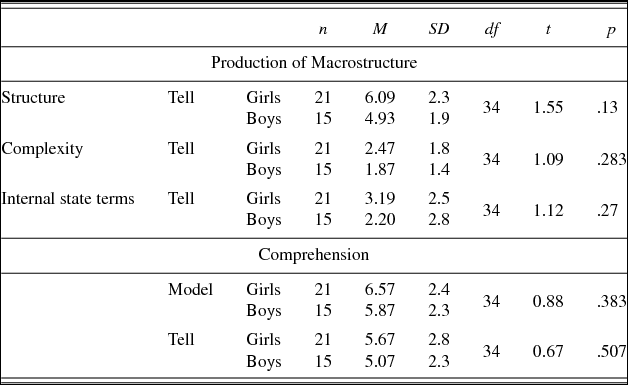
To find out whether gender made a difference, boys and girls were compared on macrostructure and comprehension measures. As shown in Table 2, the mean comparisons did not reveal significant effects of gender either on macrostructure production (tell condition) or on comprehension questions (asked after both the model and tell stories). However, the trend was in the expected direction, with girls having slightly higher means on all production and comprehension measures.
Effects of gender on narrative production and comprehension in Study 1
Narrative tasks
To investigate task effects, dependent samples t tests were conducted on children's (n = 36) responses to comprehension questions asked after the model story versus after the tell story. Results showed a significant difference between conditions, t (35) = 2.51, p = .017. The number of correct answers given to the comprehension questions of the model story (M = 6.27, SD = 2.34) was higher than the number for the tell story (M = 5.41, SD = 2.62); that is, children gave more correct responses following a model story, in comparison to responses to questions after the story they generated.
For a subset of the participants, scores on the tell after model task were also compared to the scores of children completing the tell with no model task in a separate study, as described next. Study 2 is followed by a discussion of results from both Studies 1 and 2.
METHOD STUDY 2
Participants
The participants were 13 children: 7 girls and 6 boys aged from 5;5 to 7;11 (M = 83.1 months, SD = 11.4 months). All were Turkish–German simultaneous bilinguals attending monolingual German-speaking kindergartens/schools in Berlin, Singen, and Konstanz. Cognitive and language assessments were available for the participants as in Study 1. The children participated in two tasks: tell (with no model) and retell (see Procedures below). Their tell (with no model) results were also compared to the tell after model results of a subset of 13 age- and gender-matched children from Study 1 (8 girls, 5 boys, aged 5;5 to 7;11, M = 79.4 months, SD = 12.3 months).
Materials and procedures
The picture sets from the MAIN described in Study 1 were also used in Study 2. Each child started by telling a story (either “Baby Birds” or “Baby Goats”) while looking at the pictures (i.e., the MAIN “material cards”), and then answered the comprehension questions of the selected story. Then, the experimenter told the child either the “Cat” or the “Dog” story. The child retold the same story, and afterward, the child answered the related comprehension questions (see Figure 1). The session was audio recorded. The audio-recorded data were transcribed and scored according to the MAIN procedures described in Study 1.
RESULTS STUDY 2
Age
The children (n = 13) were divided into two age groups: younger children (ages 5;5–7;0) and older children (7;1–7;11). When the groups were compared, we found no age effect on either the tell or the retell for macrostructure production (i.e., story structure, complexity, or internal state terms). On the contrary, comprehension was affected by age; the younger children significantly differed from the older age group, t (11) = –2.66, p = .022; that is, their scores (M = 5.50, SD = 3.2) for tell comprehension were lower than the older children (M = 8.00, SD = 1.8).
Gender
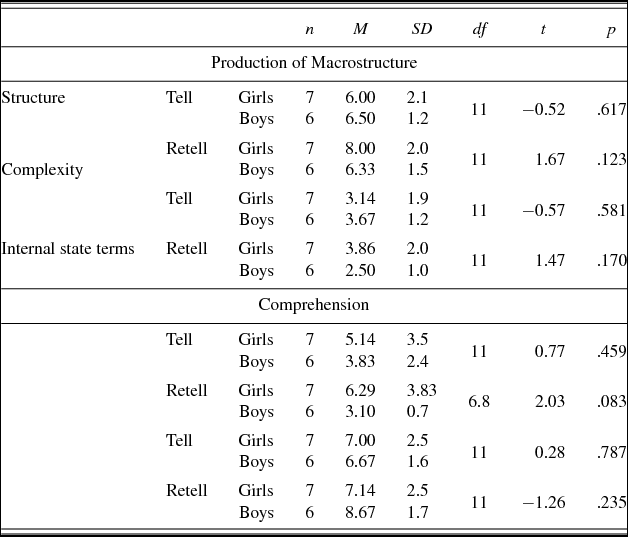
As shown in Table 3, girls scored higher than boys in the use of internal state terms in the tell and retell tasks and on structure and complexity in the retell task. Boys were better than girls in retell comprehension and in structure and complexity in the tell task. However, none of these differences were statistically significant at the .05 level.
Effects of gender on narrative production and comprehension in Study 2
Narrative task
Within-group comparison
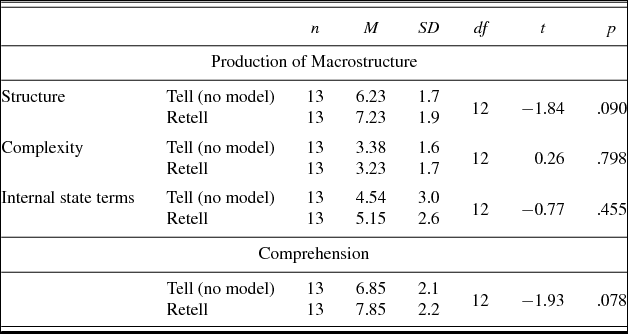
Dependent samples t tests were used to compare performance on the tell and retell tasks. As Table 4 shows, the macrostructure components did not significantly differ by task, nor did comprehension scores. However, as can be seen in Table 3, the results were in the expected direction, with higher means for the retell task.
Effects of task (tell vs. retell) on narrative production and comprehension in Study 2
Between-group comparison
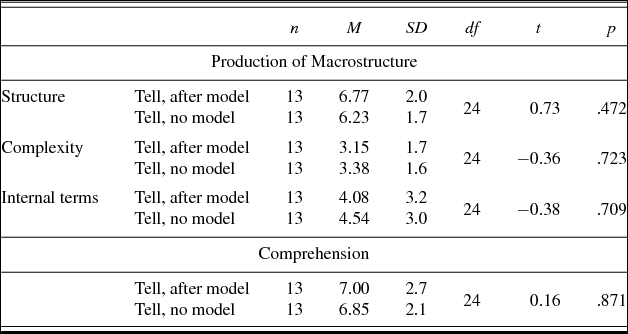
Independent samples t tests were used to compare scores on the tell task for the 13 Study 2 participants to scores on the tell task of the 13 age- and gender-matched participants from Study 1 (see Participants above). The reader will recall that in Study 2, the children told stories without a model, while in Study 1, participants told stories following a model.
As seen in Table 5, there was no group difference in either the production or the comprehension of macrostructure components; that is, the children who did not listen to the model story produced almost the same number of macrostructure components as did the other children who told the story after listening to a model story.
The effects of task (tell after model vs. tell without model) on narrative production and comprehension
Note: Between-group comparisons of a subset of participants from Study 1 in tell (after model) condition, matched by age and gender to the participants in Study 2 in tell (no model) condition.
DISCUSSION
In the first study, 36 Turkish–German bilingual children (ages 2;11 to 7;11) took part. Their narrative skills were evaluated in L1-Turkish through the analyses of the production of macrostructure components (story structure, story complexity, and internal state terms) and comprehension of picture sequence stories developed in a new assessment tool: the MAIN (Gagarina et al., Reference Gagarina, Klop, Kunnari, Tantele, Välimaa and Balčiūnienė2012a). A subset of 13 children from Study 1 were also age- and gender-matched to 13 Turkish–German bilingual children in Study 2 (ages 5;5 to 7;11) in order to further investigate key variables, as further described below.
In general, both comprehension and production of narratives can be influenced by a number of parameters; for example, the context (formal or informal), the modality (audio, visual or audio–visual input), the narrative theme and child's familiarity with the story, and the familiarity of the child's experiences as a teller or a listener (Lam-de Waal, Reference Lam-de Waal2012; Liles, Reference Liles1993). We were particularly interested in gender, age, and task effects on children's narrative skills. For task effects, we compared (a) children's comprehension after a model story and after a story each child told based on the model (Study 1), (b) production and comprehension in a tell and retell condition (Study 2), and (c) production in the tell (after model) condition in Study 1 versus the tell (no model) condition in Study 2.
Gender was examined based on some findings in the literature of superior narrative skills among girls. Researchers have long investigated whether girls have superior language abilities to boys, and some have observed that girls engage in more verbal interaction in social contexts than do boys of the same age (Buckner & Fivush, Reference Buckner and Fivush1998, Reference Buckner and Fivush2000), which could affect opportunities to develop narrative skills. In this study, the raw mean scores for macrostructure components, including mental states and comprehension, showed a trend in the expected direction (i.e., to girls’ advantage; see Table 2). However, there were no statistically significant differences. Gender differences may be found with a larger sample of participants in future studies.
The other studied factor was age. Monolingual children generally become better storytellers as they get older. Previous findings (Blankenstijn & Scheper, Reference Blankenstijn and Scheper2003; Trabasso & Rodkin, Reference Trabasso, Rodkin, Berman and Slobin1994) confirm that young typically developing children, around the age of 3 or 4 years, introduce characters and some initiating events but still have difficulties in producing complete GAO sequences. However, they can reply to questions regarding the goals of characters in a story (Trabasso & Rodkin, Reference Trabasso, Rodkin, Berman and Slobin1994). Children at 5 years old realize about half of the initiating events and attempts, which show a development toward a globally ordered narrative.
In studies with Turkish–Kurdish bilingual children living in Turkey (between ages 3;06 and 8;04; Maviş et al., Reference Maviş, Tunçer and Akyıldız2011) and three Turkish–German bilingual children living in Germany (aged from 4 to 6; Maviş et al., Reference Maviş, Gagarina, Tunçer, Ünal, Yeleğen and Akyıldız2012), macrostructure components were found to increase with age; that is, age was positively correlated with macrostructure components such as story structure and story complexity, as well as with comprehension scores. The studies also confirmed that children could begin answering the comprehension questions correctly at 4 years old and that the number of correct responses to comprehension questions then increased with age. In this study, age was found to be moderately correlated with story structure and complexity and also correlated significantly more weakly with internal state terms; as age increased, macrostructure components improved. In accordance with the correlation, children with older ages (6;0–7;11) were found to be significantly better than the ones in the youngest (2;11–3;11) and middle-age groups (4;0–5;11) in Study 1.
Comprehension, an important component to be assessed in narration, requires strategic processes such as making inferences, identifying main ideas, summarizing, predicting, monitoring, and backtracking (Paris & Paris, Reference Paris and Paris2003); therefore, it is expected to improve with age. Regardless of monolingualism or bilingualism, Turkish-speaking children in two previous studies scored better on comprehension questions following story retells (Maviş et al., Reference Maviş, Tunçer and Akyıldız2011). Age effects for comprehension in Study 1 were alluded to just above. In Study 2, comprehension scores were also significantly better in the older age group (7;1–7;11) than in the younger group, but only on the tell task; the comparison between the younger and older children on the retell task was not significant. When comprehension was considered for the whole sample (i.e., across the two age groups), the results failed to reach significance (p = .078), but were in the expected direction, favoring the retell. In addition, comprehension was significantly better after children heard a model story, than when they told a story without a model and were then asked questions.
The results imply that as children get older, they understand the story and its questions better regardless of the story tasks. The results also confirm that sensitivity to structural complexity increases with age. In previous studies, children have been found to include GAO sequences by the age of 5 years, and by 9 years of age, tend to include the same frequency of GAO sequences as adults (Trabrasso & Nickels, Reference Trabasso and Nickels1992). In this study, story complexity was affected by age (Table 1), with the youngest children (2;11–3;11) and the middle groups (4;0–5;11) both scoring lower than the older age group (6;0–7;11). No significant age difference was found between the younger children and those in the middle age group.
Manhardt and Rescorla (Reference Manhardt and Rescorla2002) claim that children are able to include in their narratives some indications of the mental states of characters as early as age 4 but continue to progress until age 9. The authors noted that children's recall of the setting, attempts, and consequences in stories develops earlier than it does for internal responses (Griffith, Ripich, & Dastoli, Reference Griffith, Ripich and Dastoli1986; Mandler & Johnson, Reference Mandler and Johnson1977; Stein & Glenn, Reference Stein, Glenn and Freedle1979) and Louchheim (Reference Louchheim2012) reports similar findings. John et al. (Reference John, Lui and Tannock2003) stated that older children in their study included internal state terms more often in the retelling tasks as compared to telling, a finding which was not confirmed in our study. Our study is interesting in that it showed no significant differences in internal state terms when these were compared by task or by the age of the children. The raw scores from Study 2 suggested that the children between ages 5;5 and 7;0 were better than older children in the use of internal state terms, on both the tell and retell tasks. This may be partly due to a preference by younger children for direct reported speech (rather than indirect), which requires linguistic state verbs before introducing quoted words or sentences (e.g., The mother goat says . . . The cat tells the bird . . .). These kinds of verbs are included in the MAIN's internal state terms and thus might explain the scores.
To summarize, the studies partly confirmed our hypotheses. Age affected the complexity of the story and comprehension in Study 1 and comprehension in Study 2. The finding that age affected only complexity but not the other macrostructural components in production might be due to the age groupings. In further studies, groupings with different or larger age intervals might be more discriminant. Nevertheless, regardless of the experimental modes of data collection (i.e., elicitation tasks) or gender, this study emphasized the better performance of the older ages in aspects of production and in the comprehension of narratives among Turkish–German bilingual children, assessed in their L1. This study, in general, contributes to our knowledge about bilingual children and their narrative development, and the task effects observed have implications for future research and clinical use of the MAIN with bilinguals.
ACKNOWLEDGMENTS
We thank the following people who helped with the study or preparation of the paper: Özlem Ünal, Didem Akyıldız, and Gülce Tüzüner from Anadolu University, Center for Speech and Language Disorders, in Eskişehir. Deniz Akpınar and her colleagues from the Berliner Interdisciplinary Alliance for Multilingualism provided great assistance in collecting the data in Germany. We gratefully acknowledge this support for the research for this paper from Grant 109K001 from TUBITAK-COST 2515 (to İ.M. and M.T.). Some studies were done in collaboration with researchers working at ZAS; many thanks to Duygu Yelegen, Tanja Rinkers, and Natalia Sürmeli who helped us in collecting data in Berlin and Konstanz and in the preparation of this paper. We acknowledge Sharon Armon-Lotem and the project team of COST Action, who gave us an opportunity to participate and share our studies in the meetings in COST Action IS0804 (Language Impairment in a Multilingual Society: Linguistic Patterns and the Road to Assessment), where portions of this study were presented. It was very fruitful and enjoyable to work with all colleagues in the Working Group for Narrative and Discourse. Financial support by COST is hereby gratefully acknowledged. We owe many thanks to the children and families who participated willingly in our assessments in Germany and in Turkey.