Conduct problems (CP; e.g., fighting or stealing) are a major public health concern and a leading cause of youth treatment referral (Bywater, Reference Bywater2012). CP youth engage in antisocial and disruptive behaviors that result in significant distress to victims, impairment of life opportunities, and economic burden on judicial, healthcare, and social welfare services (Colman et al., Reference Colman, Murray, Abbott, Maughan, Kuh, Croudace and Jones2009). In particular, an early-onset of CP (at or before the age of 10) designates a high-risk group of children, who show more severe and recidivistic patterns of antisocial behavior, higher levels of comorbid psychopathology (Barker, Oliver, & Maughan, Reference Barker, Oliver and Maughan2010), increased risk for poor adult outcomes (Fergusson, Horwood, & Ridder, Reference Fergusson, Horwood and Ridder2005; Odgers et al., Reference Odgers, Caspi, Broadbent, Dickson, Hancox, Harrington and Moffitt2007), and who account for the majority of criminal offences within a given community (Farrington, Reference Farrington, Pinard and Pagani2001). Consequently, early-onset CP are recognized as an important target for prevention and intervention efforts.
Like most complex phenotypes, early-onset CP are thought to result from the developmentally dynamic interplay of genetic and environmental influences. Studies have shown that the heritability of early-onset CP is moderate to high (~50%–80%; see Barker, Cecil, Walton & Meehan, Reference Barker, Cecil, Walton, Meehan, Lochman and Matthys2017, for a review) and that this genetic vulnerability interacts with environmental risk exposure (e.g., Jaffee et al., Reference Jaffee, Caspi, Moffitt, Dodge, Rutter, Taylor and Tully2005). Exposure to adversity during pregnancy (e.g., maternal smoking, stress, and psychopathology) as well as the postnatal years (e.g., maltreatment and poverty) is frequent among this group of children, and thought to play an important role in the development and persistence of CP behavior (Barker & Maughan, Reference Barker and Maughan2009; Moffitt, Reference Moffitt, Cicchetti and Cohen2006; Odgers et al., Reference Odgers, Caspi, Broadbent, Dickson, Hancox, Harrington and Moffitt2007, Reference Odgers, Moffitt, Broadbent, Dickson, Hancox, Harrington and Caspi2008). Yet, little is known about the biological mechanisms through which these influences confer increased risk for early-onset CP.
In recent years, DNA methylation (DNAm), an epigenetic mechanism that regulates gene expression (Jaenisch & Bird, Reference Jaenisch and Bird2003), has emerged as a potential mechanism underlying gene–environment interplay and disease susceptibility across the life span. Specifically, studies have shown that (a) DNAm patterns are under significant genetic control, as evidenced by the discovery of a large number of methylation quantitative trait loci (mQTL; Gaunt et al., Reference Gaunt, Shihab, Hemani, Min, Woodward, Lyttleton and Ho2016; Jones, Fejes, & Kobor, Reference Jones, Fejes and Kobor2013); and (b) DNAm is also sensitive to environmental influences (McGowan & Roth, Reference McGowan and Roth2015), including numerous nutritional, chemical, physical, and psychosocial exposures occurring in utero (e.g., Monk, Spicer, & Champagne, Reference Monk, Spicer and Champagne2012; Richmond et al., Reference Richmond, Simpkin, Woodward, Gaunt, Lyttleton, McArdle and Tilling2015; Tobi et al., Reference Tobi, Goeman, Monajemi, Gu, Putter, Zhang and Müller2014) and postnatally (Lutz & Turecki, Reference Lutz and Turecki2014; Szyf & Bick, Reference Szyf and Bick2013; Tyrka et al., Reference Tyrka, Parade, Eslinger, Marsit, Lesseur, Armstrong and Seifer2015). In turn, DNAm patterns have been shown to play a central role in neurobiological and developmental processes (e.g., neurogenesis, synaptic plasticity, learning, and memory; Murgatroyd & Spengler, Reference Murgatroyd and Spengler2011), and aberrations in DNAm have been implicated in a range of negative outcomes, including childhood psychopathology and stress-related psychiatric disorders (Klengel, Pape, Binder, & Mehta, Reference Klengel, Pape, Binder and Mehta2014; van Mil et al., Reference van Mil, Steegers-Theunissen, Bouwland-Both, Verbiest, Rijlaarsdam, Hofman and Verhulst2014; Weder et al., Reference Weder, Zhang, Jensen, Yang, Simen, Jackowski and Kaufman2014). Consequently, it has been suggested that DNAm may represent a molecular pathway through which environmental exposures become translated into phenotypic variation, conferring increased susceptibility to mental and physical health problems (Kofink, Boks, Timmers, & Kas, Reference Kofink, Boks, Timmers and Kas2013; Lewis & Olive, Reference Lewis and Olive2014).
For example, experimental studies in animals have shown that exposure to early adversity (e.g., prenatal stress and low postnatal care) can cause alterations in offspring DNAm (e.g., in hypothalamus–pituitary–adrenal axis genes), driving differences in the offspring's behavioral response to future stressors (Turecki & Meaney, Reference Turecki and Meaney2016; Weaver et al., Reference Weaver, Cervoni, Champagne, D'Alessio, Sharma, Seckl and Meaney2004). Because DNAm marks can be passed on during cell division (and in some cases across generations), they can lead to long-term programming of gene expression, with downstream effects on stress sensitivity, behavior, and disease risk (Rodgers & Bale, Reference Rodgers and Bale2015; Zannas & West, Reference Zannas and West2014). In the context of CP, epigenetic alterations may thus represent a mechanism through which genetic and environmental factors intersect, influencing developmental trajectories of childhood aggression and antisocial behavior (Tremblay & Szyf, Reference Tremblay and Szyf2010).
Thus far, only a handful of studies in humans have examined associations between DNAm and CP-related phenotypes. Of these, the majority have been carried out by a research group comparing patterns of DNAm (extracted from peripheral blood samples collected at ages 26–28) between adult males with a childhood history of chronic physical aggression (ages 6–15) and controls who maintained low levels of physical aggression during the same time period, based on data from a longitudinal cohort (Booij et al., Reference Booij, Tremblay, Leyton, Séguin, Vitaro, Gravel and Diksic2010; Guillemin et al., Reference Guillemin, Provencal, Suderman, Cote, Vitaro, Hallett and Szyf2014; Provençal et al., Reference Provençal, Suderman, Caramaschi, Wang, Hallett, Vitaro and Szyf2013, Reference Provençal, Suderman, Guillemin, Vitaro, Côté, Hallett and Szyf2014; Wang et al., Reference Wang, Szyf, Benkelfat, Provençal, Turecki, Caramaschi and Booij2012). Using this case-control design, these studies reported that childhood aggression associated with (a) higher levels of solute carrier family C6, member 4 (SLC6A4) gene promoter methylation and lower in vivo levels of brain serotonin synthesis (Booij et al., Reference Booij, Tremblay, Leyton, Séguin, Vitaro, Gravel and Diksic2010; Wang et al., Reference Wang, Szyf, Benkelfat, Provençal, Turecki, Caramaschi and Booij2012); (b) DNAm levels in a set of genes involved in cytokine function and inflammation (Provençal et al., Reference Provençal, Suderman, Caramaschi, Wang, Hallett, Vitaro and Szyf2013); and (c) across a large number of gene promoter regions in an epigenome-wide scan (Provençal et al., Reference Provençal, Suderman, Guillemin, Vitaro, Côté, Hallett and Szyf2014), a finding that was later extended to a small sample of adult females as well (Guillemin et al., Reference Guillemin, Provencal, Suderman, Cote, Vitaro, Hallett and Szyf2014). Another set of studies based on a sample of antisocial boys diagnosed with oppositional defiant disorder or conduct disorder (4–16 years) have also documented an association between severity of callous–unemotional traits (e.g., low capacity for empathy, lack of guilt, and shallow affect) and DNAm levels (obtained from peripheral blood) across several candidate genes, including lower DNAm of the 5-hydroxytryptamine (serotonin) receptor 1B gene (HTR1B; Moul, Dobson-Stone, Brennan, Hawes, & Dadds, Reference Moul, Dobson-Stone, Brennan, Hawes and Dadds2015), and higher DNAm of the oxytocin receptor gene (OXTR; Dadds et al., Reference Dadds, Moul, Cauchi, Dobson-Stone, Hawes, Brennan and Ebstein2014), which in turn related to lower circulating oxytocin levels.
Despite these promising findings, research to date has been limited in a number of important ways. First, no study to our knowledge has specifically investigated DNAm patterns associated with early-onset CP, which designates a subgroup of children at high risk for negative adult outcomes. Second, the available research has been primarily cross-sectional or retrospective with regard to DNAm (i.e., associating behavioral phenotypes in childhood to DNAm later in development). As such, it is currently unclear whether observed alterations in DNAm patterns represent a risk factor for and/or a consequence of CP. In other words, it has not been possible to establish whether DNAm is a prospective risk for CP or, alternatively, the biological correlate of a chronic antisocial lifestyle. Third, there is a lack of studies integrating measures of the environment, which has precluded the possibility of assessing the epigenome in relation to both risk exposure and psychiatric phenotypes.
To address the above gaps, research from our group has begun to assess prospective associations between environmental risks, DNAm at repeated time points (birth and childhood), and CP-related outcomes, using data from the Avon Longitudinal Study of Parents and Children (ALSPAC; Fraser et al., Reference Fraser, Macdonald-Wallis, Tilling, Boyd, Golding, Davey Smith and Lawlor2013). For example, in children with early-onset CP and low internalizing problems, we found that DNAm levels in the promoter region OXTR at birth (but not at later points in childhood) associated with higher risk exposure in utero, reduced experience of victimization during childhood (i.e., indicative of an “evocative epigenetic–environment correlation”) and more severe callous–unemotional traits at age 13 (Cecil et al., Reference Cecil, Lysenko, Jaffee, Pingault, Smith, Relton and Barker2014). In addition, in early-onset CP, we found that a sugar- and fat-rich diet during pregnancy prospectively associated with higher DNAm of the intrauterine growth factor gene 2 (IGF2) at birth (but not during childhood), which, in turn, associated with more severe co-occurring attention-deficit/hyperactivity disorder symptoms (Rijslasdaam, Cecil, et al., Reference Cecil, Walton, Smith, Viding, McCrory, Relton and Barker2016). The temporal specificity around birth observed across these and other studies (e.g., Cecil et al., Reference Cecil, Walton, Smith, Viding, McCrory, Relton and Barker2016; Walton et al., Reference Walton, Pingault, Cecil, Gaunt, Relton, Mill and Barker2016) may reflect a number of factors, including large-scale variability in DNAm patterns across developmental eras (Gaunt et al., Reference Gaunt, Shihab, Hemani, Min, Woodward, Lyttleton and Ho2016), differences between the tissues examined at each time point (i.e., cord blood at birth vs. whole blood in childhood), as well as the influence of developmentally specific genetic effects on symptom trajectories (e.g., Pingault, Rijsdijk, Zheng, Plomin, & Viding, Reference Pingault, Rijsdijk, Zheng, Plomin and Viding2015). In addition, findings may lend support for the developmental origins of health and disease hypothesis (Barker, Reference Barker2007; Nigg, Reference Nigg2016), whereby methylation changes at birth may represent a more reliable proxy for intrauterine risk exposures (compared to DNAm in childhood), and associated perturbations in fetal development. However, the extent to which DNAm patterns across the genome at birth may prospectively associate with an early-onset of CP has yet to be examined.
In addition to advancing knowledge of potential biological differences between children with early-onset versus low CP, the study of DNAm may also help us to better understand why early-onset children themselves show considerable heterogeneity in their developmental trajectories of CP. Studies have found that, despite being considered a high-risk group as a whole, less than 50% of children with an early-onset of CP will actually continue to exhibit these problems into adolescence (i.e., early-onset persisting trajectory; EOP), while the rest will remit to near-typical levels of CP (i.e., childhood-limited trajectory [CL]; Barker & Maughan, Reference Barker and Maughan2009; Odgers et al., Reference Odgers, Moffitt, Broadbent, Dickson, Hancox, Harrington and Caspi2008). This heterogeneity poses a challenge for accurate diagnostic screening, clinical classification, and treatment formulation, as well as raising important questions about what factors may underlie these increasingly divergent trajectories of CP within early-onset children (i.e., in line with the concept of multifinality; Cicchetti & Rogosch, Reference Cicchetti and Rogosch1996). So far, evidence regarding early-life predictors of EOP versus CL trajectories has been somewhat mixed (see Moffitt et al., Reference Moffitt, Arseneault, Jaffee, Kim-Cohen, Koenen, Odgers and Viding2008, for a review), but generally suggests that the difference may be more quantitative than qualitative, with pre- and postnatal risk exposures found to be particularly high for EOP children, compared to their CL peers (i.e., EOP > CL > low CP; Barker & Maughan, Reference Barker and Maughan2009). However, it is currently unknown whether such a “graded” difference on the same risk factors may also exist at a biological level. The analysis of DNAm patterns between early-onsets who follow different developmental trajectories of CP (i.e., EOP vs. CL) may therefore help to refine the phenotype and contribute to a better understanding of heterogeneity within this high-risk group of children.
The Present Study
In light of the above research gaps, we made use of data from the ALSPAC cohort spanning pregnancy to late childhood to address three key aims. First, we examined whether DNAm patterns at birth (measured at >450,000 sites across the genome) prospectively differentiate children who will go on to develop early-onset (n = 174) versus low CP (n = 86). Second, to explore heterogeneity in CP trajectories within the early-onset group, we tested whether these DNAm patterns further distinguish between children who will persist (EOP; n = 91) versus desist (CL; n = 83) in CP over time. Third, we investigated potential genetic and environmental influences associated with the identified DNAm sites, including known genetic mQTLs and measures of prenatal adversity that have been previously linked to early-onset CP (e.g., maternal diet, smoking, and exposure to stressful events).
Methods
Sample
The Epigenetic Pathways to Conduct Problems Study consists of a subsample of youth (n = 321; 50% female) drawn from the ALSPAC and partially overlapping with a larger study of DNA methylation, the Accessible Resource for Integrated Epigenomics Studies (http://www.ariesepigenomics.org.uk; Relton et al., Reference Relton, Gaunt, McArdle, Ho, Duggirala, Shihab and Davey Smith2015). Specifically, children were included if they (a) have available measures of DNAm at two or more time points and (b) follow previously established trajectories of CP between 4 and 13 years of age (see Measures section below; Barker & Maughan, Reference Barker and Maughan2009). Children in this study were white Caucasian (6 removed from analyses due to missing ethnicity data).
ALSPAC is an ongoing epidemiological study of 14,541 pregnant women resident in Avon, United Kingdom, with expected dates of delivery April 1, 1991, to December 31, 1992. Of these initial pregnancies, there was a total of 14,676 fetuses, resulting in 14,062 live births and 13,988 children who were alive at 1 year of age (Fraser et al., Reference Fraser, Macdonald-Wallis, Tilling, Boyd, Golding, Davey Smith and Lawlor2013). When compared to 1991 National Census Data, the ALSPAC sample was found to be broadly similar to the United Kingdom population as a whole (Boyd et al., Reference Boyd, Golding, Macleod, Lawlor, Fraser, Henderson and Davey Smith2013). The study website contains details of all the data that are available (http://www.bris.ac.uk/alspac/researchers/data-access/data-dictionary). Ethical approval for the study was obtained from the ALSPAC Law and Ethics Committee and the Local Research Ethics Committees.
Measures
CP
CP trajectories were previously identified and validated in the whole ALSPAC sample using growth mixture models based on repeated measures of the Strengths and Difficulties Questionnaire conduct problems subscale (ages 4, 7, 8, 10, 12, and 13; Goodman, Reference Goodman2001), with boys and girls modeled in the same trajectories (Barker & Maughan, Reference Barker and Maughan2009). The original analysis identified four CP trajectories: (a) an early-onset persistent (EOP; 9%) group of children, who show high levels of CP early on and remain high across time; (b) a childhood-limited (CL; 15%) group who also show an early-onset of CP, but desist around adolescence; (c) an adolescent-onset group who only show CP behaviors later on (AO; 12%); and (d) a low CP group, who maintain low levels of CP throughout (low CP; 64%). The percentage of youth identified in the CP trajectories in ALSPAC is consistent with reported prevalence estimates in the general population (4%–20%; Egger & Angold, Reference Egger and Angold2006; Kim-Cohen et al., Reference Kim-Cohen, Caspi, Moffitt, Harrington, Milne and Poulton2003). In contrast to the overall ALSPAC sample, our epigenetic subsample featured a near equal number of youth in each trajectory, and was therefore enriched for CP (EOP: n = 91, 28%; CL: n = 83, 26%; AO: n = 61, 19%; low CP: n = 86, 27%). In this study, early-onset CP youth were defined as youth who follow either an EOP or CL trajectory. The AO group was excluded from the main analyses for two reasons. First, although AO and low children appear phenotypically similar in CP levels during the developmental period under investigation, they have been shown to differ in levels of environmental risk exposure and temperamental features (Barker & Maughan, Reference Barker and Maughan2009), so that we decided against combining AOs within the low (i.e., typical) group. Second, we did not include AOs as a separate comparison group in the epigenome-wide analyses due to concerns over statistical power and multiple testing burden resulting from the increase in number of comparisons.
DNA extraction and methylomic profiling
DNA was obtained from cord blood samples at birth. Each sample of 500 ng genomic DNA was bisulfite converted using an EZ-DNA methylation kit (Zymo Research, Orange, CA) and DNAm quantified using the Illumina HumanMethylation450 BeadChip (450K array; Illumina) with arrays scanned using an Illumina iScan (software version 3.3.28). The Illumina 450K array comprises >485,000 probes, each quantifying DNAm at a specific cytosine nucleotide–phosphate–guanine nucleotide (CpG) site, covering 99% of Reference Sequence genes, with an average of 17 CpG sites per gene region (distributed across promoter, 5′ untranslated region (UTR), first exon, gene body, and 3′UTR regions). The BeadChip covers 96% of CpG islands, with additional coverage in island shores and their flanking regions. Initial quality control of data generated was conducted using GenomeStudio (Version 2011.1) to determine the status of staining, extension, hybridization, target removal, bisulfite conversion, specificity, nonpolymorphic, and negative controls. Furthermore, multiple checks for sample mismatch were carried out to ascertain that all cord blood samples in the study reflected infant DNA as opposed to maternal DNA. Specifically, samples were checked by calculating concordance with (a) genome-wide association data from the same participants, (b) single nucleotide polymorphism (SNP) probes on the Illumina 450k array across mother and child, and (c) sex. Data were quantile normalized using the dasen function as part of the wateRmelon package (wateRmelon_1.0.3; Pidsley et al., Reference Pidsley, Wong, Volta, Lunnon, Mill and Schalkwyk2013) within the R statistical analysis environment and batch corrected using the ComBat package (Johnson, Li, & Rabinovic, Reference Johnson, Li and Rabinovic2007). Probes previously reported to hybridize to multiple genomic regions or containing a SNP at the single base extension site were removed from subsequent analyses (Chen et al., Reference Chen, Lemire, Choufani, Butcher, Grafodatskaya, Zanke and Weksberg2013; Price et al., Reference Price, Cotton, Lam, Farre, Emberly, Brown and Kobor2013), in addition to the 65 SNPs used for sample identification on the array (total probes removed 72,067). For each probe, DNAm levels were indexed by beta values (i.e., the ratio of methylated signal divided by the sum of the methylated and unmethylated signal [M/M + U]).
Prenatal environment
Multiple environmental influences were included that have been previously linked to early-onset CP, including maternal prenatal diet, smoking, alcohol use, and exposure to stressful events (Barker & Maughan, Reference Barker and Maughan2009). Information on dietary patterns was drawn from maternal ratings of the Food Frequency Questionnaire at 32 weeks gestation, where factor scores of “healthy” (i.e., high on fish, nonmeat protein, and vegetables) and “unhealthy” (i.e., high on processed and junk food) diet were extracted using confirmatory factor analysis, both of which showed acceptable model fit (for full details, see Barker, Kirkham, Ng, & Jensen, Reference Barker, Kirkham, Ng and Jensen2013). Maternal smoking and alcohol use during the first trimester of pregnancy were measured via maternal ratings, using a yes/no binary variable for smoking, and a 4-point scale for alcohol use (never to daily). With regard to stress exposure, we included cumulative risk scores of prenatal (18 to 32 weeks) adversity, based on 56 dichotomous items from the Life Events inventory (adapted in ALSPAC based on the work of Brown, Sklair, Harris, & Birley, Reference Brown, Sklair, Harris and Birley1973, and Barnett, Hanna, & Parker, Reference Barnett, Hanna and Parker1983) and the Family Adversity Index (Wolke, Steer, & Bowen, Reference Wolke, Steer and Bowen2004). Briefly, items were organized into four conceptually distinct but related risk domains, and summed to create the following cumulative scores: (a) life events (22 items; e.g., death in family or accident), (b) contextual risks (16 items; e.g., poor housing or financial problems), (c) maternal risks (10 items; e.g., psychopathology or criminal behavior), and (d) interpersonal risks (8 items; e.g., partner abuse or family conflict). The full list of items contained in these cumulative scores is provided in online-only supplementary Table S.1, and further information is available elsewhere (Cecil et al., Reference Cecil, Lysenko, Jaffee, Pingault, Smith, Relton and Barker2014; Rijlaarsdam, Pappa, et al., Reference Rijlaarsdam, Pappa, Walton, Bakermans-Kranenburg, Mileva-Seitz, Rippe and van IJzendoorn2016).
Statistical analyses
All analyses were performed within R (Version 3.0.1; R Core Team, 2014) on DNAm data regressed for sex and cell-type proportions (CD8 T lymphocytes, CD4 T lymphocytes, natural killer cells, B lymphocytes, and monocytes), estimated using the reference-based approach detailed in Houseman et al. (Reference Houseman, Accomando, Koestler, Christensen, Marsit, Nelson and Kelsey2012).
Step 1: Are there differences in neonatal patterns of DNAm between children who go on to develop early-onset versus low CP?
In the first step, a methylome-wide association analysis was performed using the CpGAssoc package (Barfield, Kilaru, Smith, & Conneely, Reference Barfield, Kilaru, Smith and Conneely2012) to identify DNAm sites at birth that differentiate children who go on to develop early-onset (i.e., EOP and CL) versus low CP. False discovery rate (FDR) correction was implemented across all probes (i.e., genome-wide significance threshold set at q < 0.05). Effect sizes were calculated and interpreted following Cohen's guidelines, where an effect of 0.20 represents a small effect, an effect of 0.50 is a medium effect, and an effect of 0.80 is a large effect (Cohen, Reference Cohen1988).
Genome-wide significant loci were then uploaded to the UCSC genome browser (GRCh37/hg19 assembly; Kent et al., Reference Kent, Sugnet, Furey, Roskin, Pringle, Zahler and Haussler2002) to explore their potential functional relevance, by comparing their genomic location to that of key regulatory elements recorded in the Encyclopedia of DNA Elements (ENCODE) database (http://genome.ucsc.edu/ENCODE/). These included (a) transcription factor binding sites, which are DNA regions where one or more specific proteins responsible for regulating transcription bind to (data generated on 161 transcription factors in 91 cell types via ChIP-seq); (b) DNase I hypersensitivity clusters, which tend to coincide with regulatory regions of the gene and indicate an open chromatin state that facilitates transcription (based on data from 125 cell types); and (c) histone marks, which are chemical modifications that influence how tightly packaged the DNA is around histone protein, thereby regulating how accessible DNA is for transcription (data available for seven cell types; however, given that DNAm patterns can be tissue specific, we only selected here the three cell types that are most relevant to cord blood; i.e., blood [GM12878, K562] and human umbilical vein endothelial [HUVEC] cells). To identify enriched biological pathways, we also analyzed probes that were significant at p < .001 using an optimized gene ontology method that corrects for multiple potential confounds, including background probe distribution and gene size (see online-only supplementary text).
Step 2: Within the early-onset group, do these DNAm sites also differentiate children who will persist versus desist in CP over time?
As a second step, we examined whether the identified DNAm sites may help to explain heterogeneity in developmental trajectories within the early-onset CP group. Specifically, we used one-way analysis of covariance models to test whether DNAm levels across the sites identified in Step 1 also differentiate early-onsets who will go on to follow a persisting (i.e., EOP) versus desisting (i.e., CL) trajectory of CP behavior over time, controlling for sex and cell type proportions.
Step 3: Are the identified DNAm sites associated with genetic and environmental factors?
As a third and final step, we explored potential genetic and environmental factors that may influence the DNAm sites associated with early-onset CP (i.e., identified in Step 1). As our sample was underpowered to directly examine genetic polymorphisms (i.e., SNPs) affecting DNAm, we used the mQTLdb resource (http://www.mqtldb.org/) to search for known mQTLs associated with our DNAm sites of interest. The mQTLdb database contains the results of a large-scale study based on the Accessible Resource for Integrated Epigenomics Studies sample in ALSPAC (from which our subsample is derived), characterizing genome-wide significant cis effects (i.e., SNP within ±1000 base pairs of the DNAm site) and trans effects (i.e., ±1 million base pairs) on DNAm levels across Illumina 450k probes at five different life stages, including cord blood DNAm at birth (Gaunt et al., Reference Gaunt, Shihab, Hemani, Min, Woodward, Lyttleton and Ho2016). Here, we searched for mQTLs based on results from the conditional genome-wide complex trait analysis, which was used to identify mQTLs with the most representative, independent effect on each DNAm site in order to account for linkage disequilibrium (Gaunt et al., Reference Gaunt, Shihab, Hemani, Min, Woodward, Lyttleton and Ho2016). With regard to environmental influences, we examined associations between DNAm levels in the identified sites and prenatal exposures (i.e., maternal diet, smoking, alcohol use, and stressful events) using Pearson bivariate correlations. Again, the significance threshold was set at an FDR-corrected level of q < 0.05 to adjust for multiple comparisons.
Results
Neonatal DNA methylation and early-onset CP
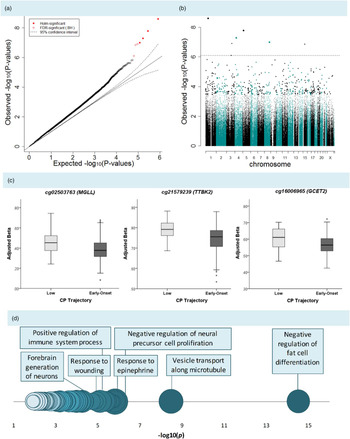
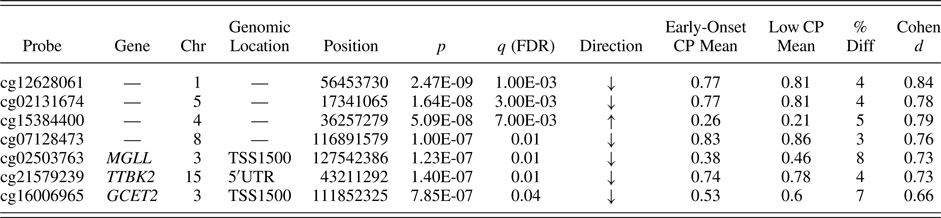
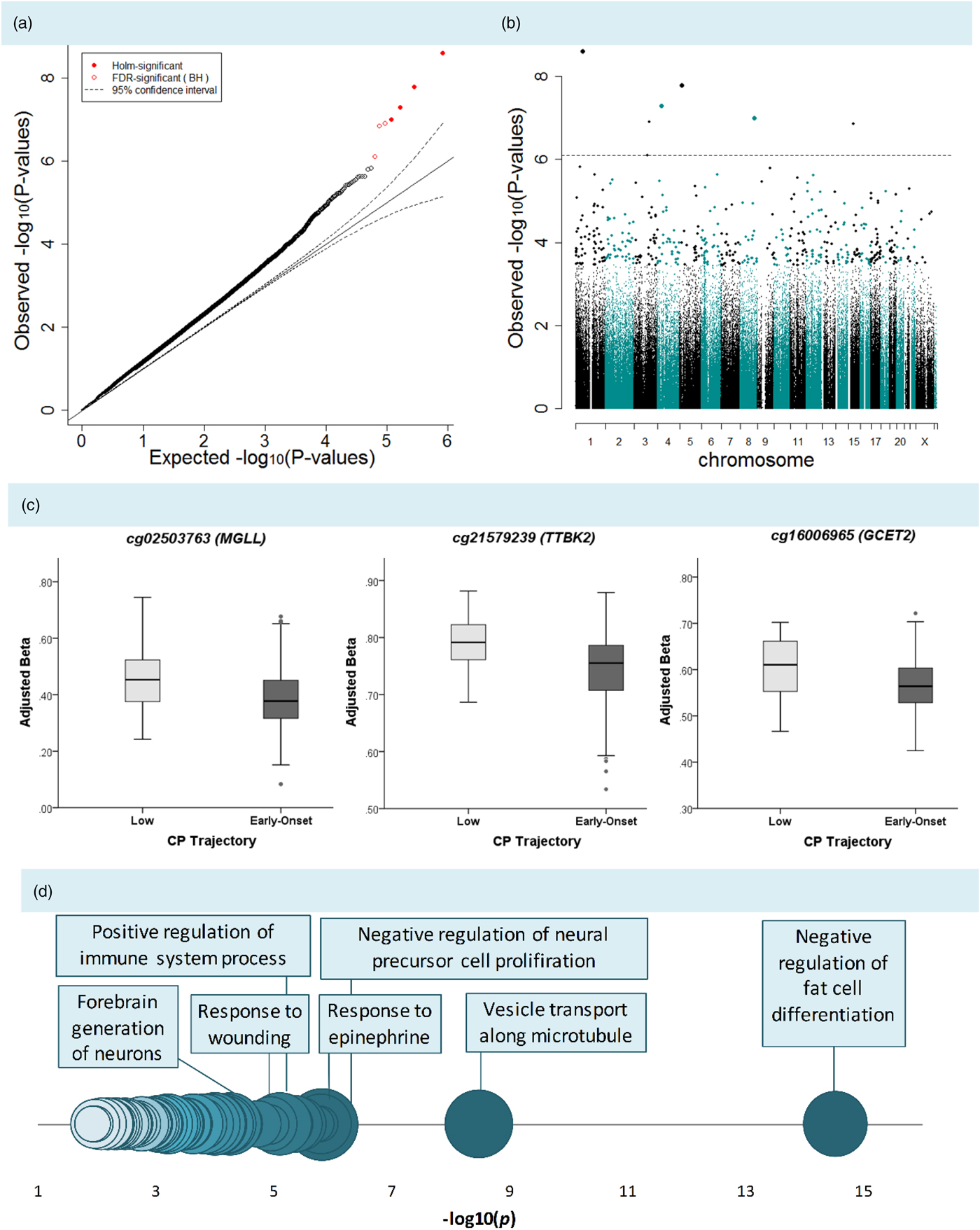
The Q-Q plot and Manhattan plot for the epigenome-wide association analysis at birth are displayed in Figure 1a and b. Table 1 shows the seven differentially methylated sites (q < 0.05) between early-onset versus low CP groups, as identified via our genome-wide analysis. Group differences were medium to large in effect size based on Cohen's guidelines (d = 0.66–0.84), and ranged from 4% to 8% in terms of mean DNAm difference. Of note, all seven sites remained differentially methylated after additionally adjusting for gestational age. DNAm levels across these sites were all significantly intercorrelated (both positive and negative correlations observed; see online-only supplementary Table S.2). Three of the sites had genic annotations (Figure 1c): (a) cg02503763, located in the promoter regulatory region of MGLL, a gene implicated in endocannabinoid signaling and nociperception (Iwasaki, Ishiguro, Higuchi, Onaivi, & Arinami, Reference Iwasaki, Ishiguro, Higuchi, Onaivi and Arinami2007); (b) cg21579239, annotated to the 5′UTR region of tau tubulin kinase 2 (TTBK2), a gene involved in tau protein phosphorylation, of which mutations have been linked to neurodegenerative disorders (Liao, Yang, Weng, Kuo, & Chang, Reference Liao, Yang, Weng, Kuo and Chang2015); and (c) cg16006965, located in the promoter regulatory region of germinal center expressed transcript 2 (GCET2), a gene implicated in immune function (Pan et al., Reference Pan, Shen, Ge, Du, McKeithan and Chan2007). The other four differentially methylated sites identified at birth were distal to annotated transcripts (see online-only supplementary Figure S.1 for boxplots): cg12628061 located between AK127270 (–407 kb) and phosphatidic acid phosphatase type 2B (PPAP2B; –507 kb), cg02131674 located closest to brain abundant membrane attached signal protein 2 (BASP1; –123 kb), cg15384400 located between ArfGAP with RhoGAP domain, ankyrin repeat and pH domain 2 (ARAP2; –12 kb) and death domain containing 1 (DTHD1; +26 kb), and cg07128473 located between tandom repeat S1 (TRPS1; –210 kb) and eukaryotic translation initiation factor 3 subunit (EIF3H; +876 kb). In all cases, except for probe cg15384400, methylation of these sites was lower in the early-onset versus low CP groups. These seven sites were then viewed in Genome Browser for functional characterization, based on ENCODE data on regulatory elements. Four of the DNAm loci coincided with transcription factor binding sites, including MGLL cg02503763 and GCET2 cg16006965, and implicated a number of shared transcription factors, including MAX (4/4 loci), POLR2A, RUNX3, and EP300 (3/4 loci). The majority of DNAm sites also overlapped with histone marks (6/7 loci) and DNAse I hypersensitive clusters (4/7 loci), suggesting that they are located in genomic regions that are likely to play regulatory roles in transcription. Gene ontology analysis (n probes = 1,101; n genes = 758) further indicated that DNAm sites (at birth) that differentiate between CP groups are annotated to genes involved in a range of biological processes, including regulation of fat cell differentiation and immune system process, response to epinephrine and wounding, as well as forebrain generation of neurons and CNS neuron differentiation (2.95E-15 < p < 6.66E-05; Figure 1d). GO results for the top 20 enriched biological pathways (including those displayed in Figure 1d) are provided in online-only supplementary Table S.3.
(Color online) Methylomic variation at birth prospectively associated with early-onset versus low conduct problems in childhood. Epigenome-wide associations between DNA methylation at birth and early-onset versus low conduct problems, including (a) Q–Q plot, (b) Manhattan plot, and (c) scatterplots of the top three differentially methylated sites with genic annotations. (d) Significantly enriched biological processes at birth are shown, based on gene ontology analysis of genes annotated to probes that associate with early-onset versus low conduct problems (p < .001). Circles represent gene ontology terms that survive false discovery rate correction and contain at least two genes. The X axis represents –log(10) p values. The opacity of the circles indicates level of significance (darker = more significant). The size of the circles indicates the percentage of genes in our results for a given pathway compared to the total number of genes in the same pathway (i.e., larger size = larger %).
DNA methylation sites at birth that differentiate early-onset versus low CP children (genome-wide significance; q < 0.05)

Note: CP, conduct problems; FDR, false discovery rate. Arrows represent the direction of methylation differences, where ↑ indicates higher methylation levels in early-onset versus low CP children, while ↓ indicates lower methylation levels in early-onset versus low CP children. For the Cohen d values, 0.20 is a small effect size, 0.50 is a medium effect size, and 0.80 is a large effect size.
In light of the above findings, we conducted two follow-up analyses to further investigate the relationship between DNAm at birth and early-onset CP.
Methylomic variation in MGLL, TTBK2, and GCET2
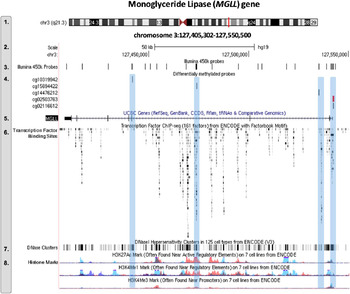
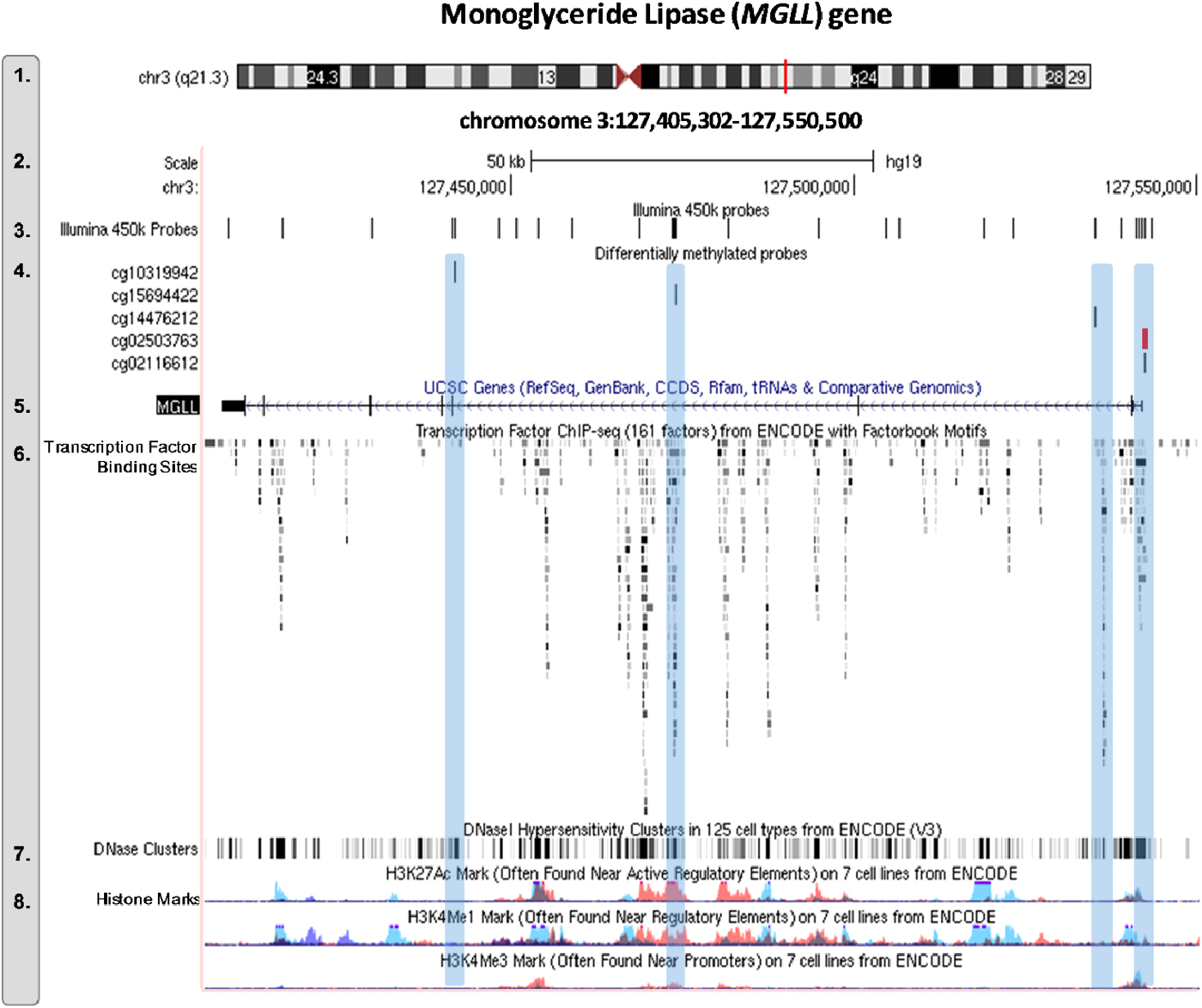
Our genome-wide analyses indicated that three of the seven sites identified as differentiating early-onset versus low CP children were annotated to genes, including MGLL, TTBK2, and GCET2 (one site each). As an additional step, we examined whether any other probes in the vicinity of these genes associated with early-onset CP at a nominal level. While none of the other probes in TTBK2 (n total = 10 probes) or GCET2 (n total = 19 probes) associated with early-onset versus low CP (p > .05), four additional probes in MGLL were differentially methylated between groups, including another probe in the TSS1500 region (cg02116612; p = 1.95E-05; significant at gene level Bonferroni correction: 0.05/26 total annotated probes = 0.002) and three probes in the gene body region (cg14476212, p = .028; cg10319942, p = .034; and cg15694422, p = .048). The location of these probes and their relationship to ENCODE regulatory elements is displayed in Figure 2 (for more detailed information, see online-only supplementary text). Of note, two of these additional probes correlated significantly with the genome-wide significant site MGLL cg02503763, including a stronger association with the most proximal probe in the TSS1500 region (cg02116612; r = .46, p = 6.04E-15) and a weaker association with one of the probes in the gene body (cg10319942; r = .15, p = .01).
(Color online) Functional characterization of monoglyceride lipase (MGLL) DNA methylation sites associated with early-onset conduct problems. Expanded views from the UCSC genome browser of the MGLL gene showing the position of the DNA methylation sites associated with early-onset conduct problems relative to ENCODE regulatory elements. Track numbers are displayed on the left-hand site and represent the following: 1, genomic position of MGLL in chromosome 3; 2, genomic coordinates and scale; 3, location of all Illumina 450k probes that map onto the MGLL gene (n = 26); and 4, location of differentially methylated probes associated with early-onset versus low conduct problems (n = 5). These are highlighted in blue to facilitate comparison with the regulatory elements displayed in lower tracks (Tracks 6–8). In red online is the probe that survived genome-wide correction (MGLL cg02503763; all other probes significant at p < .05); 5, schematic representation of the MGLL gene; 6, location of transcription factors (based on ChIP-seq data from 91 cell types), where darker shades indicate a stronger signal occupancy; 7, DNaseI hypersensitivity clusters (based on ChIP-seq data from 125 cell types), where darker shades also indicate a stronger signal; and 8, levels of enrichment of three histone marks (H3K27Ac, H3K4Me1, and H3K4Me3) across three cell types, including blood (GM12878 [in red online], K562 [in purple online]) and human umbilical vein endothelial (HUVEC [in blue online]) cells.
Methylomic variation in candidate genes for CP
As shown in Table 1, none of the genome-wide significant loci identified resided in “traditional” candidate genes for CP. In order to maximize comparability with existing molecular studies, we carried out a follow-up analysis to investigate DNAm variation in the vicinity of genes that have been previously implicated in CP-relevant phenotypes. The selection of candidate genes was informed by a recent systematic review (Waltes, Chiocchetti, & Freitag, Reference Waltes, Chiocchetti and Freitag2015) and meta-analysis (Pappa et al., Reference Pappa, St. Pourcain, Benke, Cavadino, Hakulinen, Nivard and Tiemeier2015) of genetic influences on aggression. Specifically, we selected a total of 15 genes (n total = 387 probes), across dopaminergic (monoamine oxidase A [MAOA, 14 probes], catechol-O-methyltransferase [COMT, 22 probes], SLC6A3 [52 probes], dopamine receptor D2 [DRD2; 22 probes], and DRD4 [21 probes]); serotonergic (SLC6A4 [14 probes], HTR1A [14 probes], HTR2A [25 probes], tryptophan hydroxylase 1 [TPH1; 4 probes], an TPH2 [18 probes]); and neuroendocrine and neurodevelopmental pathways (nuclear receptor subfamily 3, group C, member 1 [NR3C1; 35 probes], FK506 binding protein 5 [FKBP5, 32 probes], arginine vasopressin [AVP; 14 probes], OXTR [17 probes], and brain-derived neurotrophic factor [BDNF, 73 probes]). As done by Weder et al. (Reference Weder, Zhang, Jensen, Yang, Simen, Jackowski and Kaufman2014), we used a gene-level Bonferroni correction for these hypothesis-driven analyses, correcting for the total number of probes within each gene.
In total, 12% of probes were differentially methylated between groups at a nominal significance threshold (p < .05), with at least one probe associating with early-onset CP for each gene (see online-only supplementary Table S.4). However, only four of these loci survived gene-level Bonferroni correction (see Table 2), including sites annotated to BDNF (cg01225698, cg18354203), FKBP5 (cg07061368), and the MAOA promoter region (i.e., TSS200; cg05443523). Effect sizes for these loci were small (d = 0.44–0.49), and mean group DNAm differences ranged from 1% to 3%. Based on ENCODE data, all four probes coincided with transcription factor binding sites and histone marks, with two of the probes coinciding with DNase I hypersensitivity clusters. As with the loci identified via our epigenome-wide analysis, these four probes remained significantly associated with CP trajectory after controlling for gestational age.
Candidate gene follow-up: Loci that differentiate between early-onset and low CP children (gene-level Bonferroni correction)

Note: CP, conduct problems; FDR, false discovery rate. Arrows represent the direction of methylation differences, where ↑ indicates higher methylation levels in early-onset versus low CP children, while ↓ indicates lower methylation levels in early-onset versus low CP children. For the Cohen d values, 0.20 is a small effect size, 0.50 is a medium effect size, and 0.80 is a large effect size.
Comparison of top DNAm probes between early-onsets who persist versus desist in CP
Within the early-onset CP group, none of the DNAm sites identified in the previous step (i.e., seven FDR-corrected genome-wide significant loci and four Bonferroni-corrected loci from the candidate gene follow-up analyses) were found to differentiate children who will go on to follow a persisting versus a desisting trajectory of CP over time (p > .05, see online-only supplementary Table S.5 for full results). This lack of differences suggest that, while methylomic variation at birth prospectively associates with an early-onset of CP (i.e., distinguishing between high vs. low CP early in childhood), this variation is not likely to contribute toward heterogeneity in developmental trajectories of CP observed within early-onset children.
Potential relevance of genetic and in utero environmental influences on the identified DNAm sites
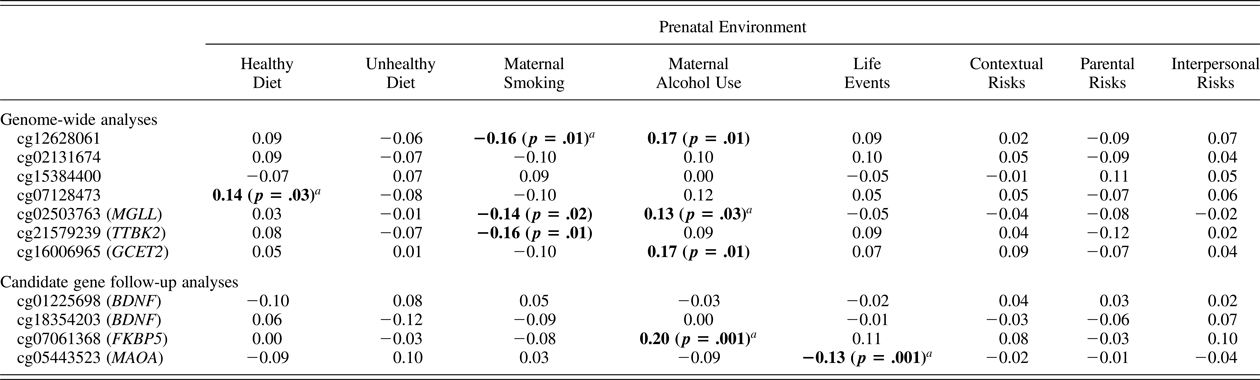
The 11 DNAm sites associated with early-onset CP were carried forward to explore associations with potential genetic and environmental influences. Based on mQTLdb search, we found that none of the identified loci were associated with cis or trans mQTLs, suggesting that DNAm levels across these sites are not likely to be heavily influenced by known genetic polymorphisms. Bivariate correlations between the DNAm loci and prenatal exposures are shown in Table 3, controlling for sex and cell type. Of the 11 probes examined, 7 were nominally correlated with one or more exposures (p < .05), but none of these associations remained significant after multiple correction (q > 0.05). The majority of associations involved maternal smoking and alcohol use during the first trimester of pregnancy. Around half of associations identified remained significant after controlling for all other prenatal exposures (i.e., unique association; see Table 3).
Associations between prenatal environmental exposures and loci that are differentially methylated in early-onset versus low CP children
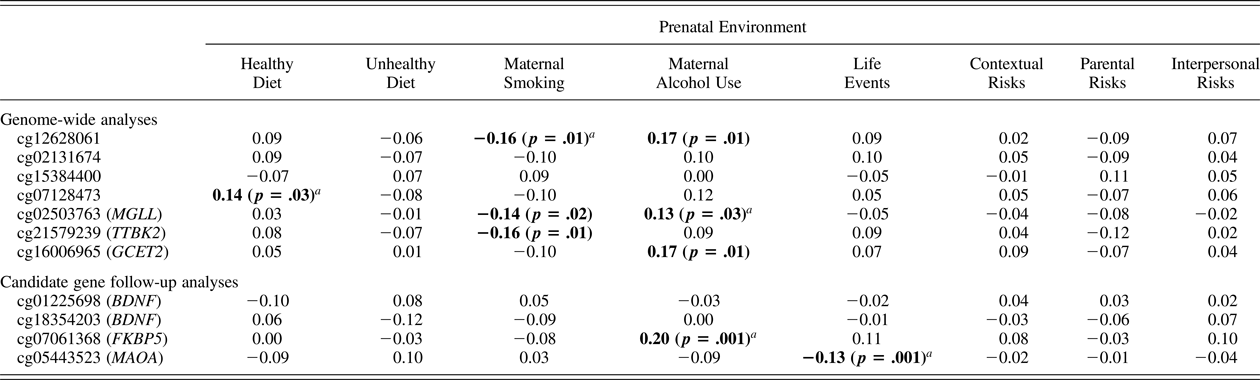
Note: All associations control for sex and cell type.
aAssociation remains significant after additionally controlling for other exposures (p < .05).
Discussion
This is the first study to investigate the epigenetic landscape of early-onset CP, using a prospective design. The study offers a number of strengths, including the examination of genome-wide data collected prior to the emergence of CP symptoms and the inclusion of the largest epigenetic CP sample to date, allowing for adequately powered group comparisons (Tsai & Bell, Reference Tsai and Bell2015), as well as the integration of environmental, DNAm, and phenotypic data. We highlight here three key findings: (a) methylomic variation across multiple loci at birth differentiated children who go on to develop early-onset versus low CP; (b) DNAm levels across these loci were comparable for early-onsets who persist versus desist in CP over time; and (c) several of the identified loci showed suggestive associations with prenatal exposures, while none were linked to known genetic mQTLs.
Genome-wide findings point to the potential importance of methylomic variation at birth
The use of a genome-wide, hypothesis-free approach enabled us to identify novel loci for CP, pointing to potential avenues for future investigation. Specifically, we found that seven loci at birth prospectively differentiated CP groups, showing a moderate to large effect size difference between children who go on to develop early-onset versus low CP. Functional characterization using ENCODE data indicated that the majority of the identified sites coincided with regulatory elements that play a key role in gene expression, including transcription factor binding sites, DNase I hypersensitivity clusters (i.e., regions of open chromatin), and histone marks. Six of the loci were significantly hypomethylated in early-onset versus low CP children, and three were annotated to genes. Of these, MGLL encodes a serine hydrolase that converts monoacylglycerides to free fatty acids and glycerol and acts as a major endocannabinoid metabolic enzyme (Iwasaki et al., Reference Iwasaki, Ishiguro, Higuchi, Onaivi and Arinami2007). It is interesting that previous studies have shown that MGLL activity associates with substance abuse (Hopfer et al., Reference Hopfer, Lessem, Hartman, Stallings, Cherny, Corley and Crowley2007), which is highly comorbid with CP (McAdams, Salekin, Marti, Lester, & Barker, Reference McAdams, Salekin, Marti, Lester and Barker2014). Furthermore, CB1 cannabinoid receptor function (modulated indirectly by MGLL via 2-arachidonoylglycerol [2-AG] activation) has been shown to mediate aggression in animal knockout studies (Rodriguez-Arias et al., Reference Rodriguez-Arias, Navarrete, Daza-Losada, Navarro, Aguilar, Berbel and Manzanares2013). Together, these findings support a link between MGLL function and CP-relevant phenotypes, although more work will be needed to delineate the functional effects of MGLL methylation on broader endocannabinoid signaling and downstream consequences on behavior. We do note that in follow-up analyses, a number of additional DNAm sites associated with early-onset CP across the promoter region and gene body of MGLL, as well as coinciding with key regulatory elements, which further supports a link between epigenetic regulation of this gene and CP.
Another DNAm site that showed CP-related DNAm at birth was annotated to TTBK2. This gene is highly expressed in subcortical brain structures (e.g., cerebellum and hippocampus) and is involved in the phosphorylation of tau and tubulin, two key microtubule stabilization proteins that are robustly associated with multiple nervous system pathologies, including Alzheimer disease (Liao et al., Reference Liao, Yang, Weng, Kuo and Chang2015). Although we are not aware of studies directly investigating the link between TTBK2 and CP-relevant phenotypes, it is noteworthy that associations between levels of tau phosphorylation in the brain and aggressive behavior have been previously reported in patients with Alzheimer disease (e.g., Guadagna, Esiri, Williams, & Francis, Reference Guadagna, Esiri, Williams and Francis2012). As such, it will be of interest in the future to examine whether TTBK2 methylation may contribute to early-onset CP via microtubule alterations in the brain.
The third gene identified, GCET2, plays a role in immune processes, including cytokine function (Pan et al., Reference Pan, Shen, Ge, Du, McKeithan and Chan2007). While an increasing number of studies have documented a link between inflammation and psychiatric phenotypes, including childhood aggression (e.g., Provençal et al., Reference Provençal, Suderman, Caramaschi, Wang, Hallett, Vitaro and Szyf2013), little is known about the function of this gene in relation to CP. It is interesting, however, that a genome-wide study recently identified GCET2 expression levels as a potential biomarker for antidepressant treatment response (Hennings et al., Reference Hennings, Uhr, Klengel, Weber, Putz, Touma and Lucae2015), pointing to a potential role of this gene in mood regulation.
DNA methylation of candidate genes: Maximizing comparability with previous studies
Consistent with what has been previously reported in the psychiatric epigenetic literature (e.g., Cecil, Walton, & Viding, Reference Cecil, Walton and Viding2015), we found that none of the DNAm sites identified via our hypothesis-free, epigenome-wide analysis were annotated to genes that are typically examined in hypothesis-driven, candidate gene studies. In order to maximize comparability with existing molecular studies, we carried out an additional analysis focusing on DNAm in the vicinity of 15 genes that have been extensively investigated in relation to CP and related phenotypes (e.g., aggression; Pappa et al., Reference Pappa, St. Pourcain, Benke, Cavadino, Hakulinen, Nivard and Tiemeier2015; Waltes et al., Reference Waltes, Chiocchetti and Freitag2015). It is important to note that these studies have primarily focused on genetic (as opposed to epigenetic) contributions to CP, so that a direct test of replication was not possible. Rather, this follow-up analysis was designed to explore the potential role of these genes in early-onset CP from an epigenetic perspective. Although none of the DNAm sites annotated to candidate genes passed genome-wide correction, subthreshold associations were identified across three genes, including BDNF (two probes), MAOA (one probe), and FKBP5 (one probe). Of note, effect sizes were small but not trivial (>0.44), suggesting that these DNAm differences may hold relevance for understanding biological vulnerability for early-onset CP.
BDNF encodes for a neutrophic protein that performs a wide range of functions, including regulation of neurodevelopment, synaptic plasticity, and mood. While a link between aggression and BDNF activity has been documented by multiple lines of evidence, including findings from genetic, knock-out, endocrine, and pharmacological studies (Waltes et al., Reference Waltes, Chiocchetti and Freitag2015), this is the first report, to our knowledge, of an association with BDNF DNAm levels. The role of MAOA activity on aggression has also received widespread attention from both the animal and human literature, due to its key role in the degradation of amine neurotransmitters in the brain, including dopamine, norepinephrine, and serotonin (Nelson & Trainor, Reference Nelson and Trainor2007). Consistent with our findings, a recent study reported that hypermethylation of the MAOA promoter region (with an average DNAm difference between groups of 3%, the same as observed in the present study) was associated with antisocial personality disorder in a forensic population, as well as decreased gene expression and dysregulation of serotonin blood serum levels (Checknita et al., Reference Checknita, Maussion, Labonte, Comai, Tremblay, Vitaro and Turecki2015). MAOA promoter DNAm in blood has also been shown to robustly predict MAOA enzymatic activity in the brain (Shumay, Logan, Volkow, & Fowler, Reference Shumay, Logan, Volkow and Fowler2012), suggesting that peripheral MAOA DNAm status may be a promising biomarker for functional levels in live central tissue, which is most relevant to CP. Finally, the FKBP5 gene, which codes a co-chaperone of the glucocorticoid receptor that regulates its sensitivity, has been extensively investigated for its role in mediating stress, hormonal, and immune responses to adverse experiences, particularly in the context of gene–environment interactions (Zannas & Binder, Reference Zannas and Binder2014). For example, FKBP5 polymorphisms have been found to interact with childhood trauma (e.g., maltreatment) to predict a range of psychiatric outcomes, including childhood aggression (Bryushkova et al., Reference Bryushkova, Zai, Chen, Pappa, Mileva, Tiemeier and Beitchman2016). While emerging evidence suggests that FKBP5 methylation may mediate these observed Gene × Environment interactions (Zannas, Wiechmann, Gassen, & Binder, Reference Zannas, Wiechmann, Gassen and Binder2015), more work is needed to characterize its relevance to CP behavior.
Heterogeneity in developmental trajectories within the early-onset CP group
Whereas the identified DNAm sites at birth differentiated children who develop early-onset versus low CP, these same sites did not further discriminate between early-onsets who go on to follow a persisting (i.e., EOP) versus desisting (i.e., CL) trajectory of CP into adolescence. This lack of associations may reflect a number of possibilities. For example, it is possible that, at birth, EOP and CL children may be phenotypically and biologically similar. In other words, while they may both be at increased risk for early-onset CP relative to typical children, it may not yet be possible to separate those who will persist versus desist in CP behavior over time. Given that EOP versus CL children start to diverge in levels of CP around late childhood and predict different outcomes in adulthood (Farrington, Gallagher, Morley, Ledger, & West, Reference Farrington, Gallagher, Morley, Ledger and West1988; Moffitt, Caspi, Harrington, & Milne, Reference Moffitt, Caspi, Harrington and Milne2002), it will be of interest in the future to extend epigenetic analyses later in development, so as to investigate whether these behavioral differences may coincide with underlying epigenetic differences. In addition, the examination of DNAm at later time points would enable one to test potential associations with postnatal environmental influences, which are likely to play an important role in the divergence between EOP and CL trajectories. It is also possible that statistically, our analyses were underpowered to examine within-group differences in DNAm patterns among the early-onset group. Larger longitudinal studies will be needed in the future to enable a more fined-tuned comparison of DNAm patterns between EOP and CL children across multiple developmental periods.
Genetic and prenatal influences on DNAm patterns associated with early-onset CP
As a final step, we investigated whether DNAm loci at birth that differentiated between early-onset versus low CP children (both at the genome-wide and candidate-gene level) were also associated with potential genetic and environmental influences relevant to CP (Barker & Maughan, Reference Barker and Maughan2009; Salvatore & Dick, Reference Salvatore and Dick2016). Based on findings from a large-scale study of genetic effects on DNAm (Gaunt et al., Reference Gaunt, Shihab, Hemani, Min, Woodward, Lyttleton and Ho2016), we found that none of the identified loci associated with known cis or trans mQTLs. While this suggests that the identified loci were unlikely to be heavily influenced by genetic structure, it is important to note that the heritability of DNAm patterns is greater than what can currently be explained using known mQTLs (Gaunt et al., Reference Gaunt, Shihab, Hemani, Min, Woodward, Lyttleton and Ho2016). As such, it is still possible that the identified loci may have been influenced by polygenic effects, involving many mQTL that each explain too little variance in isolation to be detected with currently available samples.
With regard to environmental influences, we identified suggestive associations between the identified DNAm sites and prenatal exposures. Of note, we found that proximal exposures (e.g., maternal smoking and alcohol use) correlated with DNAm more strongly than more distal exposures (e.g., life events). Albeit preliminary, these findings are consistent with previous studies showing that DNAm is associated with environmental influences (e.g., Lewis & Olive, Reference Lewis and Olive2014), with smoking-related effects, in particular, being among the most replicated across epigenetic studies (Gao, Jia, Zhang, Breitling, & Brenner, Reference Gao, Jia, Zhang, Breitling and Brenner2015). For example, we found that prenatal smoking correlated with hypomethylation of the MGLL probe, which in turn prospectively associated with early-onset CP. This is of interest given that activity of this gene has been shown to influence nicotine withdrawal in animals and humans (Muldoon et al., Reference Muldoon, Chen, Harenza, Abdullah, Sim-Selley, Cravatt and Damaj2015), as well as interacting with environmental exposures to predict cannabis dependence symptoms and amygdala function (Carey et al., Reference Carey, Agrawal, Zhang, Conley, Degenhardt, Heath and Bogdan2015). However, it is important to note that the associations identified in the present study were based on correlational analyses and did not survive multiple corrections. Consequently, they should be interpreted with caution and considered more as well-grounded hypotheses for further examination in larger longitudinal studies.
Limitations
Findings should be interpreted in light of a number of limitations. First, because results from this study were based on DNAm collected from peripheral samples, the extent to which they may be tissue specific is unclear. More research will be needed to assess the relevance of the identified DNAm sites to brain tissue, as well as characterizing their potential role in CP-related brain-based phenotypes. Furthermore, because we did not have access to RNA, functional characterization of the identified loci was performed using recorded ENCODE data. However, integration of transcriptomic data will mark an important step toward establishing the functional significance and downstream effects of the observed DNAm changes. Second, the current study was based on a community sample of children with relatively low rates of CP. In the future, it will be important to replicate our findings in high-risk populations who show more severe externalising problems (e.g., young offenders and psychiatric inpatients). Furthermore, the use of a larger number of cases versus controls will make it possible to examine potential moderators in the relationship between DNAm and early-onset CP (e.g., sex). Third, although we used a prospective design where DNAm was collected prior to the emergence of CP symptoms, the results from the study are correlational and cannot be taken to reflect causal pathways. As such, findings should be considered as hypothesis generating and in need of replication. In the future, the application of advanced inference methods (e.g., two-step Mendelian randomization; Pingault, Cecil, Murray, Munafò, & Viding, Reference Pingault, Cecil, Murray, Munafò and Viding2016; Relton & Davey Smith, Reference Relton and Davey Smith2012), will offer unique opportunities to establish causal relationship between prenatal environmental risk, DNAm, and CP.
Conclusion
In this study, we find that DNA methylation at multiple loci at birth prospectively associated with early-onset versus low conduct problems. These findings highlight the neonatal period as a potentially important window of biological vulnerability for conduct problems, as well as pinpointing novel potential risk markers for future investigation. Suggestive evidence of associations between the identified loci and prenatal exposures also lend preliminary support for a link between the early environment, DNA methylation, and the development of early-onset conduct problems.
Supplementary Material
To view the supplementary material for this article, please visit https://doi.org/10.1017/S095457941700092X.