1. Racialized subjects of empire
International legal histories are, ultimately, narratives of European imperial expansion and the transformation of empires into sovereign states.Footnote 1 Recent historical work has redescribed this process as the transition from ‘informal empire’ practiced in the colonization of the Americas, to the ‘formal empire’ constituted with the distribution of Africa during the Berlin Conference of 1884–85. In both cases, imperial governments were centered in Europe while the dependent territorial units were located on another continent.Footnote 2 Empire was regarded as a necessary and virtuous form of government in which the civilized centre would bring moral and cultural improvement to the distant barbarian areas in exchange for the metropole's economic growth.Footnote 3
What is often overlooked, however, is that the control and management of non-Europeans through taking over their lands as well as extracting and commercializing their natural resources was foundational to the legal and social structures through which those empires expanded. Pre-1492 feudal European practices and laws racialized subjects (Irish, Jews, Gypsies, Slavs, etc.) in order to dispossess, subjugate, enslave and colonize them within Europe. European monarchies exaggerated differences in order to dominate and exploit their subjects through slavery or servitude in roles as mercenaries, peasants, slaves and others. As Cedric Robinson argues, capitalism emerged within feudalism, integrated racialism and evolved into a world dependent on slavery, violence, imperialism and genocide.Footnote 4 Racialist myths defined modern European nationalism and explained the inevitability and naturalness of the superiority of some Europeans over other Europeans. Racial capitalism divided peoples by exaggerating subcultural, regional, and other differences into racial ones.
The justifications for the Atlantic slave trade and the control over indigenous peoples were therefore a continuum of a European feudal order that differentiated ethnic and cultural groups for the exploitation of their labor and their lands. The conquest and colonization of the Americas inspired Spanish imperial theologians to develop a language of private rights (dominium) with which they legitimized and naturalized the control over indigenous peoples in order to extract resources and create wealth for the Spanish crown.Footnote 5 The appropriation and sale of Africans through the Atlantic slave trade incorporated more peoples to the workings of empire. The commodification of racial identity is therefore at the heart of empire and the birth of the national states of the Americas. For many centuries, Europeans believed (legally and morally/religiously) that people of colour could be bought and sold or their land and labor appropriated and exploited.
At the same time, peoples oppressed by the racialized (and gendered) economic system developed their own world views and acts of resistance that at the minimum questioned, and at the extreme, overtook the practices of their rulers. This article presents the case of Haiti, the former French colony of Saint Domingue, as the most evident example of imperial practices and ideologies sustained by racial capitalism, as well as illustrating how the same ideology formed its own nation and then resisted past independence. The first part of the article briefly describes slavery and manumission in Europe before the Atlantic slave trade and in Saint Domingue. The second part focuses on the former slave colony of Saint Domingue as the new nation of Haiti, and the process of negotiating its recognition of independence, a sort of manumission for Haiti's freedom. The final part will argue that France´s recognition of Haiti, like the masters’ acknowledgement of slaves’ manumission, did not make her fully independent or sovereign. To the contrary, Haiti continued as a new imperial location, a ‘commercial colony’, dependent through her external debt and foreign governance until today.Footnote 6
1.1. From European to African slaves
Before 1492, migrations of different peoples, wars, dispossession of lands, slavery and unfree labor formed an integral part of European life. Indeed, ancient Greek and Roman societies depended upon slavery as the basis of their economic, political, legal and social structures. In both Athens and Rome, slaves and freed slaves formed a high proportion of the population. They were acquired in wars, trade, debt sales, or by birth as natural slaves.
As property and outsiders, Athenian slaves did not have rights and duties, the capacity to make claims or be defendants or witnesses, or the social standing to have families, and their bodies could be abused by their owners. In other words, they were not citizens.Footnote 7 However, as an incentive for obedience, Athenian slaves could buy or be rewarded with their freedom, though in practice, low life expectancy and legal limitations made it more of an exception than the rule.Footnote 8 In the rare cases where they obtained freedom, freedmen often continued to serve their patrons but were constantly threatened with re-enslavement and stigmatized for their origins. Former slaves seldom obtained citizenship and were not regarded as in the same category as citizens born free.Footnote 9 Freed female slaves would often remain indebted and in service to their masters as concubines, servants, and sometimes wives.Footnote 10 Freed Roman slaves, on the other hand, were allowed to intermarry and become citizens, though they still could not participate in the army or as magistrates.Footnote 11
With the fall of the Roman empire and the rise of Christianity, non-Christians could be enslaved, traded or sold through ‘just wars’ against infidels, inferiors or ‘barbarians’ such as the Slavs, but the ancient traditions of commutation of a death penalty, sale for extreme indebtedness and birth as natural slaves continued. During the expansion of the Crusades, more categories of peoples were considered capable of being enslaved, including the Jews, Moors, Muslims and ‘Turks’, Sardinians, Greeks, Russians, and Canary Islanders.Footnote 12 Furthermore, Portuguese traders legitimized African enslavement with the Papal Bulls of 1454–56 that accepted the capture and Christianizing of pagans as a just cause.Footnote 13 They also invoked the Aristotelian argument of natural slavery by birth for those peoples considered to be more physically apt for manual labour.Footnote 14
The ‘Curse of Ham’ (Genesis 9:18–29), a biblical story in which Noah curses the lineage of his grandson Canaan as ‘servant of servants’ for Ham's dishonorable actions, was transferred from previously enslaved groups to Africans.Footnote 15 In the new version of the myth, Ham's rebellious and indignant behaviour darkened his skin to show his shame and condemned him to a life without honour. Consequently, dark-skinned people from Africa and Muslims came to be identified with the ‘race of Canaan’ condemned to natural (and thus eternal) slavery.Footnote 16 As the demand for slave labour grew with the expansion of European imperial projects in the Americas, the cheaper, African-born slaves became more attractive because of their perceived Aristotelian and Christian natural destiny as slaves as well as their foreign character. Gradually, slave contracts began to insist on darker skin colour to highlight the ‘Africanness’ of slaves.Footnote 17
Initially, the Roman Civil Code played a large role in determining the law codes of the Spanish, French and Portuguese slave societies in the Americas through its ancient rules for manumission and punishment as well as limitations to legal representation.Footnote 18 Many of these rules became inapplicable when they clashed with the differences with Indian servitude, economic and religious motives and administrative challenges so that new and local versions of slave codes were developed. France´s participation in the Atlantic slave trade was later than the Spanish and Portuguese, but by the end of the seventeenth century their number of slaves had increased dramatically so that King Louis XIV issued the Code Noir in 1685, a first comprehensive slave code for France's Caribbean colonies.Footnote 19 By the time of the Haitian revolution, slavery was a broadly accepted institution of jus gentium or law of nations, authorized by theologians, ratified by the custom of centuries and modern slave codes, and fundamental to sustaining the economies of empire.
1.2 Slavery in Saint Domingue
The territory we now call Haiti was the site of Christopher Columbus’ first landing in December of 1492. He named the island ‘Hispaniola’ after practicing the Spanish Crown's symbolic and legalizing ceremony of possession, known as the ‘Requerimento’.Footnote 20 After 1512, the Spanish Crown´s legal advisers devised a new form of appropriation based upon ancient Islamic practices, which involved the reading of an elaborate text declaring the mandatory submission of those infidels who heard it, or a declaration of war against those who resisted it. This act of dominium over the land and its people was used until 1573.Footnote 21 During this period, Spanish theologians debated the kind of legal authority the law of nations gave the Crown on the jurisdiction, status and nature of the natives and the type of property or possession in the conquered lands.Footnote 22
For the Arawak/Taino natives of Hispaniola those debates did not apply because by 1550 they had been decimated, but Spanish colonists replaced them with indigenous people that they had captured from neighbouring islands. As the rest of the native population died out from harsh working conditions or disease, Bartolomé de las Casas made the argument that Indians were subjects of the Spanish crown and should be protected, while Africans should replace them as slaves because of their idolatry.Footnote 23
In 1625 French buccaneers arrived on the nearby Tortuga Island. King Louis XIV recognized their settlements in France´s name in 1659. Soon thereafter, Spain agreed to divide the island into Saint Domingue and Santo Domingo through the Treaty of Ryswick of 1697. Saint Domingue became the most productive colony in the hemisphere fueled by the permanent import of Africans; anywhere from 25,000 to 40,000 slaves died each year due to punishments, work conditions, diseases and suicide.Footnote 24 Close to three million slaves were brought in total to grow and harvest Saint Domingue's many crops. On the eve of the revolution, the French colony produced more than the Spanish and British colonies combined, with its ‘793 sugar, 3117 coffee, 789 cotton, 3150 indigo, 54 cacao, 182 guildiveries, and 370 fours a chaux plantations’ and more than 1,500 ships that transported goods to Europe.Footnote 25
1743 Le Code noir. Nantes, Bibliotheque municipale
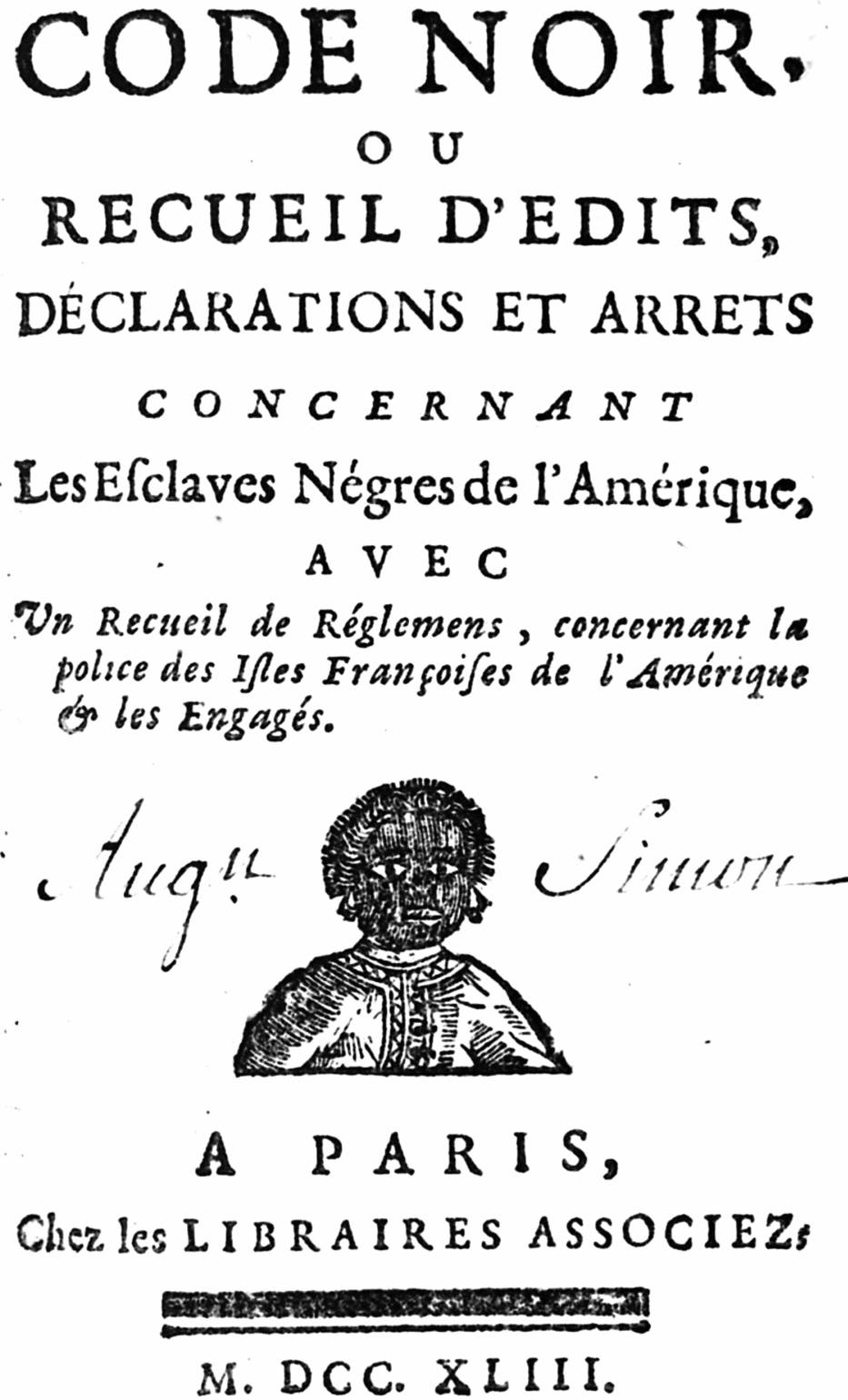
Saint Domingue's social and legal structure was based on the 1685 Code Noir, issued by King Louis XV, in order to legislate the ‘discipline and the commerce of blacks and slaves’. The code's purpose was to control but also to obtain maximum profit from the slave system. Sixty articles regulated religion, security, communication, food, clothing, punishments and slave manumission.Footnote 26 By the time of the 1789 revolution, the Code Noir had ruled a century of relations between masters and slaves and between plantation owners and metropoles, as well as constructed, imposed and legitimized a hierarchical race-based regime that granted different social, legal, and economic standings to the various Saint Domingue populations (i.e., gens de colour, affranchis, mulatre, negres libres, etc.).Footnote 27
The colonial structure was headed by two French administrators (a governor general and an intendant) who received instructions from Paris for the direction of government, finance and the judiciary. They were followed by approximately 30,000 white French plantation owners who shared privileges and economic interests in trade and slaves, with an equal number of mixed race (mulatto, petit blanc) plantation, artisans and business owners. The majority of the remaining population consisted of 500,000 African slaves who also were divided into hierarchies, such as domestic mulatto slaves vis-à-vis darker skinned field work slaves. By the time of Haiti´s revolution and declaration of independence, the territory had already experienced three centuries of a profitable Atlantic slave trade.
The religious view (‘Ham's Curse’) that black people were natural slaves and property had produced a racial consciousness that presented Africans and their descendants as inherently unfree. Skin colour and African origins became synonymous with a condition of perpetual limits on freedom and equality: blacks were born as property, in servitude, and if they were ever freed, the legal and social system ensured that they would never be equal to those born free (and white). The generalized belief among Europeans was that as slaves or freedmen, Africans did not have the capacity to be sovereign over themselves, let alone over a nation. During the first years of the revolution in Saint Domingue, the coloured leadership could not make the leap (in ideology and in practice) to a completely independent and bondage-free society. After the revolution, the leaders of the Saint Domingue uprising took over the colonial administration without considering themselves as an autonomous nation. As an assembly of landowners and merchants, they continued to uphold and apply the Code Noir, appealed their grievances in Paris, and maintained slaves until abolition in 1794. In fact, most petit blancs and affranchis feared full independence because they worried that the grand blancs would have more control without the limitations that the metropole imposed on them. Therefore, during the aftermath of the revolution, land and business owners agreed that the colony needed to look for new markets, continue to buy cheap slaves from the British colonies, and provide plantation products in exchange for necessary ones.Footnote 28
2. The quest for recognition
According to an early twentieth century study, the doctrine of recognition was born out of the American revolutions: first, when the United States declared neutrality in 1793 in the face of war between Great Britain and France and required recognition as an equal to European nations; and second, with the independence of the South American Republics.Footnote 29 However, the author did not contend that the US policy of neutrality should have been applied to Haiti, ‘for its population was black and the temper of the southern states would not permit such a reward to a revolted slave population’.Footnote 30 Haiti had become a symbol of a successful slave revolt and a dangerous example to all surrounding colonies. After Haiti´s 1804 claim of independence her territory was still disputed among five leaders, but in 1807 Alexandre Pétion was chosen president by a constituent assembly. He was re-elected three times until he was named ‘president for life’ in 1816. Pétion had signed the Act of Independence of 1804 and the Dessalines Constitution of 1805. His purpose was to unite the Haitian territory, but he had a never-ending strife with his rival Henry Christophe.Footnote 31
France continued to regard Haiti as a colony in rebellion. Aside from some information gathering and failed attempts at recovery, the period of Napoleon´s reign was one of inaction except by the former colonists, who assumed they could play into the racial divide of a black and radical King Christophe in the North in opposition to a mulatto and French friendly Pétion regime in the South.Footnote 32
With the death of Pétion in 1818 after 11 years in power, his successor, General Boyer, united the North and South under one government but still felt it necessary to obtain France´s recognition of Haiti's independence. Boyer feared that the end of the Napoleonic wars and the Bourbon restoration would incentivize France to reclaim its former colony under pressure from the plantation and slave owners who survived the revolution and had launched an incessant political, legal and publicity campaign in the French press for France to reconquer, reinstate slavery and reclaim their lost possessions. The colonists lobbied the highest government officials and obsessively planned different forms of taking back the island, as they felt they were victims of the ‘barbarian’ African slaves as well as the inept French government. They managed to pressure Louis XVIII and the Congress of Vienna to obtain a five-year extension of the slave trade as well as recognition of France's sovereignty and the right to reconquer Saint Domingue, despite the concession given to Great Britain over their territory.Footnote 33 Therefore, the Haitian participation in the (unilateral) negotiations that followed are not surprising, considering the enormous and mounting pressure on the Haitian government.
2.1. First negotiation, 1814
A few months after the Congress of Vienna's secret agreement with France, Louis XVIII, the new Bourbon king, assigned Pierre-Victor Malouet (1740–1814), leader of the anciens colons pro-slavery ‘Club Massiac’, as head of the ‘Ministry of Marine and Colonies’.Footnote 34 Malouet had written against the Amis des Noirs, and advocated for a new colonial system that did not consider any form of manumission, and allied with the British government so they would re-establish slavery and receive its benefits.Footnote 35
Malouet sent three representatives on a secret mission in October of 1814 in order to gain information and position Pétion against the anti-French King Christophe by proposing an insulting and unacceptable return to pre-1789 conditions: reinstitute slavery and force them back to the plantations; impose a stratified caste system that would privilege the mulatto or coloured by giving them ‘nearly perfect equality of rights’ but below the ‘White cast’ if they could obtain white titles ‘by the fairness of their complexion, their fortune, their education, or their public services’. The proposal also stated that if they did not comply, the King of France would cut Saint Domingue off from all commerce so they would soon be ‘reduced to live like savages’, exterminated, or ‘transported to the Isle of Ratau’. The main purpose of the proposal was to ensure that plantation owners would regain property titles to their lands, buildings and slaves.Footnote 36
The trio was well received by colonial refugees in London, Barbados, Martinique and Jamaica, who believed it was still possible to take back Saint Domingue and re-enslave the Haitian people.Footnote 37 Christophe heard of the proposal before the committee reached him and he ordered an all-out war of extermination, if necessary, and sent a declaration which said:
we will never become a party to any treaty, to any condition, that may compromise the honour, the liberty, or the independence of the Haytian people that, true to our oath, we will sooner bury ourselves beneath the ruins of our native country, than suffer an infraction of our political rights.Footnote 38
Pétion, on the other hand, was interested in acting as a representative of a sovereign state so he received Malouet´s less drastic official proposal. In any case, Pétion found the proposal insulting and unjust. In the spirit of avoiding further threats of re-colonization and re-enslavement, and as if he was negotiating manumission, he offered, for the first time, a reasonable pecuniary indemnity in order to compensate for the loss of land but only in exchange for recognition of Haiti´s independence.Footnote 39 The French government disavowed this first proposal.Footnote 40
2.2. Second negotiation, 1816
After Malouet´s death in 1814 and the failed first attempt at an agreement with Haiti, a new negotation commission was designated with former plantation owners Viscount de Fontanges and Charles Esmangart. The King ordered Fontanges and Esmangart to be more benevolent than the other team had been in 1814, but their proposal was based on Malouet´s. Christophe did not want to receive the new emissaries but Pétion, however, listened to one of them, but immediately suspended negotiations when a similar offer to the previous one was made. Both Christophe and Pétion agreed that such a proposal should be rejected and that they preferred death to a betrayal of the nation´s purpose of freedom from slavery. However, both thought that national independence with recognition from France should continue to be the final objective. Their counter proposal was based on the Code Noir’s concept of manumission, which was still at the basis of the legal thinking at the time. If slaves could be manumitted and their masters compensated for their loss of property, the country could be freed by paying former slave and plantation owners for their land and slaves.Footnote 41 The indemnity payment was also inspired by the sale of Louisiana to the United States in 1803 for F50 million, in which the United States doubled the size of its territory. Pétion informed Esmangart that he would only accept an agreement that conceded full independence from France.
In the North, where former slaves were strongly represented, there was general opposition against the indemnity payment. Christophe's foreign secretary, Limonade, declared that:
Is it conceivable that Haitians who have escaped torture and massacre at the hands of these men, Haitians who have conquered their own country by the force of their arms and at the cost of their blood, these same free Haitians should now purchase their property and persons once again with money paid to their former oppressors? It is not possible.Footnote 42
2.3. Negotiations suspended, 1818–1820
Henri Christophe´s black kingdom of the North had established a state run plantation system and a strong military government, while Pétion´s Southern republic privileged the French-speaking mulattos to run the government and commerce. After Pétion´s death on 30 March 1818 the Senate elected his preferred guard, General Jean-Pierre Boyer, as President of Haiti (for life) in homage to the deceased. Boyer wanted to organize the country's finances and unify Haiti. In August of 1820, however, Christophe had an accident which left him paralyzed, and he committed suicide two months later. Boyer took advantage of Christophe´s death, and on 26 October 1820 he claimed leadership of a unified Republic.Footnote 43
By then, French re-conquest and proposals to re/enslave the majority of Haitians and give ‘white’ status to the elites had failed. Therefore, the Ministry of Foreign Affairs of Louis XVIII came up with a new strategy: the idea of ‘un nouveau genre de colonisation . . . la colonie commercial’ without having the inconvenience and expense of the former slave colony. The proposal aimed to substitute the classic form of colonial domination with a new form of ‘commercial and industrial dependence’ that would convert Haiti into ‘a commercial colony with the stipulations of friendship, alliance, reciprocity and commerce’.Footnote 44 Esmangart, proponent of the neo-colonial form, insisted that France would not lose with Haitian independence because colonialism could be perpetuated without the responsibilities and costs of a colony:Footnote 45
We can negotiate a treaty with Haiti which will be more or less advantageous to France according to the skill of the negotiator . . . The Treaty of Commerce . . . would leave matters in the condition in which they were placed by the revolution and would enable us to carry on openly what we now do clandestinely.Footnote 46
But in late 1821, with Christophe´s death, Boyer was also able to profit from a non-violent annexation of the Eastern or Spanish side of the island. Following independence movements occurring elsewhere in the Americas, José Nuñez de Cáceres wanted to declare independence of Santo Domingo from Spain while at the same time incorporating the new State to the Gran Colombia. On 1 December, Nuñez´s troops took over the fortress and declared the Independent State of Spanish Haiti by replacing the flag of Castille with the Colombian flag. Nuñez, now self-declared president, established the continuation of slavery under a new constitution. Boyer announced that his troops would arrive soon to visit the new president. Nuñez feared slave uprisings, and he decided to change to the Haitian flag in light of the majority of the population's admiration of and supported for the Haitian revolution. French slave owners on the Spanish side tried to prevent a further entrance of Haitian troops, but to no avail. On 9 February 1822, Boyer entered Santo Domingo peacefully and with much acclaim as he unified the entire island territorially and abolished slavery under the Haitian flag for the next 22 years.Footnote 47
Though there had been a suspension of negotiations with France between the death of Pétion and Christophe's suicide, a unified Haiti that included the former Spanish colony gave Boyer a stronger hand at negotiating a recognition that would allow Haiti’s full independence. Many believed that France´s recognition was the key to Haiti´s future, an endeavour England would support because it might obtain lower duties on its exports to Haiti. But on the contrary, the British maintained the status quo and secretly supported French intentions of reconquering Saint Domingue and continuing the slave trade, and began a de facto recognition policy for the Spanish American states.
2.4. Third negotiation, 1821
After president Boyer integrated the North and South and annexed the eastern Spanish part of the island of Hispaniola, he viewed recognition as more urgent and necessary for expansion of trade and commerce. Secretly, however, he may have hoped for a protectorate state in view of the internal racial divide and hierarchies that continued to complicate a unified Haiti. Boyer limited black access to higher military and government posts and maintained mulatto privilege. As a consequence, Haiti's internal strife made it more vulnerable to interventions despite the outward appearance of strength through the unification.Footnote 48
As the French knew that Boyer admired England, he was made a new offer based upon the idea of suzerainty, which was similar to the British control over the Ionian Islands under the Treaty of Paris of 1815. During the European middle ages, suzerainty described the ‘relation of a feudal superior to his vassal’, while ‘sovereignty’ referred to ‘superiority in jurisdiction’ such as a queen who is ‘over all persons and in all causes within her dominions supreme’. A state under suzerainty could have specific rights recognized in a constitution like other sovereign states while also recognizing an imperial power. The new proposal of 1821 intended to continue imperial control over Haiti under the guise of this alternative form of sovereignty, which in practice would convert Haiti into a commercial colony of France, with economic rights and privileges for the former colonial power but without the expense and dangers of governing a colony of enslaved peoples. Yet again, Boyer declined this new mode of dependence but renewed the offer of recognition of Haiti's independence in exchange for giving France a favoured trading nation status and a reasonable indemnity.
2.5. Fourth negotiation, 1823
Despite rejecting the suzerainty offer of 1821, Boyer continued to advocate for France´s recognition in order to expand Haiti´s commercial interests and enjoy the dignity of acting as an independent nation internationally. Under a unified Haiti, Boyer considered France would be interested in ending the strife between both nations through a generous commercial agreement that would include recognition. As a new approach, in August of 1823 Boyer sent a French representative to Brussels, General Jacques Boye, to speak with Esmangart in Haiti´s name. Boye requested France´s full recognition of Haiti´s independence in exchange for an exemption of all import duties for French goods for five years, and after that period France would pay half the duties levied for other states. Boyer considered the exemptions to be generous and a sufficient economic compensation for the former French colonists’ request for indemnity, as Haiti would lose millions each year and it was the best offer Haiti had made since 1814. Esmangart would not admit full recognition of independence and insisted on an additional sum of money to compensate plantation and slave owners for their property losses. Both parties viewed the situation as unjust and talks ended with no agreement.
2.6. Fifth negotiation, 1824
President Boyer viewed France´s rejection of Haiti's best proposal as another demonstration of their lack of interest in any concessions and an obsession with reconquering its former colony. However, a new French emissary, Mr. Laujon, requested to resume talks and Boyer conceded in a last attempt to negotiate.Footnote 49 He sent two Haitian citizens, Senators Larose and Rouanez, to meet with Esmangart in France. Though they were taken on a tour to several cities as a way of exhausting them, the emissaries insisted and eventually succeeded in having the negotiations in Paris. Boyer had instructed them to be stronger than in the offer of 1823 and demand recognition, leaving:
no doubts as to the clauses of the treaty which they were to conclude, and on the indispensable formality of recognition, by a royal ordinance, of our independence from all foreign domination, any kind of suzerainty, even of any protectorate of any power, in short, of independence which we have enjoyed for twenty years.Footnote 50
In return, Boyer granted the principle of compensation to France through the status of ‘most favoured nation’ and requested that Haitian products in France would not be obliged to pay higher duties than those paid by similar products from other French colonies. Esmangart made the negotiation impossible, however, by claiming that he had authority to deal with the old Saint Domingue and that France would not recognize the new Spanish part of the island as belonging to Haiti despite its peaceful possession and government by Haiti since 1822.
In addition, another French agent, the Marquis de Clermont-Tonnerre, minister of marine and colonies, informed the Haitian emissaries that in the case of recognition, the King of France reserved the exercise of Haiti´s exterior sovereignty for himself and Haiti would remain with an interior sovereignty. Both exterior and interior sovereignties were unknown categories under the law of nations.Footnote 51 Insulted and exhausted, the Haitians made their rejection and protests clear and left France on 15 August 1824. The failed negotiations upset the ex-colonists who had been expecting an indemnity for the past 30 years, as well as the French mercantile and manufacturing classes, who were counting on new trade privileges with Haiti.Footnote 52 Upon their arrival in Haiti in October, President Boyer was informed of the mission´s failure as a result of France´s insulting proposal and placed the military on alert again, in preparation for protection from a possible invasion.
2.7. Sixth negotiation and final imposition, 1825
An 1824 pamphlet printed by the Boyer government, summarized the history of the different offers made by the French and the Haitian reaction to them:
In 1814, they wished to impose upon us the absolute sovereignty of France; In 1816, they were satisfied with a Constitutional sovereignty; In 1821, only a simple suzerainty was demanded; In 1823, during the negotiation of General Boyer, they confined themselves to claiming as a sine qua non, the indemnity which we had previously offered: by what return to a spirit of domination, did we, in 1824, subject ourselves to an external Sovereignty? What then is this external sovereignty? It consists, in our opinion, of two kinds of rights: one which is restricted to the Protectorate; And it is the one presented to us; The other, which extends to external relations, whether political or commercial, and which, afterwards, would not fail to be asserted. But from whatever side we consider this Sovereignty, it seems to us injurious or contrary to our security: that is why we reject it.Footnote 53
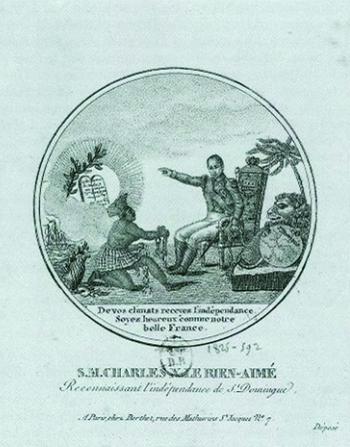
While Boyer continued to govern Haiti and look for other alternatives to French recognition, such as that of the Spanish American states if they participated in the Congress of Panama that would be held in 1826, King Charles X of France delivered a unilateral ultimatum. The purpose of France´s final proposal, or rather imposition, was to grant recognition while at the same humiliating Haiti and destroying her capital by making her into a dependent commercial colony for France. Much like the manumitted slaves who had to continue working for their former owners, Haiti was made an offer that was already unconscionable on its face. On 17 April 1825, the King signed an ordinance, which translates as follows:
Charles, by the grace of God, King of France and of Navarre, to all present and to come, Salute. Having regard to Articles 14 and 73 of the Charter: Wishing to provide for the interest of French commerce, the misfortunes of the former colonists of Santo Domingo, and the precarious condition of the present inhabitants of that island; We have ordered the following:
Article I. The ports of the French part of St. Domingo shall be open to the commerce of all nations. The duties levied in these ports either on ships or on goods, both at entry and exit, shall be equal and uniform for all flags except the French flag in favour of which such charges shall be Reduced by half. Article 2. The present inhabitants of the French part of Santo Domingo shall pay to the Caisse des Depots and consignations of France in five equal terms from year to year, the first due to 31 December 1825, the sum of one hundred and fifty million francs intended to compensate the former settlers who demanded an indemnity. Article 3. We grant these conditions by the present Ordinance to the present inhabitants of the French part of Santo Domingo, the full and complete independence of their government. And shall be the present seal of the great seal. Given at Paris, at the Chateau des Tuileries, on the 17th of April, in the year of 1825, and of our reign first. Charles.
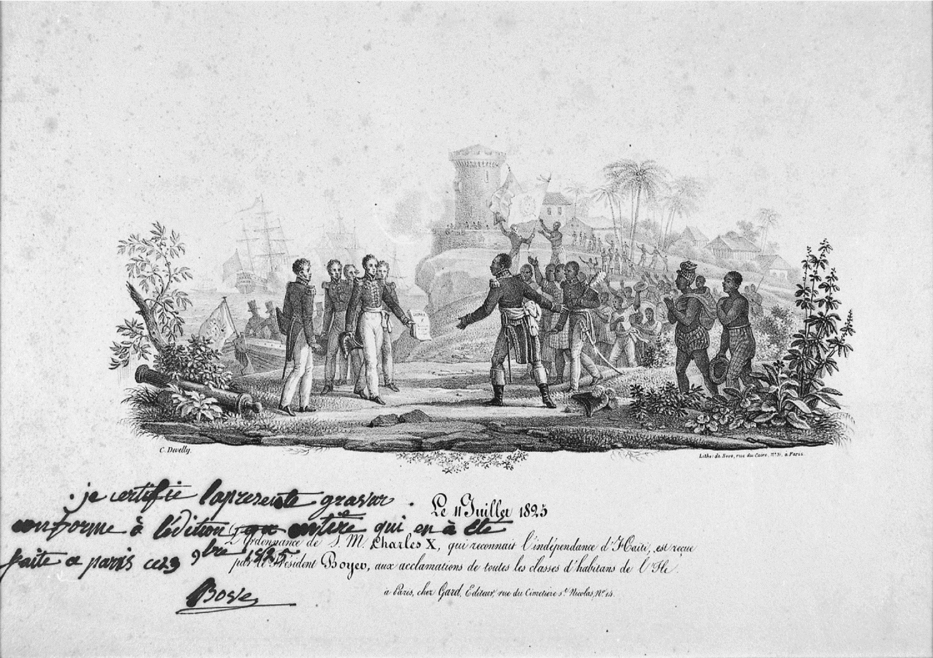
The King sent the Baron de Mackau to submit the ordinance to Boyer in May of 1825. Mackau arrived on board the frigate Circe, and in company of two other ships as well as the powerful naval fleet of Admiral Jurien in order to enter Port-au-Prince supported by the physical threat of armed boats. On 4 July 1825 14 army ships docked in Port-au-Prince with an imposition that president Boyer could not refuse. The royal ordinance signed by King Charles X would concede ‘full and entire independence’ under two imposed conditions: French ships would pay half of docking rights for future commerce and the citizens of Haiti would compensate former plantation owners with F150 million.Footnote 54 The indemnity amounted to five times France´s total annual budget and ten times as much as the United States paid Napoleon for the Louisiana Purchase (F50 million), the sum that Pétion had argued would be the maximum they were willing to pay. As a sign of force, the ships anchored in Haitian docks until the terms of the ordinance were accepted. The French squadron was prepared to strike a decisive blow to a city that did not have the fortifications necessary to resist the attack and no naval force sufficiently prepared to defend them. The only option left for Boyer was to undertake a final war of extermination or to accept the long awaited recognition. Boyer accepted the ordinance on 7 July 1825 and the Senate adopted it four days later.
Commentary from the time of the indemnity viewed it not as recognition of sovereignty, but rather as an imposition upon Haiti as well as a form of surrender. The event was effectively a surrender because there was no treaty, but rather a unilateral act by France granting independence to the current inhabitants of Haiti, and not necessarily to future inhabitants. The commentator also argued that Boyer had betrayed the trust reposed in him, and that henceforth ‘he must be regarded as a French viceroy, rather than as the head of an independent state’.Footnote 55 Another observer characterized the outcome in forceful terms, noting the ‘slavish resemblance’ of the ordinance:
one effect of this foolish treaty—foolish only on the part of Boyer—is, that by purchasing the acknowledgment of what was before an undisputed fact, he has brought the fact itself into question, for he has afforded room to doubt, that Hayti had the means of keeping that which she had beggared herself to buy. A second consequence is, that by so large a drain of resources from the republic, she in the same degree deprives herself of the means of enforcing the very right for which she stipulates. What power of resisting any encroachment, or resenting any insult, or securing any respect from France, can the Haytian people boast of, after stripping themselves of a sum which few states in Europe could bear to sacrifice, without a long course of national weakness and privation? They were in bondage until the arrival of the French fleet—they were vassals up to the moment when the royal ordinance was read—they paid homage to their master when receiving the cap of liberty; and, that nothing might be wanting to complete the slavish resemblance, the manumitting rod was represented by an imposing naval force.Footnote 56
Anonymous sketch ‘S.M. CHARLES X, le bien aimé, recognizes the independence of Saint Domingue.’ Engraving kept at the Bibloteque Nationale.

3. The century payment of the double debt
Despite having participated in the agreement process, Haitians felt betrayed and offended by France´s arrogance of having imposed a new form of colonial burden. Unable to pay the first installment, the Haitian government took a F30 million loan from a French bank, with another F30 million for principal at a 6 per cent annual interest rate, and an additional F6 million for handling fees, which meant that only F24 million made it to the French treasury for compensation of former slave owners. Thus, the indemnity payment turned into what became known as Haiti´s ‘double debt’, as Haiti was indebted to make the payments to France as well as to the French banks which would lend to her.
For the second instalment, another loan was taken with French bankers Lafitte, Rothschild, Lapanonze, to repay F227 million during 35 yearly instalments of F6.5 million.Footnote 57 Haiti quickly defaulted after the two first instalments.Footnote 58 Boyer announced the debt as belonging to all Haitians, and he imposed a rural tax base, forced overproduction, and issued paper money, all of which made him unpopular.
Boyer´s anxiety over what had been imposed on the Haitian people was evident. Between 1825 and 1838 different attempts were made to change the conditions of the ordinance, but most attempts failed. The colonists were not happy with the defaults and hired the law firm of Dalloz, Delagrange, Hennequin, Dupin, Jeune, et al. to review the original ordinance and evaluate the French government's responsibility in their delayed payment. The firm reported that Haiti was imposed an unpayable amount though they insisted that the F150 million constituted only 12 per cent of the actual property losses suffered by the planters. However, Dalloz et al. argued that the French government was ultimately responsible for paying the colonists indemnity because it had not recovered its colony, and by abandoning its sovereignty over Saint Domingue with the recognition of Haitian independence, France had disposed of their private property and given up their rights over lost land and slaves.Footnote 59
Under pressure from the colonists and Haitians, and with warships deployed in Haitian waters, a final agreement titled ‘Traité D´Amité’ was forced in 1838. The agreement brought the balance down to F60 million, payable in 30 annual installments (with loans from French banks and exorbitant fees) and gave full recognition to Haiti. Haiti ended up borrowing over F166 million to pay the F60 million, with more than half used to pay bank commissions, fees, and interests. Nonetheless, the Haitian government complied and a final payment was made in 1910 after a century of debt.Footnote 60 The action of 26,000 planters and slave owners (or their descendants) affected by the revolution, and who had opposed Haiti´s recognition for decades, received a symbolic amount but forced Haiti into a neo-colonial state.Footnote 61
Anonymous sketch ‘The Ordinance of SM CHarles X, which recognizes the independence of Haiti, is recovered by President Bouer, with the cheering of all classes of inhabitants of the island.’
4. Conclusion: The manumitted state that never became free
The history of Haiti´s revolution is well known, and the state is praised for its early declaration of independence. Less known is the process of re-colonization experienced by Haiti after its leaders made an unconscionable agreement to pay France for its recognition of independence and slave and plantation owners an indemnity for their losses. On the other hand, Haitians never asked or received compensation for the millions of people who were enslaved, for those who died as a consequence of enslavement, or for their 300 years of free labour.
The indemnity debt and the claims for its repayment in moments of political and natural disasters in this century illustrates how the Haitian population has never experienced itself as completely free of empire. Though ‘neo-colonialism’ was a term coined in the 1960s to refer to European (and particularly French) foreign capital control of the newly decolonized African states, Haiti was the first ‘African’ state where creditors built a practice of economic imperialism.
Through loans from French and other European (and later US) banks in order to pay the independence debt, Haiti became doubly tied to its creditors.Footnote 62 Several states did not want to recognize Haiti after France did because they considered that the new debt made Haiti not properly independent. Other states used non-recognition first and the indemnity payment second to send the message to the slave population in their own states that black people could not rule themselves and their destiny was to fail. Finally, some states did not recognize Haiti to support their interests with France and to profit from their alliance in case that France was able to regain its control over the island.
It took all of the nineteenth century for an international agreement, the Brussels Act of 1890, to make the slave trade illegal. The parties to the treaty agreed to ‘put an end to Negro Slave Trade by land as well as by sea’, but in the same phrase they also allowed themselves to ‘improve the moral and material conditions of existence of the native races’ of Africa. The end of the slave trade was in accordance with the beginning of Europe´s new colonial commercial enterprise in Africa, as had been legitimized by the Berlin Act five years earlier. Though black Africans were no longer to be enslaved, their status as savage ‘native races’ made them conquerable, or manageable at a minimum, as the new workers and cheap labor force necessary to build the colonial infrastructure to exploit and transport the abundant resources that the African continent offered. Racial capitalism continued well into the twentieth century, but with a different strategy: colonialism without slaves in order to ‘remember Africa’ and ‘forget Haiti’.Footnote 63
As such, it is easier to understand why Haiti was not granted recognition of her sovereignty and full freedom after the revolution and declaration of independence. A parallel can be made to the limits of manumission in slave societies: freedom after slavery did not translate into social, political, and religious equality and access to the same opportunities as the freeborn.