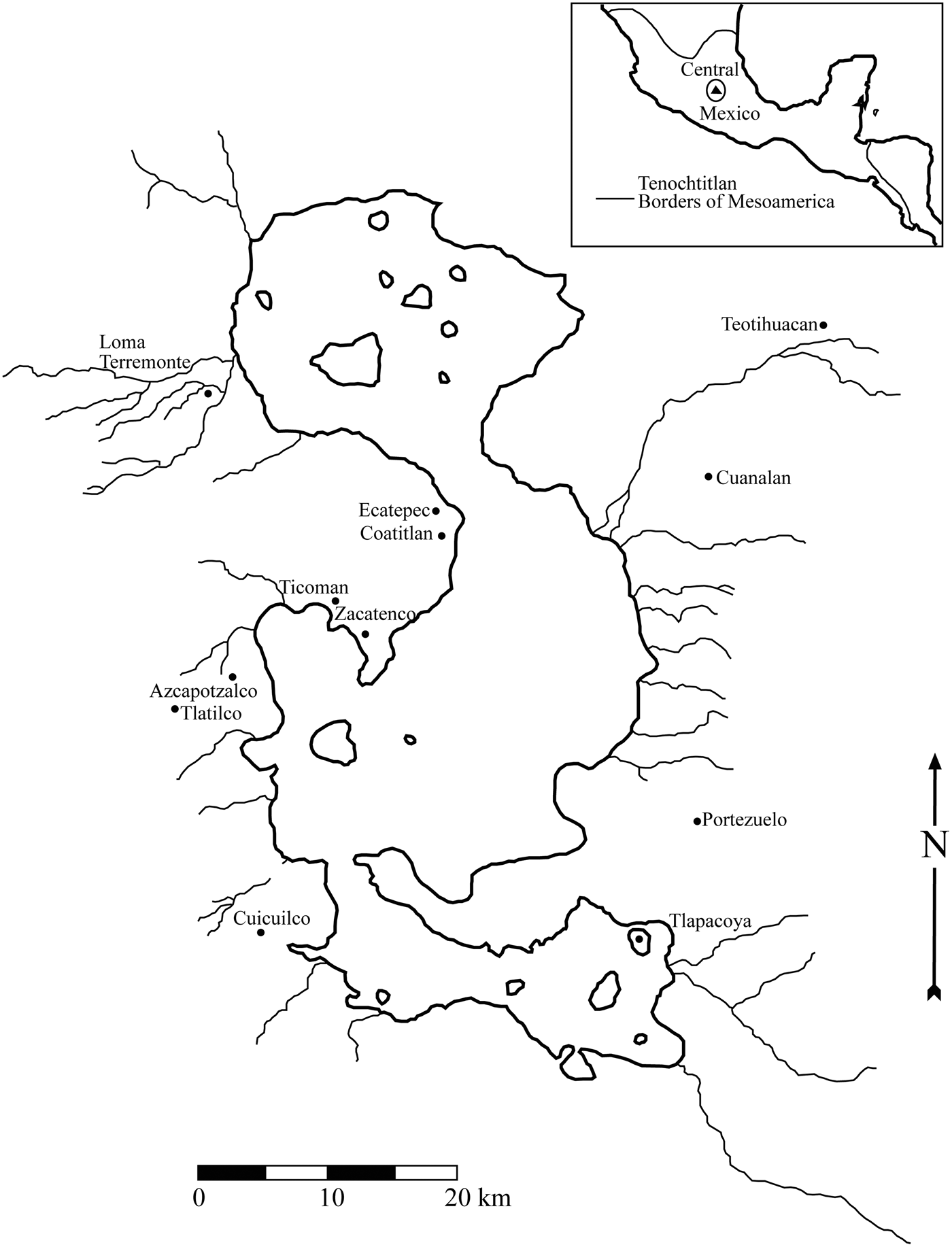
The history of the Basin of Mexico as a geo-political core and as a setting for the growth of unusually large cities extends to the prehispanic past. The time from ca. 2000/1500 bc to ca. ad 200 that archaeologists refer to as the Formative or Preclassic period spans the change from the initial establishment of villages to the earliest cities and states; among the latter was Teotihuacan, an urban center that became the largest and most influential city and state of its day in Mesoamerica (Figure 1). The organizers of this special section of Ancient Mesoamerica asked me focus on intensive agriculture and the development of complex societies during the Formative period in the Basin of Mexico, a key time of sociocultural evolution in the region. Some time after 2000/1500 bc, agriculture became integral to the daily lives and worldviews of the people of the basin. Early state formation and urbanism were multicausal, but these developments depended on mobilizing surpluses generated by farming households. The emergence of complex societies in the region thus, in many ways, relates to the politics of farming in the Formative period.
Schematic map of the Basin of Mexico showing Formative period sites.

Prior research certainly has recognized the central role of agriculture in the sociocultural evolution of the Basin of Mexico. By the mid-twentieth century, the work of Pedro Armillas (Armillas et al. Reference Armillas, Palerm and Wolf1956), René Millon (Reference Millon1957), Angel Palerm (Reference Palerm1955, Reference Palerm1961, Reference Palerm1973), and Eric Wolf (Wolf and Palerm Reference Wolf and Palerm1955) had demonstrated the importance of hydraulic agriculture in the Postclassic basin. At that time, the remains of Aztec terraces still dotted hillsides. But, how much earlier did these land use systems occur, and what prompted farmers to employ them? Moreover, what were the interrelationships between agricultural intensification and politics, economy, and ecology? Although there is much that we know about these issues, there also is much that we still do not know. I begin this paper by outlining the theoretical frameworks archaeologists have employed to understand intensive agriculture in relation to the development of complex societies in the Formative period and then review the evidence. Archaeologists working in the Basin of Mexico have been at the forefront of important debates on this issue.
THEORETICAL UNEDERPINNINGS
Theoretical developments in anthropology and archaeology in the mid-twentieth century stimulated archaeologists’ interests in the relationship between agricultural systems and complex societies in the Basin of Mexico. Such developments included the shifting orientation of archaeology in Mexico to a social science and the associated introduction of a materialist approach, championed by Pedro Armillas; the influence of the ideas of V. Gordon Childe and Marxism; and the growth of neoevolutionism and cultural ecology in anthropology (Armillas Reference Armillas and Bennett1948; see also Bernal Reference Bernal1980:391; Lorenzo Reference Lorenzo1981:202; Nichols Reference Nichols, Mastache, Parsons, Puche and Santley1996: 67–68; Willey and Sabloff Reference Willey and Sabloff1993). Among North American archaeologists, Julian Steward's (Reference Steward1955) concept of cultural ecology, emphasizing interrelationships between environment, technology, settlement patterns, and social organization became especially influential (e.g., Sanders and Price Reference Sanders and Price1969). Although much criticized, Karl Wittfogel's (Reference Wittfogle1957) broad theory of hydraulic management and political centralization drew attention to the political dimensions of irrigation as emphasized by Sanders and Price (1968:177–178) and continues to be influential (Marcus and Stanish Reference Marcus, Stanish, Marcus and Stanish2006).
Influenced by these developments, in the mid-1950s William T. Sanders (Reference Sanders1965) began to lay out a theoretical framework that subsequently guided the Basin of Mexico settlement pattern surveys and formed the basis for his influential interpretations of the roles of agricultural intensification and economic symbiosis in state formation in the basin. Sanders’ model had two interrelated components. First, he argued that micro-geographic variations in agricultural and other resources encouraged exchange, specialization, and economic interdependence. Second, he saw that the marked year-to-year variations in rainfall that characterize the basin's semi-arid climate, along with the timing of fall frosts, prompted early agricultural intensification and specialized agricultural adaptations capable of sustaining large populations. This materialist model influenced by theories of cultural ecology and evolution provided the conceptual framework for the Basin of Mexico settlement pattern project that had as one of its goals the exploration of the relationship between “settlement patterns, agricultural techniques, and demography so as to illuminate the general process of cultural evolution in the Teotihuacan Valley, the Basin of Mexico, and the Central Mexican Symbiotic Region” (Sanders et al. Reference Sanders, Parsons and Santley1979:5).
Boserup
In the mid-1960s Esther Boserup (Reference Boserup1965) offered a theory of agricultural change that stimulated considerable interest among archaeologists, and its strengths and weaknesses have been much discussed. Although the general relationship that Boserup defined between shortening fallow cycles and increasing workloads has empirical support, her model of agricultural intensification treated population growth as constant and did not explore factors other than population pressure and land shortages that lead people to intensify farming practices (Netting Reference Netting and Upham1990; Stone and Downum Reference Stone and Downum1999:114–115; Thurston and Fisher Reference Thurston, Fisher, Thurston and Fisher2007).
Inspired by Boserup's work, Sanders, Parsons, and Santley (Reference Sanders, Parsons and Santley1979) proposed in their synthesis of the initial findings of the Basin of Mexico settlement pattern surveys a dynamic model of prehispanic land use and argued that population pressure was a driving force in cultural evolution. They also integrated Robert Carneiro's (Reference Carneiro1970) widely influential theory of competition, warfare, circumscription and differential access to strategic resources in the centralization of political power. The theory Sanders, Parsons, and Santley developed mirrored an important shift in cultural evolutionary frameworks of the 1970s away from technological change as a prime mover (Trigger Reference Trigger1989:319–321).
Although Sanders (Logan and Sanders Reference Logan, Sanders and Wolf1976; Sanders et al. Reference Sanders, Parsons and Santley1979) and his colleagues drew significant inspiration from Boserup, they also recognized non-Boserupian reasons for intensification (Stone and Downum Reference Stone and Downum1999:115). For example, Boserup had not considered risk reduction as a factor in intensification, as Sanders and Webster (Reference Sanders, Webster, Redman, Berman, Curtin, Langhorne, Versaggi and Warers1978) articulated in their discussion of multilinear evolution in Mesoamerica (Nichols Reference Nichols1982, Reference Nichols1987a). Sanders and his colleagues also saw a role for social relations and institutions in agricultural intensification. They pointed out that stratification would have been a stimulus to intensification and risk reduction as agriculturalists expanded into the drier northern Basin of Mexico (Sanders et al. Reference Sanders, Parsons and Santley1979:391). Following the ideas of Jane Jacobs (Reference Jacobs1969), they also discussed how the growth of cities prompts intensification (Sanders et al. Reference Sanders, Parsons and Santley1979; Sanders and Santley Reference Sanders, Santley, Vogt and Leventhal1983).
Demonstrating cause and effect relationships between ancient population and agricultural change proved more complicated than initially thought (Gage and DeWitte Reference Gage and DeWitte2009). Critics also saw treating population pressure-agricultural intensification as a prime mover, as economic/demographic determinism that failed to give sufficient weight to politics and ideology (for example, Blanton Reference Blanton and Wolf1976; Brumfiel and Earle Reference Brumfiel, Earle, Brumfiel and Earle1987; Millon Reference Millon and Hammond1974; Patterson Reference Patterson1995:124). Cowgill's (Reference Cowgill1975:516) comments from the mid-1970s anticipated recent social and political economy approaches to agricultural intensification (for example, Morehart and Eisenberg Reference Morehart and Eisenberg2010; Nichols et al. Reference Nichols, Frederick, Alatirrem, Martínez, Lucero and Fash2006; Thurston and Fisher Reference Thurston, Fisher, Thurston and Fisher2007; Scarborough Reference Scarborough2003):
One implication is that if population increase means only that, on average, people have to work harder to meet their food requirements, and if there is nothing one can do with food in excess of one's own household's nutritional requirements except store it as long as possible for insurance against possible future shortages, and eventually to let unused food rot, then there is no incentive for population growth. It seems likely that this, indeed, was the situation throughout most of the Pleistocene, and that it has much to do with why both population growth and cultural innovation were so slow then. In the broadest terms, the key seems to be the presence of institutional, ecological, and technical factors that enable one to convert some food (or other resources) that one has produced or procured into something else that one desires.
Cowgill explained that the something else could be raw materials that are not locally available, craft goods, services of specialists, expert or esoteric knowledge, or prestige, status, or authority obtained through accumulation and redistribution. Boserup focused on subsistence crops, but in a similar vein to Cowgill, Thurston and Fisher (Reference Thurston, Fisher, Thurston and Fisher2007:16) noted that a desire to expand production of high-value cultigens for their prestige and religious and symbolic significance can be another impetus. For Mesoamerica, Blanton (Reference Blanton, Thurston and Fisher2007:viii) pointed to cotton, cacao, and dyes, such as cochineal which was produced in the Basin of Mexico.
Boserup's most important contribution for archaeologists was her attention to intensification as a process, a process created by deliberate, rational actions of farmers.
Top-Down or Bottom-Up
As part of a broader trend in social theory, archaeologists in the late 20th century questioned prime-mover models for their overemphasis on structure and systems and their failure to articulate people as agents of change (Brumfiel Reference Brumfiel1992:599; Marcus and Flannery Reference Marcus and Flannery1996). Brumfiel pointed out that a systemic emphasis homogenizes gender, status, class, and factional differences between individuals and groups and “focuses on abstract behavior rather than groups of actors that control resources and power” (Brumfiel Reference Brumfiel1992:553). She argued that the focus on system and structure leads archaeologists to lean too much on external and top-down, rather than internal and bottom-up causes of change.
The top-down perspective of hydraulic management models of state formation has been subject to such criticism, along with what some see as an oversimplification of both the range of water management and the political economy (Hirth Reference Hirth1996; Scarborough Reference Scarborough2003; Fisher et al. Reference Fisher, Pollard and Frederick1999:643; Thurston and Fisher Reference Thurston, Fisher, Thurston and Fisher2007). Although most irrigation societies involve some form of water authority, strongly centralized regional water control by early states was more the exception than the rule (Hunt Reference Hunt, Scarborough and Isaac1993; Hunt and Hunt Reference Hunt and Hunt1976; Scarborough Reference Scarborough2003). Routine decisions about water allocation and maintenance of agricultural facilities are often best made at the local level. Direct state intervention in hydraulic water management in the Basin of Mexico probably was situational, and occurred when it involved significant economic investments and major landscape modifications seen as advantageous to leaders and elites or when major disputes threatened disruption (Millon et al. Reference Millon, Hall and Diaz1962; Scarborough Reference Scarborough2003). Scarborough (Reference Scarborough, Nichols and Pool2012: 545) observes that “it is not at all clear that the state is either the cause or the effect of agricultural intensification in most cases.”
Bottom-up agency and political economy models of agricultural intensification (see summary in Thurston and Fisher Reference Thurston, Fisher, Thurston and Fisher2007:16) focus on social and political, as well as economic, relations as a cause of agricultural change. Aspiring leaders, elites and rulers may encourage intensification to secure predictable surpluses to finance activities that enhance their status, authority and/or power. Depending on the scale of the society, such activities may include gift exchanges, craft specialization, tribute, taxes, and so on. (Nichols et al. Reference Nichols, Frederick, Alatirrem, Martínez, Lucero and Fash2006). Households will also intensify agricultural production as a buffer, to generate surpluses to obtain goods and raw materials for utilitarian, social, and ritual activities, and for tribute and taxes (De Lucia Reference DeLucia2011; Brumfiel and Nichols Reference Brumfiel, Nichols and Hirth2009; Hirth Reference Hirth and Hirth2009).
Geographer Harold C. Brookfield's (Reference Brookfield1972:37–38) ideas have been especially influential in developing this bottom-up perspective. His studies of agricultural intensification led him to make two distinctions, first, between production for use by a domestic group or household and social production of surpluses, and second, between agrotechnical innovations versus traditional intensification, i.e., shortening of fallow cycles. In the island Pacific, he found that shortening of fallow cycles correlated with population and land pressure, but agricultural innovations and landesque intensification were linked with social surplus production and systems of social differentiation. Landesque intensification refers to land modifications involving long-term investments that raise productivity but do not necessarily increase labor input over the long run. Examples of such modifications would be terraces, irrigation features, and raised fields. Innovations also may raise productivity without increasing labor (Kirch Reference Kirch1994:18–19). Brookfield argued that within systems of social differentiation, leaders, prestige-seekers, and elites favor or encourage innovations and landesque intensification because they see possible advantages for financing activities to enhance their social position, authority, and power.
An example of landesque intensification was the fifteenth century rerouting of the Cuauhtitlan River in the northwestern Basin of Mexico, undertaken at the direction of ruler of Cuauhtitlan (Anales de Cuautitlán Reference Velázquez1945:49; Nichols Reference Nichols1987a:611–612; Rojas Rabiela Reference Rojas Rabiela1988; Rojas Rabiela et al. Reference Rojas Rabiela, Strauss K. and Lameiras1974). In addition to reducing flooding in the town of Cuauhtitlan, rerouting the river, a major capital project, expanded permanent irrigation on the alluvial plain. The ruler and nobles of Cuauhtitlan allowed people to settle in the area in return for assisting in the dam construction. Farmers in return gained access to high quality irrigated land and Cuauhtitlan subsequently expanded its tributary domain to include all the communities along the course of the rerouted river.
Diversion of the Cuauhtitlan River might also be part of the puzzle Morehart and Eisenberg (Reference Morehart and Eisenberg2010) raise as to why during a period of intensification in the Late Postclassic were the Xaltocan chinampas abandoned? They take a political economy and ecology perspective to argue that the abandonment is linked to Xaltocan's political misfortunes and its defeat by Cuauhtitlan and subsequent incorporation into the Triple Alliance empire (Morehart and Frederick Reference Morehart and Frederick2014). In addition to economic changes associated with the empire, Cuauhtitlan's tlatoani (ruler) strengthened his hand by diminishing the productive capacity of a former enemy.
A focus on elites, aggrandizers, and prestige-seekers as agents, and on their reasons to promote intensification to finance activities that enhance their power and authority, avoids the systemic bias that Brumfiel questioned. Political economy models direct our attention to why increasing social differentiation during Formative period favored agricultural innovations and intensification. This helps explain the early development of some large early agricultural water management systems, such as the Purrón Dam complex in Puebla (Nichols et al. Reference Nichols, Frederick, Alatirrem, Martínez, Lucero and Fash2006; Spencer Reference Spencer and Lentz2000: 175–176). Although impressive, small work groups constructed the dam, which emphasizes the importance of non-elites, who, after all, farmed land for their households. In the Formative period households reduced risk by intensifying production and diversifying with craft production (Hirth Reference Hirth and Hirth2009).
Ostrom's (Reference Ostrom1990, Reference Ostrom1994) research on collective action in water management really opened up understanding the collective and corporate aspects of irrigation and illuminated how it is put into practice in water management. From my excavations of Formative- and Classic-period irrigation features, I concluded that they were most likely managed by local corporate groups and thus irrigation encouraged supra-household and in some cases supra-community cooperation. Carballo (Reference Carballo and Carballo2013:252) discusses conditions that make possible the collective management of watersheds involving up to 15,000 persons. As subgroups begin to cooperate across tributaries, this can expand to an entire woodshed without centralized management. Carballo points out that this is very similar to the process Angulo (Reference Angulo, de Tapia and Rattray1987) hypothesizes for Teotihuacan once the final grid orientation was determined and Teotihuacan engineers rerouted and canalized the San Juan and San Lorenzo rivers to conform to it (Evans and Nichols Reference Evans, Nichols, Gonlin and French2016; Nichols Reference Nichols2015).
Environment
In the mid-twentieth century archaeologists embraced cultural ecology and examined prehispanic land use in the Basin of Mexico from the perspective of adaptation to seasonal and annual climatic variations—for example, irrigation in the Basin of Mexico allows earlier spring planting so that crops can be harvested before a killing fall frost. They also looked at intensification as a risk reduction strategy (for example, Sanders Reference Sanders1965). Risk and perceptions of risk, cannot be divorced from the political economy and social relations (Nell Reference Nell and Diamond1979).
Recent models developed by climate scientists have drawn attention to possible effects of longer-term climatic cycling on pre-Hispanic agriculture (Lachniet Reference Lachiet, Bernal, Asmeron, Olyak and Pipirno2012; Stahle Reference Stahle, Diaz, Burnette, Pardes, Heim, Fye, Soto, Therrell, Cleaveland and Stahle2011). In the Basin of Mexico, slight shifts in rainfall and temperature pose risks for maize farming (Manzanilla Reference Manzanilla, Inomata and Webb2003:95; McClung de Tapia Reference McClung de Tapia and Lenz2000; McClung de Tapia et al. Reference McClung de Tapia, Borja, Sánchez, Noguera, Morales, Paz and Castro1998; Nichols Reference Nichols1987a, Reference Nichols1989). Climate change, especially drought, has received renewed attention as a cause of intensification (Scarborough Reference Scarborough, Nichols and Pool2012: 542). Stahle et al. (2012) discuss implications of droughts in the central Highlands for the Classic and Postclassic periods, but their dendroclimatic model does not cover the Formative period. McClung de Tapia (Reference McClung de Tapia, Cooper and Sheets2012a) and her colleagues have not found evidence in the Teotihuacan Valley of environmental changes connected with major prehispanic droughts. On the other hand, there is clear evidence that eruptions of the volcanoes Popocatepetl and Xitle in the Terminal Formative, degraded agricultural lands and caused major population relocations that contributed to Teotihuacan's explosive growth (Plunket and Uruñela Reference Plunket and Uruñuela2005:95).
Agriculture itself is a major cause of anthropogenic environmental changes. For example, when I excavated the Early-Middle Formative floodwater canals at Santa Clara near Ecatepec, I suggested that early farmers practicing swidden cultivation of hill slopes caused the massive deposition of soil on the alluvial plain (Nichols Reference Nichols1982; Reference Nichols1987a:609–610). The rapid modern development of the area prevented further investigations, but, as discussed below, now there is good evidence for such anthropogenic effects from early farming elsewhere in central Mexico. McClung de Tapia and her colleagues have documented how as farmers expanded cultivation of the alluvial plain and piedmont slopes surrounding Teotihuacan in the Terminal Formative, they removed primary vegetation (grassland and oak scrub and pine-oak forest above 2550 m) and altered sedimentation (McClung de Tapia Reference McClung de Tapia2003; McClung de Tapia and Aguilar Hernández Reference McClung de Tapia and Lenz2000:114–115). Manzanilla (Reference Manzanilla, Inomata and Webb2003) thinks that over-intensification contributed to Teotihuacan's collapse. Conversely, the loss of population and labor force necessary to maintain agricultural features, such as terraces, can cause degradation (Sanders Reference Sanders, Inomata and Webb2003). Cordova and Parsons (Reference Córdova and Parsons1996) documented a cycle of erosion of the piedmont in the Texcoco region between ad 500 and 1000 that followed the Classic-period population decline. When farmers recolonized the region in Aztec times they reclaimed the land by constructing metepantli (maguey-reinforced earthen terraces) and check dams. Sorting out Colonial-period impacts from prehispanic changes and processes and external and human-induced environmental changes has proven complex and calls for more coordinated multidisciplinary studies (for example, Frederick Reference Frederick, Thurston and Fisher2007; McClung de Tapia et al. Reference McClung de Tapia, Solleiro-Rebolledo, Gama-Castro, Villapando and Sedov2003, Reference McClung de Tapia, Rubio, Castro, Solleiro and Sedov2005)
McClung de Tapia (Reference McClung de Tapia, Nichols and Pool2012b) has adopted historical ecology as an alternative to a functionalist ecosystemic framework for understanding long-term changes in agriculture and land use in central Mexico. She sees complex adaptive systems as another productive approach that has yet to be fully applied in the region (Ullah et al. Reference Ullah, Kuijt and Freeman2015). Archaeologists also have begun to employ resilience theory and sustainability science to explain land use changes during the Postclassic period in the Basin of Mexico (Morehart Reference Morehart2011).
The early twenty-first century is rich in theoretical frameworks to understand agricultural change and its relationship to the environment and the domestic and political economy. When these frameworks are linked with research programs as in the work of Borejsza, Frederick, McClung de Tapia, and Morehart, for example, the results are productive. In the Basin of Mexico, however, until Wes Stoner and I began investigations at the little known site of Altica, for several decades there had been little research directed at the Early through Late Formative period (Stoner et al. Reference Stoner, Nichols, Alex and Crider2015).
THE FORMATIVE PERIOD
Agricultural intensification is caused not solely by demography or ecology or politics. It is itself multifaceted. Systems of pre-Hispanic agricultural land use resulted from a complex matrix of decisions made by farming households that took place within a dynamic political context (see also Whitmore and Turner Reference Whitmore and Turner2001:49). In the following section I explore what we know about intensive agriculture within the dynamic context of the Formative period that ended with Teotihuacan as an unusually large and influential city and center of the first state that politically integrated the Basin of Mexico.
From Foraging to Farming
To understand the development of agricultural economies in the basin and early social differentiation, we need to look back to the Archaic period and the transition to food production. Hunter-gatherers were living in the basin by the Late Pleistocene (Jiménez López et al. Reference Jiménez López, González, Pompa, Padilla and Pedraza2006). The Basin of Mexico settlement pattern surveys, however, were not designed to discover small preceramic campsites. Consequently, we know little about the nature of regional settlement-subsistence systems during the Archaic period.
The lake margins in the basin provided an array of resources, and Christine Niederberger (Reference Niederberger1979, Reference Niederberger, Benson and de la Fuente1996, Reference Niederberger, Clark and Pye2000) has argued that exploitation of the varied plants and animals along the lakeshore, along with some cultivation, formed the basis of sedentary hunter-gatherers by ca. 6000 to 4500 bc. Although this paper focuses on agriculture, Parsons (1996, Reference Parsons2006) and Serra Puche (Reference Serra Puche1988) showed that lacustrine resources remained important to the economy throughout prehispanic times. After 3000–2200 bc the use of cultigens and grinding tools intensified, although people continued hunting and fishing the same species as previously. They worked obsidian, obtained directly or through trade, more frequently for tools, and began to fire clay figurines, suggesting an important shift in ritual practice and world view linked with the growing importance of cultivation and fertility.
The findings from Zohapilco-Tlapacoya have been cited in support of social models of the transition to food production. Hayden (Reference Hayden, Price and Gebauer1995, Reference Hayden2009) and Clark and Blake (Reference Clark, Blake, Brumfiel and Fox1994, [see Smalley and Blake Reference Smalley and Blake2003; Blake Reference Blake2015]) situated domestication and the adoption of cultigens in the context of political economies of complex sedentary hunter-gatherers and competition for prestige. Other archaeologists are critical of what Bruce Smith (Reference Smith, Feinman and Price2001) called the “food fight in the Garden of Eden” theory of agricultural origins. Instead, these archaeologists emphasize factors such as risk reduction, increased use of seed plants, decreased mobility, storage, and/or environmental change (for example, Bettinger et al. Reference Bettinger, Richerson and Boyd2009; Cohen Reference Cohen2009; Gremillion and Piperno Reference Gremillion and Piperno2009; Winterhalder and Kennett Reference Winterhalder and Kennett2009).
Another area of debate concerns whether the shift to food production was an in situ development, as Niederberger (Reference Niederberger1979) argued, or whether early farming populations expanded into the basin from regions to the south and displaced or absorbed local food collectors (Grove Reference Grove1970; Sanders et al. Reference Sanders, Parsons and Santley1979:95). Influenced by the ideas of Peter Bellwood (Reference Bellwood2005), linguist Jane Hill (Reference Hill2001) also favors the migration model. She challenged the conventional history of a north-south spread of Uto-Aztecan languages during the Postclassic. Hill concluded that the linguistic evidence is more consistent with an early south to north spread of Uto-Aztecan by early farmers. Lesure et al. (Reference Lesure, Borejsza, Carballo, Frederick, Popper and Wake2006) determined from their recent investigations around the lakes of the Apizaco area in Tlaxcala that the evidence there also favors the migration model. Recent work has established the Balsas River basin as the heart of maize domestication (Gremillion and Piperno Reference Gremillion and Piperno2009; Piperno et al. Reference Piperno, Ranere, Hoist, Iriate and Dicau2009; Ziziumbo-Villarreal and Colunga-García Marín Reference Ziziumbo Villarreal and Marín2010). Plunket and Uruñuela (2011:10) point out that the presence of Granular White pottery in both Morelos and the Basin of Mexico is consistent with an expansion of farming groups from central Guerrero (Padilla Reference Padilla2009).
Without regional settlement-subsistence data for the Archaic period, the transition to food production in the basin remains an open question. Perhaps the dichotomy between ecological and social processes has been overdrawn. Blake (Reference Blake2015: 70–71) points out that environmental/economic and social factors are not mutually exclusive and “there is growing evidence that maize was subject to both types of selective pressures from humans.” The decisions by Archaic period people to plant, tend, and cultivate plants involved ecology, but as storage becomes important among food collectors, social relations change (Bettinger Reference Bettinger, Feinman and Price2001). Smith (Reference Smith2001) sees the transition to food production involving two phases: incipient cultivation and the development of an agricultural economy. At this time most of what we know about the phase of incipient cultivation during the Archaic period in the basin comes from the work at Tlapacoya. Emily McClung de Tapia and Guillermo Acosta have recently begun excavation of a preceramic occupation in the southern basin. The subsequent development of agricultural economies during the Formative period and increasing social differentiation were interconnected.
Early Formative
The earliest period for which we have data on regional settlement-subsistence systems in the Basin of Mexico is the Early Formative (Initial Ceramic period, ca. 2000/1700–1500 bc; Early Formative 1500–1150 bc). (For summaries of the Formative period in the Basin of Mexico see Blanton et al.Reference Blanton, Kowalewski, Feinman and Finsten1993; Charlton and Nichols Reference Charlton, Nichols, Nichols and Charlton1997; Clark Reference Clark, Evans and Webster2001; Doolittle Reference Doolittle1990, Evans Reference Evans2004:150, 196; Manzanilla Reference Manzanilla, Politis and Alberti1999; McClung de Tapia Reference McClung de Tapia and Lenz2000; McClung de Tapia and Zurita Noguera Reference McClung de Tapia, Noguera, Manzanilla and Luján1994; Nichols and Frederick Reference Nichols and Frederick1993; Nichols et al. Reference Nichols, Frederick, Alatirrem, Martínez, Lucero and Fash2006; Niederberger Reference Niederberger, Benson and de la Fuente1996; Parsons Reference Parsons, Evans and Webster2001; Plunket and Uruñuela Reference Plunket and Uruñuela2012; Rojas Rabiela Reference Rojas Rabiela1988; Rojas Rabiela et al. Reference Rojas Rabiela, Strauss K. and Lameiras1974; Serra Puche Reference Serra Puche1988; Sanders et al. Reference Sanders, Parsons and Santley1979.). Although archaeologists have investigated prehispanic hydraulic agricultural features, few recent projects have been undertaken specifically to examine agricultural practices of the Formative period in the Basin of Mexico (McClung de Tapia Reference McClung de Tapia and Lenz2000:34).
Early Formative villages concentrated in the southern basin, generally in areas of high moisture favorable for farming. Villagers cultivated maize, beans, and squash and other plants, but they also hunted, fished, and gathered wild plants. Serra Puche et al. (Reference Serra Puche, de la Vara, Durand, Benson and de la Fuente1996) argued that swidden cultivation was the most common farming method. McClung de Tapia and Serra Puche (McClung et al. Reference McClung de Tapia, Puche and de Dyer1986) suggested that for many early villagers lacustrine resources were as, if not more, important, than cultigens. Isotopic analyses of human remains could provide useful information on diet and patterns of migration.
Tolstoy (Tolstoy et al. Reference Tolstoy, Fish, Boksenbaum, Vaughn and Smith1977:93) and Serra Puche (Reference Serra Puche1988; McClung et al. Reference McClung de Tapia, Puche and de Dyer1986) found house mounds at El Terremote along Lake Xochimilco built of alternating layers of lake vegetation and mud with wood and stone retainers similar to construction techniques used by modern and Aztec farmers to build chinampas. This suggested to Tolstoy that the technique might have been applied to early garden plots. But no chinampas or drained fields have been dated to the Formative period, and we still do not know when chinampa cultivation started in the Basin of Mexico (Frederick Reference Frederick, Thurston and Fisher2007).
Early Formative settlements were not simple undifferentiated villages; inherited rank and status differences existed between individuals and lineages as indicated by burial and artifact studies (Joyce Reference Joyce, Grove and Joyce1999; Niederberger Reference Niederberger1976, Reference Niederberger1979, Reference Niederberger, Benson and de la Fuente1996, Reference Niederberger, Clark and Pye2000; Tolstoy Reference Tolstoy, Sharer and Grove1989; Tolstoy and Fish Reference Tolstoy and Fish1975; Serra Puche Reference Serra Puche1988; Vaillant Reference Vaillant1930; Reference Vaillant1931, Reference Vaillant1935). The degree of centralization of leadership or regional political hierarchy at this time in the Basin of Mexico, however, is less clear, and is much debated (Blanton Reference Blanton1972:37–40; Blomster et al. Reference Blomster, Neff and Glascock2005; Charlton and Nichols Reference Charlton, Nichols, Nichols and Charlton1997:172; Clark Reference Clark1997; Earle Reference Earle1987; Flannery and Marcus Reference Flannery and Marcus1994:385; Grove Reference Grove, Sharer and Grove1989; Neff et al. Reference Neff, Blomster, Glascock, Bishop, Blackman, Coe, Cowgill, Cyphers, Diehl, Houston, Joyce, Lipo and Winter2006a, Reference Neff, Blomster, Glascock, Bishop, Blackman, Coe, Cowgill, Diehl, Houston, Joyce, Lipo, Stark and Winter2006b; Niederberger Reference Niederberger, Clark and Pye2000; Sanders et al. Reference Sanders, Parsons and Santley1979:95; Sharer et al. Reference Sharer, Balkansky, Burton, Feinman, Flannery, Grove, Marcus, Moyle, Price, Redmond, Reynolds, Rice, Spencer, Stoltman and Yaeger2006, Tolstoy Reference Tolstoy, Sharer and Grove1989; Tolstoy and Paradis Reference Tolstoy and Paradis1970). Niederberger (Reference Niederberger, Benson and de la Fuente1996:86) observed a decade ago that destruction of Formative sites by later occupations and the megalopolis of Mexico City have impeded understanding the nature of Early Formative societies.
Prestige-seekers and their corporate groups participated in Early Formative exchange networks that included imports of pottery from the Olmec Gulf Coast and West Mexico and exports of obsidian from sources in the northeastern basin (Blomster et al. Reference Blomster, Neff and Glascock2005:1071; Charlton Reference Charlton and Hirth1984; Clark and Pye Reference Clark, Pye, Clark and Pye2000; Hirth et al. Reference Hirth, Cyphers, Cobean, DeLeón and Glascock2013; Niederberger Reference Niederberger, Benson and de la Fuente1996; Pool Reference Pool, Nichols and Pool2012; Stoner et al. Reference Stoner, Nichols, Alex and Crider2015; Tolstoy Reference Tolstoy, Sharer and Grove1989; Tolstoy and Paradis Reference Tolstoy and Paradis1970). Source studies are providing valuable new data on exchange relations and lessening reliance on qualitative subjective judgments of influence. Despite recent debates, I do not find either the mother culture or sister culture model especially helpful in moving forward our understanding of interactions between Gulf Coast Olmecs of the Early and Middle Formative and highland societies (Blomster et al Reference Blomster, Neff and Glascock2005; Neff et al. Reference Neff, Blomster, Glascock, Bishop, Blackman, Coe, Cowgill, Cyphers, Diehl, Houston, Joyce, Lipo and Winter2006a, Reference Neff, Blomster, Glascock, Bishop, Blackman, Coe, Cowgill, Diehl, Houston, Joyce, Lipo, Stark and Winter2006b; Sharer Reference Sharer, Balkansky, Burton, Feinman, Flannery, Grove, Marcus, Moyle, Price, Redmond, Reynolds, Rice, Spencer, Stoltman and Yaeger2006). Lesure and Blake (Reference Lesure and Blake2002), Pool (2012), Rosenswig (Reference Rosenswig2007, Reference Rosenswig2010), and Stark (Reference Stark and Isaac1990, Reference Stark, Scarborough and Clark2007) offer alternatives that we have just begun to consider for the Basin of Mexico (Stoner et al. Reference Stoner, Nichols, Alex and Crider2015).
Niederberger (Reference Niederberger, Benson and de la Fuente1996, Reference Niederberger, Clark and Pye2000) avoided the “mother-sister” terminology and talked of dual systems of exchange between ranked societies of the Basin of Mexico and Gulf Coast by 1250 bc. She saw ranking as an outgrowth of preceramic sedentary villages in the Basin of Mexico reliant on lacustrine resources and cultigens. Charlton (Reference Charlton and Hirth1984:23–27) suggested analogies with the complex networks of personal trading partners in New Guinea, but argued that in central Mexico geographic constrictions channeled the movement of goods and gave rise to trading nodes. As demand from the Gulf Coast Olmecs for highland goods increased, “the importance of communities situated advantageously for both production and exchange was enhanced” in the Basin of Mexico (Charlton Reference Charlton and Hirth1984:29). The Early-Middle Formative site of Altica, the earliest known village in the Teotihuacan Valley was one such node located 10 km from Otumba obsidian source (Stoner et al. Reference Stoner, Nichols, Alex and Crider2015). Both locally manufactured and imported white ware pottery likely from the Gulf are present at Altica. Although the village only covered 6 ha, recently excavated burials included one adult male placed in a rectangular grave cut into the tepetate bedrock with a greenstone bead and two jars, one a tlacuache (possum) effigy. Another burial was of an adult woman placed in a seated position in a roughly cut bell-shaped pit with no associated grave goods (Storey, personnel communication).
Along similar lines, David Grove (Reference Grove and Sabloff1981, Reference Grove1984, Reference Grove, Sharer and Grove1989, Reference Grove2007) employed a gateway model to look at Early Formative interactions. Based on ceramic distributions, Grove (Reference Grove2007) observed that during the Early Formative the basin was divided into two interaction spheres (see also Plunket and Uruñuela Reference Plunket and Uruñuela2012). The western or Tlatilco sphere sites have specular red/brown vessels often with smudge-resist decoration and minor amounts of pottery decorated with Olmec motifs. This sphere encompassed the western Basin of Mexico, Morelos, including Chalcatzingo, and northern Guerrero. According to Grove, the eastern sphere including Tlapacoya exhibits a slightly different ceramic complex and had ties to Puebla and some Gulf Coast connections. The central lake system formed the divide between the two interaction spheres, with each side of the basin serving as a gateway. Grove (Reference Grove2007) explained that gateways usually develop at the boundary between regions with different resources. Interregional interaction and exchange were well developed before stratification in the Basin of Mexico, where “east meets west” (Plunket and Uruñuela Reference Plunket and Uruñuela2012). As Rosenswig (Reference Rosenswig2000) reasons for Oaxaca, political strategies depended on interaction with other groups and the Gulf Coast was only one among a number of sources of prestige goods.
Middle Formative
Interrelated trends of the Middle Formative period included population growth and expansion into the northern Basin of Mexico, agricultural intensification, development of small hierarchical polities, intensification of social network exchange, and hereditary leaders linked with ancestors and cosmic forces. The Middle Formative provides the first evidence of canal irrigation in the basin, in this case, small-scale floodwater irrigation at Santa Clara in the Guadalupe Range in the west-central basin (Nichols Reference Nichols1982). Irrigation systems were initiated at this time in other parts of the highlands as well (Fowler Reference Fowler1969, Reference Fowler1987; Woodbury and Neely Reference Woodbury, Neely and Johnson1972; Nichols et al. Reference Nichols, Frederick, Alatirrem, Martínez, Lucero and Fash2006; Plunket and Uruñuela Reference Plunket and Uruñuela2012; Spencer 2000). As farmers established villages in the drier northern basin, they began to irrigate fields as part of household risk-reduction strategies. At the same time, increasing socio-political differences among individuals and among kin groups also meant greater social demands for predictable surpluses. Investing in irrigation facilities offered advantages to village leaders and incentives for them to encourage their kin groups to undertake agricultural landscape modifications and maintain them.
Formative-period farming practices themselves became a cause of anthropogenic changes. Excavations at the Santa Clara irrigation system found that about six meters of soil from the hill slopes were deposited on the plain during the Middle Formative compared with only about 50 cm over the next 2,500 years (Nichols Reference Nichols1982). Sanders et al. (1979:381) proposed that early farmers in the basin practiced swidden agriculture (tlacolol) of lower piedmont slopes because they offered protection from fall frosts. Clearing of hill slopes most likely caused significant erosion of Santa Clara's piedmont slopes and this was not an isolated occurrence. Scientists have documented serious erosion of hill slopes from swidden cultivation elsewhere in the central highlands during the Formative period (Borejsza et al. Reference Borejsza, López, Frederick and Bateman2008; Heine Reference Heine2003; McAuliffe, et al. Reference McAuliffe, Sundt, Banuet, Casa and Luis2001; Plunket and Uruñuela Reference Plunket and Uruñuela2012:10). Crops grown in shallow piedmont soils were more vulnerable to drought. Degradation of piedmont soils now seems to have been an important element early in the agricultural ecology of central Mexico. At Santa Clara farmers tapped the increased floodwater runoff to irrigate fields on the plain. Irrigation in the context of such anthropogenic changes, increasing social differentiation, and growing populations set up new opportunities for political manipulation and creating patron-client relations (Nichols et al. Reference Nichols, Frederick, Alatirrem, Martínez, Lucero and Fash2006:57;[see Earle Reference Earle1978 for a comparable situation in Hawaii]). Paralleling the importance of agriculture in people's daily lives were new rituals for managing water that included facilities used in irrigation such as dikes, canals, and dams (Angulo Reference Angulo1988).
Intensive agriculture now was part of a political economy that perhaps emphasized network strategies in the Middle Formative as we see with the growth of Chalcatzingo as a regional center, increased craft specialization, and expansion of prestige goods exchanges (Grove Reference Grove1984). Obsidian exchange networks in central Mexico underwent shifts in the Middle Formative involving more formalization and increasing specialization and obsidian became more widely available, perhaps no longer as prestigious as it had been earlier (Stoner et al. Reference Stoner, Nichols, Alex and Crider2015: 33). It is not clear in central Mexico how much, if any, control leaders of centers asserted over obsidian exchange networks and production (Carballo et al. Reference Carballo, Carballo and Neff2007:39–40). At Chalcatzingo leaders took advantage of their strategic location on communication routes and their access to certain natural resources including kaolin and iron ore, and good agricultural land, in forging relations with Gulf Coast Olmecs to their advantage (Grove Reference Grove and Sabloff1981).
Late Formative
Various lines of evidence indicate that by the Late Formative (650–200 bc) farmers in both the southern and northern basin were irrigating their fields (Doolittle Reference Doolittle1990:44; Nichols and Frederick Reference Nichols and Frederick1993:128; Parsons Reference Parsons and Harvey1991:23–25; Stanley Reference Santley1977:428). Sanders (Reference Sanders and Wolf1976) placed the beginnings of both permanent irrigation and chinampa cultivation in the Teotihuacan Valley in the Late Formative. Tetimpa in Puebla provides a rare look at Formative agricultural fields preserved by volcanic eruptions. Plunket and Uruñuela (Reference Plunket and Uruñuela2005:98) reported furrowed fields between house compounds were laid out to reduce erosion of the sandy piedmont soils with furrows spaced 1.0 to 1.3 m apart, likely for milpa cultivation. Smaller areas of narrow furrows, 0.45 to 0.85 m apart, they interpreted as gardens and orchards. At Cuicuilco permanent irrigation canals tapped water from spring-fed rivers (Cordova et al. Reference Córdova and Parsons1996; Doolittle Reference Doolittle1990:48; Palerm Reference Palerm1961; Pastrana and Fournier 1997).
The Late Formative Basin of Mexico was divided into a series of hierarchical polities each with a central large village or town; Cuicuilco, with an estimated population of 5,000 to 10,000, persons was notably larger than any other center (Sanders et al. Reference Sanders, Parsons and Santley1979:98). Grove (Reference Grove1984:155) linked the growth of Cuicuilco and other centers in the basin and the decline of Chalcatzingo to the widespread use of canal irrigation. The productivity, security, and large expanse of irrigable land provided a means for leaders of highland polities to redirect exchange networks and alliances in their favor and away from Gulf Coast Olmec centers no longer able to successfully compete for foreign raw materials and goods. Consequently, Chalcatzingo lost its gateway function and other centers took over its regional status. The focus of obsidian production shifted to Cuicuilco (Charlton Reference Charlton and Hirth1984:36; Hirth Reference Hirth and Hirth1984:131). Manzanilla (Reference Manzanilla, Politis and Alberti1999:95) observed that evidence of community-level craft specialization supports Sanders’ economic symbiosis model.
Some have suggested that Cuicuilco and other Late Formative polities represented chiefdoms (see summary in Charlton and Nichols Reference Charlton, Nichols, Nichols and Charlton1997). Sanders and Webster (Reference Sanders, Webster, Redman, Berman, Curtin, Langhorne, Versaggi and Warers1978:288) saw clear evidence of stratification, but not the lavish mortuary elaboration often associated with chiefdoms (see also Yoffee Reference Yoffee, Nichols and Charlton1997; Reference Yoffee2005). In their model, stratification emerged out of patron-client relations and they attributed a key role to agricultural intensification and the development of hydraulic agriculture and access to restricted resources. Building on Renfrew's (Reference Renfrew and Moore1974) earlier distinction between group-oriented versus individualizing chiefdoms, Blanton et al. (Reference Blanton, Feinman, Kowalewski and Peregrine1996:9) suggested that during the Late Formative leaders and elites began to shift from network, individualizing, to corporate, group-oriented political strategies (see also Rosenswig Reference Rosenswig2000). They also observed a correlation between the largest-scale corporate political economies in Mesoamerica and irrigated alluvium. Earle (Reference Earle2001:31) argued that resource circumscription played an important role in the development of corporate strategies and staple finance systems.
A corollary of an increasing emphasis in corporate strategies was an ideological shift from a focus on sacred persons to a concern with sacred places (Blanton et al. Reference Blanton, Feinman, Kowalewski and Peregrine1996). Network and corporate strategies are not mutually exclusive. Moreover, although the shift in emphasis in the Basin of Mexico perhaps began in the Late Formative, Cowgill (Reference Cowgill2015) thinks that corporate strategies were not dominant at Teotihuacan until ca. the Early Classic, when an early ruler cult ended as marked by the termination of the Temple of the Feathered Serpent and construction of the adosada (see also Manzanilla Reference Manzanilla2006).
At the village level, lineage (or house) organization was important in the Late Formative. Senior lineage house compounds have been found to be associated with more access to foreign trade goods, craft production, and in some cases greater storage, more serving vessels, and certain ritual activities (see Manzanilla Reference Manzanilla, Monjarás-Ruiz, Rocha and Brambila1985, Reference Manzanilla, Politis and Alberti1999:95; Nichols et al. Reference Nichols, Frederick, Alatirrem, Martínez, Lucero and Fash2006:56; Plunket and Uruñuela Reference Plunket and Uruñuela1998, Reference Plunket and Uruñuela2005; Sanders Reference Sanders1965:97; Sanders et al. Reference Sanders, West, Fletcher and Marino1975; Santley Reference Santley and Hirth1984, Reference Santley, Santley and Hirth1993). Rituals maintained connections to ancestors; Plunket and Uruñuela (2002:31) interpreted central shrines in residential patios as “a point of contact with the underworld where the ancestors reside, the most important of whom are buried in the fill of the platform” behind the shrines. Increasing social distance and the growing position of village leaders, lineage heads, was evident in their tomb burials (Uruñuela et al. Reference Uruñuela Ladrón de Guevara and Nagoda2001). Carballo (Reference Carballo and Carballo2013) has stressed the role of ritual historically in Mesoamerica in organizing cooperation. Clark and Blake (Reference Clark, Blake, Brumfiel and Fox1994), Hayden (Reference Hayden2009), Lesure and Blake (Reference Lesure and Blake2002) and Rosenswig (Reference Rosenswig2007) have focused on the competitive aspects of feasting in the development of inequalities, but Carballo (Reference Carballo and Carballo2013: 248) also points to how ceremonies and feasts reaffirm community identity and are bound up in the reciprocity of the gift.
Construction of temple pyramids/platforms as sacred mountains that began modestly in the Late Formative in the Basin of Mexico denotes an increasing hierarchical and tributary relationship between people and cosmic forces of rain and fertility (Nichols et al. Reference Nichols, Frederick, Alatirrem, Martínez, Lucero and Fash2006:64). Water, fertility, political power and authority formed key concepts in pre-Hispanic cosmology and ritual in central Mexico (Manzanilla Reference Manzanilla, Carrasco, Jones and Sessions2000).
Terminal Formative
The Terminal Formative (ca. 200 bc–ad 200) saw dramatic changes in the Basin of Mexico, although until recently there has been a paucity of excavations from this time period (see Blucher Reference Blucher1971; Cowgill Reference Cowgill2015; Nichols 2015; Rattray Reference Rattray1968; Sanders et al. Reference Sanders, West, Fletcher and Marino1975). Sugiyama and Carbrera Castro's (Reference Sugiyama and Castro2007) Moon Pyramid Project has provided valuable new data on the early Teotihuacan state. Tensions between regional polities increased and early in the Terminal Formative, Cuicuilco and Teotihuacan became the dominant regional centers vying for control of the basin. In addition to these cities were 10 smaller centers, each controlling a rural hinterland. These centers probably were independent at the outset of the Terminal Formative, but then were incorporated by the increasingly powerful centers at Cuicuilco and Teotihuacan. Charlton and Nichols (Reference Charlton, Nichols, Nichols and Charlton1997:182) have discussed how that beginning with the first appearance of peer polities in the Formative a few polities, perhaps for both political and ecological reasons, became much larger than the others (see also Trigger Reference Trigger2003:97). Through competition and alliance building, larger polities dominated and subordinated smaller ones—the Moon Pyramid project investigations clearly showed the importance of militarism in the development of the early Teotihuacan state (Carballo Reference Carballo2007; Spence and Pereira Reference Spence and Pereira2007; Sugiyama and Cabrera Castro Reference Sugiyama and Castro2007; Sugiyama and López Luján Reference Sugiyama and Luján2007; White et al. Reference White, Price and Longstaffe2007).
Around 150 bc Teotihuacan began its explosive growth (Cowgill Reference Cowgill2015). Most people in the basin relocated to, or were relocated to, Teotihuacan as the capital of the first state to unify the Basin of Mexico politically. The eruption of Popocatepetl in the mid-first century ad deposited ash and lava that devastated fields and villages on both sides of the Sierra Nevada and caused thousands to flee to cities, including to Teotihuacan. The eruption might also have blocked Cuicuilco's access to important exchange networks; redirected trade through a northern Tlaxcala corridor would have been a huge advantage for Teotihuacan (Plunket and Uruñuela 2011:33). Contrary to earlier views, recent studies show that by the time, Xitle erupted, most of Cuilcuilco was already abandoned, leaving Teotihuacan without any immediate major competitor (Cordova et al. Reference Cordova, del Pozzo and Camacho1994; Siebe Reference Siebe2005).
Teotihuacan's rulers initiated a bold reorganization to reshape the urban landscape that included significant hydraulic engineering, including channelization of the San Juan and San Lorenzo rivers that flowed through the heart of the city. Large numbers of farming households lived at Teotihuacan, but the often-cited estimate of two-thirds of the city's population (Millon Reference Millon and Wolf1976:228) needs to be reevaluated in light of the evidence of multicrafting and farming by Teotihuacan households. Although agriculture was the mainstay of many Teotihuacanos, we still know less than we should about cultivation practices, agricultural land use, land tenure, and so forth. By Tzacualli times (100 bc – ad 200), floodwater irrigation was widely practiced in the Teotihuacan Valley. The systems that have been documented so far at Teotihuacan were mostly small, probably begun by local corporate groups (Nichols Reference Nichols1988; Nichols et al. Reference Nichols, Spence and Borland1991; Nichols and Frederick Reference Nichols and Frederick1993; Sanders Reference Sanders and Wolf1976:263–268). Charlton (Reference Charlton1977, Reference Charlton1978, Reference Charlton1980) found floodwater canals and deposits on the alluvial plain north of Otumba, which lies north of Teotihuacan, with an initial construction date in the Late or Terminal Formative. Along the southern edge of Teotihuacan in the Tlajinga area, I excavated floodwater canals and features dating to the Early Classic and Postclassic, but the earliest canals dated to Tzacualli (Nichols Reference Nichols1988). When the Barranca de San Mateo that fed the canals was rerouted to accommodate the city's grid, the irrigation network was also reconfigured. Canals dating to the Terminal Formative phase have also been found in the La Ventilla barrio (Cabrera Reference Cabrera, Gallut and Peralta2005; Gazzola Reference Gazzola2009; Gómez Chavez Reference Gómez Chávez2000). Angulo (Reference Angulo, de Tapia and Rattray1987:401) suggests such networks were integrated with the city's drainage system.
On the western edge of Teotihuacan in Tlailotlacan, the Zapotec enclave, Spence discovered floodwater canals underneath a Teotihuacan compound (Nichols et al. Reference Nichols, Spence and Borland1991). Evelyn Rattray (Michael Spence, personal communication, 1990) reported finding similar features underneath the Merchants Barrio. Use of the Tlailotlacan canals began in Tzacualli times and they were abandoned sometime in the Miccoatli phase when the land was taken out of production for construction of the apartment compound (Nichols et al. Reference Nichols1991). Irrigated land on the edge of the expanding city would have been valuable, and Spence and I suspect that the local corporate group who controlled it probably did not gladly surrender their irrigated fields to newcomers with no traditional claims to land. This suggests that the early Teotihuacan state expropriated land to suit its priorities. Not only did urban expansion cover over some irrigated lands, construction projects consumed large amounts of soil (McClung de Tapia Reference McClung de Tapia, Cooper and Sheets2012a).
Sanders (Reference Sanders and Wolf1976:117–119) discovered floodwater canals that extended along a group of Early Classic settlements near Maquixco Bajo west of Teotihuacan. They represent the first recorded inter-village irrigation network in the Teotihuacan Valley.
Farmers also must have practiced permanent irrigation. Finding buried permanent irrigation features especially on the alluvial plain has proven difficult, and complicated by the continued use of irrigation in the Teotihuacan Valley and increasing development. In the late 1970s, Sanders employed infrared aerial photography to try to detect buried irrigation features, and this is how the Tlajinga irrigation canals were found (Nichols Reference Nichols1988). Remote sensing technology and analysis of digital data are much improved and should be tried again before the basin is even more built up than it is now.
Based on pollen and other data, Sanders (Reference Sanders and Wolf1976:117–118) suggested an initial date for chinampa cultivation in the area south of Teotihuacan in the Late or Terminal Formative. Salvage excavations in the area found agricultural drainage canals dating to the Late Tlamimilolpa/Early Xolalpan and perhaps earlier.
Teotihuacan's farmers cultivated maize as their staple crop along with many other plants (McClung de Tapia Reference McClung de Tapia and Lenz2000). Maguey cultivation, however, was more important than we once realized (Evans Reference Evans1990; Manzanilla Reference Manzanilla1996:235; Parsons and Parsons Reference Parsons and Parsons1990; Sheehy 2001; Sanders Reference Sanders1994:63). Some cultivation might have taken place within the city. Cowgill (Reference Cowgill and Stone2007: 268–269) suspects that where apartment compounds were more widely spaced the intervening land held garden plots.
The concentration of much of the basin's population at Teotihuacan, including most of its farmers, meant that agricultural intensification had to be focused on a limited area, and this left significant agricultural resources in some other areas of the basin underutilized. This suggests to some archaeologists a deliberate strategy of direct political control by the Teotihuacan state of agricultural land and labor (Parsons Reference Parsons and Harvey1991:36). Others (Cowgill Reference Cowgill1997, Reference Cowgill2015; Nichols et al. Reference Nichols, Neff and Cowgill2013) think that Teotihuacan's political economy was less centralized. (See also Manzanilla [Reference Manzanilla, Politis and Alberti1999, Reference Manzanilla2015] for another view of Teotihuacan governance.) George Cowgill and I directed a project to test models of Teotihuacan's relations with its immediate hinterlands by reanalyzing artifacts and data from George Brainerd's 1950s excavations at Cerro Portezuelo, a small Classic period hinterland center in the eastern Basin of Mexico. Our findings indicate that Teotihuacan's interactions with settlements, even in its immediate hinterlands, were quite variable and the city did not dominate the regional economy to the extent that many researchers have presumed from its primate settlement pattern (Nichols et al. Reference Nichols, Neff and Cowgill2013). Obsidian, for example, from Ucareo-Zinapécuaro that was abundant at Cuilcuilco in the Formative period continued to be available in the Early Classic to Cerro Portezuelo, along with obsidian from the Pachuca and Otumba sources under Teotihuacan's control (Parry and Glascock Reference Parry and Glascock2013). The east-west division of the basin recognized by Grove in the Early Formative, although attenuated, persisted. Cuicuilco's collapse opened up opportunities for other regional centers in the western basin such as Azcapotzalco within the Teotihuacan state system.
The political significance of irrigation was much debated in the 1970s (Millon1976; Sanders et al. Reference Sanders, Parsons and Santley1979). Vernon Scarborough (Reference Scarborough2003:119) has taken the position that it was chinampa cultivation, not irrigation that played a critical role in the city's nucleation and political centralization. He further speculated that canalization for chinampas inspired Teotihuacan's grid. But the channelization of the San Juan and San Lorenzo rivers as they traversed the heart of the Early Classic city, along with rerouting of numerous smaller drainages and streams to conform to the urban grid with its calendric associations suggests to me that this is unlikely (Evans and Nichols Reference Evans, Nichols, Gonlin and French2016; Sugiyama Reference Sugiyama1993). McClung de Tapia (Reference McClung de Tapia, Cooper and Sheets2012a) cites some recent hints that the drained fields may date to the Colonial period.
Scarborough's ideas, however, touch on a larger issue of how political practice operated through landscapes in early states. Adam Smith (Reference Smith2003) explored how early states created a new sense of order through landscapes and he drew on Mesopotamia and the Classic Maya for examples. Teotihuacan, however, offers a case par excellence. Both the concentration of the basin's population at Teotihuacan and the re-organization of the city were political strategies that reconfigured the landscape as a means of creating a new sense of order with Teotihuacan at the center. Teotihuacanos of all stripes literally lived the new order—farmers walked an urban grid of streets and alleyways to cultivate fields outside the city, where they dug canals connected to straightened streams, and many returned home to apartment compounds, a uniquely Teotihuacan architectural form.
Apartment compounds incorporated older familiar elements of domestic architecture and symbolism to invoke “ancient emblems of house and lineage” (Plunket and Uruñuela Reference Plunket and Uruñuela2005:98), and they expressed varied social identities of class, ethnicity, and occupation (Manzanilla Reference Manzanilla and Plunket2002). Apartment compounds became sites of individual, family, and lineage/house rituals to sustain connections to ancestors and cosmic forces. Having large numbers of farmers living in the city and in apartment compounds, along with rerouting streams and rivers to accommodate the city's grid, made agricultural resources and labor part of the new state's order. This order also linked rulers to forces of water, renewal, and rain, and to Teotihuacan as a sacred place (Evans and Nichols Reference Evans, Nichols, Gonlin and French2016; Millon Reference Millon and Berlo1992:382).
CONCLUDING THOUGHTS
James Scott (Reference Scott1998) in his book, Seeing Like a State, developed the idea that modern states attempt to simplify and standardize local practices and the environment to make society more legible and, thus, more governable. Strategies of legibility may or may not be successful, but they often have enduring consequences. Scott (Reference Scott1998:2) argued that ancient states did not undertake strategies of legibility because they “lacked a detailed ‘map’ of its terrain and its people, a measure, a metric, that would allow it to ‘translate’ what it knew into a common standard necessary for a synoptic view.” Although modern and early states differ in important respects, Teotihuacan refutes Scott's view and shows that early states did engage in such strategies (Barbour and Millon Reference Barbour, Millon, Gallut and Peralta2005; Yoffee Reference Yoffee2005:92–94).
Teotihuacan's early rulers had to grapple with creating order and cohesion among more people than ever had lived in a city, and many were immigrants from elsewhere in central Mexico and more distant places. Their strategies included large-scale reorganization of the urban landscape, hydraulic engineering, creating a cruciform layout, employing standardized measures, incorporating older architectural elements and ritual practices and later introducing the multi-family apartment compound as a standard residential unit (Cowgill Reference Cowgill and Stone2007:294; Millon Reference Millon and Wolf1976; Sugiyama Reference Sugiyama2005:40). These represent early state strategies of legibility, even if Millon (Reference Millon and Wolf1976) was correct and Teotihuacan's rulers did not have a master plan. The first construction of the Moon Pyramid dating to ca. ad 100, for example, did not follow the grid layout we see today (Sugiyama and Cabrera Castro Reference Sugiyama and Castro2007:116). The Moon Pyramid and the other great pyramids represent monumental expressions of Teotihuacan's powerful links with water and agricultural fertility. Nonetheless, much of the impetus for intensification came from households. They through agriculture, and manufacturing, specialization, and exchange, developed the productive potential of the Basin of Mexico that forever changed its physical and social landscape.
At present, ideas and theories about intensive agriculture and the development of complex societies during the Formative period outstrip the available research for the Basin of Mexico. Millon (Reference Millon and Wolf1976:229) suggested more than three decades ago that using remote sensing techniques to uncover ancient field borders along the edge of the city might offer a way to investigate the relation of the state to landownership. Archaeologists are applying geo-physics, LiDAR, and multispectral imagery to Teotihuacan. Expanded geoarchaeology and paleo-environmental studies building on the recent work of Frederick (Reference Frederick, Thurston and Fisher2007), McClung de Tapia (2011) and her colleagues, and Morehart (Reference Morehart2012) could further advance our understanding of the recursive relationships between agricultural practices, the environment, and politics. A household archaeology approach to Formative site excavations, where excavations are still possible, would provide new perspectives on the dynamics of social relations. Where excavations are not feasible, intensive systemic surface collections could still provide much useful information. There exist exciting possibilities for broader applications of isotopic and DNA analyses and source studies to existing, as well as, new Formative period collections. Early Teotihuacan and Cuicuilco remain under-investigated. Lastly, and perhaps, most importantly, we need to encourage international collaborations and a younger generation of archaeologists and local communities to become interested in the Formative period and the foundations of urbanism and state formation in the Basin of Mexico.
RESUMEN
La agricultura intensiva era fundamental para el desarrollo de las sociedades complejas tempranas de la Cuenca de México. En este artículo, se resumen los fundamentos teóricos del conocimiento arqueológico sobre los cambios agrícolas, su relación con los cambios culturales y como estas perspectivas teóricas han vacilado entre perspectivas de arriba hacia abajo y de abajo hacia arriba. Después de la Segunda Guerra Mundial, varios investigadores documentaron la importancia de la agricultura intensiva azteca, en particular los sistemas de irrigación y las chinampas; sin embargo, su historia y desarrollo aún quedaron por descubrir. Wittfogel llamó la atención a las dimensiones políticas del riego, lo cual desencadenó un debate sobre la centralización de la gestión de agua agrícola. Los datos generados por las prospecciones regionales de patrones de asentamiento fueron utilizados para probar la teoría de Boserup sobre la intensificación agrícola y la utilidad de la ecología y la evolución cultural. Los debates subsiguientes resaltaron la importancia de examinar la intensificación como un proceso. Críticos de las teorías estructurales se enfocaron en la agencia. Recientemente, se han aplicado las teorías de la acción y resistencia colectiva además de la ecología histórica y política para examinar los cambios sociales y agrícolas en la Cuenca de México. Las perspectivas de abajo hacia arriba sobre los grupos corporativos y la economía doméstica también se han convertido en temas importantes, junto con los cambios climáticos y antropogénicos al medioambiente. Hasta hace poco, existían pocas investigaciones recientes del período formativo ya que el crecimiento rápido de la población y la expansión urbana a finales del siglo XX habían ocultado o destruido muchos sitios arqueológicos. Se concluye con una discusión sobre cómo nuestros modelos y teorías sobre la compleja interacción entre la agricultura intensiva y la economía doméstica y política en la transición de aldeas a estados y ciudades exceden los datos disponibles para la Cuenca de México.
ACKNOWLEDGMENTS
I thank Ian Robertson and Larry Gorenflo for the opportunity to participate in the conference and also Oralia Cabrera Cortes for her assistance and Kristin Sullivan for her translation of the abstract. Ben Nelson provided valuable comments, Support for preparing the paper was provided by the William J. Bryant 1925 Professorship, Dartmouth College.