Introduction
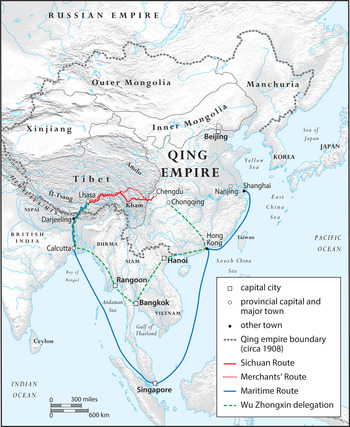
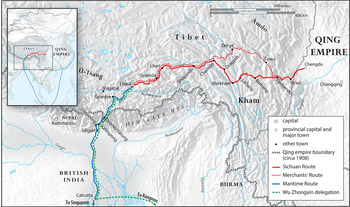
On 23 December 1905, Lianyu, the newly appointed Qing assistant amban Footnote 1 of Tibet, arrived in Dartsedo, the town marking the boundary between China proper and cultural Tibet.Footnote 2 He had already been travelling on the Grand Sichuan-Tibet Route (Ch. Chuan Zang dadao, the Sichuan Route hereafter; see Figures 1 and 2) for three weeks, but he knew that it was upon departing Dartsedo that the real drudgery would begin.
The Sichuan and Maritime routes (overview).
Source: Commissioned by the author and created by Isabelle Lewis.

The Sichuan and Maritime routes (enlarged/partial).
Source: Commissioned by the author and created by Isabelle Lewis.

After dawdling in Dartsedo for several weeks, Lianyu wrote to the Qing court on 2 February 1906:
If I return […] and board a steamship in Shanghai, I can arrive in Lhasa within two months. This [proposed alternative] definitely would not delay the journey [compared to the expected travel time on the Sichuan Route].Footnote 3
At first glance, this proposal seems nonsensical. Why was Lianyu so reluctant to take the well-trodden path tested by dozens of his predecessors over the decades? And how could one reach the centre of the Tibetan Plateau on a steamboat and guarantee this choice's efficiency? But the court knew precisely what Lianyu was referring to and hurled a curt rebuttal at him:
You shall proceed through the postal stations [on the Sichuan Route] as planned and inspect local situations along the way. You must not stall further with excuses.Footnote 4
Cowed by such a harsh reprimand, Lianyu had no alternative but to carry on westward. Seven months later, he arrived in Lhasa an exhausted and emaciated man.Footnote 5 Drawing on his previous experiences in China and Europe, Lianyu testified that what he had just undergone was ‘likely the most arduous journey on the globe’.Footnote 6 He was spared from enduring this intolerable hardship a second time, though. In 1912, as the last amban of the fallen Qing empire (1636–1911), Lianyu was marshalled across the Indo-Tibetan border at gunpoint by the Tibetans, who had settled on eradicating the Qing political presence in Tibet and deporting all its agents through the Maritime Route (Ch. haidao; T. chu thog, ‘via water’; see Figure 1). The Tibetans then demolished the Sichuan Route. It was not until 22 years later that another high official managed to reach Lhasa overland from China.
Lianyu's story is one of many cases illustrating that in both the Qing and post-Qing eras, the method by which one travelled between China and Tibet was a politically charged matter. This amban's experience also highlights that the two competing transportation routes—the Sichuan Route and the Maritime Route—were substantial concerns for both Tibetan and Qing (later Chinese) decision-makers at critical moments. In the eyes of the decision-makers of the Qing empire and the Republic of China (1912–1949, ROC hereafter), the two routes were conduits for the exercise of power over Tibetan land and peoples as well as places for state agents to display and strengthen authority. The routes were also locations where the dominance of the Qing and ROC states and agents was disputed not only by the Lhasa government (the Ganden Phodrang) but also by the indigenous peoples and political entities dwelling between Chinese and Tibetan metropoles. In negotiating with the groups and individuals who often disrupted transportation and challenged state agents, the Qing empire and the ROC reluctantly came to terms with the fact that their strength and influence were limited in not only Central TibetFootnote 7 but also the Tibetan cultural region of Kham, through which the eastern half of the Sichuan Route meandered. This article will also examine the symbolic meanings that the politicians of Tibet and the ROC assigned to the two routes, as well as how such meanings, in turn, affected the political decisions of both Tibet and China in the post-Qing decades. In investigating the Sichuan Route and the Maritime Route on the levels of experience and representation, this research seeks to illustrate the distinctive roles that the two routes played in the shaping of Sino-Tibetan relations amid the transformation of the imperial mode of governance of the Qing empire into the modern nation-state framework embraced in the twentieth century.
This research builds on recent studies on Sino-Tibetan political relationsFootnote 8 and continues the current academic advertence to the geographical and cultural middle grounds between Chengdu and Lhasa.Footnote 9 The historical sources investigated include the writings of Qing functionaries such as Xu Ying, Zhongfang, Yao Ying, Songui, Youtai, Fengquan, Wu Chongguang, Lianyu, and Zhang Qiqin, and the accounts of ROC emissaries such as Liu Manqing, Tan Yunshan, Huang Musong, and Wu Zhongxin, all of whom travelled between China and Tibet either overland or via the Indian Ocean. This article also consults Tibetan materials such as the testimonies of the Tibetan officials Shatra Rimshi Ganden Paljor (T. bshad sgra rim bzhi dga' ldan dpal 'byor) and Sekshing Lozang Döndrup (T. sreg shing blo bzang don grub), who interacted with the Chinese delegations and recorded what they witnessed.
This article unfolds in three chronologically arranged sections. In sketching the history of the Sichuan Route, the first section stresses that in much of the Qing era, the route was sustained by the reciprocity of obligations that existed under the imperial discourse, with which both the metropole and the indigenous entities complied. The emergence of the Maritime Route in the late Qing, the focus of the second section, hastened the empire's pursuit of sovereignty over the Tibetan regions, without regard for local interests. With the empire's previous approach to governance overturned, the Sichuan Route—the epicentre of the tension between the metropole and local entities—underwent obstruction, forced modernization, and, eventually, destruction within a few short years. The final section moves onto the post-Qing decades. As China and Tibet were rapidly evolving into two antagonistic national bodies, who was allowed to travel on what route continued to be a political matter for the governments of both sides, especially in the context of issues concerning their troubled bilateral relations.
Empire carried on a sedan chair
Tibet became an integral component of the Qing empire during the latter's expansionist eighteenth century. Following a series of successful military operations, the empire incorporated Tibet into the Sichuan defence zone, regulated the theocratic system of reincarnated lamas, inserted two ambans (imperial Residents in Tibet) into the indigenous political organism, and constructed a postal passage—the Sichuan Route—that tethered Tibet to the rest of the empire.Footnote 10 Upon the completion of these intricate and expensive political and military restructurings, the Qing assigned approximately 2,300 Sichuanese Green Standard Army soldiers to strategic towns in Central Tibet and along the Sichuan Route to guard the newly acquired territories.Footnote 11
‘The Route of Officials’
The Sichuan Route was also known as ‘the Grand Route to enter Tibet’ (Ch. jin Zang dadao) or simply ‘the Route of Officials’ (Ch. guandao). Along a pre-existing transportation artery,Footnote 12 the Qing state, by combining its postal station system with Green Standard military outposts, created an administrative conduit and a military lifeline. The first batch of stations emerged following the early Qing military action in the eastern Tibetan region of Kham. In 1718, ten stations were erected between Dartsedo and Lithang. After deciding to maintain a regular military presence in Tibet, the empire extended the route further to Bathang, Chamdo, and Lhasa in 1720. After two overhauls in 1751 and 1789, both the route and stations remained relatively stable until the empire's final days. There were approximately 80 stations, with over 1,600 Chinese soldiers and officials guarding the route and supervising the indigenous corvée labourers.Footnote 13 The stations provided travelling officials with basics such as food, water, fodder, firewood, and, most importantly, the helpers and pack animals required for the next leg of the journey.
With Lhasa connected to Chengdu, Tibet was tethered to the rest of the Qing empire. The Qianlong emperor found the Sichuan Route ‘essential to [Qing control of] Tibet’.Footnote 14 The route also became the default choice for Qing officials travelling between China and their posts in Tibet. The ambans, special emissaries, and minor agents stationed throughout Tibet travelled back and forth on the route. State couriers also scurried along it day and night, carrying government correspondence and the personal letters of state agents. The route was so frequently used that Xu Ning, on his journey from Chengdu to his position in Lhari in 1824, chanced upon at least ten convoys of military and civilian officials returning from Tibet to China.Footnote 15
The journeys of Qing functionaries became further streamlined in 1846 with the publication of Zhu Zang xuzhi (Protocols for Stationing in Tibet). Compiled by Zhongfang, a former assistant amban, the book is a compendium of essential government regulations as well as practical information, such as what items an amban should prepare for the journey, the distances between stations and the road conditions, the locations of military camps and granaries, and how to perform routine inspections and exchange gifts with the indigenous population. The book also provides instructions for the proper manner in which to receive Tibetan officials upon arriving in Lhasa and for interacting with the Dalai Lama. Although intended for ambans, Zhu Zang xuzhi proved useful to all Qing agents, ranging from first-rank special emissaries to minor employees of the lowest ninth level. For Qing officials who had little experience in border affairs, the book demystifies most of the challenges ahead of them: what to pack for a journey beyond China proper, how to deal with the indigenous population, and which tasks to perform on the first days of their new jobs. Zhu Zang xuzhi became a go-to guide for ambans and was available in Beijing's book markets at a time when most Tibet-related publications could be found only in Chengdu. Youtai (1846–1910), who recorded minute details regarding the functions of the Sichuan Route in daily journal entries, secured his copy in Beijing upon his appointment as amban in 1902. He kept the book close at hand throughout his journey to Lhasa, circulated it among his entourage, and consulted it in his daily travels.Footnote 16
Zhu Zang xuzhi also reveals the Qing agents’ role as more than mere consumers of the Sichuan Route's resources. Zhongfang stresses that the arrival of a high official should be announced to all stations weeks in advance in order for the local officials to have sufficient time to repair roads, renovate lodgings, and summon indigenous corvée labourers.Footnote 17 Many agents, after completing the journey, reported to the court on the conditions of the road and lodges, recommending improvements whenever necessary.Footnote 18 After all, as the Qing court sometimes reminded its Lhasa-bound officials, it was their duty to ‘investigate situations along the route’.Footnote 19 In this way, as the agents travelled back and forth, they helped to keep the Sichuan Route serviced and functional.
However, the road, the stations, and the scurrying imperial officials should not be interpreted as indicating that the vast regions beyond Dartsedo had been transformed into Qing territories. Until the empire's final years, both Kham and Central Tibet remained indirectly governed by the metropole. While Beijing supervised Central Tibet through the amban office in Lhasa, its relationship with Kham, a region that was culturally Tibetan but politically beyond either Lhasa or Beijing's direct control, was more complicated than the hierarchical relationship between Lhasa and Beijing. Recent scholarship portrays Kham as a land dominated by a host of secular and religious polities that were subject to Beijing and Lhasa's respective political and spiritual influences but which remained relatively independent of the two centres’ direct administration. Some Khampa polities even possessed the strength to dispute Beijing's and Lhasa's dominance,Footnote 20 and the decades of triangular tensions and negotiations between Beijing, Lhasa, and the local Khampa powers resulted in a ‘lattice-like structure of authority’ that can be witnessed throughout the area.Footnote 21 The Sichuan Route along which the Qing officials moved was therefore among the few tangible representations of the Qing presence in the vast non-Chinese territories of Kham and Tibet. These men's experience on the route, consequently, is particularly worthy of attention.
Within and beyond the Qing space
The movements of imperial functionaries either within or beyond the Qing space seldom lacked political incentives, and a state agent could hardly pass through a region without arousing awareness among the locals of the political purpose of his journey. The most riveting case is the Qianlong emperor's grand tours to Jiangnan, during which he forcefully substantiated Manchu political, military, and cultural prowess in the newly conquered Chinese heartland.Footnote 22 The Macartney Mission in 1793, which demonstrated the shared obsession of Qing and British politicians regarding how their speech and behaviour would be perceived by their counterparts, is equally compelling.Footnote 23 The official journeys of middle-level Qing agents along the Sichuan Route, due to their similar objectives, were in many ways comparable to those of the higher-level political actors. However, these men's adventures also departed from these celebrated expeditions. On the Sichuan Route, each agent belonged to a larger collective in which every member's experience was as much a continuation of his predecessors’ as it was an overture to those of future travellers. That the Sichuan Route was both within and beyond the Qing political space also contributed to the particularity of the experience of the Route.
The Qing court was aware that its agents’ journeys to Tibet were unlike their generic trips from one appointment to another within China proper. It also understood that upon stepping out of Dartsedo, these men were to embody Qing authority in places where such authority was rarely witnessed. The Treasury therefore provided itemized budgets for regimentals, hired ‘coolies’, pack animals, and travel gear such as tents and saddles, ensuring that the agents could afford to present themselves as dignified and gracious figures to the indigenous population along the route. It also allocated a special shangxu (‘reward needs’) budget with which the officials purchased silver medallions, silks, and tea bricks, awarding them to local dignitaries who approached them to perform their loyalty and submission.Footnote 24
Nevertheless, in contrast to later myths that portrayed the processions of ambans as extravagant parades of Qing riches and supremacy, the actual journeys were modest due to the travellers’ limited budgets and the stations’ limited catering capacities. Youtai, for example, divided his men into three teams that travelled a few days apart. The amban was the only one who could afford a sedan chair, and all the members of his entourage, although they were also rank-holding men, had to ride to Lhasa on horseback.Footnote 25 The gifts to the local dignitaries were nominal: a few tea bricks or a silver medallion, enough of a showing to prevent the gift-givers themselves from being embarrassed.Footnote 26 However, the austerity of the ambans’ processions and the thriftiness that they exercised along the route should not be interpreted as indicative of the frailness of the Qing or its lack of authority in Kham and Tibet. Rather, this frugality reflected local compliance with Qing dominance, which was based on the empire's previous demonstration of military prowess and its commitment to maintain the established power structure embodied by the route, the stations, and the travelling officials.
However, what the Qing agents’ daily interactions with the various indigenous peoples and political entities on the road reflected was more complicated than a reiteration of Qing superiority. In embarking on the route, the Qing agents also took part in a multilateral game of deterrence during which the balance of power between the imperial metropole and the local players was repeatedly disturbed and renegotiated.
Although most of the Qing agents’ interactions with local dignitaries were ritualistic confirmations of the established political hierarchy, this was not always the case. In 1844, Amban Mengbao was detained for seven weeks by the local authorities of the Dragyab (T. brag g.yab) region on his return journey due to a dispute that he had promised, but failed, to mediate during his outbound journey a few years prior. The amban did not dare report this humiliation to the court, fearing punishment for incompetence.Footnote 27 Lianyu shared a tale of encountering a reincarnated lama who had built a garden off the Sichuan Route. Whenever an amban approached, the lama would enter the garden beforehand, prepare a banquet, and send an underling to invite the amban to enjoy the meal with him. Having lured many ambans into his garden, the lama managed to convince the locals that his position was so high that even the imperial emissaries had to approach him to pay their respects. Lianyu shared the tale so that his successors would not be taken advantage of by similar shenanigans. However, even though Lianyu stated that ‘beyond the pass, every move of the official is connected to the dignity of the state, and one must be cautious’,Footnote 28 neither he nor his predecessors who had been deceived reported this lama to the court—most likely out of fear that they would be accused of sullying the dignity of the state—and the lama was able to game the ambans for years.
While many local groups and individuals settled for minor gains that could be negotiated without directly challenging the existing imperial power structure, others openly opposed it, hence faced the empire's aggression. The most intriguing instance of the latter is the Gönpo Namgyel rebellion in Kham, which ended with a Qing military intervention. Nevertheless, sources show that although Gönpo Namgyel began disrupting the regional status quo as early as the late 1840s, it was not until his forces blocked the Sichuan Route in 1862, and consequently cut off the circulation of people, materials, and information between Chengdu and Lhasa, that the Qing court deployed troops against the rebels.Footnote 29 Regardless of whether the Qing reluctance to take military action in the uprising's initial phase can be attributed to the empire's decline in power in the latter half of the nineteenth century, the entire affair reiterates the fact that Qing authority in Kham and Tibet was embodied in, channelled through, and restricted along the Sichuan Route. While the court could turn a blind eye to regional military turmoil off the route, any threat to its connectivity prompted the Qing empire to take immediate action.
An exploration of travelling Qing agents’ interactions with indigenous commoners reveals a similar pattern of power being exploited and appropriated by multiple parties on the Sichuan Route. In their dealings with the corvée labourers who shouldered the heavy burden of transporting themselves and their belongings, many Qing officials considered it a virtue to treat these locally drafted men and women gently and compensate them generously.Footnote 30 Nevertheless, it seems that the Qing travellers’ public display of compassion was as much pragmatic as it was humanitarian. After all, the average number of soldiers assigned to each station was below 20, meaning the average military presence on the Sichuan Route was fewer than two men per mile. The deterrent power of the Qing along the route, therefore, was far from adequate to guarantee its agents’ safety. As a result, it was not unusual for travellers to encounter ‘irresponsible and obstinate’ (Ch. wangeng) labourers who demanded lighter work and weightier compensation. Customarily, meting out some of the gift tea and silks that they had purchased with the shangxu budget was enough for the Qing agents to pacify their disgruntled helpers.Footnote 31 On other occasions, labour disputes became so irreconcilable that the labourers and the amban's retinue threw stones at and even drew swords against each other.Footnote 32 Youtai once ordered a disobedient labourer to be arrested by a joint force of Chinese and Khampa officials, leading to the man's ear being cut off and pinned to the door of his superior officer as a warning to others.Footnote 33 At other times, the agents circulated reminders about where they might encounter locals who were prone to greet them with scorn and advised one another to tread lightly in these troublesome regions.Footnote 34
Since corvée service was a form of compulsory tax payment that the men and women dwelling along the Sichuan Route were required to provide, it is understandable that they did not have much interest in serving the Qing travellers with the level of enthusiasm that the latter expected. After all, the compensation that the Qing men offered, no matter how generous, could hardly offset the resources that they consumed. However, in the eyes of the locals, the travelling Qing officials were not always a nuisance. For instance, ambans’ processions were sometimes followed by caravans of Lhasa-bound Khampa pilgrims.Footnote 35 By trailing Qing travellers, pilgrims could reduce their chances of being harassed by abusive local strongmen or roaming bandits. They also benefited from mended roads and fortified bridges on the otherwise treacherous Sichuan Route.
Indeed, the Qing agents were mindful of their duty to project Qing superiority whenever possible on the road, and the local population was required to meet these men's demands for resources, labour, and submissive gestures. Nevertheless, as the agents travelled on the route with minimal defensive recourse, it did not take long for them to realize that they could be easily overpowered by the numerous indigenous groups and individuals dwelling along it. To keep the journey smooth and themselves out of trouble, these imperial representatives tolerated the corvée labourers who treated them with disrespect, condoned the pilgrims who regarded them as path-clearers and security details, and gamed with local dignitaries who schemed to appropriate the imperial authority that they represented. With respect to local groups and individuals of Kham and Tibet, by challenging the travelling agents’ authority through a variety of means, they managed to confine Qing influence within the narrow corridor that was the Sichuan Route and its vicinity.
Over the decades that the Sichuan Route functioned as the conduit of imperial authority, both the Qing and the regional entities came to terms with the strengths and limitations of their powers. The relationship between the imperial metropole and the indigenous groups and individuals, instead of being hierarchical or confrontational, was closer to a precarious balance that was maintained not only by the situation of mutually assured destruction in which the Qing officials and the indigenous entities found themselves but also by the reciprocal responsibilities that were negotiated by the empire, its travelling agents, and the indigenous men and women living along the Sichuan Route.
Rites of passage and the culture of the route
Unsurprisingly, many Qing travellers found their journeys on the Sichuan Route simultaneously enlightening and traumatizing. Such mixed feelings were not uncommon among the middle-level state agents of both the Qing empire and the surrounding Asian states stepping into or venturing beyond the Qing space, many of whom shared this transformational experience in the written form.Footnote 36 Of particular interest are the adventures of a group of Beijing-bound Korean emissaries, out of whose record of their experiences a literary and cultural tradition emerged.Footnote 37 The Korean emissaries' experience is similar to that of the Lhasa-bound Qing officials in many respects, as both cohorts strode beyond the familiar into the unknown, and their missions were both individual and collective. However, the Koreans were subjects of imperial power and temporary sojourners in the Chinese metropole, whereas the Qing officials were representatives of an expansive force on expeditions to maintain and strengthen the empire's presence beyond the imperial heartland. The impact that the Qing officials had on the route and the transformations that the men themselves underwent during the journey can hardly be detected in the Korean missions.
Many Qing agents viewed the journey to Tibet as an unavoidable affliction that they had to endure to reach their remote posts. Their aversion to the Sichuan Route notwithstanding, these men's experience on the route was also a rite of passage, during which they evolved from ordinary Qing officials, the majority of whom had never stepped out of China proper, into experts on the complex political and social situations of Kham and Tibet. Furthermore, through decades of knowledge-making and knowledge-circulation among themselves, the agents also constructed a peculiar cultural space paralleling the Qing political space along the Sichuan Route.
Chengdu, the starting point of the Sichuan Route, was also the home base for most newly appointed ambans: it was in Chengdu that they settled their family members and collected most of the necessities for their upcoming travel to Tibet. Sometimes it took as long as a year to complete the preparations.Footnote 38 In addition to amassing material objects, an amban needed to recruit an entourage to fill the minor positions in his office in Lhasa. He also needed to accumulate both textual and oral information regarding the journey and the destination. Youtai, for example, actively sought out colleagues with experience in Tibet, who offered him not only occupational but also travel advice. He learned practical particulars such as the need to build a smaller sedan chair because his grand Beijing-style chair would be too cumbersome to survive the formidable road conditions beyond Dartsedo.Footnote 39 In addition to gathering men and information, he also purchased related books and maps presented to him by solicitous local vendors.Footnote 40
In addition to circulating existing intelligence on the Sichuan Route and the Tibetan territories, some agents felt obligated to contribute their own thoughts and experiences to the already sizable trove of knowledge. For instance, a member of Lianyu's entourage, Zhang Qiqin, composed Lu Zang daoli zuixin kao (Latest Survey of Routes and Distances between Dartsedo and Lhasa) in 1907. The book, in essence, was a response to previous travel guides, which Zhang deemed no longer accurate due to recent administrative adjustments. In writing the book, Zhang hoped that ‘future travellers would know what to expect, and would not be misled by previous publications’. Zhang's manuscript began circulating among his fellow travellers and was updated even before its publication, as his supervisor, the amban himself, added a preface and substantive in-line comments to the main text. His colleague, another member of Lianyu's entourage, contributed a postscript.Footnote 41
The Sichuan Route also functioned as an immersive, interactive course on border affairs for Qing agents. On the road, the travellers read their newly acquired books and maps, shared information with other officials they encountered, and applied the knowledge that they had cultivated in their daily interactions with indigenous elites and commoners. By the time they arrived in Lhasa, many had not only learned the proper manner of exchanging gifts and greetings with Tibetan politicians on diplomatic occasions but had also become familiar with the Qing and Chinese literature on the political and religious histories of Tibet. One could even pick up a few hundred Tibetan words with the help of the ‘Barbaric Language’ volume of the popular 1792 publication Weizang tushi (Ü-Tsang Pictorial Gazetteer).
Meanwhile, what the substantive knowledge created and curated by the Qing officials over the decades had reinforced was a self-feeding circle that constrained these men within the scope of the Qing imperial narrative regarding Kham and Tibet, and a Sino-centric interpretation of non-Chinese territories and peoples. Zhu Zang xuzhi, for instance, directed the agents’ attention solely towards Qing governmental infrastructure along the Sichuan Route. Other publications, many of which aimed to celebrate the Qing colonial enterprise, invited travellers to appreciate imperial monuments such as fortresses, battle grounds, demarcation steles, and royal inscriptions. Xizheng jixing shiji (Collected Poems on the Western Expedition), for example, is a collection of poems composed by Yunli (1697–1738), a son of Emperor Kangxi who visited Kham in the aftermath of a Qing military expedition in the region in 1734. The royal prince's poetry collection, which reinterprets the sights, the local population, and the Qing agents’ travel experience within the context of the Qing military expansion into Tibet, became one of the most cited works among Qing travellers to Tibet.Footnote 42 On the level of the fantastic, the route was dotted with the purported sites of the western expedition of Zhuge Liang (181–234), an ancient Chinese politician who had risen to the level of a semi-deity in Chinese culture due to the Ming historical work of fiction Sanguo yanyi (Romance of the Three Kingdoms). There were also sites where certain episodes in Xiyou ji (Journey to the West)—a popular Ming novel romanticizing the Tang dynasty monk Xuanzang's (602–664) historic journey through Inner Asia—had allegedly occurred.Footnote 43 In other words, after decades of knowledge-making and knowledge-circulation along the Sichuan Route, the Qing travellers constructed a curious space in which the relationship of the Qing empire, the travelling officials, and the indigenous Tibetan land and people was aligned as much with the complicated political and social realities of Kham and Tibet as it was with the Qing discourse on these regions and the Chinese imaginary of China's southwestern frontiers.Footnote 44
Balance disrupted
The precarious balance between the Qing empire, its agents, and the local forces that had sustained the Sichuan Route for much of the eighteenth and nineteenth centuries was disrupted in 1905, when Youtai's successor-to-be, Assistant Amban Fengquan (1846?–1905), was assassinated on the Sichuan Route near Bathang. As the incident occurred in the aftermath of the Francis Younghusband invasion of Tibet (1903–1904), it was conventionally understood as a violent venting of the xenophobic sentiment boiling up among the locals and catalysed by the Western military attire worn by the assistant amban's guards and Fengquan's own unrestrained display of arrogance. However, recent investigations suggest that, rather than an unfortunate concurrence, the Fengquan incident was in fact a clash caused by the Qing empire's resolution to redefine its presence in this region and the local Khampa residents’ unhinged response to the Qing court's unannounced decision.Footnote 45
The empire's revisionist attitude towards Kham and Tibet was attributable in part to recent international developments on the southwestern Qing frontiers. Younghusband's invasion unveiled a British appetite for greater political and economic sway over Tibet. At the same time, Russia was also seeking diplomatic channels with Lhasa. The Qing, having lost wars and vassals to both Asian and European powers in recent decades, had every reason to fear for its own influence over the vast non-Chinese territories beyond Dartsedo.
The Qing assessment that its authority in Tibet was declining, however, was as real as it was imagined. The Thirteenth Dalai Lama (1876–1933), after failing to thwart the British aggression, fled Lhasa as Younghusband's troops advanced on the town. With the Dalai Lama out of the picture, the amban assumed a more assertive managerial role over Tibet's politics. Meanwhile, the Qing court took control of the exiled lama and brought him to Beijing, where he was compelled to publicly demonstrate his submission to the empire. Such an act would eventually alienate the lama and the Lhasa government, but Qing authority in Tibet increased in the short term.Footnote 46
Nevertheless, the augmented imperial power was too miniscule to assuage Qing officials’ growing dissatisfaction with the imperial approach to the larger non-Chinese territories, which included not only Tibet but also Mongolia and Xinjiang. Such sentiment emerged against the backdrop of the empire's increasing diplomatic and intellectual interactions with Western political thoughts and practices over the previous decades and the subsequent introduction of concepts such as nation-state, sovereignty, and international law into China. Qing political elites, who found themselves in a disadvantageous position when confronted by Western powers regarding the legitimacy of their rule over the non-Chinese regions, began to scrutinize the empire's existing mode of control over these regions with growing scepticism and concluded that only through reinforcing territorial sovereignty and establishing absolute authority could the empire prevent the loss of these territories to foreign powers. Their consensus was soon endorsed by the court, setting in motion the Qing transformation from a pluralist empire into a Chinese nation.Footnote 47
The Qing resolution to redefine itself in the Kham and Tibetan regions was embodied by Fengquan's appointment as assistant amban in 1904. As soon as he arrived in Bathang, he inaugurated a series of colonialist initiatives, including opening mines, curbing local secular and monastic powers, and encouraging Chinese agricultural immigration. He also coordinated with Chengdu to increase the number of soldiers stationed along the Sichuan Route. The overwhelmed locals responded to these intrusive plans with a riot, and Fengquan was assassinated in the midst of the chaos.Footnote 48
After Fengquan's death, the local Khampas fumbled in vain to restore the bilateral relations with the Qing authorities with which they were more familiar. They supplied the Qing court with a viable excuse to de-escalate the conflict by portraying the incident as a tragic misunderstanding generated by nothing other than the locals’ anti-Western patriotism. They then claimed that should the Qing government decide to punish them for Fengquan's death, they would demolish the stations on the Sichuan Route and cut off transportation. Such manoeuvres indicate the locals’ awareness of the route's political significance and physical fragility. They also reveal the Khampas' perception of the empire not as a sovereign but as a political counterpart at whom they could dart threats and with whom they could arrange negotiations. However, what they did not realize was that the empire, by appointing Fengquan, had already decided to revoke the understanding that it had previously maintained with the indigenous populations. It responded to the Khampas’ petition with brutal military suppression, followed by the implementation of gaitu guiliu, a policy aimed at replacing indirect control with direct governance.Footnote 49
With respect to Fengquan himself, while his role as both an indicator and a facilitator of the Qing forward policy in Kham has been reiterated by previous scholarship, the man's own agency in the incident remained obscure until the recent unearthing of a cache of personal correspondence that he composed on the Sichuan Route during the last six months of his life. The 14 letters that he wrote to his family members, who were living in Chengdu at the time, reveal not only the instrumental role that the amban played in the incident but also the tensions between the Qing empire, its agent, and the Sichuan Route at a politically mercurial moment.
Contradicting the notorious caricature of Fengquan as an impudent person and an undiplomatic politician, the amban's family letters sketch a nuanced portrait of an ailing 60-year-old man overwhelmed by the hardships that he had been enduring on the Sichuan Route and torn between public duties and personal concerns regarding his appointment as assistant amban. The letters illustrate that instead of colonial zeal, it was the dread of travelling further on the route and being stranded for any longer beyond China proper that prompted Fengquan to loiter in Bathang, where he tried to bulldoze the locals into accepting his radical reforms. He schemed to score the maximum number of political points in Bathang in the shortest time, in the hope that should he be able to generate applaudable results within months, when he submitted his petition to return to Dartsedo (or even Chengdu), he would not be denied by the court and derided by his colleagues for cowardice. In other words, in prioritizing his own desires over his duties to the state at a vexatious juncture, Fengquan assured his own demise and propelled both the Qing and the local Khampas towards an irreconcilable confrontation.Footnote 50
Although Fengquan was the only amban who met a violent end on the Sichuan Route, he was neither the first nor the last state agent afflicted by the tension between his firm alignment with the state's Tibet policies and an equally grave concern over the threat posed to his personal well-being along the Sichuan Route. As detailed in the following sections, such discordance would become more salient as tensions between Tibet and the Qing empire (later the ROC) continued to escalate and as the Maritime Route began to transform travel on the Sichuan Route from an unwelcome prerequisite to an unnecessary nuisance.
A challenge from the ocean
In December 1905, Lianyu, Fengquan's replacement as assistant amban, embarked on the Sichuan Route in the immediate aftermath of the Qing military campaign in Kham. In Dartsedo, Lianyu sent the petition presented at the beginning of this article, asking to be allowed to forego the Sichuan Route altogether and travel to Lhasa by boat instead. The route that he planned on taking was the Maritime Route, a newly emerged conduit connecting China and Tibet via the Indian Ocean.
The Maritime Route, in Lianyu's time, was as follows (see Figure 1): from Shanghai, one boarded a commercial steamboat that would arrive in Calcutta in three weeks. The Calcutta-Siliguri Railway, which extended to Darjeeling in 1881, then carried one to the foot of the Himalayas in two days. After crossing the Indo-Tibetan border and arriving at Yatung (T. gro mo), one travelled further north along the Yatung-Gyantse road built by the British following the Younghusband invasion. From Gyantse, one made an easy ride on horseback to arrive in Lhasa within ten days. The entire journey, which required as little as eight weeks, including delays and transfers, was significantly less time-consuming and more comfortable than the Sichuan Route.
In fact, lower-level Qing officials had been using the Maritime Route for two decades prior to Lianyu's petition. The first recorded journey was completed in the 1880s, and the second occurred in 1896.Footnote 51 By the 1900s, although few dared travel to Tibet via the Maritime Route—no one, presumably, fancied the idea of explaining to the emperor why he needed a British visa for a domestic trip—many returned to China from Tibet by boat, as the ambans seemingly had the authority to issue the documents required for the return journey and were lenient in this regard. Although most services on the Sichuan Route were free of charge for official journeys, whereas taking the Maritime Route meant that officials had to pay out of their own pockets, many preferred to shoulder the costs in order to avoid hardship. Unlike Xu Ying, who in 1824 frequently met returning Qing agents on the Sichuan Route, Youtai completed his 1903 journey mostly in solitude, presumably because many of his colleagues were now returning to China by boat. The lower-level official Wu Chongguang, for example, travelled to Lhasa via the Sichuan Route in 1903 but returned to China via the Maritime Route in 1906. Wu's travel account, Chuan Zang Zhe Yin shuilu jiyi (Peculiars in my overland and maritime journeys to Sichuan, Tibet, Sikkim, and India), paints a vivid picture of the stark difference between the two routes. The difficulties that Wu experienced during four months riding on horseback along the Sichuan Route were so overwhelming that on the journey, Wu was sometimes unable to hide his tears from his fellow travellers. By contrast, he found his nine-week voyage on the Maritime Route most delightful, and during it, he was awed and dazzled by all the modern wonders of British India.Footnote 52
In addition to siphoning travellers from the Sichuan Route, the Maritime Route also undermined its competitor's postal functions. Accompanying Younghusband's brief invasion, British telegraph wire was extended across the Indo-Tibetan border to Yatung (and later Gyantse). Whereas information used to take weeks, if not months, to travel between Lhasa and Beijing via the Sichuan Route, the British telegraph shortened the duration to less than seven days.Footnote 53 Along the Sichuan Route, the telegraph service was extended from Chengdu to Dartsedo in 1896 but did not push further west,Footnote 54 presumably due to the geographical complexities of the route and an insufficient Qing military presence to guard the facilities. Therefore, after the installation of the British telegraph, although the Qing still used the Sichuan Route for non-essential correspondence, urgent messages began being transmitted via the British telegram service.
The Maritime Route's impacts on Sino-Tibetan relations
As Qing men and messages began travelling the Maritime Route, transportation and communication innovations were rapidly redefining the landscape of Asia, leading to the collapse of preindustrial distance while providing travellers with transformative experiences.Footnote 55 In China, simultaneous with the rise of the Maritime Route, railroads and steamboats began connecting the vast territories within and beyond China through innovative means, and direct wire communication was spreading from China proper to Korea, Manchuria, and Xinjiang. These infrastructures revolutionized people's temporal and spatial consciousnesses, creating a heightened sense of connectedness in China, and boosted many Qing officials’ confidence in domestic and international affairs.Footnote 56 Meanwhile, since such innovations paralleled Western, especially British, colonial expansions in Asia, they generated widespread apprehension among Asian travellers and politicians.Footnote 57
As an embodiment of British transportation industrialization and imperial ambitions in Asia, the Maritime Route, while functioning as an object of fascination, simultaneously became a source of anxiety among Qing agents attentive to frontier affairs. Such anxiety was not solely a response to the British menace—it was also a result of the overall reformulation of space between Tibet and China proper, a process in which the Sichuan Route played a quintessential role.
While the Maritime Route was gaining popularity among Qing travellers, the geographical challenges associated with the Sichuan Route stymied the empire's attempts to keep pace with the modern transportation innovations that were rapidly spreading across China. In the early 1900s, people and information were still carried along the route on the backs of corvée labourers and pack animals. Nevertheless, as testified by Youtai, who travelled the route in 1903, although some facilities were in an unsatisfactory state, the roads, bridges, and lodges were nevertheless renovated and rebuilt regularly. Fengquan's journey the following year was also smooth (at least up to Bathang). The route's interruption due to the military campaign following Fengquan's assassination was brief and Lianyu, who travelled the route the next year, had an uneventful journey.Footnote 58 The postal and package services between Lhasa and Sichuan were also functional.
Nevertheless, by the time Lianyu sent his petition, the Sichuan Route had been demoted from the sole to the less favourable option for Qing agents travelling between China and Tibet. Although the ill fate of Fengquan and the subsequent military action in the Kham region surely tarnished the route's image, it was due more to modern transportation methods, which had facilitated the collapse of time and space in both China and around the world, that Qing men began to see the Sichuan Route in a different light. Instead of considering it a strategic conduit, some dismissed it as ‘an obstacle to transportation’ (Ch. daotu zhonggeng) and an ‘inconvenience’ (Ch. bubian).Footnote 59 Such aversion to the Sichuan Route soon spread to Qing agents at all levels: after Lianyu's request to take the Maritime Route was declined, seven out of the eight members of his newly recruited entourage absconded, even though doing so meant squandering a coveted chance at upward career mobility within the overpopulated pool of lower-level officials in Sichuan.Footnote 60
What the obstinacy of the court and the reluctance of its officials caused was a division between the state and its agents that was unprecedented since the Qing had obtained control over Tibet. Although no direct evidence proves that the Qing court's insistence that its agents travel on the Sichuan Route was due to sovereignty concerns, there are nevertheless allusions to the court's awareness of its agents’ role in maintaining the route and the Qing presence in Kham and Tibet. From the perspective of the agents, the court's demand put them through unnecessary hardship and in unnecessary danger. Even Fengquan, the most ardent supporter of the Qing reform plans in Tibet, schemed to persuade the court to let him double back. Lianyu, in arguing that the Maritime Route was more efficient, attempted to avoid the trek altogether. But the court was indifferent to its agents’ apprehensions. With harsh reprimands, it goaded them westward into the Tibetan territories.
The Sichuan Route: its final moments
As the Qing empire continued pushing its unenthusiastic agents through the Sichuan Route, it also carried on with its ambitious plan for Kham and Tibet. After the completion of its political and military operations in Kham, by 1909, 2,000 well-equipped New Army soldiers had advanced into Tibet in support of the court's larger scheme to convert the region politically, militarily, and technologically into an integral part of China. The troops marched into Lhasa in early 1910, heedless of the diplomatic protests and military resistance of the Tibetans. The Dalai Lama fled to India. The Qing took military control of Tibet.Footnote 61
These rapid developments required the newly appointed Qing agents to arrive in Tibet in a timelier manner, and the Qing court itself grew sceptical of the Sichuan Route, which it found was becoming increasingly incompatible with its rapidly unfolding designs for Tibet. As a result, assistant ambans Wen Zongyao and Qian Xibao were allowed to take the Maritime Route in 1908 and 1910, respectively. Ironically, as the ambans travelled via British India, the Qing had to formally request Britain to ‘take care of’ (Ch. zhaoliao) them. Qian, for example, relied on the British to schedule the journey and even book boat tickets for the entire team.Footnote 62
But the empire's abandonment of the Sichuan Route proved to be only a temporary arrangement. Aware that it was the technological imbalance between the Sichuan Route and other parts of the empire that had contributed to the distortion of the space between Tibet and China proper, upon taking over Tibet, the Qing prioritized bringing the Sichuan Route up to date. Wider roads and steel bridges were commissioned and modern postal regulations were drafted.Footnote 63 Telegraph wire was finally extended further west from Dartsedo, arriving in Chamdo by 1909.Footnote 64
The empire's implosion in 1911, however, caused the Qing reformers to taste the bitter fruit of their audacious adventures, which had alienated Tibetan elites and commoners alike. United by their shared distaste for the Qing and commanded by the exiled Dalai Lama, the Tibetans disarmed and deported all imperial soldiers and officials.Footnote 65 The people of Kham rioted, returning the region to the semi-autonomous status it had held prior to the late Qing reforms. The Sichuan Route was destroyed. The lodges, garrisons, granaries, postal stations, and telegraph wires that the Qing had been maintaining at great expense were demolished or abandoned to fall into disrepair. Many Qing men guarding the route were slaughtered or driven away. When Chinese agents revisited the region two decades later, the remarkable establishment and what it represented—the intricate and dynamic relations that an imperial state and its agents had maintained with the indigenous groups and individuals along the route—had long since disappeared without a trace.Footnote 66
Sedan chair diplomacy
After the demise of the Qing empire, Tibet, now a de facto autonomous power, strove to elevate itself from China's subordinate to its equal. One method that the Lhasa government used to update its relationship with China was the exercise of strict control of its borders, and it was especially cautious about opening overland transportation channels for Chinese politicians. As the Chinese delegates, now forced to resort to the Maritime Route, were delayed or denied entry into India or Tibet, they came to believe that the entire affair was a British ploy to sabotage Sino-Tibetan harmony. On the contrary, it was more likely to have been a Tibetan manoeuvre to maintain distance from China and Britain by pitting the two powers, both of which craved a stronger presence in Tibet, against each other.Footnote 67
In addition to controlling the method by which the Chinese were allowed to enter Tibet, the Lhasa government also dictated what route they were allowed to use to exit the country. As early as the 1910s, Lhasa deported all former Qing soldiers and officials—including Amban Lianyu—across the Indo-Tibetan border.Footnote 68 After winning a regional war against Sichuanese troops in Chamdo in 1918, it repeated this manoeuvre. Although Chamdo bordered Chinese territories, the Tibetan military chose to march the more than 1,000 Chinese captives across Tibet and deport them to India instead.Footnote 69
The symbolism of the two routes
With the Sichuan Route destroyed and overland communication obstructed, Chinese politicians began to view the Maritime Route—now the default travel passage for Sino-Tibetan political functionaries—as a symbol of British imperialist expansion and Chinese national humiliation. In 1931, Sun Ke, the son of Sun Yat-sen and the head of the Railways Department of the ROC, accused Britain of weaponizing the Maritime Route in their colonial enterprise. Through it, Sun claimed, the British could ‘enter Tibet as if entering their own foyer and exploit Tibet as if from their own cupboard’. He then lamented that China, due to the obstruction of the overland route, ‘has no means to intervene’.Footnote 70 Tan Yunshan, a Chinese representative who took the Maritime Route and entered Tibet in disguise in 1930, exclaimed,
The fact that a person must pass through a foreign country to access the territories of one's own country is already a humiliation; and that the person must travel in disguise, in secrecy, is humiliation upon humiliation!Footnote 71
With the Maritime Route symbolizing Chinese national humiliation, the destroyed Sichuan Route was now viewed as evidence of China's historical connection with Tibet. In 1929, Liu Manqing, an administrative secretary of the ROC government, volunteered to visit Lhasa to mend the strained Sino-Tibetan relationship. She began the journey without soliciting Tibetan permission, traversed the now abandoned, bandit-infested Sichuan Route in three months, and approached the Sino-Tibetan border by the end of the year. Tibetan officials tried to dissuade her from proceeding further, but Liu, an adroit identity-performer with both Chinese and Tibetan cultural heritage and linguistic capabilities, persuaded the Tibetan government to let her enter the Tibetan territories. She arrived in Lhasa in early 1930 and met with the Thirteenth Dalai Lama. Liu became the first official of the Chinese central government to visit Lhasa since the Tibetan cleansing of Qing remnants in the 1910s. Upon her return to China, she was elevated to the level of a national heroine.Footnote 72 Wang Zhengting, then foreign minister of the ROC, interpreted Liu's journey as follows:
After enduring the greatest hardships, Secretary Liu reopened the [Sichuan-]Tibet route. Her tremendous contribution will be engraved in historical canons.Footnote 73
The gallantry and perspicacity that Liu had manifested in pursuance of her mission merited the ROC's recognition indeed, although Wang's statement that Liu ‘reopened’ the Sichuan Route is imprecise. After all, she could not have completed the journey without Lhasa's permission, and her mission occurred at a providential moment when the Dalai Lama, pressured by the domestic and international challenges that Tibet was facing at the time, was considering pursuing a less confrontational relationship with China. In other words, it was still the Tibetans, not the Chinese, who determined the viability of the transportation routes between Tibet and China. Additionally, despite Liu's mission, what made the Sichuan Route indispensable to Sino-Tibetan politics—the government infrastructure that the Qing had invested in installing and maintaining—remained non-existent. What Wang's commendation of Liu reflects, therefore, is less the facts of the case than the ROC government's comprehension of the significance of the Sichuan Route in China's relationship with Tibet and its strong desire for the route to resume operations.Footnote 74
The Huang Musong mission
In the following months, an unexpected military skirmish that occurred on the Sichuan-Tibetan border precipitated the rapid deterioration of Sino-Tibetan relations, and it was not until the Thirteenth Dalai Lama's sudden demise in 1933 that the ROC government had an opportunity to build on Liu Manqing's limited achievement. Chinese politicians viewed the passing of the strong-minded Tibetan supreme leader as an opportunity to readjust China's relations with Lhasa. The timing also coincided with the ROC government's re-evaluation of its frontier policies: having failed to persuade the border communities to embrace Sun Yat-sen's Five Peoples Republicanism (Ch. wuzu gonghe) discourse and voluntarily join the Chinese Republic, it began presenting itself as the rightful inheritor of Qing privileges instead. In reverting to an imperial stance, the ROC hoped that non-Chinese peoples would be more willing to acquiesce to its claim to former Qing territories.Footnote 75
Under the influence of this new directive, ROC politicians, upon learning about the death of the Thirteenth Dalai Lama, decided to send a delegation to Lhasa to uphold the Qing tradition of offering condolences (Ch. zhiji) and granting posthumous titles (Ch. cefeng) to deceased Dalai Lamas. Should this mission be successful, it would substantiate the ROC contention that the Sino-Tibetan relationship had always been, and still was, that of sovereign-subordinate. However, unlike in the Qing era, the ROC had to obtain Tibetan permission prior to crossing the Sino-Tibetan border, and Lhasa granted it only because it sought to negotiate over the current Sino-Tibetan border dispute face-to-face with Chinese decision-makers. Lhasa initially suggested that the Chinese delegation take the Maritime Route but eventually acceded to the Chinese demand to travel overland in hopes of facilitating the much-needed direct conference with China.Footnote 76 At the time, Lhasa did not realize that the Chinese had no intention of respecting Tibet's status as a de facto autonomous political entity, nor did it have any interest in discussing further topics, such as border demarcation.Footnote 77
In 1934, a high-profile diplomatic delegation departed from Nanjing and headed west towards Lhasa. The delegation, presided over by Chiang Kai-shek's trusted associate Huang Musong (1883–1937), used every means to radiate an imperial aura.Footnote 78 Prior to entering the Kham territory, all the staff and servants received rigorous training to ensure that they carried out their tasks in an ‘orderly and spirited’ fashion so that ‘the brothers in Kham and [Central] Tibet’ would be awed by their ‘good appearance and courteousness’.Footnote 79 Throughout their journey, Huang and his deputies spent much time being carried in sedan chairs, even though such chairs, in post-Qing China, had become obsolete objects and stigmatized remnants of a darker time. The transportation of Huang's chair alone cost thousands of silver dollars, but Huang deemed it an essential element of the mission without which ‘propriety’ (Ch. tizhi) would be jeopardized.Footnote 80 As Huang approached Lhasa, the Tibetan welcoming party witnessed an imposing procession comprising dozens of armed Chinese soldiers and over a hundred staff and servants, highlighted by a long succession of four-carrier, grand sedan chairs. Decades later, Sekshing Lozang Döndrup, the Tibetan nobleman who greeted Huang on the outskirts of Lhasa, still remembered the spectacle vividly, especially the silk sheath and tassels that lavishly decorated Huang's chair.Footnote 81
Impressing the Tibetans in every possible way was exactly the objective of the Chinese, as the Huang delegation aimed not only to imitate but also to outperform its Qing predecessors. While the Qing ambans could afford only nominal tokens, Huang, with an astronomical budget of 400,000 silver dollars, purchased hundreds of loads of luxurious silk, tea, and silver in various places in China. He showered these gifts on regional political and religious dignitaries who approached to pay respects along the route and received their enthusiastic expressions of affection for China in return.Footnote 82 The main theatre for Huang's extravagant gift-giving performance, however, was Lhasa, where most noble families in town received lavish presents. The gifts were so impressive that some Tibetans jokingly commented that Huang distributed silk bolts as liberally as if they were rolls of toilet paper and that what the Chinese delegation engaged in was more like a religious mass donation than diplomacy.Footnote 83 Huang's gifts seemed to have achieved their purpose, at least for a brief moment. Most likely to reciprocate Huang's generosity, Tibetan officials and dignitaries began to pay Huang private visits and express their hopes for Sino-Tibetan reconciliation.Footnote 84
The delightfulness of Huang's gifts, however, did not translate into China's political success in Tibet. After all, each party's basic understanding of what constituted a harmonious relationship between China and Tibet was at odds with the other's. As Huang pressed Lhasa to acknowledge China as Tibet's sovereign, Tibetan politicians responded that they would welcome China's continuance as Tibet's ‘patron’ (Ch. tanyue) instead. They also made it clear to Huang that Tibet had been, and would remain, an autonomous country (Ch. zizhu zhi guojia).Footnote 85 Neither side was willing to compromise, despite several rounds of negotiation, and the Chinese delegation left Lhasa empty-handed and frustrated. Deflated by the diplomatic defeat, Huang lamented in his journals that ‘border affairs are indeed thorny’.Footnote 86
The political gridlock that Huang had encountered in Lhasa notwithstanding,Footnote 87 back in China, the delegation's safe return assuaged Chinese anxiety over its fading presence in Tibet. In his official report to the ROC government, Huang labelled the mission a success and claimed that Tibetan politicians, clergy, and commoners all demonstrated a ‘sincere intention of turning toward [China]’ (Ch. chengxin neixiang).Footnote 88 To the Chinese audience that evaluated its government based in part on its ability to reconnect with Tibet,Footnote 89 the team members boasted about the smoothness of the journey, the welcoming Tibetans, and the bright prospects for Sino-Tibetan relations.Footnote 90 The exhilarated Chinese media showered praise on the mission, some calling Huang a ‘deity of peace’ (Ch. heping shen) who possessed the power of ‘transforming shields and halberds into jades and brocades’ (Ch. gange huawei yubo).Footnote 91
In addition to insisting that it had facilitated Sino-Tibetan reconciliation, the Huang mission also took pride in treading ‘the route that Qing ambans used to take’.Footnote 92 In reality, instead of taking the Sichuan Route, Huang turned north after passing Dartsedo, heading towards the sparsely populated Dege and Garze regions. Explaining the reason behind choosing what was known as ‘the Route of Merchants’ (Ch. shangdao; see Figure 2) over ‘the Route of Officials’, Huang spoke of ‘the ferocious indigenes and rampant banditry’ in the densely populated Litang and Bathang regions where the Qing used to maintain postal stations.Footnote 93 In contrast to the Qing ambans, who considered keeping the indigenous groups from turning hostile and banditry at bay an integral part of their mission, Huang, by taking a detour, circumvented both the challenges and the responsibilities entailed in a Qing amban's journey.Footnote 94
It was not just Huang's controversial choice of route that marked his delegation's departure from the Qing ambans’ journeys. As discussed in the previous pages, the Qing had kept the Sichuan Route functional by routinely renovating the permanent infrastructure along the route. The Qing agents, by resting in government lodges on their journeys, had pressured local officials to maintain the facilities. They had also drilled the local Khampas and Tibetans by requiring supplies and services from them. The Huang delegation, in contrast, pitched its own tents and brought its own travel necessities. In addition, while the Qing fortified the route through its agents’ repeated journeys, the Huang mission was a singular event, leading only to temporary road repairs and corvée drafting. Upon completing his performances on the route and in Lhasa, Huang voluntarily took the comfortable Maritime Route back to China, without even contemplating the possibility of returning overland.
In retrospect, Huang's ‘success’ obscured the future prospects of overland transportation between China and Tibet. The mission broadcast Chinese interest in reopening the overland channel, and the consequences of having allowed them to do so reminded the Tibetans of the significance of keeping the channel closed. During its negotiations with Huang, the Lhasa government made it clear that should China agree not to force Tibet into acknowledging it as a component of the Chinese territory (which China would never have agreed to anyway), Tibet, in reciprocation, would allow a Chinese representative and his team of fewer than 25 civilians to be stationed in Lhasa. The Tibetans then emphasized that these hypothetical Chinese delegates must take the Maritime Route to enter and exit Tibet.Footnote 95 This specific demand highlighted Tibetan uneasiness with the sheer number of military and civilian officials that accompanied the Huang delegation. The Tibetans also noticed that Chinese delegations travelling overland tended to bring in unwelcome items without Tibetan permission. The Huang delegation brought a radio and a cache of pistols, and it managed to leave both items at a temporary liaison office that it had created in Lhasa. The radio, the pistols, and the liaison officers began causing headaches for the Tibetans not long after Huang's departure. Learning from this lesson, the Tibetans decided to make a concentrated effort to block the Chinese from entering Tibet overland in the future. In the years that followed Huang's visit, this effort included blocking the Chinese from marshalling the Ninth Panchen Lama back to Tibet and preventing the Chinese from entering for the purposes of routine personnel rotation at China's liaison office in Lhasa.
The Wu Zhongxin mission
In 1939, the reincarnated child of the deceased Thirteenth Dalai Lama was located in the territories of the Qinghai warlord Ma Bufang (1903–1975), who decided to withhold the child from the Lhasa government for political leverage and monetary gain. Speculating that the Chinese were either scheming with the warlord or were capable of pressuring him to release the child, Lhasa reached out to China and promised that should China aid in prying the child from Ma's hands, it would grant the Chinese their wish to attend the enthronement of the child as the Fourteenth Dalai Lama.Footnote 96 Impatient to secure the child from the capricious warlord, the Tibetan government initially suggested that the Chinese dispatch a delegation to chaperone the child from Qinghai to Lhasa. But the ROC authorities passed on this opportunity, fearing that doing so would imperil their amicability with Qinghai. Instead, the Chinese paid Ma a handsome sum to have the Qinghai government bring the child to Tibet on its own.Footnote 97 As soon as the child arrived in Lhasa, the Tibetans became adamant that should China still wish to attend the enthronement, its delegation must take the Maritime Route and bring only a skeleton crew.Footnote 98 Although Chiang Kai-shek believed that China should not give up on the overland option, Wu Zhongxin (1884–1959), the chairman of the Tibetan and Mongolian Affairs Committee and the man who was to lead the delegation, persuaded Chiang to acquiesce.Footnote 99 Having dealt with the Tibetans for some time, Wu came to believe that insisting on travelling overland would only generate Tibetan obstruction and British suspicion, jeopardizing the Chinese scheme of ‘exercising sovereignty’ (Ch. xingshi zhuquan) in Tibet through attending the event.Footnote 100 Fixated on securing China's seat at the enthronement ceremony,Footnote 101 Wu willingly took the Maritime Route, observed Tibetan regulations, and minimized the delegation's size and grandeur. The Maritime Route's comfort also appealed to Wu, especially since the recent commercialization of aviation enabled him to travel from Hong Kong to Calcutta within two days (see Figure 1).Footnote 102
As a result, the Wu delegation was fundamentally different in appearance from the Huang mission five years earlier. Wu did arrive in Lhasa in a herculean sedan chair even larger than Huang's, not only because the delegation had come to believe that the Tibetans were hierarchy-minded and would slight any Chinese official arriving in a less pretentious manner but also because the two cameramen that they had brought along planned to film Wu's grand entrance into Lhasa for publicity purposes back in China.Footnote 103 Prior to Wu's arrival, the delegation's advance party worked frantically in Lhasa and managed to produce a majestic, eight-carrier sedan chair.Footnote 104 Its size and style were of the Qing era and were comparable to those of the sedan chairs of Regent Reting, Tibet's topmost politician at the time. The advance party arranged for the chair to be brought to Wu as he approached Lhasa, which he mounted when he was ten miles from the town. As the delegation entered the town, Wu was carried on the chair by eight locally recruited Chinese ‘coolies’, and the rest of the team rode on the handsome horses they had borrowed from the Lhasa government.Footnote 105 All members were dressed in ceremonial uniforms, and honorary badges were pinned on the chests of the team leaders—both the outfits and the badges were specially designed for the mission. Nevertheless, in contrast to the Huang team, which had consisted of over a hundred staff, servants, and soldiers, Wu's meagre delegation numbered approximately 30 people and was unaccompanied by armed guards.Footnote 106 The unimpressed locals soon composed a street song to deride the irony they perceived in the Wu delegation:
The [Chinese] master has double tassels on his horseFootnote 107 but not a single servant to himself.Footnote 108
In other words, the updated Maritime Route, efficient and comfortable as it was, prevented Wu from displaying the same level of fanfare as Huang, despite the larger budget that he had received. The Lhasa government, by using the Maritime Route to discipline the Chinese delegation, managed to further minimize the already weakened influence of China in Tibet.
Nevertheless, how the delegation was perceived by the Tibetans was of little concern to the Chinese government. As demonstrated by Wu's voluntary forgoing of the overland route to salvage the mission, by this time, China had given up negotiating with the Tibetans for the sake of preserving the illusion among its own citizens that Tibet was under Chinese sovereignty. Unlike Huang, who engaged in rounds of talks regarding the nature of the Sino-Tibetan relationship with Tibetan leaders, while in Lhasa, Wu chose not to press political issues to avoid provoking the Tibetan politicians who had the authority to decide whether the Chinese were allowed to attend the enthronement. The Wu mission, in essence, was a performance that the Chinese politicians orchestrated not for the Tibetans but for themselves and their audience in China. Disregarding a clear statement that he had received from Regent Reting specifying that Tibet was ‘autonomous’ (Ch. zizhi) and ‘an independent country’ (Ch. duli guo),Footnote 109 Wu confidently claimed to himself that China, by having him ‘preside’ (Ch. zhuchi) at the Dalai Lama's enthronement, had ‘reclaimed the [Chinese] sovereignty that had been previously lost in Tibet’.Footnote 110 He also asserted to his audience back in China that ‘the central government has established sovereignty in Tibet’.Footnote 111
In summary, in the decades after 1911, the tension over the routes between China and Tibet became a tension between the Tibetans, who maintained autonomy from China through controlling both the overland and maritime channels, and the Chinese, who were becoming increasingly obsessed with concocting an imagined sovereignty over the Tibetan territories rather than engaging the Khampa and Tibetan peoples in actual political consensus. Over the years, as the Tibetans became increasingly adroit at undermining the Chinese image and influence in Tibet, Chinese politicians were compelled to come to terms with the fact that they could not gain much of a foothold in Tibet despite all their efforts. By the late 1930s, they had developed a schizophrenic attitude towards Tibet: on the one hand, they fully understood the autonomous status of Tibet and the Tibetan determination to retain it; on the other hand, they professed, to both themselves and others, that China possessed and exercised sovereignty in Tibet.
It was not until after the Chinese Communist ‘liberation’ of Tibet in 1951 that China bridged the chasm between fantasy and reality regarding its presence in the former non-Chinese territories of the Qing empire. By the end of the decade, China had completed the construction of two motorways over the Sichuan and Qinghai routes, thereby succeeding in securing Tibet within Beijing's economic and military perimeter.Footnote 112 Following the exile of the Fourteenth Dalai Lama to India in 1959, China closed the Indo-Tibetan border in 1962, concluding the histories of the Sichuan and Maritime Routes and sealing the fate of Tibet in the decades to come.
Conclusion
In analysing the Sichuan Route and the Maritime Route on the levels of experience and representation, this study has sought to highlight the connections between the fates of the two transportation conduits and the metamorphoses of Sino-Tibetan relations in the modern era.
Over the course of the Qing-ROC transition, the experiences of Qing travellers on the Sichuan Route underwent fundamental transformations. In much of the eighteenth and nineteenth centuries, the route was the site of an imperial ritual diplomacy that fulfilled substantial political and social functions for the Qing court. For the imperial agents, the experience of the Sichuan Route—seeing and interacting with the local Khampa and Tibetan elites and commoners—was essential to maintaining the imperial space and was paramount to the agents’ self-training in border affairs. Such an experience ended with the Qing pursuit of direct administration over its southwestern frontier regions, when the Khampa and Tibetan territories and peoples came to be understood by the Qing (and later the ROC) through the simplifications of international law and sovereignty. When Huang Musong journeyed through Kham and Tibet in the 1930s, his agendas were starkly different from those of the Qing agents, as was his experience. Although he may have resembled Qing imperial agents in appearance, his objective was not to negotiate with the local peoples on behalf of his government but to perform Chinese sovereignty, which was a clear departure from the Qing approach to governance over Kham and Tibet.
With its emergence in the late nineteenth century, the Maritime Route not only reconfigured the connectivity between China and Tibet but also added a representational dimension to both routes. For post-Qing China, the Maritime Route equalled national humiliation, as its existence accentuated China's harrowing anxiety about sovereignty in an uncertain age. Simultaneously, the destroyed Sichuan Route was decocted into an emblem of Qing dominance of Tibet, and developing an overland link reminiscent of the Sichuan Route became a political agenda in itself for the ROC government. As for the Lhasa government, cutting off direct overland connectivity and channelling Chinese officials through the Maritime Route became a resounding demonstration of autonomy. With the representation of the routes gaining stronger significance in the shaping of both Chinese and Tibetan thinking and actions, the political symbolism of the routes, whether Sichuan or Maritime, grew more important than their transportation functions in the eyes of the decision-makers in both Tibet and China.
The two routes also played crucial roles in the larger story of Tibetan estrangement from Chinese regimes. While the Sichuan Route was used to facilitate the differential connectivity that the imperial centre sustained with the various Khampa and Tibetan regions and entities, the rise of the Maritime Route expedited the replacement of such a relationship with bilateral hostility between Lhasa and the Qing (later the ROC), in which process the territories and peoples along the Sichuan Route became subsumed by the dehumanizing discourse of hierarchy and sovereignty. The vast distance between the Chinese officials and the Tibetan people illustrated by the Wu delegation, therefore, was not primarily the result of modern transportation and communication technologies that had largely bypassed middle-ground localities. Rather, it was due to the fact that by the late 1930s, the Khampas and Tibetans had ceased to matter to Chinese decision-makers as potential fellow citizens. Instead, they had become objects of the Chinese sovereignty discourse and props that the ROC used to maintain legitimacy among its own people.
After the numerous political and social upheavals that have occurred since the 1950s, Lhasa is now connected to all major Chinese cities through a railroad, a handful of highways, and two dozen airline routes on the transportation map of the People's Republic of China. Nevertheless, should Beijing continue to view the Khampas and Tibetans in a similar light to Wu and the regime that he represented, despite all these modernized transportation conduits, the physiological chasm between Tibet and China will only grow more profound. After all, it is not the quality of rails, tarmac, or airfields but the intentions of the travellers that matter the most to the territories and peoples that these routes aim to reach and connect.