On the night of October 29, 2012, Hurricane Sandy devastated the New York City metropolitan area. The hurricane reached the Northeast as a category 2 storm as the largest Atlantic storm on record. The New York bight, a concave bend in the coastline between New Jersey and Long Island, made this region especially vulnerable to the record-breaking storm surge by channeling the oncoming rush of ocean water directly into New York City, amplifying flooding and the ensuing destruction. At NYU Langone Medical Center (NYULMC), a Comprehensive Stroke Care Center, STEMI Center, and National Cancer Institute–Designated Cancer Center located on the coastline of the Lower East Side of Manhattan, hospital power failed as floodwaters rapidly rose to unprecedented levels and poured into the hospital’s foundation. A 14-foot storm surge delivered 15 million gallons of seawater into the medical center and demolished the emergency department (ED) at NYULMC Tisch Hospital (NYULMCTH). 1 Hundreds of patients were evacuated in darkness to neighboring facilities.
Neighboring EDs that continued operating were quickly overwhelmed by the resultant increase in patient and ambulance volume, which, coupled with a regional lack of inpatient bed availability, created a public health disaster. The ED at the Beth Israel Medical Center in Manhattan saw daily ambulance volume surge by 100 and the average daily ED volume double as a result of the destruction of local EDs by the hurricane.Reference Jangi 2 , Reference Lee, Smith and McStay 3
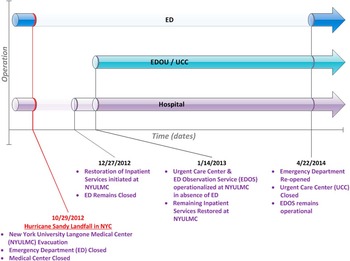
On January 14, 2013, 77 days after the ED was destroyed, the Department of Emergency Medicine at NYULMCTH opened an urgent care center (UCC) in response to the dire need for restoration of acute care services, to advance the recovery process at NYULMCTH, and to reestablish the department’s clinical presence in lower Manhattan (Figure 1). It did so while the ED remained closed for 18 months following Hurricane Sandy. The UCC was compelled to operate on 2 different floors because the destruction of hospital infrastructure created severe space constraints. A ground floor site contained an area for primary triage and stabilization as well as care for low-acuity patients, whereas higher-acuity patients were cared for at a second location on a hospital ward of NYULMCTH, where the Observation Services were also located. Despite the absence of a physical ED and lack of designation as a 911-ambulance-receiving facility, patients continued to arrive to the UCC by multiple means in an effort to remain connected to their primary medical center. This included taxicabs or privately hired ambulances for those with more advanced diseases. The Department of Emergency Medicine realized the potential for Observation Medicine to care for these UCC patients and implemented the department’s first ED-run Observation Service (EDOS), absent an ED, during the disaster.
Timeline of Events.

METHODS
Study Design
This was a retrospective cohort study of a protocol-driven EDOS that was operationalized in conjunction with the UCC at NYULMCTH after destruction and continued closure of the main ED. The conduct of this study was approved by the Institutional Review Board of the NYU School of Medicine, Office of Science and Research. A waiver of consent and authorization was granted for this study.
Study Setting
NYULMC is a large, urban, tertiary care academic medical center located on the Lower East Side of Manhattan. The UCC was established in 2 geographically distinct locations owing to destruction of the physical plant. The arrival area of the UCC was located on the ground level of the hospital near the main entrance. This area was staffed by emergency medicine nurses, physicians, and physician assistants. Patients arrived on this ground level and were triaged and a medical screening exam was performed. Low-acuity patients remained in this location for the duration of their evaluation. Higher-acuity patients were screened for stability and then transported to the second area of the UCC on a repurposed wing of the 16th floor of the hospital building. “16 West” was a 35-bed unit on a traditional inpatient ward that was refitted for the UCC. Patients completed their UCC work-up on 16 West and were dispositioned to inpatient, observation, or discharge status. All patients placed in the EDOS originated from the UCC.
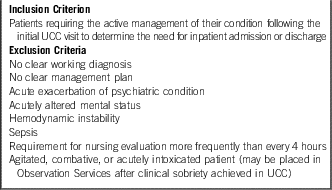
Patients dispositioned to the EDOS were placed in a physically separate 9-bed area for further evaluation and management at the discretion of the ED attending on the basis of predefined inclusion and exclusion criteria (Table 1). Because the Department of Emergency Medicine had no prior experience with observation medicine, clinical protocols were adopted from sample protocols available from the American College of Emergency Physicians (ACEP) in consultation with subject matter experts in observation medicine. 4
Inclusion and Exclusion Criteria for Emergency Department Observation Services (as of January, 2013)Footnote a

a Abbreviation: UCC, urgent care clinic.
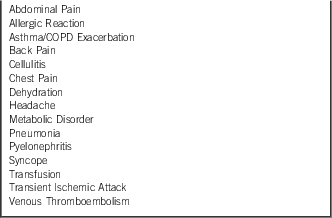
Initially, protocols were implemented to streamline care for the most common conditions placed in the EDOS (Table 2). Once observation services were ordered by the UCC provider, the patient was transferred to the EDOS bed adjacent to the UCC. The UCC attending continued to care for the patient in conjunction with a dedicated EDOS physician assistant who was trained in emergency medicine. The nursing staff caring for the patients in the EDOS joined the ED from inpatient medical-surgical nursing units when the UCC opened.
Clinical Protocols Used in the Emergency Department Observation ServiceFootnote a

a Abbreviation: COPD, chronic obstructive pulmonary disease.
Data Collection
We included all patients presenting to the UCC and those who were placed in the EDOS during the period of January 14, 2013, until April 22, 2014—the period of ED closure during which the UCC and EDOS were operational. Patients for this review were identified by referencing a report of all patients placed in the EDOS during the study time frame from the institutional electronic health record (EHR). We captured 100% of the charts available for review via the EHR. An emergency medicine physician assistant who was blinded to the study goals manually reviewed each patient visit in its entirety and assigned a diagnosis. A secondary review was performed by a board-certified emergency medicine physician to confirm the diagnosis when needed. We did not utilize administrative billing codes to assign the diagnosis.
The duration of observation services was determined by using the interval from the start time, defined as the time the request to place the patient in ED observation services was entered in the EHR, to the time of disposition in ED observation services. Disposition was defined by using standard definitions of discharge home or inpatient conversion, the point at which the care team in the UCC admitted the patient from observation to inpatient status for further management on a typical inpatient service (eg, internal medicine, cardiology).
Data Analysis
We evaluated UCC volume, Emergency Severity Index (ESI) score on presentation, patient age, gender, diagnosis, ED disposition, clinical protocol, length of stay in observation, and disposition from the EDOS. The ESI is a standard 5-level tool for use in ED triage.Reference Gilboy, Tanabe and Travers 5 The nursing triage cohort assigning this score did not change significantly during the study period. In a de-identified, aggregate format, descriptive statistical analysis of these data was performed by using Microsoft Excel software (version 15.0; Microsoft Corp, Bellevue, WA).
RESULTS
Urgent Care Center Patient Characteristics
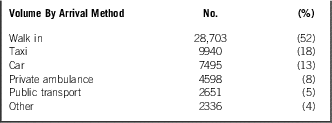
During the 18-month study period, the UCC had 55,723 patient visits. Of these, 15,498 patients (28%) were hospitalized (admitted inpatient or placed in observation status), reflecting a severity of illness equivalent to a designated ED population. Although the UCC was not designated to receive 911-participating ambulances, 4598 patients (8% of total UCC arrivals) arrived by private ambulance in an effort to remain connected to their primary health center (Table 3). ESI level 1 and 2 patients constituted 6% of UCC visits combined, ESI level 3 patients made up 64% of UCC visits, and ESI level 4 and 5 patients constituted 30% of UCC visits. Initially, the UCC cared for 61 patients per day; at its peak while the ED remained closed, the UCC provided care for 138 patients per day. Eventually, the patient population being cared for in the UCC and EDOS was deemed so similar to that of an ED that government agencies considered mandating the UCC and EDOS to meet Emergency Medical Treatment and Labor Act requirements.
Volume by Arrival Method to the Urgent Care Center

EDOS Patient Characteristics
Of 55,723 visits to the UCC, 3167 patients were placed in the EDOS, representing 5.7% of total UCC visits and 20.4% of hospitalizations. The average age of the patients placed in the EDOS was 58 years. Of the EDOS patients, 47% were male and 53% were female. Eighty-four percent of the patients placed in the EDOS were discharged home.
EDOS Performance
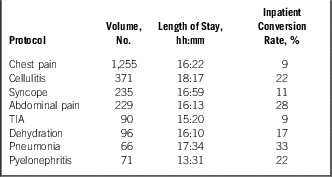
Clinical protocol utilization and performance metrics are described in Table 4 and Table 5. Of note, the inpatient conversion rate is the rate of conversion from observation status in the EDOS to an inpatient on a typical inpatient service. The patient was discharged home if not converted to an inpatient in the EDOS. During the 18-month study period, 3167 patients received care in the EDOS. The average length of stay was 16 hours and 27 minutes. The 8 most frequently used protocols accounted for 76% of EDOS patient care (Table 5).
Overall First-Year Performance Metrics for the Emergency Department Observation Service

Most Commonly Used Emergency Department Observation Services Clinical Protocols with Performance MetricsFootnote a

a Abbreviation: TIA, transient ischemic attack.
Inpatient Conversions
Of the 3167 patients receiving observation services following their UCC visit, 507 were subsequently admitted to the hospital as an inpatient for further management of their conditions. This corresponded to an inpatient conversion rate of 16%.
DISCUSSION
Emergency medicine is considered society’s health care safety net. Observation medicine extends this safety net through the delivery of short-term, acute care to patients requiring active management of their presenting condition beyond the initial ED portion of the visit. In the 18 months of ED closure that followed Hurricane Sandy, a flexible, adaptive, and scalable system for patient care was required. Observation medicine held the potential to provide high-quality, cost-effective care in a resource-sparing manner, which was of particular interest in the disaster recovery phase. Of note, the post-Sandy EDOS differed from standard ED observation units in that it operated independent of an ED.
By using evidence-based, protocol-driven care in a dedicated space, outcomes for common chief complaints can be achieved such that the majority of patients can be discharged home without utilizing an inpatient bed.Reference Sun, McCreath and Liang 6 By safely improving efficiency, more patients per hospital bed per day can receive care. Furthermore, by expediting the diagnostic evaluation, reducing the likelihood of a missed diagnosis, and improving compliance with initial diagnostic evaluation and therapy, costs can be reduced and the value of care can be maximized.Reference Gomez, Anderson and Karagounis 7 - Reference Hadden, Dearden and Rocke 11 These characteristics were critically important in the post-Sandy disaster recovery period, because many destroyed inpatient and outpatient resources were still coming online at the medical center and full operations had not yet been restored.
The Emergency Department at NYULMCTH operationalized an UCC and EDOS in just 77 days after the Hurricane Sandy disaster and ED closure. This was a short period in which to implement an entirely new form of clinical care in a constrained space, particularly in the midst of a crisis. Almost one-fifth of all patients hospitalized from the UCC were placed in a 9-bed EDOS. Patients stayed on average for 16 hours and 27 minutes under 1 of 18 clinical protocols. Eighty-four percent of patients placed in the EDOS were discharged directly home and never required the use of inpatient resources. These metrics were comparable or better than reported national suggested benchmarks, a notable accomplishment for a department whose ED remained closed for 18 months following its destruction.Reference Graff 12
The Department of Emergency Medicine implemented observation services at NYULMCTH in the period after Hurricane Sandy for several reasons. The most obvious was the need to augment health care delivery in New York City during the post-disaster crisis and to establish an interface between what remained of severely disrupted outpatient services and inpatient hospital services during the period of ED closure. Patients circumvented the traditional 911 system to arrive by private conveyance and private ambulance to access care at the medical center. Further, in the wake of Hurricane Sandy with the establishment of an UCC, there was a concomitant need for short-term management beyond the initial UCC encounter.
Although new for the Emergency Department at NYULMCTH, observation medicine has been utilized in emergency medicine for almost 25 years. The first step in implementation required regrouping ED staff and sharing the vision of opening the UCC and implementing an observation medicine program. Many ED staff had been redeployed to various neighboring EDs or boroughs in New York City following the loss of the ED at NYULMCTH in the post-disaster period. Once staff had regrouped, aggressive planning and training began, including lectures and faculty discussions on utilizing this model of health care.
There were challenges to rapidly implementing an observation medicine program in less than 3 months. Operationalizing an EDOS required more than predicting patient volumes, referencing clinical protocols from ACEP, and speaking with subject matter experts. A significant transformational change was required with respect to the care model emergency medicine providers would provide. With the exception of a few emergency medicine physicians with backgrounds predating formal emergency medicine residency training, the majority of practitioners had never delivered longitudinal care before. Few in the department had formal observation medicine experience, with the exception of those who experienced this as part of their residency curriculum. Although it may have been within any emergency practitioner’s scope to deliver this type of care, there was a lack of familiarity and comfort for most with observation medicine for these reasons.
In the wake of the storm, an experienced group of inpatient nurses joined the department in order to staff the EDOS. Previously, these nurses cared for patients with an average length of stay of 3 to 4 days, but were now asked to complete their care in a matter of hours. These nurses were suddenly confronted with providers practicing a novel form of medicine that neither nurses nor providers had confronted previously. Similarly, the emergency medicine providers were to begin working with nurses with no prior ED experience. The providers and nurses learned how to complement one another in developing a foundation of clinical principles based in acute care medicine. A critical interdependence developed and a new, functional team was formed.
Strengthening interdepartmental relationships and points of care transition were paramount to the operation of the EDOS. Coordination with specialists to expedite diagnostic modalities such as cardiac stress testing, neuroimaging, and other frequently used diagnostics was essential to achieve quality and efficiency. Communication between providers in the EDOS and primary care providers, care managers, and social workers was vital to executing safe discharges, implementing home services, and effective transitions back to the community, especially for the more complex, chronically ill patients.
The final transition marking the end of the 18-month period of ED closure at NYULMCTH, lasting October 29, 2012, to April 22, 2014, was the reopening of the ED, which occurred smoothly and with demand for services substantially greater than previously projected. Presently, the EDOS has expanded to 35 beds with over 30 clinical protocols and delivers care for thousands of patients annually with quality metrics that remain consistent or better than national benchmarks.
Limitations
The limitations of the present study include that we did not evaluate patients placed in observation status on other services (“virtual observation”). Also, our analysis did not include UCC patients who were placed in observation status outside the EDOS.
CONCLUSIONS
Our experience demonstrates that implementing ED observation services can occur during a disaster response as an innovative, flexible means of delivering quality health care during a crisis. Observation services can be operationalized in the absence of an ED in a very brief period of time. Emergency medicine providers and nurses are ideal candidates to deliver this type of care given their broad scope of practice and ability to intensively manage acute presentations. This may have implications for the future use of observation medicine in circumstances where inpatient resources are limited, such as disaster responses, extending the clinical capabilities of free-standing EDs and/or UCCs, as well as resourcing geographically remote locations without ready access to hospitals.
Acknowledgments
The authors thank Joeury Nunez and Eitan Blander, BA, for data analysis; Rohan Bansal, BSE, for assistance in data collection and analysis; Chest Poon for assistance with figure preparation; and Maneesha Sabharwal, MD, for institutional review board and reference preparation.
Funding
This work was funded by the US Department of Health and Human Services, Office of the Assistant Secretary for Preparedness and Response (ASPR), award number HITEP130006-01-00, to the NYU School of Medicine. Additional funding has been received for follow-on studies from ASPR, award number HITEP 150030-01-00, to the NYU School of Medicine. SWS derives additional salary support from the Fridolin Charitable Trust to the Ronald O. Perelman Department of Emergency Medicine Safety Program and has received an intramural departmental 2015 scholarly innovation grant for work unrelated to the current study. The funding agency (ASPR) played no role in the design or conduct of the study; collection, management, analysis, or interpretation of the data; preparation of the manuscript; or decision to publish.
Disclaimers
The content of this article is the responsibility of the authors and does not necessarily represent the official views of the US Department of Health and Human Services (DHHS), the Office of the Assistant Secretary for Preparedness and Response (ASPR), the NYU School of Medicine, NYU Langone Medical Center, or any employers, affiliations, named entities, or other funding agencies.