1. Introduction
One of the most well-established facts in the gender and politics literature is that men and women focus on different policy areas as legislators. In particular, women lawmakers are more likely to serve on committees and sponsor bills that focus on areas of traditional concern to women, such as education, health, and welfare (e.g., Werner, Reference Werner1968; Kirkpatrick, Reference Kirkpatrick1974; Diamond, Reference Diamond1977; Thomas and Welch, Reference Thomas and Welch1991; Huddy and Terkildsen, Reference Huddy and Terkildsen1993; Fox and Smith, Reference Fox and Smith1998; Swers, Reference Swers2002; Dolan, Reference Dolan2010; Volden et al., Reference Volden, Wiseman and Wittmer2016). Scholars have spent decades trying to disentangle whether the gender gap in policy focus stems primarily from the distinct preferences of districts that elect men and women (Burrell, Reference Burrell1994; Carey et al., Reference Carey, Niemi and Powell1998; Poggione, Reference Poggione2004; Gerrity et al., Reference Gerrity, Osborn and Morehouse Mendez2007; MacDonald and O'Brien, Reference MacDonald and O'Brien2011), from disparities in legislator background (Carroll, Reference Carroll1994; Thomas, Reference Thomas1998), or from gendered political processes that may constrain and shape the choices available to women in office (Kathlene, Reference Kathlene1994; Duerst-Lahti and Mae Kelly, Reference Duerst-Lahti and Mae Kelly1995; Thomas, Reference Thomas2005). These are by no means the only relevant explanations, but they are among the most well-studied and theoretically important.
This research note uses fine-grained new data on the committee assignments of almost 25,000 US state legislators and over 700,000 bills they sponsored to systematically decompose the origin of the gender gap in legislative behavior. While all three mechanisms described above are likely at play, data and methodological constraints have limited the ability of researchers to causally isolate these different channels. If women are explicitly or implicitly pressured to focus on women's issues as a result of the environment inside the legislature, we would reach different conclusions about the desirability of such a gender gap than if women were simply representing the preferences of their constituents or capitalizing on their distinctive backgrounds.
Work by Palmer and Simon (Reference Palmer and Simon2010) and others has demonstrated that certain districts tend to be more progressive and “women-friendly.” Perhaps, then, women legislators tend to focus on women's issues because their constituents value this type of service. To account for district selection effects, we employ a difference-in-differences design that exploits within-district changes in the gender of legislators, holding fixed the underlying, time-invariant preferences of the district.Footnote 1 This allows us to examine whether the gap in committee assignments and bill sponsorship persists after comparing men and women legislators who serve the same district.
Second, women may choose to focus on different policy areas inside the legislature because they come from different backgrounds than their male colleagues (Carroll, Reference Carroll1994; Fox and Lawless, Reference Fox and Lawless2004; Lawless and Fox, Reference Lawless and Fox2005). There is mixed empirical evidence on whether women are self-selecting onto different committees than men as a result of their prior experiences. Carroll and Taylor (Reference Carroll and Taylor1989) conclude that skewed committee assignments reflect women's preferences rather than discrimination, but Thomas and Welch (Reference Thomas and Welch1991) find that women state legislators are more likely to be appointed to health committees even when they do not request such assignments. We introduce a new proxy for personal backgrounds that relies on campaign fundraising. The idea is that legislators who raise money from similar industries and professional sectors likely share pre-existing expertise or ties with those sectors. We validate this claim in several ways and then examine whether the gender gap in policy focus persists after comparing men and women who raised the same amount of money from particular sectors in their first election.
Finally, formal and informal processes within the legislature may shape the opportunities and choices available to women elected to office (Kathlene, Reference Kathlene1994; Milyo and Schosberg, Reference Milyo and Schosberg2000; Sanbonmatsu, Reference Sanbonmatsu2002, Reference Sanbonmatsu2006). For a variety of reasons, legislative leaders, parties, and norms within the legislature as a whole may channel women legislators into roles that are stereotyped for women—like health and education committee assignments—even if they do not come from districts that care particularly about these issues and even if they do not come from related professional backgrounds. This could happen, for example, because of the explicit biases of senior men, because of constituent expectations reflecting state attitudes toward women, or because of national events that raise the salience of women's issues (to name a few).
We cannot test for this mechanism directly. However, we can rule out several plausible stories through our research design. State and year fixed effects allow us to adjust for differences in state perceptions regarding women in politics and account for major national events that might affect legislative behavior across states, such as the Women's March. We argue that the unexplained variance that remains after adjusting for district characteristics, personal backgrounds, and state-by-year fixed effects can provide an estimate of the degree to which gendered processes within the legislature are driving the observed difference in policy focus between men and women.
When we control for district preferences with difference-in-differences and existing policy expertise with fundraising data, the estimated gender gap in bill sponsorship shrinks by over half, suggesting that a large part of this difference is driven by men and women serving different constituencies and having different policy interests. However, the gender gap in committee assignments stays virtually constant across specifications. Given that legislators have more discretion over the types of bills they sponsor relative to the types of committees they are assigned to, we tentatively conclude that the committee assignment process plays an important role in steering women onto certain types of committee positions.
2. New data on women in state legislatures
To decompose the origins of the gender gap in legislative policy focus, we assemble a new dataset that contains information on the election and committee service of roughly 25,000 state legislators during the years 1986–2014. Information on the committee assignments of state legislators comes from a dataset we constructed by keying in information from the State Yellowbooks. We merge this dataset with campaign finance data from Follow the Money using legislator names and with information on bill sponsorship for the 14 states for which we were able to gather the bill titles, summaries, and sponsors from on-line sources following Fouirnaies and Hall (Reference Fouirnaies and Hallforthcoming). Finally, we identify which legislators are women by matching our data with the names of women legislators identified by the Center for American Women and Politics. Additional details about the data collection and the 14 states used in the bill sponsorship analysis can be found in the on-line appendix.
2.1 Classifying women's issues committees and bills
We follow a long line of research that studies the legislative issues most commonly associated with women (Thomas, Reference Thomas1998; Reingold, Reference Reingold2003; Barnello and Bratton, Reference Barnello and Bratton2007). Scholars have attempted to define such issues in a variety of ways, including examining public opinion polls (Burrell, Reference Burrell1994; Reingold, Reference Reingold2003), relying on women's issue groups (Thomas, Reference Thomas1989), and identifying voter perceptions and stereotypes of such issues (Provins, Reference Provins2017). To be clear, there are a variety of methodological and conceptual concerns with labeling “women's issues” in this way (Reingold and Swers, Reference Reingold and Swers2011). We know, for example, that women of color tend to define these issues differently (Smooth, Reference Smooth2011), and distinctions exist between more “traditional” women's concerns (Carroll, Reference Carroll1994) as opposed to feminist issues (Bratton, Reference Bratton2005). While acknowledging the importance of this debate, for the purposes of this paper, we adopt the standard classifications used in this literature and define health and education to be women's issues. The results are also robust if we code welfare as a women's issue, which we discuss in the appendix.
Different state legislatures use different names for their committees, which presents a challenge for identifying which committees across states are concerned with health and education. We follow Fouirnaies and Hall (Reference Fouirnaies and Hall2017) in using a defined set of keywords to identify these committees in each state. Specifically, we count a committee as being concerned with health if we find any of the following word stems in the committee's official name: “health,” “hosp,” “medic.” For education, the word stems are: “educ,” “school,” “univer,” “teach.” For consistency, we then use the exact same word stems to define legislation related to these issues, and we count any bill as a women's issue bill if it contains any of the health or education word stems.
3. District preferences, self-selection, or gendered institutions?
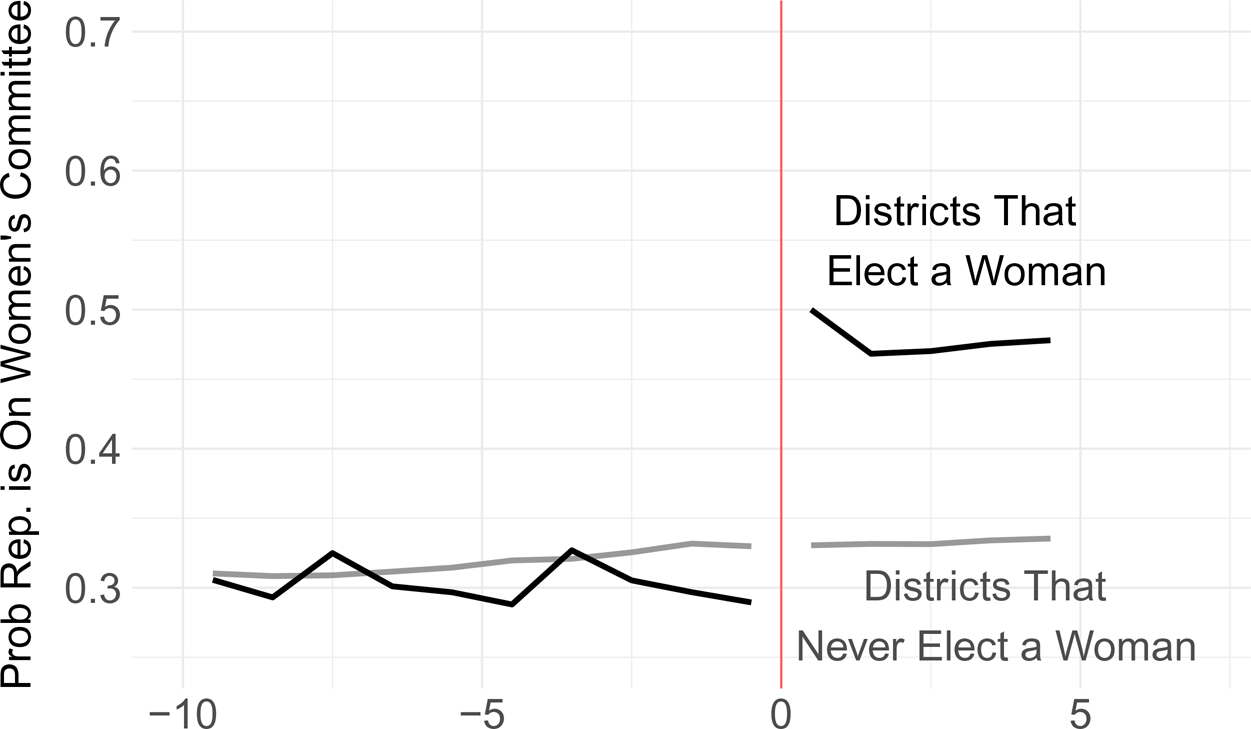
Are the differences in policy focus between men and women the result of district preferences, self-selection, or formal or informal processes within the legislature? To address district selection, we compare the difference in committee service for men and women legislators who are elected from the same district at different times. Before moving to the formal estimates in this vein, we examine the effect of electing a woman legislator on observed committee assignments graphically. To simplify things, we group the committees the literature has identified as focused on women's issues—education and health—into a single dummy variable indicating that a legislator serves on at least one such committee. We then plot the average of this variable for candidates in two sets of districts: those that at some point elect a woman and those that do not. Figure 1 plots the resulting trends. When a district switches from having a male representative to a woman representative, we observe a sharp jump in the average number of women-related committee positions. Women clearly serve on committees traditionally associated with women's issues at higher rates than men, and this phenomenon does not appear to be the result of women serving in different districts than men.
Women are more likely to be assigned to women's issue committees. Compares changes in committee positions related to women's issues for the set of districts who elect a woman to changes in these committee positions for a comparable set of “control” districts who have never elected a woman.

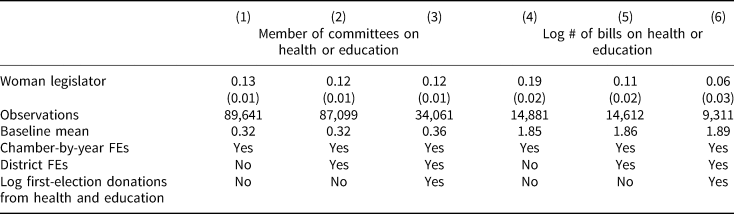
In Table 1, we analyze the gender gap in policy focus more formally. We examine two outcomes: the probability that a legislator serves on a health or education committee and the number of health and education bills sponsored. In columns 1 and 4, we present simple cross-sectional correlations that confirm the well-established fact that women and men differ in terms of their committee assignments and policy focus. These descriptive results indicate that women legislators are more likely than men to serve on women's issue committees and more likely to sponsor legislation related to women's issues. Interestingly, the gender gap is similar for Democratic and Republican women. We show all of the following results broken down by party in Tables A.4 and A.5 in the appendix and find little evidence that party is contributing significantly to the observed gender gaps in either committee assignment or bill sponsorship.
Women are more likely to work on women's issues.

Columns 1 and 4 reflect the overall difference between men and women. Columns 2 and 5 include district fixed effects to account for district preferences. Columns 3 and 6 adjust for money raised in first election as a proxy for background. Robust standard errors clustered by district in parentheses.
In columns 2 and 5, we include district fixed effects to examine whether the gap in legislative policy focus can be attributed to district-level factors. The inclusion of district fixed effects means that we are implicitly performing a difference-in-differences analysis in which we compare changes in the outcomes (probability of serving on specific types of committees or sponsoring specific bills) for districts that switch to having a woman legislator compared to districts that do not switch.Footnote 2 In the appendix, we perform standard tests of the parallel trends assumption for the difference-in-differences design. In particular, we add linear district-specific time trends, and we add a leading indicator for the election of a woman legislator. In both cases, the assumption appears sound for each analysis.
After including district fixed effects, the estimates for the committee assignment analysis barely change. Within the same district, women remain 12 percentage points more likely than men to be appointed to a health or education committee, suggesting that women are not simply serving on these committees because of pressures from their district. However, the coefficient on bill sponsorship shrinks from 0.19 to 0.11 when we perform this within-district comparison. Women are still more likely than men to sponsor legislation related to health and education, but accounting for district preferences appears to explain over half of the effect size. In Table A.7 in the appendix, we further decompose these effects by examining whether they are driven by women replacing male legislators or men replacing women. We find slightly larger effects for both committee assignment and bill sponsorship when women legislators replace men, although the effect is almost as large and in the opposite direction when a man takes the place of a woman representative.
In columns 3 and 6, we control for donations from the health and education industries in a legislators’ first electoral campaign.Footnote 3 We use campaign donations in a candidate's first election as a proxy for a legislator's background in and connections to an industry (e.g., teachers who run for office often receive donations from teacher's unions). Logically, candidates who come from a particular sector should be more likely to raise money from donors in that sector. We validate this idea in the appendix in two ways. First, we show that raising money from a sector in your first election strongly predicts serving on the committee related to that sector if you win office. Second, we use data from California to show that schoolboard members are much more likely to raise money from the education sector than are other candidates. Although campaign finance is clearly not an exhaustive measure of legislator background, we believe it provides a useful signal of which legislators have pre-existing ties to or expertise within particular sectors.
After controlling for legislator background with this proxy, when women are elected to represent a district they are still 12 percentage points more likely than men to serve on a health or education committee. In other words, even when men and women represent the same districts and raise the exact same amount of money from the health or education sectors, women are significantly more likely to be assigned to those committees. However, when we turn to bill sponsorship, we see that adjusting for fundraising background further reduces the observed gender gap. The original coefficient shrinks dramatically after accounting for constituent preferences via district fixed effects and legislator policy expertise via campaign contributions from relevant industries.Footnote 4
To sum up, we find strong evidence that the gender gap in committee assignments is not driven by district preferences or by differences in the fundraising backgrounds of legislators. On the other hand, we find that each of these explanations accounts for a significant portion of the estimated effect of the gender gap in bill sponsorship, accounting for over two-thirds of the observed difference between men and women in the number of health and education bills sponsored. While bill sponsorship is a largely voluntary activity, committee assignments are generally made by party leaders and subject to various formal and informal institutional rules (Francis, Reference Francis1989). The fact that the gender gap in bill sponsorship shrinks when we account for district preferences and fundraising background while the gender gap in committee assignments remains constant suggests that gendered norms or institutions within the legislature itself are an important reason why men and women tend to serve on different committees.
4. Conclusion
Scholars have studied for decades whether and how women are distinct from men as legislators. A large body of theoretically and descriptively rich work documents these differences across many dimensions, including policy priorities, bill sponsorship, and committee assignments. Consistent with existing work, we find strong cross-sectional evidence that women disproportionately focus on women's issues in terms of the committees they serve on and the bills they sponsor. Understanding what these differences mean requires understanding whether they are driven by differences in the types of districts that elect men and women, by differences in the motivations and backgrounds of men and women, or whether they reflect formal or informal factors within the legislature that distort the choices available to men and women.
Using a difference-in-differences design, we find that differences in the types of districts that elect men and women can explain about a half of the variation in bill sponsorship, and existing expertise or industry ties (as proxied by campaign fundraising) can explain another third. However, neither of these approaches can account for the dramatic over-representation of women on health and education committees. These results suggest that institutional processes are playing a substantial role in channeling women onto certain types of committees. For example, women may be assigned to women's issue committees because of explicit stereotypes, or because of implicit biases, or because of self-censoring, or for any combination of these reasons and others. It is our hope that the large-scale evidence we have laid out in this paper will help to motivate future investigations into these precise mechanisms. Whatever the ultimate cause, the pattern of results we document may help to explain the well-known fact that women seek political office in the US at lower rates than men. Women may be reluctant to enter politics if they observe that the internal operations of the legislature constrain and shape the opportunities available to them.
Supplementary material
The supplementary material for this article can be found at https://doi.org/10.1017/psrm.2021.72. To obtain replication material for this article, please visit https://doi.org/10.7910/DVN/3S72WD
Acknowledgments
Julia Payson (julia.payson@nyu.edu) is an Assistant Professor in the Politics Department at NYU. Andrew Hall (andrewbhall@stanford.edu) is a Professor in the Department of Political Science at Stanford University and a Senior Fellow of the Stanford Institute for Economic Policy Research. Alexander Fouirnaies (fouirnaies@uchicago.edu) is an Assistant Professor at the Harris School of Public Policy at the University of Chicago. For comments, the authors thank Michael Barber, Chris Berry, Jack Blumenau, Kelly Dittmar, Carlo Prato, Jessica Preece, Johanne Rickne, and Stephane Wolton. Previous versions of this paper were presented at MPSA, the LSE-NYU Political Economy Conference, BYU's American Politics Workshop, and Columbia's American Politics Seminar.