Introduction
Both early chest compression and defibrillation are essential for resuscitation.Reference Travers, Rea and Bobrow1, Reference Wissenberg, Lippert and Folke2 The appropriate information from the emergency call is also imperative to detect a critical patient for early response. The Medical Priority Dispatch System (MPDS) has operated in many places in the United States as a computer-based Emergency Medical Dispatcher (EMD) system to evaluate patient acuity and to prioritize response units for critical patients. A number of studies have demonstrated the predictive accuracy of MPDS.
However, there are no systematic call triage protocols like MPDS in Japan. Japanese emergency response systems operate on a “first-come, first-served” basis whatever the nature of complaint is. The national average of the response time increases year after year; 7.0 minutes in 20073 and 8.2 minutes in 2011,4, 5 according to the Fire Disaster Management Agency in Japan. In many rural areas, the response times are more than 10 minutes. This indicates low resuscitation rates.4
In such circumstances, one possible way to shorten response time is a Community First Responder (CFR) system for early chest compression and defibrillation. A CFR is supposed to be a neighbor who is neither a firefighter nor a police officer,Reference White, Asplin, Bugliosi and Hankins6–Reference Smith, Peeters and McNeil8 but a community member who is trained in resuscitation. To the authors’ knowledge, there is no call triage protocol to determine whether dispatchers should activate CFRs, considering CFR safety and mental health.5–Reference Smith, Peeters and McNeil8
The aim of this study was to propose CFR call triage protocols for a future CFR system in Japan, and to indicate the effectiveness of CFR protocols in terms of the predictability to determine if dispatchers should activate CFRs and the adequate number of CFR activations.
Methods
All data were collected prospectively in the study. The data were collected from October 1, 2012 through January 31, 2013 in the Haga Area Fire Department in Tochigi prefecture, Japan. The district has 11 fire stations, a population of 149,000, and its area size is 563.93 kmReference Wissenberg, Lippert and Folke2, 9 Formal call triage protocols are not used.
Protocol Setting
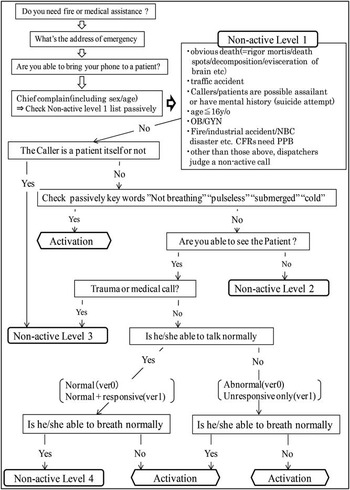
Both CFR call triage protocol Ver.0 and Ver.1 were established to determine if dispatchers should activate CFRs, which were based on the September 2006 draft –Version 2.0 for emergency dial analysis made by the research group of The Fire and Disaster Management Agency in Japan.10 Also, first responder guidelines in other countries were reviewed.Reference Agarwal, Hess, Atkinson and White11–14 Nonactive conditions, which have four nonactivation levels (NALs), were added to these two protocols. The aims of NAL 1 and NAL 2 are to protect CFR's safety and mental health. The aims of NAL 3 and NAL 4 are to avoid unnecessary activation when the patients made emergency call by themselves. Breathing and consciousness are normal in these cases, and thus, the resuscitation rate is low.
On the other hand, the aim of activation is to respond to the patient who has a chance of successful resuscitation by chest compression and defibrillation. There are three activation conditions for CFRs. The first one is defined by one of the four words included in the emergency call: “not breathing,” “pulseless,” “submerged,” and “cold.” The second one is defined as when breathing and level of consciousness are both abnormal. The third one is defined as when either breathing or level of consciousness is abnormal.
Lastly, CFR protocol Ver.0 differs from CFR protocol Ver.1 in the method used to determine whether the level of consciousness is normal or abnormal; in CFR protocol Ver.1 “abnormal conscious level” applies only to unresponsive patients, while “abnormal conscious level” in Ver. 0 applies to all patients except those with normal response. The flow chart in Figure 1 illustrates CFR call triage protocol Ver.0 and Ver.1.
Community First Responder Call Triage Protocol Ver.0 and Ver.1

Data Management
Emergency callers were asked a series of scripted questions that included the patient's age, sex, caller's relationship to the patient, chief complaints, consciousness level, breathing status,Reference Clawson, Barron, Scott, Siriwardena, Patterson and Olola15 the possibility of visual contact with the caller, and traumatic or nontraumatic. For example, the question used to determine consciousness level was “does he or she talk normally?” The other question to determine breathing status was “does he or she breathe normally?” Dispatchers recorded the patient's information on paper with hand-written notes during the calls. Also, dispatchers recorded the 8-digit numbers for matching dispatch data to paramedic field reports. When an emergency call is activated by a caller, the dispatch system in the Haga area assigns the call number for routine dispatch data and paramedic field reports. This study investigated if dispatchers activated CFRs through CFR protocols. Dispatchers received all emergency calls during the research period. However, duplicate calls, interfacility calls, and calls in which data collection may have led to a delay in dispatch were excluded from this study.
Dispatchers were responsible for compliance with the CFRs protocol and were trained on data collection by members of the study group. The purpose of the protocols was primarily to use standardized definition for consciousness levels and respiratory status. Moreover, the dispatchers were offered thorough guidance on avoiding delaying response units.
Next, this study examined if the detection by the protocols was adequate by comparing paramedic field reports. Paramedic field reports in Japan are made obligatory and archived as legal documents for five years. Paramedic field reports with the 8-digit numbers have to be recorded for all the emergency calls.
Because the data include individual information in this study, disclose of call information and paramedic field reports were approved by the Haga Area Fire Department in Tochigi prefecture.
Analysis
Data analysis was conducted using receiver operating characteristic-area under curve (ROC-AUC) using the results of sensitivity/specificity, followed by comparisons with the CFR protocol Ver.0, Ver.1, and the results of Melbourne call triage detection by MPDS.Reference Flynn, Archer and Morgans16 As for call triage studies, comparing positive predictive value (PPV) and negative predictive value (NPV)/confidence interval (CI) is often used, but the results of this study were compared by ROC-AUC values to evaluate the predictability of CFR protocols because CFR protocols have to evaluate the quality for both CFR activation and nonactivation.
Calculation
The number of CFR annual activations was calculated from the result of each protocol. The calculation was based on the following condition: CFR jurisdiction is four km2, and habitable area in Haga area is 363 km2. This shows that a jurisdiction per CFR is 90.8 km2.
Then, the number of monthly activation orders from the dispatch was calculated by dividing the numbers of activation by four, as the research period was four months. Next, the monthly activation per CFR was calculated by dividing the number of monthly activations by 90.8. Lastly, annual activation per CFR was calculated by multiplying by 12 months.
Results
A total of 2,988 emergency calls were made to the dispatch center during the study period. A total of 1,360 calls went through the CFR call triage protocols for analysis.
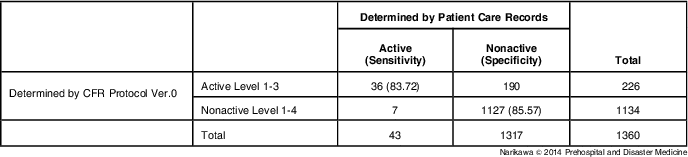
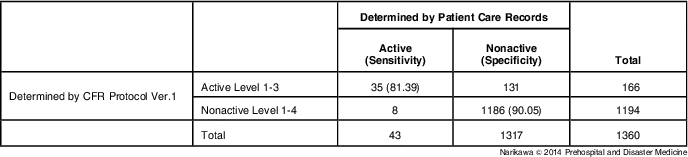
The ROC-AUC values were 0.857 (95% CI, 79.8-91.7) in CFR protocol Ver.1 and 0.847 (95% CI, 79.0-90.3) in CFR protocol Ver.0, which were slightly lower than 0.874 (95% CI, 85.9-89.0) in the detection of cardiac arrest by MPDS in Melbourne.14Table 1 and Table 2 show the results of predictability in each protocol. The sensitivity of CFR protocol Ver.0 is 83.7% (95% CI, 72.7-94.8) and the specificity is 85.6% (95% CI, 72.7-94.8). The sensitivity of CFR protocol Ver.1 is 81.4% (95% CI, 69.8-93.0) and the specificity is 90.1% (95% CI, 88.4-91.7). Table 3 shows PPV/NPV values, the numbers of monthly activation orders from the dispatch center, monthly activation per CFR, and annual activation times per CFR.
Positive and Negative Predictive Value of CFR Protocol Ver.0
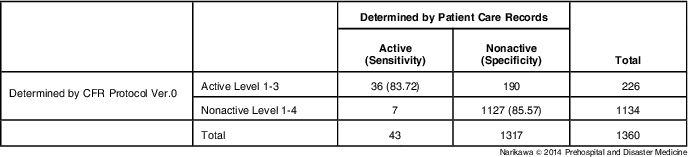
Abbreviation: CFR, Community First Responder.
Positive and Negative Predictive Value of CFR Protocol Ver.1
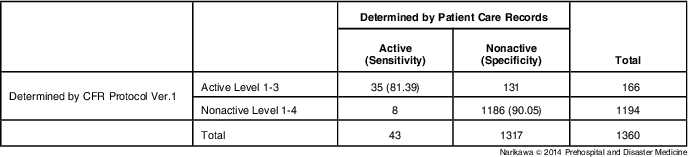
Abbreviation: CFR, Community First Responder.
PPV, NP, and the Number of Activation for Each CFR Protocol

Abbreviations: CFR, community first responder; NPV, negative predictive values; PPV, positive predictive values.
Discussion
Community First Responder protocol, if dispatchers should activate CFRs, was established and examined for the predictability of detecting cardiac arrest. The study indicates that both CFR protocol Ver.0 and Ver.1 have enough capacity to decide if dispatchers activate CFRs in a comparison with the ROC-AUC values of Melbourne by MPDS.Reference Flynn, Archer and Morgans16 Also, the ROC-AUC value of CFR protocol Ver.1 is slightly better than that of CFR protocol Ver.0.
There have been numerous studies for call triage protocols such as MPDS to prioritize response units for patient's acuity. However, CFR protocols in this study are different from those in MPDS. The difference is the purpose of MPDS is to detect patient acuity, such as cardiac arrest, whereas the purpose of CFR protocols is to detect cardiac arrest with potentially successful resuscitation.
Also, first responder systems, called CFR systems in Japan, are operated in Rochester, Minnesota (USA)Reference Agarwal, Hess, Atkinson and White11 and in Scotland.12 However, to the best of the authors’ knowledge, there is no criterion or protocol for first responder activation . No study has focused on whether the first responder's activation by the dispatcher is adequate, although the Scottish ambulance service has “not knowingly dispatch criteria.”12
Community First Responder protocol Ver.1 is recommended for use when the CFR system is operated because PPV in CFR protocol Ver.1's is higher than that in CFR protocol Ver.0. A dispatch center is supposed to run the system for 24 hours, every day. The order of CFR's activation from the dispatch center should not cause emergency units to delay response time. Since CFR is a volunteer system, a CFR's activation should not interfere with daily life. Therefore, dispatchers’ and CFRs’ workloads should be as light as possible.
The main aim of an emergency medical service is to offer emergency treatments and transport by ambulance. Currently, in a majority of Japanese areas, no call triage system like MPDS is available because most fire departments do not have enough resources and budgets. However, whenever the emergency calls are activated by inhabitants, particularly in the case of cardiac arrests that need chest compression or defibrillation, the response time is a critical factor for resuscitation. Another problem is that even if Japan operates MPDS with multiple resources, the current Japanese system would not be able to cover the whole area. Specifically in the Japanese rural areas, response time is usually more than 10 minutes. Eventually, the response time by CFRs who are the neighbors living near the site will be the fastest responders. Community First Responder protocols are expected to contribute to increased resuscitation rates.Reference Key, Pepe, Persse and Calderon17, Reference Van Alem, Vrenken, de Vos, Tijssen and Koster18
Limitations
Community First Responder protocol Ver.1 was activated once under triage. This is because altered level of consciousness (ALOC) patients are hard to determine from an incoming call. On the contrary, CFR protocol Ver.1 was established to detect unresponsive patients who are more severe than ALOC patients in the level of consciousness.
Also, it is easier to define cardiac arrest patients than to detect rigor mortis patients. Although EMD solicits the patients’ information from callers to detect if the case is non-activation indication, it is difficult to get the patient's details. These protocols need room for improvements to detect rigor mortis patients. A CFR is basically a layperson who is rarely called to emergent situations, particularly cardiac arrest. It is shocking for CFR to face rigor mortis, so CFRs may suffer post-traumatic stress disorder. One of the solutions is to have counseling before becoming a CFR.
Conclusion
This study found that both CFR protocol Ver.0 and Ver.1 are of nearly equal quality to MPDS predictability. Ver.1 seems to be better than CFR protocol Ver.0. Also, CFRs activated by the protocols would lower the possibility of safety issues or mental health concerns exist. Thus, the results show that CFR protocol Ver.1 gives relatively accurate predictability so that it is sufficient for the operation of a CFR system.