Introduction
Changing climatic conditions coupled with overexploitation of natural resources have led to great changes in the agricultural potential of land in Kenya. The changing climatic conditions have resulted in changes in precipitation patterns characterized by long periods of dry weather leading to a loss of vegetative cover, followed by periods of very heavy rainfall and subsequent flooding, which threaten and adversely affect communities, notably those that live beside rivers and river floodplains (IPCC, 2007). The Nyando basin in Western Kenya, a rich agricultural flood plain around Lake Victoria is one region that has been adversely affected by the changing climate. The challenges are compounded by the high population density in the area (more than 400 persons/km2), and a high rate of poverty (Macoloo et al., Reference Macoloo, Recha, Radeny and Kinyangi2013). Farming is the primary source of income and food in Nyando; however, land holdings are small, and the area suffers serious soil erosion with run-off during rainy seasons that forms deep gullies affecting about 40 percent of the landscape.
From late 2011, the CGIAR research programme on Climate Change Agriculture and Food Security (CCAFS), in collaboration with World Neighbors, Vi Agroforestry and Kenya's Ministry of Agriculture, Livestock and Fisheries have been testing a portfolio of promising climate change adaptation, mitigation and risk management interventions for smallholder farmers grouped into “Climate smart villages” (CSVs). CSVs are the sites where the partners work with farmers using participatory approaches to identify needs, then test the portfolio of agricultural interventions identified for the site, and develop the capacity of the communities to respond to and manage the relevant resources in order to improve their livelihoods. One such intervention has been the introduction of improved strains of indigenous sheep and goats [collectively referred to as small ruminants (SRs)] in a bid to improve the productivity of the local SR.
SRs are important in ensuring food security as they provide households with both nutrition and disposable income. Their small body size, flexible feeding habits and short generation intervals make them suited to the smallholder farming systems. They also require lower initial investment costs, play a complementary role to other livestocks in the utilization of feed resources and are often owned and tended by women and children (Kosgey, Van Arendonk and Baker, Reference Kosgey, Van Arendonk and Baker2004; Peacock, Reference Peacock2005). The role of SR in income generation and food security of most smallholder farmers of Kenya is substantial (Peacock, Reference Peacock2005; Ojango et al., Reference Ojango, Ahuya, Okeyo, Rege, Ojango, Malmfors and Okeyo2010), as they enhance the livelihoods of smallholder farmers through the sale of products such as milk, live animals and manure. Outputs from SR within smallholder systems however tend to be low and few initiatives for change are in place. System-based research is thus required to understand the context under which SR are kept, and help the smallholder systems better respond to the changing social, economic and environmental conditions in which they operate (Kosgey and Okeyo, Reference Kosgey and Okeyo2007; Rege et al., Reference Rege, Marshall, Notenbaert, Ojango and Okeyo2011). In this paper, we outline the characteristics of the SR production environment, and the flock structures and dynamics at the household level within CSV of the CCAFS project in order to determine best-bet options for sustainable SR improvement in the villages.
Materials and methods
Study area
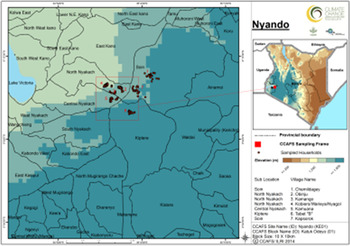
This study was conducted in the Nyando basin, covering two counties of Western Kenya namely, Kisumu County and Kericho County (Figure 1). As part of the CCAFS sites in East Africa, Nyando was selected because it had a range of key bio-physical and agro-ecological gradients; a range of agricultural production systems; an anticipated gradient of temperature and precipitation changes; established research and development partners; long-term socio-economic and weather data; a network of regional partners to facilitate scaling up; and had mitigation and/or carbon sequestration potential (Kristjanson et al., Reference Kristjanson, Neufeldt, Gassner, Mango, Kyazze, Desta, Sayula, Thiede, Forch, Thornton and Coe2012). The main land uses in the area are cultivation of crops and pasture. Vegetation is scanty in the area, and run-off from seasonal rivers has caused soil erosion, which has resulted in deep gullies that run across large areas and hinder farming activities (Macoloo et al., Reference Macoloo, Recha, Radeny and Kinyangi2013).
Map of Kenya indicating the Nyando basin and the location of the “Climate Smart Villages”.

Sampling procedure
In the initial design of the Nyando CSV, 139 households were randomly selected from seven villages which in turn were randomly selected from 106 villages within a 10 × 10 km2 block of land. The sample size was chosen to enable CCAFS to measure changes in a series of pre-determined indicators over a 5-to-10-year period. Additional details on the sampling frame and regional focus are available at http://www.ccafs.cgiar.org/resources/baseline-surveys.
A requisite sample of households rearing SR was required to provide a base population for genetic improvement within the project area. However, of the 139 households that were part of the initial CCAFS survey on general household characteristics and resource endowment (Mango et al., Reference Mango, Mideva, Osanya and Odhiambo2011), only 64 percent owned a minimum of either three sheep or three goats. Households without SR were thus replaced by randomly selecting alternative households keeping SR within the same vicinity. Additional information on the villages and households selected are presented by Ojango et al. (Reference Ojango, Audho, Oyieng, Recha and Muigai2015).
Data collection
A participatory systems research approach was adopted in order to understand the community and the existing management practices and values attached to SR within Nyando. Information was collected at a household level using survey tools developed at the International Livestock Research Institute (ILRI) as part of the CGIAR research programme on livestock and fish (CRP 3.7; http://livestockfish.cgiar.org/). The information collected sought first to establish the characteristics of the various farmers in the CSV and understand their reasons for keeping SR, then to understand the attributes of SR that the farmers consider to be most important, and the dynamics of flocks within the CSV and finally to determine the production constraints, challenges and opportunities for improved productivity of the SR populations in CSV.
The data were collected using the “Open Data Kit” (ODK) information technology platform (https://opendatakit.org/). This enabled direct entry of information provided by each household in an electronic format to a central database, thus saving on time and reducing the number of secondary errors usually associated with manual data collection and entry.
Crosschecking of the information obtained was carried out through a series of focus group discussions during which syntheses of the initial results of the survey were presented and discussed with livestock keepers in the different CSV. Additional interviews and discussions related to the evidence arising from the household survey were conducted with Key informants who included both Public and Private sector actors within the lower Nyando region.
Data analyses
Data analyses procedures comprised both qualitative and quantitative methods. Simple descriptive statistics were used to analyse data across sites. Tests of statistical significance were carried out using either Chi-square (χ 2) or t-tests.
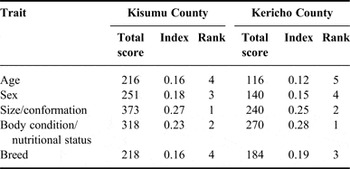
Farmers were requested to rank various traits in SR that they perceived to be important in order of preference on a scale of 1–5 (where 1 = most important and 5 = least important). Information generated through this ranking would be useful in developing objectives for improving SR in the CSV. An average score (I i ) for each trait (i) was calculated as follows (adapted from Bett et al., Reference Bett, Kosgey, Kahi and Peters2008):
 $$I_i = \displaystyle{{\sum\nolimits_{\,j = 1}^5 {r_j X_{\,ji}}} \over {\sum\nolimits_i {\sum\nolimits_{\,j = 1}^5 {r_j X_{\,ji}}}}},$$
where X ji is the number of respondents giving rank j, j = 1, 2, 3, 4, 5 to trait i, where i = age, sex, size, body condition and breed. r j is the weight corresponding to rank j. The weight is given by r = 5, 4, 3, 2, 1. The weights given for each rank were based of the order of preference, with the highest rank having a higher weight, and the lowest rank having a lower weight.
Results
Farmer characteristics
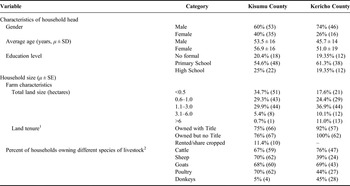
The general characteristics of the smallholder farmers in the CSV are presented in Table 1. Majority of households from which information was obtained within the two counties were headed by males (Table 1). There were significant differences in the proportion of households headed by women in between the two counties (P < 0.01), with Kisumu County having more women-headed households than Kericho County. When looking at the general composition of the households by age group, more than 65 percent of the household members were aged below 25 years in both counties.
Characteristics of smallholder farmers and their farms in the “Climate Smart Villages”.

1 Households could own different parcels of land under more than one system of tenure.
2 Households could own more than one species of livestock.
Interestingly, within each household, there were a higher proportion of adult women over 15 years of age than adult men (53.43 percent in Kisumu County and 53.09 percent in Kericho County). Literacy levels for the household heads were moderate. Compared to Kisumu, Kericho had a higher proportion of household-heads with a primary school education and therefore could read and write. There were also significant differences (P < 0.01) in the level of education of the household heads depending on their genders. Of the men who headed households in Kisumu and Kericho Counties, respectively 56.6 and 65.2 percent had at least a primary level of education, while 34 and 24 percent of them had a high school education. Among the women who headed households, only 51.4 and 50 percent in Kisumu and Kericho counties respectively had at least a primary level education, while much fewer (11.4 percent in Kisumu and 6.2 percent in Kericho) had a high school education. The implications of the gender, age structure and education levels within households on income, asset ownership and livelihoods within the communities requires further investigation as this would potentially have great impact on livestock development within the communities.
Farm characteristics
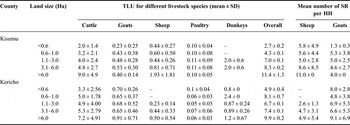
The parcels of land owned by the farmers were quite small (Table 1). In Kisumu County, 64 percent of the farmers owned <1 ha, while in Kericho County 42 percent of the farmers owned <1 ha. Land available for grazing or growing pastures for animals was limited. Only in Kericho County did a significant percent of farmers (11 percent) own more than 6 ha of land. The farmers tended to keep several species of livestock (Table 1). The number of animals reared per household presented as tropical livestock units (TLU) varied in relation to land size (Table 2). This generally reflects the resource availability for the smallholder farming systems, with less endowed households owning smaller parcels of land and maintaining fewer TLU than better endowed households. Farmers in Kericho County tended to have more cattle and goats than those in Kisumu, while in Kisumu farmers had more sheep than those in Kericho (Table 2). On the very small land holdings (<1 ha), farmers in Kericho County kept more animals than those in Kisumu County.
Number of tropical livestock units (TLU) for different species of livestock and mean number of sheep and goats reared by small holder farmers owning different sizes of land the two Counties.

TLU of 250 kg live weight (Njuki et al., Reference Njuki, Poole, Johnson, Baltenweck, Pali, Lokman and Mburu2011).
When gender was taken into consideration 54 percent of the households that kept sheep in Kericho County were headed by women, while in Kisumu County more male headed households owned sheep (63 percent) compared with female headed households. In both counties, a higher proportion of male-headed households owned goats (76 percent in Kericho and 63 percent in Kisumu) than female-headed households. Differences in ownership of SR by gender have great implications on control of incomes that accrue from the sale of the SR and their products.
Access to, and regular availability of water was noted to be a challenge within both counties. Harvesting and storage of rain water was mainly practiced within Kisumu County though only to a small degree, with 4.6 percent of the households harvesting rain water from their roofs, and 23 percent of the households storing rain water in water pans. The main constraints related to availability of water within both counties were; long distances to watering points and seasonality in availability of water. Farmers noted that during the drier periods of the year, the amount of water offered to animals tended to be less than when conditions were wet. In both counties the use of boreholes or wells was minimal.
SR breed-types kept and management practices
A large proportion of the sheep reared (68.5 percent in Kisumu and 60 percent in Kericho) were crosses of unspecified local breed-types. Pure-bred Red Maasai sheep had been introduced in the area for crossbreeding, however the numbers of crosses were still low (9 percent in Kisumu and 17 percent in Kericho). There were also some Dorper and Blackhead Persian sheep in the two Counties; however, their numbers were low.
Unlike what was observed in the case of sheep breeds, a larger proportion of the goats reared in both counties were well-defined breed-wise. The largest proportion of the goat population in Kisumu comprised the Small East African goats (38.7 percent) followed by Galla goats and their crosses (32.3 percent). In Kericho County, there were more Galla goats and their crosses (49 percent) than the Small East African goats (34.2 percent). Other goat breeds found in the areas were the Alpine and crosses between the different breed-types.
The breed-types of sheep and goats owned differed depending on the gender of the household head, with a higher proportion of the female headed households owning pure Red-Maasai sheep and their crosses (Red Maasai × Dorper in Kisumu and Red Maasai × Blackhead Persian in Kericho). Also in both Counties, the male headed households had more of the Galla goats and their crosses than the female headed households. When mating animals, the farmers practiced both pure breeding and crossbreeding of their sheep and goat populations. They noted that cross-bred animals had better (i.e. more desirable) attributes for their environments than either the pure-bred local animals, or the introduced pure-breeds.
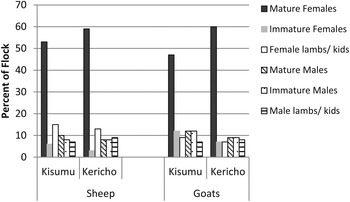
SR flocks for all the farmers had a higher proportion of mature female animals (>50 percent) than other age groups (Figure 2). The flocks however also comprised 20 percent mature male animals. Very limited control of breeding was practiced across the villages.
Flock structure for sheep and goats in the small holder farming systems.

Rams used for mating in Kisumu County were said to be mainly home-bred (41 percent of the households), while in Kericho County, farmers noted that they bought rams from other farmers or through development projects. More than 25 percent of the households in the two Counties however indicated that they used rams in an opportunistic manner as they left their sheep in open pastures and any ram from within the vicinity mated their ewes.
For goats, a significantly high proportion (65 percent in Kisumu and 57 percent in Kericho, P < 0.05) of the bucks used for breeding was sourced from outside the farms either from other farmers, or through activities of development projects within the areas. Twenty two percent of the farmers in both counties however noted that they bred their own bucks, while the rest relied on random mating during grazing and at shared water points. None of the farmers indicated that they had specific measures in place to control inbreeding among the SR reared.
SRs kept were mainly fed stovers of planted maize, millet and sorghum after harvesting of the crops, implying seasonal variation in SR feed resources. In a few instances, the farmers purchased dry crop residues from neighbouring farms to feed their SR. Stover was generally obtained from the fields directly by the animals, however, 58 percent of the households in Kisumu and 65 percent of the households in Kericho County indicated that they sometimes chopped the stovers into smaller pieces using a hand held blade prior to feeding it to their SR. Concentrates and/or mineral supplements were provided by some of the farmers (37 percent versus 25 percent in Kericho and Kisumu County, respectively), while 26 percent of the farmers in Kisumu and 55 percent in Kericho purchased processed feeds for their SR.
SR trait preferences
The traits perceived as being of primary importance in SR and their ranking in order of importance based on an index calculated from the scores provided on each trait by the farmers are presented in Table 3.
Relative ranks for traits perceived by farmers as being of primary importance in both sheep and goats.

The size and body condition of the animal were the most important traits for the farmers. This tended to be linked to the possible price the animals could attract in the market and, irrespective of breed type, larger animals were sold for better prices than smaller animals.
Flock dynamics
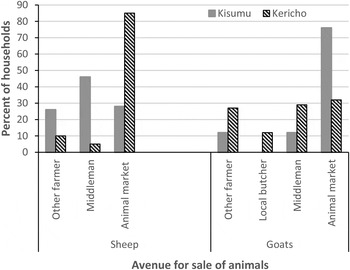
The flock numbers and structure within the farms was dynamic. Over a 12-month period, it was noted that 29 percent of the sheep and 34 percent of the goats had left the flocks in Kisumu County, while 27 percent of the sheep and 18 percent of the goats had left the flocks in Kericho County. Though animals exiting flocks were said to have been sold through different channels (Figure 3), the farmers noted that the mortality rates in the flocks, particularly for sheep were high (15 percent in Kisumu and 19 percent in Kericho). The mortality rates were significantly different (P < 0.01) between sheep and goats within the two counties, with a higher proportion of the sheep that left the flocks noted to have died (53 percent in Kisumu and 70 percent in Kericho) relative to goats (32 percent in Kisumu and 19 percent in Kericho).
Percent of households selling sheep and goats through different avenues.

There were also a significant number of new entries into the flocks through births and purchases, therefore the total population of SR remained relatively stable. In Kisumu County, 24 percent of all the sheep and 32 percent of all the goats comprised new animals while in Kericho County, 33 percent of all the sheep and 31 percent of all the goats comprised new animals. More than 60 percent of the new animals in both counties were born within flocks and were thus of local indigenous breed-types and their crosses with introduced breeds which the farmers owned. New animals were bought either to replace animals that had been lost, or as reserves for sales at later dates. Animals purchased tended to be mature, with farmers giving preference to body condition than to age. The selection of the animals to be purchased can have a great influence on the possible improvement of flocks, especially because older animals available for sale in markets could have been culled for various reasons by the original owner.
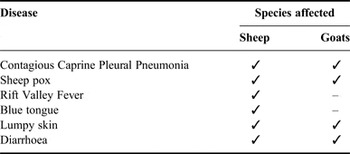
Animal health services were generally available through trained private animal health assistants. The farmers were also quite knowledgeable of the main diseases that affected their SR as presented in Table 4. Not all animals had been vaccinated against diseases with <50 percent of the farmers indicting that they had vaccinated their animals against some of the diseases listed in Table 4.
Main diseases noted to affect SRs in the two Counties.

Discussion
Previous studies have noted that breeding programmes must be preceded by full characterization of the available genetic resources (Jaitner et al., Reference Jaitner, Sowe, Secka-Njie and Demple2001; Kosgey and Okeyo, Reference Kosgey and Okeyo2007; Bett et al., Reference Bett, Bett, Kahi and Peters2009).The context under which SR are kept, and the reasons for keeping them needs to be understood before initiating any genetic improvement programme. This study was undertaken in order to provide an insight to the importance of SR under smallholder farming conditions where livestock keepers have very limited resources and are faced with the challenge of changing climatic conditions.
Household structure and gender
Households in the communities studied were generally headed by older persons (>50 years). A substantial proportion of those heading households had either no formal education, or only a basic primary level of education. Farming practices implemented were mainly those learned from within the communities. In a study on breeding practices in dairy goat populations, Bett et al. (Reference Bett, Kosgey, Kahi and Peters2008) noted that having a high proportion of farmers being elderly may have a negative impact on breed improvement efforts. Within the households of Nyando, there was however a sizable proportion of young people within the population who could be influenced to improve SR productivity.
A strong association between SR production and gender was observed in the CSV of Nyando. Specifically, goats tended to be owned by men, while sheep were owned by the women. Not surprisingly, more of the women headed households had adopted the improved Red-Maasai sheep breeds that were introduced, while more male headed households adopted the improved Galla goats. This pattern in ownership was different to that reported for West Africa where women tend to own and have greater control of goats and their products, while the men own a greater proportion of the sheep (Jaitner et al., Reference Jaitner, Sowe, Secka-Njie and Demple2001; Ejlertsen, Poole and Marshall, Reference Ejlertsen, Poole and Marshall2013). Ownership of livestock by either men or women in communities is greatly influenced by culture with small stock in many communities left under the responsibility of women and children (Ahuya, Okeyo and Peacock, Reference Ahuya, Okeyo and Peacock2005; Bett et al., Reference Bett, Kosgey, Kahi and Peters2008; Peacock et al., Reference Peacock, Ahuya, Ojango and Okeyo2011). When asked on the pricing of SR in the CSV through focus group discussions, it was clear that in Nyando goats fetch higher prices than sheep.
Resource endowment
The limited land that is available to the households in the CSV greatly impacts flock sizes and structure and has implications for sustainable flock/herd productivity. Water availability was also limited, with great variations depending on the season. As the farming practices were geared towards subsistence production, fodders for SR were limiting. The Nyando area has a very short growing period for crops, when farmers tend to use all the available arable land to grow subsistence crops (Macoloo et al., Reference Macoloo, Recha, Radeny and Kinyangi2013). During such periods there is little land available for both grazing and fodder production. Feeding of SR tended to depend heavily on crop residues. Studies have shown that under-feeding and poor quality feed are some of the major factors that limit SR production (Gatenby, Reference Gatenby1986). In the CSV of Nyando, the farmers noted that it takes long (an average of 4 years) for a sheep or goat to grow and reach a mature size, worse still the mature sizes are still quite small in comparison with indigenous sheep and goats from other parts of Kenya. Slow growth rates lead to low offtake rates, which in turn limit flock/herd productivity and incomes from SR. Farmers therefore need to adopt practices that promote fodder production as an economic activity to boost livestock productivity within the area. Manure from the SR could also be used to improve soil fertility, which in turn would improve crop productivity and quantity of fodder available for animals.
Trait preferences and flock dynamics
The farmers in the CSV considered size and body condition as the most important traits in their SR. They were however concerned about the slow growth rates, and differential mortality across the sheep and goats. For SR improvement in the CSV, the breeding objective traits should correspond to what the livestock keepers consider important. However, the production levels targeted should be supported by husbandry practices, practical feasibility and the market for SR (Kosgey and Okeyo, Reference Kosgey and Okeyo2007).
Generally growth related traits are highly heritable, easy to measure and are therefore relatively easy to improve through selection or crossbreeding. However, as the feed and water resource base needs to be taken into consideration, a trade-off is needed between improving production (meat and milk traits) and improving the more functional traits (adaptability, survival and reproductive efficiency). With the very small flock sizes at individual farm level, the loss of even one animal is indeed very costly to a household. High mortality together with the long-time taken for a female animal to grow to a weight where it can breed negates potential productivity and offtake of any livestock enterprise.
Demand for SR products was high within the area and larger animals were more easily marketed than the smaller ones. The sale of SR provided buffer income for periods when crop products were not available for sale. The market chains for SR production in the lower Nyando area are however still undeveloped. The markets do not segregate very much based on the quality of the animals. The farmers also lacked expertise and animal husbandry skills to develop a specific quality of SR product for the market, which may strongly influence the value of an animal in traditional markets as noted in smallholder farming systems of Ethiopia by Gizaw, Komen and van Arendonk (Reference Gizaw, Komen and van Arendonk2010). A strong training package including animal husbandry, management and marketing of products that targets both the youth and more mature livestock keepers would need to be implemented.
Breeding and improvement programme
Bett et al. (Reference Bett, Bett, Kahi and Peters2009) indicated that improving SR productivity in unfavourable environmental conditions can generally be enhanced by focusing on improving husbandry. However, in low-input systems where farmers tend to avoid risks and dependencies, introduction of genes from other “exotic” populations at the initial stages of a breeding and improvement programme can be successful and is recommended as long as the functions and attributes of existing populations are duly taken into account (Peacock et al., Reference Peacock, Ahuya, Ojango and Okeyo2011; Mueller et al., Reference Mueller, Rischkowsky, Haile, Philipsson, Mwai, Besbes and Wurzinger2015). Indigenous tropical breeds of sheep and goats that have adaptive and productive attributes could serve as good candidates for such introductions (Baker and Gray, Reference Baker and Gray2004). However, such animals need to be carefully selected so that they meet the needs and aspirations of the farming communities to which they are being introduced and should have the potential to adapt to the new environments. In many instances, improved indigenous lines are not available, resulting in the introduction of exotic breed lines unable to cope with the long-term stresses of tropical environments. This has often negatively impacted livestock improvement programmes in developing countries as high resultant mortalities of exotic breeds render livestock keepers destitute (Kosgey et al., Reference Kosgey, Baker, Udo and Van Arendonk2006). The changing climatic conditions have catalysed the need for developing countries to invest in selecting and developing productive yet resilient indigenous breed lines able to cope with the changes, while at the same time improving the livelihoods of their keepers.
The need for improving household incomes demands that any new livestock improvements or interventions should be market orientated. The mode of implementation of a breeding programme needs to be adapted with cognisance of the prevailing literacy level of the communities targeted. Simple animal identification and monitoring practices should be used to generate data and information on both the animals and the production systems. Results generated through analysis of the data collected should be illustratively presented in order to guide flock management and breeding decisions. In smallholder systems operated by households with diverse age groups and differential levels of literacy working collectively, all the households within the community can undertake the performance and pedigree recording of their animals. This would enable male animals to be selected at reasonably younger ages (9–12 months of age). The selected males can then be retained by a few farmers and used for breeding by the community members (Peacock et al., Reference Peacock, Ahuya, Ojango and Okeyo2011; Mueller et al., Reference Mueller, Rischkowsky, Haile, Philipsson, Mwai, Besbes and Wurzinger2015). In order to avoid the risk of “improved” female animals being exposed to non-improved males within the population, some form of control can be implemented through early castration of male progeny from the general population. As the average flock sizes are small, gains would be possible through a group approach to breeding (Gizaw, Hans and van Arendonk, Reference Gizaw, Hans and van Arendonk2009; Mueller et al., Reference Mueller, Rischkowsky, Haile, Philipsson, Mwai, Besbes and Wurzinger2015). The gain in growth and mature size of animals within the population should however be optimized in line with feed resources and environmental conditions. The CSV provide a good platform for developing an optimized community breeding programme for SRs. Formation of farmer groups, provision of breeding stock, extension and animal health services and training could serve as an incentive for farmers' to participate in the programme as described by Bett et al. (Reference Bett, Bett, Kahi and Peters2009).
For improved SR to sustainably contribute to transformation of livelihoods and household incomes, a fully integrated approach that is grounded on principles of genetic and better economic management of livestock resources is required. Improving productivity per animal is the most efficient way of mitigating ecological degradation, high water consumption and excessive emissions of green-house gases as reported in “Livestock's Long Shadow – Environmental Issues and Options” (Steinfeld et al., Reference Steinfeld, Gerber, Wassenaar, Castel, Rosales and de Haan2006).
Conclusions
In situations and production systems such as the ones found and practiced in Nyando, SRs can play an important role in both adapting to climate change and mitigating the effects of climate change on livelihoods of affected communities. A community breeding programme geared towards the optimal use of available resources and incorporating gender-integrated innovative technologies can be developed using indigenous breeds. Economic breeding objectives however need to be developed for the area. Complementary to this the SR product market value chain should grow. Capacity development is however required to improve husbandry and to sensitize farmers on cooperation in decision making on the improvement and progress of their flocks.
Acknowledgements
The support and contribution of colleagues in the CCAFS Nyando project from ViAgroforestry and World Neighbors is acknowledged. We also acknowledge the livestock keepers within Kisumu and Kericho Counties for their time and support for the project. We would also like to thank the Government of Kenya officers for their assistance towards logistics and to the enumerators who spent many days collecting data.
Statement of interest
No conflict of interest.