A Never-ending Debate
The current financial crisis in the Eurozone has put the debate on EU integration back on the table. This is not surprising, considering that crises generally have the tendency to activate both the human inclination to unite and/or separate for the sake of economic, political, and ideological fortune. It is, however, interesting to note just how much the search for a practical solution to the current crisis appears to be hijacked by a resurfacing of the general debate on EU integration and at the same time takes place entirely separately from it. While pragmatic responses to the crisis have been sought to a great extent at the EU level, e.g. the plans for EU budgetary oversight and an emergency fund (next to national austerity measures), support for such a transfer of national sovereignty among the populace and parliaments of the member states is fragmented.
This gives rise to an intriguing question. In how far does the debate on EU integration, particularly the arguments and ideals used in it, actually influence the process of EU integration? How does it compare with, for instance, the influence of particular events, circumstances, and the specific interests of the various member states at certain points in time? In short, does the debate really matter or are we merely wasting time, money, and paper? This article wishes to provide some food for thought by arguing the debate’s irrelevance in furthering or hindering EU integration. It does so by first discussing the role of the debate’s arguments in shaping EU integration and then comparing the EU debate with that waged by the founding fathers of the US. We conclude with a brief discussion of the debate’s sense and non-sense.
The EU Integration Debate
The political debate on EU integration focuses on the question of whether or not we should integrate and the forms this integration should take institutionally. It is therefore an inherently normative exercise. In this sense it should not be confused with the scientific debate between intergovernmentalists and supranationalists (and institutionalists and constructivists).Reference Burgess1–Reference Cini3 That debate focuses more on explaining the integration process of the EC and EU and embodies a more empirical exercise into drivers, barriers, and general spill-over and bargaining dynamics. The arguments employed in the contemporary political debate have remained largely the same since the ideas for a European federation first emerged. They are summed up briefly here.
On the one side are the Europhiles or federalists who argue that EU integration is beneficial for both the populace and the member states. First, they claim that there is no credible alternative to integration in dealing with global economic competition and (geo)political rivalry. They question, for instance, whether single member states are still able to protect their (national) interests without the EU in a world in which their competitors increasingly resemble continental states rather than nation states in terms of geographical and demographical scope (e.g. the US and China). Second, the EU has delivered very concrete practical results. It brought economic benefits through the free movement of goods, services, capital, and labour and allowed for free travel across its member states. The EU also maintained internal stability by institutionalizing nation states in a web of interdependence that mediates possible conflicts by providing conflict resolution mechanisms, promoting the human rights of its citizens, and cementing democratic ideals. Third, the Europhiles or federalists argue that Europeans represent a community of peoples with common historical bonds, shaped over the course of millennia, which distinguishes them from their African, Middle Eastern, and Central Asian neighbours, in spite of internal differences among the various European countries. Finally, Europhiles feel strengthened by the fact that while many citizens might question the nature of EU integration or its current institutional construction, these citizens also seem in favour of the general notion and necessity of integration, rather than sticking to the nation state as the desired polity. For example, ‘in the euro area, 63% of respondents support the single currency’ and ‘a large majority of Europeans believe that, as a consequence of the crisis, EU countries will have to work more closely together (84%)’.4
Eurosceptics on the other side have been quick to point out some reservations with regard to EU integration that cannot simply be ignored. The first is the lack of a common vision of where the integration process is heading. It is unclear, for example, what the end-state should be, i.e. whether the EU should become a ‘United States of Europe’ or whether it should resemble a more modest effort resulting in an intergovernmental institutional structure. Second, they question the desirability to integrate, pointing to the costs of integration (and the EU) and asking whether integration benefits all parties equally or leads to domination by a few member states. They also point to the democratic deficit, the possible loss of subsidiarity in governance, and the lack of transparency of EU institutions that disregard the sentiments of a populace that feels that its opinion regarding the EU has been circumvented by national political elites. Finally, the lack of a common identity to hold a European polity together is considered to be a major challenge, both culturally and politically. They hence warn for further integration, argue for a more gradual, slower pace, or perhaps even seek to undo what has been done.
The arguments put forward by proponents and opponents of EU integration touch upon important considerations. The integration process itself, however, need not necessarily be affected by them. Indeed, we would argue that it seems to be largely driven by specific circumstances or events and the particular interests of member states – although it is not always easy to differentiate arguments and ideals from events, circumstances, and interests as the main drivers or obstacles for integration. Put differently, we would argue that in general the arguments in favour of integration were not the main driving forces furthering integration and the arguments against integration were not the main obstacles hindering integration.
First, most steps in the EU integration process can be readily attributed to specific circumstances or particular national interests. The dominant reasons for integration in the early years between 1945 and 1967, for example, were a desire to rebuild war-ravaged national economies, prevent future conflict by addressing the Franco-German rivalry, and an awareness of weakness in comparison to the new superpowers, the US and USSR. The period of Eurosclerosis between 1968 and 1985 can in large part be ascribed to the attitude of the French president de Gaulle and complacency with economic prosperity among the general public; where is the need to integrate? In this light it is interesting to note that the current financial crisis has already provoked further integration out of practical necessity (even to the point where Merkel and van Rompuy discussed political integration) in straight contrast to the popular sentiment reflected in the ‘no’ votes on the EU constitution a few years earlier.
Second, even when an argument seems to carry the day, it is often because circumstances elevate it over others. For example, the idealism of Delors and Spinelli regarding a single European space and a political union portrayed in the SEA (much in line with the ‘prosperity for all’ argument of proponents) was delayed by Thatcher’s neoliberal and intergovernmental stance. It required the drastic events of the collapse of the USSR, German reunification, the EMS, and the political reforms and power vacuum in Eastern Europe to move towards the Maastricht treaty and the Euro. Another example is that the EU blueprint itself seems to have required the devastation of the European continent in the Second World War in order to start serious negotiations towards a Union, although the interbellum already signalled plenty of federalist ideals to bring peace to the continent (by Kalergi and Briand). These were applauded at the time but not transformed into concrete action due to other events: the depression and the rise of Nazi-Germany. In short, there is no shortage of situations where ideals needed a catalyst to truly catch on.
Third, none of the arguments holds an intrinsic value over the others, so that it would allow us to decide upon a ‘winner’ of the debate. While unification indeed could provide geopolitical and economic strength to withstand global pressures, without a clear and solid institutional constellation such potential strength might not materialize. While the EU has indeed delivered economic benefits, political stability, and individual rights, it also remains to be seen how far these benefits are distributed equally (the current financial crisis being a case in pointReference Scholten5) and how far the democratic deficit may delegitimize future EU policy making. Finally, while the EU may be a community of peoples based on a shared history and cultural heritage, they do not yet share a common identity in the sense of nation states. Because of this impasse, we may expect that circumstances remain decisive; only they can determine a direction.
In spite of the above, there are, however, also moments where certain arguments have outweighed others and been decisive in determining the integration process. Examples might be the growing popular dissatisfaction with the operation of EU institutions that lay at the heart of the ‘no’ votes in the referenda on the constitution in France and the Netherlands, the expansion of economic, political, and individual benefits that helped to push the EU and the euro, and the increasing role of the European Parliament in the late 1970s to deal with the lack of democratic accountability towards the European populace. We might perhaps also add the accession delays Turkey is enduring, since they can be unofficially ascribed to common identity issues (next to failing to meet accession criteria). Here there is no highly significant international political event that triggered change, but rather the fact that popular opinion found politicians sensitive to it.
Summarizing, it can be stated that the arguments of the integration debate have been overshadowed by specific circumstances and that pragmatism generally has determined the process of EU integration. This reduces the debate to a hobby of academics and rhetoric of politicians; it matters little. That is not to say that the debate does not raise valid considerations, for it does. It is to say, however, that an old wisdom in the field of International Relations is reconfirmed: ‘the rhythm of European integration has been always strongly affected by international relations. Rising international tension seemed to accelerate the integration process while it was more difficult to do business in a calmer international climate’.Reference Hermans6 This has some interesting implications for the EU integration process. First, this leaves us with an integration process that moves slowly or step-by-step because it depends on the right circumstances arising and a particular constellation of national interests, an integration process that runs behind the facts because a significant challenge seems required before most member states consider further integration, and an integration process that is uncertain and reversible, considering it is not driven by idealism or a conviction about the intrinsic need to integrate. Second, the finding highlights the role of political and economic crises as an opportunity for further integration for Europhiles as well as the fuel to hinder, slow down, or even undo integration for Eurosceptics. In this light it will be interesting to see whether the current financial crisis marks the beginning of a further round of EU integration or a new era of eurosclerosis.Reference Cohen7
Forming the United States of America
One may be forgiven in believing that the integration debate is a typical European ‘thing’. Still, one needs only to look at the arguments that the founding fathers used against the anti-federalists in the establishment of the US to see how not arguments and ideals, but simple pragmatism in addressing economic and political challenges on that occasion decided the process of integration.
Three major concerns shaped the integration debate between the federalists and anti-federalists: (1) a common vision on future integration; (2) the institutional constellation of the new Union and its republican credentials; and (3) the common identity issue. While both camps aimed at protecting liberties and ensuring republican government, the legacy of the Declaration of Independence, the debate centred on the means by which these aims could best be achieved.
To the Federalists, the American Revolution ‘meant independence, growth in national power, and prosperity, all within a federal system of government retaining the states and deriving its authority from the people, but also competent to all needs and exigencies of respectable, energetic nationhood’ (Ref. Reference Ketcham8, p. 20). Federalists were ‘well aware of the tendency of confederations and small, vulnerable republics to be merely provincial, to quarrel among themselves, and to be gobbled up by more united, powerful nations’ (Ref. Reference Ketcham8, p. 15). They hence sought ‘the stability and strength that could come from union and from steady, effective government’ (Ref. Reference Ketcham8, p., 15), an attractive purpose for large numbers of people of all classes at the time. The Federalists’ ‘grand plan’ necessitated the creation of federal institutions that ensured republican ideals. This not only entailed the separation of powers, but also the election of two chambers of Congress, one representing the states and the other the nation as a whole – and for the President to ensure representation at the federal level in different ways. Moreover, protection of the people’s liberties found its place in the Bill of Rights, adopted directly after the passing of the US Constitution. Finally, the Federalists seemed little concerned about the supposed lack of a common identity. The common colonial past, the shared ideals of republican government protecting human liberties, and simple pragmatism in addressing economic and political challenges constituted an identity as common as one could get.
Conversely, the anti-federalists’ ideal regarding future integration was without big aspirations for nationhood; it was based on the idea of life in small communities with local governments, which they saw as the only possible way to establish true self-government of, by, and for the people, an ideal deeply embedded in the minds of Americans who had been a colony of the British Empire. Especially important was the direct contact between the population and its representatives, and retaining as much powers as possible at the local level. Self-governance ‘was tied inextricably to something like a town meeting […] or at least to a state legislature of many annually elected representatives who would really know the people of their districts’ (Ref. Reference Ketcham8, p. 17). This was far removed from any form of strong central government, thought to lead to a new kind of tyranny: too much power in a few hands with questionable representation of the people it would govern. Basically, the anti-federalists were afraid of losing the just obtained freedom from the British crown to a new strong central government. In addition, the anti-federalists were concerned about the geographical, commercial, religious, custom, and credit differences between the 13 states, which they saw as an obstacle to putting together a legislature that serves the common interest: it was thought to become stuck between the concerns and wants of its parts (Ref. Reference Ketcham8, p. 279).
The integration debate arose only a few years after the confederal union established by the Articles of Confederation, the first US Constitution, proved to be ineffective. The confederal union was established for the purposes of providing common defence, preserving public order, and regulating commerce between its members as well as with other nations. It possessed, however, weak or no tools to achieve these purposes; it even lacked the means to enforce actions against those states that did not comply with what was decided by the federal Congress. In addition, Congress failed to raise the money to pay off the debts incurred during the war for independence. The economy of the newly established nation also quickly got into trouble due to the mercantilist policy of the British Empire (and others) which closed its ports for US goods. Moreover, while Union representatives could negotiate trade agreements with foreign nations, such agreements needed to be ratified and further implemented by individual states. These, however, were inclined to create barriers to trade among each other and open their borders to British goods in times of economic troubles, directly going against what had been agreed at the central level. As such, the ‘separation from Great Britain and eleven years of independent state and national government had left Americans with an uncertain national identity, an intriguing republican idealism, and an intricate array of unresolved tensions and practical problems’ (Ref. Reference Ketcham8, p. 5). As ‘the means ought to be proportioned to the end’ (Ref. Reference Kesler and Rossiter9, p. 149), a government as energetic as that proposed for the preservation of the Union based on the ideals of republican government and protection of human liberties became the only alternative to the economically collapsing and military and politically vulnerable yet sovereign states (Ref. Reference Schwartz10, p. 702).
In the end, as we all know, the Federalists prevailed. Necessity decided the debate. Nevertheless, the expressed concerns of opponents and the proponents’ responses remain debated to this today, more than two hundred years later. The 50 states constituting the present USA still differ in ‘geography, commerce, religion, customs, land speculation, and credit’ and self-govern a number of crucial issues, including education and family law. In addition, the democratic credentials of the republican government continue to be debated, especially within the walls of the Supreme Court.
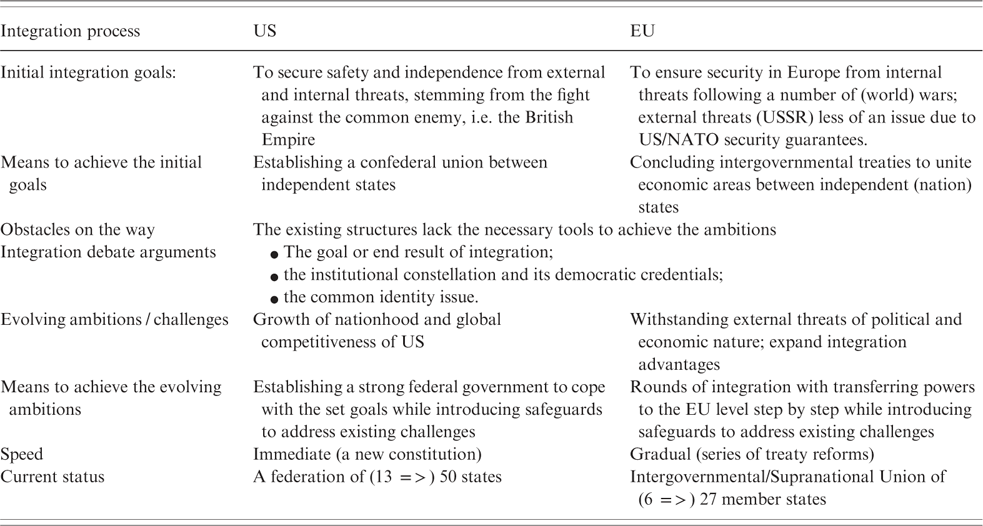
What does the US teach us about the EU integration debate? First, the arguments shaping both integration debates strike us with their similarity: divergent ideas for the goal of integration, a variety of blueprints on institutional constellation and its democratic credentials, and disagreements as to what constitutes the ‘common identity’ of integrating partners. History seems to repeat itself like a pendulum going back and forth (Ref. Reference Reich11, p. 4). Second, both cases have shown that the debate arguments are not decisive as to the question of whether to integrate or not. It was the dire political-economic circumstances and pragmatic leadership that triggered the ambition to realise the ambitious Federalist plan. Finally, the US case gives reasons to speculate on the relationship between the speed of progress and the size of the crises both polities faced, progress implying a deepening of cooperation, an expansion of member states, and/or an increase in policy areas. Is a big crisis necessary for a step towards federation? Do Europeans have to wait (despite the cold war and financial crisis) for a crisis or threat that matches the magnitude of that the US faced in order to make the ‘big jump forward’ towards a political union? See also appendix A for a comparison between both integration processes.
Sense and Non-sense
While this article thus far has argued that the EU integration debate has had little impact on the process of integration in the EU, showing the non-sense of it, we would like to end on a more normative note by asking whether the debate should not matter more. After all, its ideals and arguments raise important, sensible considerations. For it to matter more, however, the debate would need to be resolved by a clear popular support for either side. The fact that ideals and arguments are outgunned by events, circumstances, and interests may well be due to the absence of a ‘winner’ of the debate. But then again, perhaps only circumstances are able to determine a winner…
Integration processes compared

Miroslava Scholten is a postdoctoral researcher at the University of Utrecht, the Netherlands, Faculty of Law, Economics and Governance, the Utrecht Centre for Regulation and Enforcement in Europe (RENFORCE) and the Europa Institute.
Daniel Scholten is an Assistant Professor at TU Delft, the Netherlands, Faculty of Technology, Policy and Management.