


A high frequency of current comorbidity — the presence of symptoms that meet criteria for more than one mental disorder — has been a common finding in surveys using fully structured diagnostic interviews. Half the people who met criteria for one mental disorder also endorsed symptoms that met criteria for one or more additional disorders: 54% in the Epidemiologic Catchment Area Study (Reference Robins and RegierRobins & Regier, 1991); 56% in the US National Comorbidity Survey (NCS; Reference Kessler, Tsuang, Tohen and ZahnerKessler, 1995); and 45% in the Netherlands Mental Health Survey and Incidence Study (Reference Bijl, Ravelli and van ZessenBijl et al, 1998). Clinical practice is different, and DSM-IV encourages the listing of a ‘principal diagnosis or reason for visit’ (American Psychiatric Association, 1994: p. 3). The aims of the study reported here were to use the correlates of current comorbidity to explore whether comorbidity is in part an artefact of the diagnostic interview; to determine whether disability and service utilisation are a function of the number or type of disorders present; and to present a method whereby epidemiological instruments can identify a principal diagnosis.
METHOD
Data from the Australian National Survey of Mental Health and Well-Being were used (see Andrews et al, Reference Andrews, Henderson and Hall2001a ,Reference Andrews, Issakidis and Carter b for references to method and measures). Seventy-eight per cent of those approached, or 10 641 adults aged 18 and over, responded. Interviewers administered a computerised interview that included the Composite International Diagnostic Interview (CIDI; World Health Organization, 1997) to identify symptoms within the 12 months prior to the interview that satisfied criteria for the common affective, anxiety and substance misuse disorders. People who met criteria for either neurasthenia or psychosis as their only or main diagnosis were not included as they were so few. The DSM-IV diagnostic criteria (exclusion criteria not operationalised) were used for this paper. A screening interview was used for personality disorder. The interview also contained the Kessler Psychological Distress Scale (K10; Reference Kessler, Andrews and ColpeKessler et al, 2002), a neuroticism scale of the Eysenck Personality Questionnaire (Reference Eysenck, Eysenck and BarrettEysenck et al, 1985), a service utilisation questionnaire and two disability measures: the 12-item Short Form Health Survey (SF-12; Reference Ware, Kosinski and KellerWare et al, 1996), see Sanderson & Andrews (Reference Sanderson and Andrews2002) for utility data, and ‘days out of role’ (Reference Kessler and FrankKessler & Frank, 1997).
Respondents who reported symptoms consistent with more than one disorder were asked to nominate which of their clinically significant groups of symptoms they would consider to be ‘the problem that troubles you the most’. Thus, it was possible to code all respondents who met criteria for two or more disorders against a principal disorder (further details available from the author upon request). The results presented here refer to people who met criteria for a CIDI diagnosis some time in the preceding 12 months and who said that the set of symptoms they endorsed had been present in the preceding 4 weeks (i.e. current cases). Disability and psychological distress were assessed over a similar 4-week time frame. The questions on neuroticism were trait questions, asking about ‘your nature, how you usually are’. The question on number of ‘consultations with a health professional for a mental problem such as stress, anxiety, depression or dependence on drugs or alcohol’ was applied to the previous 12 months.
Analysis
Is the association between comorbidity and other indicators meaningful?
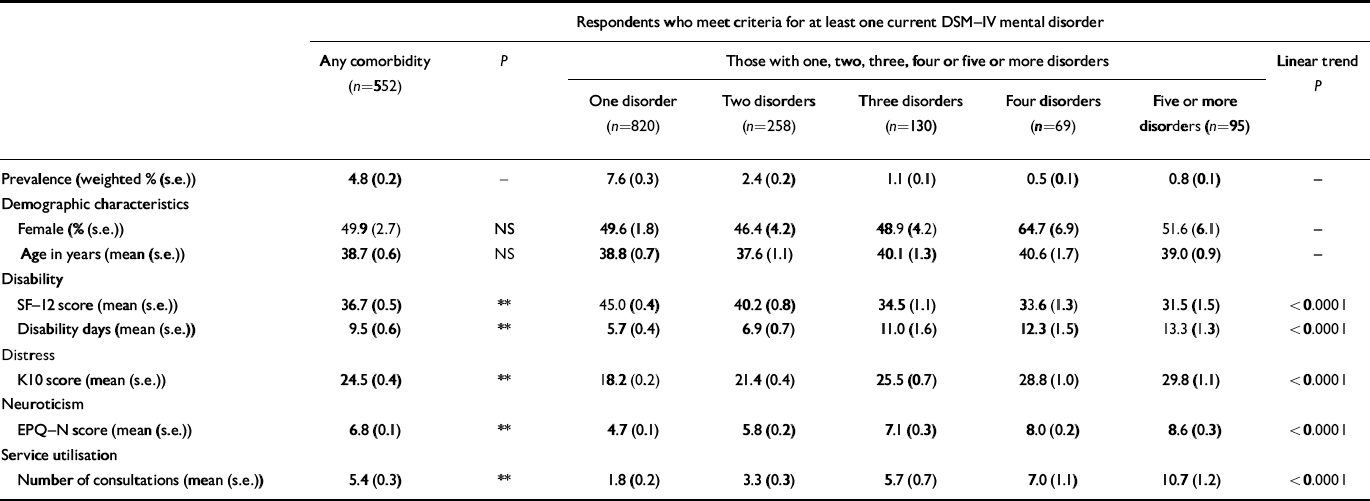
First, to evaluate disability, distress, neuroticism and service utilisation by number of disorders in the total sample, respondents were coded against the total number of mental disorders for which they met criteria (none, one, two, three, four, five or more) from a total of 12: two affective disorders (depression, dysthymia), five anxiety disorders (panic/agoraphobia, social phobia, generalised anxiety disorder, obsessive—compulsive disorder, post-traumatic stress disorder), two substance use disorders (alcohol abuse/dependence, other drug abuse/dependence), and three personality disorder clusters (cluster A, cluster B, cluster C). The age and gender distribution, and levels of disability, distress, neuroticism and service utilisation, were examined across these groups (Table 1).
Disability, distress, neuroticism and service utilisation by number of current disorders
| Respondents who meet criteria for at least one current DSM-IV mental disorder | ||||||||
|---|---|---|---|---|---|---|---|---|
| Any comorbidity (n=552) | P | Those with one, two, three, four or five or more disorders | Linear trend P | |||||
| One disorder (n=820) | Two disorders (n=258) | Three disorders (n=130) | Four disorders (n=69) | Five or more disorders (n=95) | ||||
| Prevalence (weighted % (s.e.)) | 4.8 (0.2) | - | 7.6 (0.3) | 2.4 (0.2) | 1.1 (0.1) | 0.5 (0.1) | 0.8 (0.1) | - |
| Demographic characteristics | ||||||||
| Female (% (s.e.)) | 49.9 (2.7) | NS | 49.6 (1.8) | 46.4 (4.2) | 48.9 (4.2) | 64.7 (6.9) | 51.6 (6.1) | - |
| Age in years (mean (s.e.)) | 38.7 (0.6) | NS | 38.8 (0.7) | 37.6 (1.1) | 40.1 (1.3) | 40.6 (1.7) | 39.0 (0.9) | - |
| Disability | ||||||||
| SF-12 score (mean (s.e.)) | 36.7 (0.5) | ** | 45.0 (0.4) | 40.2 (0.8) | 34.5 (1.1) | 33.6 (1.3) | 31.5 (1.5) | <0.0001 |
| Disability days (mean (s.e.)) | 9.5 (0.6) | ** | 5.7 (0.4) | 6.9 (0.7) | 11.0 (1.6) | 12.3 (1.5) | 13.3 (1.3) | <0.0001 |
| Distress | ||||||||
| K10 score (mean (s.e.)) | 24.5 (0.4) | ** | 18.2 (0.2) | 21.4 (0.4) | 25.5 (0.7) | 28.8 (1.0) | 29.8 (1.1) | <0.0001 |
| Neuroticism | ||||||||
| EPQ-N score (mean (s.e.)) | 6.8 (0.1) | ** | 4.7 (0.1) | 5.8 (0.2) | 7.1 (0.3) | 8.0 (0.2) | 8.6 (0.3) | <0.0001 |
| Service utilisation | ||||||||
| Number of consultations (mean (s.e.)) | 5.4 (0.3) | ** | 1.8 (0.2) | 3.3 (0.3) | 5.7 (0.7) | 7.0 (1.1) | 10.7 (1.2) | <0.0001 |
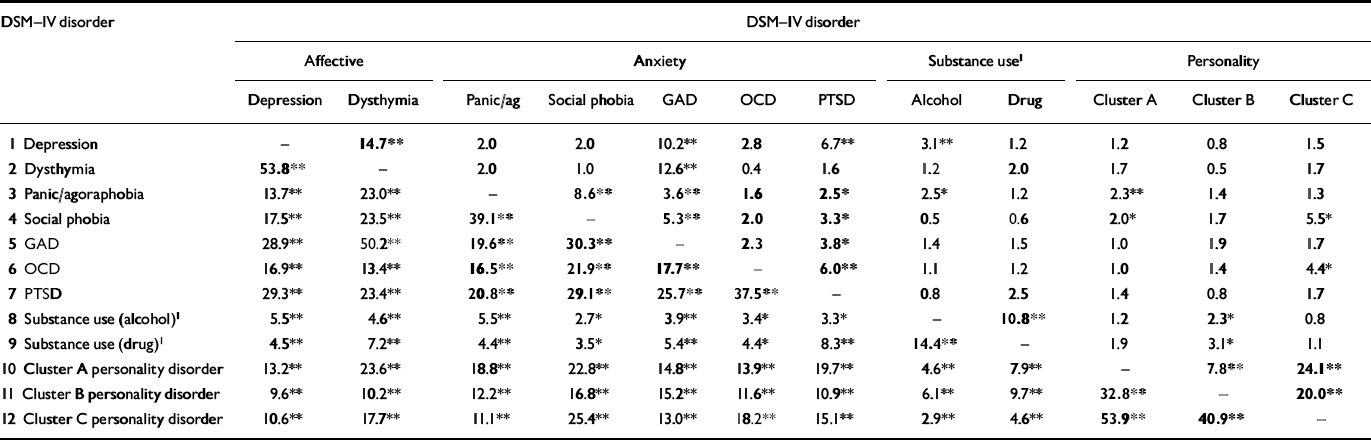
Second, patterns of bivariate comorbidity in the total sample were examined. Bivariate associations of mental disorders were calculated from a series of logistic regression models containing only pairs of disorders. In each model one disorder of the pair was used as the dependent variable and the other served as the independent variable. Comparisons significant at the 0.05 level are displayed in Table 2. However, a more conservative α level of 0.001 was used to assess the significance of comorbid disorder pairs, to account for multiple estimation (Reference Tabachnick and FidellTabachnick & Fidell, 1996). Associations were estimated for current comorbidity and for comorbidity in the preceding 12 months.
Bivariate associations (below and to the left of the diagonal) and multivariate associations (above and to the right of the diagonal) of DSM-IV mental disorders in the Australian National Survey of Mental Health and Well-Being
| DSM-IV disorder | DSM-IV disorder | |||||||||||
|---|---|---|---|---|---|---|---|---|---|---|---|---|
| Affective | Anxiety | Substance use1 | Personality | |||||||||
| Depression | Dysthymia | Panic/ag | Social phobia | GAD | OCD | PTSD | Alcohol | Drug | Cluster A | Cluster B | Cluster C | |
| 1 Depression | - | 14.7** | 2.0 | 2.0 | 10.2** | 2.8 | 6.7** | 3.1** | 1.2 | 1.2 | 0.8 | 1.5 |
| 2 Dysthymia | 53.8** | - | 2.0 | 1.0 | 12.6** | 0.4 | 1.6 | 1.2 | 2.0 | 1.7 | 0.5 | 1.7 |
| 3 Panic/agoraphobia | 13.7** | 23.0** | - | 8.6** | 3.6** | 1.6 | 2.5* | 2.5* | 1.2 | 2.3** | 1.4 | 1.3 |
| 4 Social phobia | 17.5** | 23.5** | 39.1** | - | 5.3** | 2.0 | 3.3* | 0.5 | 0.6 | 2.0* | 1.7 | 5.5* |
| 5 GAD | 28.9** | 50.2** | 19.6** | 30.3** | - | 2.3 | 3.8* | 1.4 | 1.5 | 1.0 | 1.9 | 1.7 |
| 6 OCD | 16.9** | 13.4** | 16.5** | 21.9** | 17.7** | - | 6.0** | 1.1 | 1.2 | 1.0 | 1.4 | 4.4* |
| 7 PTSD | 29.3** | 23.4** | 20.8** | 29.1** | 25.7** | 37.5** | - | 0.8 | 2.5 | 1.4 | 0.8 | 1.7 |
| 8 Substance use (alcohol)1 | 5.5** | 4.6** | 5.5** | 2.7* | 3.9** | 3.4* | 3.3* | - | 10.8** | 1.2 | 2.3* | 0.8 |
| 9 Substance use (drug)1 | 4.5** | 7.2** | 4.4** | 3.5* | 5.4** | 4.4* | 8.3** | 14.4** | - | 1.9 | 3.1* | 1.1 |
| 10 Cluster A personality disorder | 13.2** | 23.6** | 18.8** | 22.8** | 14.8** | 13.9** | 19.7** | 4.6** | 7.9** | - | 7.8** | 24.1** |
| 11 Cluster B personality disorder | 9.6** | 10.2** | 12.2** | 16.8** | 15.2** | 11.6** | 10.9** | 6.1** | 9.7** | 32.8** | - | 20.0** |
| 12 Cluster C personality disorder | 10.6** | 17.7** | 11.1** | 25.4** | 13.0** | 18.2** | 15.1** | 2.9** | 4.6** | 53.9** | 40.9** | - |
Third, to investigate patterns of multivariate comorbidity in the total sample, multivariate associations of mental disorders were calculated from a series of logistic regression models each containing the disorder of interest as the dependent variable, every other disorder in turn as the independent variable, and in each case an additional variable representing the number of other diagnoses for which criteria had been met. A conservative α level of 0.001 was again used to assess the significance of comorbid disorder pairs to account for multiple estimation.
Fourth, patterns of comorbidity across diagnostic time-frames were examined using comparisons with the US NCS data. Bivariate odds ratios (ORs) for NCS life-time and 6-month, and current survey 12-month and 1-month, comorbid disorder pairs were calculated. The distribution of ORs was compared across these time-frames using the Wilcoxon signed ranks test (Reference SiegelSiegel, 1956).
Is the relation between comorbidity, disability and service utilisation associated with particular disorders or groups of disorders? In order to examine the effect of specific comorbid disorder group pairs on disability and service utilisation, two separate series of regression analyses were conducted. The first contained the mental health component scale of the SF-12 as a dependent variable and modelled the effect of each comorbid disorder group pair (affective/anxiety disorders, affective/substance use disorders, affective/personality disorders, anxiety/substance use disorders, anxiety/personality disorders and substance use/personality disorders) on disability. These linear regression models controlled for the number of disorders as well as for variables that have been shown to contribute to disability in the total sample — socio-demographic factors and presence of chronic physical conditions (Reference Sanderson and AndrewsSanderson & Andrews, 2002). The second series of logistic regression models contained ‘any mental health consultation’ as the dependent variable. Models were estimated in the same way, again controlling for the number of disorders and factors that have been shown to predict service utilisation in the total sample (Reference Andrews, Issakidis and CarterAndrews et al, 2001b ).
Is there a method whereby survey data could be obtained to control for comorbidity?
Disability, distress, neuroticism and service utilisation were analysed according to main problem (taken as a proxy for the principal disorder) among those with two disorders from different groups. Respondents who reported symptoms of more than one disorder were asked to nominate which of their clinically significant groups of symptoms was ‘the problem that troubles you the most’. Thus, it was possible to code all respondents who met criteria for two or more disorders against their principal disorder. The age and gender distribution and level of disability, distress, neuroticism and service utilisation were examined across these comorbid groups.
The same analysis of disability, distress, neuroticism and service utilisation by principal disorder was performed for the total sample, with the difference that all respondents who met criteria for at least one current DSM-IV mental disorder were included and were coded against their principal disorder. Comparisons between these four groups were made using analysis of variance with planned contrasts and a conservative error rate of P=0.001 to account for multiple comparisons.
Variance estimation
Standard errors around proportions, means and regression parameters were calculated using jackknife repeated replication to account for the complex survey design (Reference Kish and FrankelKish & Frankel, 1974). The SUDAAN software package, designed for use with complex survey samples, was used for these calculations (Reference Shah, Barnwell and BieglerShah et al, 1997).
RESULTS
Validity of association between comorbidity and other indicators
Within the confines of the data, is the phenomenon of current comorbidity an artefact of the instrument used (which simply reflects the current nosology), or is the association between comorbidity and other indicators meaningful? In Table 1 we present data for any current comorbidity between the 12 DSM-IV disorders. Forty per cent of people with one or more of these 12 mental disorders met criteria for more than one disorder (column 1). They were not different in gender (χ1 2=0.00, P=0.94) or age (t=0.1, P=0.93) from those with only one disorder (column 2). They were more disabled (SF-12 score and days out of role), more distressed (K10 score), were higher users of consultations for a mental problem, and had higher scores on the Eysenck neuroticism scale than those with only one disorder (t-values range from 6.5 to 16.3, P < 0.001 for all five comparisons). We then present these data in terms of number of current diagnoses (one to five or more current diagnoses) and show that there is a dose—response relationship: the greater the number of current diagnoses, the greater the disability, distress, neuroticism and consulting behaviour (test of linear trend; P < 0.001 for all variables). The 40% of people with symptoms that meet criteria for more than one disorder accounted for 51% of the disability days reported by people meeting criteria for these mental disorders, and for 56% of the consultations for a mental problem. This table contains information about any comorbidity; it does not contain any information about comorbidity between specific disorders.
In the cells below and to the left of the diagonal (signified by —) in Table 2 we present a matrix of bivariate ORs for all 66 comorbid disorder pairs that shows that almost all combinations are larger than one, and thus are much more common than expected. In the present material, 83% of the displayed ORs for current comorbid disorder were larger than the ORs for 12-month comorbidity (Wilcoxon signed ranks test, P < 0.001; Reference SiegelSiegel, 1956).
The cells above and to the right of the diagonal in Table 2 give the multivariate ORs in which the unique association between two diagnoses are presented, after controlling for the general probability of comorbidity. The resulting multivariate ORs are significantly less than the bivariate ORs. The within-disorder group ORs (in bold) are significantly larger than those between disorders in different groups (Mann—Whitney U=85.5, P<0.001; Reference SiegelSiegel, 1956). There are, however, a number of significant and informative associations between disorders from different groups. There is a significant association between generalised anxiety disorder (GAD) and affective disorders (ORs of 10.2 for depression, 12.6 for dysthymia) and the ORs are higher than those between GAD and the other anxiety disorders (ORs of 2.3-5.3). Similarly, the ORs for post-traumatic stress disorder (PTSD) are highest for its association with depression (OR=6.7), and with the exception of obsessive—compulsive disorder (OR=6.0) the associations with other anxiety disorders are not significant at the 0.001 level. The multivariate associations between obsessive—compulsive disorder and the other anxiety disorders are also non-significant (ORs of 1.6-2.3). Substance abuse/dependence have only moderate relationships with other disorders, with only alcohol abuse/dependence and depression reaching a significance level of 0.001 (OR=3.1). Cluster A personality disorders exhibit a significant relationship with panic/agoraphobia (OR=2.3) and cluster C personality disorders exhibit a significant relationship with social phobia (OR=5.5). Multivariate comorbidity is strong between the clusters of personality disorder (ORs of 7.8-24.1).
It is clear from Table 1 that comorbidity is associated with increased disability, distress, service use and neuroticism. From Table 2 it is evident that comorbidity occurs more often than would be expected by chance, and that even when controlling for this phenomenon, some disorder pairs occur more often than others and that these combinations are meaningful. What is not clear from either of these tables is which diagnostic combinations are particularly likely to generate an excess of either disability days or consulting for a mental problem.
Relationship with specific disorders
Is the relation between comorbidity, disability and service utilisation associated with particular disorders or groups of disorders? We used regression models to explore the association between disability, service use and the comorbidity by pairs of disorder groups (i.e. depression plus dysthymia equals affective disorder group, etc.), controlling for socio-demographic factors, presence of a chronic physical disorder and number of comorbid mental disorder groups. Although most pairs of groups were more disabling than each disorder group alone (affective/anxiety, P<0.001; affective/substance use, P<0.001; affective/personality disorders, P<0.001; anxiety/substance use, P<0.01; anxiety/personality disorders, P<0.001), the combination of substance use and personality disorder was not (P=0.79; Table 3). Only the combination of affective and anxiety disorders was significantly associated with disability as measured by the SF—12 (P<0.001) and with number of consultations for a mental problem (P<0.001) in comparison with other comorbid disorder group pairs.
Parameter estimates and P values from linear regression models examining comorbid disorder groups as predictors of disability, controlling for comorbidity in general

| Comorbid disorder group | Mean disability1 (s.e.) | Significance of comorbid disorder group comparisons in predicting disability | |||
|---|---|---|---|---|---|
| Comparison 1: comorbid disorder group v. each disorder group alone | Comparison 2: comorbid disorder group v. all other two-disorder group combinations | ||||
| β (s.e.) | P | β (s.e.) | P | ||
| Model 1: affective disorder with anxiety1 | 30.1 (1.1) | 10.0 (1.2) | 0.0000 | 9.2 (1.2) | 0.0000 |
| Model 2: affective disorder with substance use | 32.8 (2.9) | 11.2 (2.9) | 0.0005 | 3.3 (3.1) | 0.2935 |
| Model 3: affective disorder with personality disorder | 33.7 (1.5) | 9.0 (1.5) | 0.0000 | 2.6 (1.9) | 0.1901 |
| Model 4: anxiety with substance use | 39.4 (2.3) | 6.8 (2.1) | 0.0026 | -3.5 (2.2) | 0.1203 |
| Model 5: anxiety with personality disorder | 38.8 (1.1) | 6.2 (1.3) | 0.0000 | -3.4 (1.5) | 0.0274 |
| Model 6: substance use with personality disorder | 47.2 (2.4) | 0.7 (2.5) | 0.7919 | -12.7 (2.6) | 0.0000 |
Comorbidity, measured by the number of disorder groups, is associated with increased disability and service use, regardless of which disorder groups are in combination. However, once the general effect of comorbidity between disorder groups is controlled, only anxiety and affective disorder groups in combination are associated with increased disability and service use compared with other disorder group combinations.
Use of survey data to control for comorbidity
Respondents who reported symptoms of more than one disorder were asked to nominate which of their clinically significant groups of symptoms they would consider to be ‘the problem that troubles you the most’. Thus, it was possible to code all respondents who met criteria for two or more disorders against their principal disorder, as recommended in DSM—IV. We initially restricted analysis to people who had at least one disorder from two different disorder groups, that is to those comorbid disorder group pairs listed in the section above. People who had affective or anxiety disorders in combination with other disorder groups were more likely to choose affective or anxiety disorders as their main problem. Only a limited number of people with comorbid personality (n=22) or substance use disorders (n=29) identified these disorders as their main problem. People who nominated affective or anxiety disorders as their main problem in a comorbid pair were more likely to be female, more disabled, more distressed, to have a higher neuroticism score, and to use more services than people with personality or substance use disorders (P<0.001 for all comparisons). Those with substance use disorders were younger than those in the other three groups (P<0.001 for all comparisons).
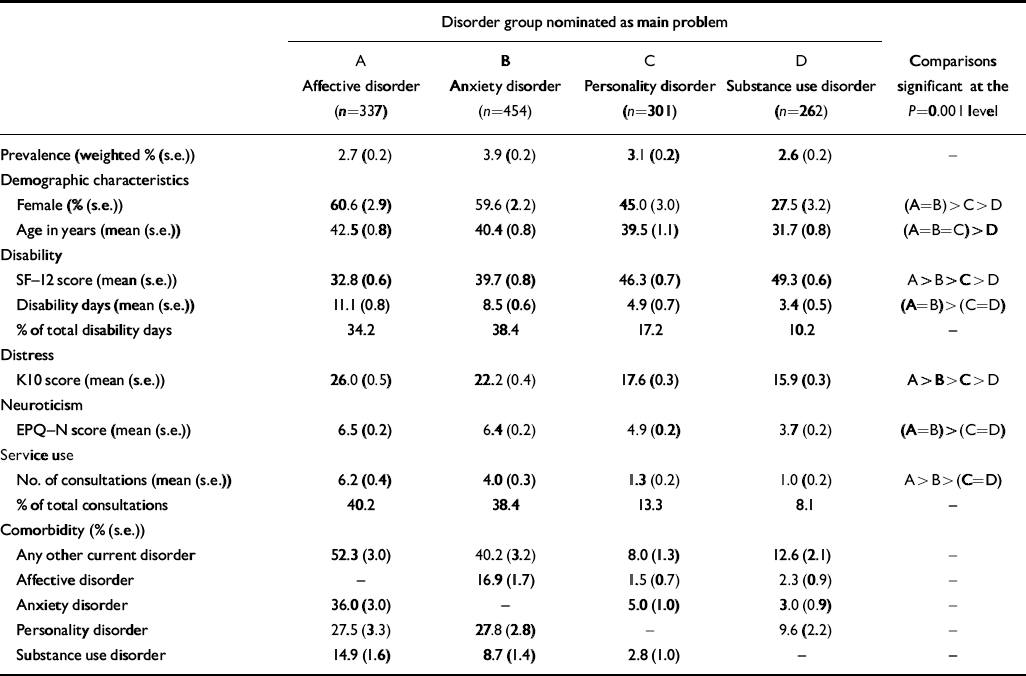
In order to consider the usefulness of this approach it needs to be applied to the whole sample, not just to those who met criteria for disorder group pairs. In Table 4 we present data from everyone in the study who met the criteria for any of these 12 mental disorders. For the 60% who met criteria for only one disorder, that disorder would be their only, and therefore main, problem, whereas the 40% who met criteria for more than one disorder nominated one of their comorbid disorders as their main problem. Twenty people with comorbid neurasthenia or psychosis nominated one of those disorders as their main problem and were lost to the calculation. Table 4 also presents the significance of specific comparisons across the groups. In general, people whose only or main problem was an affective or anxiety disorder were more likely to be older, female, disabled, distressed, have a higher neuroticism score, or use more services than people whose only or main problem was a personality or substance use disorder (P<0.001 for all comparisons). In short, people with an affective or anxiety disorder as their main problem accounted for 73% of the total disability days and 79% of the consultations recorded by people who identified a disorder in one of these four groups of disorders as their main problem. Affective and anxiety disorders, separately and together, are significant sources of disability and service utilisation.
Disability, distress, neuroticism and service utilisation by main problem (in the whole sample)
| Disorder group nominated as main problem | |||||
|---|---|---|---|---|---|
| A | B | C | D | Comparisons significant at the P=0.001 level | |
| Affective disorder (n=337) | Anxiety disorder (n=454) | Personality disorder (n=301) | Substance use disorder (n=262) | ||
| Prevalence (weighted % (s.e.)) | 2.7 (0.2) | 3.9 (0.2) | 3.1 (0.2) | 2.6 (0.2) | - |
| Demographic characteristics | |||||
| Female (% (s.e.)) | 60.6 (2.9) | 59.6 (2.2) | 45.0 (3.0) | 27.5 (3.2) | (A=B)>C>D |
| Age in years (mean (s.e.)) | 42.5 (0.8) | 40.4 (0.8) | 39.5 (1.1) | 31.7 (0.8) | (A=B=C)>D |
| Disability | |||||
| SF—12 score (mean (s.e.)) | 32.8 (0.6) | 39.7 (0.8) | 46.3 (0.7) | 49.3 (0.6) | A>B>C>D |
| Disability days (mean (s.e.)) | 11.1 (0.8) | 8.5 (0.6) | 4.9 (0.7) | 3.4 (0.5) | (A=B)>(C=D) |
| % of total disability days | 34.2 | 38.4 | 17.2 | 10.2 | - |
| Distress | |||||
| K10 score (mean (s.e.)) | 26.0 (0.5) | 22.2 (0.4) | 17.6 (0.3) | 15.9 (0.3) | A>B>C>D |
| Neuroticism | |||||
| EPQ—N score (mean (s.e.)) | 6.5 (0.2) | 6.4 (0.2) | 4.9 (0.2) | 3.7 (0.2) | (A=B)>(C=D) |
| Service use | |||||
| No. of consultations (mean (s.e.)) | 6.2 (0.4) | 4.0 (0.3) | 1.3 (0.2) | 1.0 (0.2) | A>B>(C=D) |
| % of total consultations | 40.2 | 38.4 | 13.3 | 8.1 | - |
| Comorbidity (% (s.e.)) | |||||
| Any other current disorder | 52.3 (3.0) | 40.2 (3.2) | 8.0 (1.3) | 12.6 (2.1) | - |
| Affective disorder | - | 16.9 (1.7) | 1.5 (0.7) | 2.3 (0.9) | - |
| Anxiety disorder | 36.0 (3.0) | - | 5.0 (1.0) | 3.0 (0.9) | - |
| Personality disorder | 27.5 (3.3) | 27.8 (2.8) | - | 9.6 (2.2) | - |
| Substance use disorder | 14.9 (1.6) | 8.7 (1.4) | 2.8 (1.0) | - | - |
In the lower part of Table 4 we list, by main-problem disorder group, the proportion who had other comorbid disorders. In the affective disorder group 52.3% had concurrent disorders, of which 36.0% were anxiety disorders, 27.5% personality disorders and 14.9% substance use disorders. In contrast, only 12.6% of people with substance use disorders as their principal disorder met criteria for a comorbid disorder and, with the exception of personality disorder (9.6%), comorbidity with affective and anxiety disorders was rare.
DISCUSSION
Is comorbidity an artefact?
Much has been published about comorbidity in the mental disorders (see Reference SturtSturt, 1981; Reference Boyd, Burke and GruenbergBoyd et al, 1984; Reference AndrewsAndrews, 1996; Reference Kessler, Nelson and McGonagleKessler et al, 1996; Reference WittchenWittchen, 1996). Using data from community surveys, all these researchers have noted that concurrent comorbidity is more frequent than could be expected from the prevalence of the individual disorders, and that such comorbidity is associated with increased morbidity and service utilisation. It is sometimes unclear whether the extra morbidity is due simply to the number of comorbid disorders, or to the impact of particular disorders when comorbid. Discussion of comorbidity has centred around three topics: whether some or all of the phenomenon is an artefact of the instruments; whether the relation between comorbidity and disability and service utilisation is a function of the number of comorbid disorders or is associated with particular disorders, or both; and whether there is some method whereby the epidemiological data can be used to prioritise comorbid disorders.
In the present study concurrent comorbidity was common and 40% of the sample with any current disorder met criteria for more than one current disorder. Kessler (Reference Kessler, Tsuang, Tohen and Zahner1995) and Angst (Reference Angst1996) noted that people who were comorbid at some time had increased rates of service utilisation. We are unaware of data on increases in disability measures, distress and neuroticism associated with current comorbidity. The data analysed here were restricted to disorders currently present, but even so, there was a strong linear relation between number of disorders and disability, distress, neuroticism and service use. Twenty-one per cent of the people who met criteria for any mental disorder met criteria for three or more current disorders, and they accounted for 33% of the disability days and for 37% of the service use. Comorbidity has serious consequences and, because of the linear nature of the relationships, is unlikely to be an artefact of the method of inquiry, a view proposed by Sturt (Reference Sturt1981).
Does the pattern of comorbidity inform nosology?
Is the pattern of comorbidity random or meaningful? Bivariate ORs for current comorbidity were significantly higher than those for the 12-month comorbidity. Data from Kessler (Reference Kessler, Tsuang, Tohen and Zahner1995) showed a similar phenomenon. In the NCS, 90% of the 6-month ORs were larger than the corresponding lifetime ORs (P < 0.001). The NCS data and the 12-month and 1-month data from our survey show similar patterns. This replicated finding raises the possibility that the occurrence of one disorder can be affected by the presence of another disorder. Kessler (Reference Kessler, Tsuang, Tohen and Zahner1995) reported a drop in average odds ratios from within a diagnostic group to between diagnostic groups. This effect was also obvious in the present data. It is difficult to think what might explain these changes, except for the idea that the presence of one disorder might generate symptoms in an individual that could meet criteria for another disorder, or be sufficient to convert a sub-threshold secondary disorder into one that met diagnostic criteria, especially when both were within the same diagnostic group.
Bivariate ORs illustrate the general phenomenon, whereas multivariate ORs, in which the general tendency is controlled, throw the specific associations into relief. Odds ratios were highest within disorders of the same group, as expected, but significant ORs occurred between disorder groups, and were especially pronounced between the affective and anxiety disorders. Cross-category influences are important, and many have argued that depressive disorders follow anxiety disorders. Kessler et al (Reference Kessler, Stang and Wittchen1999), for example, calculated that 10-15% of depression could be attributed to earlier social phobia. Kessler (Reference Kessler, Tsuang, Tohen and Zahner1995) had shown a stronger association between the anxiety and affective disorders than between substance use disorder and either anxiety or affective disorders. A similar picture was evident in the present regression analyses: comorbid anxiety and affective disorders were better predictors of disability and service utilisation than any other pair. Comorbidity with substance use disorders is often regarded as giving rise to great morbidity. Neither in the NCS, nor in the present survey, was this so.
Looking at the pattern of multivariate ORs, the within-group elevated ORs are to be expected because disorders in the same group share similar symptom sets, a finding that supports the dimensionality of most diagnoses. For example, depression and dysthymia, social phobia and panic/agorapobia, alcohol and drug dependence all have symptoms in common and show elevated ORs. We have elsewhere argued that the three panic/agoraphobia disorders should be reclassified as one syndrome (Reference Andrews and SladeAndrews & Slade, 2002), and did so for this analysis because having three mutually exclusive categories would preclude the calculation of ORs.
When disorders in the same group do not show elevated ORs one can ask whether the disorder is misclassified as a member of that group. For example, obsessive—compulsive disorder does not show elevated odds ratios with the other anxiety disorders, the ICD-10 classifies it separately (World Health Organization, 1992), and there is continuing discussion as to whether it is best categorised as part of a separate group of disorders sometimes called the obsessive—compulsive spectrum disorders (Reference Hollander and WongHollander & Wong, 1995). Conversely, elevated between-group ORs might inform about more appropriate classification or about common causes of two disorders. Although there is, as every clinician knows, a significant bivariate association between all affective and anxiety disorders, only GAD and PTSD maintain this association multivariately. Generalised anxiety disorder is highly comorbid with both depression and dysthymia, and there are genetic and phenomenological data that suggest it may be more akin to the affective group than to the anxiety group of disorders (Reference KendlerKendler, 1996; Reference Vollebergh, Iedema and BijlVollebergh et al, 2001). Depression and PTSD are also highly comorbid, which may not be surprising given that adversity can cause both.
Is the principal complaint method informative?
Although the combination of affective disorders with anxiety disorders is found to be the best predictor of disability and service utilisation, there is no method for deciding the relative contribution of each. Identifying each person's main problem or principal complaint is a possible advance. We looked at data for all people reporting two or more of the four groups of disorders, and found that few people nominated substance use or personality disorders as their main problem. Inspecting data from the whole data-set we discovered that when identified as the principal complaint, the anxiety and affective disorder groups contribute equally, and together account for four-fifths of disability days and mental health consultations attributed to people with these four groups of disorders. In a population sample neither principal complaints of substance use disorder nor of personality disorder are of great importance as determinants of disability or service use.
Two disorders were excluded from the current analysis. Criteria for current neurasthenia were met by a weighted 1.1% of the population (i.e. 140 survey respondents); 33 had no comorbid condition and only 22 of the remaining 107 persons nominated neurasthenia as their main problem. The addition of neurasthenia to the present results would have complicated but not changed the meaning of the tables. Psychosis is different. The survey used a psychosis screener and identified 0.4% of the entire population as possibly suffering from psychosis. The related low-prevalence disorder survey (Reference Jablensky, McGrath and HerrmanJablensky et al, 2000) using precise diagnostic instruments also calculated the prevalence of psychosis to be 0.4%. We have concluded (Reference Andrews, Issakidis, Slade, Teesson and BurnsAndrews et al, 2001c ) that psychosis accounts for only 8% of the disability attributed to mental disorders given the following conservative assumptions; that the 0.4% of the population identified by the screener were all cases, that all identified psychosis as their principal complaint, and that their average level of disability was severe (3 standard deviations below the population mean on the SF-12). Even with those assumptions, the anxiety and affective disorders still accounted for more than 70% of the disability attributed to mental disorders. The inclusion of psychosis would not have materially altered the present data.
What are the implications?
This paper has described the epidemiology of current comorbidity — information that has clinical value. The majority of people who seek help for a mental disorder have more than one disorder and will be more disabled, distressed and have higher neuroticism scores than people who do not consult. Patients can nominate the disorder that troubles them the most, and wise clinicians would formulate an initial treatment plan to take this principal complaint into account. Not to do so would invite non-compliance. Substance use disorders and personality disorders were seldom nominated as principal complaints, but this does not mean that they were unimportant, only that they were not the principal reason the patient came for treatment. If compliance is dependent on responding to the principal complaint, therapeutic success might be dependent on treatment of the associated substance use or personality disorder. Identification of a principal complaint does not mean devaluing the importance of the comorbid disorders, only of prioritising the elements of the treatment plan. For example, depression with a comorbid anxiety disorder has a poor prognosis (Reference McLeod, Kessler and LandisMcLeod et al, 1992), and its treatment — although initially focused on the depression — would have to take account of the anxiety if relapse was to be inhibited. Thus, on both epidemiological and clinical grounds comorbidity is valuable information that needs to be understood.
CLINICAL IMPLICATIONS
-
▪ Most patients seen in clinical psychiatric practice will meet criteria for more than one mental disorder, and this comorbidity is associated with disability, distress and a high neuroticism score.
-
▪ Comorbidity between affective and anxiety disorders accounts for the majority of disability days and consultations due to mental disorders.
-
▪ People can nominate their principal complaint, which should be the focus of initial treatment.
LIMITATIONS
-
▪ The populations sampled in household surveys may not inform the situation in clinical populations.
-
▪ These data depend on self-report of symptoms to a lay interviewer, and the validity of a nominated main problem has not been established.
-
▪ Multivariate odds ratios were used to impute causality and to question class membership of some diagnoses. Cross-sectional data mean that these ideas are speculative.
Acknowledgements
This study was supported by a contract from the Australian Department of Health and Aged Services to the WHO Collaborating Centre for Mental Health, Sydney, to support a survey data analysis consortium (G. Andrews, V. Carr, G. Carter, R. Crino, W. Hall, A. Henderson, I. Hickie, C. Hunt, L. Lampe, J. McGrath, A. McFarlane, P. Mitchell, L. Peters, M. Teesson and K. Wilhelm). The survey was conducted by the Australian Bureau of Statistics, who do not necessarily endorse the view expressed in this paper.




eLetters
No eLetters have been published for this article.