1. Introduction
Carbon dioxide (CO2) and methane (CH4) are the two dominant gaseous forms of carbon in the atmosphere. The atmospheric CO2 concentration depends on a multitude of processes involving the exchange of carbon between atmosphere, lithosphere, oceans and biosphere, collectively defined as the global carbon cycle (Carlson et al. Reference Carlson, Bates, Hansell, Steinberg, Steele, Thorpe and Turekian2001). The excessive use of fossil fuels (coal, petroleum) since industrialization has increased the atmospheric CO2 concentration to levels unprecedented in the last ∼800 000 years (Lüthi et al. Reference Lüthi, Floch, Bereiter, Blunier, Barnola, Siegenthaler, Raynaud, Jouzel, Fischer, Kawamura and Stocker2008). The atmospheric CO2 combines with rainwater to form weak carbonic acid that dissolves rocks on the earth’s surface. The dissolution of rocks, termed as silicate weathering, releases calcium and bicarbonate ions from the rocks into the rivers and subsequently into the oceans (Misra & Froelich, Reference Misra and Froelich2012). The silicate weathering is one of the significant components of the global carbon cycle, on longer timescales (Brady, Reference Brady1991; Raymo & Ruddiman, Reference Raymo and Ruddiman1992; Wan et al. Reference Wan, Clift, Li, Yu, Li and Hu2012).
In the oceans, calcareous organisms combine calcium ions with bicarbonate ions to form calcium carbonate (CaCO3) (Zeebe & Wolf-Gladrow, Reference Zeebe and Wolf-Gladrow2001). In modern oceans, most of the CaCO3 is precipitated as the shells of microorganism, like foraminifera, coccolithophores and corals (Ramaswamy & Nair, Reference Ramaswamy and Nair1994; Schiebel, Reference Schiebel2002). Foraminifera, single-celled organisms with hard outer shells called test, contribute a significant fraction of the marine carbonate flux (Langer, Reference Langer2008). After the death of the organisms, the shells sink to the ocean floor. Foraminiferal tests are usually constructed either by secreting CaCO3 or by cementing sand, silt and other particles, known as agglutinated tests (Kaminski & Kuhnt, Reference Kaminski, Kuhnt, Kaminski, Geroch and Gasinski1995; Saraswat, Reference Saraswat2015; Saalim et al. Reference Saalim, Saraswat, Suokhrie and Nigam2019). Foraminiferal shells are one of the most abundant and significant fossil remains in marine sediments. In addition to the biogenic carbonate, organic matter also removes a substantial fraction of carbon from the ocean water and buries it in the sediments, as carbon is the main component of all life forms (Ciais et al. Reference Ciais, Sabine, Bala, Bopp, Brovkin, Canadell, Chhabra, DeFries, Galloway, Heimann, Jones, Le Quéré, Myneni, Piao, Thornton, Stocker, Qin, Plattner, Tignor, Allen, Boschung, Nauels, Xia, Bex and Midgley2013). The photosynthesizing plants, collectively termed as marine productivity or marine primary productivity, constitute a substantial part of the oceanic organic matter (Field et al. Reference Field, Behrenfeld, Randerson and Falkowski1998). Thus, the long-term carbon burial in the oceans includes both the organic carbon (Corg) and CaCO3 in the sediments. Therefore, oceans are vital in modulating the global carbon cycle by regulating the amount of carbon buried in the sediments (Falkowski et al. Reference Falkowski, Scholes, Boyle, Canadell, Canfield, Elser, Gruber, Hibbard, Högberg, Linder, Mackenzie, Moore, Pedersen, Rosenthal, Seitzinger, Smetacek and Steffen2000).
The anthropogenic greenhouse-gas-emission-induced warming is likely to affect the marine organisms and thus their contribution to carbon cycling. However, the likely response of the marine carbon cycling to the anthropogenic greenhouse-gas-emission-induced warming is not clear. Because of the unprecedented increase in atmospheric CO2 concentration during the last ∼150 years, it is crucial to understand its effect on marine carbon cycling. The carbon burial records from the oceans, covering the times of different atmospheric CO2 concentrations in the past, can help understand the effects of anthropogenic contribution in global carbon cycling (Falkowski et al. Reference Falkowski, Scholes, Boyle, Canadell, Canfield, Elser, Gruber, Hibbard, Högberg, Linder, Mackenzie, Moore, Pedersen, Rosenthal, Seitzinger, Smetacek and Steffen2000). The large influence of anthropogenic activities on global CO2 supposedly began after the industrial revolution (IPCC, Reference Masson-Delmotte, Zhai, Pirani, Connors, Péan, Berger, Caud, Chen, Goldfarb, Gomis, Huang, Leitzell, Lonnoy, Matthews, Maycock, Waterfield, Yelekçi, Yu and Zhou2021). Therefore, long-term multi-decadal records of carbon burial, spanning the interval before significant anthropogenic activities, are required to understand the effect of human-induced perturbations on the carbon cycle.
The tropical Indian Ocean has a considerable carbon burial potential as its several regions have high primary productivity during the summer and winter monsoon (Prell & Curry, Reference Prell and Curry1981; Prasanna Kumar et al. Reference Prasanna Kumar, Madhupratap, Dileepkumar, Muraleedharan, DeSouza, Gauns and Sarma2001; Sreeush et al. Reference Sreeush, Valsala, Pentakota, Prasad and Murtugudde2018). The northern Indian Ocean has the highest flux of inorganic (CaCO3) and particulate organic carbon (Sarma et al. Reference Sarma, Dileep Kumar and Saino2007). Many workers have documented the temporal changes in both the organic matter and CaCO3 burial in the northern Indian Ocean and the processes affecting these changes (von Rad et al. Reference von Rad, Schulz, Riech, den Dulk, Berner and Sirocko1999; Staubwasser & Sirocko, Reference Staubwasser and Sirocko2001; Reichart et al. Reference Reichart, Schenau, de Lange and Zachariasse2002; Agnihotri et al. Reference Agnihotri, Bhattacharya, Sarin and Somayajulu2003 a, b; Naik et al. Reference Naik, Godad, Naidu, Tiwari and Paropkari2014; Azharuddin et al. Reference Azharuddin, Govil, Singh, Mishra, Agrawal, Tiwari and Kumar2017; Naik et al. Reference Naik, Saraswat, Lea, Kurtarkar and Mackensen2017). The monsoon-induced productivity, terrigenous influx by the rivers, grain size and bottom water conditions strongly influence the Corg and CaCO3 content in the modern surface sediments of the Arabian Sea (Kolla et al. Reference Kolla, Ray and Kostecki1981; Galy et al. Reference Galy, France-Lanord, Beyssac, Faure, Kudrass and Palhol2007). The large spatial heterogeneity observed in the distribution of Corg and CaCO3 in the surface sediments of the Arabian Sea (Kolla et al. Reference Kolla, Ray and Kostecki1981; Paropkari et al. Reference Paropkari, Babu and Mascarenhas1992) is also prevalent during the geologic past. The continuous increase in CaCO3, biogenic opal, biogenic Ba and their mass accumulation rates throughout the Holocene in the SE Arabian Sea were attributed to higher productivity due to increased upwelling during the summer monsoon (Naidu, Reference Naidu1991; Thamban et al. Reference Thamban, Rao and Raju1997; Naidu & Shankar, Reference Naidu and Shankar1999; Bhushan et al. Reference Bhushan, Dutta and Somayajulu2001; Pattan et al. Reference Pattan, Masuzawa, Naidu, Parthiban and Yamamoto2003). However, the decrease in CaCO3 abundance in the NE Arabian Sea during the Holocene was attributed to terrigenous dilution (Naidu, Reference Naidu1991; Azharuddin et al. Reference Azharuddin, Govil, Singh, Mishra, Agrawal, Tiwari and Kumar2017). Interestingly, the relatively high Corg but low CaCO3 in the SW margin of India during the late Holocene was attributed to increased productivity and diagenesis (Kessarkar & Rao, Reference Kessarkar and Rao2007). Although, the CaCO3 content in the NE and mid-eastern Arabian Sea was more during the interglacial period, no specific variation was observed in the organic matter content during glacial and interglacial times (Guptha et al. Reference Guptha, Naidu, Haake and Schiebel2005). A rapid decrease in productivity coeval with very low dissolved oxygen in the bottom waters during the Last Glacial Maximum was reported from the SE Arabian Sea (Naik et al. Reference Naik, Saraswat, Lea, Kurtarkar and Mackensen2017). A strengthened winter monsoon during the Little Ice Age was inferred from the NE Arabian Sea (Böll et al. Reference Böll, Lückge, Munz, Forke, Schulz, Ramaswamy, Rixen, Gaye and Emeis2014). A consistent increase in Corg throughout the Meghalayan Age was attributed to increased sedimentation and better preservation under a more reducing environment (Nagoji & Tiwari, Reference Nagoji and Tiwari2017). Interestingly, an altogether different pattern with higher Corg accumulation during the cold glacials and stadials as compared to low accumulation during the warmer interglacials and interstadials in the neighbouring Bay of Bengal was attributed to intense winter-monsoon-induced increased marine primary production during the colder intervals (Weber et al. Reference Weber, Lantzsch, Dekens, Das, Reilly, Martos, Meyer-Jacob, Agrahari, Ekblad, Titschack, Holmes and Wolfgramm2018; Xu et al. Reference Xu, Wan, Colin, Clift, Chang, Li, Chen, Cai, Yu and Lim2021).
Therefore, a vast spatial variation is observed in both the organic matter and CaCO3 burial in the Arabian Sea during the past, necessitating more regional records. The majority of previous studies focused on carbon burial changes during the glacial–interglacial interval. High-resolution carbon burial studies focused on the Holocene are limited. Additionally, the sample resolution in the majority of previous studies was too coarse to understand short-term carbon burial changes in the northern Indian Ocean. Therefore, the objective of this work was to reconstruct the multi-decadal carbon burial changes from the Gulf of Mannar during the last ∼5000 years covering the Meghalayan Age (4.2 ka to recent), and to understand the factors affecting carbon burial in this region.
2. Study area
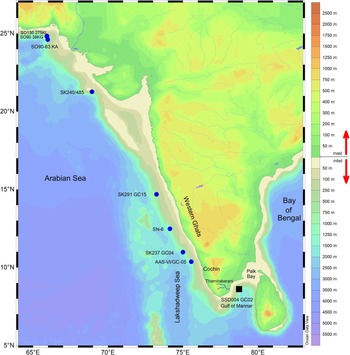
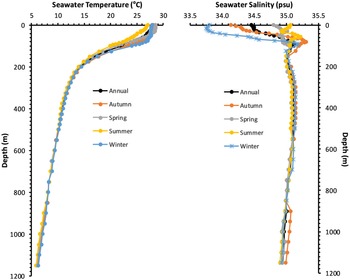
The gravity core (SSD004 GC02) collected from the upper slope of the Gulf of Mannar, off the southern tip of India (8° 37.9443′ N, 78° 44.1874′ E), during the fourth cruise of RV Sindhu Sadhana (October 2014) was used (Fig. 1). The core was retrieved from a depth of 1002 m. The study area is between the west coast of Sri Lanka and the southeast coast of India. The oceanographic processes mainly control the salinity, as except for the only perennial river of Tamil Nadu, namely the Thamirabarani River, no significant rivers drain directly into the Gulf of Mannar. A sizable seasonal change is observed in both the seawater temperature (varying from a lowest of 26.6°C during the summer monsoon season to a highest of 28.5°C during the pre-summer-monsoon season, in the top 25 m of the water column) (Locarnini et al. Reference Locarnini, Mishonov, Baranova, Boyer, Zweng, Garcia, Reagan, Seidov, Weathers, Paver and Smolyar2018) and salinity (varying from a lowest of 33.8 psu during the post-summer-monsoon season to the highest of 35.0 psu during the summer season, in the top 25 m of the water column) (Zweng et al. Reference Zweng, Reagan, Seidov, Boyer, Locarnini, Garcia, Mishonov, Baranova, Weathers, Paver and Smolyar2018). The changes are, however, restricted to the top ∼200 m of the water column, and the deeper waters are relatively stable (Locarnini et al. Reference Locarnini, Mishonov, Baranova, Boyer, Zweng, Garcia, Reagan, Seidov, Weathers, Paver and Smolyar2018; Zweng et al. Reference Zweng, Reagan, Seidov, Boyer, Locarnini, Garcia, Mishonov, Baranova, Weathers, Paver and Smolyar2018; Fig. 2). The hydrography of the area is controlled mainly by the monsoon system. The mean annual rainfall varies from 760 mm to 1270 mm (Sulochanan & Muniyandi, Reference Sulochanan and Muniyandi2005). The study area receives copious rainfall during both the summer and winter monsoon. The summer monsoon occurs from June to September and the winter monsoon occurs from October to November. The summer monsoon brings more rainfall as compared to the winter monsoon (Gadgil & Kumar, Reference Gadgil and Kumar2006). The seasonal reversal of winds results in considerable variation in the intensity of upwelling as well as the primary productivity (Haake et al. Reference Haake, Ittekkot, Rixen, Ramaswamy, Nair and Curry1993). The upwelling increases productivity in the area during May–June (Thomas et al. Reference Thomas, Padmakumar, Smitha, Devi, Nandan and Sanjeevan2013). The Ekman Pumping induces large phytoplankton bloom increasing the chlorophyll-a content (up to 2 mg m−3) in the SW Bay of Bengal during the winter monsoon season (Vinayachandran & Mathew, Reference Vinayachandran and Mathew2003). The high-productivity water advects into the Gulf of Mannar from the Palk Bay during the winter season, increasing the productivity (Jyothibabu et al. Reference Jyothibabu, Balachandran, Jagadeesan, Karnan, Gupta, Chakraborty and Sahu2021). The large influx from the rivers draining into the Gulf of Mannar also increases the nutrient availability and, in turn, productivity during the winter season (Chandramohan et al. Reference Chandramohan, Jena and Sanilkumar2001). The zooplankton biomass and chlorophyll-a concentration during the winter season is comparable with that during the summer season in the Gulf of Mannar (Jagadeesan et al. Reference Jagadeesan, Jyothibabu, Anjusha, Mohan, Madhu, Muraleedharan and Sudheesh2013). The seasonally reversing winds generate coastal currents that transport warm saltier water from the Arabian Sea into the Bay of Bengal during the summer, and cold fresher water from the Bay of Bengal into the Arabian Sea during the winter (Schott & McCreary, Reference Schott and McCreary2001).
The core location and other cores from the eastern Arabian Sea (SO90-39 KG/SO130-275 KL, Böll et al. Reference Böll, Lückge, Munz, Forke, Schulz, Ramaswamy, Rixen, Gaye and Emeis2014; SO90-63 KA, Burdanowitz et al. Reference Burdanowitz, Gaye, Hilbig, Lahajnar, Lückge, Rixen and Emeis2019; SK240/485, Azharuddin et al. Reference Azharuddin, Govil, Singh, Mishra, Agrawal, Tiwari and Kumar2017; SK291 GC15, Saravanan et al. Reference Saravanan, Gupta, Zheng, Panigrahi and Prakasam2019; SN-6, Nagoji & Tiwari, Reference Nagoji and Tiwari2017; AAS-VI/GC-05, Pattan et al. Reference Pattan, Parthiban and Amonkar2019; SK237 GC04, Naik et al. Reference Naik, Saraswat, Lea, Kurtarkar and Mackensen2017) discussed in the paper. The filled black square is the location of core SSD004 GC02 in the Gulf of Mannar. The coloured contours are bathymetry/topography and the scale is on the right. The major bathymetric and topographic features and Thamirabarani River are also marked. The faint blue lines mark the major rivers draining in the northern Indian Ocean.

Annual and seasonal water column temperature (Locarnini et al. Reference Locarnini, Mishonov, Baranova, Boyer, Zweng, Garcia, Reagan, Seidov, Weathers, Paver and Smolyar2018) and salinity (Zweng et al. Reference Zweng, Reagan, Seidov, Boyer, Locarnini, Garcia, Mishonov, Baranova, Weathers, Paver and Smolyar2018) at the core location.

The region has an extensive relict carbonate platform, with the age of the overlying sediments varying from 7.3 to 8.4 ka (Rao et al. Reference Rao, Rajagopalan, Vora and Almeida2003). The sediments are sandy on the continental shelf, gradually dominated by the silt and clay on the slope and further deeper regions (Hashimi et al. Reference Hashimi, Kidwai and Nair1981; Reference Hashimi, Nair, Kidwai and Purnachandra Rao1982; Singh et al. Reference Singh, Saraswat and Kaithwar2018). The inner shelf sediments are dominated by CaCO3 of biogenic origin (foraminifera, molluscs, pteropods) (Hashimi et al. Reference Hashimi, Nair, Kidwai and Purnachandra Rao1982). The Corg in surface sediments varies from 1.5 % to 6.9 % (Singh et al. Reference Singh, Saraswat and Kaithwar2018). The dissolved oxygen varies from 0.48 mL L−1 to 3.84 mL L−1, with the oxygen-deficient zone (<2 mL L−1) between 152 and 1550 m (Singh et al. Reference Singh, Saraswat and Kaithwar2018). Based on the previous studies, sedimentation rate is comparatively high on the slope (Ray et al. Reference Ray, Rajagopalan and Somayajulu1990; Singh et al. Reference Singh, Saraswat and Naik2017). Consequently, the core location was selected to ensure a high sedimentation rate record.
3. Materials and methodology
The core (SSD004 GC02) was 5.95 m long and the top 1.50 m section of the core was used for the study. The core was subsampled at 1 cm intervals and thus a total of 150 samples were used. The samples were processed in several stages.
3.1. Sample processing for foraminiferal studies
A small aliquot (5–10 g) of sediment was collected in a pre-weighed glass Petri dish and freeze-dried. The dried sediments were weighed and sieved using a 63 µm sieve. The material retained on the sieve (>63 µm, coarse fraction, CF) was dried, weighed and stored in clean plastic vials. For picking planktic foraminifera, one-quarter of the coarse fraction was weighed and dry-sieved using a 125 µm sieve. Both the >125 µm and <125 µm fractions were then weighed and stored in separate vials. A representative aliquot of >125 µm fraction was weighed and uniformly spread in a picking tray. A minimum of 300 completely intact planktic foraminifera tests were picked from this fraction using an Olympus SZX16 stereozoom microscope. Planktic foraminiferal abundance was normalized to 1 g dry sediment weight. The number of specimens of Globigerina bulloides was counted and its relative abundance was calculated.
3.2. Total carbon, nitrogen and inorganic carbon analysis
About 1–2 g of the freeze-dried sediment was finely powdered for the total and inorganic carbon and total nitrogen analysis. The total inorganic carbon (TIC) was analysed using a coulometer (model CM 5015 CO2, UIC Inc. USA). The pure limestone (CaCO3) was used as standard, with carbon percentage of 12 %. The total carbon and total nitrogen content was analysed using the Flash 2000 series CN Elemental Analyzer. For total carbon and nitrogen analysis, NC Soil Standard was used. The nitrogen content in the standard was 0.21 ± 0.01 % and the carbon was 2.29 ± 0.07 %. The Corg was estimated by subtracting inorganic carbon from the total carbon. The CaCO3 was estimated by multiplying the inorganic carbon by 8.33 (Johnson et al. Reference Johnson, Phillips, Torres, Piñero, Rose and Giosan2014).
3.3. Radiocarbon dating
The radiocarbon dating provides the age of carbon-comprising material derived from the living organisms. The chronology of the top 1.5 m section of the core was established by five accelerator mass spectrometer (AMS) radiocarbon dates (Table 1). The surface-dwelling planktic foraminifera, namely Globigerinoids ruber and Trilobatus sacculifer, were picked for radiocarbon dating. The radiocarbon dates were obtained from the Inter University Accelerator Center, Delhi, India, and the Center for Applied Isotope Studies (CAIS) at the University of Georgia. The radiocarbon ages were calibrated using the CALIB 8.2 radiocarbon calibration program (Stuiver & Reimer, Reference Stuiver and Reimer1993; Reimer et al. Reference Reimer, Bard, Bayliss, Beck, Blackwell, Bronk-Ramsey, Buck, Cheng, Edwards, Friedrich, Grootes, Guilderson, Haflidason, Hajdas, Hatté, Heaton, Hogg, Hughen, Kaiser, Kromer, Manning, Niu, Reimer, Richards, Scott, Southon, Turney and van der Plicht2013). A reservoir correction of 77 ± 58 yr from the nearby locations (Dutta et al. Reference Dutta, Bhushan and Somayajulu2001; Southon et al. Reference Southon, Kashgarian, Fontugne, Metivier and Yim2002) was used to calibrate the dates.
AMS radiocarbon age details

4. Results
4.1. Chronology
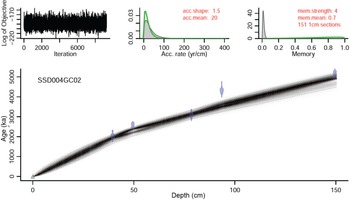
The chronology of the core was established by using the Bacon age model (Blaauw & Christen, Reference Blaauw and Christen2011), utilizing the five AMS radiocarbon dates (Table 1; Fig. 3). Based on the sedimentation rate between the top two dated intervals (39.5 cm and 49.5 cm), the core top was assigned a modern age. The age of the bottommost section (149–150 cm) of the studied core was radiocarbon-dated to be 4600 ± 25 yr. The modelled age for the bottommost section is 4926 (−445 / +262) yr BP. The age uncertainty varies from a minimum of −46 / +100 yr towards the core top to −445 / +282 yr in the older section. Thus, the core covers the entire Meghalayan Age. The sedimentation rate varied from 13.0 cm kyr−1 to 67.6 cm kyr−1, with a mean sedimentation rate of 34.5 cm kyr−1 (Fig. 3). The sample resolution varied from 15 years to 77 years, with an average resolution of 41 years.
The chronology of core SSD004 GC02 asestablished by Bacon age model, utilizing the AMS radiocarbon ages. The core top age was interpolated to be modern, based on the sedimentation rate between the subsequent radiocarbon-dated intervals. The radiocarbon ages are plotted as grey filled points, and the age uncertainty is marked by the dotted line envelope.

4.2. Coarse fraction (>63 µm)
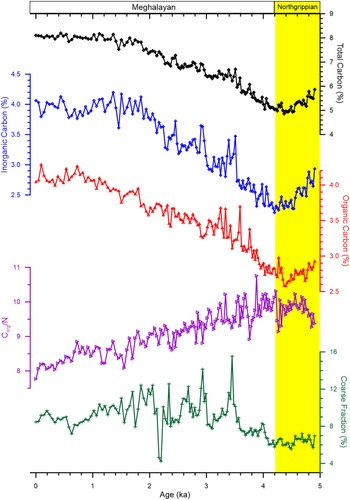
The coarse fraction comprises of sand-sized sediments. As the sediments were not pre-treated, the sediments also contained biogenic carbonates. A gradual increase in coarse fraction abundance is observed from the bottom of the section to a depth of 90 cm (3.45 ka). The coarse fraction was most abundant (15.5 %) at 90 cm (3.45 ka). Subsequently, it decreased abruptly, only to increase again at 72 cm (2.93 ka). A very prominent abrupt decrease in coarse fraction (4.2 %) was observed at 47 cm (2.20 ka). The coarse fraction abundance increased again at 43 cm (2.05 ka). The coarse fraction decreased gradually from 43 cm onwards, except for a minor increase in the core top sections (Fig. 4).
Down-core variation in total carbon, inorganic carbon, organic carbon, Corg/N and coarse fraction (>63 µm) in core SSD004 GC02. The yellow shaded bar is the Northgrippian Age.

4.3. Calcium carbonate (CaCO3)
A 6 % decrease in CaCO3 is observed from the bottom of the studied section up to a depth of 120 cm (4.20 ka) (Fig. 4). Subsequently, CaCO3 increased rapidly up to a depth of 92 cm (3.51 ka). Later, the weight percentage of CaCO3 decreased up to a depth of 78 cm (3.10 ka). From 3.08 ka onwards, CaCO3 increased gradually up to a depth of 28 cm (1.36 ka) to reach a peak value of 35.0 %. Two prominent peaks, centred at 72 cm and 55 cm (2.91 ka and 2.45 ka, respectively), are observed within this gradual increase. The concentration of CaCO3 remained uniform in the top ∼25 cm section (1.17 kyr) of the core (Fig. 4).
4.4. Organic carbon (Corg)
The down-core variation in Corg is similar to CaCO3 (Fig. 4). A small decrease (0.3 %) in Corg is observed from the bottommost section until 4.39 ka (128 cm). The Corg gradually increased by 1.7 %, from 4.37 ka (127 cm) until 0.60 ka (15 cm). Corg remained uniform in the top 15 cm section (0.68 kyr) of the core. A few minor variations are also observed within the gradual increase in Corg.
4.5. Organic carbon/nitrogen (Corg/N)
The organic matter in marine sediments accumulates from both the land and marine sources. The terrestrial and marine organic matter has a distinct carbon to nitrogen ratio (Corg/N) (Calvert et al. Reference Calvert, Pedersen, Naidu and Von Stackelberg1995) and thus is used to understand the change in the relative contribution of these two sources. Corg/N increased from the bottommost section until 4.51 ka (135 cm). A continuous decrease in Corg/N, from 10.56 to 7.76, is observed from 4.23 ka (122 cm) onwards to the core top (Fig. 4). Within this gradual decreasing pattern, a few prominent lows (4.02 ka, 102 cm and 1.36 ka, 32 cm) are also observed.
4.6. Planktic foraminiferal abundance (specimen/g sediment)
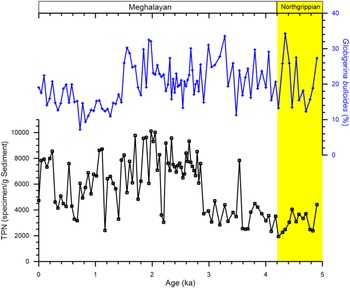
After a minor decrease from the bottommost section until 4.34 ka, the planktic foraminiferal abundance increased from 4.22 ka to 1.98 ka (∼41 cm). Subsequently, the planktic foraminiferal abundance decreased until 0.25 ka (∼7 cm). The abundance was again high in the top 7 cm section (0.29 kyr) of the core (Fig. 5). A few minor fluctuations in planktic foraminiferal abundance are also observed within the general trend stated above. The abundance varied from a minimum of 1945 specimen/g sediment at 4.22 ka (124.5 cm) to a maximum of 10 110 specimen/g sediment at 1.98 ka (41 cm).
The absolute abundance of planktic foraminifera normalized to 1 g dry sediment and the relative abundance of upwelling indicator species Globigerina bulloides in core SSD004 GC02. The yellow shaded bar is the Northgrippian Age.

4.7. Relative abundance of Globigerina bulloides (%)
Globigerina bulloides is a widely accepted upwelling indicator planktic foraminifer. The relative abundance of G. bulloides was low in the bottommost section of the core (average 18.0 % between 4.6 ka and 4.9 ka). The relative abundance increased and remained high (average 22.6 %) until 1.5 ka (32 cm). A prominent decrease in G. bulloides relative abundance was observed in the top 25 cm section (1.17 kyr) of the core (Fig. 5).
5. Discussion
The total carbon, CaCO3 as well as Corg, was very low towards the end of the Northgrippian Age covered in the studied core section (4.2–4.9 ka) and the beginning of the Meghalayan Age. Following these low sedimentary carbon values at the Northgrippian–Meghalayan transition, both the organic and inorganic carbon increased throughout the Meghalayan Age. The beginning of the increase in Corg (4.4 ka) preceded that in CaCO3 (4.2 ka) and resulted in higher total carbon burial in the Gulf of Mannar during the Meghalayan Age (Figs 6, 7). The low CaCO3 as well as Corg during the Northgrippian–Meghalayan transition is attributed to weaker monsoon-induced productivity. The weaker summer monsoon at the Northgrippian–Meghalayan boundary has also been inferred from the terrestrial records (Enzel et al. Reference Enzel, Ely, Mishra, Ramesh, Amit, Lazar, Rajaguru, Baker and Sandle1999; Dixit et al. Reference Dixit, Hodell and Petrie2014; Kotlia et al. Reference Kotlia, Singh, Joshi and Dhaila2015). The persistent increase in total carbon, CaCO3 as well as Corg, stabilized between 2.7 ka and 3.7 ka as well as in the top ∼1.2 kyr section of the core.
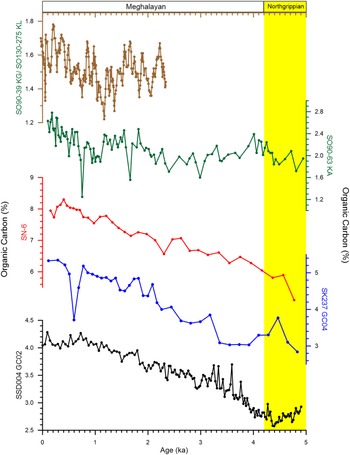
A comparison of Corg variation in the Gulf of Mannar (SSD004 GC02) during the last 5 kyr with that in different parts of the eastern Arabian Sea (SO90-39 KG/SO130-275 KL, Böll et al. Reference Böll, Lückge, Munz, Forke, Schulz, Ramaswamy, Rixen, Gaye and Emeis2014; SO90-63 KA, Burdanowitz et al. Reference Burdanowitz, Gaye, Hilbig, Lahajnar, Lückge, Rixen and Emeis2019; SK291 GC15, Saravanan et al. Reference Saravanan, Gupta, Zheng, Panigrahi and Prakasam2019; SN-6, Nagoji & Tiwari, Reference Nagoji and Tiwari2017; SK237 GC04, Naik et al. Reference Naik, Saraswat, Lea, Kurtarkar and Mackensen2017). The yellow shaded bar is the Northgrippian Age.

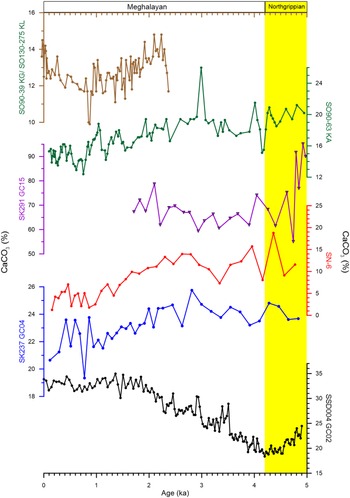
A comparison of CaCO3 wt % variation in the Gulf of Mannar (SSD004 GC02) during the last 5 kyr with that in different parts of the eastern Arabian Sea (SO90-39 KG/SO130-275 KL, Böll et al. Reference Böll, Lückge, Munz, Forke, Schulz, Ramaswamy, Rixen, Gaye and Emeis2014; SO90-63 KA, Burdanowitz et al. Reference Burdanowitz, Gaye, Hilbig, Lahajnar, Lückge, Rixen and Emeis2019; SK291 GC15, Saravanan et al. Reference Saravanan, Gupta, Zheng, Panigrahi and Prakasam2019; SN-6, Nagoji & Tiwari, Reference Nagoji and Tiwari2017; SK237 GC04, Naik et al. Reference Naik, Saraswat, Lea, Kurtarkar and Mackensen2017). The yellow shaded bar is the Northgrippian Age.

In the SE Arabian Sea, CaCO3 content in sediments is strongly coupled with monsoon (Guptha et al. Reference Guptha, Naidu, Haake and Schiebel2005; Narayana et al. Reference Narayana, Naidu, Shinu, Nagabhushanam and Sukhija2009). Thus, the increased Corg, CaCO3 and nitrogen during the Holocene has often been used to infer higher productivity due to stronger summer monsoon in the eastern Arabian Sea (Kessarkar et al. Reference Kessarkar, Rao, Naqvi, Chivas and Saino2010). A substantial fraction of the CaCO3 is biogenic, comprising calcareous shells. Amongst a huge variety of calcareous marine organisms, foraminifera and coccolithophores contribute the largest fraction of the biogenic carbonate flux in the ocean (Ramaswamy & Gaye, Reference Ramaswamy and Gaye2006; Langer, Reference Langer2008). The increase in CaCO3 is thus mainly due to an increased abundance of foraminiferal shells. The diversity and abundance of foraminifera depends on the ambient conditions, especially food availability (Schiebel et al. Reference Schiebel, Waniek, Bork and Hemleben2001). In the northern Indian Ocean, monsoon influences the Corg flux, the food for foraminifera. Both summer and winter monsoons affect the primary productivity in the northern Indian Ocean by bringing nutrients from the land by terrigenous influx as well as through upwelling and convective mixing (Madhupratap et al. Reference Madhupratap, Prasanna Kumar, Bhattathiri, Dileep Kumar, Raghu Kumar, Nair and Ramaiah1996; Sreeush et al. Reference Sreeush, Valsala, Pentakota, Prasad and Murtugudde2018). The enhanced terrigenous supply to the Arabian Sea and a subsequent increase in biological productivity during the summer monsoon has been confirmed by sediment trap studies (Nair et al. Reference Nair, Ittekkot, Manganini, Ramaswamy, Haake, Degens and Honjo1989). Many zooplanktons feeding on primary producers have a calcareous skeleton. The calcareous skeletons also sequester a substantial fraction of carbon and bury it in the ocean sediments. Thus the CaCO3 in the sediments is influenced by productivity, dissolution of CaCO3 and dilution by terrigenous material (Naidu, Reference Naidu1991; Pattan et al. Reference Pattan, Parthiban and Amonkar2019). The shift in monsoon-induced evaporation–precipitation during the Holocene was synchronous with a change in surface productivity, planktic foraminiferal abundance and coarse sediment fraction (Saraswat et al. Reference Saraswat, Naik, Nigam and Gaur2016). In modern times, the higher primary productivity during the later phase of the summer monsoon is attributed to the coastal upwelling and river runoff bringing nutrients to the surface waters (Jyothibabu et al. Reference Jyothibabu, Asha Devi, Madhu, Sabu, Jayalakshmy, Jacob, Habeebrehman, Prabhakaran, Balasubramanian and Nair2008).
The increasing CaCO3 thus suggests that the monsoon began to intensify at 4.0 ka, which would have enhanced the upwelling-induced productivity in the Gulf of Mannar (Naidu, Reference Naidu1991). The findings are in line with the records from the northern India and eastern Arabian Sea. Dixit et al. (Reference Dixit, Hodell and Petrie2014) reported that the weak monsoon phase at the Northgrippian–Meghalayan transition lasted for only 200 years and further that the monsoon recovered to the present level by 4 ka. A clear monsoon intensification trend beginning at 4 ka is also observed in core 63KA recovered from the northern Arabian Sea (Staubwasser et al. Reference Staubwasser, Sirocko, Grootes and Segl2003). A similar consistent increase in CaCO3 in the SE Arabian Sea, during the late Holocene, was also attributed to the strengthened monsoon (Sarkar et al. Reference Sarkar, Ramesh, Somayajulu, Agnihotri, Jull and Burr2000). The increasing trend in CaCO3 in the Gulf of Mannar matches with another core (AAS-VI/GC-05) collected off Cochin from the SE Arabian Sea (Pattan et al. Reference Pattan, Parthiban and Amonkar2019), suggesting a strong regional feature (Fig. 7). However, the high primary productivity during the winter season could also drive the increase in CaCO3. The increased Indus runoff during the late Holocene was attributed to strengthened winter monsoon precipitation (Staubwasser et al. Reference Staubwasser, Sirocko, Grootes and Segl2003).
The higher primary productivity may not always result in increased biogenic carbonate flux. The bottom water conditions, including the dissolved oxygen concentration and grain size of the sediments, strongly influence the burial of both the Corg and biogenic carbonate. Incidentally, the increase in both the primary productivity and denitrification during the Northgrippian and Meghalayan (since ∼7 ka) in the eastern Arabian Sea was reported to be coeval with an increase in CaCO3 dissolution, as evident from the low CaCO3 concomitant with low shell weight and prominent dissolution features in the shells, suggesting a significant regional bias in preservation (Naik et al. Reference Naik, Godad, Naidu, Tiwari and Paropkari2014). The decreased CaCO3 was contemporaneous with the lowest dissolved oxygen levels in the bottom waters (Naik et al. Reference Naik, Godad, Naidu, Tiwari and Paropkari2014). Thus, the preservation of foraminiferal carbonate in the ocean sediments resulting in long-term carbon burial, varies regionally (Naik et al. Reference Naik, Saraswat, Lea, Kurtarkar and Mackensen2017) and depends on sedimentation rate (Agnihotri et al. Reference Agnihotri, Sarin, Somayajulu, Jull and Burr2003 b) and bottom water conditions (pH, CaCO3 compensation depth). Earlier, similar higher productivity and extreme suboxic condition during the late Holocene (5.5 ka to present) were reported from the SE Arabian Sea (Pattan et al. Reference Pattan, Parthiban and Amonkar2019). Therefore, the consistent increase in CaCO3 in the Gulf of Mannar suggests persistence of conditions favouring carbon burial in the sediments. The stabilization of carbon burial in the Gulf of Mannar in the last 1.5 kyr suggests weakening of the upwelling during the summer monsoon, as also inferred from the terrestrial records (Sanwal et al. Reference Sanwal, Kotlia, Rajendran, Ahmad, Rajendran and Sandiford2013). The weakened upwelling signature in the Gulf of Mannar during the last 1.5 kyr is, however, opposite to that of the western Arabian Sea (Gupta et al. Reference Gupta, Anderson and Overpeck2003). The response of this region to summer monsoon winds is different than that of the western Arabian Sea (Bassinot et al. Reference Bassinot, Marzin, Braconnot, Marti, Mathien-Blard, Lombard and Bopp2011). It should, however, be noted here that the carbon burial in the upper section of the core might also be influenced by anthropogenic activities.
5.1. Organic carbon (Corg) contribution
The Corg increased throughout the Meghalayan Age, with the exception of the interval between 2.7 ka and 3.7 ka, as well as the top 1.2 kyr section (Fig. 6). A few other records from the SE Arabian Sea also have an increasing Corg burial during the Meghalayan Age, suggesting increased productivity mainly controlled by the summer monsoon (Diniz et al. Reference Diniz, Nayak, Noronha-D’Mello and Mishra2018). A similar progressive increase in productivity is observed in the SE Arabian Sea, throughout the Holocene, with a sharp jump at 5.4 ka (Naik et al. Reference Naik, Saraswat, Lea, Kurtarkar and Mackensen2017). The increase in Corg in the SE Arabian Sea since the mid-Holocene has been attributed to better preservation facilitated by the higher sedimentation rate and reducing conditions (Nagoji & Tiwari, Reference Nagoji and Tiwari2017). The principal reason for the increased Corg accumulation in the sediments is the organic matter flux from the highly productive surface waters. Both, the strong upwelling due to intense summer monsoon (Sarma et al. Reference Sarma, Dileep Kumar and Saino2007) and convective mixing during the winter season (Madhupratap et al. Reference Madhupratap, Prasanna Kumar, Bhattathiri, Dileep Kumar, Raghu Kumar, Nair and Ramaiah1996) increase the primary productivity and the subsequent organic matter flux. Thus, a strong monsoon leads to an increase in productivity and subsequent higher Corg flux to the seafloor (Sreeush et al. Reference Sreeush, Valsala, Pentakota, Prasad and Murtugudde2018). The strong influence of monsoon on the biological productivity in the Arabian Sea has been confirmed from the sediment trap studies. The biological productivity is generally high during the summer monsoon (Nair et al. Reference Nair, Ittekkot, Manganini, Ramaswamy, Haake, Degens and Honjo1989). Additionally, increased productivity, lower than that during the summer season but higher than that in the non-monsoon months, is observed during the winter season (Nair et al. Reference Nair, Ittekkot, Manganini, Ramaswamy, Haake, Degens and Honjo1989; Guptha et al. Reference Guptha, Curry, Ittekkot and Muralinath1997). The past records also demonstrate a strong influence of productivity on organic matter flux. A substantial increase in Corg content and CaCO3 in the eastern Arabian Sea has been reported during the Holocene, and attributed to the increased productivity (Thamban et al. Reference Thamban, Rao and Raju1997; Agnihotri et al. Reference Agnihotri, Bhattacharya, Sarin and Somayajulu2003 a). Thus the increased Corg accumulation during most of the Meghalayan Age in the Gulf of Mannar can be attributed to increased productivity. However, it is to be noted that the quick burial and dissolved oxygen concentration at the sediment–water interface strongly modulate Corg preservation.
The core is located towards the lower boundary of the oxygen minimum zone. Therefore, the temporal variation in carbon burial is likely to be influenced by the changes in bottom water oxygen concentration. In the eastern Arabian Sea, the higher Corg concentration coincides with the oxygen minimum zone (OMZ; 150–1500 m), suggesting the strong influence of anoxic bottom waters in preserving the organic matter (Paropkari et al. Reference Paropkari, Babu and Mascarenhas1992). However, from the subsequent studies covering a broader zone, it was found that the Corg and nitrogen are maximum between 200 and 1600 m depth and the lowest dissolved oxygen is at 200 and 800 m depth (Calvert et al. Reference Calvert, Pedersen, Naidu and Von Stackelberg1995). Thus, although the deficient oxygen is one of the factors favouring better organic matter preservation, variation in supply, dilution by other sedimentary components and texture of the sediment also strongly influence the amount of organic matter buried in the sediments (Calvert et al. Reference Calvert, Pedersen, Naidu and Von Stackelberg1995). The Corg and CaCO3 show a similar trend throughout the core, except for a few minor short-term deviations (between 2.6 ka and 3.6 ka). The CaCO3 fraction in the sediment decreased whereas Corg increased from 3.0 ka to 3.4 ka. The subsequent abrupt increase in the CaCO3 fraction at 2.9 ka was contemporaneous with a decrease in Corg. The short-term opposite trend of Corg and CaCO3 concentration is due to diagenetic effects, mainly sulphate reduction and other associated processes. The sulphate reduction dissolves the CaCO3, but a higher sedimentation rate and increased clay content lead to a better preservation of Corg (Bhushan et al. Reference Bhushan, Dutta and Somayajulu2001).
5.2. Upwelling indicator planktic foraminifera
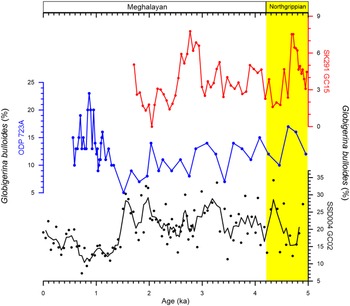
The relative abundance of G. bulloides was higher than average (20.0 %), between 4.50 ka and 1.50 ka and lower in the last 1.47 kyr. A few planktic foraminifera thrive in upwelled colder, nutrient-rich waters with plenty of food. Globigerina bulloides is one such planktic foraminifera species abundant in cold, organic-matter-rich waters and thus is used as an indicator of upwelling (Auras-Schudnagies et al. Reference Auras-Schudnagies, Kroon, Ganssen, Hemleben and Van Hinte1989; Saraswat & Khare, Reference Saraswat and Khare2010; Naik et al. Reference Naik, Saraswat, Lea, Kurtarkar and Mackensen2017). From the foraminiferal distribution during the summer monsoon, it was suggested that the change in the relative abundance of G. bulloides could be used to trace the palaeo-upwelling intensity (Prell & Curry, Reference Prell and Curry1981) and thus the associated summer monsoon strength and productivity in both the Arabian Sea and Bay of Bengal (Naidu et al. Reference Naidu, Ramesh Kumar and Ramesh Babu1999). The relative abundance of G. bulloides in the Gulf of Mannar is comparable with that in typical summer-monsoon-wind-induced upwelling-affected regions like the western Arabian Sea (Gupta et al. Reference Gupta, Anderson and Overpeck2003). Therefore, the higher relative abundance of G. bulloides between 1.50 ka and 4.50 ka (average 22.6 %) suggests intense upwelling and thus strengthened summer monsoon during the larger part of the Meghalayan Age, as compared to the last 1.5 kyr (Fig. 8). The change in the relative abundance of G. bulloides in the Gulf of Mannar is, however, different than that in the western Arabian Sea (Gupta et al. Reference Gupta, Anderson and Overpeck2003; Saravanan et al. Reference Saravanan, Gupta, Zheng, Panigrahi and Prakasam2019). The abundance consistently decreases in the western Arabian Sea from ∼5 ka until ∼1.5 ka (Gupta et al. Reference Gupta, Anderson and Overpeck2003), whereas we see a higher relative abundance of G. bulloides between 1.50 ka and 4.50 ka, but no consistent increasing or decreasing trend. The difference is attributed to the varying response of the different parts of the Indian Ocean to the summer-wind-intensity and direction-induced upwelling (Bassinot et al. Reference Bassinot, Marzin, Braconnot, Marti, Mathien-Blard, Lombard and Bopp2011). The change in the relative abundance of G. bulloides between 1.5 ka and 4.5 ka slightly matches with that in a core (SK291/GC15) collected from the central eastern Arabian Sea (Saravanan et al. Reference Saravanan, Gupta, Zheng, Panigrahi and Prakasam2019). However, we need to mention that core SK291/GC15 was collected from a very weak upwelling area (Saravanan et al. Reference Saravanan, Gupta, Zheng, Panigrahi and Prakasam2019). A similar higher G. bullodies during most of the Meghalayan Age was also reported in another core (MD77-191) collected from the nearby SE Arabian Sea (Bassinot et al. Reference Bassinot, Marzin, Braconnot, Marti, Mathien-Blard, Lombard and Bopp2011). The last ∼1.5 kyr record is missing from MD77-191, hampering the comparison of our late Meghalayan Age record with this core.
The relative abundance of monsoon wind forced upwelling-induced cold nutrient-rich water indicator Globigerina bulloides in the Gulf of Mannar (SSD004 GC02), Oman Margin (ODP 723A, Gupta et al. Reference Gupta, Anderson and Overpeck2003) and central eastern Arabian Sea (SK291 GC15, Saravanan et al. Reference Saravanan, Gupta, Zheng, Panigrahi and Prakasam2019). The yellow shaded bar is the Northgrippian Age.

It is interesting to note that although the relative abundance of G. bulloides was consistently high during the early Meghalayan Age, we did not see any persistent increasing trend. The lack of any increasing trend in G. bulloides relative abundance suggests additional factors facilitating increased productivity and thus Corg flux. It is likely that the increased carbon burial was due to the increased productivity during the winter season coupled with better preservation. The Gulf of Mannar receives precipitation during the winter season. The rivers debouching in the Gulf of Mannar bring nutrient-rich turbid waters during the winter season (Chandramohan et al. Reference Chandramohan, Jena and Sanilkumar2001). Additionally, the nutrient-rich water advects from the Palk Bay, in the SW Bay of Bengal, to the Gulf of Mannar (Jyothibabu et al. Reference Jyothibabu, Balachandran, Jagadeesan, Karnan, Gupta, Chakraborty and Sahu2021). Therefore, the zooplankton biomass and chlorophyll-a concentration is high during both the summer and winter monsoon seasons in the Gulf of Mannar, suggesting increased productivity (Jagadeesan et al. Reference Jagadeesan, Jyothibabu, Anjusha, Mohan, Madhu, Muraleedharan and Sudheesh2013). The nearly fourfold increase in planktic foraminifera abundance from 1945 specimen/g sediment at 4.22 ka to 10110 specimen/g sediment at 1.98 ka suggests an overall increase in productivity, during this interval. As the summer-monsoon-induced upwelling, although it was high, did not increase consistently, the increase in productivity between 4.22 ka and 1.98 ka, as inferred from planktic foraminifera abundance, is attributed to intense winter monsoon.
On the finer timescale, from the relative abundance of G. bulloides, we report a weaker monsoon between 2.65 ka and 2.28 ka and a subsequent strengthening of the monsoon between 2.05 ka and 1.50 ka. The weak monsoon followed by the strengthened monsoon phase between 2.05 ka and 1.50 ka in the Gulf of Mannar core is similar to the weakening of the monsoon at 2 ka and the subsequent wet phase, inferred from the eastern Arabian Sea (Khare et al. Reference Khare, Nigam and Hashimi2008). However, the duration of the wet phase in the two records is different, likely because the region off Goa is mainly influenced by the summer monsoon, while the Gulf of Mannar receives substantial precipitation during both the summer and winter seasons. A part of the difference may also be because of the different radiocarbon age calibration methods followed in these records. The decreased G. bulloides abundance during the last 1 kyr, however, suggests a weakened summer monsoon. The impact of weakened summer monsoon during the last 1 kyr is evident in deceased Corg and CaCO3 accumulation in the Gulf of Mannar. However, the Gupta et al. (Reference Gupta, Anderson and Overpeck2003) G. bulloides percentage data would suggest an increase in upwelling and thus strengthened summer monsoon winds during the last 1 kyr. The different trend in G. bulloides in the Gulf of Mannar and the western Arabian Sea is attributed to the differential response of these two regions to the summer winds (Bassinot et al. Reference Bassinot, Marzin, Braconnot, Marti, Mathien-Blard, Lombard and Bopp2011).
5.3. Terrestrial versus marine organic carbon contribution
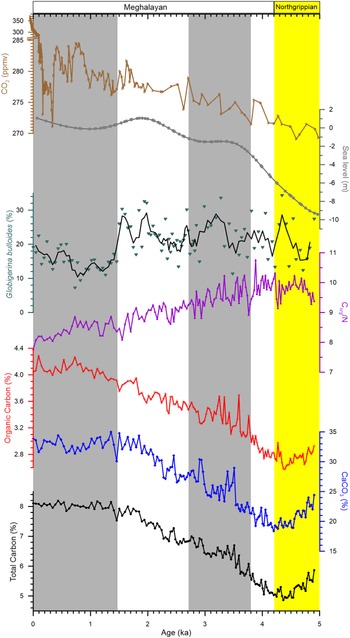
The Corg/N increased during the Northgrippian but consistently decreased from 4.0 ka onwards until recent times. Although, the overall decrease in Corg/N during the Meghalayan Age was ∼2, the trend was very prominent. In addition to the primary productivity, a substantial fraction of the organic matter in the ocean, especially the marginal marine regions, is also of terrestrial origin, brought by the river runoff as well as winds. The marine and terrestrial contribution of the organic matter is delineated with the help of Corg/N (Calvert et al. Reference Calvert, Pedersen, Naidu and Von Stackelberg1995). The marine organic matter has a relatively lower Corg to nitrogen ratio as compared to terrestrial plants. The Corg/N ratio is thus an index to determine the relative contribution of marine or terrestrial organic matter. The terrigenous organic matter generally has a high Corg/N (>20), whereas marine origin organic matter has low Corg/N (5–8) (Jasper & Gagosian, Reference Jasper and Gagosian1989). The Corg in core SSD004 GC02 is increasingly of marine origin, based on Corg/N ratio (Fig. 9). The gradually decreasing Corg/N ratio throughout the core confirms the increase in marine organic matter contribution to the Corg throughout the Meghalayan Age. The decreasing terrestrial organic matter contribution is attributed to the increasing distance of the core site from the Thamirabarani River due to a >10 m rise in sea-level since the beginning of the Meghalayan Age (Grant et al. Reference Grant, Rohling, Ramsey, Cheng, Edwards, Florindo, Heslop, Marra, Roberts, Tamisiea and Williams2014), as well as the increase in marine productivity. The increasing marine contribution to the organic matter, despite there being no such trend in upwelling indicator G. bulloides, further supports our inference of higher primary productivity due to winter monsoon in the Gulf of Mannar.
The change in total carbon, CaCO3, Corg, Corg/N and relative abundance of Globigerina bulloides during the Meghalayan Age, compared with the sea-level changes (Grant et al. Reference Grant, Rohling, Ramsey, Cheng, Edwards, Florindo, Heslop, Marra, Roberts, Tamisiea and Williams2014) and atmospheric CO2 concentration (Bereiter et al. Reference Bereiter, Eggleston, Schmitt, Nehrbass-Ahles, Stocker, Fischer, Kipfstuhl and Chappellaz2015). The yellow shaded bar is the Northgrippian Age. The intervals of significant change are marked by grey shaded regions.

5.4. Comparison with regional high-resolution records
We compared the SSD004 GC02 CaCO3 and Corg with other similar high-resolution records from the eastern Arabian Sea (SO90-39 KG/SO130-275 KL, Böll et al. Reference Böll, Lückge, Munz, Forke, Schulz, Ramaswamy, Rixen, Gaye and Emeis2014; SO90-63 KA, Burdanowitz et al. Reference Burdanowitz, Gaye, Hilbig, Lahajnar, Lückge, Rixen and Emeis2019; SN-6, Nagoji & Tiwari, Reference Nagoji and Tiwari2017; SK237 GC04, Naik et al. Reference Naik, Saraswat, Lea, Kurtarkar and Mackensen2017). All these records are from the continental slope region. A couple of these records (SO90-39 KG/SO130-275 KL and SO90-63 KA) are from the NE Arabian Sea. The primary productivity is very high in the NE Arabian Sea due to convective mixing during the winter (Madhupratap et al. Reference Madhupratap, Prasanna Kumar, Bhattathiri, Dileep Kumar, Raghu Kumar, Nair and Ramaiah1996) and advection of high-nutrient water from the western Arabian Sea during the summer (Saraswat et al. Reference Saraswat, Kurtarkar, Yadav, Mackensen, Singh, Bhadra, Singh, Tiwari, Prabhukeluskar, Bandodkar, Pandey, Clift, Kulhanek, Bhishekar and Nair2020). A similar high productivity during both the summer and winter seasons is also observed in the Gulf of Mannar, although the physical mechanisms are different than those in the NE Arabian Sea. A large difference is observed in both the trend and absolute abundance of CaCO3 during the last 5 kyr in these two regions (Fig. 7). The Gulf of Mannar CaCO3 record is different than other SE Arabian Sea records (Nagoji & Tiwari, Reference Nagoji and Tiwari2017, Naik et al. Reference Naik, Saraswat, Lea, Kurtarkar and Mackensen2017), but strikingly similar to another core, AAS-VI/GC-05, collected from a depth of 280 m in the SE Arabian Sea (Pattan et al. Reference Pattan, Parthiban and Amonkar2019). The SE Arabian Sea is influenced by upwelling-induced primary productivity during the summer season. Amongst these regions, the highest CaCO3 was in the Gulf of Mannar during the Meghalayan Age. We report a significant increase in CaCO3 between ∼1 ka and 3 ka, as compared to a consistent decrease in several other records. The records, however, match in a constant CaCO3 during the last millennium. Interestingly, Corg consistently increased throughout the Meghalayan Age in all the records (Fig. 6). A similar Corg but different CaCO3 in various parts of the eastern Arabian Sea is intriguing. A relatively high CaCO3 in the Gulf of Mannar is attributed to its better preservation, due to a less intense oxygen-deficient zone as compared to the NE Arabian Sea (Sarma et al. Reference Sarma, Udaya Bhaskar, Kumar and Chakraborty2020). The increased microbial respiration in a Corg-rich environment decreases the pH, leading to dissolution of biogenic carbonates (Cai et al. Reference Cai, Hu, Huang, Murrell, Lehrter, Lohrenz, Chou, Zhai, Hollibaugh, Wang, Zhao, Guo, Gundersen, Dai and Gong2011). A similar Corg in all records suggests comparable productivity as well as its burial in sediments throughout the eastern Arabian Sea.
5.5. Factors affecting carbon burial and preservation
The preservation of both the biogenic CaCO3 and organic matter in the sediments depends on ambient conditions. One of the major factors influencing organic matter preservation is the grain size. The finer grains preserve more organic matter (Bergamaschi et al. Reference Bergamaschi, Tsamakis, Keil, Eglinton, Montluçon and Hedges1997). The sediments in the oceans are mainly brought by rivers or wind. The distance of a marine region from the river mouth thus affects the size and volume of the sediments being brought into an area. The sea-level also controls the grain size. The transgressing sea-level inundates and the regressing sea-level exposes the continental shelf. In the case of the marine regions close to the river mouth, the change in sea-level significantly shifts the point of sediment debouchment by rivers (Phillips & Slattery, Reference Phillips and Slattery2006). Therefore, sea-level changes significantly affect the size as well as the volume of sediments being brought into the marginal marine regions and deeper waters through channels, and thus affect the carbon burial in marine sediments. The terrigenous dilution and/or dissolution increases the amplitude of the carbonate cycle but reduces CaCO3 concentration in the Indian Ocean (Olausson, Reference Olausson and Funnel1971; Naidu, Reference Naidu1991). The sea-level has increased by >10 m since the beginning of the Meghalayan Age (Grant et al. Reference Grant, Rohling, Ramsey, Cheng, Edwards, Florindo, Heslop, Marra, Roberts, Tamisiea and Williams2014; Fig. 9). The transgressing sea-level completely inundated the extensive, gently sloping relict carbonate platform along the southern margin of India (Hashimi et al. Reference Hashimi, Nair, Kidwai and Purnachandra Rao1982). A significantly consistent CaCO3 between 2.7 ka and 3.7 ka, matches with a decreased rate of sea-level rise during the same interval, as against a comparatively rapid rate of sea-level increase in the early Meghalayan Age. The inundation of the carbonate platform thus increased the distance of the core site from the nearby Thamirabarani River and thus reduced the coarse fraction supply to the area. However, the quantity and grain size of the sediments supplied by the river to the core site can also change due to the delta lobe avulsion as it is closely linked with the sea-level change (Chadwick & Lamb, Reference Chadwick and Lamb2021). The substantial change in terrigenous fraction and CaCO3 was also highlighted from the western margin of India (Khare, Reference Khare2018). In the SE Arabian Sea, the change in Corg during the glacial–interglacial interval was attributed to the variation in sediment texture as a result of higher terrigenous supply leading to increased dilution (Narayana et al. Reference Narayana, Naidu, Shinu, Nagabhushanam and Sukhija2009). The resultant increase in finer fraction facilitated better preservation of both the organic matter and the biogenic carbonate.
The seawater pH at the sediment–water interface as well as of the pore water, also strongly modulates carbon burial (Keil, Reference Keil2017; LaRowe et al. Reference LaRowe, Arndt, Bradley, Estes, Hoarfrost, Lang, Lloyd, Mahmoudi, Orsij, Shah Walter, Steen and Zhao2020; Freitas et al. Reference Freitas, Arndt, Hendry, Faust, Tessin and März2022). As the core site lies in the oxygen-deficient zone, the pH at the sediment–water interface is likely to strongly modulate carbon burial in the sediments, before the remineralization of both the organic matter and CaCO3. All such factors also have to be evaluated to fully understand the temporal changes in carbon burial in this region. With the available data, it is clear that both the intense monsoon-induced primary productivity and increasing sea-level facilitated the persistent increase in both the inorganic and carbon burial in the Gulf of Mannar, throughout the Meghalayan Age. However, the uniform carbon concentration in the topmost section of the core is most likely influenced by anthropogenic activities.
5.6. Carbon burial during the last millennium
A distinct shift in almost all the parameters in the top ∼25 cm section representing the last ∼1.17 kyr is intriguing. We want to state that this section has a chronological uncertainty as the age of the top section of the core was interpolated based on the sedimentation rate between the subsequent radiocarbon-dated intervals (39.5 cm and 49.5 cm). The total carbon remains uniform in this section, mainly due to the similar trend in CaCO3. The increasing trend in Corg also flattens in the top ∼15 cm section of the core. The atmospheric CO2 concentration increased rapidly during the later part of this interval, driven by increased fossil fuel usage since the beginning of the industrial revolution (Fig. 9; Bereiter et al. Reference Bereiter, Eggleston, Schmitt, Nehrbass-Ahles, Stocker, Fischer, Kipfstuhl and Chappellaz2015). The low relative abundance of G. bulloides in this section suggests a reduced upwelling and thus weaker summer monsoon. A weaker summer monsoon during the Late Meghalayan Age has also been reported from the terrestrial records (Srivastava et al. Reference Srivastava, Agnihotri, Sharma, Meena, Sundriyal, Saxena, Bhushan, Sawlani, Banerji, Sharma, Bisht, Rana and Jayangondaperumal2017). Thus the flattening of the total carbon burial during the last 1.17 kyr was driven by the weakening of the summer monsoon. It should, however, be noted here that the findings are in contrast with the high relative abundance of G. bulloides during the similar interval in the western Arabian Sea, suggesting a stronger monsoon-induced upwelling (Gupta et al. Reference Gupta, Anderson and Overpeck2003). The differential response of these two regions is attributed to the difference in the orientation of the coastline to the wind direction and thus upwelling (Bassinot et al. 2003). Thus, it is clear that the summer-winds-driven upwelling-induced productivity decreased during the last 1.17 kyr in the Gulf of Mannar.
5.7. Implications for carbon cycling
The increase in carbon burial during the Meghalayan Age in the eastern Arabian Sea coincides with ∼10 ppmv increase in the global atmospheric CO2 (Fig. 9; Bereiter et al. Reference Bereiter, Eggleston, Schmitt, Nehrbass-Ahles, Stocker, Fischer, Kipfstuhl and Chappellaz2015). It is intriguing that the atmospheric CO2 increased during times of enhanced carbon burial. The opposite trend between the atmospheric CO2 and carbon burial in the eastern Arabian Sea can be explained by several factors. First and the foremost is the regional nature of the carbon burial, with the ambient conditions in the Gulf of Mannar being favourable for carbon burial during the Meghalayan Age. Another factor contributing CO2 is the carbonate counter pump, whereby precipitation of CaCO3 by the marine organisms increases the CO2 concentration in the surface waters and its subsequent efflux to the atmosphere (Salter et al. Reference Salter, Schiebel, Ziveri, Movellan, Lampitt and Wolff2014). The increase in planktic foraminifera abundance during the early Meghalayan Age must have contributed CO2 to the surface waters and subsequently to the increasing atmospheric CO2, through the carbonate counter pump.
6. Conclusions
We report a persistent increase in the total carbon, CaCO3 and Corg in the Gulf of Mannar, throughout the Meghalayan Age, except the bottommost (4.9 ka to 4.2 ka, 120–150 cm) and the topmost section (1.17 kyr, 0–25 cm) of the core. The increase in CaCO3 and Corg is concomitant with a phase of high relative abundance of the upwelling indicator G. bulloides in the early Meghalayan Age, suggesting intense upwelling in response to the strong monsoon. The increasing planktic foraminifera abundance and decreasing Corg/N ratio suggest higher marine productivity due to winter monsoon. Thus the high CaCO3 and Corg content in the Gulf of Mannar during most of the Meghalayan Age is attributed to high primary productivity influenced by the consistent summer and strong winter monsoon. The corresponding increase in sea-level during the early phase of the Meghalayan Age facilitated better preservation of both the Corg and CaCO3, thus leading to increased carbon burial in the SE Arabian Sea. The uniform carbon content in the top section of the core is attributed to the weakening of the summer monsoon.
Acknowledgements
Authors acknowledge the help by Dr C Prakash Babu and Ms Teja Naik in analysing the total and inorganic carbon, using the Central Analytical Facility of the CSIR–National Institute of Oceanography. We thank Dr Dharmendra Pratap Singh, Assistant Professor, Indian Institute of Technology, Roorkee, for the Bacon age model based chronology of the core. Authors also acknowledge the help by Shri Shashikant Velip in collecting the core samples during the cruise. RS is grateful for financial support by the Science and Engineering Research Board, Department of Science and Technology, Government of India (CRG/2019/000221), and the Council of Scientific and Industrial Research in the form of Young Scientist project. Authors thank the technical staff at the radiocarbon-dating facility of the Inter-University Accelerator Center, India. We also thank Prof. Peter Clift, Editor, Geological Magazine, Dr Zhaokai Xu, Key Laboratory of Marine Geology and Environment, Institute of Oceanology, Chinese Academy of Sciences, China, and an anonymous reviewer for comments and suggestions to improve the manuscript. This is National Institute of Oceanography, Goa, India contribution number 6980.