Milk tampering is a major issue in the global dairy industry. One of the most frequent adulterations is the addition of extraneous water, which can be accompanied by various ways to disguise it, such as addition of melamine, urea, sodium chloride, urine, sucrose, starch and/or ethanol (Wanjala et al., Reference Wanjala, Mathooko, Kutima and Mathara2018). It is estimated that the addition of ethanol occurs at a frequency of 7.7% (Mareze et al., Reference Mareze, Marioto, Gonzaga, Daniel, Tamanini and Beloti2015). The official method for detecting ethanol residues in milk is labor-intensive, requiring specific glassware and specific reagents. The estimated average time of this analysis is 15 min per sample. As a result, a rapid ethanol detection method is highly demanded, and it could be useful for official control entities and for quality control in dairy manufacturing (Brasil, 2018a, 2018b).
To detect the presence of alcohol in human milk, some countries already provide domestic testing. In the US there are strip tests for detecting alcohol in breast milk, sold in pharmacies under the name MilkScreen®. This test promotes better quality of life for mothers, allowing them to occasionally consume alcoholic beverages without endangering the infant's health by avoiding consumption of breast milk with alcohol residues. According to the manufacturer, the test pad will change color if the alcohol is present at, or above, 13.1 mg/dl.
Other tests are also available including Safe Milk™ and the PREGMATE One Step Alcohol Breast Lek Test™, both with precision of 20 mg/dl. Although manufacturers do not identify the chemical principle of these tests, they are likely to be based on an enzymatic oxidation reaction with alcohol dehydrogenase, utilizing several reactions and having as a closing point a color change after 2 min (Christopher and Zeccardi, Reference Christopher and Zeccardi1992).
Considering the sensitivity of these strip tests and the compositional similarity between milk and breast milk, it is likely that the MilkScreen™ could identify ethanol residues in non-human milk samples (ie dairy industry milks) and in the future be used as an alternative to the official test. On this basis, we aimed to determine if the MilkScreen™ is a suitable tool to detect extraneous ethanol in bovine milk.
Material and methods
To evaluate if Milkscreen® can detect extraneous ethanol mixed in milk, ethanol 92 ml/dl from Dinâmica (Diadema, Brasil) was diluted in fresh raw bovine milk to provide working samples with final volume of 100 ml and concentration of 0.00 ml/dl (control), 0.010 ml/dl, 0.017 ml/dl and 0.020 ml/dl. Each sample was homogenized in vortex for 7 s and after 30 min the analyses were performed.
For the Milkscreen® test, the strip was plunged in the milk sample for ten seconds, and after 2 min, the reading was performed. With the assistance of a color scale supplied by the manufacturer, the reading was performed observing any color change in the strips.
For the official alcohol test 100 ml of the sample was transferred to the Büchner flask, adding 3 ml of 3 ml/dl antifoam solution (Tec-Lab, Brazil). The Büchner flask was boiled for 5 min and the steam was conducted through a latex tube and a Pasteur pipette to a test tube containing 2 ml of sulphochromic solution. Finally, the yellowish coloration of the sulphochromic solution represented the negative result for the presence of ethyl alcohol, while the appearance of the green color was considered positive (Brasil, 2018a).
The analyses were repeated 10 times for each alcohol concentration, except for the lowest detection concentration reported by the Milkscreen® manufacturer, which was repeated 20 times. At all concentrations, the proportion of positive and negative results from each test was compared using the χ2 test with Yates correction and P ≤ 0.05.
In order to evaluate the robustness of the methods against storage of milk during 48 h under refrigeration, the same concentrations used for the sensitivity evaluation were stored in a volumetric flask for 48 h at 2 °C to 8 °C prior to the tests. After the mentioned period, the tests were performed as reported above.
In order to evaluate the robustness of the methods against the acidity, the same samples used for the sensitivity assessment were stored at 28 °C until the titratable acidity naturally reached 0.20 g/dl of lactic acid concentration. Then, the ethanol detection was assessed by Milkscreen® and by official method as reported above.
The robustness tests were repeated in triplicate. In case of inconsistency of results, a new test was performed with another ten repetitions to make it possible to compare the proportion of positive and negative results by the χ2 test with Yates correction and P ≤ 0.05.
In order to evaluate the selectivity of the methods against formaldehyde residues, different concentrations of formaldehyde 38 ml/dl (Dinâmica, Brazil) were diluted into a total volume of 100 ml of raw milk. The final concentrations of formaldehyde used were 0.005, 0.0075, 0.010 ml/dl. After 30 min the strips were immersed and read as described previously. The selectivity tests were repeated in triplicate. In case of inconsistency of results, a new test was performed with another other ten repetitions to make it possible to compare the proportion of positive and negative results by the χ2 test with Yates correction and P ≤ 0.05.
Results and discussion
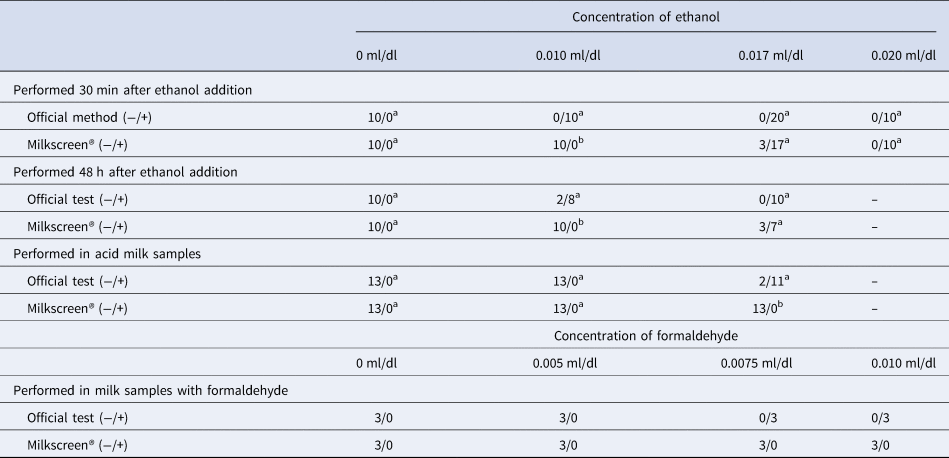
Milkscreen® was able to detect ethanol residues from concentrations of 0.017 ml/dl. On the other hand, the official test was more sensitive, being able to detect ethanol residues from concentrations of 0.010 ml/dl as described in Table 1. Considering the results of the effect of ethanol on the milk's freezing point, concentrations of 0.010 and 0.017 ml/dl ethanol respectively allow the fraudulent addition of water in concentrations of 0.75 and 1.29 ml/dl, keeping the freezing point parameters within specified limits for an authentic milk.
Absolute frequencies of positive and negative results in milk samples added with ethanol evaluated by Milkscreen® and by official method

Proportions followed by distinct letters differed in test χ2 (P < 0.05); (−/+) absence/presence of ethanol detection.
However, the amounts of water added by fraudsters are usually higher. In 2007 researchers detected fraud by the addition 3.6 ml/dl of water in raw milk (Barbosa et al., Reference Barbosa, Pires, Barbosa, Canuto, Araújo and Nunes2007). In this case, it would be necessary to add 0.05 ml/dl ethanol to the milk to keep the freezing point parameters within specified limits for an authentic milk and to disguise the dilution of the milk. In 2013, a Brazilian investigation called ‘Compensated Milk Operation’ and conducted by the Federal Prosecution Service discovered that milk producers acted fraudulently by the addition of 10 ml/dl water (Globo, 2013). To disguise this adulteration, it would be necessary to add about 0.15 ml/dl ethanol. Based on this, the Milkscreen® could be performed on the milk reception laboratories along with the screening tests used in dairy products.
Even after storage of the milk samples for 48 h under refrigeration, the sensitivity of both tests remained unaltered, remaining 0.010 ml/dl for the official test and 0.017 ml/dl for the Milkscreen® (Table 1). Thus, it is possible to detect ethanol residues even after 48 h of milk storage, conditions allowed by current Brazilian regulations (Brasil, 2018b).
Regarding the detection of ethanol in acid milk samples, both tests had variations in sensitivity. The official test failed to detect ethanol residues in concentrations of 0.010 ml/dl and began detecting them in concentrations of 0.017 ml/dl. In its turn, the sensitivity of the Milkscreen® also decreased with milk acidification, being unable to detect ethanol residues even in concentrations of 0.017 ml/dl (Table 1). In the samples with 0.010 ml/dl of ethanol, it would be possible to add 0.076 ml/dl water. In its turn, the ethanol added at the concentration of 0.017 ml/dl would allow addition of up to 1.29% water. Notwithstanding the decrease in sensitivity of both tests, the acidity could be detected during commercial milk collection through the test of alcoholic stability and/or in the reception of the dairy through the titration of acidity, mandatory tests before the industrial processing of the milk (Brasil, 2018b).
Regarding the selectivity of the tests due to formaldehyde residues, the Milkscreen® was more robust compared to the official test, without changing the sensitivity results in concentrations up to 0.010 ml/dl of formaldehyde. In its turn, false-positive results in the official test were observed from 0.0075 ml/dl formaldehyde, as can be seen in Table 1. The official alcohol test is not specific for alcohol detection, as the reduction of Cr+6 to Cr+3 occurs in the presence of aldehyde groups, which, in addition to being formed in the oxidation of primary and/or secondary alcohols, may also be from the formaldehyde molecule (Tojo and Fernández, Reference Tojo and Fernández2006).
In conclusion, with good sensitivity and robustness, Milkscreen® is comparable to the official method to detect extraneous ethanol in fresh raw milk, working even in sour milk and without false-positive results due to formaldehyde residues. These results support the validity of Milkscreen® strips for screening purposes by dairy manufacturers, combining it with the official method to make a final diagnosis.
Acknowledgements
The authors acknowledge the Fundação Nacional de Desenvolvimento do Ensino Superior Particular (FUNADESP) for financial support.