Implications
Dietary interventions influence body and tissue composition; and affect tissue metabolism by influencing gene expression. We explore the transcriptional effects of diets with different energy source and evaluate the effects of growth period and feeding/fasting on lipogenic gene expression. Results deepen in the understanding of lipogenesis regulation by nutritional factors in fatty pigs along growth, and are of interest for pig production facing with a variety of nutritional resources that can be used for diet formulation. The specific mechanisms underlying the high lipogenic and desaturation potential of Iberian pigs should be addressed in future comparative studies employing different breeds.
Introduction
Animal tissue fat content and composition are important determinants of meat quality (Wood et al., Reference Wood, Enser, Fisher, Nute, Sheard, Richardson, Hughes and Whittington2008), which are influenced by nutritional, hormonal and metabolic factors. Dietary approaches are being essayed in order to influence body and tissue composition, aiming to improve the nutritional value of pig meat and products (Raes et al., Reference Raes, De Smet and Demeyer2004). These approaches usually involve modifications of dietary energy content, energy source (fat v. carbohydrates) or fatty acid (FA) composition. Regarding FA composition, diets enriched with different sources of FA have been essayed in pigs. These interventions have remarkable results for certain FA which proportions in animal tissues increase linearly as the dietary intake increase, as linoleic acid which is entirely derived from diet (Wood, Reference Wood1984). Nevertheless, other monounsaturated and saturated fatty acids (SFA) may be products of endogenous synthesis in the animal, and interconversions between them limit the impact of dietary additions (Wood et al., Reference Wood, Enser, Fisher, Nute, Sheard, Richardson, Hughes and Whittington2008).
The failure or inconsistency of nutritional approaches to modulate fat deposition and to influence fat composition has raised the interest in the molecular regulation of lipogenesis. Nutrients influence metabolism by affecting gene expression of lipid metabolism enzymes and thus the balance between lipogenesis and lipolysis/FA oxidation. This balance determines the net composition of fat tissues. Lipogenesis is well known to be stimulated by high carbohydrate (CH) diet (Kersten, Reference Kersten2001), mainly postprandially, as plasma glucose levels stimulate lipogenesis by different mechanisms. On the opposite, lipogenesis is inhibited by polyunsaturated fatty acids (PUFA), high fat diets and food deprivation (O’Hea and Leveille, Reference O’Hea and Leveille1969; Kersten, Reference Kersten2001; Sampath and Ntambi, Reference Sampath and Ntambi2006), and the latter one conversely enhances lipolysis in adipose tissue (Viscarra and Ortiz, Reference Viscarra and Ortiz2013). These effects are in part mediated by hormones as leptin (Wang et al., 1999), which stimulates FA oxidation and inhibits lipogenesis by down-regulating the expression of genes involved in FA and triglycerides synthesis. Impacts of diet composition on the expression of genes related to lipid metabolism are known to be highly dependent on different factors, including the species, age, tissue and treatment length and timing (Ding et al., Reference Ding, Lapillonne, Heird and Mersmann2003; Duran-Montgé et al., Reference Duran-Montgé, Theil, Lauridsen and Esteve-García2009). Regarding timing, many transcripts have transient changes in response to a stimulus (Ding et al., Reference Ding, Lapillonne, Heird and Mersmann2003) and thus short term and serial studies are indicated to understand the diet effects on tissue metabolism and gene expression.
The traditional fattening system of Iberian pigs is based on the intake of acorns in the finishing growth period, which provide high levels of monounsaturated fatty acids (MUFA), mainly oleic acid (López-Bote, Reference López-Bote1998). This production system is the basis of highest-quality dry-cured pig products, and a reference model for sustainable production of many local Mediterranean breeds (Pugliese and Sirtori, Reference Pugliese and Sirtori2012). In Iberian pigs, higher leptin levels than other lean breeds are observed, concomitantly with a very high lipogenic potential (López-Bote, Reference López-Bote1998; Fernández-Figares et al., Reference Fernández-Figares, Lachica, Nieto, Rivera-Ferre and Aguilera2007). This pattern is in agreement with the leptin resistance syndrome proposed as cause of extreme fattening characteristic of this breed. Besides, the Iberian breed is characterized by a specific tissue FA profile and a high desaturation capacity (Barea et al., Reference Barea, Isabel, Nieto, López-Bote and Aguilera2013). MUFA enriched diets, through the inclusion of high oleic acid sunflower oil, are being used in Iberian pigs intensive fattening systems in order to mimic the FA profile characteristic of pigs fattened with the traditional system. The effects of these diets on the FA composition of different tissues have been studied in the last decade, reporting nonconsistent and tissue-specific effects (Pérez-Palacios et al., Reference Pérez-Palacios, Ruiz, Tejeda and Antequera2009). Recently, the impact of high oleic sunflower oil (HO) v. CH enriched diets on tissues composition joint with their long-term effects on gene transcription have been also evaluated (Óvilo et al., Reference Óvilo, Benítez, Fernández, Isabel, Núñez, Fernández, Rodríguez, Daza, Silió and López-Bote2014). According to this study, Iberian pigs fed the HO diet showed higher MUFA content and lower SFA in all the analyzed tissues. On the other hand, animals receiving CH diet were able to synthesize considerable amounts of SFA but also MUFA. Nevertheless, the effect of diet on the transcription of lipogenic enzyme genes was modest in the long term, suggesting a subtle effect of the diet on the regulation of several lipid metabolism pathways. These joint results suggest that de novo lipogenesis coupled with elongation and desaturation may be playing a key role in the tissue FA profiles, and these pathways may be differentially regulated between dietary groups. The timing when samples are obtained for gene transcription analysis may be also of importance. Indeed, changes in lipogenesis along growth (Anderson and Kauffman, Reference Anderson and Kauffman1973; Hood and Allen, Reference Hood and Allen1973; Mourot et al., Reference Mourot, Kouba and Bonneau1996) may influence the impact of diet on lipogenesis at different growth periods, thus, short- and long-term effects must be explored. Short-term effects are especially interesting in this fatty pig breed in which adipo and lipogenesis processes are expected to start more precociously than in other selected lean breeds (López-Bote, Reference López-Bote1998).
The present work employed the same experimental material studied previously in Óvilo et al. (Reference Óvilo, Benítez, Fernández, Isabel, Núñez, Fernández, Rodríguez, Daza, Silió and López-Bote2014), with the objective of evaluating short- and long-term effects of diet energy source (HO v. CH) on transcription of candidate genes in ham subcutaneous adipose tissue of Iberian pigs. In addition, effects on gene expression of the growth period and the feeding/fasting status of the animals were explored.
Material and methods
Animals
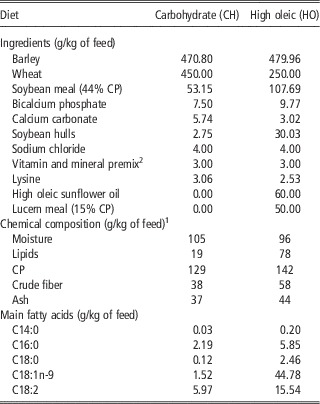
The current study was carried out at the facilities of the CIA Deheson del Encinar (Toledo, Spain). Animal manipulations were performed in compliance with the regulations of the Spanish Policy for Animal Protection RD1201/05, which meets the European Union Directive 86/609 about the protection of animals used in experimentation. The study comprised 27 barrows born in 15 litters of the Torbiscal Iberian strain. At 28 kg (SD=3 kg) of BW the animals were distributed in two dietary groups (n=14 and 13, respectively), and penned individually, with full-sibs pairs being splitted in the two groups. A group was fed with a high oleic sunflower oil enriched diet (HO) and the other one (CH) with a diet of carbohydrates as the main source of energy. Feeds composition is shown in Table 1. The energy content per kilogram of feed was 9.6 MJ of net energy for the CH diet, and 10.43 MJ for the HO diet. During the 23 weeks of treatment, animals were fed individually twice a day according to a scale based on average live weight. The daily feed supplied for pigs of the HO group increased from 1.0 to 3.3 kg. A 10% greater quantity of feed was supplied to the CH group in order to match the lower energy and protein content of CH feed and provide isoenergetic and isoproteic rations to the pigs of both groups. Fresh water was provided ad libitum. Ham subcutaneous fat samples were obtained in vivo by shot-biopsies at two different growth periods: growing (44 kg mean BW and SD=3 kg) and finishing (100 kg mean BW and SD=4.4 kg). In the first sampling biopsies were obtained before morning meal. In the last sampling, fat biopsies were obtained immediately before (animals fasted for 18 h, from 16.00 h of the previous day to 10.00 h of sampling day) and 3 h after feeding (postprandial sampling).
Ingredients, calculated chemical compositionFootnote 1 and fatty acid composition of the experimental diets (g/kg; as-fed basis)

CH=carbohydrate diet without added fat; HO=high oleic diet with high oleic sunflower oil.
1 According to Fundación Española Desarrollo Nutrición Animal (2010).
2 Vitamin-mineral premix provided per kg of feed: vitamin D3, 1200 IU; vitamin E, 11 UI; vitamin B1, 0.2 mg; vitamin B2, 2.5 mg; vitamin B12, 0.015 mg; vitamin B6, 1.3 mg; calcium pantothenate, 8 mg; nicotinic acid, 20 mg; biotin, 0.1 mg; folic acid, 0.5 mg; vitamin K3, 2 mg; Fe, 75 mg; Cu, 16.0 mg; Co, 0.10 mg; Zn, 110 mg; Mn, 40 mg; I, 1.3 mg; Se, 0.30 mg; ethoxyquin, 150 mg.
Pigs were tranquilized by intramuscular injection of 20 mg of azaperon per 10 kg live weight (Stresnil; Esteve, Barcelona, Spain) 1 h before micro-biopsies were taken. Biopsies were taken using a cylindrical biopsy device with a diameter of 5 mm under local anesthesia with 2% lidocaine-HCL (Alphacaine; Fendigo, Brussels, Belgium). After biopsy, the zone was sprayed with oxytretracycline and lidocaine (Veterin Tenicol; Lab. Intervet S.A., Salamanca, Spain). Pigs did not suffer any pain because of the employed analgesia. Similar procedures have been used before, that is in Barea et al. (Reference Barea, Isabel, Nieto, López-Bote and Aguilera2013). Biopsy samples were placed in cryotubes, snap frozen in liquid nitrogen and stored at −80°C until analyses.
Candidate gene expression analyses by qPCR
The entire available adipose tissue sample (~50 to 100 mg) from each biopsy was used for total RNA extraction using RiboPureTM RNA isolation kit (Ambion, Austin, TX, USA) following the manufacturer’s recommendations. RNA obtained was quantified using a NanoDrop equipment (NanoDrop Technologies, Wilmington, DE, USA) and RNA quality was assessed with an Agilent bioanalyzer device (Agilent Technologies, Palo Alto, CA, USA). The RNA integrity number values obtained for all the samples were in the range 7.5 to 8.5. First-strand cDNA synthesis was carried out with Superscript II (Invitrogen Life Technologies, Paisley, UK) and random hexamers in a total volume of 20 µl containing 1 µg of total RNA and following the supplier’s instructions.
Selection of candidate genes
A total of 10 candidate genes were selected. Peroxisome proliferator activated receptor γ (PPARG) and Retinoic X receptor γ (RXRG) are involved in gene expression regulation of adipogenesis and lipogenesis processes (Kersten, Reference Kersten2001; Lefebvre et al., Reference Lefebvre, Benomar and Staels2010). Leptin (LEP) is a hormone produced by adipose tissue, which controls energy balance and has also local effects inhibiting lipogenesis in adipose tissue and promoting FA catabolism (Wang et al., 1999). In addition, seven candidate genes with direct functional involvement in lipogenesis and FA transport were selected: ME1, SCD, FASN, ACACA, ELOVL5, ELOVL6 and FABP5. In addition, RXRG, LEP and ME1 genes were found to be differentially expressed (DE) conditional on dietary energy source in a previous transcriptome analysis at adipose tissue level (Óvilo et al., Reference Óvilo, Benítez, Fernández, Isabel, Núñez, Fernández, Rodríguez, Daza, Silió and López-Bote2014).
The expression of this panel of candidate genes was quantified by qPCR. Primer pairs used for quantification were designed using Primer Select software (DNASTAR, Wisconsin, USA) from the available GENBANK and/or ENSEMBL sequences, covering different exons in order to assure the amplification of the cDNA. Sequence of primers and amplicon lengths are indicated in Supplementary Table S1. Standard PCRs on cDNA were carried out to verify amplicon sizes. Transcript quantification was performed using SYBR Green mix (Roche, Basel, Switzerland) in a LightCycler480 (Roche). The qPCR reactions were prepared in a total volume of 20 µl containing 2.5 µl of cDNA (1/20 dilution), 10 µl of SYBR Green mix and 0.15 µM of both forward and reverse primers. As negative controls, mixes without cDNA were used. Cycling conditions were 95°C for 10 min, followed by 45 cycles of 95°C (15 s) and 60°C (1 min) where the fluorescence was acquired. Finally, a dissociation curve to test PCR specificity was generated by one cycle at 95°C (15 s) followed by 60°C (20 s) and ramp up to 95°C with acquired fluorescence during the ramp to 0.01°C/s. Data were analyzed with LyghtCycler480 SW1.5 software (Roche). All points and samples were run in triplets as technical replicates and dissociation curves were carried out for each individual replicate. Single peaks in the dissociation curves confirmed the specific amplification of the genes. For each gene, PCR efficiency was estimated by standard curve calculation using four points of cDNA serial dilutions. Cycles to threshold (Ct) values were employed for the statistical analyses of differential expression. Data normalization was carried out using the most stable endogenous gene out of GAPDH, ACTB, TBP and B2M. Stability of endogenous genes was tested with genorm software (http://medgen.ugent.be/~jvdesomp/genorm/). ACTB gene was employed for normalization.
Statistical analyses of candidate gene expression data
Statistical analysis of gene expression data was carried out following the method proposed by Steibel et al. (Reference Steibel, Poletto, Coussens and Rosa2009), which consists in the analysis of Ct values for the target and endogenous genes simultaneously using a linear mixed model. The following model was used for this purpose in a joint analysis of all the recorded gene expression measures:
 $$y_{{gijkr}} {\equals}TG_{{gi}} {\plus}P_{{gj}} {\plus}B_{{gk}} {\plus}D_{{ijk}} {\plus}e_{{gijkr}} $$
where
 $y_{{gijkr}} {\,\equals\,}{\minus}{\rm log}_{2} \left\big( {E_{g}^{{{\minus}ct_{{gijkr}} }} } \right\big)$
, E
g
brings the efficiency of the PCR of each gene, Ct
gijkr
is the value obtained from the thermocycler software for the gth gene from the rth well in the jth qPCR plate corresponding to the the kth animal subjected to the ith treatment, TGgi the specific effect of the ith treatment on the expression of gene g, P
gj
and B
gk
the specific random effects on the expression in the jth qPCR plate of gene g and the kth pig, D
ik
the random sample-specific effect common to all genes, and e
gijkr
the residual effect. Six different treatments were fitted to the model: dietary effects (two levels: HO and CH) in growing pigs (44 kg BW) and the four combinations of the two diets and fasting/feeding status in finishing pigs (100 kg BW).
To test differences or interaction between classes in the expression rate of genes of interest (diff
TG
) normalized by the endogenous gene, different contrasts were performed between the appropriate estimates of TG levels. Significance of diff
TG
estimates was determined with the t statistic. For accounting of the multiplicity of comparisons, adjusted P-values were calculated using the correction method of Benjamini and Hochberg (Reference Benjamini and Hochberg1995). These calculations were performed using the R Stats Package version 3.2.0 (https://stat.ethz.ch/R-manual/R-patched/library/stats/html/p.adjust.html). To obtain fold change (FC) values from the estimated diff
TG
values, the following equation was applied:
 $FC\,{\equals}\,2^{{{\minus}diff_{{TG}} }} $
. Standard errors of fold change values (SE (FC)) were calculated from the standard error of the estimated differences (SE), using a similar transformation: SE (FC)=2
-SE
. Asymmetric confidence intervals (95% CI) were calculated for each FC value by using the SE values: 95% CI from
 $$2^{{{\minus}\left( {diff_{{TG}} {\plus}t(\gamma ,0.975).SE} \right)}} $$
to
 $2^{{{\minus}\left( {diff_{{TG}} {\minus}t(\gamma ,0.975).SE} \right)}} $
, where t(γ,0.975) is the 97.5 quantile of the Student-t distribution with γ degrees of freedom. In our analyses γ ranged from 57 to 103.
Results
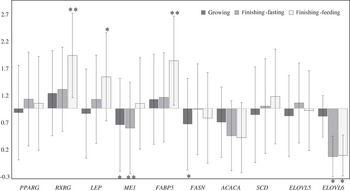
Diet effects on candidate gene expression in the three samplings are shown in Figure 1. In the first sampling (growing period, 44 kg average BW) obtained from fasted animals, diet influenced the expression of ME1 and FASN genes, which showed higher expression in CH than in HO group (1.4× for both genes; P<0.05). Gene expression was also quantified in subcutaneous fat biopsies obtained before and 3 h after feeding, in a sampling performed after a long period (23 weeks) of dietary treatment (finishing period, 100 kg of average BW). In the samples obtained before feeding, diet influenced the expression of ME1 and ELOVL6, with both lipogenic genes showing also higher expression in CH group (1.5× and 9×; P<0.01 and P<0.05, respectively). In the postpandrial sampling a higher number of statistically significant effects of diet was found. ELOVL6 gene was upregulated in CH group (7.7×, P<0.05), while RXRG, FABP5 and LEP were upregulated in HO group (1.98×, 1.88×, 1.58×, respectively; P<0.01 for RXRG and FABP5 and P<0.05 for LEP).
Fold change (FC) ratios of candidate genes expression between Iberian pigs fed HO v. CH diets in ham subcutaneous adipose tissue biopsies obtained at growing, finishing-fasting and finishing-feeding. Error lines indicate the standard errors for the estimated FC values. FC values >1 indicate higher expression in HO diet. *P<0.05, **P<0.01. HO=high oleic diet with high oleic sunflower oil; CH=carbohydrate diet without added fat.

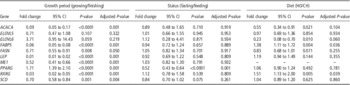
Growth period significantly affected the expression of most of the analyzed genes (Table 2). The genes ACACA, FABP5, LEP, ME1, RXRG, FASN and SCD showed higher expression in samples obtained at finishing (FCs ranging from 1.4× for FASN gene to 88× for LEP gene); and PPARG showed higher expression in biopsies obtained in growing pigs (1.7×). No significant effect was found for the interaction diet×growth period. Feeding/fasting status effects on gene expression were also evaluated (Table 2). Only PPARG gene was significantly affected by feeding status, with postpandrial samples showing higher expression than fasting ones (1.9×, P<0.0001). This response was similar in both CH and HO groups. Regarding the interaction diet×feeding status, only one significant interaction effect was found for ME1 gene (P<0.05). In finishing pigs, this gene was down-regulated by HO diet in pigs considered after an overnight fast, but expression level did not differ between HO and CH diet when pigs were considered few hours after refeeding (Figure 1).
Main effects of growth period, feeding/fasting status and diet on gene expression of candidate genes in ham adipose tissue of Iberian pigs

HO=high oleic diet with high oleic sunflower oil; CH=carbohydrate diet without added fat.
No significant growth period×diet interaction effect was found. A significant status×diet effect was found for ME1 gene (P<0.05).
Taking into account the general lack of significant interactions among samplings, the diet effects on gene expression were better estimated from the whole sampling. These results are shown in Table 2 and indicate a higher expression of ACACA and ELOVL6 in CH group; and a higher expression of FABP5 and RXRG in HO group. For the LEP gene, which was significantly upregulated in HO group in the postprandial sampling, no significant diet effect was detected in the joint analysis of the three samplings. Due to the interaction effect, ME1 gene expression differences due to diet are better estimated from the joint analysis of fasting samplings (1.5× in CH group, P<0.001).
Results with nominal P-value<0.05 were considered statistically significant in the above paragraphs. Adjusted P-values corrected for the multiplicity of performed tests were also reported in Table 2. Nevertheless, the existent correlation between the expressions of many of the studied genes prevents to consider all the tests as independent, and thus the multiple test correction may be considered too demanding. In any case, all the nominally significant results showed adjusted P-values<0.10, except the dietary effect on FASN gene expression (adjusted P-value<0.17).
Discussion
Our previous study (Óvilo et al., Reference Óvilo, Benítez, Fernández, Isabel, Núñez, Fernández, Rodríguez, Daza, Silió and López-Bote2014) on the long-term effects of HO/CH dietary intervention reported small magnitude and scarce differences in adipose tissue gene expression, suggesting a low genetic responsiveness of fat tissues to dietary treatments in the obese breed employed, at least in the long term. In this previous work, the effects of diet on tissue composition were observed to be established very early after the start of the treatment, suggesting that diet effects on metabolism could vary in response and intensity along the treatment. Our present results, obtained from the same animals employed in Óvilo et al. (Reference Óvilo, Benítez, Fernández, Isabel, Núñez, Fernández, Rodríguez, Daza, Silió and López-Bote2014), indicate that the growth period has an important effect on lipogenic gene expression, but the transcriptional response to the dietary intervention is only slightly modulated along time. Moreover, feeding status only marginally affected expression levels of targeted genes.
Candidate gene expression strongly differed between the two growth periods studied. Eight out of the 10 analyzed genes were significantly affected by growth period, with most genes showing upregulation in the late sampling (finishing, 100 kg BW). In addition, the magnitude of gene expression differences was strong, reaching 88-fold expression change for LEP gene. These results agree with those reported by Hood and Allen (Reference Hood and Allen1973) who found, in a fatter porcine line, a greater activity of lipogenic enzymes in older (and heavier) pigs. In this previous work a different pattern was found in leaner pig lines, in agreement with later findings in Meishan and Large White pigs (Mourot et al., Reference Mourot, Kouba and Bonneau1996). This ensemble of results may indicate differences in lipogenesis and its evolution along time between Iberian and both lean and other fat pig breeds. PPARG is the only gene showing higher expression in the early sampling (growing, 44 kg BW), in agreement with a more intense adipocyte differentiation, which is expected in young animals.
Regarding the diet effect, it is interesting to note that the present results show a wider transcriptional response, involving more candidate genes, than the previous study. Nevertheless, these differences may be also related to the analyzed samples: ham subcutaneous adipose tissue biopsies in the present work (including both layers) and backfat inner layer in the previous one; hindering the comparison. These results highlight the difficulty in the choice of tissue anatomical location in nutrigenomic or gene expression studies. In general, we observe an increase in the expression of lipogenic genes in CH group (ME1, ELOVL6, ACACA), which is in agreement with the expected greater de novo FA synthesis from the available dietary carbohydrates. Cytosolic malic enzyme (ME1) generates NADPH which contributes to de novo FA synthesis by FASN (Wise and Ball, Reference Wise and Ball1964). ACACA and FASN are the two central enzymes of de novo lipogenesis, which use acetyl-CoA and malonyl-CoA derived from glucose or other carbon precursors to generate palmitate (Wakil et al., Reference Wakil, Stoops and Joshi1983), which can be modified by endogenous elongase and desaturase enzymes to produce multiple lipid species. In particular the ELOVL6 gene is a member of the elongation-of-very-long-chain-fatty-acid gene family of condensing enzymes that perform the first and rate-limiting step in the elongation cycle in mammals (Jakobsson et al., Reference Jakobsson, Westerberg and Jacobsson2006). The ELOVL6 gene, which shows the diet-induced expression change of highest magnitude (9×), is involved in de novo lipogenesis, and catalyzes the elongation of long-chain SFA and MUFA. It is interesting to note that a different response to diet is observed for ELOVL5 and ELOVL6 genes, in spite of having a similar role. Their different behavior may be due to different substrate specificity and availability, as ELOVL5 preferentially elongates PUFA, while ELOVL6 more effectively elongates SFA and MUFA (Jakobsson et al., Reference Jakobsson, Westerberg and Jacobsson2006; Green et al., Reference Green, Ozguden-Akkoc, Wang, Jump and Olson2010). The higher availability of SFA and MUFA synthetized from dietary CH, which is observed at the tissue composition level (Óvilo et al., Reference Óvilo, Benítez, Fernández, Isabel, Núñez, Fernández, Rodríguez, Daza, Silió and López-Bote2014), would particularly induce the ELOVL6 expression.
On the other hand, an increase in the expression of RXRG and FABP5 genes is observed in HO group, mainly in finishing pigs, at postprandial state. Fatty acid binding proteins (FABPs) play an important role in the trafficking of free FAs and other lipids in different tissues (Zimmerman and Veerkamp, Reference Zimmerman and Veerkamp2002), and thus, our results are in accordance with the higher dietary FA levels available for transport in HO pigs. Upregulation of RXRG in HO group was observed in the previous work analyzing backfat inner layer after a 24 weeks treatment (Óvilo et al., Reference Óvilo, Benítez, Fernández, Isabel, Núñez, Fernández, Rodríguez, Daza, Silió and López-Bote2014), and is in agreement with works reporting the activation of RXR receptors by different unsaturated FAs, including oleic acid (Lengqvist et al., Reference Lengqvist, Mata De Urquiza, Bergman, Willson, Sjovall, Perlmann and Griffiths2004). RXRs are involved in adipogenesis, lipid and glucose homeostasis, and in particular, RXRG is involved in adipocyte survival, lipogenesis and hypertrophy (Lefebvre et al., Reference Lefebvre, Benomar and Staels2010). As previously proposed, the changes observed in the expression of RXRG, with higher expression in the HO group, could reflect a metabolic adaptation to a higher FA turnover. Differential expression results obtained for RXRG and PPARG genes are unexpected taking into account their synergistic roles. Both molecules are involved in the same adipogenic and lipogenic pathways, and work coordinately, acting as heterodimeric partners. A possible explanation may be related to the differential role of the several PPAR isoforms. RXRG response may be coordinated with functional changes in PPARA gene (not analyzed in this work), which main role is related with FA catabolism and lipid storage, thereby protecting against lipotoxicity (Georgiadi and Kersten, Reference Georgiadi and Kersten2012). On the other hand, PUFA are known ligands for PPARG, but a regulatory role by MUFA is not known for this gene, contrarily to RXRG evidences.
The Stearoyl-CoA desaturase (SCD) gene encodes an endoplasmic reticulum enzyme that catalyzes the biosynthesis of MUFAs from SFAs (Paton and Ntambi, Reference Paton and Ntambi2009). Previous results observed in vitro and in vivo in other pig breeds and species, showed that oleic acid inhibits SCD expression, while high carbohydrate diets induces its expression (Duran-Montgé et al., Reference Duran-Montgé, Theil, Lauridsen and Esteve-García2009; Paton and Ntambi, Reference Paton and Ntambi2009; Zulkifli et al., Reference Zulkifli, Parr, Salter and Brameld2010). Nevertheless, in the present study no change on SCD gene expression is observed conditional on diet HO/CH content. Moreover, FA composition data available from the growing biopsies (Óvilo et al., Reference Óvilo, Benítez, Fernández, Isabel, Núñez, Fernández, Rodríguez, Daza, Silió and López-Bote2014) indicate that the different diet composition results in a significant difference in the oleic acid content in adipose tissue (47.36±0.37 v. 56.78±0.36 in CH and HO groups, P<0.001). These results suggest a lack of an inhibitory effect of oleic acid on SCD gene expression in Iberian pigs, although regulation of the SCD at protein expression or activity levels cannot be discarded (Doran et al., Reference Doran, Moule, Teye, Whittington, Hallett and Wood2006).
At last, we have to take into account that, in order to provide isocaloric regimens, animals receiving HO diet also had a higher fiber content in the diet. Dietary fiber is known to influence nutrient utilization and feed intake and interacts with gut micro-environment. In our experiment there were no differences in feed intake as pigs ate the complete provided rations (no feed refusals were recorded), but differences in nutrient utilization and fat metabolism due to different fiber levels cannot be discarded.
Fasting, including short-term food deprivation, is known to reduce lipogenesis and induce lipolysis (Kersten, Reference Kersten2001; Palou et al., Reference Palou, Sánchez, Priego, Rodríguez, Picó and Palou2010). Nevertheless, in our work feeding/fasting status only affected the expression of PPARG gene, which is upregulated after feeding. In agreement, previous data have shown down-regulation of PPARG with fasting, but in that situation, other lipogenic regulators were also repressed (Houseknecht et al., Reference Houseknecht, Bidwell, Portocarrero and Spurlock1998; Morgan et al., Reference Morgan, Uyuni, Nandgiri, Mao, Castaneda, Kathirvel, French and Morgan2008). The lack of effects of fasting on lipogenic enzymes expression observed in the present study is unexpected and could be related to the duration of the fasting applied. Probably, after short or medium fasting periods lipogenesis regulators are affected, while longer fasting periods may lead to a higher response in downstream genes. In fact, acute fasting (72 h) has been reported to produce greater effect on LEP than on PPARG genes expression (O’Gorman et al., Reference O’Gorman, Stanko, Keisler and Garcia2010). On the other hand, results could be consistent with findings indicating that, in obese animals, de novo lipogenesis persist in liver and adipose tissue during fasting (Morgan et al., Reference Morgan, Uyuni, Nandgiri, Mao, Castaneda, Kathirvel, French and Morgan2008). Persistence of lipogenesis during fasting, with independence of the diet, may be a characteristic of the Iberian pigs employed. In other words, a longer food deprivation period than the one applied (standard overnight fasting) could be necessary to stop lipogenesis and induce lipolysis in these fatty animals.
In addition, no differences in SCD gene expression are observed between the two physiological states compared in the present work (fasting v. feeding), indicating a stable SCD gene expression independent of nutritional factors. This is in agreement with the high desaturation potential and the high capacity of the breed to storage high quantities of oleic acid in their tissues, narrowly related with its sensorial and nutritional meat quality (López-Bote, Reference López-Bote1998; Barea et al., Reference Barea, Isabel, Nieto, López-Bote and Aguilera2013).
In conclusion, both in the short/medium term and in the long term, several transcriptional adaptations are observed in ham subcutaneous adipose tissue following a nutritional intervention with MUFA/CH enriched diets. Results regarding diet effects are coherent in the very different timings analyzed, in spite of strong differences in candidate gene expression between growth periods, and compatible with a higher de novo endogenous synthesis of FA in the carbohydrate-supplemented group and a higher FA transport in the oleic acid-supplemented group. Results from the comparison of feeding and fasting samples suggests persistence of de novo lipogenesis during fasting, which may be a characteristic trait of the fatty phenotype of the employed Iberian breed.
Acknowledgments
The research was supported by INIA grant RTA2007-00075-00-00 and P2009-AGR1704. The authors are grateful to Jaime Rodrigañez and the staff of ‘El Dehesón del Encinar’ for their invaluable help.
Supplementary Material
For supplementary material/s referred to in this article, please visit http://dx.doi.org/10.1017/S1751731115003055