Introduction
Maize is an important ingredient in traditional Chilean cuisine (Montecino, Reference Montecino2004). When it is consumed at green stage (i.e. R3 stage or milky kernel stage), it is considered a vegetable and commonly called ‘choclo’. In the last decades, it has been the most widely grown vegetable crop in Chile (ODEPA, 2013). ‘Choclo’ production is based mainly on two types of maize; Choclero, a traditional Chilean maize cultivated for fresh consumption (Paratori, Reference Paratori1983); and sweet corn, destined for both fresh consumption and agro-industry (Luchsinger and Camilo, Reference Luchsinger and Camilo2008). About 139 million ears are traded annually in the Chilean market and two-thirds of them are Choclero (ODEPA, 2013).
Choclero is a floury maize characterized by conical ears, with trapezoidal and deep light yellow kernels disposed in irregular rows (Timothy et al., Reference Timothy, Peña and Ramírez1961). Its soft starch has thermal properties, different from other Chilean races, producing a very creamy paste when is cooked (Campbell et al., Reference Campbell, Anih, Conatser, Grau-Saavedra and Pollak2006). The softness of the grain pericarp, its aroma and flavour, conical ear shape with width ear bracts are characteristics that distinguish it from other types of maize (Fuentes and Ciudad, Reference Fuentes and Ciudad1974; Galinat, Reference Galinat1996) hence preferred by local consumers in traditional meals such as ‘cazuela’ (casserole), ‘pastel de choclo’ (corn-pie) and ‘humitas’ (fresh corn paste spiced with basil, wrapped in ear bracts and boiled). Recently, the food industry has introduced these traditional elaborations in frozen formats.
Choclero breeding programmes started in the 1970s, focusing on better yield, uniformity, and precocity (Cox, Reference Cox1989; Castro, Reference Castro2000). However, a narrow genetic background has limited the offer of new varieties, not exceeding 15 (Jara, Reference Jara2005). Currently, Choclero varieties adapted to industrial processing and with better paste yield per unit area are also on demand. To increase variability, companies often incorporate sweet and dent germplasm (JL Fonaro, Semameris-Chile and G Delard, Tuniche Seed-Chile, pers. Commun.). This strategy is effective to modify traits such as precocity, vigour, plant architecture, ear size and shape, among others. However, important quality traits (flavour, aroma), kernel texture and ear bracts shape have also been modified.
Since the 1970s, the maize landrace disappearance is the result of intense replacement by varieties that are more homogeneous with better yields (Timothy et al., Reference Timothy, Peña and Ramírez1961; Paratori, Reference Paratori1983). To avoid genetic erosion, the Instituto de Investigaciones Agropecuarias (INIA) from Chile conducted several expeditions to establish a maize germplasm collection. This germplasm was classified in races and typified as typical of the race, similar, mixture or hybrid (Paratori, Reference Paratori1983). The Choclero germplasm collection is composed by 96 landraces. Although there are some studies that report intra-racial variation (Salhuana et al., Reference Salhuana, Pollak, Ferrer, Paratori and Vivo1998; Pollak, Reference Pollak2002; Santacruz-Varela et al., Reference Santacruz-Varela, Widrlechner, Ziegler, Salvador, Millard and Bretting2004; Salhuana and Pollak, Reference Salhuana and Pollak2006), Choclero genetic diversity has not been investigated under a comprehensive approach, which hinders the possibilities to breed it under standard strategies. As a first step to understand the genetic diversity of Choclero landraces, an extensive phenotypic characterization was conducted in order identify distinguishable morphological groups.
Materials and methods
Plant material and field evaluations
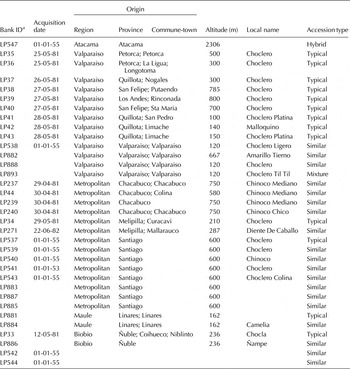
Thirty-four accessions of Choclero maize (13 classified as typical to the race, 19 classified as similar, one hybrid and one mixture) collected in different periods (1952, 1955 and 1981) from several Chilean localities were used in this study (Table 1). Seed samples were taken from regeneration stocks conserved ex situ in the Germplasm Bank Network of the Instituto de Investigaciones Agropecuarias, Chile (http://www.inia.cl/recursosgeneticos/). In this study, accessions were evaluated in two localities of the central zone (La Platina 33°34′S, 70°37′W, elevation 605 m; and Pichidegua 34°20′S, 71°16′W, elevation 149 m), in two seasons (2005–2006 and 2010–2011), which in combination conformed three different evaluation environments (online Supplementary Table S1). ‘Batuco’ (early) and ‘Peumo’ (intermediate) commercial Choclero hybrids were included as reference samples. Plots of 0.75 × 3.75 m2 with one row of 15 plants per plot were established in a randomized complete block design with three replicates. Ears without bracts were dried in a drying chamber to homogenize grain humidity to ~10% before being measured.
Details of the selected Choclero maize landraces used in this study.

a La Platina Germoplasm ID.
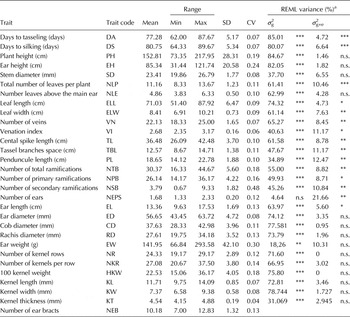
Two phenological variables and 39 morphological traits (30 quantitative and nine categorical) were recorded using the IBPGR descriptors (IBPGR, 1991) and the Catálogo de Recursos Genéticos de Maíz de Chile (Paratori et al., Reference Paratori, Sbárbaro and Villegas1990) (Table 2). For each accession, plant traits were measured on 10–20 representative plants in perfect competence once the milky kernel stage (R3) was reached. Ear trait measurements were made in 6–10 main ears with 10% humidity. Kernel characters were measured in 6–10 kernels selected from the central part of each evaluated ear.
Descriptive statistics and contribution of genotypic and genotype × environment effects on the variation of each trait, and test of significance determined over the average of the three evaluation sites.

a REML variance in the total phenotypic variance for some traits: variance of the genotype effect (σ 2 g), variance of the genotype × environment interaction effect (σ 2 g × e).
Significance. Code according to likelihood ratio test of the variance components (P value): 0–0.001 ‘***’; 0.001–0.01 ‘**’; 0.01–0.05 ‘*’;>0.05 n.s., non-significant (P > 0.05).
Statistical analysis
Phenotypic and genotypic variability
Descriptive statistics (mean, range, standard deviation and coefficient of variation) were determined for the quantitative and qualitative characters. Continuous and discrete variables were tested for normality (Kolmogorov–Smirnov test).
To test the effect of each genotype on each trait given by genotypic variance (random genotypic effect), and their possible interaction with the environment (fixed effect), linear mixed models (LMM) were proposed. Genotypic effect was defined according to a linear additive model:
 $${y_{ijk}} = \mu + {g_i} + {e_j} + (gxe)\,ij + {e_{ijk}},$$
where y ijk is the phenotypic value measured for character y, in replica k of genotype i with environment j; μ is the overall mean; g i is the random effect of genotype i representing the genotypic effect on character y; e j is the fixed effect of the environment with three levels; (gxe) ij is the random interaction between genotype i and environment j and ε ijk is the random residual error per replica k of genotype i with environment j. Significance of the effects was assessed using the Akaike and Bayesian criteria, and tested by likelihood ratio (Sillampää and Corander, Reference Sillampää and Corander2002). A backward elimination of non-significant effects of the linear mixed effects model was performed in order to select a final model. In this procedure, the significance of fixed and random effects are based on likelihood ratio tests and F tests, based on Sattethwaite and Kenward-Roger approximations, respectively (Kuznetsova et al., Reference Kuznetsova, Brockhoff and Christensen2013). The contribution of the genotypic effect of the variation of each trait was estimated according to restricted maximum likelihood (REML) variance components which were obtained from the model selected (Dieters et al., Reference Dieters, White, Littell and Hedge1995). The consistency of group conformation in all the environments evaluated was also tested by mixed model analysis. The proposed groups were considered as random effects and mean values of each accession per environment were considered as replicates.
All the analyses were performed in the R environment (R Development Core Team, 2011) and its lme4 packages (Bates and Maechler, Reference Bates and Maechler2009) and lmer test (Kuznetsova et al., Reference Kuznetsova, Brockhoff and Christensen2013) for linear mixed models.
For promising accessions, identification trait means comparison among accessions and commercial hybrids was done using Fisher's least significant difference (LSD) a posteriori test.
Relations among characters
To determine the existence and degree of association between the variables a matrix of Pearson phenotypic correlations coefficients (r) for all quantitative variables was calculated and represented in a correlogram using corrplot of the R package (Wei, Reference Wei2013). Then, R-values were calculated using the mean values between different environments of each genotype.
To identify which variables explained most of the total variation observed, a principal components analysis (PCA) using the correlation matrix was performed. Consistence between the PCA ordination and the groups identified in the cluster analysis was determined in an analysis of ellipsoids using the ade4 package of R (Dray and Dufour, Reference Dray and Dufour2007).
Conformation and description of groups
Classification of the accessions into groups based on quantitative characters was performed with a hierarchical cluster analysis using Ward's grouping algorithm and Manhattan distance. Both were selected for their high degree of cophenetic correlation (Everitt and Hothorn, Reference Everitt and Hothorn2011). Number of groups was determined by largest Wilks’ F value obtained in a multivariate analysis of variance (Mohammadi and Prasanna, Reference Mohammadi and Prasanna2003). Statistical significance of groups and subgroups found in the cluster analysis was determined with Monte Carlo simulations using Sig Clust module of R (Huang et al., Reference Huang, Liu and Marron2010), applying pseudo F criterion.
Classification quality was determined using a linear discriminant analysis with a jackknife-type cross-validation (Wehrens, Reference Wehrens2011).
Quality trait analysis
The contribution of categorical variables in accessions differentiation was tested by random forest modelling (RFM) method (Breiman and Cutler, Reference Breiman and Cutler2004). A permutation test with 1000 replicates was used to estimate a threshold or significance level of each variable for 0.05, 0.025 and 0.01 P values (Acharjee et al., Reference Acharjee, Kloosterman, de Vos, Werij, Bachem, Visser and Maliepaard2011). After RFM, accessions were re-classified to generate the corresponding out-of-bag (OOB) classification of the model. To identify categorical variables that most contribute to the precision of the classification, estimation of the mean decrease in Gini index was calculated. Finally, to contrast the classification with that obtained from the quantitative variables, a confusion matrix was constructed and classification error rate determined (Hefner et al., Reference Hefner, Spradley and Anderson2014).
To determine if similarity or dissimilarity among accessions was related to their geographic distances, the Mantel test using Manhattan and geographic distance matrices (calculated from the latitude and longitude of each accession), was performed. Correlation significance was estimated using 1000 permutations of rows and columns of one matrix. Statistical analyses and graphs were performed in R statistical package (R Development Core Team, 2011) and in ggplot2 package (Wickham, Reference Wickham2009), respectively.
Results and discussion
Phenotypic variability
This study evaluated phenotypic diversity of 35% INIA Choclero maize germplasm collection, considered highly representative of the race (Table 1). Descriptive statistics for 30 quantitative characters evaluated in 34 Choclero accessions, as well as variance components are given in Table 2. LMM analysis showed significant differences among accessions in all quantitative variables evaluated except NEPS. Standard deviations (SD) and coefficients of variation (CV) were similar to those reported in other studies of maize landraces (Beyene et al., Reference Beyene, Bottha and Myburg2005; Knežecić et al., Reference Knežecić, Prodanović, Iwarsson and Minina2010; Williams, Reference Williams2014), which indicates that there is large diversity among Choclero maize accessions for every analysed trait. This illustrates the potential of this germplasm as a source of variability for breeding purposes. The morphological characters with greatest variation were NSB, EW, EH, PH and HKW, which had CV of 48, 30, 24, 19 and 18%, respectively. Characters associated with ear leaf (ELL; ELW, VN, VI) and kernels size (KL, KW, KT) were the most stable, with CV ranging between 4 and 9%. Choclero maize endosperm is almost 100% floury. Floury kernels are lighter than horny kernels. In our study, kernel weight is more variable than kernel size, indicating that there are differences in terms of kernel starch conformation among accessions.
Commercial importance traits for the race such as EL, EW, KL and NEB had CV in the range of 8–14%. Mean ear length was 13.36 cm, with a minimum of 9.63 cm and a maximum of 17.53 cm. Although no accession had mean length larger than the reference hybrids, accessions LP271, LP886, LP36, LP34, LP887 and LP893 were not significantly different from the hybrids (P ≤ 0.05). Ear diameter varied between 4.34 and 6.37 cm with a mean of 5.65 cm. As with ear length, ear diameter of several accessions was not significantly different from reference hybrids (P ≤ 0.05). The ears of accessions LP893, LP887 and LP886 were long and narrow, while those of LP271 and LP36 were long and wide. Nowadays, these character combinations are very interesting for Choclero maize breeding programmes, because they are associated with different markets needs and/or culinary uses.
Grain length varied from 9.7 to 14.0 mm, with a mean of 11.7 mm. Although none of the accessions had longer grains than the intermediate hybrid, most of them had longer kernels than the early commercial hybrid. Bracts per ear ranged from 7 to 13, with an average of 10. None of the accessions evaluated surpassed the 16.5 bracts of the intermediate hybrid. However, some developed significantly more than the 10 bracts of early hybrid. Accessions LP239, LP237, LP539 and LP537 registered the largest numbers of ear bracts.
Days to male and female anthesis were 77.3 and 80.8 in average, respectively; with 26 d of difference between the earliest and latest accessions for both for male and female flowers. Accession LP240 was the only one with a vegetative cycle significantly shorter than the early hybrid; while LP44, LP239 and LP237 registered similar masculine and feminine flowering times.
Choclero maize ears for fresh consumption are classified as first and second quality depending on their size. Jara (Reference Jara2005), in a Choclero hybrid characterization, defined as first quality ears with length and diameter larger than 20.0 and 6.0–7.5 cm for both semi-early and intermediate hybrids. The flowering period for each type was of 69 and 77 d on average, with a number of ear bracts of 10. The two reference hybrids used in our study had lower mean values than those reported by Jara (Reference Jara2005); early and intermediate hybrid mean ear length was 17.0–18.5 cm, and mean width was 5.1–6.4 cm, respectively. The number of ear bracts was similar to the reported by Jara (Reference Jara2005), and the days between sowing and silking were somewhat more extended (78.0–88.5). Since commercial hybrids have been selected for these characters, the similarities or superiority of the evaluated materials reveals the potential of this germplasm.
Genotype × environment interaction is often described as the inconsistency of the behaviour of genotypes under different environments; when considerable it reduces the genetic progress of selection (Yang and Baker, Reference Yang and Baker1991; Magari and Kang, Reference Magari and Kang1993); hence the importance of its estimation. Table 2 shows the significant effects of the initial model and the contribution of each random effect (genotype and genotype × environment) to the total observed phenotypic variability. Differences between accessions in the ear and kernel characters are mainly and significantly explained by the genotype, whose contribution was greater than 60% in the majority of the characters associated with these structures, except for EW where it was lower. Only for EL, the observed variation among accessions was explained significantly by both genotype and genotype × environment interaction.
Regarding plant traits, the observed variation in PH, EH, number of leaves above the ear (NLE) and stem diameter (SD) were also explained by the genotypic factor. In remaining plant traits, both genotype and genotype x environment inter effect explained the variation among accessions. The interaction component was no > 12.5% in any character evaluated, which would indicate that morphological and agronomic characters evaluated have an acceptable local reproducibility. Main contribution of genotype in ear characters variance agrees with previous studies in maize, based on estimations of heritability (Ruiz de Galarreta and Alvarez, Reference Ruiz de Galarreta and Alvarez2001; Hartings et al., Reference Hartings, Berardo, Mazzinelli, Valoti, Verderio and Motto2008). Camus-Kulandaivelu et al., (Reference Camus-Kulandaivelu, Veyrieras, Madur, Combes, Fourmann, Barraud, Dubreuil, Gouesnard, Manicacci and Charcosset2006) found that both genotype and genotype × environment interactions contributed significantly to the variability in days to anthesis, but the genotype explained a larger proportion of the variability, concordant with our results. Environment effect in the group variation, was negligible for all traits considered in the classification (data not shown). Although our results show group stability in the three environments of evaluation, it is important to mention that these environments are all representative of the Mediterranean climate of the central zone of Chile. Thus, it is expected that the behaviour of the groups would only be reproducible in sites with similar agro-ecological conditions. Since Choclero maize cultivation is being displaced north and south of the core production area, evaluation in new environments is necessary to confirm the stability of the groups.
Relations among characters
Pearson correlation coefficients between the estimated mean values of morphological characters are represented graphically in a correlogram (online Supplementary Fig. S1). Fifty two per cent of the 378 coefficients were positively and significantly correlated (P ≤ 0.05). Phenological variables (DA and DS) were moderately correlated (r = 0.70–0.80), only with some vegetative traits such as EH, PH and NLP; and very weakly with ear and kernel traits. PH and EH were highly correlated with NLP (r = 0.91), ELL (r = 0.92) and EW (r = 0.90); and moderately correlated with EL (r = 0.74) and HKW (r = 0.70). The number of kernel rows (NR) was moderately and negatively correlated with EL (r = −0.63), and positively with ED (r = 0.61). Pairwise correlations are used as indicators of quantitative characters on which breeders should give greater consideration, since they indicate the contribution or effect (direct associated with larger ears or indirect) of other important traits in the expression of other important traits. Moderate and positive correlation of phenological and vegetative characters, along with low correlations between vegetative characters and ear and kernel traits, indicate that plant vigour depends partly on the duration of the vegetative cycle. Although, more vigorous plants are not always associated with larger ears ears, but with heavier ones. In maize, the weight of the ear not only depends on the size of the ear and the size and number of kernels, but also on the grain texture and cob tissue density. In comparison with dent types, Choclero ears tend to be lighter due to floury texture of kernels and their less compact cobs.
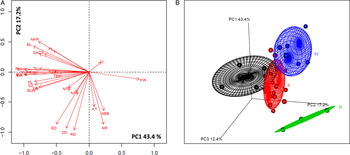
Variables that discriminate Choclero accessions are clustered in three groups (Fig. 1(a)): phenological variables; a group of variables associated with ear diameter, and a more complex group that integrate vegetative (PH, EH, NLP, ELL, SD), ear (EW, HKW, EL, NKR) and kernel (KW and KL) variables. Our results suggest the possibility of combining phenological characters with plant architecture characters in the same genotype. Within ear traits, the low correlation between EL and ED, and the lack or low association of both characters with NR, HKW and NEB also suggest the possibility of obtaining ears with different trait combinations. In PCA, the first three principal components explained 73.0% of the total observed variation (online Supplementary Table S2). The first component explained 43.4% of the variation among accessions and it was associated mainly with variables related to plant architecture and precocity, and some specific ear characters (EL, EW and HKW). This component separated late flowering accessions with tall plants, long ears and heavier kernels, from early flowering accessions, which were less vigorous, with short ears and light kernels. Gouesnard et al. (Reference Gouesnard, Dallard, Panouille and Boyat1997), studied morphological variability of 262 maize landraces from France and found that precocity was one of the factors that contributed most to the accessions classification.
(a) Biplots of 29 quantitative morphological and two phenological traits, and (b) of 34 Choclero landraces with the ellipsoid confidence interval (P < 0.05).

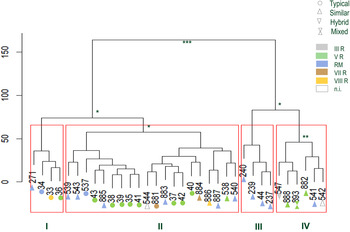
The second principal component explained 17.2% of the variation and differentiated the accessions by ED, NR and NEB, separating accessions with ears of greater diameter, more conical and with a higher number of rows and ear bracts (Choclero ear type) from those with cylindrical ears, less rows and less ear bracts. The third component explained 12.4% of the observed variation, and was mostly associated with the phenotype of the tassel, mainly the density of the ramifications [online Supplementary Table S2]. Graphic representation of the three PCA components (Fig. 1(b)) showed phenological and morphological differences among the accessions; and four well-differentiated groups may be distinguished. The ellipsoid analysis showed high correspondence in the number and composition of the groups between the PCA and the cluster analysis (Fig. 2). Low overlapping between groups reveals a high tendency of these accessions to have a group structure.
Clustering of the selected Choclero landrace accessions using Manhattan distance and Ward's method of minimum variance. Based on the mean values of 29 morphological and two phenological traits recorded in the three environments. Level of significance: *** (P < 0.001); ** (P < 0.01); * (P < 0.05).

Composition and description of groups
For cluster analysis we used all variables that showed significant differences among associations, independent of environment contribution to the observed variation. According to Rincon (Reference Rincon, Johnson, Crossa and Taba1997), the identification of potentially useful germplasm may be more effective if a large number of characters are considered simultaneously. Gutierrez et al. (Reference Gutierrez, Franco, Crossa and Abadie2003) suggested that classification should be based on traits that mainly reflect genetic differences between accessions more than on environmental effects or genotype × environment interaction. However, these same authors validated the inclusion of specific variables influenced by the environment when considered informative. Our clustering criterion was verified by a discriminant analysis, which fully confirmed the classification, indicating that all variables utilized contribute to a correct assignment of the accessions to the proposed groups.
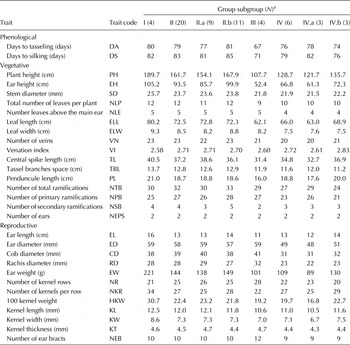
Cluster analysis based on quantitative characters separated the 34 accessions into four main groups, two with significantly differentiated subgroups (Fig. 2). Group I was composed by four accessions of vigorous plants with long vegetative cycles (80 and 82 d from sowing to 50% tasseling and silking, respectively), and synchronized male and female flowering. Plants were tall (189.7 cm) with large panicles and intermediate number of ramifications, with thick stems (25.7 cm), larger and numerous leaves, without anthocyanin pigments. Ears were heavy (21 g), long (16 cm) and wide (5.9 cm), cylindrical to cylindrical–conical shape, with a lesser number of rows (21), but more kernels per row (34), with long (12.5 mm), thick (8.6 mm) and heavy kernels (HKW = 30.7 g). Kernels were toothed, mostly with semi-floury or semi-flint texture (Table 3). This group included accessions of several geographic zones near the coast and in coastal valleys with elevation no > 300 m. Accessions of this group were classified as typical to the race by Paratori et al. (Reference Paratori, Sbárbaro and Villegas1990). Nevertheless, a degree of contamination possibly with Diente de Caballo race or dent commercial varieties was common among all accessions, which are more vigorous and later than Choclero (Paratori et al., Reference Paratori, Sbárbaro and Villegas1990; Faiguenbaum, Reference Faiguenbaum2004). Dent maize was also cultivated in the central zone of the country for fresh consumption (Parker and Paratori, Reference Parker and Paratori1965; Paratori, Reference Paratori1983). This factor would explain the existence of variants with cylindrical cobs (33%) and regular (38%) or straight (10%) row arrangement, and the large presence of ears with dent kernels of semi-floury (70%) or semi-flint (10%) texture. Three of the four accessions of this group (LP34, LP36 and LP271) were considered part of the best 20% of the native maize germplasm regarding yield, precocity, plant height and lodging resistance (Paratori and Silva, Reference Paratori and Silva1987).
Phenotypic means of attributes for the groups and subgroups identified in Choclero maize germplasm based on the cluster analysis.

a N, number of individuals belonging to each group.
Group II clustered the largest number of accessions (20), characterized by late flowering (79–83 d to 50% tasseling and silking, respectively), and intermediate to high values in the majority of the evaluated traits. Some accession had anthocyanin pigments. Ear shapes were conical or cylindrical–conical in equal proportions, mostly floury kernels with some of them semi-floury, kernels arranged in irregular rows. This group was composed of two subgroups, IIa (n = 9) and IIb (n = 11). In comparison, group IIa had somewhat earlier flowering with lower plant height and ear height (154.1 and 85.7 cm, respectively), greater proportion of conical ears (56%) with greater diameter (5.9 cm), but lower weight (138 g), longer (12.1 mm) and thicker (4.7 mm) shrunken kernels. These kernels had roughed or pointed upper surfaces, irregular row arrangement in 100% of ears, and panicles with few numbers of ramifications (Table 3). This group was composed mostly of accessions classified by Paratori et al. (Reference Paratori, Sbárbaro and Villegas1990) as typical of the race. All accessions were collected from central depression valleys and coastal plains in the Region of Valparaíso. According to this study, accessions from this group best fit with the race description given by Timothy et al. (Reference Timothy, Peña and Ramírez1961); Parker and Paratori (Reference Parker and Paratori1965) and Paratori et al. (Reference Paratori, Sbárbaro and Villegas1990). Therefore, they can be considered as representatives of Choclero. Group IIb clustered accession with more vigorous plants, with ears of similar length to group IIa but thinner and with fewer ear bracts. Three of the four accessions of this cluster come from the southernmost collection sites. The low presence of this race in the southern regions suggests that these accessions were probably introduced from the core region.
Group III clustered four accessions representative of a Choclero maize locally named Chinoco. These accessions flowered very early (14 d in average before the later groups). They are characterized by short plants (107.7 cm) with scarce pigmentation, with short (62.1 cm) but wide (88.2 cm) ear leaves, small panicles. With very short (11 cm) but thick ears, they are covered with a higher number of ear bracts (12), mostly conical with a large number of irregularly disposed rows (28), low number of kernels per row (22), and short (10.6 mm) and light kernels (HKW = 19.2 g) of floury texture with trapezoidal kernels, a shape typical to the race (Table 3). Parker and Paratori (Reference Parker and Paratori1965) and Aljaro (Reference Aljaro1972) studied Chinoco-type maize; their description agrees with those given by this study. In spite of their smaller size, the ears and kernels of this group correspond to the description of the race, suggesting that this group could be a variant of Choclero. The origin of the accessions is restricted to Metropolitan Region, which is a semi-arid suprathermal zone with a high accumulation of degree-days (1500–2000°C) and low relative humidity (50–55%) in spring-summer, with 226–272 frost-free days (Uribe et al., Reference Uribe, Cabrera, De la Fuente and Paneque2012). Association between Choclero plants with little vegetative growth, reduced leaf development, small ears, with high-temperature and high evaporation areas was also observed by López et al. (Reference López, Santacruz, Muñoz, Castillo, Córdova and Vaquera2005) and Paratori (Reference Paratori, Paratori and Altamirano1995a). High temperatures and a large frost-free period in some areas of the Valparaiso and Metropolitan Regions, allow early sowing (end of winter) and, therefore, anticipate the harvest period (end of spring) (Sepúlveda, Reference Sepúlveda2000). This situation led farmers to select precocious varieties such as common Chocleros such as Chinoco, Colinano and Chadino types, which are better paid on market (Paratori, Reference Paratori, Paratori and Altamirano1995b). The group composition, only by accessions collected in the Chacabuco province and the absence of other types of maize in the sector, suggests that this Choclero type probably originated by adaptation, local selection or a combination of both. Prasanna and Sharma (Reference Prasanna and Sharma2005) mentioned that temporal isolation (due to early flowering) and farmers’ deliberate selection of specific phenological attributes are factors that contribute to the development of race variants.
Group IV, with two subgroups, clustered six semi-early accessions with relatively small plants (128.7 cm), thin stems (21.9 mm), tassels with few ramifications (24), short (66 cm) and narrow (7.5 cm) ear leaves, ears of medium length (13) but very narrow (4.9 cm) with white cob (Table 3). Group IVa clustered three pigmented accessions with more de-synchronized and late flowering, with lower values in almost all traits evaluated except for those related to the tassel. Their ears were very narrow (4.8 cm) and light (89 g), with conical or cylindrical–conical shape and small pointed and floury texture kernels. By contrast, group IVb clustered accessions with dent trapezoidal kernels, with flat upper surface and mainly floury or semi-floury texture. Group IV included accessions LP547 and LP893 that were classified as a hybrid and mixture respectively by Paratori et al. (Reference Paratori, Sbárbaro and Villegas1990), indicating that accessions of this group have contamination or mixture with races different from dent ones. This group may be considered of interest for Choclero breeding programmes because their accessions have small tassels in comparison with the rest of the plant, producing less competition with the ear for photosynthates and also less shading of the plant (Zerene, Reference Zerene1985). Furthermore, its ear shapes (cylindrical and slim) are more desirable in the elaboration of some typical dishes like casserole, but also, for industrial purposes because it allows mechanized thresh (JL Fonaro, Semameris-Chile, pers. commun.).
In an analysis of the zonal maize distribution in Chile, Parker and Paratori (Reference Parker and Paratori1965) mentioned that between Tarapacá (20°S) and Linares (35°S), the races Dentado Harinoso, Dentado Corriente, Camelia, Curagua and Choclero were co-cultivated supporting the possible interaction and gene flow among the races. Although some morphologically similar accessions have the same geographical origin (i.e. group III), in general, a significant correlation between morphological similarity and geographic distance was not observed. Accessions collected in Northern (Atacama, LP547) or Southern (Ñuble, LP33 and LP886) regions grouped together with accessions collected in the central area. It is important to mention that in the collecting periods there was very little presence of Choclero maize outside the core zone (Valparaíso and Metropolitan Regions), suggesting that the presence of Choclero in Atacama and Ñuble could be due to introductions from the core zone. Seed exchange among farmers is frequent. Louette (Reference Louette1999) and Badstue et al. (Reference Badstue, Bellon, Berthaud, Ramírez, Flores and Juárez2007) established that existence of varieties in a given region is not static, and may change as preferences of farmers change or new types of seeds become available.
Clustering by qualitative traits
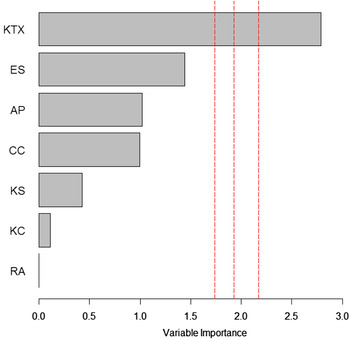
Using categorical data, the RFM method separated four dent-type accessions (LP271, LP33, LP36 and LP886) from the 30 remaining Choclero-type accessions. Kernel texture (KTX) was the only trait that significantly contributed to the accessions differentiation (Gini index of 2.72) (Fig. 3). The low contribution of other qualitative traits could due to their low variability (with only one or two classes); or inversely, highly variable at intra and inter accession level, with low discrimination ability. In the Choclero race, grain texture is an important trait, since it is associated with the quality of maize paste. Choclero maize have starch with specific thermal properties that produce a maize paste with a slimy consistency and creaminess. These characteristics difference Choclero from other floury maize (Campbell et al., Reference Campbell, Anih, Conatser, Grau-Saavedra and Pollak2006), hence an important trait to retain when developing of new Choclero varieties.
Variable importance (VI) value determined by the mean decrease in Gini (Gini index). The more important a variable is the higher the value for that variable. Dashed lines indicate threshold values that better grouped the accessions from left to right 95, 97.5 and 99%. kernel texture (KTX), ear shape (ES), anthocyanin pigmentation (AP), cob colour (CC), kernel shape (KS), kernel colour (KC) and kernel row arrangement (RA).

Accessions LP34 and LP886, which belonged to groups I and II respectively in the cluster analysis, were re-classified by RFM analysis. The large proportion of floury kernels explained the classification of LP34 into group II of RFM grouping, while a semi-hard texture of LP886 explained its classification into group I. These antecedents suggest that both continuous and categorical variables are important for a better classification. Gutierrez et al. (Reference Gutierrez, Franco, Crossa and Abadie2003) found that kernel texture and shape highly contributed to accession discrimination, supporting the relevance of categorical traits in accessions classification. Moreover, kernel shape was determinant in the redistribution of the analysed races into two differentiated groups. Thus, a grouping method that uses both types of variables is desirable to obtain a final and more comparatoriprehensive morphological classification.
Paratori (Reference Paratori1983) proposed an intra-racial classification focusing on ear and grain traits, discriminating the typical and similar accessions from the hybrid or mixed ones, probably based on the Chilean races description made by Timothy et al. (Reference Timothy, Peña and Ramírez1961). Our results show that this classification is not sufficient to fully understand the diversity within the Choclero race, and do not allow the complete understanding of relationships between the Choclero accessions.
Implications for breeding
For fresh consumption, Choclero maize is sold by units, thus in this case the ‘choclo’ (green ear plus ear bracts) is the most important component of yield. Choclero plants usually produce only one ear; longer and thicker ears have higher commercial value (Castro, Reference Castro2000; Sepúlveda, Reference Sepúlveda2000; Jara, Reference Jara2005), because they yield more grain. Bigger and wider ears also produce better quality ear bracts. Large and wide ear bracts are also desirable because they result in better quality ‘humitas,’ based on larger sizes. In addition to its culinary value, the bracts have agronomical value since they protect the ear from mechanical and insect damage, as well as undesirable pesticide residue accumulation and ear post-harvest dehydration (Jara, Reference Jara2005) and this is what gives this trait its importance in the selection process.
Given the recent development of frozen products such as frozen humitas and frozen maize paste, the industry is demanding long and cylindrical Choclero ears with longer grains, in order to facilitate mechanical thresh and increment recovery (percentage of green ear mass represented by fresh kernel mass) and case production. Earliness is other desirable trait since it determines an early supply of this maize in the market, which means higher prices for the farmer. To meet these needs, introgressive hybridization between Choclero and sweet or dent maize germplasm is currently being implemented by breeders. However, this strategy could modify Choclero organoleptic characteristics, affecting the quality of the culinary preparations.
In maize, development of hybrids is based on crossings between highly homozygous and contrasting inbred lines. Genetic distance is very important in this regard; usually crosses between inbreds of different races have better yields or adaptability to certain conditions (Jugenheimer, Reference Jugenheimer1959). However, crossings between too distant genotypes may produce undesirable changes associated with quality. Presence of morphologically distant groups within the Choclero race and consistent behaviour of variables in the evaluated environments, along with the low association among some commercially important variables, indicate that this germplasm could be used for the development of new varieties with superior and novel characteristics without compromising Choclero's organoleptic characteristics.
In conclusion, these findings highlight a number of useful traits present gene pool, and a wide range of phenotypic variation that provides a good source of diversity for use in Choclero maize breeding programmes. Ample phenotypical characterization helped a better understanding of the patterns of diversity present in the race, allowing a better intra-racial grouping. The introgression with other races and local adaptation/selection are factors that probably modulate phenotypic differences found between accessions evaluated in this study. We also identified several promising accessions for ear characteristics, including flowering behaviour, with similar or superior performance than commercial varieties. Such accessions could be of considerable value in breeding programmes. Although the phenotypic evaluation of this study contributes to description and classification of this germplasm, characterization of the entire collection, and the incorporation of molecular data are indispensable to better define the racial diversity and its true potential. Here, we present the first step towards demonstrating the value of this maize germplasm, and is part of the strategies to optimize its conservation and promote its utilization.
SUPPLEMENTARY MATERIAL
The supplementary material for this article can be found at https://doi.org/10.1017/S1479262116000137.
Acknowledgements
This work was partially funded by the CONICYT scholarship (D-21080026) from the ‘Programa Nacional de Becas de Postgrado – Doctorado 2008’ and by the Conservation of Genetic Resources Program of Instituto de Investigaciones Agropecuarias -INIA La Platina (Code 501453-70). We also thank to La Platina Genetic Resources Unit staff for their assistance in developing this study.